Quality Characteristics of Mackerel Immersed in Sea Wind Mugwort Extract
Sun-Kyung Oh1, Hae-Reon Son1, Ki-Woong Kim2, Sang-Ok Bae3, Sung-Young Kim4 and Myeong-Rak Choi1*
1Department of Biotechnology, Chonnam National University, Yeosu 59626, Korea
2Department of Marine Bio Food Science, Chonnam National University, Yeosu 59626, Korea
3Department of Culinary Art, Chodang University, Muan 58530, Korea
4Department of Food Science, Andong Science College, Andong 36616, Korea Received May 19, 2017 /Revised August 7, 2017 /Accepted August 9, 2017
This study examined the influence of sea wind mugwort extract treatment on quality characteristics of mackerel during storage. Mackerel were packaged individually and then immersed in 5% sea wind mugwort extract for 2, 3, or 4 hr and stored at -20℃. The salinity of a control (no treatment) and that of mackerel immersed in sea wind mugwort for 2 hr was lowest (0.07%). pH of 5.90-6.23, and the change in acidity was in the opposite range. Immersion for 2, 3, and 4 hr led to a decrease in the tensile strength of the samples following storage, whereas the tensile strength of the control increased. The volatile basic nitrogen (VBN) content of the mackerel immersed for 2 hr was sig- nificantly lower than that of the control (5.6-15.4 mg% vs. 4.2-50.7 mg%). In the mackerel immersed for 2 hr, the total polyphenol and total flavonoid content was 286.3-497.0 mg gallic acid equivalents (GAE)/100 g and 177.5-385.6 mg quercetin equivalents (QE)/100 g, respectively. The 1,1-diphenyl-2-pic- rylhydrazyl (DPPH) and 2,2-azino-bis(3-ethyl-benzothizoline-6-sulfonic acid) (ABTS) radical scavenging activities of the mackerel immersed in sea wind mugwort for 2 hr were 50.6% and 61.3%, respectively.
Overall, the immersion of mackerel in sea wind mugwort for a short time significantly improved qual- ity characteristics, such as salinity, pH, acidity, hardness, antioxidant activity, and perceptible quality, fol- lowing storage.
Key words : Antioxidant activity, Artemisia, Scomber japonicas, volatile basic nitrogen
*Corresponding author
*Tel : +82-61-659-7303, Fax : +82-61-659-7309
*E-mail : [email protected]
This is an Open-Access article distributed under the terms of the Creative Commons Attribution Non-Commercial License (http://creativecommons.org/licenses/by-nc/3.0) which permits unrestricted non-commercial use, distribution, and reproduction in any medium, provided the original work is properly cited.
Journal of Life Science 2017 Vol. 27. No. 9. 1011~1019 DOI : https://doi.org/10.5352/JLS.2017.27.9.1011
Introduction
Mugwort is a highly fertile, perennial herb, which belongs to Artemisia of Compositae. It is widely distributed in Europe as well as Asia, for example, Korea, China, and Japan. It is known that about 300 varieties grow widely in Korea [19].
Presently, in Korea, research is being conducted multi- laterally on Artemisia capillaris Thunberg (Injinssuk), ab- sinthium (Yakssuk), Artemisia dubia Wall. (Chamssuk), or Artemisia montana Pampan (Sanssuk). Among these, Injins- suk has been reported for its several physiological activities, for instance, antioxidant and anticancer activities, facilitating lipid metabolism, and reducing hepatotoxicity [7]. Concern- ing absinthium extract’s antioxidative activity, ethyl acetate
fractions demonstrate the highest activity, and this is attrib- uted to the total phenol and flavonoid contents in the sam- ples [5]. Ganghwasajabalssuk controls the expression of Bcl-2, the proto-oncogene, and reduces the accumulation of cancer cells [18]. Recently, Artemisia annua L. has been proved to have immense antioxidant and anticancer activ- ities from its components like phenolic acids such as chloro- genic acids, salicylic acids and catechins, for example, epi- catechins or catechin or gallo-catechin gallates. It is eval- uated as herbal medicine, being highly noticeable through- out the world [26]. Several physiological activities have also been reported for Mugwort, this includes, its volatile ar- omatic components’ anti-mutagenic activity [15], anti-in- flammatory activity [32], antibiotic activity against Staphylo- coccus aureus [1], and four-season mugwort’s anticancer ac- tivity against HeLa cells [20]. Meanwhile, mackerel (Scomber japonicus) is a Teleostean fish belonging to Scombridae of Perciformes. It is one of the “four famous external blue col- ored fishes”along with sardine, jackmackerel, and horse mackerel. Mackerel is a highly nutritive, high-fat fish con- taining plenty of taurine and nucleic acids [2]. Above all,
it is rich in n-3 fatty acids, such as, EPA (eicosapentaenoic acid, 20:5n-3) and DHA (docosahexaenoic acid, 22:6n-3) [9, 12, 29]. It is known that mackerel’s polyunsaturated fatty acids (PUFA) are effective against arteriosclerosis, cerebral thrombosis, and myocardial infarction [4]. Mackerel tends to be caught in bulk at a time, and it is red-fleshed fish that contains a lot of lipids. In addition, as it contains abundant non-protein nitrogen components inside its muscle, they are consumed by bacteria while it decays; therefore, it is re- garded to be more easily deteriorated than other kinds of high-protein food. Moreover, its freshness reduces rapidly.
Furthermore, during processing it is acidified at a fast rate by lipid oxidation and produces bad odor. Since the product is hard to be used as fresh fish or as a processed food, it is mainly used in the form of salted products [29]. In order to solve such problems in use of mackerel and to promote its use, ways to improve mackerel’s storage quality and pref- erence are actively being searched. Methods such as radia- tion exposure [2, 14], UV-ray exposure [30], low-temperature osmotic dehydration [21], and heatless treatments like high hydrostatic pressure [10] have been employed. Further, nat- ural oxidizers such as, citron juice [8], onion and ginger juice [22], Cho-phi, persimmon leaves, or betony extract [32] have also been employed. However, there has been no study on the use of sea wind mugwort to reduce fishy smell and en- hance antioxidative activity. We have found that addition of citron or green tea to mackerel increases storage quality.
In this study, we provide foundational data about mackerel’s freshness as well as the utility of sea wind mugwort-treat- ment for improving the quality of mackerel upon storage.
Materials and Methods
Materials
The mugwort used in this experiment was sea wind mug- wort (SWM), one of the specialties cultivated in Geomun-do.
The powdered sea wind mugwort was purchased from Geomun-do Sea Wind Mugwort Agricultural Association.
The mackerel (Scomber japonicas) was provided by ARAUM Co., Ltd., Mangyang-ro of Yeosu City, Jeonnam. Mackerels fillet were used, and thickness was 1.5 cm.
Preparation of sea wind mugwort
SWM was extracted using the following steps. Powdered samples (100 g) of SWM were immersed in 10 x volume of distilled water. The extract was obtained through reflux
cooling [11]. Thereafter, the extract was filtered through a filter paper (Whatman No. 3, Maidstone, England), and con- centrated in a rotary vacuum condenser. The final concen- trate had a concentration of 100 mg/ml, and its antioxidant activity was measured.
Preparation of mackerel in the sea wind mugwort SWM extract was diluted with water at the ratio 1:1(v/v), and mackerels were immersed for 2, 3, or 4 hr. After quench- ing for 1 hr at -35℃, they were vacuum-packed and stored at -18℃. The subsequent experiments were performed at in- tervals of 15 days. Samples were stored at room temperature for 30 min before analysis.
Salinity, pH and acidity measurements of mackerel in the sea wind mugwort during storage
The salinity of SWM mackerel was measured with a sal- imeter (TM-30D, Tokyo, Japan). To measure pH, samples were powdered finely in a blender (Hanil, HNF-340, Seoul, Korea), and filtered through a gauze to gain 35 ml juice.
The pH of this filtered juice was measured using a pH meter (Orion 520A, Boston, USA). Acidity was measured on 20 ml juice of SWM mackerel. For this, it was titrated with 0.1 N-NaOH solution so that the samples pH reached 8.2. The volume of 0.1 N-NaOH in ml was converted into lactic acid (%, v/v) using the following formula.
Acidity (%, v/v) = [(0.1 N-NaOH(ml)×0.0091)×factor)/
sample(ml)]×100
1)The amount of lactic acid (g) corresponding to 1 ml of 0.1 N-NaOH solution
Hardness measurement
Samples of size 4×1 cm² were cut from the central part of mackerel in the SWM at each stage of storage. The hard- ness of the SWM-immersed mackerel was measured using a rheometer (CR-500DX, Osaka, Japan). A 10.00 kg load cell was installed at the rheometer cross-head and chart speeds were 5 and 1.0 mm/s, respectively. Hardness analysis is a type of compression test that was used to determine the hardness of the sample. Samples were stored at room tem- perature for 30 min before analysis. All samples were ana- lyzed three times.
Quantification of volatile basic nitrogen (VBN) con- tent of mackerel in sea wind mugwort during storage To examine the degree of change in proteins, volatile basic
nitrogen was measured through microdiffusion analysis [25]
employing the Conway unit. Sample medicine was manufac- tured by adding 10 g of sample to about 90 ml distilled water and homogenizing it in 100 ml. Thereafter, 1 ml of the sam- ple solution was placed in the left side of the Conway’s outer room, and 1 ml of 50% K2CO3 was placed in the right side of its outer room. In the inner room, 1 ml 0.01 N H2BO3
and 500 µl mixed indicator of methyl red and bromocresol green were placed. The lid was closed after applying glycer- ine, and the outer room’s sample were reacted with K2CO3. The reaction was allowed to occur at 37℃ for 120 minutes.
On the contrary, to the control group, K2CO3 was not applied. After opening the lid of the Conway where reaction was facilitated, the inner room’s boric acid solution was ti- trated with 0.02 N H2BO3 solution to quantify volatile basic nitrogen.
Sensory evaluation of mackerel in sea wind mugwort during storage
Students of department of Biotechnology in Chonnam National University were asked to participate in the evalua- tion at intervals of 15 days while mackerel was stored at -18℃. The evaluation included 3 criteria, namely, color, smell, and overall acceptability, and a 5-point scale was adopted with 5 points, being for very good, and 1 point, for very bad.
Measurement of total polyphenol content
The total polyphenol content in SWM-immersed mackerel was measured using colorimetry by using Folin-Ciocalteu phenol reagent [24]. We added 2.6 ml of distilled water and 200 μl of Folin-Ciocalteu phenol reagent to 200 μl of the sam- ple and mixed together; the mixture was allowed to react for 6 min at room temperature, subsequently, 2 ml of 7%
(w/v) Na2CO3 solution was added. The mixture was allowed to react for 90 min, and the absorbance was recorded using a spectrophotometer (Ultraspec 2000; Pharmacia Biotech, Cambridge, England) at 750 nm. A standard curve was ob- tained using gallic acid as the standard, and the polyphenol content was reported in mg gallic acid equivalents (GAE)/
100 g.
Measurement of total flavonoid content
The total flavonoid content in SWM-immersed mackerel was measured using the method described by Jia et al. [24].
Briefly, 1 ml of the sample, 3.2 ml of distilled water, and
150 μl of 5%(w/v) NaNO2 were mixed together and allowed to react for 5 min. Thereafter, 10% AlCl3 solution was added and the mixture was reacted for 1 min, and 1 M NaOH was added; subsequently, the absorbance was measured at 510 nm. A standard curve was obtained using quercetin as a standard substance, and the flavonoid content was reported in mg quercetin equivalents (QE)/100 g.
DPPH radical scavenging activity measurement The DPPH assay was performed by using a modification of the method reported by Brand-Williams et al. [24]. Briefly, DPPH solution was prepared by dissolving 16 mg of DPPH in 100 ml of methanol and then 100 ml of distilled water was added, mixed, and filtered through Whatman No. 2 fil- ter paper (Whatman International Ltd, England). Thereafter, 5 and 1 ml of DPPH solution and the sample, respectively, were mixed, and incubated for 30 min at room temperature.
The absorbance of the mixture was recorded using a spec- trophotometer (Ultraspec 2000, Pharmacia Biotech, Cam- bridge, England) at 528 nm. Ascorbic acid was used as the positive control, and the results were calculated using the following equation:
DPPH radical scavenging activity (%) = 1-(Abssample/ Abscontrol)×100
Where, Abssample and Abscontrol are the absorbance values of the sample and control solutions, respectively.
2,2-azino-bis(3-ethyl-benzothizoline-6-sulfonic acid) (ABTS) radical scavenging activity
The ABTS radical scavenging activity was measured using a slight modification of the method reported by Kriengsak et al. [24]. Briefly, equal volumes of 1.8 mM ABTS solution and 0.63 mM potassium persulfate were combined and were reacted in dark for 24 hr at 37°C to create an ABTS solution with ABTS free radicals. The solution was diluted such that the absorbance at 735 nm was 1.4±0.1. Next, 5 ml of the ABTS solution with ABTS radicals was mixed with 0.1 ml of the sample, and the mixture was allowed to react for 7 min; subsequently, the absorbance was recorded at 735 nm.
The results were calculated according to the following equa- tion:
ABTS radical scavenging activity (%)
= (1 - absorbance of the solution with the sample add- ed/absorbance of the solution without sample)×100
Table 1. Changes in pH, acidity, salinity during storage period of mackerel immersed with sea wind mugwort extract
Storage (days) Treated time (hr)
Control1) 2 hr2) 3 hr3) 4 hr4)
Salinity (%)
0 15 30 45 60
0.11±0.01aA 0.13±0.01aA 0.11±0.01aA 0.10±0.01cA 0.09±0.01aA
0.08±0.01bA 0.08±0.01bA 0.07±0.01bA 0.08±0.01bA 0.08±0.01aA
0.08±0.01bA 0.08±0.01bA 0.08±0.01bA 0.09±0.01aA 0.09±0.00aA
0.08±0.01bA 0.08±0.00bA 0.08±0.00bA 0.08±0.00bA 0.08±0.00aA
pH
0 15 30 45 60
5.90±0.02dC*
6.14±0.01cB 6.08±0.00cB 6.01±0.01cB 6.23±0.01bA
6.13±0.11cB 6.30±0.02bA 6.20±0.02bA 6.14±0.01cB 6.23±0.02bA
6.32±0.04aB 6.61±0.01aA 6.70±0.02aA 6.84±0.04aA 6.54±0.06aB
6.20±0.02bB 6.26±0.05bB 6.38±0.06bB 6.50±0.07bA 6.04±0.04cC
Acidity (%)
0 15 30 45 60
0.85±0.04aB 0.73±0.01bC 0.76±0.02bC 0.80±0.01bB 1.36±0.02aA
0.81±0.02aB 0.68±0.02bD 0.73±0.01bC 0.75±0.01cC 1.22±0.03bA
0.73±0.06aB 0.85±0.01aA 0.87±0.01aA 0.89±0.01aA 0.92±0.01cA
0.73±0.02aB 0.85±0.04aA 0.76±0.01bB 0.80±0.01bB 0.86±0.02cA
1)Control: No-treated with sea wind mugwort extract
2)2 hr: Sea wind mugwort extract, 2 hr immersion treatment
3)3 hr: Sea wind mugwort extract, 3 hr immersion treatment
4)4 hr: Sea wind mugwort extract, 4 hr immersion treatment
*Data represent the mean ± SD of experiments performed in triplicates. The different lower-case letters (superscript) in the same row (a-c) and column (A-C) indicate statistically significant difference by Duncan’s multiple range test (p<0.05).
Statistical analysis
All tests and analyses were repeated at least three times.
The results are expressed as mean±standard deviation (SD).
One way analysis of variance (ANOVA) and Duncan’s test were used for multiple comparisons using the SPSS version 21.0 (SPSS Institute, Chicago, IL, USA). In all experiments, differences were considered to be statistically significant if p<0.05.
Results and Discussion
Salinity, pH, acidity, and hardness measurements of mackerel in the sea wind mugwort during storage
During storage, mackerel’s salinity, pH, acidity, and hard- ness were measured. A control group (control) not immersed with SWM extract and experimental groups post 2 hr, 3 hr and 4 hr (2 hr, 3 hr, and 4 hr respectively) of SWM extract treatment were analyzed. In comparison with the control group, none of the experimental groups indicated changes in salinity up to 30 days (Table 1). It was observed that the 2 hr group showed salinity of 0.07% up to the 30 days, and it was the lowest amongst all groups. pH of samples ranged from 5.90 to 6.23 in the control group from the zero to 60 days. Whereas, that of the 2 hr, 3 hr, and 4 hr treatment
groups ranged from 6.13 to 6.23, 6.32 to 6.54, and 6.04 to 6.20 respectively. Generally, it is known that the pH of fresh fish muscle ranges from 5.5 to 6.5. However, after being caught, there is loss of freshness, and the pH increases with the accumulation of basic materials like trimethylamine (TMA) or dimethylamine (DMA) [23]. Unlike the pH, acidity decreased on the 15th day of storage and then increased in general in the control and 2 hr-immersed group. However, the 3 hr and 4 hr treatment groups indicated gradually in- creasing pH as storage proceeded. In addition, as storage proceeded, the control tensile strength tended to increase while the treatment groups indicated a decrease (Table 2).
Kim et al. [13] added marinated mackerel to extracts having different dried thyme contents and found that as thyme ad- dition increases, it turns softer. In this experiment as well, as time of treatment in 5% SWM extract increased the sam- ples progressively became softer.
Measuring the volatile basic nitrogen (VBN) content of mackerel in sea wind mugwort during storage
Although fresh fish and shellfish flesh contains a small amount of VBN, generally, it is known to increase after they are caught and as freshness decreases. This occurs because ammonia or nitrogen is generated as trimethylamineoxide
Table 2. Changes in hardness during storage period of mackerel immersed with sea wind mugwort extract
Storage (days) Treated time (hr)
Control1) 2 hr2) 3 hr3) 4 hr4)
Hardness
0 15 30 45 60
11.07±0.02aB*
11.05±0.02aC 11.13±0.03aA 11.11±0.06aA 11.08±0.03aB
11.08±0.02aA 11.04±0.03aB 11.04±0.02bB 11.00±0.01bC 11.08±0.03aA
11.03±0.04bA 11.00±0.02bB 11.00±0.03cB 10.97±0.01cC 10.91±0.03bD
11.01±0.02bA 11.00±0.03bA 10.99±0.04cB 10.97±0.03cB 10.91±0.03bC
1)Control: No-treated with sea wind mugwort extract
2)2 hr: Sea wind mugwort extract, 2 hr immersion treatment
3)3 hr: Sea wind mugwort extract, 3 hr immersion treatment
4)4 hr: Sea wind mugwort extract, 4 hr immersion treatment
*Data represent the mean ± SD of experiments performed in triplicates. The different lower-case letters (superscript) in the same row (a-d) and column (A-D) indicate statistically significant difference by Duncan’s multiple range test (p<0.05).
Fig. 1. Changes in volatile basic nitrogen (VBN) during the stor- age period of mackerel immersed with sea wind mug- wort extract. Data represent the mean ± SD of triplicate experiments (n=3).
(TMAO), which is subsequently reduced by the functions of reductase or bacteria in fish flesh thereby generating basic materials like TMA. Further, proteins are degraded by the reproduction of bacteria. The measurement of the VBN con- tent is now being widely used as a way to measure freshness of fish or shellfish [29, 30]. Fig. 1 presents the results of VBN quantification in SWM extract-immersed mackerel during storage. The VBN content in the control group was 4.2~50.7 mg%, while among the SWM extract-immersed groups, the 2 hr group indicated a significantly lower value than the control of 5.6~15.4 mg%. Generally, 5~10 mg% of the VBN content is a characteristic of extremely fresh fish flesh, 15~25 mg% indicates moderately fresh fish flesh, 30~40 mg% in- dicates fish flesh in early spoilage, and over 50 mg% in- dicates fish flesh in severe spoilage [10]. Therefore, all the treatment groups indicated freshness in early storage and moderate freshness on the 30th day of storage, however be- yond that except for the 2 hr-immersed group, all other
groups indicated flesh in early spoilage state. The results demonstrated that the VBN contents in immersed groups were significantly lower than those of the control group, cit- ron or steamed juice-immersed mackerel fillet, and persim- mon leave/betony/Cho-phi extract-immersed salted mack- erel [8, 32]. Moreover, the results demonstrated lower VBN content than that of the mackerel fillet immersed with a sol- ution of green tea, dill weed, ginger, chitosan, and oligo- saccharides [28].
Sensory evaluation of mackerel in the sea wind mugwort during storage
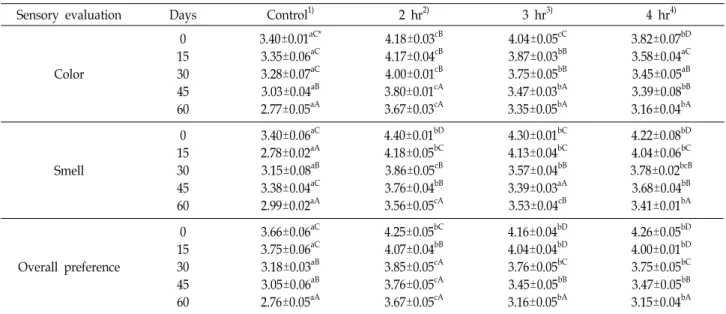
SWM extract-immersed mackerel was evaluated in terms of its color, smell, and general preference (Table 3). The con- trol group gained a lower point than the experimental groups, however, within the different experimental groups there was no significant difference. The control group scored between 2.7 to 3.4 for color, and it was lower than the treat- ment groups. Similarly, for flavor, the treatment groups re- ceived a higher point than the control group. Thus, it was speculated that SWM extract treatment hinders the gen- eration of fishy smell or rancid odor. In terms of general preference, the 2 hr-immersed group gained a higher point, but it was not significantly different. Taken together, as per sensory evaluation, increased treatment time with SWM does not improve the perceptible quality of mackerel and the functional quality of the preserved mackerel can be im- proved through treatment for just 2 hr.
Total polyphenol and total flavonoid content Phenolic compounds are one of the secondary metabolites widely distributed in plants. They have various structures and molecular weights. The phenolic hydroxyl (OH) groups
Table 3. Changes in sensory evaluation during storage period of mackerel immersed with sea wind mugwort
Sensory evaluation Days Control1) 2 hr2) 3 hr3) 4 hr4)
Color
0 15 30 45 60
3.40±0.01aC*
3.35±0.06aC 3.28±0.07aC 3.03±0.04aB 2.77±0.05aA
4.18±0.03cB 4.17±0.04cB 4.00±0.01cB 3.80±0.01cA 3.67±0.03cA
4.04±0.05cC 3.87±0.03bB 3.75±0.05bB 3.47±0.03bA 3.35±0.05bA
3.82±0.07bD 3.58±0.04aC 3.45±0.05aB 3.39±0.08bB 3.16±0.04bA
Smell
0 15 30 45 60
3.40±0.06aC 2.78±0.02aA 3.15±0.08aB 3.38±0.04aC 2.99±0.02aA
4.40±0.01bD 4.18±0.05bC 3.86±0.05cB 3.76±0.04bB 3.56±0.05cA
4.30±0.01bC 4.13±0.04bC 3.57±0.04bB 3.39±0.03aA 3.53±0.04cB
4.22±0.08bD 4.04±0.06bC 3.78±0.02bcB 3.68±0.04bB 3.41±0.01bA
Overall preference
0 15 30 45 60
3.66±0.06aC 3.75±0.06aC 3.18±0.03aB 3.05±0.06aB 2.76±0.05aA
4.25±0.05bC 4.07±0.04bB 3.85±0.05cA 3.76±0.05cA 3.67±0.05cA
4.16±0.04bD 4.04±0.04bD 3.76±0.05bC 3.45±0.05bB 3.16±0.05bA
4.26±0.05bD 4.00±0.01bD 3.75±0.05bC 3.47±0.05bB 3.15±0.04bA
1)Control: No-treated with sea wind mugwort extract
2)2 hr: Sea wind mugwort extract, 2 hr immersion treatment
3)3 hr: Sea wind mugwort extract, 3 hr immersion treatment
4)4 hr: Sea wind mugwort extract, 4 hr immersion treatment
*Data represent the mean ± SD of experiments performed in triplicates. The different lower-case letters (superscript) in the same row (a-c) and column (A-D) indicate the significant difference by Duncan’s multiple range test (p<0.05).
A B
Fig. 2. Changes in total polyphenol (A) and total flavonoid content (B) during the storage period of mackerel immersed with sea wind mugwort extract. Data represent the mean ± SD of triplicate experiments (n=3). Columns with the same lower-case letters (a–c) are not significantly different by Duncan’s multiple range test (p<0.05).
of these compounds enable them to be easily combined with proteins or other giant molecules. They exhibit many physio- logical activities such as antioxidant or anticancer activities.
It was observed that 5% SWM extract total polyphenol and total flavonoid contents were 357.34 mg GAE/100 g and 246.40 mg QE/100 g, respectively (not shown in Fig. 2). The control and the experimental groups immersed with 5%
SWM extract indicate the total polyphenol and total fla- vonoid content as shown in Fig. 2. The control group
showed the total polyphenol content as 99.6~120.1 mg GAE/
100 g, and it was lower than that in the treatment groups.
The 2 hr, 3 hr, and 4 hr-immersed groups indicated 497.0, 327.5, and 282.0 mg GAE/100 g on the 30th day of storage, suggesting that the 2 hr-immersed group showed a highest polyphenol content amongst different groups. Also, the con- trol group indicated the total flavonoid content as 100.8~
135.5 mg QE/100 g, and on the 30th day of storage, the 2 hr, 3 hr, and 4 hr-immersed groups indicated higher contents
A B
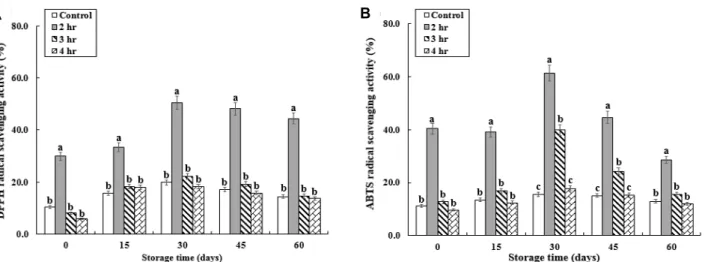
Fig. 3. Changes in DPPH (A) and ABTS (B) radical scavenging activity during the storage period of mackerel immersed with sea wind mugwort extract. Data represent the mean ± SD of triplicate experiments (n=3). Columns with the same lower-case letters (a–c) are not significantly different by Duncan’s multiple range test (p<0.05).
of 385.6, 383.1, and 374.8 mg QE/100 g. Increased by the production of free phenolic components by the enzymatic action of microorganisms during the storage period, when comparing control group, mackerel immersed in SWM ex- tract is considered to be due to by the effect of lignan-based substances and flavonoids and other components.
DPPH radical scavenging activity and ABTS radical scavenging activity
Lipid oxidation in food reduces its nutritive and sensory value, affects consumer preferences, and also brings about cell damage with the generation of peroxides, which results in aging or other kinds of diseases [28]. Accordingly, oxi- dizers that can get rid of free radicals generated in the proc- ess of lipid auto-oxidation are used to hinder lipid oxidation in food. In the human body, they are used to hinder aging and other diseases attributed to free radicals [6]. DPPH and ABTS radical scavenging activities of 5% SWM extracts are 32.08% and 66.92%, respectively. The control group in- dicated less than 20% DPPH radical scavenging activity dur- ing storage (Fig. 3A). In contrast, the 2 hr, 3 hr, and 4 hr experimental groups, demonstrated an increase in DPPH radical scavenging activity during storage, and on the 30th day, the 2 hr experimental group showed the highest activity of 50.6%. The ABTS radical scavenging activity was as high as 61.3% of 2 hr-immersed group (Fig. 3B). Notably SWM extract-immersed mackerel is equipped with antioxidant ac- tivity comparable to the natural antioxidants such as green tea and pine needles’ hot water extract which showed DPPH radical scavenging activities of 55% and 53%, respectively
[17]. This is attributed to the high total polyphenol and fla- vonoid content. Interestingly, mackerel immersed with mushrooms also possessed DPPH and ABTS radical scav- enging activity of more than 50%. It was reported that the total phenolic compounds contained in the extract increased and the antioxidant activity increased, similar to the current report [27].
Acknowledgment
This work (2015-3079) was supported by Business for Cooperative R&D between Industry, Academy, and Research Institute funded Korea Small and Medium Business Administration in 2015.
References
1. Cho, H. Y., Yoon, S. Y., Park, J. J., Yun, K. W. and Park, J. M. 2006. Antimicrobial activity of water soluble extract from Artemisia princeps var. orientalis. Kor. J. Biotechnol.
Bioeng. 21, 129-132.
2. Cho, S. J., Choe, Y. K., Lee, S. Y., Byun, S. M. and Chung, J. R. 1985. Radurization effect of Korean mackerel. Bull Kor.
Fish Soc. 18, 219-222.
3. Choe, Y. O. and Min, D. B. 2005. Chemistry and reactions of reactive oxygen species in foods. J. Food Sci. 70, 142-159.
4. Garcia, D. J. 1998. Omega-3 long-chain PUFA nutraceuticals.
Food Technol. 52, 44-49.
5. Hong, J. H., Jeon, J. L., Lee, J. H. and Lee, I. S. 2007.
Antioxidative properties of Artemisia princeps Pamp. J. Kor.
Soc. Food Sci. Nutr. 36, 657-662.
6. Jang, J. K. and Han, J. Y. 2002. The antioxidant ability of grape seed extracts. Kor. J. Food Sci. Technol. 34, 524-528.
7. Jin, Y.X., Yoo, Y. S., Han, E. K., Kang, I. J. and Chung, C.
K. 2008. Artemisia capillaris and Paecilomyces japonica stim- ulate lipid metabolism and reduce hepatotoxicity induced carbon tetrachloride in rats. J. Kor. Soc. Food Sci. Nutr. 37, 548-554.
8. Jung, B. M., Chung, G. H., Jang, M. S. and Shin, S. U. 2004.
Quality characteristics of citron treated mackerel oil and fil- let during refrigerated storage. Kor. J. Food Sci. Technol. 36, 574-579.
9. Jung, S. A. 2013. Inhibitory activity of histidine de- carboxylase in mackerel by natural materials and high hy- drostatic pressure treatments. MS Thesis, Pukyong National University, Korea. p 1-7.
10. Kang, B. K., Kim, K. B. W. R., Kim, M. J., Kim, D. H., Jung, S. A., Bark, S. W., Pak, W. M., Kim, B. R., Park, H. M., Byun, M. W. and Ahn, D. H. 2013. Inhibitory effect of high hydrostatic pressure treatments on histamine production in mackerel Scomber japonicus. Kor. J. Fish Aquat. Sci. 46, 733- 738.
11. Kang, K. M. and Lee, S. H. 2013. Effects of extraction meth- ods on the antioxidative activity of Artemisia sp. J. Kor. Soc.
Food Sci. Nutr. 42, 1249-1254.
12. Kim, D. H. 2012. Inhibitory effect of natural materials and high hydrostatic pressure treatments on histamine pro- duction in mackerel. MS Thesis, Pukyong National Univer- sity, Korea. p 1-94.
13. Kim, I. H., Kim, J. E. and Kang, J. H. 2012. A study on the quality characteristics and shelf-life of marinade mack- erel with thyme extract. Kor. J. Food Cook. Sci. 28, 753-761.
14. Kim, J. H. and Ha, J. H. 1989. Preservation of mackerel by irradiation. Cheju National University Journal, 29, 201-210.
15. Kim, J. O., Kim, Y. S., Lee, J. H., Kim, M. N., Rhee, S. H., Moon, S. H. and Park, K. Y. 1992. Antimutagenic effect of the major volatile compounds identified from mugwort (Artemisia asicica nakai) leaves. J. Kor. Soc. Food Nutr. 21, 308-313.
16. Kim, J. S., Yeum, D. M., Kang, H. G., Kim, J. S., Kong, C.
S., Lee, T. G. and Heu, T. G. 2002. Fundamentals and appli- cations for canned foods. Hyoil Publishing Co., Seoul, Korea, p 32-36.
17. Kim, S. M., Cho, Y. S., Sung, S. K., Lee, I. G., Lee, S. H.
and Kim, D. G. 2002. Antioxidant and nitrite scavenging activity of pine needle and green tea extracts. Kor. J. Food Sci. Ani. Resour. 22, 13-19.
18. Kwon, M. C., Kim, C. H., Kim, H. S., Lee, S. H., Chio, G.
P., Park, U. Y., You, S. G. and Lee, H. Y. 2007. Optimal extract condition for the enhancement of anticancer activ- ities of Artemisia princeps Pampanini. Kor. J. Med. Crop. Sci.
15, 233-240.
19. Lee, C. B. 1997. Korea botanical book. Jin Myung Publication
Co., Seoul, Korea. P 292.
20. Lee, H. J., Kim, K. H., Park, J. K. and Hwang, E. H. 2008.
Effects of Artemisia capillaris thunberg on apoptosis in HeLa cells. Kor. J. Nutr. 41, 22-30.
21. Lee, J. S., Joo, D. S., Kim, J. S., Cho, S. Y. and Lee, E. H.
1993. Processing of a good quality salted and semi-dried mackerel by high osmotic pressure resin dehydration under cold condition. Kor. J. Food Sci. Technol. 25, 468-474.
22. Lee, Y. K. and Lee, H. S. 1997. Effects of onion and ginger on the lipid peroxidation and fatty acid composition of mackerel during frozen storage. J. Kor. Soc. Food Nutr. 19, 321-329.
23. Nam, K. H., Jang, M. S., Lee, D. S., Yoon, H. D. and Park, H. Y. 2011. Effect of green tea and lotus leaf boiled water extracts treatment on quality characteristics in salted mack- erel during storage. Kor. J. Food Preserv. 18, 643-650.
24. Oh, S. K., Kim, K. W. and Choi, M. R. 2016. Antioxidant activity of different parts of Dolsan leaf mustard. Food Sci.
Biotechnol. 25, 1463-1467.
25. Pharmaceutical Society of Japan. 1983. Standard methods of analysis for hygienic chemists with commentary. Kyumwon Publishing Co., Tokyo, Japan pp. 62-63(in Japanese).
26. Ryu, J. H., Lee, S. J., Kim, M. J., Shin, J. H., Kang, S. K., Cho, K. M. and Sung, N. J. 2011. Antioxidant and anticancer activities of Artemisia annua L. and determination of func- tional compounds. J. Kor. Soc. Food Sci. Nutr. 41, 509-516.
27. Seo, Y. H., Kim, I. J., Yie, A. S. and Min, H. K. 1999. Electron donating ability and contents of phenolic compounds, toco- pherols and carotenoids in waxy corn (Zea mays L.). J. Food Sci. Technol. 31, 581-585.
28. Shin, S. R., Hong, J. Y., Nam, H. S., Huh, S. M. and Kim, K. S. 2006. Chemical changes of salted mackerel by Korean herbal extracts treatment and storage methods. Kor. J. Food Preserv. 13, 18-23.
29. Song, E. J., Kim, J. Y., Lee, S. Y., Kim, K. B. W. R., Kim, S. J., Yoon, S. Y., Lee, S. J., Lee, C. H. and Ahn, D. H. 2009.
Effect of roasted ground coffee residue extract on shelf-life and quality of salted mackerel. J. Kor. Soc. Food Sci. Nutr.
38, 780-786.
30. Song, H. N., Lee, D. G., Han, S. W., Yoon, H. K. and Hwang, I. K. 2005. Quality changes of salted and semi-dried mack- erel fillets by UV treatment during refrigerated storage. Kor.
J. Food Cook. Sci. 21, 662-668.
31. Tariq, M., Mossa, J. S., Al-Yahya, M. A., Parmar, N. S. and Ageel, A. M. 1987. Evaluation of Artemisis inculta for anti-in- flammatory activity in rats. Am. J. Chin. Med. 15, 127-132.
32. Yoon, K. Y., Hong, J. Y., Kim, M. H., Cho, Y. S. and Shin, S. R. 2007. Changes on the characteristics of salted mackerel treated extracts of edible plants during storage. Kor. J. Food Preserv. 14, 439-444.
초록:해풍쑥 추출물에 침지 처리한 고등어의 품질특성 오선경1․손혜련1․김기웅2․배상옥3․김성영4․최명락1*
(1전남대학교 생명산업공학과, 2전남대학교 해양바이오식품학과, 3초당대학교 조리과학부, 4안동과학대학 식품영
양과)
거문도 해풍쑥 추출물을 처리한 고등어의 저장 기간 동안의 품질 특성을 조사하였다. 5% 해풍쑥 추출물에 고등 어를 2시간, 3시간, 4시간 처리한 후 개별 포장하여 -20℃에 저장하여 실험하였다. 해풍쑥 추출물을 처리하지 않은 고등어(control)와 해풍쑥에 2, 3, 4시간씩 처리한 고등어의 염도는 2시간 처리한 고등어가 0.07%로 가장 낮은 수 치를 나타냈다. pH는 모두 5.90~6.23를 나타냈고 산도는 15일째 감소 후 증가하는 경향을 나타냈다. 또한, 저장기 간이 길수록 인장강도는 control은 증가하고, 2, 3, 4시간씩 처리한 고등어는 감소하였다. Volatile basic nitrogen (VBN) 함량은 control은 4.2~50.7 mg%, 2시간 처리한 고등어는 5.6~15.4 mg%로 control보다 가장 낮은 수치를 나타냈다. 2시간 처리한 고등어 제품에서 total polyphenol, total flavonoid 함량은 286.3~497.0 mg GAE/100 g, 177.5~385.6 mg QE/100 g를 나타냈다. DPPH, ABTS radical scavenging activity은 2시간 처리한 고등어 제품에서 50.6%, 61.3%를 각각 나타냈다. 전반적으로, 고등어를 SWM으로 단시간 처리하면 염도, pH, 산도, 경도, 항산화 활성 및 저장기간 연장과 같은 품질특성이 크게 향상되었음을 알 수 있다.