Quorum Quenching Enzymes and Biofouling Control
Young Jae Jeon*, Won-Geom Jeong and Hye-Sook Heo
Department of Microbiology, Pukyong National University, Busan 608-737, KoreaReceived December 11, 2016 /Revised December 20, 2016 /Accepted December 27, 2016
Bacterial cell to cell communication strategies called quorum sensing (QS) using small diffusible sig- naling molecules (auto-inducers) govern the expression of various genes dependent on their pop- ulation density manner. As a consequence of synthesis and response to the signaling molecules, in- dividual planktonic cells synchronized group behaviors to control a diverse array of phenotypes such as maturation of biofilm, production of extra-polymeric substances (EPS), virulence, bioluminescence and antibiotic production. Many studies indicated that biofilm formations are associated with QS sig- naling molecules such as acyl-homoserine lactones (AHLs) mainly used by several Gram negative bacteria. The biofilm maturation causes undesirable biomass accumulation in various surface environ- ments anywhere water is present called biofouling, which results in serious eco-technological problems.
Numerous molecules that interfere the bacterial QS called quorum quenching (QQ), have been dis- covered from various microorganisms, and their functions and mechanisms associated with QS have also been elucidated. To resolve biofouling problems related to various industries, the novel approach based on QS interference has been emerged attenuating multi-drug resisting bacteria appearance and environmental toxicities, which may provide potential advantages over the conventional anti-biofoul- ing approaches. Therefore this paper presents recent information related to bacterial quorum sensing system, quorum quenching enzymes that can control the QS signaling, and lastly discuss the anti-bio- fouling approaches using the quorum quenching.
Key words : Acyl-homoserine lactone, anti-biofouling, biofouling, quorum quenching enzymes, quorum
sensing (QS)
*Corresponding author
*Tel : +82-53-629-5612, Fax : +82-53-629-5619
*E-mail : [email protected]
This is an Open-Access article distributed under the terms of the Creative Commons Attribution Non-Commercial License (http://creativecommons.org/licenses/by-nc/3.0) which permits unrestricted non-commercial use, distribution, and reproduction in any medium, provided the original work is properly cited.
Journal of Life Science 2016 Vol. 26. No. 12. 1487~1497 DOI : http://dx.doi.org/10.5352/JLS.2016.26.12.1487
Introduction
Biofouling is a phenomenon caused by undesirable accu- mulation of biomass composed of microorganisms, plants, algae, or invertebrate animals in a surface contacting with water. This can occur almost anywhere water is present such as aquatic transportation vessels, aquaculture, petroleum in- dustries, medical devices, bioreactors or water distribution network and wastewater plant see recent reviews [24, 28, 83]. Bacteria are the most common biofouling agents and the feature of biofouling is related to the bacterial commun- ity composed of one or more species able to generate biofilms. The major cost of biofouling is associated with the increased of operating cost or fuel consumption [75]. The traditional anti-biofouling strategies rely on physical clean-
ing, or the use of antibacterial compounds (cooper salts), de- tergent and oxidizing agents such as hydrogen peroxide, chlorinated compounds [10]. The traditional antifouling ap- proaches to the confined environments have resulted in seri- ous health and environmental problems due to their eco-tox- icities to many aquatic organisms [10].
Many bacterial species are commonly known to control their expression of gene circuits in a population dependent manner through the release of extracellular signaling mole- cules to monitor their population density in various environ- ments called quorum sensing. The small diffusible mole- cules called autoinducers (AIs), also known as a quorum sensing molecules, reaches the threshold level in proportion to the cell density, and then the signal molecules bind to a specific receptor protein and activates the expression of specific genes. Synthesizing, secreting, and responding to these small diffusible molecules as a part of regulating the synchronizing behaviors trigger a diverse array of pheno- types such as bioluminescence [21], antibiotic production [66], virulence [1], sporulation [30], and biofilm formation [14]. There are many types of QS molecules have been dis- covered such as acylhomoserine lactones (AHLs), auto-in- ducer peptides (AIPs), hydroxyl-palmitic acid methylester
- Review -
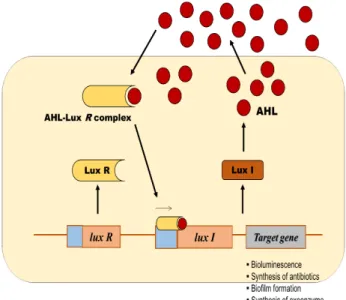
Fig. 1. Schematic diagram of the AHL/LuxR/LuxI type quorum sensing system in Gram-negative bacteria. The luxR is a gene encoding LuxR type transcriptional factors and luxI is a gene coding for LuxI type AHL synthases. The expression of target genes for such as bioluminescence and biofilm formation are transcriptionally regulated by LuxR homologue proteins when the high concentration AHL depending on a threshold level of bacterial cell density is present
(PAME), furnocylborate (AI-2) and ethyl dodecenoic acid (DSF) [27, 67, 80, 93, 94]. Among them, Gram positive bac- teria mainly use the peptide-based signaling, whereas Gram negative bacteria use the AHLs based signaling.
The process interfering QS communication systems has been generally referred as quorum quenching (QQ) [19]. QQ mechanisms so far described in nature use two strategies.
One is the enzymes that inactivate QS signals are called QQ enzymes and the other is the chemicals disturbing the path- way of QS system called QS inhibitors (QSI). The production of QQ enzyme and QSI have been reported from various organisms including algae and invertebrates, terrestrial plants, bacteria, and mammalian cells [27, 73]
This review focuses on the novel strategies to overcome the conventional anti-fouling approaches relying on AHLs mediated QS sensing interference of QQ enzymes so far dis- covered and the application for the quorum quenching en- zymes in anti-fouling strategy.
AHLs molecules mediated quorum sensing Among the QS molecules, AHLs are the most well charac- terized, and share common chemical structure features with an acyl chain and homoserine lactone ring. Gram negative bacteria have a conserved QS system, with two central com- ponents, where a LuxR-type (R) regulator and LuxI-type (I) protein serve as the signal receptor and an AHL synthase, respectively (Fig. 1). These signal molecules are synthesized by LuxI synthase from S-adenosyl-methionine and an acyl chain carried by an acyl carrier protein. Once the AHL mole- cules recognized by Lux R-type regulators, and then the reg- ulators control the gene expression associated with various phenotypes. Structural variants of the basic AHL molecules have been discovered and they vary in length and degree of saturation of the acyl side chain as well as in the func- tional group located at C
3[87]. These QS signals have been identified and characterized in over 100 species of Gram- negative bacteria belonging to Proteobacteria, other bacteria and archaea such as the haloalkaliphilic archaeon Natrono-
coccus occultus [61] and the acidophilic gamma-proteobacte-rium Acidithiobacillus ferrooxidans [70], the cyanobacterium
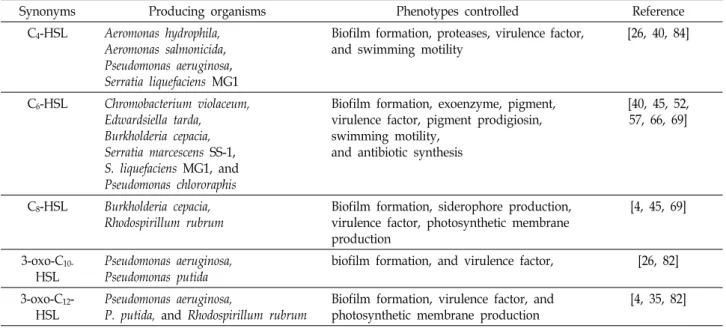
Gloeothece [78] and different marine Bacteriodietes [71]. In par-ticular, the bacteria that use AHL mediated QS for biofilm formations and other phenotypes are summarized in Table 1.
Quorum quenching enzymes
Since the quorum quenching strategy prevents the ex-
pression of the biofilm formation related genes have been discovered, various biological origins of quorum quenching enzymes or QS inhibitors have been identified from quorum sensing and non-quorum sensing microbes [27].
Based on the chemical structure of AHLs, three different ways of degradation have been discovered as shown in Fig.
2; the lactonases that open the homoserin lactone ring, the acylases (also referred as deaminase) that cleave AHLs at the amide bond and release fatty acid and homoserine lactone. In addition, signal confusing QQ enzymes: the re- ductases that convert 3-oxo-substitured AHL to their 3-hy- droxyl-substitured AHL, and cytochrome oxidase that cata- lyze oxidation at the acyl chain have also discovered [20].
AHL lactonase
Lactonase activities against AHL signal have been dis-
covered from diverse microorganisms as summarized in
Table 2. Based on amino acid sequence and structure of AHL
lactonases, the QQ enzymes belong to amidohydrolase su-
perfamily and further subclassified into four different lacto-
nase families such as metallolactamase-like lactonase (MBL),
phosphotriesterases-like lactonase (PLL), paraoxonase, and
α/β-hydrolase fold lactonase (HFL) [49, 53].
Table 1. Summary of various Gram negative bacteria using AHLs based QS and their molecules that mediate biofilm formation
Synonyms Producing organisms Phenotypes controlled Reference
C4-HSL Aeromonas hydrophila, Aeromonas salmonicida, Pseudomonas aeruginosa, Serratia liquefaciens MG1
Biofilm formation, proteases, virulence factor, and swimming motility
[26, 40, 84]
C6-HSL Chromobacterium violaceum, Edwardsiella tarda, Burkholderia cepacia, Serratia marcescens SS-1, S. liquefaciens MG1, and Pseudomonas chlororaphis
Biofilm formation, exoenzyme, pigment, virulence factor, pigment prodigiosin, swimming motility,
and antibiotic synthesis
[40, 45, 52, 57, 66, 69]
C8-HSL Burkholderia cepacia, Rhodospirillum rubrum
Biofilm formation, siderophore production, virulence factor, photosynthetic membrane production
[4, 45, 69]
3-oxo-C10-
HSL
Pseudomonas aeruginosa, Pseudomonas putida
biofilm formation, and virulence factor, [26, 82]
3-oxo-C12- HSL
Pseudomonas aeruginosa,
P. putida, and Rhodospirillum rubrum
Biofilm formation, virulence factor, and photosynthetic membrane production
[4, 35, 82]
O O
NH2
O O
N H
O R
n
AHL
O N H
O R
n
Acyl-Homoserine
O O
N H
O OH
n
Hydroxy-Homoserine
Homoserine lactone Fatty acid
OH HO
HO
O R
+
nAHL-acylase
AHL-lactonase Ox
idorsd uctase
Fig. 2. AHL-degradtion or modification mechanism of quorum quenching enzymes.
Table 2. Summary of AHL lactonase enzymes produced by various organisms
Species/Source QQ
enzyme
Protein
family Substrates Metal
Ion Reference
Bacillus thuringiensis subsp.
kurstaki
AiiA MBL 3-oxo-C6-HSL Zn2+ [18]
Geobacillus kaustophilus HTA426
GkaP PLL C4-, C6-, C8-, C10-HSL; 3-oxo-C6-, 3-oxo- C8,
3-oxo-C12-HSL
Zn2+ [95]
Agrobacterium tumefaciens c58 AttM MBL 3-oxo-C8-HSL Zn2+ [5]
Agrobacterium tumefaciens c58 AiiB MBL C6-, C7-, C8-HS; 3-oxo-C6-, 3-oxo-C8-HSL Zn2+ [49]
Arthrobacter sp. IBN110 AhlD MBL C4-, C6-, C8-, C10-HSL; 3-oxo-C6-, -oxo-C10-HSL Zn2+ [63]
Rhodococcus erythropolis W2 QsdA PLL C6-, C8-, C10-, C12-, C14-HSL; 3-oxo-C6-, 3-oxo-C8-, 3-oxo-C10-, 3-oxo-C12, 3-oxo-C14-HSL
Zn2+ [86]
Flaviramulus ichthyoenteri Th78T
FiaL MBL C6-HSL; 3-oxo-C6-, 3-oxo-C10-HSL Zn2+ [96]
Sulfolobus islandicus SisLac PLL C4-, C8-, C12-HSL; 3-oxo-C8-, 3-oxo-C10-, 3-oxo-C12
Co2+, Fe3+ [22, 29]
Sulfolobus solfataricus P2 SsoPox PLL C8-HSL; 3-oxo-C8-, 3-oxo-C10-, 3-oxo-C12-HSL Co2+, Fe3+ [15]
Soil metagenomics clone QlcA MBL C6-, C7-, C8-HSL; 3-hydroxy-C6-, 3-hydroxy-C8-HSL; 3-oxo-C8-HSL
Zn2+ [68]
Ochrobactrum sp. T63 AidH HFL C4-, C6-, C10-HSL; 3-oxo-C6-, 3-oxo-C8-HSL Mn2+ [53]
Human PONs Paraoxonase C6-HSL; 3-oxo-C12 HSL Ca2+ [9]
The QQ enzymes, AiiA isolated from Bacillus thuringinesis BTK [37] and AiiB from Agrobacterium tumefaciens [49] be- long to the metallolactamase-like lactonase family with the characteristics requiring the Zn
2+binding conserve motif
“HXHXDH~H” at the active center of the enzyme which is involved in the cleavage of the ester bond on the lactone ring and the proper folding of the AHL lactonase [37].
Several other lactonase not relying on zinc or other ions for activity have also been reported such as AttM from
Agrobacterium tumefaciens [5], AhlD from Arthrobacter [63]and QlcA from metagenomes [68], although their motifs are similar to the Zn
2+binding motif (HXHXDH) of several met- allohydrolases [19].
Phophotriesterase-like lactonase (PLL) containing a tri- osephosphate isomerase (TIM) like fold consisting of eight α-helices and eight parallel β-strands have been discovered from many eubacteria and several archaea [48, 95]. The lacto- nase belonging to this family, in particular, appeared to have important biotechnology aspects [3, 58]. Several enzymes from this family have interestingly shown thermostable lac- tonase activities such as GkaP from Geobacillus kaustophilus HTA426 [95], SisLac from Sulfolobus islandicus [29] and SsoPox from S. solfataricus [15, 58]. Although quorum quenching lactonases have great potential to prevent the
pathogenicity from various pathogenic bacteria, broad AHLs substrate ranges and thermostabilities of the enzyme are im- portant characteristics in anti-fouling section. Chow et al. [7]
reported directed evolution strategy to isolate thermostable quorum quenching lactonase from Geobacillus kaustophilus HTA426. In addition Seo et al. [77] reported a thermostable quorum quenching lactonase from Geobacillus caldoxylosilyti-
cus YS-8 with broad substrates specificity.Despite different amino acid sequence and architecture, the lactonases are all belonging to amidohydrolase su- per-families with a similar catalytic mechanism using metal ions and key active site [23]. Besides the zinc binding motifs, possible other catalytic motifs for metal binding to lactonase have been elucidated indicating that the diversity and poly- morphism of lactonase are exist [56]. Their characteristics as- sociated with substrate usage and metal ion requirements are summarized in Table 2.
Acylase
AHL acylases degrade the amide bond in AHL molecules
yielding homoserine lactones and their corresponding acyl
chain of fatty acids which severe as the carbon energy and
nitrogen source respectively for bacterial growth as shown
in Fig. 2. Since the first AHL acylase AiiD has been reported
Table 3. Summary of AHL acylase enzymes produced by various organisms
Species/Source QQ enzyme Protein family Substrates Reference
Variovorax paradoxus VAI-C ND ND C4-, C6-, C8-, C10-, C12-, C14-HSL; 3-oxo-C6-HSL [43]
Ralstonia sp. XJ12B AiiD Ntn-hydrolase 3-oxo-C6-, 3-oxo- C8, 3-oxo-C12-HSL [47]
Pseudomonas aeruginosa PAO1 PvdQ Ntn-hydrolase C7-, C8-, C10-, C11-, C12-, C14-HSL; 3-oxo-C10-, 3-oxo-C12HSL
[81]
Pseudomonas aeruginosa PAO1 QuiP Ntn-hydrolase C6-HSL, C8-HSL, C10-HSL, and C12-HSL [32]
Streptomyces sp. M664 AhlM Ntn-hydrolase C8-, C10-HSL; 3-oxo-C12HSL [65]
Anabaena sp. PCC7120 AiiC Ntn-hydrolase C4-, C6-, C8-, C10-, C12-, C14-HSL; 3-oxo-C4, 3-oxo-C6-, 3-oxo-C8-, 3-oxo-C10-, 3-oxo-C12-, 3-oxo- C14-HSL;
3-hydoxo-C4-, 3-hydoxo-C6-, 3-hydoxo-C8-, 3-hydoxo-C10-, 3-hydoxo-C12-, 3-hydoxo-C14-HSL
[72]
Rhodococcus sp. BH4 ND ND C6-, C8-, C10-, C12-HSL; 3-oxo-C6-, 3-oxo- C8,
3-oxo- C10-, 3-oxo-C12-HSL
[59]
Ochrobactrum sp.A44 AiiO α/β-Hydrolase C10-, C12-HSL; 3-oxo- C10-, 3-oxo-C12-, 3-oxo-C14-HSL; 3-hydoxo-C12-HSL
[13]
Rattus norvegicus AcyI ND C4-, C8-HSL [89]
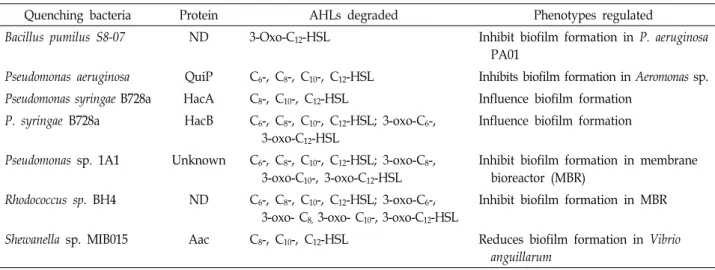
Table 4. Summary of AHL acylase enzymes produced from various bacteria that have been used in the inhibition of biofilm formation
Quenching bacteria Protein AHLs degraded Phenotypes regulated
Bacillus pumilus S8-07 ND 3-Oxo-C12-HSL Inhibit biofilm formation in P. aeruginosa PA01
Pseudomonas aeruginosa QuiP C6-, C8-, C10-, C12-HSL Inhibits biofilm formation in Aeromonas sp.
Pseudomonas syringae B728a HacA C8-, C10-, C12-HSL Influence biofilm formation P. syringae B728a HacB C6-, C8-, C10-, C12-HSL; 3-oxo-C6-,
3-oxo-C12-HSL
Influence biofilm formation
Pseudomonas sp. 1A1 Unknown C6-, C8-, C10-, C12-HSL; 3-oxo-C8-, 3-oxo-C10-, 3-oxo-C12-HSL
Inhibit biofilm formation in membrane bioreactor (MBR)
Rhodococcus sp. BH4 ND C6-, C8-, C10-, C12-HSL; 3-oxo-C6-, 3-oxo- C8, 3-oxo- C10-, 3-oxo-C12-HSL
Inhibit biofilm formation in MBR
Shewanella sp. MIB015 Aac C8-, C10-, C12-HSL Reduces biofilm formation in Vibrio anguillarum
from Variovorax paradoxus VAI-C [43], various bacteria are reported to produce this enzyme family. Currently the por- cine kidney and several bacterial enzymes such as AiiD, PvdQ, ahlM, AiiC and QuiP belong to this family known N-terminal nucleophile (Ntn) hydrolase family. Table 3 sum- marizes the QQ acylase enzyme characterized so far with their substrate preference. In contrast to the AHL lactonase which belongs to various protein families, the majority of the characterized AHL acylase belongs to the Ntn hydrolase family. Most of AHL acylases in general exhibit a preference for long-chain AHLs (with or without a substituent at C-3 of the acyl chain). In particular, AiiC from Anabaena sp.
PCC7120 [72] showed a broad range of AHLs hydrolyses, which has high potential for anti-biofouling control agents.
Compared to AHL lactonases, AHL acylases are considered as advantageous for anti-biofouling applications, because in contrast to the lactonase product N-acyl homoserine, which can re-circularize to the AHL at acidic pH, the acylase re- action products cannot spontaneously regenerate a func- tional QS signal. Also several AHL acylase from various bac- teria have been reported to reduce biofilm formation which is summarized in Table 4.
AHL oxidoreductase
AHL reductase is considered as QS confusing enzymes
which modify the signal molecules but not destroy as shown
in Fig. 2. It has been reported that an AHL reductase pro-
duced from Rhodococcus erythropolis W2 converts 3-oxo-sub-
stituted AHLs to 3-hydroxy derivatives with a high substrate preference against long-chain 3-oxo-AHLs (> Carbon num- ber 8) [64]. This enzyme showed a broad stereospecificity capable of reduction on both D- and L- isomers of 3-oxo AHL substrates as well as on other AHL analogs such an aromatic acyl chain substituent, N-(3-oxo-6-phenyhexanol) and 3-oxododecanamine which lacks the homoserin lactone ring. Recently another QQ reductase BpiB09 from a meta- genomic library has been reported to attenuate Pseudomonas
aeruginosa biofilm formation [2].The cytochrome P450 oxidase CYP102A1 from Bacillus
megaterium catalyzing the oxidation of acyl homoserine andfatty acids at the ε-1, ε-2, ε-3 positions [8, 62]. The AHL oxi- dation products still act as QS auto-inducers, but are sig- nificantly less active than the parent compounds [8]
Application of QQ as anti-biofouling strategy
Marine biofoulingMarine biofouling is the undesirable biomass accumu- lation of microorganisms, plants, algae and invertebrate ani- mals on any structures in contact with seawater, such as boats, fish nets, or pipelines. This is causative for friction on boats resulting in excessive fuel consumption, increased maintenance costs, and generates considerable economic losses annually [75, 76]. Since the use of toxic organotin trib- ultyin based paint products has been banned due to its tox- icities caused to marine organisms, various novel ap- proaches searching for non-toxic alternatives have been at- tempted for either preventing biofouling formation or de- stroying biofilms using plant extracts [11, 17], bacteriophage [54], macroalga extract [25, 50] and new surfaces materials using new coating and paint and silver nanoparticles [6, 34, 46, 51, 55]. A detail summary of the known novel anti-bio- fouling strategies used is provided by other review [74].
Despite of relatively abundant data, anti-QS strategies have not been widely investigated in particular in the marine industry.
QS disrupting strategies using QQ enzymes would be of promising strategy as QQ enzymes could reduce QS-regu- lated biofilm formation involved in microfouling, but may also prevent the attraction and fixation of macrobiofouling species, which have demonstrated the influence of bacterial biofilm on the settlement of spores from algae or others [16, 85]. Several reviews discuss the potential of quorum quench- ing enzymes such as AHL-acylase, AHL-lactonase, and oxi- doreductases to control biofilm formation as an anti-biofoul-
ing agents or their incorporation into paints or coatings [12, 39, 60]. Even though QQ enzymes have been considered as efficient anti-fouling agents, no comparable work has been reported for marine biofouling. The main limitation would be the stability of QQ enzymes within paints as well as pos- sible limited activities in seawater. QQ enzymes from ex- tremophile organisms or halophile organisms would be of promising source as they usually are highly robust and may be active in marine environments.
Membrane biofouling
Membrane filtration has been wildly used in food in- dustry, fresh water or wastewater treatment industries as an efficient solid/liquid separation technology. However bi- ofilm formation on membrane altering their functions is one of inevitable problems. Quorum quenching (QQ) enzyme as an effective antifouling strategy for membrane biofouling has recently been adapted in this field in membrane bio- reactor (MBR) in advance wastewater treatment due to many advantages over conventional activated sludge treatments [31, 42, 44, 79, 88, 91]. Simpler steps, higher volumetric load- ing, lower sludge production and better effluent quality pro- vide substantial benefits from the MBR base process over conventional waste water processes [92]. However, the per- formance of MBR filtration inevitably decreases with oper- ation time due to the formation of biofilm onto the membrane. This phenomena cause by bacterial community developed through the quorum sensing. Therefore, this re- mains one of the most challenging issues for further MBR development process. In addition, studies to attenuate mem- brane biofouling have suggested that biofilm formation is mostly associated with Gram-negative bacteria and their se- creted metabolites [14, 41]
To resolve this technical issue, several studies addressed quorum quenching enzyme as an anti-biofouling strategies with immobilized QQ enzymes or immobilized QQ bacteria.
Yeon et al. [90] applied a QQ technique for MBRs. When the QQ enzyme (porcine kidney acylase I) was added to an MBR, a great reduction in membrane fouling was observed.
Synergistic or combined effects of physical cleaning modes
with QQ were also been investigated in MBRs. Further im-
provement in this innovative approach was achieved by im-
mobilizing QQ enzymes on various matrixes such as mag-
netic particles [91] or sodium alginate capsules [33], nano-
filteration membrane [36]. These techniques found to pre-
vent membrane biofouling caused by QS signal molecules
due to a reduced secretion of extracellular polymeric sub- stances (EPS). A significant improvement in membrane per- meability was observed without any negative impact on ef- fluent quality. However, the enzyme production cost and enzyme stabilities for long-term use constrain this technol- ogy in this MBR based wastewater plants.
In this respect, Oh et al. [59] proposed an alternative method, where QQ bacteria Rhodococcus sp. BH4 were used instead of QQ enzymes. When a microbial vessel containing QQ bacteria was placed in an MBR, QS was inhibited while mitigating the formation of a biofilm on the membrane surface. Further improvement of this approach was made by Kim et al. [38] who fabricated free-moving beads for en- trapping QQ bacteria, and they found that biofouling was controlled by both physical and biological actions. The EPS production was decreased due to QQ and the bombardment of beads onto the membrane surface enabled the biofilm to slough off from the membrane surface more easily.
However, above mentioned studies were investigated under synthetic wastewater at lab scales. In this respect, recently Lee et al. [44] have reported a similar strategy of entrapped QQ bacteria of Rhodococcus sp. BH4 in beads under pilot-scale MBRs at a pilot scale wastewater treatment plant with feed- ing real municipal wastewater. They reported effectiveness of this bacterium for membrane fouling control and the amount of energy savings due to reduction in the rate of transmembrane pressure built-up in QQ-MBR without com- promising the effluent water quality compared to that in a conventional-MBR. Furthermore, the QQ activity and me- chanical stability of QQ-beads were well maintained indicat- ing QQ-MBR has good potential for practical applications [44].
Conclusions
Large amount of literature indicates that QQ enzymes in- terfering AHLs based QS have been identified not only lim- ited to Gram negative and positive bacteria, but also found in several archaea and eukaryotic animals. This indicates their various roles in nature. One of important biological functions of QQ enzymes from nature can possibly applied to anti-biofouling strategies where biofilm formation medi- ated by AHL based quorum sensing causes serious economic and pathological problems. In particular, to prevent biofilm formation observed in various industries, alternative novel strategies have been search for. However, still conventional
anti-biofouling techniques such as copper based agents in- corporated to paints are still in use. Although several QSI from various organisms showed great potential alternatives, the application of QQ enzymes in this field are still limited due to their compatibility issues with paints or coatings and the activities in sea water. In this respect, the QQ enzymes from thermophilic or halophilic archaea would be important sources in this field as future studies. Another important ap- plicable area for QQ enzymes is to prevent biofilm for- mations cooperated to the membrane as anti-fouling strat- egies. In this respect the immobilization techniques using QQ enzymes or QQ bacteria can be practically applied in the advanced wastewater treatment using MBR systems even in large scale wastewater treatment plants. Obviously, the important applicability of QQ enzyme or bacteria in the advanced wastewater treatment using MBR systems needs to be further confirmed by life cycle assessment. Despite of many types of QQ enzymes existed, only AHL acylases mainly used this field which indicates the importance of bio- technological sources. Moreover, QQ enzymes are highly at- tractive as these molecules are usually not toxic and may be integrated into various matrices without being released.
The proofs of concept have been widely described and fur- ther investigations would obviously permit to develop con- crete applications in order to address the issues of bacterial virulence and biofouling.
Acknowledgement
This work was supported by the Pukyong National University Research fund in 2015(C-D-2015-1105).
References
1. Beck von Bodman, S. and Farrand, S. K. 1995. Capsular pol- ysaccharide biosynthesis and pathogenicity in Erwinia stew- artii require induction by an N-acylhomoserine lactone autoinducer. J. Bacteriol. 177, 5000-5008.
2. Bijtenhoorn, P., Mayerhofer, H., Müller-Dieckmann, J., Utpatel, C., Schipper, C., Hornung, C., Szesny, M., Grond, S., Thürmer, A. and Brzuszkiewicz, E. 2011. A novel meta- genomic short-chain dehydrogenase/reductase attenuates Pseudomonas aeruginosa biofilm formation and virulence on caenorhabditis elegans. PLoS One 6, e26278.
3. Bzdrenga, J., Daudé, D., Rémy, B., Jacquet, P., Plener, L., Elias, M. and Chabrière, E. 2016. Biotechnological applica- tions of quorum quenching enzymes. Chem. Biol. Interact.
(In press)
4. Carius, L., Carius, A. B., McIntosh, M. and Grammel, H.
2013. Quorum sensing influences growth and photo- synthetic membrane production in high-cell-density culti- vations of Rhodospirillum rubrum. BMC Microbiol. 13, 1.
5. Carlier, A., Uroz, S., Smadja, B., Fray, R., Latour, X., Dessaux, Y. and Faure, D. 2003. The Ti plasmid of Agrobacte- rium tumefaciens harbors an attM-paralogous gene, aiiB, also encoding n-acyl homoserine lactonase activity. Appl. Environ.
Microbiol. 69, 4989-4993.
6. Choi, O., Yu, C. P., Fernández, G. E. and Hu, Z. 2010. Inter- actions of nanosilver with Escherichia coli cells in planktonic and biofilm cultures. Water Res. 44, 6095-6103.
7. Chow, J. Y., Xue, B., Lee, K. H., Tung, A., Wu, L., Robinson, R. C. and Yew, W. S. 2010. Directed evolution of a thermo- stable quorum-quenching lactonase from the amidohy- drolase superfamily. J. Biol. Chem. 285, 40911-40920.
8. Chowdhary, P. K., Keshavan, N., Nguyen, H. Q., Peterson, J. A., González, J. E. and Haines, D. C. 2007. Bacillus mega- terium CYP102A1 oxidation of acyl homoserine lactones and acyl homoserines. Biochemistry 46, 14429-14437.
9. Chun, C. K., Ozer, E. A., Welsh, M. J., Zabner, J. and Greenberg, E. 2004. Inactivation of a Pseudomonas aeruginosa quorum-sensing signal by human airway epithelia. Proc.
Natl. Acad. Sci. USA 101, 3587-3590.
10. Ciriminna, R., Bright, F. V. and Pagliaro, M. 2015. Ecofriendly antifouling marine coatings. ACS Sustainable Chem. Eng. 3, 559-565.
11. Coenye, T., Brackman, G., Rigole, P., De Witte, E., Honraet, K., Rossel, B. and Nelis, H. J. 2012. Eradication of Propioni- bacterium acnes biofilms by plant extracts and putative iden- tification of icariin, resveratrol and salidroside as active compounds. Phytomedicine 19, 409-412.
12. Cordeiro, A. L. and Werner, C. 2011. Enzymes for antifoul- ing strategies. J. Adhes. Sci. Technol. 25, 2317-2344.
13. Czajkowski, R., Krzyzanowska, D., Karczewska, J., Atkinson, S., Przysowa, J., Lojkowska, E., Williams, P. and Jafra, S.
2011. Inactivation of AHLs by Ochrobactrum sp. A44 depends on the activity of a novel class of AHL acylase. Environ.
Microbiol. Rep. 3, 59-68.
14. Davies, D. G., Parsek, M. R., Pearson, J. P., Iglewski, B. H., Costerton, J. W. and Greenberg, E. P. 1998. The involvement of cell-to-cell signals in the development of a bacterial biofilm. Science 280, 295-298.
15. Del Vecchio, P., Elias, M., Merone, L., Graziano, G., Dupuy, J., Mandrich, L., Carullo, P., Fournier, B., Rochu, D. and Rossi, M. 2009. Structural determinants of the high thermal stability of Ssopox from the hyperthermophilic archaeon Sulfolobus solfataricus. Extremophiles 13, 461-470.
16. Dobretsov, S., Dahms, H. U., YiLi, H., Wahl, M. and Qian, P. Y. 2007. The effect of quorum-sensing blockers on the formation of marine microbial communities and larval attachment. FEMS Microbiol. Ecol. 60, 177-188.
17. Dobretsov, S., Teplitski, M., Bayer, M., Gunasekera, S., Proksch, P. and Paul, V. J. 2011. Inhibition of marine biofoul- ing by bacterial quorum sensing inhibitors. Biofouling 27, 893-905.
18. Dong, Y. H., Zhang, X. F., Xu, J. L. and Zhang, L. H. 2004.
Insecticidal Bacillus thuringiensis silences Erwinia carotovora virulence by a new form of microbial antagonism, signal interference. Appl. Environ. Microbiol. 70, 954-960.
19. Dong, Y. H., Wang, L. H., Xu, J. L., Zhang, H. B., Zhang, X. F. and Zhang, L. H. 2001. Quenching quorum-sensing- dependent bacterial infection by an N-acyl homoserine lactonase. Nature 411, 813-817.
20. Dong, Y. H. and Zhang, L. H. 2005. Quorum sensing and quorum-quenching enzymes. J. Microbiol. 43, 101-109.
21. Eberhard, A., Burlingame, A. L., Eberhard, C., Kenyon, G.
L., Nealson, K. H. and Oppenheimer, N. J. 1981. Structural identification of autoinducer of Photobacterium fischeri Luciferase. Biochemistry 20, 2444-2449.
22. Elias, M., Dupuy, J., Merone, L., Mandrich, L., Porzio, E., Moniot, S., Rochu, D., Lecomte, C., Rossi, M. and Masson, P. 2008. Structural basis for natural lactonase and pro- miscuous phosphotriesterase activities. J. Mol. Biol. 379, 1017-1028.
23. Elias, M. and Tawfik, D. S. 2012. Divergence and con- vergence in enzyme evolution: Parallel evolution of para- oxonases from quorum-quenching lactonases. J. Biol. Chem.
287, 11-20.
24. Givskov, M., de Nys, R., Manefield, M., Gram, L., Maximilien, R., Eberl, L., Molin, S., Steinberg, P. D. and Kjelleberg, S. 1996. Eukaryotic interference with homoserine lactone-mediated prokaryotic signalling. J. Bacteriol. 178, 6618-6622.
25. Givskov, M., de Nys, R., Manefield, M., Gram, L., Maximi- lien, R., Eberl, L., Molin, S., Steinberg, P. D. and Kjelleberg, S. 1996. Eukaryotic interference with homoserine lactone- mediated prokaryotic signalling. J. Bacteriol. 178, 6618-6622.
26. Gould, T. A., Herman, J., Krank, J., Murphy, R. C. and Churchill, M. E. 2006. Specificity of acyl-homoserine lactone synthases examined by mass spectrometry. J. Bacteriol. 188, 773-783.
27. Grandclement, C., Tannieres, M., Morera, S., Dessaux, Y.
and Faure, D. 2016. Quorum quenching: Role in nature and applied developments. FEMS Microbiol. Rev. 40, 86-116.
28. Harding, J. L. and Reynolds, M. M. 2014. Combating medi- cal device fouling. Trends Biotechnol. 32, 140-146.
29. Hiblot, J., Gotthard, G., Chabriere, E. and Elias, M. 2012.
Structural and enzymatic characterization of the lactonase sis lac from Sulfolobus islandicus. PLoS One 7, e47028.
30. Hoch, J. A. 1993. Regulation of the phosphorelay and the initiation of sporulation in bacillus subtilis. Annu. Rev.
Microbiol. 47, 441-465.
31. Huang, J., Shi, Y., Zeng, G., Gu, Y., Chen, G., Shi, L., Hu, Y., Tang, B. and Zhou, J. 2016. Acyl-homoserine lactone- based quorum sensing and quorum quenching hold prom- ise to determine the performance of biological wastewater treatments: An overview. Chemosphere 157, 137-151.
32. Huang, J. J., Petersen, A., Whiteley, M. and Leadbetter, J.
R. 2006. Identification of QuiP, the product of gene PA1032, as the second acyl-homoserine lactone acylase of Pseudomo- nas aeruginosa PAO1. Appl. Environ. Microbiol. 72, 1190-1197.
33. Jiang, W., Xia, S., Liang, J., Zhang, Z. and Hermanowicz,
S. W. 2013. Effect of quorum quenching on the reactor per- formance, biofouling and biomass characteristics in mem- brane bioreactors. Water Res. 47, 187-196.
34. Kalishwaralal, K., BarathManiKanth, S., Pandian, S. R. K., Deepak, V. and Gurunathan, S. 2010. Silver nanoparticles impede the biofilm formation by Pseudomonas aeruginosa and Staphylococcus epidermidis. Colloids Surfaces B. 79, 340-344.
35. Karlsson, T., Turkina, M. V., Yakymenko, O., Magnusson, K. E. and Vikström, E. 2012. The Pseudomonas aeruginosa N-acylhomoserine lactone quorum sensing molecules target IQGAP1 and modulate epithelial cell migration. PLoS Pathog. 8, e1002953.
36. Kim, J. H., Choi, D. C., Yeon, K. M., Kim, S. R. and Lee, C. H. 2011. Enzyme-immobilized nanofiltration membrane to mitigate biofouling based on quorum quenching. Environ.
Sci. Technol. 45, 1601-1607.
37. Kim, M. H., Choi, W. C., Kang, H. O., Lee, J. S., Kang, B.
S., Kim, K. J., Derewenda, Z. S., Oh, T. K., Lee, C. H. and Lee, J. K. 2005. The molecular structure and catalytic mecha- nism of a quorum-quenching N-acyl-l-homoserine lactone hydrolase. Proc. Natl. Acad. Sci. USA 102, 17606-17611.
38. Kim, S. R., Oh, H. S., Jo, S. J., Yeon, K. M., Lee, C. H., Lim, D. J., Lee, C. H. and Lee, J. K. 2013. Biofouling control with bead-entrapped quorum quenching bacteria in membrane bioreactors: Physical and biological effects. Environ. Sci.
Technol. 47, 836-842.
39. Kristensen, J. B., Meyer, R. L., Laursen, B. S., Shipovskov, S., Besenbacher, F. and Poulsen, C. H. 2008. Antifouling en- zymes and the biochemistry of marine settlement. Biotech.
Adv. 26, 471-481.
40. Labbate, M., Queck, S. Y., Koh, K. S., Rice, S. A., Givskov, M. and Kjelleberg, S. 2004. Quorum sensing-controlled bio- film development in Serratia liquefaciens MG1. J. Bacteriol.
186, 692-698.
41. Lade, H., Paul, D. and Kweon, J. H. 2014. Isolation and mo- lecular characterization of biofouling bacteria and profiling of quorum sensing signal molecules from membrane bio- reactor activated sludge. Int. J. Biol. Sci. 15, 2255-2273.
42. Lade, H., Paul, D. and Kweon, J. H. 2014. Quorum quench- ing mediated approaches for control of membrane biofoul- ing. Int. J. Biol. Sci. 10, 550-565.
43. Leadbetter, J. R. and Greenberg, E. 2000. Metabolism of ac- yl-homoserine lactone quorum-sensing signals by Variovorax paradoxus. J. Bacteriol. 182, 6921-6926.
44. Lee, S., Park, S. K., Kwon, H., Lee, S. H., Lee, K., Nahm, C. H., Jo, S. J., Oh, H. S., Park, P. K., Choo, K. H., Lee, C. H. and Yi, T. 2016. Crossing the border between labo- ratory and field: Bacterial quorum quenching for anti-bio- fouling strategy in an MBR. Environ. Sci. Technol. 50, 1788- 1795.
45. Lewenza, S., Conway, B., Greenberg, E. and Sokol, P. A.
1999. Quorum sensing in Burkholderia cepacia: Identification of the LuxRI homologs CepRI. J. Bacteriol. 181, 748-756.
46. Lewis, A. L. 2000. Phosphorylcholine-based polymers and their use in the prevention of biofouling. Colloids Surf. B.
Biointerfaces 18, 261-275.
47. Lin, Y. H., Xu, J. L., Hu, J., Wang, L. H., Ong, S. L., Leadbet- ter, J. R. and Zhang, L. H. 2003. Acyl-homoserine lactone acylase from Ralstonia strain XJ12B represents a novel and potent class of quorum-quenching enzymes. Mol. Microbiol.
47, 849-860.
48. Littlechild, J. A. 2015. Archaeal enzymes and applications in industrial biocatalysts. Archaea 10, 2015.
49. Liu, D., Thomas, P. W., Momb, J., Hoang, Q. Q., Petsko, G. A., Ringe, D. and Fast, W. 2007. Structure and specificity of a quorum-quenching lactonase (AiiB) from Agrobacterium tumefaciens. Biochemistry 46, 11789-11799.
50. Manefield, M., Welch, M., Givskov, M., Salmond, G. P. and Kjelleberg, S. 2001. Halogenated furanones from the red al- ga, Delisea pulchra, inhibit carbapenem antibiotic synthesis and exoenzyme virulence factor production in the phyto- pathogen Erwinia carotovora. FEMS Microbiol. Lett. 205, 131- 138.
51. Martín-Rodríguez, A. J., Babarro, J. M. F., Lahoz, F., Sansón, M., Martín, V. S., Norte, M. and Fernández, J. J. 2015. From broad-spectrum biocides to quorum sensing disruptors and mussel repellents: Antifouling profile of alkyl triphenyl- phosphonium salts. PLoS ONE 10, e0123652.
52. McClean, K. H., Winson, M. K., Fish, L., Taylor, A., Chhabra, S. R., Camara, M., Daykin, M., Lamb, J. H., Swift, S. and Bycroft, B. W. 1997. Quorum sensing and Chromobacterium violaceum: Exploitation of violacein production and in- hibition for the detection of N-acylhomoserine lactones.
Microbiology 143, 3703-3711.
53. Mei, G. Y., Yan, X. X., Turak, A., Luo, Z. Q. and Zhang, L. Q. 2010. Aidh, an alpha/beta-hydrolase fold family mem- ber from an Ochrobactrum sp. strain, is a novel N-acylhomo- serine lactonase. Appl. Environ. Microbiol. 76, 4933-4942.
54. Meng, X., Shi, Y., Ji, W., Meng, X., Zhang, J., Wang, H., Lu, C., Sun, J. and Yan, Y. 2011. Application of a bacter- iophage lysin to disrupt biofilms formed by the animal pathogen Streptococcus suis. Appl. Environ. Microbiol. 77, 8272-8279.
55. Mohanty, S., Mishra, S., Jena, P., Jacob, B., Sarkar, B. and Sonawane, A. 2012. An investigation on the antibacterial, cytotoxic, and antibiofilm efficacy of starch-stabilized silver nanoparticles. Nanomedicine 8, 916-924.
56. Momb, J., Wang, C., Liu, D., Thomas, P. W., Petsko, G. A., Guo, H., Ringe, D. and Fast, W. 2008. Mechanism of the quorum-quenching lactonase (AiiA) from Bacillus thur- ingiensis. 2. Substrate modeling and active site mutations.
Biochemistry 47, 7715-7725.
57. Morohoshi, T., Inaba, T., Kato, N., Kanai, K. and Ikeda, T.
2004. Identification of quorum-sensing signal molecules and the luxri homologs in fish pathogen Edwardsiella tarda. J.
Biosci. Bioeng. 98, 274-281.
58. Ng, F. S., Wright, D. M. and Seah, S. Y. 2011. Characteriza- tion of a phosphotriesterase-like lactonase from Sulfolobus solfataricus and its immobilization for disruption of quorum sensing. Appl. Environ. Microbiol. 77, 1181-1186.
59. Oh, H. S., Yeon, K. M., Yang, C. S., Kim, S. R., Lee, C. H., Park, S. Y., Han, J. Y. and Lee, J. K. 2012. Control of mem-
brane biofouling in mbr for wastewater treatment by quo- rum quenching bacteria encapsulated in microporous membrane. Environ. Sci. Technol. 46, 4877-4884.
60. Olsen, S. M., Pedersen, L. T., Laursen, M., Kiil, S. and Dam- Johansen, K. 2007. Enzyme-based antifouling coatings: A review. Biofouling 23, 369-383.
61. Paggi, R. A., Martone, C. B., Fuqua, C. and De Castro, R.
E. 2003. Detection of quorum sensing signals in the hal- oalkaliphilic archaeon Natronococcus occultus. FEMS Microbi- ol. Lett. 221, 49-52.
62. Park, S. H., Kang, J. Y., Kim, D. H., Ahn, T. and Yun, C.
H. 2012. The flavin-containing reductase domain of cyto- chrome P450 BM3 acts as a surrogate for mammalian NADPG-P450 reductase. Biomol. Ther. 20, 562.
63. Park, S. Y., Lee, S. J., Oh, T. K., Oh, J. W., Koo, B. T., Yum, D. Y. and Lee, J. K. 2003. Ahld, an N-acylhomoserine lacto- nase in Arthrobacter sp., and predicted homologues in other bacteria. Microbiology 149, 1541-1550.
64. Park, S. Y., Hwang, B. J., Shin, M. H., Kim, J. A., Kim, H.
K. and Lee, J. K. 2006. N-acylhomoserine lactonase produc- ing Rhodococcus spp. with different AHL-degrading activities.
FEMS Microbiol. Lett. 261, 102-108.
65. Park, S. Y., Kang, H. O., Jang, H. S., Lee, J. K., Koo, B. T.
and Yum, D. Y. 2005. Identification of extracellular N-acyl- homoserine lactone acylase from a Streptomyces sp. and its application to quorum quenching. Appl. Environ. Microbiol.
71, 2632-2641.
66. Pierson, L. S., Keppenne, V. D. and Wood, D. W. 1994.
Phenazine antibiotic biosynthesis in Pseudomonas aureofaciens 30-84 is regulated by PhzR in response to cell density. J.
Bacteriol. 176, 3966-3974.
67. Rai, N., Rai, R. and Venkatesh, K. 2015. Quorum sensing biosensors, pp. 173-183. In: Kalia, V. C. (eds), Quorum sens- ing vs quorum quenching: A battle with no end in sight, Springer.
68. Riaz, K., Elmerich, C., Moreira, D., Raffoux, A., Dessaux, Y.
and Faure, D. 2008. A metagenomic analysis of soil bacteria extends the diversity of quorum‐quenching lactonases.
Environ. Microbiol. 10, 560-570.
69. Riedel, K., Hentzer, M., Geisenberger, O., Huber, B., Steidle, A., Wu, H., Høiby, N., Givskov, M., Molin, S. and Eberl, L. 2001. N-acylhomoserine-lactone-mediated communica- tion between Pseudomonas aeruginosa and Burkholderia cepacia in mixed biofilms. Microbiology 147, 3249-3262.
70. Rivas, M., Seeger, M., Holmes, D. S. and Jedlicki, E. 2005.
A Lux-like quorum sensing system in the extreme acid- ophile Acidithiobacillus ferrooxidans. Biol. Res. 38, 283-297.
71. Romero, M., Avendaño-Herrera, R., Magariños, B., Cámara, M. and Otero, A. 2010. Acylhomoserine lactone production and degradation by the fish pathogen Tenacibaculum mar- itimum, a member of the Cytophaga–Flavobacterium–
Bacteroides (CFB) group. FEMS Microbiol. Lett. 304, 131-139.
72. Romero, M., Diggle, S. P., Heeb, S., Camara, M. and Otero, A. 2008. Quorum quenching activity in Anabaena sp. PCC 7120: Identification of AiiC, a novel AHL-acylase. FEMS Microbiol. Lett. 280, 73-80.
73. Romero, M., Martin-Cuadrado, A. B., Roca-Rivada, A.,
Cabello, A. M. and Otero, A. 2011. Quorum quenching in cultivable bacteria from dense marine coastal microbial communities. FEMS Microbiol. Ecol. 75, 205-217.
74. Sadekuzzaman, M., Yang, S., Mizan, M. F. R. and Ha, S.
D. 2015. Current and recent advanced strategies for combat- ing biofilms. Compr. Rev. Food Sci. Food Saf. 14, 491-509.
75. Schultz, M., Bendick, J., Holm, E. and Hertel, W. 2011.
Economic impact of biofouling on a naval surface ship.
Biofouling 27, 87-98.
76. Schultz, M. P. 2007. Effects of coating roughness and bio- fouling on ship resistance and powering. Biofouling 23, 331-341.
77. Seo, M. J., Lee, B. S., Pyun, Y. R. and Park, H. 2011. Isolation and characterization of N-acylhomoserine lactonase from the thermophilic bacterium, Geobacillus caldoxylosilyticus YS-8. Biosci. Biotechnol. Biochem. 75, 1789-1795.
78. Sharif, D. I., Gallon, J., Smith, C. J. and Dudley, E. 2008.
Quorum sensing in cyanobacteria: N-octanoyl-homoserine lactone release and response, by the epilithic colonial cyano- bacterium Gloeothece PCC6909. ISME J. 2, 1171-1182.
79. Siddiqui, M. F., Rzechowicz, M., Harvey, W., Zularisam, A.
W. and Anthony, G. F. 2015. Quorum sensing based mem- brane biofouling control for water treatment: A review. J.
Water Process Eng. 7, 112-122.
80. Singh, R. P., Desouky, S. E. and Nakayama, J. 2016. Quorum quenching strategy targeting gram-positive pathogenic bacteria. Adv. Exp. Med. Biol. 901, 109-130.
81. Sio, C. F., Otten, L. G., Cool, R. H., Diggle, S. P., Braun, P. G., Bos, R., Daykin, M., Camara, M., Williams, P. and Quax, W. J. 2006. Quorum quenching by an N-acyl-homo- serine lactone acylase from Pseudomonas aeruginosa PAO1.
Infect. Immun. 74, 1673-1682.
82. Steidle, A., Allesen-Holm, M., Riedel, K., Berg, G., Givskov, M., Molin, S. and Eberl, L. 2002. Identification and character- ization of an N-acylhomoserine lactone-dependent quo- rum-sensing system in Pseudomonas putida strain IsoF. Appl.
Environ. Microbiol. 68, 6371-6382.
83. Swain, G. and Shinjo, N. 2014. Comparing biofouling con- trol treatments for use on aquaculture nets. Int. J. Mol. Sci.
15, 22142-22154.
84. Swift, S., Karlyshev, A. V., Fish, L., Durant, E. L., Winson, M. K., Chhabra, S. R., Williams, P., Macintyre, S. and Stewart, G. 1997. Quorum sensing in Aeromonas hydrophila and Aeromonas salmonicida: Identification of the LuxRI ho- mologs AhyRI and AsaRI and their cognate N-acylhomoser- ine lactone signal molecules. J. Bacteriol. 179, 5271-5281.
85. Tait, K., Joint, I., Daykin, M., Milton, D. L., Williams, P. and Camara, M. 2005. Disruption of quorum sensing in seawater abolishes attraction of zoospores of the green alga Ulva to bacterial biofilms. Environ. Microbiol. 7, 229-240.
86. Uroz, S., Oger, P. M., Chapelle, E., Adeline, M. T., Faure, D. and Dessaux, Y. 2008. A Rhodococcus qsdA-encoded en- zyme defines a novel class of large-spectrum quorum- quenching lactonases. Appl. Environ. Microbiol. 74, 1357-1366.
87. Watson, W. T., Minogue, T. D., Val, D. L., von Bodman, S. B. and Churchill, M. E. 2002. Structural basis and specific-
초록:정족수 제어효소와 biofouling 제어
전용재*․정원겸․허혜숙
(부경대학교 미생물학과)정족수 인식 체계라 불리는 세균들의 세포간 의사교환 전략은 다양한 유전자의 발현조절을 통해, 생물막 성숙, 세포 외 고분자물질의 생산, 병원성 발현 및 항생제 생산 등과 같은 다양한 표현형을 조절하는 세균의 다세포성 행동 양식을 제어한다. 다수의 연구에 의하면 많은 종류의 그람 (Gram)음성 세균들이 정족수 인식체계에 필요한 신호전달 물질로 acyl-homoserine lactones (AHLs)를 사용하고 있으며, 이들은 생물막 형성에 중요한 인자로 작용 함을 시사하였다. 이러한 정족수 인식체계에 의한 생물막의 형성은 물이 존재하는 모든 표면환경에서 불필요한 바오매스 축적이라는 심각한 기술적, 경제적 문제를 초래하고 있다. 최근 정족수 인체 체계를 교란하는 다수의 물질들이 다양한 미생물로부터 발견되어, 그들의 정족수 인식 체계와 관련된 주요 기능과 기작들이 밝혀지고 있 다. 이러한 정족수 제어 물질들은 최근 다양한 산업에서 발생하는 생물 부착현상들을 제어할 수 있는, 환경 친화 적이며 세균의 항생제 다재 내성을 완화 시킬 수 있는 새로운 방법으로 대두되고 있다. 따라서 본 논문은 세균의 정족수 인식 체계와 관련된 최근 정보, 정족수 인식 신호를 제어할 수 있는 정족수 제어 효소와 이러한 기술을 이용한 생물 부착 저해 방법 등을 논의하고자 한다.
ity of acyl-homoserine lactone signal production in bacterial quorum sensing. Mol. Cell 9, 685-694.
88. Weerasekara, N. A., Choo, K. H. and Lee, C. H. 2014.
Hybridization of physical cleaning and quorum quenching to minimize membrane biofouling and energy consumption in a membrane bioreactor. Water Res. 67, 1-10.
89. Xu, F., Byun, T., Dussen, H. J. and Duke, K. R. 2003.
Degradation of N-acylhomoserine lactones, the bacterial quorum-sensing molecules, by acylase. J. Biotechnol. 101, 89-96.
90. Yeon, K. M., Cheong, W. S., Oh, H. S., Lee, W. N., Hwang, B. K., Lee, C. H., Beyenal, H. and Lewandowski, Z. 2009.
Quorum sensing: A new biofouling control paradigm in a membrane bioreactor for advanced wastewater treatment.
Environ. Sci. Technol. 43, 380-385.
91. Yeon, K. M., Lee, C. H. and Kim, J. 2009. Magnetic enzyme carrier for effective biofouling control in the membrane bio- reactor based on enzymatic quorum quenching. Environ. Sci.
Technol. 43, 7403-7409.
92. Yeon, K. M., Park, J. S., Lee, C. H. and Kim, S. M. 2005.
Membrane coupled high-performance compact reactor: A
new MBR system for advanced wastewater treatment. Water Res. 39, 1954-1961.
93. Zhang, K., Zheng, X., Shen, D. S., Wang, M. Z., Feng, H.
J., He, H. Z., Wang, S. and Wang, J. H. 2015. Evidence for existence of quorum sensing in a bioaugmented system by acylated homoserine lactone-dependent quorum quenching.
Environ. Sci. Pollut. Res. Int. 22, 6050-6056.
94. Zhang, W. and Li, C. 2015. Exploiting quorum sensing inter- fering strategies in gram-negative bacteria for the enhance- ment of environmental applications. Front. Microbiol. 6, 1535.
95. Zhang, Y., An, J., Ye, W., Yang, G., Qian, Z. G., Chen, H.
F., Cui, L. and Feng, Y. 2012. Enhancing the promiscuous phosphotriesterase activity of a thermostable lactonase (GkaP) for the efficient degradation of organophosphate pesticides. Appl. Environ. Microbiol. 78, 6647-6655.
96. Zhang, Y., Liu, J., Tang, K., Yu, M., Coenye, T. and Zhang, X. H. 2015. Genome analysis of Flaviramulus ichthyoenteri Th78(T) in the family Flavobacteriaceae: Insights into its quorum quenching property and potential roles in fish intestine. BMC Genomics 16, 38.