• 검색 결과가 없습니다.

Friction Characteristics of DLC and WC/C

N/A
N/A
Protected

Academic year: 2021

Share "Friction Characteristics of DLC and WC/C"

Copied!
6
0
0

로드 중.... (전체 텍스트 보기)

전체 글

(1)

Friction Characteristics of DLC and WC/C

Dong-Wook Kim

and Kyung-Woong Kim

School of Mechanical, Aerospace & Systems Engineering,

KAIST(Korea Advanced Institute of Science and Technology), Daejeon, Korea

DLC와 WC/C의 마찰특성

김동욱·김경웅

한국과학기술원 기계항공시스템학부

(Received May 20, 2011; Revised October 25, 2011; Accepted November 1, 2011)

Abstract − In this study, friction tests were performed in order to investigate the effect of sliding velocity and normal load on the friction characteristics of DLC (a-C:H) and WC/C (a-C:H:W) using a ball-on-disk type fric- tion tester. DLC and WC/C were deposited on AISI 52100 steel balls. Friction tests against carburized SCM 415 Cr-Mo steel disks were carried out under various sliding velocity (0.1, 0.78, 1.56, 3.13, 6.25, 12.5, 25, 50 and 100 mm/s) and normal load (2.4, 4.8 and 9.6 N) conditions while the relative humidity was 20~40 % R.H. and air temperature was 16~24

o

C. As results, kinetic friction coefficients of DLC and WC/C were obtained under each test condition. The results show that the kinetic friction coefficients of DLC and WC/C generally increase with the increase in sliding velocity. And, under the same sliding velocity condition, the kinetic friction coef- ficients are almost constant regardless of normal load. In addition, the kinetic friction coefficients of DLC are lower than those of WC/C under the same test conditions.

요 약 − 본 연구에서는 수직 하중과 미끄럼 속도가 DLC (a-C:H)와 WC/C (a-C:H:W)의 마찰 특성에 미치는 영향을 파악하기 위해 ball-on-disk 형태의 마찰 실험 장치를 이용하여 실험을 수행하였다.

연구 대상 고체 윤활막인 DLC와 WC/C는 AISI 52100 steel ball의 표면에 증착되었으며, 상대 마찰 면의 재질은 침탄 경화된 SCM 415 Cr-Mo steel이다. 실험은 상대 습도가 20~40 %이고 온도가 16~24

o

C 인 대기 분위기에서 다양한 미끄럼 속도 (0.1, 0.78, 1.56, 3.13, 6.25, 12.5, 25, 50, 100 mm/s) 및 수직 하중 (2.4, 4.8, 9.6 N) 조건에 대해 수행되었다. 실험 결과로 각각의 실험 조건에서의 DLC와 WC/C 의 운동 마찰 계수를 얻었다. 실험 결과 DLC와 WC/C의 운동 마찰 계수는 미끄럼 속도가 증가할 수록 대체로 증가하였으며, 수직 하중에 관계없이 거의 일정한 값을 보였다. 그리고 동일한 실험 조건에서 DLC의 마찰 계수가 WC/C의 마찰 계수에 비해 대체로 낮은 값을 보였다.

Keywords − solid lubricating film (고체 윤활막), DLC (a-C:H), WC/C (a-C:H:W), normal load (수직 하중), sliding velocity ( 미끄럼 속도), kinetic friction coefficient (운동 마찰 계수)

1. Introduction

Understanding the relationship between friction char- acteristics of solid lubricating films and influence factors

(normal load, sliding velocity, temperature, humidity and so on) is important to select appropriate solid lubri- cating film for specific machine components [1-3].

However, previous studies mainly focused on the effects of materials and coating conditions of solid lubricating films [4-8], materials and physical properties of mating

주저자 : [email protected]

책임저자 : [email protected]

(2)

surfaces [9,10] and environmental conditions [11-15]

on the friction characteristics of solid lubricating films.

The studies on the effects of sliding velocity and normal load [16,17] were not enough.

In this study, friction tests were performed to inves- tigate and compare the friction characteristics of DLC and WC/C against carburized SCM 415 Cr-Mo steel under various sliding velocities and normal loads using a ball-on-disk type friction tester.

C, AISI 52100 steel balls were cleaned by Ar ion (Ar

+

) plasma sputter cleaning process. Then, a 0.5 µm-thick Cr layer was deposited to increase the adhesion strength between solid lubricating film (DLC or WC/

C) and surface of AISI 52100 steel ball. After that, a 2.0 µm-thick DLC layer was deposited by plasma assisted chemical vapor deposition (PACVD) using acetylene (C

2

H

2

) reactive gas. The micro hardness of DLC layer was about 2000 HV

0.05

, and its surface roughness was about 0.03 µm R

a

. In the case of WC/C layer, it was deposited by magnetron cathode sputtering with acetylene gas precussor. The thickness, micro hardness and surface roughness of WC/C layer were about 2.0 µm, 1000 HV

0.05

and 0.03 µm R

a

, respectively.

The material of mating surface was carburized SCM 415 Cr-Mo steel in a disk shape (78-mm diameter and 8-mm thick) with a hardness of 810 HV

0.3

and a surface roughness of 0.05~0.07 µm R

a

.

2-2. Test apparatus and procedures

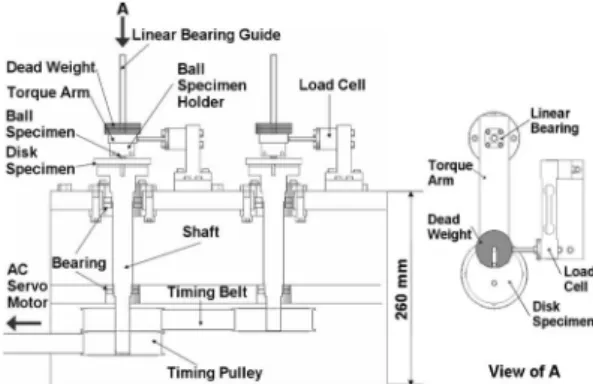
The friction characteristics of DLC and WC/C were investigated using a ball-on-disk type friction tester (shown in Fig. 1). The normal load was applied by dead weights, and the sliding velocity was exactly kept by AC servo motor. The tests were performed in an acrylic chamber to isolate the atmospheric environment.

Before tests, ball and disk specimens were cleaned ultrasonically in ethanol (C

2

H

5

OH) for about 1 hour.

Then, they were dried in a dry chamber for 1 hour.

After that, each specimen was attached to the speci- men holder. Before starting relative motion, the envi- ronmetal conditions were checked and the contact time between ball and disk specimens was exactly kept 3 minutes in stationary state. It was necessary to exclude the influence of contact time on the initial fric- tional behavior of DLC and WC/C. And each test was Fig. 1. Ball-on-disk type friction tester.

Table 1. Test conditions Friction surface 1

(Ball specimen) DLC(a-C:H)

, WC/C(a-C:H:W)

Friction surface 2

(Disk specimen) carburized SCM 415 Cr-Mo steel Sliding distance

[mm]

194.8

(1 rotation of disk specimen) Normal load

[N] 2.4 4.8 9.6

Contact pressure

[MPa] 354

★★

446

★★

562

★★

Sliding velocity [mm/s]

0.1, 0.78, 1.56, 3.13, 6.25, 12.5, 25, 50, 100 Air temperature

[

o

C] 16~24

Relative humidity

[%] 20~40

Lubricating

Condition Dry friction

°⁄

coated on AISI 52100 steel ball

°⁄ °⁄
initial mean Hertzian contact pressure between AISI

52100 steel ball and carburized SCM 415 Cr-Mo steel disk

(3)

conducted for 194.8 mm sliding distance (correspond- ing to 1 rotation of disk specimen). Under each test con- dition, friction force was measured for the whole test time, and then friction coefficient was obtained through dividing the friction force by normal load.

2-3. Test conditions

The tests were conducted in laboratory air (relative humidity: 20~40 %) at room temperature (air temper-

ature: 16~24

o

C) without any kinds of fluid lubricants.

To investigate the effects of sliding velocity and nor- mal load on friction characteristics of DLC and WC/C, various sliding velocities (0.1, 0.78, 1.56, 3.13, 6.25, 12.5, 25, 50 and 100 mm/s) were selected under nor- mal loads of 2.4, 4.8 and 9.6 N that correspond to the initial mean Hertzian contact pressures of 354, 446 and 562 MPa, respectively. The tests were repeated more than three times under the same test condition.

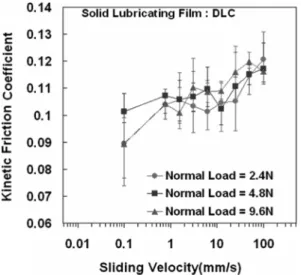
Fig. 2. Kinetic friction coefficients of DLC with variations of sliding velocity and normal load.

Fig. 3. Kinetic friction coefficients of WC/C with variations of sliding velocity and normal load.

Fig. 4. Friction surface of DLC (normal load=9.6 N, sliding velocity=100 mm/s).

Fig. 5. Friction surface of WC/C (normal load=9.6 N, sliding velocity=100 mm/s).

Fig. 6. Kinetic friction coefficients of DLC and WC/C

with variation of sliding velocity (normal load=2.4 N).

(4)

3. Result

3-1. Friction characteristics of DLC and WC/C

Figs. 2 and 3 show kinetic friction coefficients of DLC and WC/C in steady state region with variations of sliding velocity and normal load. In Figs. 2 and 3, circle, triangle and square mean the average value under the 2.4, 4.8 and 9.6 N normal load condition, respectively. And error bars represent the range of kinetic friction coefficients under each test condition.

Under the test conditions considered in this study, the kinetic friction coefficients of DLC and WC/C do not exceed 0.18. And the variation trends of DLC and WC/

C resemble each other. In Figs. 2 and 3, the kinetic fric- tion coefficients of DLC and WC/C vary irregularly within small range with variation of normal. It means

surfaces of DLC and WC/C slid against carburized SCM 415 Cr-Mo steel under a normal load of 9.6 N and a sliding velocity of 100 mm/s. Even though the test condition is most severe, there are no obvious wear scars on the friction surfaces of DLC and WC/C.

3-3. Comparison between kinetic friction coefficients of DLC and WC/C

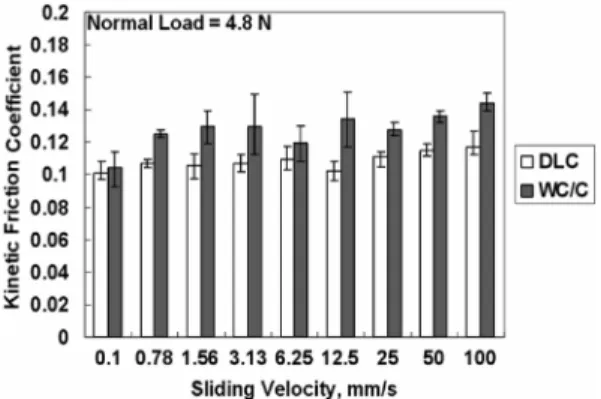
Figs. 6~8 show kinetic friction coefficients of DLC and WC/C in steady state region. In Figs. 6~8, rectan- gular bars mean the average value of kinetic friction coefficients under 2.4, 4.8 and 9.6 N normal load con- ditions. And error bars represent the range of kinetic friction coefficients under each test condition. The kinetic friction coefficients of DLC are lower than those of WC/C under most test conditions.

4. Discussion

4-1. Effects of normal load and sliding velocity on the kinetic friction coefficients of DLC and WC/C

Under the test conditions considered in this study, the kinetic friction coefficients of DLC and WC/C vary irregularly within small range with variation of normal load. It means that normal load does not affect the kinetic friction coefficients of DLC and WC/C.

And the kinetic friction coefficients generally increase with the increase in sliding velocity.

In this study, the relative motion between each solid lubricating film (DLC or WC/C) and carburized SCM 415 Cr-Mo steel was continued while the disk speci- men rotated 1 cycle. Hence, the friction characteristics of DLC and WC/C were not affected by the transfer layer formed on the mating surfaces. And the surface roughnesses of disk specimen, DLC and WC/C were 0.05~0.07 µm R

a

, 0.03 µm R

a

and 0.03 µm R

a

, respec- Fig. 7. Kinetic friction coefficients of DLC and WC/C

with variation of sliding velocity (normal load=4.8 N).

Fig. 8. Kinetic friction coefficients of DLC and WC/C

with variation of sliding velocity (normal load=9.6 N).

(5)

tively. Therefore, the friction force caused by abrasion and mechanical interlocking mechanical interlocking between surface asperities of ball and disk specimens was so small and could be negligible. In addition, there was no sufficient wear of DLC and WC/C under all test conditions. So the effect of wear particles on the friction characteristics of DLC and WC/C was also small. In accordance with these points of view, it is estimated that the friction characteristics of DLC and WC/C are strongly affected by the adhesion between surface asperities of ball and disk specimens. The fric- tion force caused by adhesion of surface asperities and friction coefficient can be represented by following equations (1) and (2) [1-3].

(1)

(2)

where, : average friction force generated by adhesion, : average shear stress at real contact area,

: real contact area, : friction coefficient, : resistance to plastic flow in compression

Therefore, the kinetic friction coefficients of DLC and WC/C are not affected by the variation of normal load.

The flash temperature at contact asperities increases with the increase in sliding velocity and normal load, but it decreases with the increase in real contact area.

Since the increase of normal load results in the increase of real contact area, the flash temperature is strongly affected by the variation of sliding velocity.

Therefore, it is understood that the variation of flash temperature due to the change of sliding velocity mainly affects the friction characteristics of DLC and WC/C. In general, the elasticity of contact asperities decreases with the increase in flash temperature. And, if the elasticity of contact asperities decreased, the real contact area would increase. On the other hand, the shear stress at the contact asperities decreases with the increase in flash temperature [1-3].

In accordance with these facts and test results, it is

estimated that the shear stress dose not significantly vary under all test conditions. So the increment of kinetic friction force due to the increase of real contact area is higher than the decrement of kinetic friction force owing to the decrease of shear stress at contact asperities. Therefore, the kinetic friction coefficients of DLC and WC/C increase with the increase in slid- ing velocity.

4-2. Difference between kinetic friction coefficients of DLC and WC/C

Under most test conditions considered in this study, the kinetic friction coefficients of DLC are lower than those of WC/C. Because of the low surface hardness due to doping of tungsten, the real contact area of WC/

C is wider than that of DLC under the same test con- dition. Therefore, the kinetic friction coefficients of WC/C is higher than those of DLC. And, the differ- ence in shear stress between DLC and WC/C is esti- mated as another reason.

5. Conclusion

The friction characteristics of DLC and WC/C were investigated by friction tests and the following conclu- sions are drawn.

(1) Under the test conditions considered in this study, the variation of normal load does not affect the kinetic friction coefficients of DLC and WC/C. On the other hand, the kinetic friction coefficients increase with the increase in sliding velocity.

(2) Under most test conditions, the kinetic friction coefficients of DLC are lower than those of WC/C.

Acknowledgment

This work was supported by the Brain Korea 21 Project in 2011.

References

1. Bhushan, B. Principles and Applications of Tribol- ogy. John Wiley and Sons, 1999.

F

A

= τA

R

µ F --- L

A

τA

R

pA

R

--- τ p ---

= = =

F

A

τ

A

R

µ

p

(6)

991-1003, 2004.

5. Liu, E., Blanpain, B., Shi, X., Celis, J. P., Tan, H. S., Tay, B. K., Cheah, L. K., and Roos, J. R. “Tribologi- cal Behavior of Different Diamond-like Carbon Materials,” Surface and Coating Technology, Vol.

106, pp.72-80, 1998.

6. Ronkainen, H., Varjus, S., Koskinen, J., and Holm- berg, K. “Differentiating the Tribological Perfor- mance of Hydrogenated and Hydrogen-free DLC Coatings,” Wear, Vol. 249, pp. 260-266, 2001.

7. Wanstrand, O., Larsson, M., and Hedenqvist, P.

“Mechanical and Tribological Evaluation of PVD WC/C coatings. Surface and Coatings Technology,”

Vol. 111, pp. 247-254, 1999.

8. Liu, Y., Gubisch, M., Hild, W., Scherge, M., Spiess, L., Knedlik, Ch., and Schaefer, J. A. “Nanoscale Multilayer WC/C Coatings Developed for Nanoposi- tioning, Part II : Friction and Wear,” Thin Solid Films, Vol. 488, pp. 140-148, 2005.

9. Ohana, T., Suzuki, M., Nakamura, T., Tanaka, A., and Koga, Y. “Tribological Properties of DLC Films Deposited on Steel Substrate with Various Surface Roughness,” Diamond and Related Materials, Vol.

13, pp. 2211-2215, 2004.

12. Tanaka, A., Suzuki, M. and Ohana, T. “Friction and Wear of Various DLC Films in Water and Air Envi- ronments,” Tribology Letter, Vol. 17, pp. 917-924, 2004.

13. Kim, H. I., Lince, J. R., Eryilmaz, O. L. and Erdemir, A. “Environmental Effects on the Friction of hydrogenated DLC Films,” Tribology Letter, Vol.

21, pp. 53-58, 2006.

14. Gao, F., Erdemir, A., and Tysoe, W. T. “The Tribo- logical Properties of Low-friction Hydrogenated Dia- mond-like Carbon Measured in Ultrahigh Vacuum,”

Tribology Letter, Vol. 20, pp. 221-226, 2005.

15. Li, H., Xu, T., Wang, C., Chen, J., Zhou, H. and Liu, H. “Tribochemical Effects on the Friction and Wear Behaviors of Diamond-like Carbon Film Under High Relative Humidity Condition,” Tribology Letter, Vol.

19, pp. 231-238, 2005.

16. Ronkainen, H., Varjus, S., Koskinen, J., and Holm- berg, K. “Differentiating the Tribological Perfor- mance of Hydrogenated and Hydrogen-free DLC coatings,” Wear, Vol. 249, pp. 260-266, 2001.

17. Jiaren, J and Arnell, J. D. “The Effect of Sliding Speed on Wear of Diamond-like Carbon Coatings,”

Wear, Vol. 218, pp. 555-560, 1999.

수치

Table 1. Test conditions Friction surface 1
Fig. 3. Kinetic friction coefficients of WC/C with variations of sliding velocity and normal load.
Fig. 8. Kinetic friction coefficients of DLC and WC/C with variation of sliding velocity (normal load=9.6 N).

참조

관련 문서

If the coefficients of static friction at the surfaces of contact are as shown, determine the smallest horizontal force P needed to move block A.. The beam AB has

The purpose of this study is to evaluate the effects of heat treatment on the load-deflection properties and transitional temperature range(TTR) of

In order to investigate the characteristics of Al/CFRP using friction spot joining, plunge depth, the rotation speed, and the dwell time were selected as parameters..

The second method is for compensation thermal expansion offering pre-load assembling that the temperature change by the repetitive movement and the friction

In this regard, this study analyzes the effect of the job characteristics and work environment of workers with physical disabilities on job satisfaction

This study has the purpose to investigate the applicability of different thickness aluminium alloys by friction stir welding to vehicle body and to

– Friction pile( 마찰말뚝 ): driven at a site where soil is not economical or rather possible to rest the bottom end of the pile on the hard stratum, Load is carried by

– Friction pile( 마찰말뚝 ): driven at a site where soil is not economical or rather possible to rest the bottom end of the pile on the hard stratum, Load is carried by