1. INTRODUCTION
Indonesia has a very large oil palm tree (Elaeis guineensis) plantation, which has reached
more than 8 million ha and spread across 22 provinces (Ministry of Agriculture Republic of Indonesia, 2012). Because of the large area of this plantation, it is creating a significant ABSTRACT
Densification of the inner part of oil palm trunk (OPT) by the close system compression (CSC) method was performed in this study. The effects of the compression temperature and time on the anatomical, physical and mechanical properties of OPT were evaluated. The inner part of OPT with an initial average density of 0.3 g/cm
3was used as samples. Oven-dried samples were immersed in water and vacuumed until fully saturated and then compressed by CSC at 120, 140, 160 or 180 ℃ for 10, 20, 30 or 40 min. The anatomical characteristics of transverse and radial sections before and after compression were compared by optical microscopy. The phys- ical and mechanical properties, including the density, recovery of set (RS), modulus of elasticity (MOE), mod- ulus of rupture (MOR), and compression parallel to grain were examined. It was observed that the anatomical characteristic of the inner part of OPT (i.e., vascular bundles, vessels, and parenchyma tissue) became flattened, fractured, and collapsed after compression by CSC. The RS decreased with increasing compression temperature and time. The lower RS indicated high dimensional stability. The physical and mechanical properties (i.e., den- sity, MOR, MOE, and compressive strength) of the inner part of OPT increased with increasing compression temperature and time. Compression by the CSC method at 160 ℃ for 40 min was the optimum treatment.
Keywords : close system compression, compressed wood, oil palm trunk, physical and mechanical properties, recovery of set
1
Date Received December 28, 2015, Date Accepted January 20, 2016
2
Forestry Department, Faculty of Agriculture, University of Sumatera Utara, Indonesia
3Department of Forest Products, Faculty of Forestry, Bogor Agricultural University, Indonesia
4Research Center for Biomaterials, Indonesian Institute of Sciences, Indonesia
5
Department of Forestry, Faculty of Agriculture, Lampung University, Indonesia
6
Department of Forest Biomaterials Engineering, College of Forest and Environmental Science, Kangwon National University, Republic of Korea
7
The Institute of Forest Science, Kangwon National University, Republic of Korea
†
Corresponding author: Nam-Hun Kim (e-mail: [email protected])
†
Corresponding author: Fauzi Febrianto (e-mail: [email protected])
amount of biomass that can be converted into value-added product to provide alternative raw material for the wood industry. When replanted, the oil palm plantation can produce 50.1 m
3/ha of sawn timber from the hard outer part of the trunk, which is generally only one-third of the entire trunk. In contrast, the soft inner two-thirds of the trunk generally becomes waste owing to several weaknesses such as high mois- ture content, high shrinkage-swelling, low strength, low durability, and low machining properties (Febrianto and Bakar, 2004). Bakar (2003) reported that the soft inner part of the oil palm trunk (OPT) has a high moisture content of 345%-500%, which causes low dimension stability of the trunk. Therefore, an effort to im- prove the properties of the inner part of the OPT is urgently needed.
A compression method could be applied to improve the physical and mechanical properties of OPT. Under compression, the density of wood is increased by densification of the pores of the cell structure. Numerous experimental studies of compression of wood from various species have been reported (Kawai et al., 1992;
Inoue et al., 1993a; Dwianto et al., 1998a, 1998b; Higashihara et al., 2000; Navi and Heger, 2004; Kamke, 2006; Kutnar and Kamke, 2012; Ratnasingam and Ioras, 2013; Cho et al., 2015). Amin et al. (2004) revealed that a com- pression method significantly increased the physical and mechanical properties of Indonesian tropical woods such as Afrika wood (Maesopsis eminii), angsana (Pterocarpus in- dicus), jengkol (Pithecellobium jiringa), mango
(Mangifera spp.), mindi (Melia azedarach L.), and randu (Bombax ceiba L.).
Recently, compression of non-wood species such as coconut oil wood and OPT have been developed (Wardhani, 2005; Salim et al., 2013;
Nordin et al., 2013). However the major prob- lem of compressed wood is recovery of set, which mean after compression, wood will re- cover to its initial thickness if it is exposed to moisture because of release of its internal stresses. Dwianto et al. (1998c) reported that when a compressed wet wood specimen is dried under restraint, the stress gradually decreases until it disappears, and the material is fixed in the deformed state. Dwianto et al. (1998c, 1998d, 1999) have studied the mechanism of permanent fixation of compressive deformation in wood. Inoue et al. (1993b) developed a com- pression method to improve permanent fixation of compressive deformation in a short time by hygrothermal treatment using moisture in wood, which is called the close system compression (CSC) method. This method resulted in a good fixation of randu (Bombax ceiba) wood (Amin and Dwianto, 2006). Therefore, the objective of this research was to analyze the physical, me- chanical, and anatomical properties of OPT compressed by the CSC method.
2. MATERIALS and METHODS 2.1. Materials
OPT approximately 40 years in age with a
diameter of 40 cm was obtained from Bogor,
Indonesia. Samples were prepared from the in- ner part of the OPT and cut into pieces 150 mm × 50 mm × 20 mm in length, width, and thickness, respectively. The samples were dried at 60 ℃ until they reached a constant weight, and then the weight and dimensions were measured to determine their initial density. The average density of the samples after drying was 0.3 g/cm
3.
2.2. Methods
2.2.1. Compression process
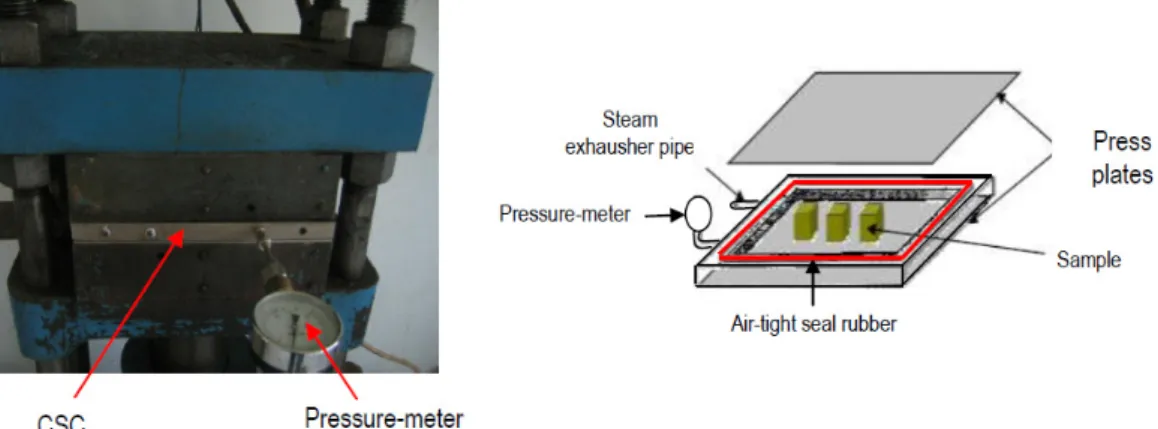
The OPT samples were compressed by a hot press machine equipped with CSC parts, as shown in Fig. 1. The CSC equipment consisted of a rectangular stainless steel frame, upper and lower press plates, a high-temperature-resistant airtight silicone rubber seal, a pressure meter, and a steam exhaust pipe. The CSC frame and hot press plates had the same size, 250 mm × 250 mm. The CSC frame was equipped with silicone rubber on its upper and lower parts to
seal it perfectly when pressing was applied.
One side of the frame had two holes for pres- sure measurement and a steam exhaust pipe to release the vapor when the compression process finished.
The CSC frame was placed in the lower part of the pressing plate so that the frame was lo- cated between the upper and lower parts of the pressing plates. After OPT samples were placed inside the frame, a cylindrical hydraulic piston pushed up the lower part of the pressing plate, and the compression process began. Samples were compressed to a compression ratio of 50%
at 120, 140, 160, or 180 ℃ for 10, 20, 30, or 40 min, with four replications under each condition. The final size of the samples after compression was 150 mm × 50 mm × 10 mm in length, width, and thickness, respectively.
The samples were conditioned under a relative humidity of 70 ± 5% at 25 ± 2 ℃ for 2 weeks before further testing.
Fig. 1. Hot-press machine (left) equipped with CSC equipment (right).
2.2.2. Anatomical observation
The anatomical structure observed in trans- verse and radial sections of OPT was analyzed.
Slices 30 µm in thickness were obtained using a sliding microtome. The sections were stained with Safranin-Astra blue, dehydrated in a grad- ed series of alcohol solutions (50%, 70%, 90%, 95%, and 99%), mounted in Canada balsam, and observed with an optical microscope (Nikon Eclipse E600, Japan).
2.2.3. Physical properties
The air-dry density of samples with di- mensions of 40 mm × 20 mm × 20 mm was determined in accordance with British Standard 373 (1957) by measuring their air-dry weight (m) and volume (v). The air-dry density was calculated as follows:
The fixation value was obtained from a re- covery test of samples with dimensions of 30 mm × 20 mm × 10 mm. The recovery test was performed by soaking the samples in room-temperature water for 24 h and then in hot water (100 ℃) for 30 min (Dwianto et al., 1997). The recovery of set (RS) was calculated as follows:
where T
ois the initial thickness, T
cis the thick- ness after compression, and T
ris the thickness after recovery. All the dimensions of the sam-
ples were measured in the oven-dry condition.
2.2.4. Mechanical properties
Modulus of rupture (MOR), modulus of elasticity (MOE), and compressive strength tests were conducted in accordance with British Standard 373 (1957) using a universal testing machine (Model 4482, Instron, Norwood, MA, USA). The sample dimensions for the MOR and MOE tests were 150 mm × 10 mm × 10 mm. Three-point bending was applied over an effective span of 100 mm at a loading speed of 5 mm/min. The dimensions of the samples for the compressive strength test were 40 mm
× 10 mm × 10 mm. The MOR, MOE, and compressive strength (R) were calculated as follows:
where P is the maximum load (N), P
pis the load at the proportional limit (N), Y
pis the de- flection (mm), L is the span length (mm), w is the sample width (mm), and t is the sample thickness (mm).
To determine the effect of the compression
temperature and time on the properties of OPT,
the data were compared with those of a
control. All runs were performed with four
replications.
3. RESULTS and DISCUSSION 3.1. Visual appearance
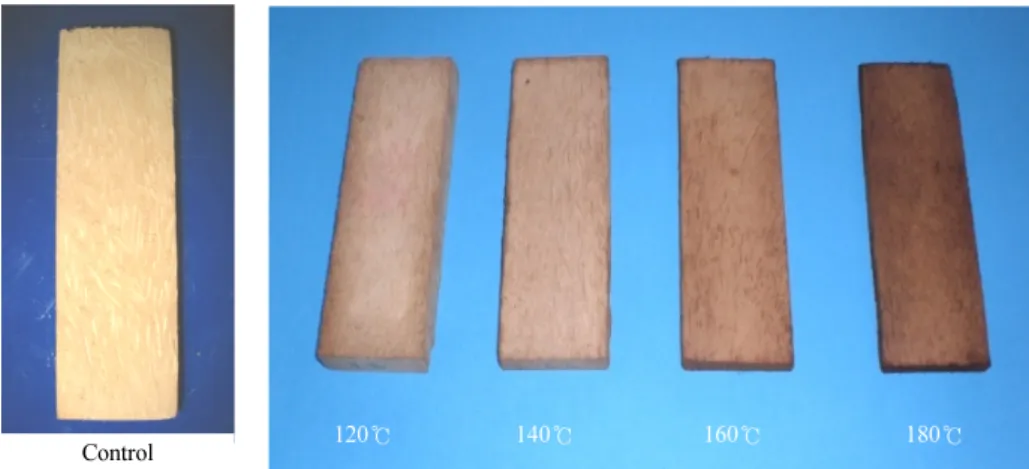
Compression of OPT by the CSC method at temperatures of 120-180 ℃ caused darkening of the wood surface color. Fig. 2 shows that the surface of OPT became darker with increasing heating temperature. OPT compressed at 180 ℃ showed the darkest color among the samples.
Hayashi et al. (2002) stated that wood heat treatment at 180 ℃ degraded the lignin, which darkened the wood color. Shi et al. (2011) reported that heat treatment had a darkening effect on wood tissue, and the color became darker with increasing temperature. The color change is attributed to oxidation of phenolic compounds, the presence of reduced sugars and amino acids, emanation of formaldehydes, formation of quinines, or caramelization of holocellulose components during heat treatment (Sundqvist, 2002; Sandoval-Torres et al., 2010;
Hidayat et al., 2015).
3.2. Anatomical properties
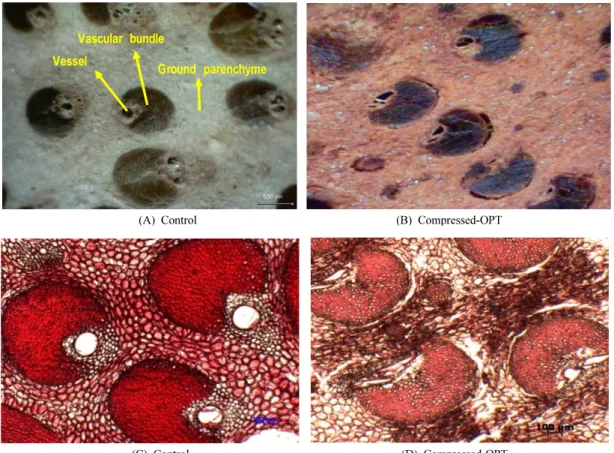
Fig. 3 and 4 show the anatomical character- istics of OPT before and after compression by the CSC method. The vascular bundles, vessels, and ground parenchyma tissue of OPT before compression were round and intact, whereas after compression they showed flattened shapes.
Moreover, vessels and parenchyma cells were severely fractured and collapsed after compression.
3.3. Physical properties
The average density and RS of OPT after compression by the CSC method are shown in Fig. 5. The compression temperature and time used in the CSC method contributed to the changes in the density and RS. Overall, the re- sults showed that compression by the CSC method increased the density of OPT, which in- creased its dimensional stability. The density af- ter compression by the CSC method increased
120 ℃ 140 ℃ 160 ℃ 180 ℃
Control
Fig. 2. Visual appearance of OPT before and after compression by CSC method.
Ground parenchyme Vessel
Vascular bundle
(A) Control (B) Compressed-OPT
(C) Control (D) Compressed-OPT
Fig. 3. Optical micrographs of OPT in cross section: (A) control, (B) compressed OPT at 30× magnification, (C) control, (D) compressed OPT at 50× magnification.
Vascular bundles
vessel
(A) Control (B) Compressed-OPT
Fig. 4. Optimal micrographs of OPT in radial section: (A) control and (B) compressed OPT at 50× magnification.
with decreasing RS. The decrease in the RS contributed to the reduction of the OPT thick- ness and consequently reduced the overall vol- ume of the sample, whereas its mass was rela- tively stable. The results showed that the den- sity of OPT after compression by the CSC method increased from 0.30 g/cm
3to 0.31-0.57 g/cm
3, or by 3.33%-90%. The highest density was achieved after compression at 180 ℃ for 40 min.
The results were consistent with those of pre- vious studies reported by Sulistyono (2001) and Kutnar and Kamke (2012). Compression of Agathis loranthifolia at a compression ratio of 50% increased the density from 0.43-0.46 g/cm
3to 0.70-0.85 g/cm
3in the radial direction and to 0.69-0.84 g/cm
3in the tangential direction (Sulistyono, 2001). Kutnar and Kamke (2012) reported that the density of hybrid poplar (Populus deltoides × Populus trichocarpa) in-
creased linearly with increasing temperature af- ter compression under a load of 5.5 MPa, reaching a density increase of 98%-208%.
The RS decreased with increasing com- pression temperature and time. A lower RS in- dicates higher dimensional stability of com- pressed OPT. The RS after compression at 120 ℃ for 10 min was 92%; it decreased to 1.74%
after compression at 180 ℃ for 30 min. The RS after compression at 120 and 140 ℃ decreased gradually with increasing compression time.
However, the RS after compression at 160 ℃ showed a dramatic decrease with increasing time. The lowest RS, which indicated reduction of the thickness of compressed OPT, was -3.75%. The value was achieved after com- pression at 180 ℃ for 40 min.
The results show that almost complete fix-
ation of set (an RS value of close to 0%) was
achieved after compression at 180 ℃ for 30
Fig. 5. Recovery of set (RS) and density after compression by CSC method.
min, with an RS value of 1.74%. Compression by the CSC method achieved faster fixation than a heat treatment method reported in pre- vious studies (Inoue and Norimoto, 1991;
Norimoto et al., 1993). Compression of sugi (Cryptomeria japonica D. Don) achieved fix- ation after heat treatment at 180 ℃ for 20 h, 200 ℃ for 5 h, and 220℃ for 3 h (Inoue and Norimoto, 1991). Norimoto et al. (1993) stud- ied bending deformation in mizunara (Quercus mongolica) and revealed that almost complete fixation of set was achieved by heat treatment above 30 h at 160 ℃ and 12 h at 180℃. Inoue et al. (2008) stated that three mechanisms are essential to obtain permanent fixation: 1) pre- vention of re-softening of wood by conversion
of its components to less water-accessible com- ponents, as the set does not recover unless re-softening of the matrix occurs, 2) formation of covalent cross-links between the wood com- ponents in the deformed state, and 3) release of the elastic stresses and strains stored in the mi- crofibrils and matrix.
3.4. Mechanical properties
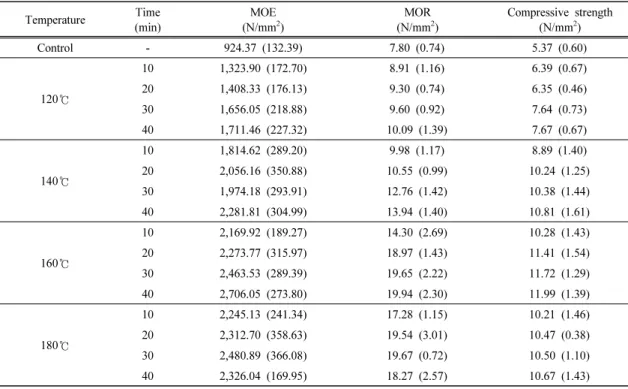
The MOE, MOR, and compression parallel to grain of OPT after compression by the CSC method are shown in Table 1. The compression temperature significantly affected MOE, MOR, and compression parallel to grain. Statistical analyses revealed that the compression time sig-
Temperature Time
(min)
MOE (N/mm
2)
MOR (N/mm
2)
Compressive strength (N/mm
2)
Control - 924.37 (132.39) 7.80 (0.74) 5.37 (0.60)
120 ℃
10 1,323.90 (172.70) 8.91 (1.16) 6.39 (0.67)
20 1,408.33 (176.13) 9.30 (0.74) 6.35 (0.46)
30 1,656.05 (218.88) 9.60 (0.92) 7.64 (0.73)
40 1,711.46 (227.32) 10.09 (1.39) 7.67 (0.67)
140 ℃
10 1,814.62 (289.20) 9.98 (1.17) 8.89 (1.40)
20 2,056.16 (350.88) 10.55 (0.99) 10.24 (1.25)
30 1,974.18 (293.91) 12.76 (1.42) 10.38 (1.44)
40 2,281.81 (304.99) 13.94 (1.40) 10.81 (1.61)
160 ℃
10 2,169.92 (189.27) 14.30 (2.69) 10.28 (1.43)
20 2,273.77 (315.97) 18.97 (1.43) 11.41 (1.54)
30 2,463.53 (289.39) 19.65 (2.22) 11.72 (1.29)
40 2,706.05 (273.80) 19.94 (2.30) 11.99 (1.39)
180 ℃
10 2,245.13 (241.34) 17.28 (1.15) 10.21 (1.46)
20 2,312.70 (358.63) 19.54 (3.01) 10.47 (0.38)
30 2,480.89 (366.08) 19.67 (0.72) 10.50 (1.10)
40 2,326.04 (169.95) 18.27 (2.57) 10.67 (1.43)
Note: Numbers in parentheses are standard deviations.