작약 연작재배지의 토양 이화학성 및 미생물 분포특성
박준홍·서영진·최성용·장용선1·하상건1·김장억2*
경상북도농업기술원, 1국립농업과학원, 2경북대학교 농업생명과학대학 응용생명과학부
Soil Physico-Chemical Properties and Characteristics of Microbial Distribution in the Continuous Cropped Field with Paeonia lactiflora
Jun-Hong Park*, Yeong-Jin Seo, Seong-Yong Choi, Yong-Sun Zhang1, Sang-Keun Ha1, and Jang-Eok Kim2*
Institute of Gyeongsangbukdo Agricultural Research and Extention Services, Daegu, 702-708, Korea
1National Institute of Agricultural Science and Technology, RDA, Suwon, 441-707, Korea
2College of Agriculture and Life Science, Kyungpook National University, Daegu, 702-701, Korea
This study was conducted to obtain the information about injury caused by continuous cropping of peony (Paeonia lactiflora). Soil physico-chemical properties, characteristics of microbial distribution and diversities in the continuous cropped field with peony were analyzed. As the results, pH and organic matter content were higher in the continuous cropping soil than those in the first cropping soil. Bulk density was decreased but porosity was increased in the continuous cropping soil. As the cultivation period was lengthened in years, the populations of bacteria and actinomyces were gradually decreased, whereas fungal population was increased.
It was shown that the metabolic diversity patterns of the microbial communities in the continuous cropping soil differed from that of the first cropping soil. These results indicate that deterioration of soil quality such as physico-chemical properties including a soil depth, bulk density, porosity and soil pH is related with a continuous cultivation periods, and also affect a microbial population, especially fungi.
Key words: Peony, Continuous Cropping, Soil physico-chemical properties, Microbial population
접수 : 2011. 9. 5 수리 : 2011. 10. 14
*연락저자 : Phone: +82539505720 E-mail: [email protected]
서 언
작약 (Paeonia lactiflora Pallas)은 미나리아재비과 (Ranunculaceae)에 속하는 다년생 숙근초본으로 중국, 한 국, 일본 등 동양에서는 주로 뿌리를 약재로 이용하고 있 으며 미국과 유럽 등 서양에서는 다양한 색깔과 아름다운 꽃 때문에 화훼로 재배하고 있다 (Bae et al., 2008; Choi, 1994). 작약 뿌리의 주요 약효성분은 paeoniflorin, albiflorin, benzoylpaeoniflorin, oxypaeoniflorin 등이며, 약리작용으로 는 활혈, 진통, 진경, 해혈, 혈압강하 등에 효과가 있는 것 으로 보고되어 있다 (Choung et al., 1999; Park et al., 1988).
우리나라의 작약 재배면적이 1990년 882 ha에서, 2007년 은 162 ha으로 급격히 감소하였지만 (MFAFF, 2008), 최근 들어 약재용뿐만 아니라 절화용으로 이용이 확대되어 전국 적으로 재배면적이 증가하고 있는 실정이다.
작약은 토심이 깊고 부식질이 많은 비옥한 사양토의 배 수가 잘되는 토질을 좋아하고 재배기술이 까다로워 재배 적지인 의성, 영천 등의 주산지에서만 주로 재배되면서 동 일지역에서 연작을 많이 하여 왔다. 일반적으로 작물의 연 작장해의 원인으로는 토양 양분소모, 토양병원균 밀도 증 가 및 토양 물리성의 악화 등이 보고되어 있다 (Banyer, 1966; Blakley, 1966; Gribel and Owens, 1972). 작약은 재식 후 3-4년이 경과되어 수확하기 때문에 흰가루병, 점무 늬병 등의 병 발생이 많은 것으로 보고되어 있다 (Choo et al., 1995; Park et al., 1996). 특히 뿌리썩음병 (Cylindrocarpon destructans)은 작약의 지제부와 뿌리를 감염시켜 심할 경 우 고사에 이르게 하며, 연작지에서 발생이 증가한다는 보고 (Choi, 2004) 이외에는 작약 연작장해와 관련된 연구는 거 의 없는 실정이다.
따라서 본 연구는 작약 연작재배지의 토양 이화학성과 미생물상의 변화를 파악하여 연작장해의 경감대책을 마련 하기 위한 기초 자료를 얻고자 수행하였다.
Table 1. Physical properties of soils by cultivation years of peony.
Cultivation years Depth of Top soil Hardness Bulk density Porosity
Top soil Subsoil Top soil Subsoil Top soil Subsoil cm --- mm --- --- g cm-3 --- --- % ---
First cropping 2 year 16a† 15.0a 18.0b 1.20b 1.31b 54.7a 50.6a
First cropping 4 year 10b 15.4a 21.4a 1.29b 1.51a 51.3a 43.0b
Continuous cropping 4 year 8b 17.1a 24.5a 1.46a 1.50a 44.9b 43.4b
†Means by the same letter within a column are not significantly different at 0.05 probability level according to Duncan’s multiple range test.
재료 및 방법
토양 이화학성 작약 연작재배지의 토양 이화학성은 경상북도 농업기술원 신물질연구소의 작약 시험포장에서 작약 생육이 양호하고 뿌리썩음병 발생이 거의 없는 초작 2년 토양, 뿌리썩음병이 약하게 감염된 초작 4년생, 연작 4년 토양, 뿌리썩음병이 심하게 감염된 연작 4년 토양으로 구분하여 5월 중순에 조사하였다. 토양 물리성은 100 cm3 core를 이용하여 토양의 표토와 심토부위에서 3반복으로 채취하였다. 표토깊이, 용적밀도, 공극율을 조사하였으며, 경도는 Yamanaka 토양경도계를 이용하여 조사하였다.
토양 화학성은 표토부분의 시료를 채취하여 음건 후 토 양화학분석법 (NIAST, 1988)에 따라 pH와 전기전도도는 초 자전극법, 유기물함량은 Tyurin법, 유효인산함량은 Lancaster 법, 그리고 치환성 양이온함량은 1N-ammonium acetate (pH 7.0) 용액으로 침출하여 원자흡광분석기 (AA Analyst 800, Perkin Elmer)로 분석하였고, NH4-N및 NO3-N 함량 은 2M KCl 용액으로 추출후 켈달증류장치를 이용하여 측 정하였다.
토양 미생물 밀도와 미생물군락의 다양성 작약 재 배토양의 미생물의 밀도와 미생물 군락의 생리적 다양성 변화는 경상북도 농업기술원 신물질연구소의 작약 시험포 장에서 5월 중순에 재배 연수별로 조사하였다. 작약 초작 지 1년, 2년, 3년, 4년, 5년 재배포장과, 연작지 4년 재배 포장에서 각각 지그재그로 10지점을 선정하여 작약 뿌리 부근의 표토로부터 10 cm 내의 작토층에서 토양시료를 채 취, 혼합하여 1 L 정도의 비닐봉지에 넣고 4℃ 냉장고에 보관하였다.
미생물밀도는 Stukus의 방법 (1997)에 따라 토양시료 10 g을 0.01 M Tris buffer solution (pH 7.2)에 넣어 진탕 한 후 희석액을 토양 세균은 TSA (tryptic soy agar, tryptone 1.5%, soytone 0.5%, sodium chloride 0.5%, agar 1.5%) 배지, 방선균은 GYA (glycerol yeast extract agar, glycerol 0.5%, yeast extract 0.2% K2HPO4 0.1%, agar 1.5%)배지, 곰팡이는 SDA (sabouraud dextrose agar, peptone 1%,
dextrose 4%, agar 1.5%)배지에 접종하여 25℃ 인큐베이 터에 배양하였으며, 세균은 3일후, 사상균과 방선균은 7일 후 colony를 조사하였다.
작약 재배토양의 미생물 군락의 생리적 다양성 변화는 31개의 각기 다른 탄소화합물을 가진 Biolog EcoplateTM (BiologInc. Hayward, CA)를 이용하여 토양 세균의 탄소 기질 (carbon substrates)의 이용 패턴을 작약 재배 연수 별로 조사하였다 (Park et al., 2008). 보관된 토양시료 5 g을 0.85% NaCl 용액 95 mL에 넣고 200 rpm rotary shaker로 15분간 교반시킨 후 Biolog Ecoplate에 각 well 에 125 μL씩 분주시켜 22℃ 항온기에 72시간 배양한 후 Biolog reader로 570 nm에서 흡광도를 측정하였다. 측정 된 흡광도를 토양미생물 군락의 각 탄소기질 이용 정도를 나타내는 결과로 사용하였다. Biolog data는 SAS 9.1 (SAS Institute Inc., USA)를 이용하여 주성분 분석 (principal component analysis)을 하였다.
결과 및 고찰
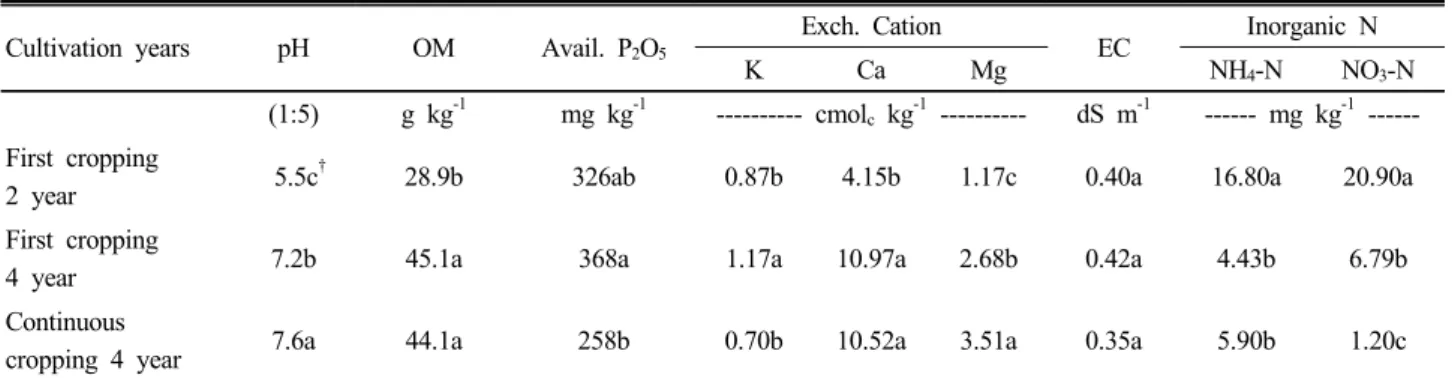
토양 이화학성 작약 초작지와 연작지로 구분하여 토 양 물리성을 조사한 결과 (Table 1), 초작 2년생 토양은 표토깊이가 16 cm, 초작 4년생 토양은 10 cm, 연작 4년생 토양은 8 cm로 재배지 토양에 따라 큰 차이를 나타내었다.
경도에서는 초작 2년생 토양은 표토 15.0 mm, 심토 18.0 mm, 초작 4년생 토양은 표토 15.4 mm, 심토 21.4 mm, 연 작 4년생 토양은 표토 17.1 mm, 심토 24.5 mm로 나타났다.
용적밀도에서도 초작 2년생 토양은 표토가 1.20 g cm-3, 심 토는 1.31 g cm-3로 차이가 적었지만 초작 4년생 토양은 표 토가 1.29 g cm-3로 용적밀도가 낮았지만 심토는 1.51 g cm-3 로 높았다. 연작 4년생 토양은 표토 1.46 g cm-3, 심토 1.50 g cm-3으로 용적밀도가 높았다. 공극률에서도 초작 2년생 토양은 표토 54.7%, 심토 50.6%인데 비해 연작 4년 생 토양은 표토 44.9%, 심토 43.4%이었다.
작약 재배지 토양별 토양화학성을 측정한 결과 (Table 2), 초작 2년생 토양은 pH 5.5이었으나, 연작 4년은 pH 7.6
Table 2. Chemical properties of soil by cultivation years of peony.
Cultivation years pH OM Avail. P2O5
Exch. Cation
EC Inorganic N
K Ca Mg NH4-N NO3-N
(1:5) g kg-1 mg kg-1 --- cmolc kg-1 --- dS m-1 --- mg kg-1 --- First cropping
2 year 5.5c† 28.9b 326ab 0.87b 4.15b 1.17c 0.40a 16.80a 20.90a
First cropping
4 year 7.2b 45.1a 368a 1.17a 10.97a 2.68b 0.42a 4.43b 6.79b
Continuous
cropping 4 year 7.6a 44.1a 258b 0.70b 10.52a 3.51a 0.35a 5.90b 1.20c
†Means by the same letter within a column are not significantly different at 0.05 probability level according to Duncan’s multiple range test.
Fig. 1. Changes of microflora in peony cultivated soil at different cultivation year.
으로 크게 증가하였다. 유기물함량은 초작 2년생 토양은 28.9 g kg-1인데 비해 초작 4년생 토양은 45.1 g kg-1, 연 작 4년생 토양은 44.1 g kg-1로 많았다. 질산태질소 함량 은 초작 2년생 토양이 20.9 mg kg-1이었으나, 초작 4년과 연작 4년생 토양은 각각 6.79, 1.20 mg kg-1으로 낮았다.
Kim et al. (2007)은 관수나 강우 등을 통한 토양에 수분 공급 시 pH가 7.5 이상일 경우에 암모니아 가스로 인한 질 소흡수 장애 및 가스피해가 나타난다고 보고하였는데, 연 작 4년생 토양의 pH가 7.6, 유기물함량이 44.1 g kg-1로 높고 표토깊이가 얕고 표토와 심토의 경도차이가 심하여 수직배수가 불량함에 따라 암모니아가스에 의한 피해 가
능성이 매우 높을 것으로 추측되었다.
토양 미생물 밀도와 미생물군락의 다양성 작약 재 배연수에 따른 토양 미생물상의 변화는 초작지 3년차 재 배까지는 토양세균수가 증가하다가 4년차 재배부터 감소 하였으며, 연작지 4년차 재배는 매우 적었고, 토양 방선균 도 토양세균과 유사한 경향이었으나 토양 사상균수는 재 배연수가 증가할수록 증가하는 경향이었다 (Fig. 1). Ryu et al. (1992)은 땅콩 주산단지의 토양미생물 밀도는 연작 할수록 사상균수가 높았고 사상균수 (F)에 대한 세균 (B) 의 비 (B/F비)는 연작할수록 낮아진다고 보고하였고, Choi
Table 3. Carbon substrates with high loading values in the principal component analysis of Biolog EcoPlate in distinguishing the microbial communities of the soils by cultivated years in peony.
Carbon source PC1† PC2 PC3
β-Methyl-D-glucoside 0.28 0.70 -0.06
D-Galacturonic acid ϒ-lactone 0.16 0.02 -0.09
L-Arginine 0.12 0.20 0.01
Pyruvic methyl ester 0.07 -0.16 0.16
D-Xylose 0.23 0.07 -0.15
D-Galacturonic acid 0.02 0.21 0.02
L-Asparagine 0.01 0.07 0.10
Tween 40 -0.01 0.06 -0.02
i-Erythritol 0.14 0.10 0.12
2-Hydroxy benzoic acid -0.14 0.06 0.10
L-Phenylalanine 0.08 0.00 0.03
Tween 80 0.04 0.09 -0.03
D-Mannitol 0.11 -0.09 0.08
4-Hydroxy benzoic acid 0.10 0.08 0.14
L-Serine 0.07 -0.04 0.17
α-Cyclodextrin 0.12 -0.04 0.13
N-Acetyl-d-glucosamine 0.10 0.24 -0.07
ϒ-Hydroxybutyric acid 0.23 -0.18 0.15
L-Threonine 0.02 0.03 -0.04
Glycogen 0.06 -0.01 0.08
D-Glucosaminic acid 0.11 -0.13 0.15
Itaconic acid 0.28 -0.08 0.37
Glcyl-L-glutamic acid -0.03 0.07 -0.03
D-Cellobiose 0.61 -0.41 -0.42
Glucose-1-phosphate 0.14 -0.08 0.34
α-Ketobutyric acid 0.02 0.01 0.01
Phenylethyl amine 0.20 0.11 0.48
α-D-Lactose 0.37 0.16 -0.06
D, L-α-Glycerol phosphate 0.03 0.05 -0.06
D-Malic acid -0.05 -0.09 0.31
Putrescine 0.04 -0.04 -0.04
Eigen value 1.38 0.67 0.54
Cumulative (%) 30.7 45.5 57.5
†Principal component.
et al. (2004)은 작약 초작지에 비해 연작지에서 사상균인 뿌리썩음병 (Cylindrocarpon destructans)의 발병율이 크게 증가한다고 보고하였는데, 작약을 연작 재배함으로써 미생 물상이 단순화되어 길항적인 미생물 종류는 감소하고 종속 영양생물인 사상균이 증가함에 따라 연작장해를 일으키는 요인이 될 것으로 생각되었다.
Biolog Microplate는 1991년에 처음 이용하기 시작하여 지금은 빠르고 간편하게 배양이 가능한 세균의 기능적 다 양성을 조사하는 토양 미생물 분석법이 되었다 (Garland and Mills, 1991). 서로 다른 31개의 탄소원을 가진 Biolog Ecoplate (Biolog Inc. Hayward, CA)는 토양 미생물 군락 의 생리적 다양성 차이 즉, 토양 미생물 군락의 탄소기질 이용성 (carbon substrates utilization pattern) 차이를 보
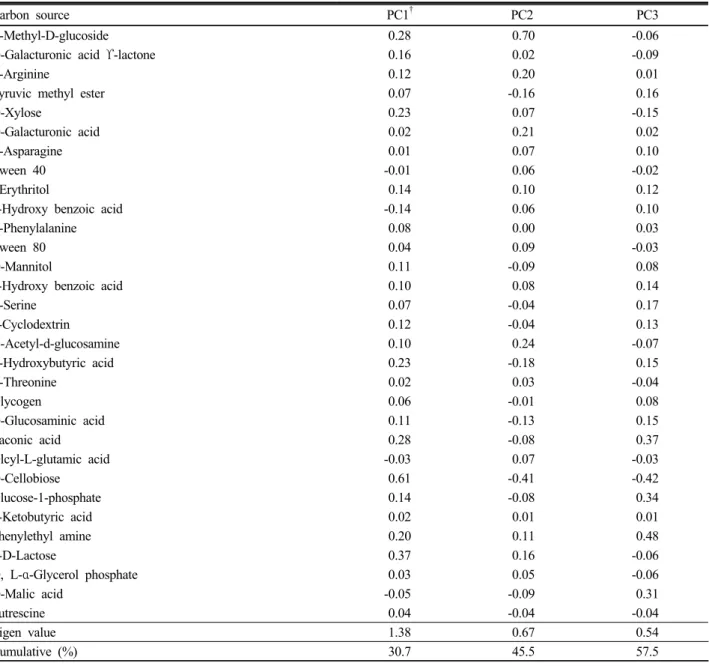
여준다 (Bradley et al., 2006; Gomez et al., 2006; Park et al., 2008). 작약 재배연수에 따른 토양 미생물 군락의 생리적 다양성 변화를 조사하기 위하여 Biolog Ecoplate에 토양 희석액을 접종하여 72시간 배양 후 얻은 각각의 탄 소원별 흡광도 값을 주성분 통계분석한 결과는 Table 3과 Fig. 2와 같다.
작약 재배연수별 토양 세균의 탄소기질 반응에 대한 값 의 표본분산 공분산 행렬로 주성분을 도출한 결과 제 3주 성분까지 57.5%의 정보를 해석할 수 있었으며, 제 1주성 분에 영향을 많이 미치는 탄소 화합물은 D-cellobiose, α- D-lactose, itaconic acid, β-methyl-D-glucoside 등이 고, 제 2 주성분에 영향이 큰 탄소화합물은 β-methyl-D- glucoside, D-cellobiose 등이고, 제 3 주성분에 영향이 큰 탄
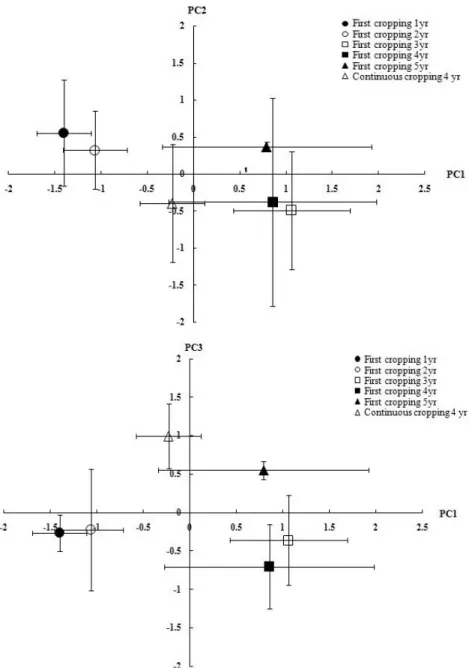
Fig. 2. Principal component analysis of substrate utilization pattern by Biolog EcoPlate in soils by cultivated years in peony. Error bars indicate standard deviation.
소화합물은 phenylethyl amine, D-cellobiose, itaconic acid 등이었다 (Table 3). 제 1 주성분에 영향을 크게 미치는 D- cellobiose, α-D-lactose, itaconic acid, β-methyl-D-glucoside 등이기 때문에 이들 탄소화합물이 작약 1, 2년차 재배지와 다른 재배지를 구분 짓는 화합물이라고 할 수 있다. 그리 고 연작지를 초작지와 구분 짓는 탄소화합물은 전술한 탄 소화합물 이외에도 제 3 주성분에 영향이 큰 itaconic acid, phenylethyl amine, D-cellobiose 등이라고 할 수 있다.
X축을 제 1주성분, Y축을 제 2주성분 혹은 제 3주성분 으로 놓고 작약 재배연수별 토양세균의 탄소기질 반응값 에 대한 주성분 score를 각각 X, Y 좌표 상에 배치하였다 (Fig. 2). 제 1주성분에서는 초작지 1, 2년차 재배와 다른 작약 재배지와는 확연히 구분되었고, 초작지 1, 2년차 간
그리고 초작지 3, 4, 5년차 간에는 차이가 없었다. 그리고 연작지 4년차는 초작지 3, 4년차와는 구분되지 않았지만 초작지 1, 2년차 및 5년차와는 확연히 구분되었는데, 그 구분의 방향이 서로 반대 방향이었다. 제 2주성분에 대하 여서는 차이가 없었지만, 제 3 주성분에 대하여서는 연작 지 4년차는 초작지 5년차를 제외한 모든 재배지와 구분되 었고, 초작지 5년차는 초작지 1, 2, 3, 4년차와 구분되었 다. 따라서 작약 재배연수가 토양 미생물 군락의 기능적 다양성에 영향을 미치고 작약 재배지 토양 미생물 군락의 기질 이용성은 재배 1, 2년차 까지는 크게 바뀌지 않다가 3년차부터 크게 바뀌고 연작지는 초작지와 다르지만 초작 지의 재배 기간이 길어지면 연작지와 차이가 없을 수 있 음을 보여주었다.
따라서 작약 연작재배지 토양은 초작지에 비해 pH가 높 고 표토와 심토의 경도차이가 심하여 수직배수가 불량하고 사상균의 밀도가 높아 작약 뿌리의 생육이 원활이 이루어 지지 않은 것으로 사료되며, 이를 예방하기 위해서는 토양 의 pH를 6.0~6.5의 범위로 유지하고 물리성을 개선되도 록 토양을 관리하는 것이 바람직한 것으로 판단된다.
요 약
작약 연작장해 경감대책을 마련하기 위하여 연작재배지 의 토양 이화학성과 미생물상 변화 및 토양 미생물 군락의 기질 이용성을 조사하였다. 작약 초작지 토양에 비해 연작 지 토양에서 표토 깊이가 얕고 표토와 심토의 경도차이가 심하였다. 토양화학성에서는 초작 2년에 비해 연작 4년생 토양이 pH 7.6, 유기물함량 44.1 g kg-1, 치환성 Ca, Mg 함량이 높았다. 작약 재배연수에 따른 미생물의 변화는 세 균과 방선균 밀도는 초작 3년까지 증가하다가 그 이후 감 소하였고 사상균 밀도는 재배년수에 따라 크게 증가하였다.
Biolog EcoPlate에 의한 토양 미생물 군락의 탄소기질 이용 성 차이는 제 3주성분까지 57.5%의 자료를 해석할 수 있 었고, 주성분에 영향을 미치는 탄소기질은 D-cellobiose, β-methyl-D-glucoside 등이었으며, 작약 재배기간이 길어 짐에 따라 뚜렷하게 구분되었다.
인 용 문 헌
Bae, S.G., J.H. Kim, S.J. Park, and J.C. Kim. 2008. Influence of forcing cultivation time on cut flower, root quality and yield in peony (Paeonia lactiflora Pall. Cv. Taebaek).
Korean J. Medicinal Crop Sci. 16(6):421-426.
Banyer, H.J. 1966. Cereal root diseases and their control.
Part Ⅲ Agric. South. Aust. 415-417.
Blakley, E.R. 1966. Gas chromatography of phenolic acid, Anal. Biochem. 15:350-354.
Bradley, R.L., B. Shipley, and C. Beaulieu. 2006. Refining numerical approaches for analyzing soil microbial community catabolic profiles based on carbon source utilization patterns. Soil Biology & Biochemistry 38:629-632.
Choi, S.J. 1994. Selection of superior peony varieties for ornamental use. J. Kor. Soc. Hort. Sci. 35:665-674.
Choi, S.Y., K.S. Park, K.J. Kim, and J.C. Kim. 2004.
Occurrence and control of black root rot of peony (Paeonia lactiflora) on continuous cropping. Res. Plant Dis. 10(4):
268-271.
Choo, Y.D., J.C. Kim, W.B. Whang, and S.D. Park. 1995.
Effect of intercropping system on the population on nematodes. Korean J. Medicinal Crop Sci. 3(2):116-119.
Choung, M.G., K.H. Kang, and Y.H. Kwack. 1999. The changes of bioactive component concentrations in different aged-peony (Paeonia lactiflora Pall.) root. Korean J.
Medicinal Crop Sci. 7:193-199.
Garland, J.L. and A.L. Mills. 1991. Classification and characterization of heterotrophic microbial communities on the basis of patterns of community level sole carbon source utilization. Appl. Environ. Microb. 57:2351-2359.
Gomez, E., L. Ferreras, and S. Toresani. 2006. Soil bacterial functional diversity as influenced by organic amendment application. Biores. Technol. 97:1484-1489.
Griebel, G.E. and L.D. Owens. 1972. Nature of the transient activation of soil microorganisms by ethanol or acetaldehyde.
Soil Biol. Biochem. 4:1-8.
Kim, Y.H., M.S. Kim, H.K. Kwak, and S.K. Jung. 2007.
Establishment of nutrient levels for environment freindly soil management practices. NIAST research report. p.744- 767. National Institute of Agricultural Science and Technology, Suwon, Korea.
MFAFF. 2008. Guide book of industrial crop production.
Ministry for Food, Agriculture, Forestry and Fisheries, Seoul, Korea.
NIAST. 1988. Methods of soil chemical analysis. National Institute of Agricultural Science and Technology, RDA.
Suwon, Korea.
Park, I.H., S.R. Lee, and H.T. Jeung. 1988. Medical plant cultivation. Sunjinmunhwasa Press, Seoul, Korea.
Park, K.C., Y.J. Seo, C.Y. Kim, J.S. Kim, Y.K. Yi, and J.A.
Seo. 2008. Influence of growing green manures on soil microbial activity and diversity under organically managed grape-greenhouse. Korean J. Environ. Agri. 27(3):260-266.
Park, S.D., K.J. Kim, O.J. You, S.J. Kim, J.C. Kim, and J.H. Shin. 1996. Incidence of major diseases on Paeonia lactiflora Pallas. Korean J. Medicinal Crop Sci. 4(3):
236-240.
Ryu, J., J.S. Na, and N.Y. Hwang. 1992. Study on the cause of injury by continuous cropping of peanut. Korean J. Soil Sci. Fert. 25(3):270-274.
Stukus, P.E. 1997. Investigating Microbiology; A laboratory manual for general microbiology, New York, NY, USA.