추출법에 따른 참당귀의 부위별 정유성분 비교
임상현*·박유화*·함헌주*·김희연*†·정햇님*·김경희*·안영섭**
*강원도 농업기술원 농산물이용시험장, **농촌진흥청 국립원예특작과학원
Comparison of Volatile Compounds in Plant Parts of Angelica gigas Nakai by Extracting Methods
Sang Hyun Lim
*, Yu Hwa Park
*, Hun Ju Ham
*, Hee Yeon Kim
*†, Heat Nim Jeong
*, Kyung Hee Kim
*, and Young Sup Ahn
***
Agriproduct Processing Experiment Station Gangwon-do Agricultural Research & Experiment Services, Chuncheon-si 200-822, Korea.
**
Department of Herbal Crop Research, National Institute of Horticultural & Herbal Science, RDA, Eumsung 369-873, Korea.
ABSTRACT : Volatile flavor compounds from the shoot and root of Angelica gigas Nakai were extracted by HE (Hydrodis- tillation extraction), SDE (Simultaneous steam distillation & extraction), and SFE (Supercritical fluid extraction system), and analyzed by GC-MS. The amount and the number of chemical components in essential oils from shoot and root by SFE was the higher than those by other extraction methods. Respectively, thirty one constituents were identified from the essen- tial oil of the shoot and root by HE, twenty seven and twenty three constituents were identified from the essential oil of shoot and root by SDE, thirty one and forty five constituents were identified from the essential oil of shoot and root by SFE. The result showed large differences in extraction methods and in plant parts of Angelica gigas Nakai. Also, the bioactive com- pounds in root part was identified as nodakenin and decursinol (11.95% and 8.42%, respectively) by SFE. These results sug- gested that SFE was the best extraction method for the increasing of extraction yield, the determination of volatile components and the increasing of bioactive compounds in the shoot and root of Angelica gigas Nakai.
Key Words : Angelica gigas Nakai, Eessential oils, Extracting Method
서 언
참당귀 ( Angelica gigas Nakai) 는 미나리과의 Angelica 속
식물로 , 우리나라와 중국의 동북부 지역에 자생하며 경북 봉
화 , 강원 평창 , 삼척 , 정선 , 인제 등지에서 재배되고 있으며
(Cho et al ., 2003), 개화기 전의 뿌리를 식용 또는 약용으로 사용한다 . 참당귀는 진정작용 , 진통억제 , 강장제뿐만 아니라 빈 혈치료에 전통적으로 사용되어온 한약재로 토끼의 호흡억제와 혈압강하작용 , 생쥐의 수면작용 변동효과 자발작용 억제 효과 ,
항암활성 등의 작용이 있다고 알려져 있다 (Kim, 2005; Lee
et al ., 2008; Lee, 2008). 이와 같은 유용한 효능과 함께 당 귀는 특유의 단맛과 냄새로 약재로 쓰이고 있는 뿌리 부분 외 에 참당귀 잎을 이용한 샐러드 , 각종 혼합차류 , 당귀주 , 사료 의 원료 등으로 쓰이고 있으며 (Kim, 2005), 뿌리 , 줄기 , 종 자 등을 원료로한 oil, oleoresin 등의 형태로 식품 , 양념류 및
의약품 등 향료로도 폭넓게 사용되고 있다 (Kwag et al ., 1998).
참당귀의 향기성분에 관하여 많은 연구가 발표되었는데 , Cho (2003) 등은 국내산 참당귀와 일당귀의 전초와 뿌리를 SDE 법으로 추출하여 GC-MS 로 분석하였다 . 참당귀 전초와 뿌 리의 정유 성분을 분석한 결과 주요 성분에 있어서 정성적 차 이는 없었으나 , 함량에 있어서 큰 차이를 보였다 . 주요 휘발성 성분은 nonane, α -pinene, limonene, β -phellandrene 이였으며 이중 nonane 과 α -pinene 의 경우 전초에서는 7.5%, 14.6% 이 었으나 , 뿌리에서는 24.5%, 31.7% 로 많은 양을 나타내었다 . Choi 과 Kim (2000) 은 저장조건별로 당귀 뿌리의 정유성분변 화를 알아보고자 SDE 법으로 추출하여 GC-MS 로 분석하였다 .
극성컬럼에서 β -elemene 등의 terpene hydrocarbon 류 , eudesmol 등의 terpene alcohol 류 , ( − )-trans-myrtanyl acetate ester 등이 동정되었고 , 비극성컬럼에서는 camphene 등의
†
Corresponding author: (Phone) +82-33-248-6526 (E-mail) [email protected]
Received 2009 November 3 / 1st Revised 2009 December 3 / Accepted 2009 December 10
terpene hydrocarbon 류 , α -eudesmol 등의 terpene alcohol 류 , butylidene phthalide 등이 동정되었다 . Chi 과 Kim (1988) 은
참당귀 뿌리를 수증기 증류법으로 추출하여 분석하여 β - eudesmol 이 9.45%, α -pinene 이 9.47%, limonene 이 3.16%, elemol 이 1.47% 의 조성을 나타내고 , GC 상에서 주요 peak 로 나타나는 monoterpene 계인 α -pinene 과 sesquiterpene alcohol
인 eduesmol 을 주요성분으로 함유하고 있음을 밝혔다 . Kim (2005) 는 당귀 뿌리의 여러 가지 추출법에 휘발성 향기성분의
회수율을 비교하기 위하여 SDE 법 , 초임계 추출법 , SPME, 가
속화용매추출법 , Purge & Trap, 무용매고체 주입법을 사용하 여 추출하고 분석하였다 .
이와 같이 참당귀 지상부와 지하부의 정유를 여러 추출방법 별로 얻어 분석한 연구는 많이 수행되어져 왔지만 지상부와 지하부의 정유를 추출법별로 동시에 비교분석한 연구는 없었 다 . 본 연구에서는 현재 지하부만 한약재로 사용되고 지상부
는 폐기되고 있는 참당귀의 지상부 활용방안을 찾고 , 한약재
로만 사용되는 지하부의 새로운 가공 활용 방안을 찾고자 추 출방법별 얻어지는 정유의 수율 및 성분을 분석하였다 .
재료 및 방법
1. 실험재료
본 실험의 재료는 2009 년 9 월 추대전의 참당귀 ( Angelica gigas Nakai) 재래종 2 년생 지상부와 지하부 (GAP 재배품 ) 를 강원도 평창군 평창읍 진부면 소재에서 수확하여 실험에 사용 하였다 .
2. 정유 추출
1) 수증기 증류법 (Hydrodistillation extraction; HE)
정유는 Choi 등 (2007), Park 과 Kim (2008) 의 방법에 따
라 수증기 증류장치를 이용하여 추출하였다 . 수증기 증류장치 의 수증기 발생부위에 2 ℓ의 증류수를 넣고 , 정유 발생부위 에 생체시료 3 ㎏을 넣은 다음 , 냉각관에는 4 ℃의 냉각수가 지속적으로 흐르도록 하였다 . 수증기 발생부위의 온도를 110
℃로 2 시간 동안 유지시키면서 수증기를 발생시켰고 , 수집된 정유는 냉각관에서 응축된 후 수용기에서 증류수층과 정유층 으로 분리되었다 . 순수한 정유만을 모으기 위하여 정유층을
sodium sulfate 가 담겨 있는 삼각깔대기에 통과시켰으며 , 수집 된 정유는 성분 분석시까지 4 ℃의 냉장고에서 보관되었다 . 본 실험은 3 회 반복되었다 .
2) SDE 추출법 (Simultaneous steam distillation and extraction apparatus; SDE)
Likens & Nickerson type 연속 수증기 증류장치를 이용하
여 각 시료의 200 g 을 잘게 세절하여 플라스크에 넣고 증류수
1,000 ㎖를 넣은 후 , 용매용 둥근바닥플라스크 (250 ㎖ ) 에는 diethyl ether 100 ㎖를 가하였다 . 시료가 들어 있는 플라스크
를 100 ℃에서 먼저 가온하였고 , 시료가 끓기 시작할 때 용매 용 플라스크를 60 ℃로 가온하였다 . 3 시간 동안 추출 후 용매 용 플라스크에 들어 있는 diethyl ether 만을 분리하여 회전감압 농축기 (EYELA NE-1101) 를 이용하여 5 ㎖로 농축하였다 . 본 실험은 3 회 반복되었다 .
3) 초임계 정유 추출법 (Supercritical fluid extraction system; SFE)
Sin (1996) 의 방법을 응용하여 초임계 지방 추출 장치 (SC- CO
2Extraction System, 일신오토클레이브 ) 로 추출하였다 . 시 료 추출기에 참당귀 생체 시료 200 g 을 넣고 , 압력 420 atm,
추출온도 45 ℃에서 5 시간 동안 추출하였다 . 한시간마다
separator/collector 의 밸브를 열어 축적된 추출물을 vial 에 담아
무게를 측정하여 수율을 구하였다 . 본 실험은 3 회 반복되었다 .
3. 정유성분 분석
채집된 참당귀 정유에 함유되어 있는 화학성분 분석은 Choi
등 (2007), Park 과 Kim (2008) 의 방법에 따라 수행되었다 .
즉 , 참당귀 정유를 diethyl ether 로 20 배 희석한 다음 그 중
1 ㎕ 를 gas chromatography-mass spectrometer (Varian CP- 3800 과 1200 L) 에 주입하여 성분을 분석하였다 . Gas chromatography 의 컬럼은 내경 0.25 ㎛의 VF-5 MS 0.25 ㎜
× 30 m capillary column (Varians 사 ) 이었으며 , injector 온도는
250 ℃이었다 . Oven 온도는 50 ℃에서 1 분간 유지하고 분당 5
℃씩 250 ℃까지 승온한 뒤 1 분간 유지시켰으며 , carrier gas 는 헬륨 (1 ㎖ /min) 을 사용하였다 . 질량분석기 mass selective detector 의 이온화 전류는 70 eV, 이온화 소스온도는 200 ℃ , 주
입구 온도는 250 ℃이었다 . 정유에 함유되어 있는 화합물의 성
분은 Wiley 275 과 NIST library 의 mass spectrum data 를 이 용하여 확인하였다 . 본 실험은 3 회 반복되었다 .
결과 및 고찰
참당귀의 지상부와 지하부를 수증기 증류법 , SDE 추출법 ,
초임계 정유 추출법을 이용하여 정유를 추출하고 GC-MS 로
분석하였다 .
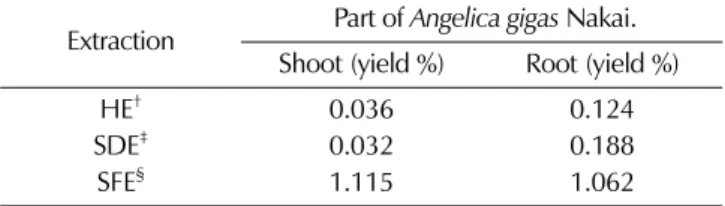
참당귀의 지상부와 지하부의 휘발성 정유 수율은 각각 초임 계 정유 추출장치가 1.115%, 1.062% 로 가장 높았으며 지상부 의 경우는 수증기 증류장치와 SDE 추출장치의 수율이
0.036%, 0.032% 로 비슷했으나 , 지하부의 경우 SDE 추출장치 의 수율이 0.188% 로 수증기 증류장치의 수율인 0.124% 보다
약간 높게 나타났다 (Table 1). 초임계 정유 추출법에서 정유
수율이 가장 높게 나온 이유로 , 초임계 정유 추출법이 증류와
용매추출의 원리가 같이 적용되는 복합기술의 성격을 갖는 추 출방법으로 , 비교적 저온에서 추출하기 때문에 열에 의한 분
해 , 변질 등을 방지할 수 있을 뿐 아니라 , 함유 성분들의 분 획 및 분리 등의 선택성이 뛰어나서 고순도의 제품을 얻을 수 있기 때문으로 알려져 있다 (Kim, 2005).
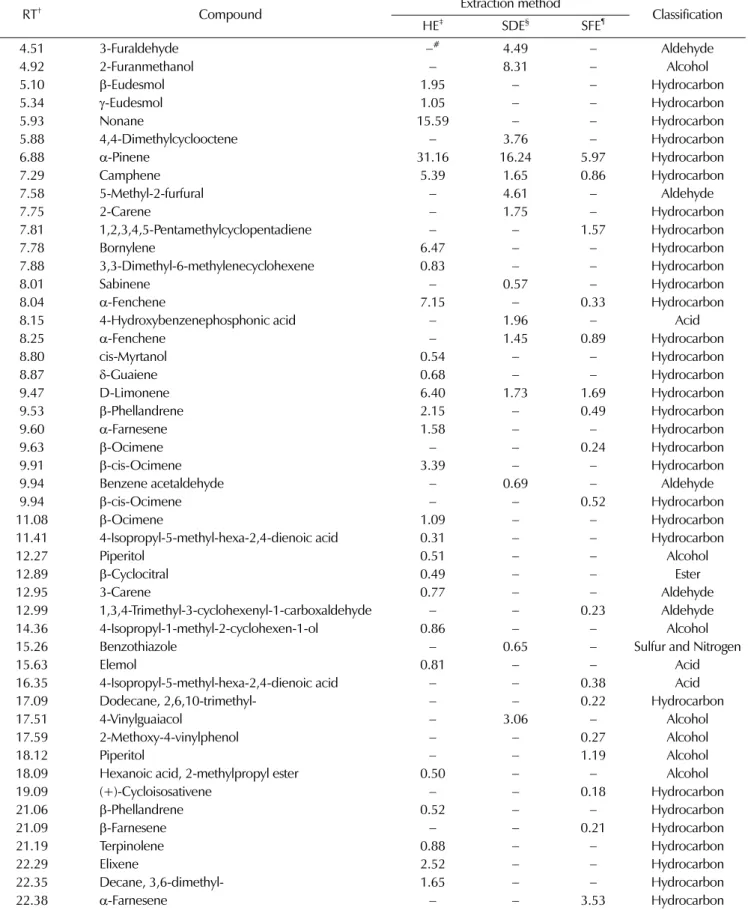
정유 추출방법별로 성분을 분석한 결과 수증기증류법으로 추출된 참당귀 지상부 , 지하부 정유에 각각 31 종의 화학성분 , SDE 장치로 추출된 참당귀 지상부 , 지하부 정유에 각각 27, 23 종의 화학성분 , 초임계 정유 추출기로 추출된 참당귀 지상
부 , 지하부 정유에 각각 31, 45 종의 화학성분이 확인되었으나 ,
그 조성비와 화학성분은 추출방법별 , 참당귀의 부위별로 차이 가 있었다 (Table 3, 4).
추출법별로 참당귀 지상부로부터 추출된 정유의 성분을 화 학그룹별로 분석한 결과 , 수증기 증류법으로 추출된 정유는
hydrocarbon 이 전체 정유 대비 93.16%, SDE 추출장치의 분
석한 결과 hydrocarbon 이 전체 정유 대비 87.24%, 초임계 정
유 추출장치로 추출한 정유의 분석결과 hydrocarbon 이 전체 정유 대비 79.21% 로 가장 높았다 (Table 2, 3). 참당귀 지하 부로부터 추출된 정유의 성분을 화학그룹별로 분석한 결과 , 수 증기 증류법으로 추출된 정유는 hydrocarbon 이 전체 정유 대 비 91.30%, SDE 장치의 분석결과 hydrocarbon 이 전체 정유
대비 49.99%, 초임계추출장치로 추출한 정유의 분석결과
alcohol 이 전체 정유 대비 43.23% 로 가장 높았다 . 참당귀 지
하부 정유의 성분조성은 지상부 정유의 성분조성보다 다양하 게 검출되었는데 , 주로 검출되는 hydrocarbon 과 alcohol 외에
lactone, acid, aldehyde, ester, acetate, sulfur 와 nitrogen 류의 화합물도 확인되었다 (Table 2, 4).
수증기 증류법으로 추출한 참당귀의 지상부와 지하부의 정 유 함량 중 α -pinene 이 각각 34.49%, 31.16%, SDE 추출법
에서는 지상부 , 지하부 각각 12.22%, 16.24% 로 그 함량이 가
장 높았으며 , 그리고 초임계 정유 추출법에서는 지상부와 지 하부 각각 10.83%, 5.97% 로 검출되었다 . α -pinene 은 소나무 속 침엽수에서 배출되는 monoterpene 중에서 가장 높은 구성 비로 배출된다고 보고되었으며 (Choi et al. , 2005), 따뜻한 수지향과 상쾌한 소나무향으로 표현된다 (Cho et al ., 2003).
초임계 정유 추출기로 추출한 참당귀 지하부 정유에서만 참 당귀 지하부의 유효성분으로 알려져 있는 nodakenin, decursinol 의 함량이 각각 11.95%, 8.42% 확인되었다 . 이러한 결과는 Kim (2005) 의 결과와도 일치하는데 , decursin 과
decursinol 은 토끼의 적출장관 및 심장에 대해 그 운동을 마비 시키고 혈압강하 및 호흡 억제 작용이 있으며 , 적출 자궁에서 는 decursin 이 비교적 흥분적으로 decursinol 은 억제적으로 작 용한다 . 한방에서 응용되는 분야는 빈혈 , 활혈효과가 있어 혈
행장애에 의한 부인과 제질환 ( 구어혈 , 조경 , 월경불순 ) 에 쓰 이며 기타 보혈강장 , 진통 등에 사용되고 있다 (Kim, 2005;
Lee et al ., 2008; Lee, 2008). 따라서 참당귀 지하부의 정유 를 활용시 초임계 정유 추출기로 추출하면 향기성분 외에도 유효성분까지 활용할 수 있어 그 활용 폭이 더 큰 것을 보여 준다 .
참당귀의 지상부와 지하부의 정유를 추출하여 분석한 결과 ,
같은 추출법으로 비교하였을 경우에는 수증기 증류법이나 SDE
추출법의 경우 성분 조성비에 함량 변화와 같은 약간의 차이
Table 1.Yield of essential oils in the part of
Angelica gigasNakai.
Extraction Part of
Angelica gigasNakai.
Shoot (yield %) Root (yield %)
HE
†0.036 0.124
SDE
‡0.032 0.188
SFE
§1.115 1.062
†
HE: Hydrodistillation extraction
‡
SDE: Simultaneous steam distillation & extraction
§
SFE: Supercritical fluid extraction system
Table 2.
Volatile composition of the essential oil from
Angelica gigasNakai.
Classification Shoot content (%) Root content (%)
HE
†SDE
‡SFE
§HE SDE SFE
Hydrocarbon 93.16 87.24 79.21 91.30 49.99 26.35
Alcohol 86.47 12.76 20.16 86.17 35.01 43.23
Lactone
−# − − − −29.56
Acid 80.34
− −81.27 81.96 0.38
Aldehyde
− −80.64 80.77 89.79 0.23
Ester
− − −80.49
− −Acetate
− − − −82.60 0.25
Sulfur and Nitrogen
− − − −80.65
−†
HE: Hydrodistillation extraction
‡
SDE: Simultaneous steam distillation & extraction
§
SFE: Supercritical fluid extraction system
#−
: not detect
Table 3.
Compounds of essential oils in the shoot part of
Angelica gigasNakai.
RT
†Compound HE
‡Extraction method SDE
§SFE
¶Classification
4.94 4-Hexen-1-ol, (E)-
−# 0.21 3.05 Alcohol
5.04 2,6-Dimethyldecane
− −0.32 Hydrocarbon
5.10 Decane, 3,6-dimethyl- 0.47
− −Hydrocarbon
5.20 Acrylaldehyde
− −0.64 Hydrocarbon
6.03 Nonane 8.79 2.87 2.67 Hydrocarbon
7.24
α-Pinene 34.49 12.22 10.83 Hydrocarbon
7.49 Camphene 2.28 0.64 0.67 Hydrocarbon
7.84
β-Phellandrene
−0.64 0.51 Hydrocarbon
8.49 (
−)-
β-Pinene 7.14 1.75 2.48 Hydrocarbon
8.70 1,5-Cyclooctadiene, 1,2-dimethyl-
−0.19 - Hydrocarbon
8.95
α-Phellandrene 1.92 1.59 0.45 Hydrocarbon
9.40 D-Limonene
− −1.21 Hydrocarbon
9.86
β-Thujene 17.05
− −Hydrocarbon
9.92
β-Phellandrene 5.74 17.41 7.83 Hydrocarbon
10.09 cis-
β-Ocimene 1.70 2.77 0.89 Hydrocarbon
10.44
γ-Terpinene 0.76 1.93
−Hydrocarbon
11.13 Terpinolene 0.22
− −Hydrocarbon
11.43 Undecane 0.17
− −Hydrocarbon
14.35 cis-Myrtanol 0.26
− −Alcohol
16.71 3-Methyl-2-butenoic acid, nonyl ester 0.34
− −Acid
17.04 Tridecane 0.45 0.32 0.45 Hydrocarbon
19.42
β-Bourbonene 0.49 1.09 1.02 Hydrocarbon
19.51
β-Elemene 0.17
− −Hydrocarbon
20.42 Caryophyllene 1.62 3.77 3.34 Hydrocarbon
20.99
β-Farnesene
− −0.45 Hydrocarbon
21.24
α-Caryophyllene
−0.71 0.64 Hydrocarbon
22.06
β-Cubebene 4.27 14.36 15.11 Hydrocarbon
21.93 (Z,E)-
α-farnesene
− −0.80 Hydrocarbon
22.21 Elixene
− −1.81 Hydrocarbon
22.36 Elemene 1.09 1.71
−Hydrocarbon
22.52
α-Farnesene 3.60 18.59 18.52 Hydrocarbon
22.58 Humulane-1,6-dien-3-ol
−0.30
−Alcohol
22.62 Isolongifolan-8-ol 0.20
− −Alcohol
22.87
β-Cadinene 0.40 0.61
−Hydrocarbon
23.17 Epiglobulol 0.49
− −Alcohol
23.58 Elemol 0.43 1.38 0.70 Alcohol
23.87 Gurjunene 0.38 0.45 0.70 Hydrocarbon
24.33 Germacrene d-4-ol 1.11
−1.94 Alcohol
25.37
γ-Eudesmol
−2.69 2.58 Alcohol
26.19
β-Eudesmol 2.93 7.72 5.63 Alcohol
26.42 Cyclotetradecane
−2.11 2.00 Hydrocarbon
26.43 1-Hexadecanol 0.53
− −Alcohol
29.66 Phytol 0.24 0.89 2.86 Alcohol
30.65 1-Hexadecanol 0.29 1.09 2.07 Alcohol
34.91 Phytol
− −1.34 Hydrocarbon
40.68 Hentriacontane
− −6.52 Hydrocarbon
†
RT: Retention time
‡
HE: Hydrodistillation extraction
§
SDE: Simultaneous steam distillation & extraction
¶
SFE: Supercritical fluid extraction system
#
-: not detect
Table 4.
Compounds of essential oils in the root part of
Angelica gigasNakai.
RT
†Compound HE
‡Extraction method SDE
§SFE
¶Classification
4.51 3-Furaldehyde
−#4.49
−Aldehyde
4.92 2-Furanmethanol
−8.31
−Alcohol
5.10
β-Eudesmol 1.95
− −Hydrocarbon
5.34
γ-Eudesmol 1.05
− −Hydrocarbon
5.93 Nonane 15.59
− −Hydrocarbon
5.88 4,4-Dimethylcyclooctene
−3.76
−Hydrocarbon
6.88
α-Pinene 31.16 16.24 5.97 Hydrocarbon
7.29 Camphene 5.39 1.65 0.86 Hydrocarbon
7.58 5-Methyl-2-furfural
−4.61
−Aldehyde
7.75 2-Carene
−1.75
−Hydrocarbon
7.81 1,2,3,4,5-Pentamethylcyclopentadiene
− −1.57 Hydrocarbon
7.78 Bornylene 6.47
− −Hydrocarbon
7.88 3,3-Dimethyl-6-methylenecyclohexene 0.83
− −Hydrocarbon
8.01 Sabinene
−0.57
−Hydrocarbon
8.04
α-Fenchene 7.15
−0.33 Hydrocarbon
8.15 4-Hydroxybenzenephosphonic acid
−1.96
−Acid
8.25
α-Fenchene
−1.45 0.89 Hydrocarbon
8.80 cis-Myrtanol 0.54
− −Hydrocarbon
8.87
δ-Guaiene 0.68
− −Hydrocarbon
9.47 D-Limonene 6.40 1.73 1.69 Hydrocarbon
9.53
β-Phellandrene 2.15
−0.49 Hydrocarbon
9.60
α-Farnesene 1.58
− −Hydrocarbon
9.63
β-Ocimene
− −0.24 Hydrocarbon
9.91
β-cis-Ocimene 3.39
− −Hydrocarbon
9.94 Benzene acetaldehyde
−0.69
−Aldehyde
9.94
β-cis-Ocimene
− −0.52 Hydrocarbon
11.08
β-Ocimene 1.09
− −Hydrocarbon
11.41 4-Isopropyl-5-methyl-hexa-2,4-dienoic acid 0.31
− −Hydrocarbon
12.27 Piperitol 0.51
− −Alcohol
12.89
β-Cyclocitral 0.49
− −Ester
12.95 3-Carene 0.77
− −Aldehyde
12.99 1,3,4-Trimethyl-3-cyclohexenyl-1-carboxaldehyde
− −0.23 Aldehyde
14.36 4-Isopropyl-1-methyl-2-cyclohexen-1-ol 0.86
− −Alcohol
15.26 Benzothiazole
−0.65
−Sulfur and Nitrogen
15.63 Elemol 0.81
− −Acid
16.35 4-Isopropyl-5-methyl-hexa-2,4-dienoic acid
− −0.38 Acid
17.09 Dodecane, 2,6,10-trimethyl-
− −0.22 Hydrocarbon
17.51 4-Vinylguaiacol
−3.06
−Alcohol
17.59 2-Methoxy-4-vinylphenol
− −0.27 Alcohol
18.12 Piperitol
− −1.19 Alcohol
18.09 Hexanoic acid, 2-methylpropyl ester 0.50
− −Alcohol
19.09 (+)-Cycloisosativene
− −0.18 Hydrocarbon
21.06
β-Phellandrene 0.52
− −Hydrocarbon
21.09
β-Farnesene
− −0.21 Hydrocarbon
21.19 Terpinolene 0.88
− −Hydrocarbon
22.29 Elixene 2.52
− −Hydrocarbon
22.35 Decane, 3,6-dimethyl- 1.65
− −Hydrocarbon
22.38
α-Farnesene
− −3.53 Hydrocarbon
만 있을 뿐이지만 , 초임계 정유 추출 경우는 지하부 정유에만 유효성분이 확인되어 다른 추출방법과 확연한 차이가 있었다 .
추출법별로 정유성분을 비교해보면 , 성분 조성 함량 간에 다
소 차이가 있었으며 , 특히 초임계 정유 추출기의 경우 성분 함량 및 확인된 화학종이 참당귀 지하부의 경우 14 종 더 많이 확인되었다 . 이는 수증기 증류법이나 SDE 추출장치는 고온인
Table 4.Continued
RT
†Compound HE
‡Extraction method SDE
§SFE
¶Classification
22.52 1H-Benzocycloheptene, 2,4a,5,6,7,8,9,9a-
− −0.15 Hydrocarbon
22.61 Isolongifolan-8-ol
− −1.43 Alcohol
22.57 Z-11-Tetradecenoic acid 0.42
− −Alcohol
22.81
δ-Cadinene
− −0.35 Hydrocarbon
23.11 Thujopsene
− −0.55 Hydrocarbon
23.51 Elemol
−1.99 0.78 Alcohol
23.54 Cedran-diol 0.40
− −Alcohol
24.73 Guaiol
− −1.32 Alcohol
25.34 1,6,10-Dodecatriene, 7,11-dimethyl-3-methylene-(z)- 1.34
− −Alcohol
25.32
γ-Eudesmol
−3.09 6.90 Alcohol
26.06
β-Eudesmol
−7.27 1.07 Alcohol
25.67 Agarospirol
− −0.92 Alcohol
25.83
γ-Eudesmol
− −0.41 Alcohol
25.92 (
−)-Aristolene
− −1.86 Hydrocarbon
26.13
β-Eudesmol
− −8.84 Alcohol
26.09
α-Phellandrene 2.14
− −Alcohol
26.31 Bulnesol
− −2.62 Alcohol
26.42 1-Hexadecanol
− −1.50 Alcohol
26.76 Bulnesol
− −0.39 Alcohol
27.62 Benzestrol
−7.18
−Alcohol
27.73 z-9-Pentadecenol
− −1.33 Alcohol
27.69 Dodecane 0.46
− −Acid
28.17 4-tert-Octyl-o-cresol
−4.12
−Alcohol
30.00 Ficusin
− −14.58 Lactone
30.71 1-Hexadecanol
− −2.11 Alcohol
32.16 di-N-Butylphthalate
−2.60
−Acetate
32.30 Ascorbyl dipalmitate
− −0.51 Hydrocarbon
32.91 2,6,10-Trimethyltetradecane
−0.60
−Hydrocarbon
34.15 Oleyl alcohol
− −1.13 Alcohol
34.36 5-Methoxypsoralen
− −5.98 Hydrocarbon
34.77 Tritetracontane
−6.56
−Hydrocarbon
35.48 2-Chloroethyl linoleate
− −0.25 Acetate
36.54 Hentriacontane
−15.68
−Hydrocarbon
36.76 Falcarinol
− −2.31 Alcohol
37.34 Isopimpinellin
− −3.02 Lactone
37.81 1-Nonynylbenzene
− −0.26 Hydrocarbon
38.89 Nodakenin
− −11.95 Lactone
39.28 Bergaptol
− −0.28 Alcohol
39.65 Decursinol
− −8.42 Alcohol
†
RT: Retention time
‡
HE: Hydrodistillation extraction
§
SDE: Simultaneous steam distillation & extraction
¶
SFE: Supercritical fluid extraction system
#
-: not detect
100 ℃에서 2 시간 이상 끓여지기 때문에 식물체 표면 조직 내
에 함유되어 있는 성분 추출에 영향을 받은 것으로 보여지며 ,
또한 초임계 정유 추출기의 특성에 따른 차이로도 추론된다
(Choi et al ., 2007). 이러한 결과로 보아 참당귀의 지상부 및 지하부의 정유를 활용시 초임계 정유 추출기로 추출하는 것이 수율 증가 , 향기성분 손실 감소 , 기능성 성분 추출 등의 이유 로 식품이나 향장품 천연소재 산업 등에 광범위하게 활용될 수 있는 가능성이 있다고 추론된다 .
감사의 글
이 논문은 농촌진흥청에서 시행한 지역 특산 약용작물 명품 화 기술 개발 어젠다과제 ( 과제번호 : RIMS 2009010FT 072045283) 의 지원으로 이루어졌으며 이에 감사드립니다 .
LITERATURED CITED
Chi HJ and Kim HS. (1988). Studies on essential oils of plants of
Angelica genusin Korea (I). Essential oils of
Angelica gigantisRadix. Korean Journal of Pharmacognosy. 19:239-247.
Choi HJ, Wang HY, Kim YN, Heo SJ, Kim NK, Jeong MS, Park YH and Kim SM. (2007). Composition and cytotoxicity of essential oil extracted by steam distillation from horseweed (
Erigeron canadensisL.) in Korea. Journal of the Korean Society for Applied Biological Chemistry. 51:55-59.
Choi SH and Kim HJ. (2000). Volatile flavor components of
Angelica gigasNakai by the storage conditions. Korean Journal of Food Science and Technology. 32:513-518.
Choi JE, Joo OJ, Bae GN, Lee SB, Moon GJ and Yoon SC.
(2005). Effect of
α-pinene concentration on the photochemical reaction of Toluene-NO_x-air mixture. Proceeding of the 40th Meeting of KOSAE Korean Society for Atomospheric Environment. 468-489.
Cho MG, Bang JK and Chae YA. (2003). Comparison of volatile compounds in plant parts of
Angelica gigasNakai and
A.acutiloba