http://bxdoi.org/10.7783/KJMCS.2012.20.5.359
재배 지대에 따른 참당귀의 추대 변이와 FLC 유전자 특성
김영국*†·여준환**·안태진*·한신희*·안영섭*·박충범*·장윤희***·김정국***
*농촌진흥청 국립원예특작과학원 인삼특작부, **전라남도한방산업진흥원, ***고려대학교 생명과학대학
Variation of Bolting at Cultivation of Different Regions and Molecular Characterization of FLC homologs in Angelica gigas Nakai
Young Guk Kim*†, Jun Hwan Yeo**, Tae Jin An*, Sin Hee Han*, Young Sup Ahn*, Chung Beom Park*, Yun Hee Jang*** and Jeong Kook Kim***
*Department of Herbal Crop Research, NIHHS, RDA, Eumseng 369-873, Korea.
**Jeollanamdo Development Institute for Korean Traditional Medicine, Jangheung 529-851, Korea.
***School of Life Sciences and Biotechnology, Korea University, Seoul 136-701, Korea.
ABSTRACT : This study were carried out to find bolting response of cultivation in different regions and to isolate FLC (FLOWERING LOCUS C) homologs in Angelica gigas Nakai. The mean temperature of different regions, ordering in alti- tude, were as follows: 100 m > 350 m > 530 m > 700 m. The largest amount of rainfall was occurred in the region of 350 m while the longest time of sunshine was occurred in the region of 100 m. The content of soil chemical properties in regions showed pH 6.2 ~ 7.4, T-N 0.17 ~ 26, organic mater 1 ~ 32 gkg-1, P2O5 151 ~ 664mgkg-1,exchangeable potassium and calcium and magnesium were 0.78 ~ 1.15, 3.9 ~ 10.0, 0.7 ~ 3.2cmol+ kg-1. L5 line of A. gigas was occurred in bolting at all regions, but the bolting ratio was 60.0% in 700 m region with non-mulching treatment. Manchu of A. gigas was not occurred in bolting at all regions. The accumulation bolting ratio of L5 line by non-mulching was higher than that of mulching as 90.4% and 72.8% in 100 m region. The MADS-box transcription factor FLC is one of the well-known examples as a strong floral repressor. We decided to isolate FLC homologs from A. gigas as a starting point of flowering mechanism research of this plant. We have isolated two RT-PCR products which showed very high amino acid sequence homology to Arabidopsis FLC.
Key Words : Angelica gigas, Bolting Response, Regions, FLC Homologs
서 언
참당귀 (Angelica gigas NAKAI)는 미나리과에 속하는 다 년생 초본 작물로 뿌리를 한약재로 이용하고, 뿌리에는 decursin, decursinol 및 nodakenin 등의 성분이 있으며, 자궁 기능 조절, 진정, 진통, 이뇨 및 항균작용 등의 약리작용이 있 다 (Han, 1992). 참당귀는 최근 지상부 추출물의 항산화 활성 평가가 이루어진 천궁 (Oh et al., 2010)과 건조방법에 따라 성분함량 변이가 밝혀진 지황 (Chang et al., 2011) 및 작약 과 더불어 사물탕을 만드는 재료가 된다.
참당귀가 중요한 약용작물로 재배되면서 재배기간 중 불시 추대가 되어 수량 감소의 가장 큰 원인이 되고 있다. 따라서 당귀의 생육기간 중 추대율을 낮추거나 지연시키기 위해서는 생육적온인 20℃ 이내가 좋으며, 화아분화기에 단일, 약광 상 태가 추대율이 감소된다고 하였다 (Yu et al., 1996, 1997,
2000; Ahn et al., 1994). 참당귀는 표고가 높아질수록 추대율 이 낮아 참당귀의 육묘적지는 적어도 표고 600 m 이상이 적 당한 것으로 보고되었다 (Lee et al., 1995). 그리고 정식시기 에 따라 추대반응이 달라지고 내추대성 품종은 둔감하게 반응 하고, 추대성에서는 민감하게 반응한다고 하였다 (Yu et al., 2003). 또한 참당귀의 추대율은 일장이 길어질수록 증가하며, 광도가 감소할수록 추대율도 감소한다고 보고하였다 (Cho and Kim, 1993).
이와 관련하여 식물의 추대와 밀접한 관련이 있는 개화경로 는 애기장대에서 3 ~ 4가지의 서로 다른 경로가 존재함이 밝 혀졌는데, 일장에 따른 장일 경로 (Mouradov et al., 2002;
Boss et al., 2004)는 주로 장일 조건에서 애기장대의 개화를 촉 진하며 (Mouradov et al., 2002; Boss et al., 2004), phytochrome 이나 cryptochrome과 같은 광수용체와 CO (CONSTANS), SOC1 (SUPPRESSOR OF OVEREXPRESSION OF CONSTANS
†Corresponding author: (Phone) +82-43-871-5565 (E-mail) [email protected]
Received 2012 August 27 / 1st Revised 2012 September 18 / 2nd Revised 2012 September 24 / Accepted 2012 September 28
2002)는 GA가 필수적인 역할을 하며, 이 경로에는 GA1 (GIBBREELLIN 1) 이나 GAI (GA INSENSITIVE), RGA (REPRESSOR OF GA-3) 등의 유전자들이 관여하고 있으며 개화 시기는 주로 단일 조건에서만 영향을 받는 것이 특징이 다 (Wilson et al., 1992; Mouradov et al., 2002; Simpson and Dean, 2002). 춘화에 의한 경로 (Michaels and Amasino, 1999; Sheldon et al., 1999)는 유전자 FRI (FRIGIDA), FLC, VRN1, 2 (VERNALIZATION1, 2), VIN3 (VERNALIZATION INSENSITIVE 3) 등이 관여한다고 하였다 (Michaels and Amasino, 1999; Sheldon et al., 1999). 자발적인 경로 (Michaels and Amasino, 1999; Sheldon et al., 1999; Rouse et al., 2002)는 유전자의 돌연변이체들이 관여하며 장일 조건이나 단일 조건에 모두 개화시기가 영향을 받으며 FCA (FLOWERING LOCUS CA), FVE (FLOWERING LOCUS VE), FLD (FLOWERING LOCUS D), FLK (FLOWERING LOCUS K), FPA (FLOWERING LOCUS PA), FY (FLOWERING LOCUS Y), LD (LUMINIDEPENDENS)와 같은 유전자들이 이 경로에 관여한다 고 하였다 (Michaels and Amasino, 1999; Sheldon et al., 1999;
Rouse et al., 2002).
따라서 본 연구는 당귀 재배지대별로 재배환경에 따른 추대 반응과 추대 관련 유전자의 존재 여부를 확인하여 고품질 당 귀 생산 및 신품종 육성의 기초 자료로 활용하고자 본 연구를 수행하였다.
재료 및 방법
1. 당귀 재배 지대별 추대 반응
지대별 당귀의 추대 변이 특성을 알아보기 위해 해발 100 m (수원), 해발 350 m (제천), 해발 530 m (진부1)과 해 발 700 m (진부2) 등 총 4개 지역으로 구분하여 시험을 실 시하였다. 공시한 품종은 국립식량과학원에서 내추대성으로 육성한 만추당귀와 추대성 계통 (L5)을 약용작물 시험포장에 서 채종하여 이용하였다. 재배방법은 온실 육묘이식재배와 직 파재배를 흑색비닐피복재배 시험구와 무피복재배 시험구로 각각 나누어 시험을 실시하였다. 파종은 2월 23일 200구 플 러그트레이 (㈜범농) 육묘상자를 이용하여 파종하였으며, 최 저 15℃ 이상, 평균 20℃를 유지하도록 하였다. 정식은 파종
Multiple Range Test LSD≥ 5%) 분석을 실시하였다.
2. 당귀 추대 유전자 탐색
당귀의 추대관련 유전자 존재 여부를 확인하기 위해 만추당 귀와 추대성 계통 (L5)을 온실에서 재배하여 시험재료로 이용 하였다. RNA 분리 및 cDNA 합성은 당귀 식물체를 액체질소를 이용하여 분쇄한 후 trizol (Molecular Research 217 Center, USA)을 이용하여 total RNA를 분리하였다. First- strand cDNA는 oligo random primer와 M-MLV reverse transcriptase (Invitrogen, USA)를 이용하여 합성하였다 (72도 5분, 42도 1 시간, 72도 15분). First-strand cDNA를 주형으로 하여 FLC 의 consensus sequence motif 부분 (MADS-box domain)에 서 primer를 고안하여 Semi-quantitative RT-PCR을 수행하였 다. PCR 수행 조건은 다음과 같다; 94℃ 5 min; 35 cycles of 94℃ 30 sec, 55℃ 30 sec, 72℃ 30 sec, and 72℃ 7 min.
Primer1 (5`-CGAATTGAGAACAAAAGTAGCCG-3`), Primer2 (5`-CGGA GGCGGAGACGACGAGAAGAGC-3`)를 이용하 여 약 130 bp의 cDNA fragment를 T-A vector에 클로닝 하 였다. 염기서열을 분석한 후 NCBI blast 프로그램을 이용하여 FLC와의 유사성을 확인하였다. RACE-PCR 수행은 당귀의 total RNA 500 ug을 이용하여 poly-A RNA (QIAGEN)를 합성하였다. Marathon cDNA Amplification Kit (clontech)을 이용하여 당귀 cDNA의 양쪽 말단에 adaptor를 ligation한 double-strand cDNA를 합성하였다. Gene-specific primer (GSP1)와 adaptor primer (AP1)를 이용하여 touchdown PCR (1차PCR)을 하였고, 이 product로 nested primer (GSP2와 AP2)를 이용하여 한번 더 PCR (2차PCR)을 하였다. PCR 조건 은 다음과 같다; 94℃ for 1 min, 5 cycles: 94℃ 30 sec 72℃
4 min, 5 cycles: 94℃ 30 sec 70℃ 4 min, 20-25 cycles: 94℃
20 sec 68℃ 4 min.
결과 및 고찰
1. 지대별 기상환경 및 토양특성
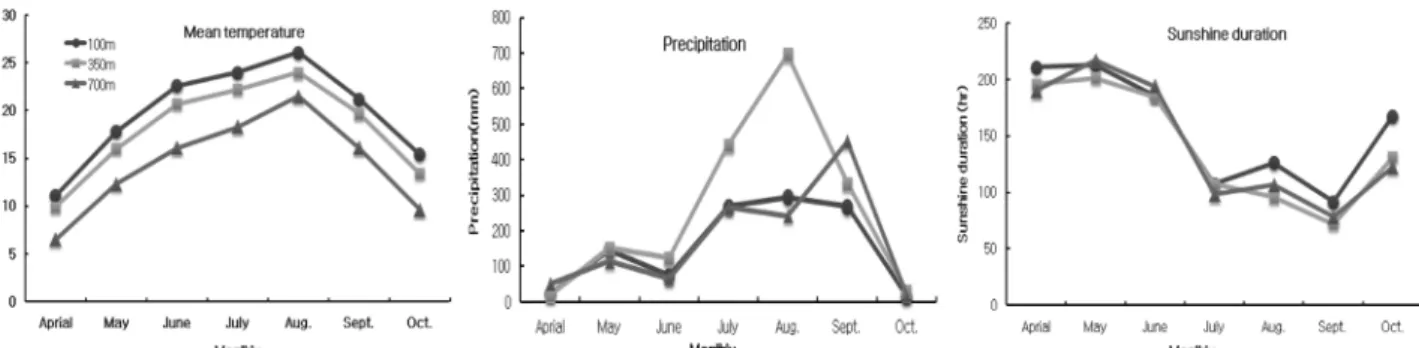
당귀 추대 반응 시험 지역에서 당귀 정식기인 4월부터 수확 기인 10월까지의 기상환경은 Fig. 1과 같이 나타났다. 평균기 온은 4월에는 해발 100 m에서 해발 700 m의 6.5℃보다 약
4.6℃ 높았으며, 수확기인 10월경에는 해발 700 m 의 9.6℃보 다 약 5.8℃ 높은 것으로 나타났다. 당귀 생육기 전반에 걸쳐 서는 해발 100 m에서 해발 350 m보다 1.2 ~ 2.1℃ 높았으나 큰 차이는 없었고, 해발 700 m보다 4.6~6.5℃ 정도 높아서 큰 차 이를 나타내었다. 강수량은 해발 350 m에서 7월과 8월에 각각 442.5㎜, 696.5 ㎜로 다른 지역보다 많았으며, 당귀 생육기간 중의 전체 강수량도 해발 100 m의 1094.9 ㎜와 해발 700 m의 1,213㎜ 보다 해발 350 m에서 1,797 ㎜로 가장 많았다. 일조 시간은 4월부터 7월까지는 지대별 차이가 없었으나 8월부터 10월까지는 해발 100 m에서 가장 높아 생육기간 중의 전체 일 조시간은 해발 100 m에서 1102.2시간으로 가장 많았고, 해발 700 m 1005.8시간, 해발 350 m 988.1시간으로 나타났다.
지대별 당귀 시험지의 토양특성은 Table 1과 같이 나타났다 . 토양 pH는 해발 100 m, 350 m 및 700 m의 시험포장 모두 중성에 가까운 pH 7.0 ~ 7.4를 보였으며, 해발 530 m에서는 pH 6.2의 약산성으로 나타났다. 총 질소함량은 해발 350 m 0.26%, 해발 350 m와 530 m 0.21% 및 해발 700 m 0.17%
를 나타냈다. 유기질함량은 해발 350 m에서 32 g ㎏-1로 유기 물함량이 가장 높았으며, 해발 700 m는 1 g ㎏-1로 가장 적은 함유량을 보였다. 인산에 있어서 해발 530 m가 664 ㎎ ㎏-1로 가장 많았으며, 700 m에서 151 ㎎ ㎏-1로 가장 낮게 나타났다.
무기성분인 K, Ca 및 Mg의 지대별 함량에 있어 K은 해발 350 m, Ca는 해발 100 m 및 Mg는 해발 530 m에서 가장 높 은 함량을 보였다.
2. 지대별 당귀 추대 변이
당귀 추대성 계통 L5와 추대가 잘 안되는 만추당귀를 트레 이 육묘상자에서 육묘하여 지대별로 정식한 후 생육단계별 추 대율을 분석한 결과추대성 계통 L5의 지대별 추대율을 Fig.
2에서 보면 정식 후 95일의 비닐피복재배 시험구에서는 해발 100 m, 해발 350 m 및 해발 530 m의 추대율은 13.3 ~ 15.1%
로 지대에 따른 유의성을 보이지 않았으나, 해발 700 m는 5.0%로 처리 간 유의성을 보였다. 또한, 무피복재배 시험구의 경우에도 해발 700 m만이 처리 간 유의성이 인정되는 것으로
나타났다. 당귀의 수확기인 정식 후 170일 경 추대성 계통 L5의 추대반응은 생육이 늦은 해발 700 m (추대율 60% 내외) 를 제외한 전 지역에서 85% 이상 추대되었다. 지대별 처리간 유의성 검정에 있어서 비닐피복재배 시험구에서는 해발 530 m 와 해발 700 m과는 지대간 차이가 인정되었으며, 해발 100 m 및 해발 350 m과는 유의성이 인정되지 않았다. 무피복재배 시 험구에서는 해발 530 m 및 100 m > 해발 350 m > 해발 700 m 순으로 지대별 차이가 인정되었다 그러나 만추당귀는 지대별, 비닐피복유무와 관계없이 수확기까지 추대율 0%로 전혀 추대 가 되지 않았다. 따라서 당귀는 추대가 되면 뿌리가 썩어 수 확을 할 수 없기 때문에 85% 이상 추대된 L5계통과 전혀 추 대가 되지 않은 만추당귀와의 수량성 비교는 의미가 없었다.
Lee 등 (1995)은 육묘지대에 따른 추대율은 표고가 높을수록 낮았고 지하부 생육 및 수량이 저지대보다 양호하여 참당귀의 육묘적지는 표고 600 m 이상이 적당하다고 하였다. 본 시험에 서 추대가 잘 안되는 품종인 만추당귀는 추대성 계통인 L5와 비교하여 지대와 기후 환경에 상관없이 추대가 전혀 발생되지 않았다. 그러나 추대성 계통 L5는 전 지역에서 추대가 발생하 였으며, 비닐피복재배가 무피복 재배에 비하여온도상승 및 생 육촉진 효과로 인해 높은 추대율을 보였고, 해발 700 m의 무 피복 재배가 재배방법 및 지대별 추대율에 있어 가장 낮은 60.0%의 추대율을 나타내었다.
이상의 결과에서 당귀의 추대는 환경적, 재배적인 요인으로 Fig. 1. Climatic conditions according to different-regions in experimental field of Angelica gigas.
Table 1. Soil characteristics of experimental field for A.ngelica gigas in areas of different altitude.
Altitude (m)
pH 1 : 5
T-N (%)
g㎏OM-1 P2O5
㎎㎏-1
K Ca Mg
Exch. cmol+ ㎏-1
100 7.4 0.21 13 288 0.79 12.1 0.7
350 7.4 0.26 32 528 1.15 10.0 3.1
530 6.2 0.21 10 664 0.78 8.3 3.2
700 7.0 0.17 1 151 0.78 3.9 0.9
Normal
field 5.9 - 20 572 0.79 5.5 1.5
0 ~ 35%, 품종간 유전적 요인으로 0 ~ 95%의 추대변이를 보여, 추대에 미치는 요인은 종자의 유전적인 요인이 재배 및 환경적 인 요인보다 크다고 판단된다.
3. 생육단계별 당귀 추대 변이
당귀의 추대성 계통 L5의 생육단계별 추대특성을 살펴보면 Fig. 3과 같다. 비닐피복재배에서 L5 계통의 추대가 시작되 는 시기는 플러그트레이 육묘상자에 파종을 한 후 136일 (7 월 9일)에 추대를 하기 시작하였고, 무피복 재배에서는 파종 후 143일 (7월 16일)에 추대 되는 것으로 보아 비닐 피복 재 배가 무피복 재배에 비해 7일 정도 빨리 추대되는 것으로 나 타났다. 그러나 누적 추대율은 무피복 재배가 93.9%로 비닐피 복 재배구의 91.2%보다 높은 추대율을 나타내었다. 추대가 가
장 많이 발생되는 시기는 비닐피복과 무피복재배 모두 8월에 가장 높은 추대율을 보였다. 10월부터 무피복 재배는 추대율 이 급격하게 감소하였으나, 비닐 피복 재배에서는 지속적으로 추대가 일어남을 알 수 있었다.
이상의 결과에서 당귀 추대는 외관상으로 관찰이 되는 시기 는 7월 상순부터 추대되기 시작하여 8월에 가장 많이 추대가 되고 9월과 10월까지 추대가 계속되는 것을 알 수 있었다.
4. 당귀에서 MADS-box domain을 보존하고 있는 유전자 분리 당귀의 추대 반응에서 나타난 결과와 같이 유전적 요인이 추대에 영향을 미치고, 애기장대에서 FLC 유전자는 MADS- box transcription factor로서 강력한 flowering repressor 역할 을 하므로 당귀에서 개화에 관련되는 FLC의 유사 유전자를 Fig. 2. Bolting ratio according to days after transplanting and mulching cultivation of regions of Angelica gigas.
Fig. 3. Bolting rate of Angelica gigas in L5 planted after seeding in greenhouse.
분리하기 위해 애기장대를 포함한 이미 알려져 있는 다른 식 물체의 FLC 단백질의 아미노산 서열을 비교한 결과 (Fig. 4) MADS-box부분이 매우 잘 보존되어 있음을 알 수 있었다. 유 사성이 높은 유전자 부위를 이용하여 primer를 제작하여 실험 한 결과 당귀에서 애기장대 FLC의 MADS-box를 갖고 있는
homolog가 존재하고 있음을 확인하였고, FLC와 유사한 MAF 에서도 MADS-box가 있음을 알 수 있었다 (Fig. 5). MAF는 FLC family의 또 다른 일원으로서 MAF1부터 MAF5가 존재 하며 역시 floral repressor로 작동 한다 (Oh et al., 2004).
그리고 MADS-box를 보유하고 있는 또 다른 유전자인 AGL8 Fig. 4. Alignment of amino acid sequence of FLC proteins. Amino acid sequences are represented by the standard single-letter codes.
Gaps are introduced in order to ensure maximum similarity. Black boxes and grey boxes represent the identical or similar amino acids of the FLC protein. The MADS-box is outlined by a bold line. At Arabidopsis thaliana; Bn Brassica napus; Br Brassica rapa;
Bv Beta vulgaris; Rs Raphanus sativus; Sa Sinapis alba; Th Thellungiella halophila.
Fig. 5. Isolation of the RT-PCR products showing high sequence similarity with the MADS-box domains of Arabidopsis FLC and MAF1 proteins. (A) The PCR inserts from transformance were digested with HindIII restriction enzyme. The DNA sequences of the inserts were analyzed to deduce their amino acid sequences. (B)Amino acid sequence alignments of two PCR products(#48 and #68) using the BlastX program. The clone #48 (shown in the lane 12 of the upper agarose gel photo) and the clone #68 (shown in the lane 12 of the lower agarose gel photo) were indicated with the arrows.
속적인 연구가 필요하며, FLC full-length가 확보 되면 애기장 대의 FLC와 비교 분석하고 당귀 FLC의 애기장대 형질전환체 특성 분석들을 통하여 당귀의 FLC의 기능을 분석하는 연구가 필요하다. 또한 당귀의 FLC 기능 뿐 만 아니라 MAF의 기능 도 분석함으로써 당귀의 추대율을 조절 하여 고품질 당귀 생 산 및 신품종 육성에 기여할 것으로 예측된다.
LITERATURE CITED
Ahn SD, Yu CY and Seo JS. (1994). Effect of temperature and daylength on growth and bolting of Angelica gigas Nakai.
Korean Journal of Medicinal Crop Science. 2:20-25.
Boss PK, Bastow RM, Mylne JS and Dean C. (2004). Multiple pathways in the decision to flower: Enabling, promoting, and resetting. Plant Cell. 16:S18-S31.
Chang JP, Kil GJ, Lee GH, Ji YS, Kim BR, Kang KH, Kim MR, Song MR, Park JY and Doh ES. (2011). Change of inorganic component, reducing sugar, catalpol and benzo[a]pyrene contents of Rehmannia glutinosa Libosch. var.
purpurea Makino by drying methods. Korean Journal of Medicinal Crop Science. 19:501-507.
Cho SH and Kim KJ. (1993). Inhibition of floral induction and variation of yield in Angelica gigas Nagai. Korean Journal of Crop Science. 38:151-158.
Han DS. (1992). Pharmacognosy(4th ed.). Dongmyongsa Press. Seoul, Korea. p.201-202.
Hepworth SR, Valverde F, Ravenscroft D, Mouradov A and Coupland G. (2002). Antagonistic regulation of flowering time gene SOC1 by CONSTANS and FLC via separate promoter motifs. EMBO Journal. 21:4327-4337.
Lee SP, Cho JH, Min GG, Kwon TR, Choi JS, Park NK and Choi BS. (1995). Inhibiting floral induction of Angelica gigas Nakai in the hilly altitude area. Korean Journal of Crop Science. 40:1-8.
Michaels SD and Amasino RM. (1999). FLOWERING LOCUS C encodes a novel MADS-domain protein that acts as a repressor of flowering. Plant Cell. 11:949-956.
Michaels SD and Amasino RM. (2001). Loss of FLOWERING LOCUS C activity eliminates the late-flowering phenotype of FRIGIDA and autonomous-pathway mutations, but not responsiveness to vernalization. Plant Cell. 13:935-941.
required for expression of the Arabidopsis FLC/MAF MADS box gene family. Plant Cell. 16:2940-2953.
Oh YJ, Seo HL, Choi YM and Jung DS. (2010). Evaluation of antioxidant activity of the extracts from the aerial parts of Cnidium officinale Makino. Korean Journal of Medicinal Crop Science. 18:373-378.
Rouse DT, Sheldon CC, Bagnall DJ, Peacock WJ and Dennis ES. (2002). FLC, a repressor of flowering, is regulated by genes in different inductive pathways. Plant Journal. 29:183- 191.
Samach A, Onouchi H, Gold SE, Ditta GS, Schwarz-Sommer Z, Yanofsky MF and Coupland G. (2000). Distinct roles of CONSTANS target genes in reproductive development of Arabidopsis. Science. 288:1613-1616.
Sheldon CC, Burn JE, Perez PP, Metzger J, Edwards JA, Peacock WJ and Dennis ES. (1999). The FLF MADS box gene: A repressor of flowering in Arabidopsis regulated by vernalization and methylation. Plant Cell. 11:445-458.
Simpson GG and Dean C. (2002). Arabidopsis, the Rosetta stone of flowering time. Science. 296:285-289.
Takada S and Goto K. (2003). TERMINAL FLOWER2, an Arabidopsis homolog of HETEROCHROMATIN PROTEIN1, counteracts the activation of FLOWERING LOCUS T by CONSTANS in the vascular tissues of leaves to regulate flowering time. Plant Cell. 15:2856-2865.
Wilson RN, Heckman JW and Somerville CR. (1992).
Gibberellin is required for flowering in Arabidopsis thaliana under short days. Plant Physiology. 100:403-408.
Yu HS, Bang JK, Kim YG and Lee ST. (1997). Selection of Angelica gigas Nakai lines using seedling characteristics.
Korean Journal of Medicinal Crop Science. 5:191-195.
Yu HS, Bang JK, Kim YG, Seong NS, Lee BH and Jo JS.
(2000). Effect of root head diameter of seedling on growth and bolting response in Angelica gigas Nakai. Korean Journal of Medicinal Crop Science. 8:283-289.
Yu HS, Jo JS, Park CH, Park CG, Sung JS, Park HW, Seong NS and Jin DC. (2003). Plant growth and bolting affected by transplanting time in Angelica gigas. Korean Journal of Medicinal Crop Science. 11:392-396.
Yu HS, Lee ST, Chang YH, Kim KS and Kim YG. (1996).
Related on bolting characteristics and root yield of seeds with different bolting years in Angelica gigas Nakai. Korean Journal of Medicinal Crop Science. 4:271-276.