• 검색 결과가 없습니다.

Measurement of Nitrous Oxide Emissions on the Cultivation of Soybean by No-Tillage and Conventional-Tillage in Upland Soil

N/A
N/A
Protected

Academic year: 2021

Share "Measurement of Nitrous Oxide Emissions on the Cultivation of Soybean by No-Tillage and Conventional-Tillage in Upland Soil"

Copied!
8
0
0

로드 중.... (전체 텍스트 보기)

전체 글

(1)

Measurement of Nitrous Oxide Emissions on the Cultivation of Soybean by No-Tillage and Conventional-Tillage in Upland Soil

Gil-Ho Yoo, Deok-Hyun Kim, Jin Yoo, Jong-Ho Yang

1

, Sang-Woo Kim

1

, Ki-Do Park

2

, Min-Tae Kim

2

, Sun-Hee Woo

1

, and Keun-Yook Chung*

Department of Environmental & Biological Chemistry, Chungbuk National University, Cheong-ju 28644, Republic of Korea

1

Department of Crop Science, Chungbuk National University, Cheong-ju 28644, Republic of Korea

2

Department of Crop Environment, National Institute of Crop Science, RDA, Suwon 16616, Republic of Korea

(Received: September 15 2015, Revised: November 9 2015, Accepted: November 9 2015)

The impact of 1 pound of nitrous oxide (N 2 O) on warming the atmosphere is almost 310 times that of 1 pound of carbon dioxide. Agricultural soil management is the largest source of N 2 O emissions, accounting for about 73% of total N 2 O emissions. This study was conducted to evaluate the nitrous oxide emission in the cultivation of soybean during the first year of No-tillage (NT) and Conventional-tillage (CT) practices, under the various conditions such as different kinds of fertilizers, soil temperature, and moisture level. In the experiment, we set CT and NT treatments into 4 different groups - control treatments (no fertilization), green manure treatments, chemical fertilizer treatments and organic manure treatments. In the case of chemical fertilizer treatments, N 2 O emission of NT treatment was 7.78 to 22.59% lower than CT treatment. In organic manure treatment, N 2 O emission of NT treatment was 6.62% higher than CT treatment in August. But In July and September, N 2 O emission of NT treatment was 9.50% 28.38% lower than CT treatment, respectively. Soil temperature was correlated with N 2 O emission positively. In the future, continued long-term research on influence of various environmental factors on the generation of N 2 O and the economic value of no-till farming is required.

Key words: Greenhouse gas, Nitrous oxide emissions, No-tillage, Upland soil, Soybean

Integrated N

2

O emissions by no tillage and conventional tillage practices in upland soil.

1)

*Corresponding author: Phone: +82432613383, Fax: +82432715921, E-mail: [email protected]

§
Acknowledgement: This study was conducted with the support of the Research Cooperating Program for Agricultural Science & Technology

Development (Project No. PJ010055), RDA, Republic of Korea.

(2)

Introduction

온실가스의 배출량이 산업화 이전 시대부터 증가함에 따 라 1997년 12월 일본 교토에서는 온실가스 배출감소방안에 대한 논의가 이어졌으며, 이산화탄소 (CO

2

), 메탄 (CH

4

), 아 산화 질소 (N

2

O), 과불화 탄소 (PFCs), 수불화 탄소 (HFCs), 육불화 황 (SF

6

)의 6대 온실가스를 규제 대상물질로서 선정 하였다 (교토의정서, 1997). 따라서, 지구온난화로 인한 기 상이변 문제가 심각해짐에 따라 범세계적으로 온실가스 방 출량을 감소시키는 방안에 대한 연구가 농업분야를 포함한 다양한 분야에서 활발히 실시되고 있다 (Lilly et al., 2003;

Reay et al., 2012). 영농에 의해 주로 발생되는 온실가스는 아산화 질소, 메탄, 이산화탄소로, 온실가스 발생 감축을 위 해서는 이산화탄소 (CO

2

)보다 각각 310배 및 21배 높은 온실 효과를 갖는 아산화 질소 (N

2

O) 및 메탄 (CH

4

) 발생을 감축 시키는 것이 중요하다 (GPG, 2000; IPCC, 1996). 특히 아산 화 질소는 온실가스의 4%를 차지하고 있지만 전체 아산화질 소의 73%를 농업분야에서 발생시키므로 농업 분야의 아산화 질소배출에 대한 주의가 필요하다 (Gogoi and Baruah 2012;

Iserman, 1994; Moiser et al., 2006). 지구온난화를 포함한 환경오염문제가 심각해짐에 따라 환경을 보전하기 위해 현 대의 농업은 식량생산을 위한 에너지 고 투입의 생산방식에 서 저 투입의 친환경 생산방식으로 바뀌었다 (Yang et al., 2011). 또한, 농업 종사자의 인구는 감소하였으며 평균연령 은 꾸준히 증가하고 있다. 이러한 추세에 따라 농업분야에서 는 작물 재배 시 발생하는 노동력 절감과 온실기체 발생량 감소를 위한 연구가 활발히 진행되고 있다 (Baggs et al., 2003; Daniel et al.,2014; Freney, 1997; Minami, 1997). 무 경운 농법을 실시할 경우 경운 농법에 비해 친환경적인 동시 에 경제적이다 (Chapuis-Lardy et al., 2007; Inselsbacher et al., 2011; Keren et al., 1993; Xinhua et al., 2004;

Yusuf et al., 1999). 무경운 재배에 대한 전 세계적인 관심 이 확산되고 있다. 국내에서도 무경운 재배의 이점에 대한 관심이 높아지면서 무경운으로 작물을 재배 시 무경운과 경 운의 효과를 비교하는 연구가 활발하게 이루어 지고 있다 (Hong at al., 1996; Hong at al., 2003; Kuk et al., 2002;

Lee 2010; Lee at al., 2002). 하지만 아직 지역별, 경작지 별, 작물별 무경운 효과에 연구는 부족한 실정이다. 따라서 본 연구는 충청 북도의 밭 토양에서의 콩 재배 시 경운 유무 에 따른 아산화질소의 배출량을 평가하고, 공급 비료의 종류 별 아산화 질소 발생량을 비교하는 것을 목적으로 실시하였 다. 본 연구는 1년차 연구 결과를 포함하고 있다.

Materials and Methods

재배작물인 콩의 공시품종은 대원콩으로 선정하였고, 6

월 17일에 Pot에서 파종을 실시하였다. 파종 7일 후, 발아된 콩을 6월 25일 포장에 이식하였으며, 처리구는 경운 여부에 따른 아산화 질소 발생량의 비교를 위해 무 경운 및 경운 처 리구를 각각 전체 면적을 절반인 496 m

2

으로 나누었다. 다 음으로, 공급하는 비료의 종류가 아산화질소 발생량에 미치 는 영향을 평가하기 위해 무경운 및 경운 처리구를 비료를 공급하지 않는 대조구, 녹비 처리구, 화학비료 처리구, 가축 분뇨 처리구의 4개의 처리구를 설정하여 최종적으로 8개의 처리구를 이용 하였다. 재식거리는 0.5 m X 0.75 m 로 하였 고, 각 처리구의 면적은 124 m

2

, 이랑과 고랑은 각각 0.4 m, 0.3 m로 하였다.

비료의 공급은 농촌진흥청에서 제시한 작물 별 시비처방 기준 (1999)에서 제시한 표준시비방법을 기준으로 하였으 며, 발아된 콩을 포장에 이식한 직후 기비를 공급하였다. 대 조구에서는 비료를 공급하지 않았고, 화학비료는 수용성 입 제로 된 로자솔132.20 Kg과 로자솔111.10 Kg을 2:1로 혼합 후 500 g을 물 500 L에 희석시킨 액비를 이용하였으며, N-P-K의 함량은 전체 액비에서 0.03-0.03-0.034 (%)이 다. 가축분뇨는 유기질 비료인 액체 돈분 퇴비를 이용하였 으며, N-P-K의 함량은 전체 돈 분뇨의 0.027-0.021- 0.052 (%)이다. 녹비는 시중에 판매되고 있는 헤어리베치 종자를 구입하여 사용하였으며 파종일은 2014년 11월 14일 이다. 녹비는 녹비작물 파종전까지 화학비료처리구와 동일 한 조건에서 실험을 진행하였다. 모든 비료의 시비량은 표 준시비량인 3-3-3.4(N-P-K)kg/10a를 맞추어 시비를 하였 다. 무 경운 및 경운 처리구는 각각의 특성으로 인해 수분공 급 방법에서도 차이가 발생하였다. 무 경운 처리구의 경우 토양의 손실이 아예 없거나, 발생되더라도 최소화시켜야 하 므로 초기에 점적관수를 설치하여 지중으로 수분을 공급하 였으며, 경운 처리구의 경우 지상에서 수분을 공급하였다.

토양온도 및 토양수분함량 측정을 위해 chamber가 설치 된 곳에서 좌로 0.1 m 거리에 온도계를 설치하였으며, 수분 함량 측정을 위해 미래센서 (한국)에서 제조한 토양 수분 센 서 WT-1000H를 이용하였다. 수분함량을 측정한 토심은 0.1 m 이며, 토양온도와 수분함량의 측정은 각각 1 주일에 1 회, 3 반복으로 실시하였다.

콩 재배 과정에서 발생되는 N

2

O gas를 포집하기 위해 아 크릴 소재의 chamber를 제조하였으며, 그 지름과 높이는 각각 0.35 m, 0.248 m 이다. 제조한 chamber는 각 처리구 별로 이식된 콩이 포함되는 임의의 위치에 3개씩 설치하였 다. N

2

O gas 채취는 Yagi et al. (1991)이 제시한 방법을 기초 로 하였으며, 7월 초부터 9월 말까지 1주일에 1회, 10:00~

13:00 사이의 시간에 60 mL syringe를 이용하여 chamber

내의 N

2

O gas를 채취하였다. 채취한 N

2

O의 농도는 6 Port

gas sampling valve가 장착된 GC-μ ECD (Agilent 6890N)

로 분석하였으며, column은 HP-Plot Q (0.53 mm * 30 m,

(3)

Table 1. Chemical properties of soil before experiment.

pH OM P

2

O

5

K Ca Mg CEC Na EC NH

4

-N NO

3

-N

1:5 g/kg mg/kg --- cmol(+)/kg --- dS/m --- mg/kg ---

6.3 4 44 0.10 3.0 0.6 7.8 0.10 0.2 6.5 12.4

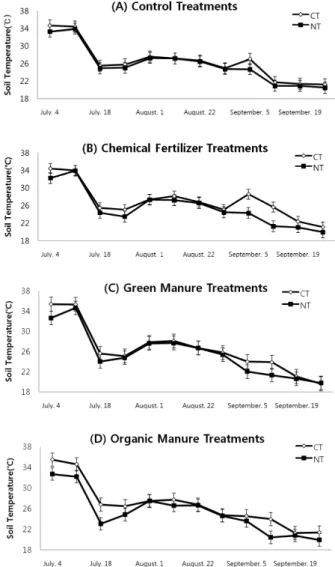
Fig. 1. Soil temperature change of all treatments in July, August, and September [CT : Conventional-Tillage, NT : No-Tillage].

40 μm film thickness)고, carrier gas는 N

2

로 유속을 분당 60 ml/min로 조절하였으며 Detector의 온도는 350°C 로 하 였다. 측정된 기체농도를 이용하여 배출된 기체의 배출량은 다음 (Eq. 1)에 의하여 계산되었다 (Kim, 2007; Kim and Oh, 2003).

  ×    ×   ×      (Eq. 1)

F : flux (μg m

-2

hr

-1

) ρ: density of gas (mg m

-3

) V: volume of the chamber (m

3

)

A: the bottom area of the chamber (m

2

)

ΔC/Δt: the average changing rate of concentration with time (ppb V hr

-1

)

T: average temperature in the chamber (°C)

통계분석은 EXCEL 기반의 KESS (Korean Educational Statistics Software, stat.snu.ac.kr/time)를 이용하였으며, 아산화 질소 배출에 대한 토양수분과 토양 온도의 상관관계 를 분석하기 위해 Pearson correlation 분석법을 이용하여 5% 수준에서 통계적 유의성을 검토하였고, 평균 배출량은 LSD 검정을 이용하였다.

Results and Discussion

토성 시험 토양의 토성은 모래 78.6%, 미사 17.4%, 점 토 4%로 이루어진 양질 사토이다. 토양 화학성 분석 결과는 아래의 Table 1과 같다.

토양온도 및 수분함량 콩의 파종 이후 7월 초부터 9 월 말까지 토양온도를 12회 측정한 결과는 아래의 Fig. 1과 같다. 무 경운 및 경운 처리구에 동일한 비료를 공급하였을 경우, 경운 처리구의 온도가 무 경운 처리구의 온도에 비해 전체적으로 1~3°C 높은 것을 확인할 수 있었다. 이 결과는 Arora et al. (2010) Parkin et al. (2013)의 토양을 경운 할 경우 토양온도가 높아진다는 연구결과와 유사하다. 경운 여 부에 따라 온도의 차이가 발생하는 원인은 다양하나, 가장 큰 요인은 경운 여부에 따라 발생하게 되는 토양 공극의 차 이에 의한 것이라 사료 된다. 이와 유사하게 Sidiras and Pavan (1986)은 경운 여부와 토양의 온도 간 관계에 대한

연구를 실시하였으며, 무 경운 토양의 토양 공극이 경운 토 양의 공극에 비해 적으므로 토양 내 열의 이동이 감소한다 는 연구결과를 보고하였다. 모든 처리구의 평균 온도는 7월>

8월>9월의 순이었으며, 수분함량은 7월에 비해 8월에 크게 증가하였다가 9월에 접어들면서 감소하는 것을 확인할 수 있었다. 이는 8월의 강우량이 많았기 때문에 토양수분 함량 이 8월에 큰 값을 가진 것으로 사료된다. 모든 처리구의 콩 작물 재배기간 동안 측정한 토양 수분함량은 Fig. 2와 같으 며, 시험포장의 작물재배기간의 강우량은 Fig. 3과 같다.

N

2

O gas 발생량 7월 초에서 9월 말까지 온실기체 N

2

O

(4)

Fig. 2. Soil water content of all treatments in July, August, and September [CT : Conventional-Tillage, NT : No-Tillage].

Fig. 3. Weekly accumulated precipitation at the Chungbuk University farm, Cheongju, Chungbuk, Korea.

의 발생량 측정 결과, 대체적으로 무 경운 처리구에서 발생 하는 N

2

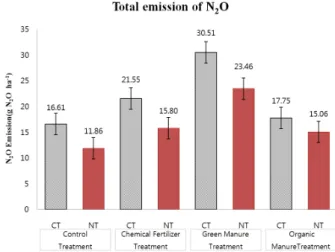
O gas의 발생량이 경운 처리구의 gas 발생량에 비 해 낮은 경향을 보였고, 결과는 Fig. 4와 같다. N

2

O gas 발 생량은 토양 온도가 높은 7월 보다 토양온도가 낮은 9월에 서, 경운 처리구에 비해 무 경운 처리구에서 적은 경향을 보 였다. 대조구에서 무 경운 처리구의 N

2

O gas 발생량은 경운 처리구의 발생량에 비해 1.66%~29.22% 낮았고, 녹비 처리 구에서 무 경운 처리구의 N

2

O gas 발생량은 경운 처리구에 비해 8.57%~31.45% 낮았다. 화학 처리구의 경우, 무 경운 처 리구에서 경운 처리구의 N

2

O gas 발생량에 비해 7.78%~

22.59% 낮았다. 가축분뇨 처리구는 다른 처리구들과 다른 경향을 보였는데, 8월의 N

2

O gas 발생량이 경운 처리구보 다 6.62% 높았다. 7월 및 9월은 무 경운 처리구에서 발생한 N

2

O gas의 양이 경운 처리구에서 발생한 양에 비해 각각 9.50%, 28.38% 낮았다. 또한, 비료 공급에 따른 N

2

O gas 발

생량은 무 경운 및 경운 처리 토양에서 유사한 양상을 보였 다. 이러한 결과는 기존의 관행적인 경운농법을 이용하여 작물을 재배하는 경우에 비해 경운을 최소화 할 때 온실가 스가 적게 생성되어 온실가스 감축 효과가 높다는 Douglas (1993)와 Kim et al. (2011)의 연구결과와 일치하였다. 비료 공급 시, N

2

O gas 발생량이 가장 낮은 처리구는 가축분뇨 처리구로 비료를 공급하지 않은 대조구와 N

2

O gas 발생량 차이가 거의 없었다. 반대로, N

2

O gas 발생량이 가장 높은 처리구는 화학비료 처리구로 대조구의 N

2

O gas 발생량에 비해 16%~137% 증가하였다. 작물생육기간 (7월~10월)동안 처 리구별 발생된 아산화질소 배출량의 총 합은 Fig. 5. 와 같다.

무경운 밭 토양에서 콩을 재배하였더니 N

2

O gas 발생량이 경

운 토양에 비해 약 15.16~28.55%로 적게 발생하였다. Hellebrand

et al. (2008), Conen et al. (2000), Xu et al. (2004)는 토양

수분, 토양온도 그리고 무기태질소 등 3가지 요인이 N

2

O

gas 발생량에 영향을 미친다 하였다. 경운의 유무와 비료의

종류별로 나눈 처리구의 토양 온도와 N

2

O gas 발생량의 상

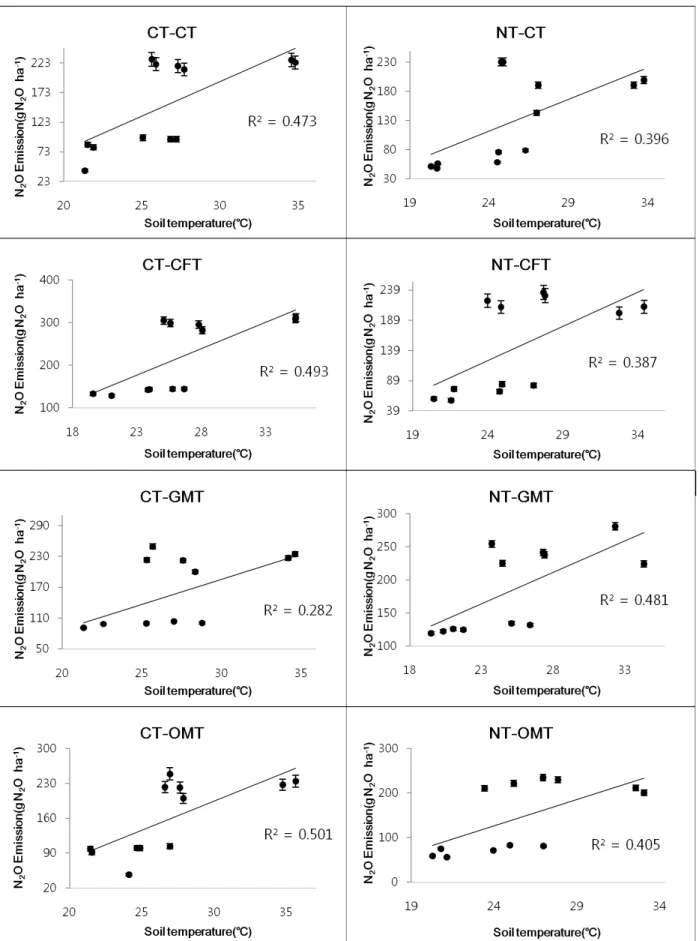
관관계 분석 결과는 Fig. 6와 같다. 경운 처리구의 상관관계

를 살펴보면, CT-CT는 토양온도와 N

2

O gas 발생량과의 상

관계수는 (r)은 0.69

*

(p<0.05%)이고 유의확률은 0.0134로

유의한 양의 상관관계를 보였으며, CT-CFT의 상관계수는

0.70

*

(p<0.05%)이고 유의확률은 0.0108로 유의한 양의 상

(5)

Fig. 5. Integrated N

2

O emissions by no tillage and conventional tillage practice in upland soil.

Fig. 4. Measurement of N

2

O emissions on the cultivation of soybean by no tillage and conventional tillage practice in upland soil.

관관계를 보였다. 반면 CT-GMT에서 토양온도와 N

2

O gas 발생량과의 상관계수는 0.53

*

(p<0.05%)이고 유의 확률은 0.0755로 유의성을 확인할 수 없었다. CT-OMT에서 상관계

수는 0.71

**

(p<0.01%) 유의확률은 0.01로 고도로 유의한 양 의 상관관계를 확인하였다. 무경운 처리구의 상관관계는 NT-CT의 상관계수는 0.63

*

(p<0.05%), 유의확률은 0.02로 유의한 양의 상관관계, NT-CFT의 상관계수는 0.62

*

(p<

0.05%), 유의확률은 0.0307로 유의한 양의 상관관계, NT-

GMT의 상관계수는 0.69

*

(p<0.05%), 유의확률은 0.0126으

로 유의한 양의 상관관계, NT-OMT의 상관계수는 0.64

*

(p<0.05%), 유의확률은 0.026으로 유의한 양의 상관관계를

보였다. 이는 Frolking et al. (1998)과 Gödde and Conrad

(1999)의 토양온도와 N

2

O gas 의 발생량간의 상관관계를 분

석한 결과와 일치하였다. 온도에 의한 N

2

O gas 의 발생량의

차이는 탈질작용에서 미생물의 활성에 온도에 따라 영향을

받는것으로 사료된다. Reay (2012)은 호기 조건에서 미생물

에 의해 질산화 작용이 촉진되며, 습한 토양에서는 탈질현

상으로 N

2

O gas 발생이 증가한다고 하였다. 또한, Parton

et al. (1996)과 Yang (2011)은 토양의 수분함량도 N

2

O 배출

량에 영향을 준다고 하였으나 본 연구에서는 토양 수분함량

과 N

2

O gas 발생량의 비교 결과에서는 유의성을 확인 할 수

없었다. 이는 실험 토양의 성분 차이와 강수량의 차이로 사

료된다. 본 토양은 토성 분석 결과 모래 78.6%, 미사 17.4%,

점토 4%로 이루어진 Loamy Sand로 배수성이 좋아 수분을

토양에 저장하는 기간이 짧아 N

2

O 배출량에 큰 영향을 주지

못한 것으로 사료된다. 토양온도와 수분과의 관계는 토양

온도가 급감한 직후 토양수분함량이 급격히 상승하는 것을

확인할 수 있었는데, 이는 토양의 온도가 감소함에 따라 포

화 수분함량은 감소한 반면, 토양에 존재하는 수분의 양은

감소하지 않았기 때문일 것이라 판단된다. 본 연구는 1년차

연구로써 경운, 무경운에 의한 토양의 변화에 대한 효과를

구명하기에는 어려움이 있었다. 하지만 앞으로 연속적으로

이어나갈 실험을 통해 경운, 무경운의 토양 물리성 변화를

구명할 수 있을 것으로 기대되며 앞으로 실시될 무경운 농

법에 대한 연구는 장기간 무경운과 경운이 토양의 성질 변

(6)

Fig. 6. Correlation of N

2

O emissions and soil temperature [CT-CT : Conventional Tillage-Control Treatment, CT-CFT :

Conventional Tillage-Chemical Fertilizer Treatment, CT-GMT : Conventional Tillage-Green Manure Treatment, CT-OMT :

Conventional Tillage-Organic Manure Treatment, NT-CT : No Tillage-Control Treatment, NT-CFT : No Tillage-Chemical

Fertilizer Treatment, NT-GMT : No Tillage-Green Manure Treatment, NT-OMT : No Tillage-Organic Manure Treatment].

(7)

화, 아산화질소 배출량 관한 연구, 무경운의 경제적인 측면 을 비교하는 방향은 물론이고 여러 복합적인 요인들의 상호 작용에 관한 연구가 필요할 것으로 사료된다.

References

Arora, V.K., C.B. Singh, A.S. Sidhu, and S.S. Thind.

2011. Irrigation, tillage and mulching effects on soybean yield and water productivity in relation to soil texture.

Agric. Water Manage. 98:563-568.

Baggs, E.M., M. Stevenson, M. Pihlatie, A. Regar, H.

Cook, and G. Cadisch. 2003. Nitrous oxide emissions following application of residues and fertiliser under zero and conventional tillage. Plant Soil. 254:361-370.

Cambardella, C.A., and E.T. Elliott. 1993. Carbon and nitrogen distribution in aggregates from cultivated and native grassland soils. Soil Sci. Soc. Am. J. 57:1071- 1076.

Chapuis-Lardy L., N. Wrage, A. Metay, J. Chotte, and M.

Bernoux. 2007. Soils, a sink for N

2

O? Global Change Biol. 13:1-17.

Conen, F., K.E. Dobbie, and K.A. Smith. 2000. Predicting N

2

O emissions from agricultural land through related soil parameters. Global Change Biol. 6:417-426.

Douglas, J.T. and C.E. Crawford. 1993. The response of a ryegrass sward to wheel traffic and applied nitrogen.

Grass Forage Sci. 48:91-100.

Freney, J.R. 1997. Emission of nitrous oxide from soils used for agriculture. Nutr. Cycling Agroecosyst. 49:1-6.

Frolking, S.E., A.R. Mosier, D.S. Ojima, C. Li, W.J. Parton, C.S. Potter, E. Priesack, R. Stenger, C. Haberbosch, P.

Dörsch, H. Flessa, and K.A. Smith. 1998. Comparison of N

2

O emissions from soils at three temperate agri- cultural sites: simulations of year-round measurements by four models. Nutr. Cycling Agroecosyst. 52:77-105.

Gödde, M. and R. Conrad. 1999. Immediate and adap- tational temperature effects on nitric oxide production and nitrous oxide release from nitrification and denitrifi- cation in two soils. Biol. Fertil. Soils. 30:33-40.

Gogoi B., and K.K. Baruah. 2012. Nitrous Oxide Emissions from Fields with Different Wheat and Rice Varieties.

Pedosphere. 22:112-121.

Hammel, J.E. 1989. Long term tillage and crop rotation effects on bulk density and soil impedance in northern Idaho. Soil Sci. Soc. Am. J. 53:1515-1519.

Hong, K.P., J.Y. Kim, D.J. Kang, W.K. Shin, and Z.R.

Choe. 1996. Varietal differences on growth characteristics of direct-sown rice under no-tillage paddy field. Korean J. Crop Sci. 41:551-557.

Hong, K.P., Y.G. Kim, W.K. Joung, G.M. Shon, G.W.

Song, Y.J. Choi, and Z.R. Choe. 2003. Changes in physicochemical properties of soil, yield and milling

quality of rice grown under the long-term no-till rice system. Korean J. Crop Sci. 48:196-199.

Inselsbacher E., W. Wanek, R. Ripka, E. Hackl, A.

Sessitsch, S. Straussm, and S. Zechmeister-Boltenstern.

2011. Greenhouse gas fluxes respond to different N fertilizer types due to altered plant-soil-microbe inter- actions. Plant Soil, 343:17-35.

IPCC. 1996. IPCC guideline for national greenhouse gas inventories.

Iserman, K. 1994. Agriculture’s share in the emissions of trace gases affecting the climate and some cause oriented proposals for reducing this share. Environ. Pollut. 83:95- 111.

Keren, J.S. and M.G. Johnson. 1993. Conservation tillage impacts on national soil and atmospheric carbon levels.

Soil Sci. Soc. Am. J. 57:200-210.

Kim, D.S. 2007. Greenhouse gas (CH

4

, CO

2

, N

2

O) emi- ssions from estuarine tidal and wetland and their charac- teristics. J. Korean Soc. Atmos. Environ. 23:225-241.

Kim, D.S. and J.M. Oh. 2003. N

2

O emissions from agri- cultural soils and their characteristics. J. Korean Soc.

Atmos. Environ. 19:529-540.

Kim, G.Y., B.H. Song, K.A. Roh, S.Y. Hong, B.G. Ko, K.M. Shim, and K.H. So. 2008. Evaluation of green house gases emissions according to changes of soil water content, soil temperature and mineral N with different soil texture in pepper cultivation. Korean J. Soil Sci.

Fert. 41:399-407.

Kim, G.Y., H.C. Jeong, K.M. Shim, S.B. Lee, and D.B.

Lee. 2011. Evaluation of N

2

O emissions with different growing periods (spring and autumn seasons), tillage and no tillage conditions in a Chinese cabbage field.

Korean J. Soil Sci. Fert. 44:1239-1244.

Kuk, Y.I., O.D. Kwon, and I.B. Im. 2002. Weed occurrence, growth and yield of rice transplanted with 10-day old seedlings in tillage and no-tillage paddy fields. Korean J. Weed Sci. 22:154-162.

Lee, B.J., Z.R. Choi., S.H. Oh, J.H. Kim, S.Y. Kim, and J.W. Ahn. 2007. Characteristics of growth of Korean native rice cultivars under the no-till rice-vetch cropping system. J. Korean Soc. Int. Agric. 19:279-284.

Lee Y.H. 2010. Rice growth and grain quality in no-till and organic farming paddy field as affected by different rice cultivars. Korean J. Soil Sci. Fert. 43:209-216.

Lilly A., B. Ball, I. McTaggart, and P. Horne. 2003.

Spatial and temporal scaling of nitrous oxide emissions from the field to the regional scale in Scotland. Nutr.

Cycling Agroecosyst. 66:241-257.

Minami, K. 1997. Mitigation of nitrous oxide emissions from fertilized soils. In : Proceedings if IGAC Sumposium, Nagoya, Japan.

Moiser, A.D., A.D. Halvorson, C.A. Curtis, A. Renle, and

(8)

X.J. Liu. 2006. Net global warming potential and green- house gas intensity in irrigated cropping systems in north eastern Colorado. J. Environ. Qual. 35:1584-1598.

Parkin G, V.B. Axel P, and J.M. Amber. 2013. Effect of tillage on soil water content and temperature under freeze - thaw conditions. Vadose Zone J. 3:12. http://dx.

doi.org/10.2136/vzj2012.0075

Parton, W.J., A.R. Mosier, D.O. Ojima, D.W. Valentine, D.S. Schimel, K. Weier, and A.E. Kulmala. 1996.

Generalized model for N

2

and N

2

O production from nitrification and denitrification. Global Biogeochem. Cycles.

10:401-412.

Plaza-Bonilla, D, Á.F. Jorge, L.A. José, and C.M. Carlos.

2014. Tillage and nitrogen fertilization effects on nitrous oxide yield-scaled emissions in a rain fed Mediterranean area. Agric. Ecosyst. Environ. 189:43-52.

RDA. 1999. Fertilizer recommendation standards for various crops. Gwangmun-dang: 57-58 (In Korean).

Reay, D.S., E.A. Davidson, K.A. Smith, P. Smith, J.M.

Melillo, F. Dentener, and P.J. Crutzen. 2012. Global agriculture and nitrous oxide emissions. Nat. Clim. Change.

2:410-416.

Shaver. T.M., G.A. Peterson, L.R. Ahuja, D.G. Westfall, L.A. Sherrod, and G.D. Surface. 2002. Soil physical properties after twelve years of dryland no-till manage- ment. Soil Sci. Soc. Am. J. 66:1296-1303.

Sidiras, N. and M.A. Pavan. 1986. Influência do sistema de manejo na temperatura do solo. Rev. Bras. Ciênc.

Solo. 10:181-184.

Xinhua Y and M.A. Mahdi. 2004. Periodic response of soybean yields and economic returns to long-term no- tillage. Agronomy J. 96:723-733.

Xu Z., H. Ouyang, G. Cao, Z. Pei, and C. Zhou. 2004.

Nitrogen deposition and carbon sequestration in alpine meadows. Biogeochem. 71:353-369.

Yagi K. 1991. Emission of biogenic gas compounds from soil ecosystem and effect of global environment. 2.

Methane emission from paddy fields. Jpn. J. Soil Sci.

Fert. 62:556-562.

Yusuf R.I, C.S. John, and G.B. Donald. 1999. Growth

analysis of soybean under no-tillage and conventional

tillage system. Agronomy J. 91:928-933.

수치

Table 1. Chemical properties of soil before experiment.
Fig. 3. Weekly accumulated precipitation at the Chungbuk  University farm, Cheongju, Chungbuk, Korea
Fig. 5. Integrated N 2 O emissions by no tillage and conventional  tillage practice in upland soil.
Fig. 6. Correlation of N 2 O emissions and soil temperature [CT-CT : Conventional Tillage-Control Treatment, CT-CFT :  Conventional Tillage-Chemical Fertilizer Treatment, CT-GMT : Conventional Tillage-Green Manure Treatment, CT-OMT :  Conventional Tillage-

참조

관련 문서

Relationship between soil pH and phosphatase activity in volcanic ash soil of citrus orchards on the different surface soil management practices at

Concentration of soil residual endosulfan-sulfate with days after treatment of endosulfan in different soils

Null hypotheses of this study was there is no difference in root canal length determination between conventional and heat-treated Ni-Ti files by 2

Comparison of pain scale between the conventional and 2-step needle insertion technique according to the injection area ··· 11... The combination of pain scale and

 In the present study, as a preliminary study, a LACC-based Compton CT was developed to estimate the activity of the spot inside the radioactive waste drum. To

- Mechanical-collimation-based Gamma CT system uses a mechanical collimator to record the unscattered gamma rays events, and to block the scattered events and other

첫째,I CT 활용 교육에 대한 인식 문제 중 I CT 활용에 대한 인식에서는 남자교사 들이 여자교사보다,연수를 받은 교사와 교육경력이 21년 이상 교사의 응답이 높

In this study, it is showed that female and blood type O are the significant factors associated with prolonged C/Epi CT value despite of aspirin discontinuation more