*Corresponding author: Cheolmin Lee, Tel: 010-2074-0409, E-mail: [email protected], Seo Kyeong University, 124, Seogyeon-ro, Seongbuk-gu, Seoul
Received: November 29, 2017, Revised: January 25, 2018, Accepted: February 26, 2018 Cheolmin Lee https://orcid.org/0000-0003-2276-2463
This is an Open-Access article distributed under the terms of the Creative Commons Attribution Non-Commercial
License(http://creativecommons.org/licenses/by-nc/3.0) which permits unrestricted non-commercial use, distribution, and reproduction in any medium, provided the original work is properly cited.
화학사고 주변 지역 거주자의 보건환경 관리를 위한 건강위해성 평가 방법 개발에 관한 연구
박시현
1
ㆍ박세정ㆍ박태현ㆍ윤단기ㆍ정종현2
ㆍ강성규2
ㆍ이동수3
ㆍ서영록4
ㆍ안연순5
ㆍ이철민*
1
서경대학교 나노생명공학과,2
대구한의대학교 보건학부,3
서울대학교 환경대학원,4
동국대학교 생명과학과,5
동국대학교 일산병원 직업환경의학과A Study on the Development of a Health Risk Assessment Method for the Management of the Health Environment of Residents Living Around Areas
Affected by Chemical Accidents
Sihyun Park
1
ㆍSejung ParkㆍTaehyun ParkㆍDanki YoonㆍJonghyeon Jung2
ㆍ Sungkyu Gang2
ㆍDongsoo Lee3
ㆍYoungrok Seo4
ㆍYeonsoon An5
ㆍCheolmin Lee*
1 Department of Nano and Biological Engineering
2 Faculty of Health Science, Daegu Haany University
3 Graduate School of Environmental Studies, Seoul National University
4 Department of Life Science, Dongguk University
5 Department of Occupational Medicine, Dongguk University Ilsan Hospital
ABSTRACT
Objectives: This research is part of a study to be conducted over five years starting from 2017 by the Ministry of Environment on the development of technologies to evaluate the impact of chemical accidents on the human body.
Methods: For this research, a five-stage specific study method was developed.
Results: In brief, the developed health risk assessment method can be summarized as follows. First, a health risk assessment system was built based on the guidelines set forth by the USA NRC/NAS. Second, based on the disease manifestation theory, the health risk assessment method was divided into 1) a carcinogenic health risk assessment method focused on all carcinogens except non-genotoxic carcinogens and 2) a non-carcinogenic health risk assessment method focused on noncarcinogens including non-genotoxic carcinogens. Third, the detailed contents of the health risk assessment method were developed in four stages(hazard identification, dose-response assessment, exposure assessment, and risk determination) through theoretical consideration of the assessment of the level of health risk related to chemical exposure. Finally, a health risk assessment methodology, classified into stages to address acute, subacute/subchronic, and chronic conditions was developed after considering the physicochemical behavior of hazardous chemicals upon implementation of countermeasures after a chemical accident.
Conclusions: A method to evaluate the health risks related to toxic chemicals generated by chemical accidents was developed. This study was performed with the purpose of developing a mathematical health risk assessment method to evaluate the health effects of exposure to hazardous chemicals upon implementation of emergency countermeasures after chemical accidents.
Key words: chemical accident, chronic, risk assessment, subacute/subchronic
I. 서 론
우리나라의 산업특성상 인화성, 독성 등 유해화학 물질을 다종, 다량 취급하는 시설을 보유한 사업장은 그렇지 않은 시설에 비해 사고발생 잠재위험성이 매 우 높은 특성을 가지고 있다. 또한 대부분의 화학물질 취급공장이나 취급공정은 고도의 기술이 집약된 복잡 한 공정 등이 상호 연속적이고 일률적인 형태로 구성 되어 있어 화학사고와 같은 심각한 환경적 재앙이 발 생할 경우에 단 한번의 사고로도 막대한 인적, 물적 손실을 초래할 뿐 아니라 환경을 오염시키거나 지역 주민들에게 피해를 주는 경우가 많다. 특히나 최근 발 생하고 있는 화학사고의 경향이 1차 피해로 끝나지 않고 2차적으로 주민과 환경에 영향을 미치는 등 많 은 위험을 내포하고 있음에 따라 이에 관련한 연구가 필요한 실정이다(Chun et al., 2013).
국내 보고된 주요 화학사고들의 경우 사고 지점 인 근의 사람 및 모든 주변 환경에 단기간 및 장기간 치 명적인 피해를 입힐 수 있다는 특징을 가지고 있다.
하지만 현재 유해 화학물질 관리 시스템들 대부분이 단기간의 1차적 피해에 대한 응급대처 및 주민대피 범위 산정과 구조 활동 등에 초점을 두고 구축되어지 고 있는 실정으로, 화학사고 처리 후 대피한 지역주민 이 생활지역(화학사고 영향지역)공간으로 복귀하였을 때 정화 활동 이후 대기, 수질 및 토양에 잔류하는 유 해화학물질의 장기간의 노출로 인한 만성적 건강영향 발현 등의 2차적 피해에 관한 예측 및 관리에 요구되 는 시스템 구축은 전무한 실정이다. 또한 현재 화학사 고로 인한 유해화학물질의 노출로 인한 2차적 피해에 관한 위해성평가, 위해도 관리 및 위해 의사소통을 위 한 지침에 대한 유용한 국내외 합의 또한 없는 실정이 다(RIVM, 2013).
환경부는 2005년부터 사고지역에 대한 체계적인 복 구 및 사후 모니터링 체계 구축사업을 추진 중에 있으 며, 사고 후 영향조사 제도의 조기정착과 보다 신뢰성 높은 사고조사가 가능하도록 노출량 산정을 위한 각 종 데이터베이스를 수집⋅구축하고, 다매체 거동모델 등의 위해성 평가 툴을 개발하는 등 단계적 사고 후 영향조사 관리시스템을 개발⋅운영하고자 노력하고 있다(Yoon et al., 2007). 이와 같은 노력의 일환으로 환 경부에서는 화학사고 대응 환경기술개발사업으로 ‘화
학사고 후 인체영향평가기술 개발’에 관한 연구를 2017년부터 총 5차년에 걸쳐 추진 중에 있다. 본 연구 는 ‘화학사고 후 인체영향평가 기술 개발’에 관한 연 구의 일환으로 화학사고로 인해 환경매체 중에 잔류 하는 유해화학물질의 장기간 노출에 의한 누적 노출 량 및 건강위해성 평가 방법을 개발하여 제시함으로 써 본 연구의 모체 연구인 ‘화학사고 후 인체영향평가 기술 개발’ 연구의 성공적 수행을 위한 연구 기반을 구축하고자 수행되었다.
Ⅱ. 연구대상 및 방법
본 연구는 화학사고 발생 시 사고비상대처 이후 환 경매체 중에 잔류하는 유해화학물질의 노출에 의한 건강위해 발현 가능성을 정량적으로 평가할 수 있는 방법의 개발을 목적으로 하고 있다. 이에 다음과 같은 단계별 세부연구목표를 설정하고 각 세부연구목표의 성공적 달성을 통해 본 연구의 최종목표가 달성될 수 있도록 연구설계 하였다.
1단계 세부연구 목적은 국내 건강위해성평가 연구 의 현황을 분석하고 화학사고 사고비상대책 이후 잔 류하는 유해화학물질의 노출에 의한 건강위해평가 기 술개발의 필요성을 검토하는 것이다. 이의 목표달성 을 위해 국내 유해화학물질의 노출에 의한 건강위해 성평가에 관한 연구의 정보수집 및 데이터베이스를 구축하고, 구축된 데이터베이스의 분석을 통한 화학 사고 유해화학물질을 대상으로 한 건강위해성평가 방 법 개발의 필요성을 검토하였다. 데이터베이스 구축 을 위한 정보 수집은 서경대학교 학술정보관에서 지 원하는 학술 데이터베이스 중 국내 전자저널 검색을 이용하여 다음과 같은 문헌검색 및 선정조건을 설정 하고 이에 적합한 연구논문을 선정하였으며, 선정된 논문의 참고문헌에서 본 연구의 내용에 부합된 자료 를 추가적으로 조사하여 본 연구의 연구대상 연구논 문으로 선정하였다. 문헌 검색에 있어 검색어로는 ‘위 해성’, ‘위험성’, ‘유해화학물질’, ‘화학사고’, ‘건강위해 성’, ‘노출평가’ 등으로 건강위해성평가 또는 화학사고 의 의미를 포함하는 단어를 이용하였다. 문헌조사 범 위로 발표기간은 국내 건강위해성평가에 관한 연구의 도입이 1980년대 중반 이후인 것을 고려하여 1980년 대 이후로 하였으며, 국내 환경에 부합되는 건강위해
성평가 방법의 도출을 도모하기 위하여 국내 환경을 대상으로 수행된 건강위해성평가 결과를 제시한 문헌 만을 선정하였다.
2단계 세부목표는 국내 유해화학물질 노출에 대하 여 적용되어진 건강위해성평가 방법과 선진국의 관련 기관에서 적용되어지고 있는 건강위해성평가방법들의 비교를 통해 화학사고 유해화학물질 건강위해성평가 방법에 가장 적합한 방법을 개발하는 것이다. 이의 목 표달성을 위해 우선적으로 구축된 데이테베이스를 활 용하여 국내 유해화학물질의 노출에 의한 건강위해성 평가를 수행하는데 활용된 평가 모델들의 종류와 각 모델의 활용 빈도수 등을 조사하여 국내에서 가장 많 이 활용되어지고 있는 건강위해성평가 모델을 도출하 고 또한 선진국에서 활용되어지고 있는 건강위해성평 가 방법들의 고찰을 통해 화학사고 유해화학물질 건 강위해성평가에 적합한 방법을 개발하였다.
3단계 세부목표는 질병발현 이론에 기초한 유해화학 물질 노출에 기인한 발암성 및 비발암성 질환 발현 가 능성을 평가할 수 있는 화학사고 유해화학물질 건강위 해성평가 방법을 개발하는 것이다. 이를 위해 일차적으 로 건강위해성평가에서 적용되어지는 질병발현 모형의 이론을 검토하였으며, 모형의 종류에 따른 구분된 건강 위해성평가 방법을 도출하였다. 또한 최근 미국환경보 호청(United States Environmental Protection Agency)에서 권장하고 있는 MOE(Margin of Exposure)를 이용한 평가 방법이 고려된 건강위해성평가 방법을 개발하였다.
4단계 세부목표는 개발된 건강위해성평가 방법의 수행에 있어 세부적 수행내용을 구체화하는 것으로 1 단계에서 3단계의 세부연구 수행을 통해 개발되어진 건강위해성평가 모델의 이론적 내용의 검토를 통해 건강위해성을 수행하는데 있어 세부적 구체적 내용을 도출하였다. 도출되어진 세부내용들은 범주화를 통해 4개의 세부수행내용(유해성 확인, 용량-반응 평가, 노 출 평가 및 위해도 결정)으로 재구성하여 제시하였다.
최종적으로 5단계 세부연구 목표는 화학사고 유해 오염물질의 사고 이후 시간에 따른 환경매채간의 이 동 및 감소 등의 특성이 고려된 건강위해성평가 모델 을 개발하는 것으로 1단계 - 4단계까지 도출된 건강위 해성평가 방법과 화학사고 특성이 고려된 노출량과 노출시간의 변화 등을 고려하여 급성, 아급성/아만성 및 만성 질환발현이 예측 가능한 건강위해성평가 방 법을 개발하였다.
Ⅲ. 연구결과 및 고찰
1. 국내 건강위해성평가 연구 현황 분석 및 평가 기 술 개발 필요성 검토
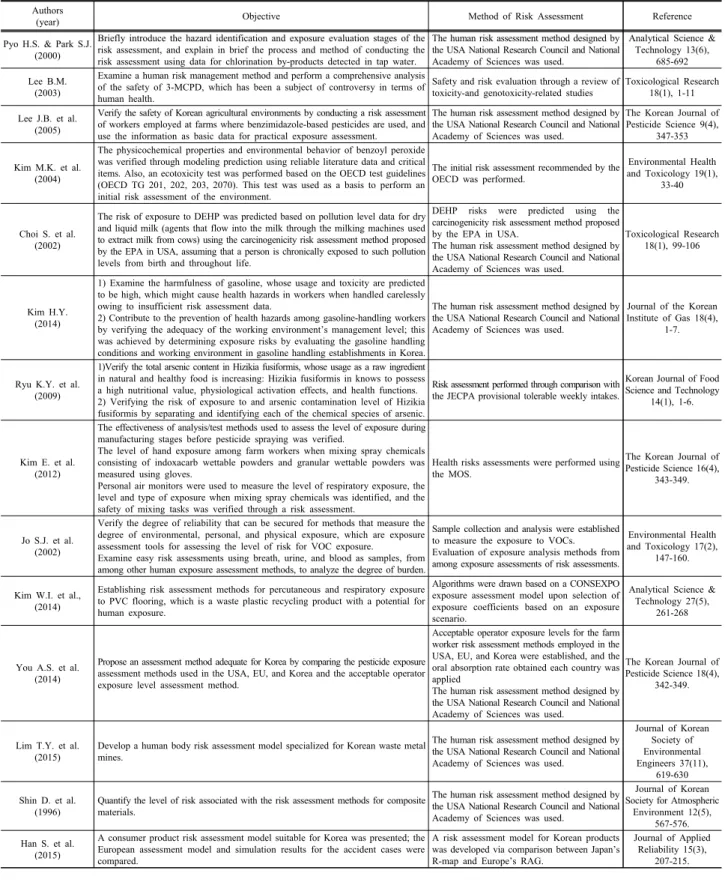
1980년대 이후 국내 학술지에 건강위해성평가 주제 로 보고된 연구는 Table 1에 제시된 것과 같이 총 60편 으로, 최초로 보고된 연구는 Shin et al.(1994)에 의해 서울시 일부지역 대기부유분진 중 중금속의 노출에 의한 발암위해성 평가를 시행한 연구인 것으로 조사 되었으며, 이후 현재까지 지속적으로 위해성평가에 관한 연구가 수행되어져 오고 있는 것으로 나타났다.
위해성평가 연구가 수행되어진 분야로는 농약성분 중 의 유해화학물질 노출에 의한 농작업자나 일반인을 대상으로 수행된 위해성평가 연구(농업분야), 식품 내 유해화학물질 노출에 의한 위해성평가 연구(식품분 야), 건축자재 및 제품 내 유해화학물질 노출에 의한 위해성평가 연구(건자재 및 제품 분야)와 대기, 물, 토 양 및 실내공기오염과 폐기물에 의한 위해성평가 연 구(환경분야) 및 위해성평가 방법에 대한 전반적인 고 찰 분야로 다양한 분야에서 연구가 수행되어져 오고 있는 것으로 나타났으며 국내 화학사고로 기인된 유 해화학물질의 노출에 의한 건강위해성평가 연구는 전 무한 실정인 것으로 조사되었다.
국내의 경우 최근 화학사고시 방출된 유해화학물질에 의한 주변 지역 거주자들의 건강영향 및 생태계에 대한 피해 방지 및 복원에 대한 국민의 요구가 증대되고 있으 며, 환경부 역시 이의 중요성을 인식하여 다양한 연구를 통한 관리방안을 마련하고 있으나 화학사고 시 응급대처 에 대한 관리방안 마련에 그치고 있는 실정으로 중장기 화학사고 유해화학물질 노출에 의한 주변 생활지역 거주 자들의 건강보호 및 생태계 보호에 관한 관리방안 마련이 이루어지고 있지 않은 실정이다. 국내의 경우 화학사고 발생시 ‘화학물질관리법’ 제45조 및 제46조와 환경부훈 령 제2015-1175호 ‘화학사고 조사단 구성⋅운영 및 영향 조사에 관한 지침’에 근거하여 화학사고 조사단을 구성 하여 운영하도록 하고 있다. 화학사고 조사단의 화학사고 영향조사의 목적은 화학사고의 원인이 되는 화학물질(사 고 물질)이 화학사고 발생지역 인근 주민의 건강 및 주변 환경에 미칠 수 있는 영향을 과학적인 방법으로 사고 원인, 피해확인, 피해규모, 피해금액 등을 규명하는 것으 로 조사 방법 중 환경영향조사 및 건강영향조사의 내용이
Authors
(year) Objective Method of Risk Assessment Reference
Pyo H.S. & Park S.J.
(2000)
Briefly introduce the hazard identification and exposure evaluation stages of the risk assessment, and explain in brief the process and method of conducting the risk assessment using data for chlorination by-products detected in tap water.
The human risk assessment method designed by the USA National Research Council and National Academy of Sciences was used.
Analytical Science &
Technology 13(6), 685-692 Lee B.M.
(2003)
Examine a human risk management method and perform a comprehensive analysis of the safety of 3-MCPD, which has been a subject of controversy in terms of human health.
Safety and risk evaluation through a review of
toxicity-and genotoxicity-related studies Toxicological Research 18(1), 1-11
Lee J.B. et al.
(2005)
Verify the safety of Korean agricultural environments by conducting a risk assessment of workers employed at farms where benzimidazole-based pesticides are used, and use the information as basic data for practical exposure assessment.
The human risk assessment method designed by the USA National Research Council and National Academy of Sciences was used.
The Korean Journal of Pesticide Science 9(4),
347-353
Kim M.K. et al.
(2004)
The physicochemical properties and environmental behavior of benzoyl peroxide was verified through modeling prediction using reliable literature data and critical items. Also, an ecotoxicity test was performed based on the OECD test guidelines (OECD TG 201, 202, 203, 2070). This test was used as a basis to perform an initial risk assessment of the environment.
The initial risk assessment recommended by the OECD was performed.
Environmental Health and Toxicology 19(1),
33-40
Choi S. et al.
(2002)
The risk of exposure to DEHP was predicted based on pollution level data for dry and liquid milk (agents that flow into the milk through the milking machines used to extract milk from cows) using the carcinogenicity risk assessment method proposed by the EPA in USA, assuming that a person is chronically exposed to such pollution levels from birth and throughout life.
DEHP risks were predicted using the carcinogenicity risk assessment method proposed by the EPA in USA.
The human risk assessment method designed by the USA National Research Council and National Academy of Sciences was used.
Toxicological Research 18(1), 99-106
Kim H.Y.
(2014)
1) Examine the harmfulness of gasoline, whose usage and toxicity are predicted to be high, which might cause health hazards in workers when handled carelessly owing to insufficient risk assessment data.
2) Contribute to the prevention of health hazards among gasoline-handling workers by verifying the adequacy of the working environment’s management level; this was achieved by determining exposure risks by evaluating the gasoline handling conditions and working environment in gasoline handling establishments in Korea.
The human risk assessment method designed by the USA National Research Council and National Academy of Sciences was used.
Journal of the Korean Institute of Gas 18(4),
1-7.
Ryu K.Y. et al.
(2009)
1)Verify the total arsenic content in Hizikia fusiformis, whose usage as a raw ingredient in natural and healthy food is increasing: Hizikia fusiformis in knows to possess a high nutritional value, physiological activation effects, and health functions.
2) Verifying the risk of exposure to and arsenic contamination level of Hizikia fusiformis by separating and identifying each of the chemical species of arsenic.
Risk assessment performed through comparison with the JECPA provisional tolerable weekly intakes.
Korean Journal of Food Science and Technology
14(1), 1-6.
Kim E. et al.
(2012)
The effectiveness of analysis/test methods used to assess the level of exposure during manufacturing stages before pesticide spraying was verified.
The level of hand exposure among farm workers when mixing spray chemicals consisting of indoxacarb wettable powders and granular wettable powders was measured using gloves.
Personal air monitors were used to measure the level of respiratory exposure, the level and type of exposure when mixing spray chemicals was identified, and the safety of mixing tasks was verified through a risk assessment.
Health risks assessments were performed using the MOS.
The Korean Journal of Pesticide Science 16(4),
343-349.
Jo S.J. et al.
(2002)
Verify the degree of reliability that can be secured for methods that measure the degree of environmental, personal, and physical exposure, which are exposure assessment tools for assessing the level of risk for VOC exposure.
Examine easy risk assessments using breath, urine, and blood as samples, from among other human exposure assessment methods, to analyze the degree of burden.
Sample collection and analysis were established to measure the exposure to VOCs.
Evaluation of exposure analysis methods from among exposure assessments of risk assessments.
Environmental Health and Toxicology 17(2),
147-160.
Kim W.I. et al., (2014)
Establishing risk assessment methods for percutaneous and respiratory exposure to PVC flooring, which is a waste plastic recycling product with a potential for human exposure.
Algorithms were drawn based on a CONSEXPO exposure assessment model upon selection of exposure coefficients based on an exposure scenario.
Analytical Science &
Technology 27(5), 261-268
You A.S. et al.
(2014)
Propose an assessment method adequate for Korea by comparing the pesticide exposure assessment methods used in the USA, EU, and Korea and the acceptable operator exposure level assessment method.
Acceptable operator exposure levels for the farm worker risk assessment methods employed in the USA, EU, and Korea were established, and the oral absorption rate obtained each country was applied
The human risk assessment method designed by the USA National Research Council and National Academy of Sciences was used.
The Korean Journal of Pesticide Science 18(4),
342-349.
Lim T.Y. et al.
(2015)
Develop a human body risk assessment model specialized for Korean waste metal mines.
The human risk assessment method designed by the USA National Research Council and National Academy of Sciences was used.
Journal of Korean Society of Environmental Engineers 37(11),
619-630
Shin D. et al.
(1996)
Quantify the level of risk associated with the risk assessment methods for composite materials.
The human risk assessment method designed by the USA National Research Council and National Academy of Sciences was used.
Journal of Korean Society for Atmospheric
Environment 12(5), 567-576.
Han S. et al.
(2015)
A consumer product risk assessment model suitable for Korea was presented; the European assessment model and simulation results for the accident cases were compared.
A risk assessment model for Korean products was developed via comparison between Japan’s R-map and Europe’s RAG.
Journal of Applied Reliability 15(3),
207-215.
Table 1. The purpose of the risk assessment study and its evaluation method reported in domestic journals
Lee M.G. & Lee S.R.
(1997)
The dietary intake was calculated after calculating the theoretical maximum intake and estimated intake of organophosphorus pesticide ingredients, and the level of risk imposed by organophosphorus pesticides on the health of Koreans was evaluated.
Various magazines (journals) were used to acquire pesticide removal rate data.
The 23 types of pesticide ingredients used in Korea and the 8 types of pesticide ingredients not used in Korea were selected as targets.
Korean Society of Food Science and Technology
29(2), 240-248.
Park J.S. et al.
(2003)
Uncertainties/variations observed in result analyses and measurements conducted in various environments and individual exposures and detectable symptoms and biomarkers listed in Korean environmental epidemiology surveys and risk assessment studies were classified via a literature review. By examining the response to each uncertainty classification item and presenting the necessary response method, basic data that accounted for uncertainties/variations at the design stage of the environmental epidemiology field surveys were provided.
Some environmental epidemiology and risk assessment literature released in Korea was collected to determine literature selection criteria and organize the selected literature contents by item accordingly.
Korean Society of Environmental Health
29(5), 101-109.
Chae H. et al.
(2009)
Analysis results from 1998 to 2007 were compared by water system and season, and the level of non-carcinogenic risk on the human body imposed by drinking tap water was evaluated based on this data.
The human risk assessment method designed by the USA National Research Council and National Academy of Sciences was used.
Analytical Science &
Technology 22(5), 386-394.
Kong J.S. & Kim Y.
(2016)
A risk assessment of the application of exposure time and measurement data on the indoor concentration of radon within military bases and underground shopping malls was performed.
The E-PERM, which is a charging membrane ionization chamber-type measurement device, was used on underground shopping malls located around major subway stations in the area of Seoul (August-September 2016) and military facilities (measurement was performed on 2015) that were part of the radon reduction program in 2014
Korean Journal of Environmental Health
42(5), 345-351.
Lim Y.W. et al.
(2008)
PCB concentration changes in the environment was predicted for two situations:
where the regulatory concentration was 2 ppm as it is currently, and where the regulatory concentration was mitigated to 50 ppm. Also, the validity of current regulatory standards was verified via human and ecological risk assessments for each situation.
The human risk assessment method designed by the USA National Research Council and National Academy of Sciences was used.
Environmental Health and Toxicology 23(1),
53-62.
Hong J.E. et al., (2003)
The concentration of 1, 4-dioxane in actual water samples was examined, and a risk assessment was performed on drinking water according to the detected quantities.
The human risk assessment method designed by the USA National Research Council and National Academy of Sciences was used.
Environmental Health and Toxicology 18(3),
219-224.
Lee J.Y. et al.
(2008)
12 water filtration plants and 4 water intake stations were selected from the water system of the Nakdong River, where 1,4 dioxane is mainly detected. Then, purified and raw water was collected from each site and the concentration of 1,4-dioxane was measured (2000 to 2007). Also, a risk assessment of potable water was performed.
The human risk assessment method designed by the USA National Research Council and National Academy of Sciences was used.
Analytical Science &
Technology 21(5), 383-391.
Chung Y. et al.
(1999)
Identify the complete lead exposure route via which the human body can come in contact with the outside environment and provide basic data on health risk assessment and risk management by evaluating the total exposure and risks of lead exposure on the human body through multiple routes by measuring the degree of pollution in the environment according to the exposure route.
The human risk assessment method designed by the USA National Research Council and National Academy of Sciences was used.
Environmental Health and Toxicology 14(4),
203-216.
Kim M.S. et al.
(2007)
Examine the potential hazards of nano-materials and consider a risk assessment plan for human and environmental risks
Organized into the need for research on the risks of nano-technology, potential exposure, toxicity research cases, required research fields, and future research direction.
Clean Technology 13(3), 161-172.
Lee J.B. et al.
(2004)
Report the dietary intake risk assessment results of the estrogenic effects of pesticides known to be endocrine disruptors by calculating the estimated maximum daily intake.
A luciferase assay was performed using human ovarian cancer cells (BG1luc4E2) to evaluate the estrogenic effects of 17 types of pesticides such as benomyl, carbaryl, and endosulfan, which are classified as endocrine disruptors.
The Korean Society of Pesticide Science 8(2),
95-102.
Choi B.W. et al.
(2006)
The characteristics of the distribution of heavy metals in the air was examined in the area of Ulsan, and carcinogenic risks were evaluated after including the recommendation criteria of the WHO, with the level of 10
-5set as the guideline value concentration for 4 trace heavy metals rated above bin the USEPA carcinogenesis rating. This was based on the characteristics of pollutant sources in Ulsan Metropolitan City.
The human risk assessment method designed by the USA National Research Council and National Academy of Sciences was used.
Korean Journal of Environmental Health
32(5) 522-531
Lee B.M.
(1999)
Consider the possibilities of utilization of biomarkers during environmental and
human risk assessments. Theoretical consideration
Environmental Mutagens and Carcinogens 19(2),
95-101.
Choi H. et al.
(2012)
The risks of exposure to heavy metals via mushroom ingestion in Koreans was evaluated through a factual survey on the content of heavy metals in mushrooms to identify the level of risk.
The average level of exposure of all Koreans to heavy metals when ingesting mushrooms distributed in Korea as food was evaluated and compared with the human exposure safety standards of the JECFA.
Korean Journal of Food Science and Technology
44(6), 666-672.
Hong S. et al.
(2013)
The level of pesticide exposure among pesticide sprayers was calculated using the model currently used for pesticides used in gardens in Korea, and a risk assessment was performed using the acceptable operator exposure levels of each country.
The human risk assessment method designed by the USA National Research Council and National Academy of Sciences was used.
The Korean Journal of Pesticide Science 17(1),
50-59.
Choi J.Y. & Kim K.
(2015)
The distribution of trace metals inside fish collected near the Yongho Pier during the marine pollution sediment purification program was identified and used as part of the basic monitoring data used to evaluate environmental changes before and after the program. Based on these data, the level of exposure to trace metals by ingestion of fish from adjacent sea areas and the potential risks to human health were evaluated to present basic data for the marine environment management of target areas in the future.
The human risk assessment method designed by the USA National Research Council and National Academy of Sciences was used.
Journal of Korean Society of Environmental Engineers 37(6),
349-356.
Choi J.Y. et al.
(2012)
The characteristics of the distribution of organochlorine pesticides and PCGs inside fish and seabed sediments within a radius of 1.5 km around the Yongho Pier were identified. Based on these data, the level of exposure of residents to PCB when ingesting the researched fish was evaluated, and the potential human risks were predicted.
The human risk assessment method designed by the USA National Research Council and National Academy of Sciences was used.
Journal of Korean Society of Environmental Engineers 34(12),
810-820
Choi J.H. et al.
(2013)
As result of analyzing residual amounts by performing packaging tests on the representative agricultural products, the source data of the national health and nutrition survey (MHW, 2009) and the food intake of vulnerable classes (infants) were calculated to perform an assessment of the risks of exposure to rotenone when ingesting the representative agricultural products and present basic data for studies on securing the safety of eco-friendly organic materials.
The human risk assessment method designed by the USA National Research Council and National Academy of Sciences was used.
The Korean Journal of Pesticide Science 17(4),
302-306.
Park E.J. et al.
(2005)
The distribution of PM10 and PM2.5 in the air, as well as the components and content of heavy metals inside them was identified to evaluate human risks in case of ingestion. Also, the potential toxicity to cardiac cells when the respiratory organs are exposed to each heavy metal component was evaluated and compared through experimental research.
The human risk assessment method designed by the USA National Research Council and National Academy of Sciences was used.
Environmental Health and Toxicology 20(2),
179-186.
Shin D.C. et al.
(1994)
A carcinogenesis risk assessment was performed on heavy metals contained in airborne dust in some areas of Seoul to calculate the excess rates of carcinogenesis by exposure and present basic data for the preparation of recommended standard values for these materials.
The human risk assessment method designed by the USA National Research Council and National Academy of Sciences was used.
Jornal of Korean Society for Atmospheric Environment 10(2),
105-115.
Jang M. et al.
(2010)
The components of residual pesticides were analyzed and its presence was identified on vegetables distributed in markets, supermarkets, and department stores of the area of Kangnam, Seoul in 2009. The Monte-Carlo simulation was used to evaluate the level of human risk imposed by ingesting vegetables that contained residual pesticides that exceeded the tolerance limit.
The human risk assessment method designed by the USA National Research Council and National Academy of Sciences was used.
The Korean Journal of Nutrition 43(4),
404-412.
Chung Y. et al.
(1997)
A qualitative human health risk assessment was performed through a literature review of the long-term toxicity and carcinogenicity of THMs and HANs. An exposure assessment was performed after accounting for ingestion, dermal and respiratory exposure, and level of generation of THMs and HANs when treating water disinfected with chlorine. The level of human health risk was calculated by evaluating the dose-response of target materials.
The human risk assessment method designed by the USA National Research Council and National Academy of Sciences was used.
Environmental Health and Toxicology 12(2),
1997.
Lee J.B. et al.
(2005)
A risk assessment was conducted on farm workers that spray benzimidazole-type pesticides to verify the safety of Korean agricultural environments and present basic data to be used in practical exposure assessments.
The human risk assessment method designed by the USA National Research Council and National Academy of Sciences was used.
The Korean journal of Pesticide Science 9(4),
347-353.
Kim Y. et al.
(2005)
Pollution data of some indoor air pollutants that are harmful to the human body was collected and used to calculate the level of human risk and the amount of economic losses generated by it. Finally, information on initial assessment means to manage the quality of indoor air in the area of Seoul was provided.
The human risk assessment method designed by the USA National Research Council and National Academy of Sciences was used.
Korean Society for Indoor Environment 1(2), 2005, 196-209
Yang J.Y. et al.
(2011)
Identifying the main exposure routes and calculating the total level of risk for nursery facilities and indoor playgrounds, which are the main activity spaces for children, by performing a health risk evaluation of multi-route exposures to harmful metals.
The human risk assessment method designed by the USA National Research Council and National Academy of Sciences was used.
Journal of Korean Society for Indoor Environment 8(1), 20-38
Kim H.Y. et al.
(2011)
To utilize basic data on indoor air quality policies on the legal use of multi-use facilities in the future by identifying priority materials and facilities in unapplied multi-use facilities through the estimation of health risk effects caused by VOCs such as HCHO and toluene, which can be present in multi-use facilities, based on national survey results on the non-application of facilities such as hotels, fitness centers, goshiwons, reading rooms, and video rooms.
The human risk assessment method designed by the USA National Research Council and National Academy of Sciences was used.
Journal of Korean Society for Indoor Environment 8(3),
157-169
Kim H.Y. et al.
(2011)
Calculate the level of health risks by configuring scenarios that reflect exposure characteristics and concentration distribution of VOCs on main activity spaces for children (outside home), such as elementary schools, which are mainly frequented by infants 7-12 years of age, and various types of educational institutes, and provide basic data for the management of risks in children facilities
The human risk assessment method designed by the USA National Research Council and National Academy of Sciences was used.
Journal of Korean Society for Indoor Environment 8(4),
263-274.
Kim H.Y. et al.
(2011)
The long-term management of risks in children facilities by performing health risk assessments by configuring scenarios that reflect the exposure characteristics and concentration distribution of aldehydes in main activity spaces for children (outside home), such as elementary schools, which are mainly frequented by infants 7-12 years of age, and various types of educational institutes.
The human risk assessment method designed by the USA National Research Council and National Academy of Sciences was used.
Journal of Korean Society for Indoor Environment 9(1),
19-31
Kim H.Y. et al.
(2012)
Identify main exposure routes caused by inhalation, ingestion, and dermal contact through a health risk assessment of multi-route exposure to metals in main activity spaces for children (aged 7-12 years), such as in the representative elementary schools and various types of educational institutes mainly used by elementary students, and identify the level of risk.
The human risk assessment method designed by the USA National Research Council and National Academy of Sciences was used.
Journal of Korean Society for Indoor Environment 9(3),
213-228.
Kim H.Y. et al.
(2012)
Calculate the total level of risks and identify the main exposure routes by performing a health risk assessment on the multi-route exposure to representative phthalate groups among children in educational institutes and elementary schools, which are main activity spaces for children aged 7-12 years.
The human risk assessment method designed by the USA National Research Council and National Academy of Sciences was used.
Journal of Korean Society for Indoor Environment 9(4),
367-381.
Choi I.W. et al.
(2013)
Examine the characteristics of indoor air pollutants among medical facilities used widely by health sensitive groups, and provide basic data on the management of the quality of indoor air inside medical facilities by performing a quantitative risk assessment that accounts for exposure characteristics and evaluates the potential health risk effects.
The human risk assessment method designed by the USA National Research Council and National Academy of Sciences was used.
Journal of Korean Society for Indoor Environment 10(2),
115-128.
Lee W.Y. et al.
(2014)
Perform a health risk assessment on the main carcinogenic substances among VOCs in day care centers to provide basic data for the establishment of plans for the management of substances that might be hazardous for the human body.
The human risk assessment method designed by the USA National Research Council and National Academy of Sciences was used.
Journal of Odor and Indoor Environment
12(4), 297-305 Heo J. et al.
(2016)
The level of exposure to chemical substances by inhalation was estimated and its level of risk was evaluated in terms of the use of bleaching agents by bathroom-cleaning workers at universities.
The human risk assessment method designed by the USA National Research Council and National Academy of Sciences was used.
Journal of Odor and Indoor Environment
15(4), 296-302
Park M.K. et al.
(2016)
Provide basic data on the promotion of the public health of all citizens by identifying the exposure to heavy metals in living environments by evaluating risks and measuring the concentration of heavy metals (cadmium and arsenic) in fine dust inside and outside houses.
The human risk assessment method designed by the USA National Research Council and National Academy of Sciences was used.
Journal of Odor and Indoor Environment
15(4), 392-400
Heo E.H., et al.
(2017)
Prevent health risks generated by asbestos among residents and prepare management plans for slate-roofed houses by evaluating the level of health risks imposed on residents of slate-roofed houses, and identify factors that increase the concentration of asbestos fiber by measuring the indoor/outdoor concentration of airborne asbestos fiber emitted from slate roofs.
The human risk assessment method designed by the USA National Research Council and National Academy of Sciences was used.
Journal of Odor and Indoor Environment
16(1), 81-90
Jeong G. et al.
(2016)
A bisphenol-A survey was performed on the tap water of the epoxy rechargeable indoor water supply pipes, and a risk assessment was performed to quantitatively evaluate the impact of the concentration of bisphenol-A in tap water on the human body and propose an alternative for the safe supply and management of tap water.
The human risk assessment method designed by the USA National Research Council and National Academy of Sciences was used.
Journal of Korean Society of Environmental Engineers 38(7),
371-376
Hong S. et al.
(2010)
Examine the risks associated with highly toxic garden pesticide sprays currently used in Korea, after developing a scenario that corresponds to the level of pesticide exposure in Korea, using pesticide spray assessment techniques employed in developed countries.
The acceptable operator exposure level, acceptable daily intake, acute reference dose, and chronic reference dose, which are toxicity reference values established by international evaluation agencies such as the JMPR, EFSA, US/EPA, and the risk assessment agencies of Korea and Japan, were examined to evaluate the level of risk of pesticides The human risk assessment method designed by the USA National Research Council and National Academy of Sciences was used.
The Korean Journal of Pesticide Science 14(2),
116-122
Jung S.W. et al., (2007)
The concentration of NO2, which is generated via indoor combustion, and VOCs, which can be generated in new buildings, was continuously monitored for a certain period of time in apartments. The Monte-Carlo simulation was used to perform an exposure and risk assessment and predict the harmful effects of exposure to NO2 and VOCs on the human body.
The human risk assessment method designed by the USA National Research Council and National Academy of Sciences was used.
Korean Journal of Environmental Health
33(4), 242-249
Kim M.H. & Yang W.H.
(2007)
This research focused on determining the air pollution caused by agricultural waste incineration during the month of October (fall) carried out by the local government of Gyeongsangbuk-do ‘A’, and generate a political plan for the effective treatment of rural waste in the future.
The human risk assessment method designed by the USA National Research Council and National Academy of Sciences was used.
Korean Journal of Environmental Health
33(1), 30-35.
Seo J. et al.
(2014)
Perform an exposure assessment of multiple sources such as air and water, based on exposure scenarios to perform a human risk assessment for PCE, and secure more precise data for the establishment of PCE management measures for the human body, such as calculating the level of exposure contributed by each source.
The human risk assessment method designed by the USA National Research Council and National Academy of Sciences was used.
Korean Journal of Environmental Health
40(5), 397-406
Lee D.S. et al.
(1997)
The degree of pollution caused by airborne dust, and the neutral fraction concentration and mutagenicity of organic extracts, which are in the form of composite materials and in which most carcinogens and toxic substances exist, were evaluated.
The mutagenicity of organic extracts of dust was evaluated by using Yahaagi’s pre-incubation method, which is a variation of the Ames test, and the metabolic substance addition method, using the Salmonella typhimurium TA98 strain.
Journal Korea Society of Environmental Administration 3,
142-153.
Yoon H. et al.
(2016)
The distribution and accumulation of microcystin inside water and fish was examined, and the human risks caused by the exposure of the body to aquatic ecosystems contaminated by microcystin was evaluated.
The concentration of microcystin inside water and fish was examined to determine its conformance with the drinking water quality standard (1 ug/L) established by the WHO to evaluate the human risks of ingesting water or fish contaminated by microcystin inside eutrophic reservoirs.
Korean Journal of Environmental Health
42(1), 10-18.
Lee G.H.
(2001)
Examining the general background of the challenges of risk analyses, and examining
how microbial risk assessments can be utilized in the process of troubleshooting Theoretical consideration on risk assessments Korean Journal of Microbiology 37(2),
101-108.
Lee C.M. & Kim Y.S.
(2004)
Research results published in environmental journals after 1990 regarding the quality of indoor air in Korea was collected and reanalyzed to present the trends of indoor air quality studies in Korea. Also, regarding health risk assessments on the quality of indoor air in target facilities per the indoor air quality management law for multi-use facilities, which is being implemented by the Ministry of Environment, safety coefficients of the maintenance criteria for pollutants and the recommended standards for pollutants were examined and presented through prior investigation to present the possibility of occurrence of adverse health effects among residents of multi-use facilities.
The risk assessment was performed using safety factors obtained via a literature review and meta-analysis
Korean Society for Indoor Environment 1(1), 2004, 39-60.
Kim Y.S. et al.
(2006)
Average concentrations of pollutants in indoor air inside houses were obtained via meta-analysis after collecting research results on the quality of indoor air inside Korean houses after 1990. Also, a health risk assessment on the inhalation of indoor air pollutants by housing residents was performed.
The human risk assessment method designed by the USA National Research Council and National Academy of Sciences was used.
Korean Society for Indoor Environment
1(2), 180-198
포함되어는 있으나 모두 화학사고 발생 시의 화학물질 노출에 의한 급성 영향을 평가하는 내용으로 구성되어 있어 화학사고 비상대책 이후 환경 매체 등에 잔류하는 유해화학물질에 장기간 지속적인 노출로 인한 건강위해 평가와 위해기반 관리 구축 및 복원 활동은 전무한 실정 이다. 이와 같은 현황을 고려할 때 화학사고 발생 시 비상 대책에 의한 단기간 대책이 아닌 비상대책 이후 잔류하는 유해화학물질에 의한 피해발생의 장기적 복원 전략과 주변 생활지역 거주자를 대상으로 한 환경보건 정책 수립 을 목적으로 한 화학사고 비상대책 이후 잔류하는 유해화 학물질의 노출에 의한 건강위해성평가 기법 개발 및 이를 기반으로 한 복원전략 수립이 요구된다.
Table 2는 국내 위해성 평가 연구의 경향을 분석하 기 위해 수집된 자료를 1990년 이후 5년 단위로 연구 주제별로 구분(농업분야, 식품분야, 건자재 및 제품 분 야, 환경분야, 고찰분야)하여 보고된 연구의 빈도수를 나타낸 것이다. 가장 우선적으로 위해성평가가 적용 된 분야는 환경분야로 Shin et al.(1994)를 비롯하여 Shin et al.(1996), Lee et al.(1997a), Chung et al.(1997), Chung et al.(1999) 등에 의해 1990년대 중반부터 환경 매체 중 유해화학물질 노출에 따른 위해성평가 연구 가 수행되어졌음을 확인할 수 있다. 환경분야 다음으 로 다수의 연구가 수행된 연구로는 농업분야인 것으 로 조사되었는데 대부분의 연구가 농약 중의 유해화 학물질 노출에 따른 농작업자 또는 일반인들을 대상
으로 위해도를 평가하는 연구가 수행되어져 오고 있 는 것으로 나타났다. 환경분야 중 실내환경분야의 위 해성평가 연구의 경우 Lee & Kim(2004)의 연구를 기 점으로 현재까지 활발히 이루어지고 있는 것으로 조 사되었는데 이는 2004년 환경부의 ‘다중이용시설 등 의 실내공기질 관리법’의 공포 이후 실내환경에 관한 연구가 활발히 이루어짐에 따른 결과로 사료된다.
위해성평가 방법에 관한 고찰의 내용을 다루고 있 는 연구로는 Lee(1999)이 환경 및 인체 위해성 평가에 있어서의 Biomarker의 활용 가능성을 고찰한 논문을 시작으로 위해성 평가에 있어서의 노출 평가의 중요 성(Jo, 2002), 유해성 논란이 있는 물질에 대한 위해성 평가 방법 및 종합적 해석 방법(Lee, 2001; Kim et al, 2007), 위해성 평가에서의 불확실성의 저감 방안(Park et al., 2003)의 주제로 1999년 말부터 2000년 초에 걸 쳐 대부분의 연구가 수행되어진 것으로 조사되었다.
이들 논문의 주요 내용의 경우 첫째, 신뢰성 있는 위 해성 평가 결과를 도출하기 위한 방안에 대한 고찰과 둘째, 새로운 유해화학물질의 등장과 이에 대한 위해 성 평가 방법 적용 가능성에 관한 고찰로 구분할 수 있다. 이는 1990년대 중반에 국내 처음 소개되어진 이 후 현재까지 꾸준히 수행되어져 오고 있는 위해성평 가 연구의 경우 도입 초기에 국내 위해성평가의 적용 및 활용성 증대를 위한 위해성평가 방법의 고찰을 내 용으로 한 연구들이 수행되어졌으며 또한 새로운 환
Lim Y.W. et al.
(2006)
A health risk assessment was performed based on national indoor survey results on new apartment houses before the entrance of residents to predict the harmful effects of formaldehyde and VOCs on the human body.
The human risk assessment method designed by the USA National Research Council and National Academy of Sciences was used.
Korean Society for Indoor Environment
3(3), 211-223
Kim H.Y. et al.
(2007)
Evaluating the risk factors of target multi-use facilities harboring formaldehyde and volatile organic compounds based on the 2006-2007 national survey results on wedding halls, indoor gymnasiums, exhibition halls, and representative social welfare facilities to provide basic data on the future management of the quality of indoor air in multi-use facilities not contemplated by the current management laws.
The human risk assessment method designed by the USA National Research Council and National Academy of Sciences was used.
Korean Society for Indoor Environment
4(1), 42-52
Research field Year
1990-1994 1995-1999 2000-2004 2005-2009 2010-2014 2015-
Agriculture 1 1 2 4
Food division 1 1 3 1
Building materials and
products 1 1
Environmental field
air, Water quality, Soil, waste 1 4 2 6 1 3
Indoor environment
(Including industrial health) 1 5 10 4
Field of study 1 4 1
Table 2. Trends and characteristics of domestic risk assessment studies
경문제 발생 시 이들 문제 해결을 위한 적절한 위해성 평가 방법을 도출하기 위한 연구들이 추진되어져 왔 음을 보여주는 결과로 화학사고에 관한 국민의 관심 증대 및 화학사고 유해화학물질의 노출에 의한 국민 건강보호에 적합한 복원전략 및 관리방안 도출을 목 적으로 한 위해성평가 방법 개발에 관한 연구가 시기 적으로 필요함을 확인할 수 있는 결과이다.
2. 화학사고 유해화학물질 노출에 적합한 건강위 해성평가 방법 도출
국내 화학사고 발생 시 화학사고 조사단의 구성 및 운영에 따른 비상대책 이후 주변 생활지역에 잔류하 는 화학사고 유해화학물질의 장기 노출에 의한 건강 위해성 평가 연구는 전무한 실정인 것으로 조사되었 으며, 위해성을 기반으로 한 복원 전략 수립에 관한 내용 역시 전무한 실정이다. 국내에서 활용된 위해성 평가 연구에 있어 가장 많이 적용된 위해성평가 방법 은 조사된 전체 60편의 연구 중 40편의 연구가 미국 국가연구위원회(National Research Council, NRC)와 국 립과학원(National Academy of Sciences, NAS)에서 제안 된 위해성평가 방법을 적용한 것으로 나타났다(Table 1). 이에 장기간 누적 노출에 의한 건강영향평가 방법 의 개발을 위해 국내에서 보편적으로 사용되어지고 있는 건강위해성평가 방법을 기반으로 한 화학사고 유해화학물질 건강위해성평가 방법의 개발 및 적용은 추후 정책결정자 및 관계 연구자들에 있어 평가방법 및 평가 결과의 적용성 및 활용성을 증대시킬 수 있을 것으로 여겨진다.
US EPA, EU, OECD 및 WHO에서 제공하고 있는 물 질별 위해성 평가 방법에 대해 비교하면 US EPA와 EU 의 위해성평가는 효과적인 환경 관리 정책 결정에 활 용하기 위하여 정성적인 유해 영향 평가뿐만 아니라 미국 또는 유럽에서 대상물질에 대한 현재의 환경 및 인체 노출 수준에 의한 정량적인 위해성평가를 수행하 고 있다. US EPA와 EU 에서는 모두 위해성평가 과정 중 정량적 위해성평가를 제공하고는 있으나 정량적 위 해도를 산출하는 과정에 다소 차이를 나타낸다. US EPA 경우에는 발암물질과 비발암물질에 따라 인체 유 해 영향(용량-반응 평가) 및 인체 위해도를 산출하는 방법을 다르게 적용하고 있는 것으로 조사되었다. US EPA에서는 발암물질의 경우에는 역치(threshold)가 존 재하지 않다고 가정하여 산출된 발암 잠재력을 이용하
여 현재 노출 수준으로 인한 초과발암위해도를 예측하 고 있으며, 비발암물질의 경우에는 역치가 존재한다고 가정하여 결정된 유해영향에 대한 참고치를 현재의 노 출 농도와 비교하여 위해도를 결정하고 있다. 이에 비 해 EU에서는 발암물질과 비발암물질 모두 역치가 존 재한다고 가정하여 대상물질에 대한 무영향관찰치(No Observed Adverse Effect Level, NOAEL)을 결정하고, 이 를 현재의 노출 수준과 비교함으로써 인체영향의 안전 역(Margin of Safety, MoS)을 산출하고 있다. OECD의 경우는 SIDS(Screening Information Data Set) 사업의 일 환으로 HPV(High Production Volume) 화학물질(연간 1,000톤 생산 화학물질)을 대상으로 유해성 확인 및 용 량-반응 평가와 사용량(노출량)을 평가하는 위주의 초 기위해성평가를 행하고 있는 것으로 조사되었다.
WHO에서는 평균 위해도평가 방법의 위해성 평가를 수행하고 있다. 즉, 기존의 역학 연구의 결과를 연구대 상 인구의 인구통계학적 자료를 이용하여 표준화를 통 한 위험도를 비교하고 있으며, 유해화학물질의 유해영 향 평가의 기초자료 제공을 주목적으로 하는 정성적 위해성 평가를 수행하고 있는 것으로 나타났다. 다음 의 Table 3은 대표적 4개 기관에서 정하고 있는 평가법 을 현재 전 세계적으로 가장 선호하는 NRC/NAS 에서 정하는 4단계 위해성 평가 절차에 따라 각 단계별 내용 을 요약하여 정리한 것이다. 1단계인 유해성 확인의 경 우 4기관 모두 자료의 수집을 통한 유해화학물질의 건 강영향에 대한 자료를 수집하고 수집된 자료로부터 대 상 유해화학물질의 건강영향을 정성적으로 평가하고 있는 것으로 조사되었다. 2단계인 용량-반응 평가의 경 우 US EPA, EU, OECD의 경우 모두 동일하게 독성 자 료로부터 정량적 용량-반응 평가 결과를 검토하고 있 으며, WHO만 3기관과 달리 정성적인 평가를 수행하고 있는 것으로 조사되었다. US EPA에서는 용량-반응 평 가에서 독성값을 용량 스케일링 및 외삽 등의 절차를 통해 최종적으로 비발암물질의 경우 참고치(Reference Dose, RfD)를, 발암물질의 경우 발암잠재력(Cancer Potency Factor, CPF)을 산출하는 정량적 평가를 수행하 고 있다. EU와 OECD 역시 US EPA와 같이 정량적인 용량-반응 평가를 수행하고 있으나, US EPA와의 차이 점으로는 비발암물질에 대해서만 독성값을 평가하는 것으로 조사되었다. 3단계인 노출평가의 경우 4개 기 관 모두 각 기관에서 정하는 방법에 따라 환경 노출평 가 및 유해오염물질의 인체 노출량을 평가하는 인체
Risk assessment
major step USEPA EU OECD WHO
Hazard
identification ․Collecting data ․Collecting data ․Collecting data ․Collecting data
․Determination of harmful grade by considering weight of harmful effect
․Qualitative Impact Assessment Harmful effect
assessment ․Perform quantitative
dose-response assessment ․Perform quantitative
dose-response assessment ․Perform quantitative
dose-response assessment ․Qualitative data evaluation
․Non-carcinogenicity substance : Reference
․Human : NOAEL, LOAEL․Human : NOAEL, LOAEL
․Carcinogenicity substance : carcinogenic potential force exposure
assessment ․Environmental exposure
assessment ․Environmental and human
exposure assessment ․Qualitative exposure data
collection ․Global environmental exposure
․Human exposure assessment․Human : public, consumer․Environmental behavior due to discharge
․Collecting data
․Human loading dose
assessment ․Employee ․Evaluation-oriented ․Daily dose for human
․Determine human exposure
level for risk determination ․Prediction
Risk
characterization ․Determine the level for
human ․Determine the level for
human ․Failure to determine risk
level ․Failure to determine
risk level
․Non-carcinogenicity substance : Human Toxic Risk Value
․Human : Margin of Safety(MoS)
․Carcinogenicity substance : Excess of human
․Carcinogenicity hazard Note ․Use quantitative risk
assessment in the United States as a major data for future management policy decisions
․Use quantitative risk assessment in Europe as a major data for future management policy decisions
․Collecting the minimum baseline data to perform a risk assessment of the HPV material is the main objective
․Providing basic data for an harmful effect assessment
Figure 1. Risk assessment and management model(NRC, 1983)
Table 3. Risk assessment by organization major step-by-step comparison
노출평가를 수행하는 것으로 조사되었다. 최종 단계인 위해도 결정은 US EPA의 경우 용량-반응 평가에서와 같이 발암물질과 비발암물질로 구분하여 각각에 대한 인체 위해수준을 정량적으로 평가하고 있으며, EU 역 시 유해오염물질에 대해 정량적 위해수준을 평가하고 있으나 US EPA와는 달리 비발암물질에 대해서 MoS의 값을 산출하여 제시하고 있다.
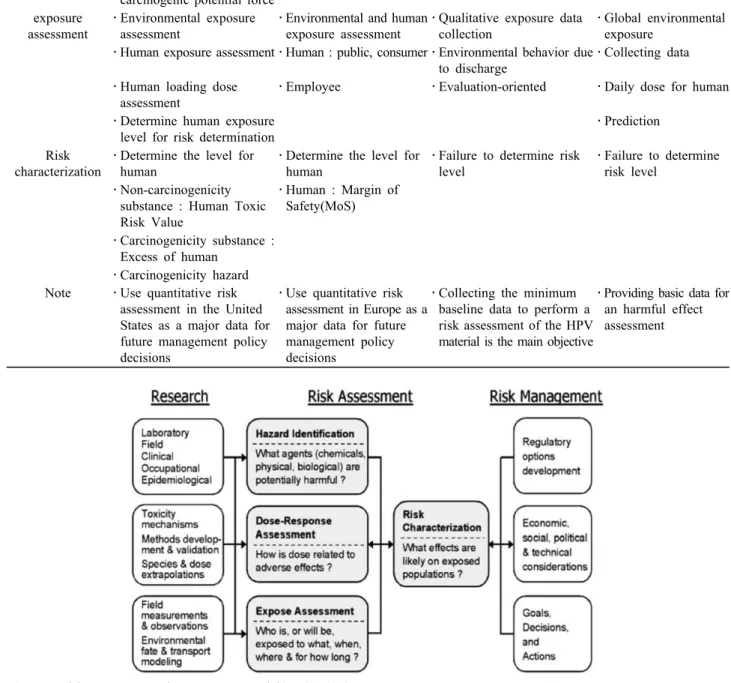
국내외 적으로 적용되어지고 있는 위해성평가 방법 들의 장단점 및 활용성의 비교⋅분석을 통해 국내 화 학사고 비상대책이후 화학사고 유해화학물질 노출에 의한 건강위해성평가 방법으로 국내 적용 가능성 및 활용성을 고려하여 미국 국가 연구위원회(NRC)와 국립 과학원(NAS)에서 고안된 위해성 평가 방법(NRC, 1993) 을 기초로 한 유해성 확인(hazard identification), 용량-반 응 평가(dose-response assessment), 노출평가(exposure assessment) 및 위해도 결정(risk characterization)의 주요 4단계로 구성된 건강위해성평가 방법(Figure 1)의 개발 이 이루어지는 것이 적합한 것으로 판단된다.
3. 질병 발현 이론을 기초로 한 화학사고 유해화학 물질 건강위해성평가 방법 도출
건강위해성평가 방법에 적용되는 건강 영향(질병) 발현의 모형은 크게 발암성 질환의 발현과 비발암성 질환의 발현으로 구분할 수 있다. Figure 2는 두 질병 발현의 특성에 관계되는 용량과 반응의 관계를 나타 낸 것으로 발암성 물질의 경우 용량과 반응 간에 비례 의 관계를 보인다는 이론 즉, 비역치(Non-threshold)이 론을 따르고 있다. 비발암물질의 경우는 발암성 물질 과는 달리 일정 용량 또는 노출 조건 이하에서 어떠한
유해한 영향이 발생하지 않으나 이 이상의 용량 또는 노출조건 이상에서 질병이 발생된다는 역치(Threshold) 이론을 따르고 있다(US EPA, 1986; NRC, 1993). 이와 같은 유해화학물질의 노출에 따른 질병 발현의 특성 으로 고려할 때 화학사고 유해화학물질 노출에 의한 건강위해성평가 방법은 발암성 유해화학물질의 건강 위해성평가 방법과 비발암성 유해화학물질의 건강위 해성평가 방법으로 구분된 평가 방법의 개발이 이루 어져야 할 것으로 여겨진다.
최근 US EPA는 발암위해성 평가 시 각 물질의 용량- 반응평가에 근거한 발암력을 활용하는 비역치 발암위 해도 예측방법의 사용을 권장하여 왔으나, 최근 들어 기존의 비역치 발암위해도예측방법론과 함께 발암영 향이 나타나는 독성기전에 근거하여 다르게 접근하는 MOE를 활용한 평가방법론을 제안하고 있다(US EPA, 1999). 이 방법은 발암을 이차영향으로 하는 유해영향 의 경우에 그 용량-반응이 선형모델가정에 적합지 않 은 경우 즉, 발암영향에 앞서 일어나는 그 일차적인 영 향의 용량-반응관계에서 역치가 존재하는 경우, 비발 암영향평가와 유사한 방법론인 역치개념을 활용한 MOE 방법을 적용하는 방법으로 MOE 분석에서 활용 되어지는 ‘point of departure’ 개념은 기존의 비발암물질 의 위해성평가방법에서 수행되어 오던 무영향관찰치 의 개념과 동일하다고 할 수 있다(US EPA, 1999).
이와 같은 질병발현 이론을 고려하였을 때 화학사 고 유해화학물질 건강위해성평가 방법 개발은 크게 두 가지로 구분된 평가 방법의 개발로 이루어져야 할 것으로 사료된다. 즉, 비유전독성 발암물질을 제외한 발암물질의 경우 NRC(1993)와 US EPA(1983)에서 제