I. 서 론
코로나바이러스감염증-19(COVID-19)의 확산은 질 병 자체의 전파력과 치명률에 대한 우려를 넘어 사회 전체의 경제와 문화, 가치 체계를 흔들고 있다. 2020년
3월 11일 세계보건기구(World Health Organization, WHO)는 COVID-19의 세계적인 대유행(pandemic) 을 선포하였으며, 2020년 6월 30일 기준으로 216개 국가에 10,193,723명의 확진자와 503,867명의 사망자 가 발생하였다(WHO, 2020). 2020년 6월 30일 현재, https://doi.org/10.15269/JKSOEH.2020.30.3.256
우리나라 COVID-19 확진자 직업 분포와 노동자 보호 방안
홍종우ㆍ최소현ㆍ박정임* 순천향대학교 환경보건학과
Vulnerable Occupations to COVID-19 and Measures for Protecting Workers from Infectious Biological Hazards at Workplaces
Jongwoo HongㆍSohyeon ChoiㆍJeongim Park*
Department of Environmental Health Sciences, Soonchunhyang University
ABSTRACT
Objectives: Everyone has been affected in some way by the COVID-19 pandemic, while some workers face threats to their health due to their jobs as well as worries about spreading the virus to intimate family members. With these concerns in mind, this study aims to identify occupations more vulnerable to COVID-19 and suggests the necessity of providing proper control measures against the risks in a timely manner in Korea.
Methods: Daily briefing reports by the Korea Centers for Disease Control and Prevention (KCDC) were compiled (n=120) between January 20 and May 31, 2020. A total of 11,486 confirmed cases were included, which were sorted by occasion, area, and occupation. Among them, 2,411 cases were classified with specific occasions and/or areas of infection, while only 544 cases were determined with identifiable occupations.
Guidelines for biological hazard management and COVID-19 guidelines for workplaces from domestic and international bodies were enlisted and compared.
Results: It is unsurprising to find that healthcare professionals are experiencing the most immediate threat from COVID-19. In addition, service workers with face-to-face practices or indirect contact are also facing high risks. Religion facilities and eating places (dining, drinking bar, café, etc.,) follow. Guidelines and manuals for biological hazards are still lacking in Korea compared to the US and EU. Workplace manuals for managing COVID-19 are neither as comprehensive as the approaches of NIOSH’s hierarchy of controls nor inclusive enough for minimizing secondary or tertiary suffering.
Conclusions: The COVID-19 crisis is still ongoing and there is no doubt there will be more such events in the future. This analysis suggests that occupational health professionals, amid a pandemic including COVID-19, are urged to anticipate emerging risks related to all sorts of occupations, identify vulnerable workers and working environments, and plan and take actions to protect workers’ health.
Key words: COVID-19, essential workers, risk management, vulnerable work
*Corresponding author: Jeongim Park, Tel: 041-530-1269, Email: [email protected]
Dept. of Environmental Health Sciences, Soonchunhyang University, 22 Soonchunhyang-ro, Shinchang-myeon, Asan-si, Chungcheongnam-do
Received: September 9, 2020, Revised: September 19, 2020, Accepted: September 29, 2020
Jongwoo Hong https://orcid.org/0000-0001-5692-9837 Sohyeon Choi https://orcid.org/0000-0001-7709-6037 Jeongim Park http://orcid.org/0000-0002-5851-1183
This is an Open-Access article distributed under the terms of the Creative Commons Attribution Non-Commercial License (http://creativecommons.org/licenses/by-nc/3.0) which permits unrestricted non-commercial use, distribution, and reproduction in any medium, provided the original work is properly cited.
전 세계의 COVID-19 일별 신규 확진자 수는 증가하 는 추세이고, 총 확진자가 20만명이 넘는 국가는 미국, 브라질, 인도를 포함하여 15개국이나 된다(WHO, 2020). 우리나라는 6월 30일 기준 확진자는 12,800명, 사망자는 282명이며, 일별 신규 확진자도 꾸준히 약 40~70명 정도 수준을 유지하고 있다(KCDC, 2020).
COVID-19는 코로나바이러스의 일종인 SARS-CoV-2 (Severity acute respiratory syndrome corona virus) 감염에 의한 호흡기증후군을 이르며, 호흡기 비 말을 통해 사람들 간에 쉽게 그리고 지속해서 전파된다.
또한, 바이러스가 있는 표면이나 물체를 만진 후, 코 또 는 입을 만지면 전염될 수 있다. COVID-19의 잠복기 는 약 2주(평균 4~7일)이며, 무증상 이어도 감염할 수 있다는 것이 기존 MERS와 같은 전염병과는 다르다 (WHO, 2020). 따라서 COVID-19은 특정 공간이나 지 역에서 동시에 감염이 발생하는 집단감염 사례가 많으 며 우리나라 확진자 12,800명 중 78%(n=10,017)가 이 에 해당한다. 우리나라에서 발생한 집단감염은 주로 확 진자 및 의심자들의 출입이 잦은 의료시설과 콜센터나 물류센터처럼 다수의 노동자가 한 공간에서 일해야 하 는 사업장에서 발생하였다.
COVID-19의 원인인 SARS-CoV-2는 바이러스의 일종이므로 산업보건관리 측면에서 생물학적 유해인자 에 해당한다. 미국산업안전보건청(Occupational Safety and Health Administration, OSHA) 및 유럽산업안 전보건청(European Agency for Safety and Health at Work, EU-OSHA)의 사업장 내 생물학적 유해인자 관리지침을 고시하고 있다(EU-OSHA, 2000; OSHA, 2020). 한편 우리나라의 경우 생물학적 유해인자 관리 지침의 필요성이 제기된 바 있으나(Rim & Park, 2013), 현재까지 법적 규제요건을 갖춘 지침으로 고시 된 바는 없다.
COVID-19 이전에 세계적으로 유행한 감염병은 대 표적으로 중증급성호흡기증후군(SARS, 사스), 신종플 루, 중동호흡기증후군(MERS, 메르스)가 있다. SARS는 2002년 전 세계 37개국에서 발생하였고, 치사율은 10%에 달했다. 우리나라에는 사망환자 없이 추정 환자 3명과 의심환자 17명만 보고됨으로써 WHO로부터 ‘사 스 예방 모범국’이라는 평가를 받기도 했다. 이를 계기 로 기존의 국립보건원이 2004년 질병관리본부로 확대 개편되었다(KCDC, 2020). 2009년 4월 미국에서 발생
해 전 세계로 확산한 신종플루는 우리나라에서도 약 75 만 명의 확진자와 270명의 사망자가 발생하였을 정도 로 심각한 호흡기 질환이었다. 전 세계 200개국 이상 에서 유행하면서 WHO가 팬데믹을 선언하기에 이르렀 다. 2012년 중동에서 시작된 MERS는 이전까지 사람 에게서 발견된 적이 없는 신종바이러스 감염에 의한 질 환으로, 치사율은 전 세계적으로 40% 이상이었다. 우 리나라에는 2015년에 발생하였고, 20.4%의 치사율을 기록하였다. 이러한 전염성 질환으로부터 근로자를 보 호하기위한 사업장 지침으로 고용노동부(Ministry of Employment and Labor, MoEL)는 사업장 내 플루 환자 발생 시 조치사항(MoEL, 2009)과 ‘메르스 예방 및 확산방지를 위한 기업 대응 지침(MoEL, 2015)을 고 시한 바 있다. 사업장 내의 청결과 소독의 유지, 방문객 을 대상으로 한 개인위생 실천방안 홍보, 해외 출장 직 원에 대한 전후 관리 등의 내용이 포함되어 있다.
이번 COVID-19에 대응하기 위하여 고용노동부는
‘COVID-19 예방 및 확산방지를 위한 사업장 대응 지 침(2020.2.24)’을 발표하였고, 6월 30일 기준 8판까지 개정했다. COVID-19 지침내용은 예방, 보호구, 다른 노동자 보호, 사회경제적인 지원 등이 있으며, 당시 집 단 감염이 있었던 콜센터 관련 세부지침이 추가로 고시 되었다(MoEL, 2020).
본 연구는 질병관리본부의 ‘코로나바이러스감염증 -19 국내 발생 현황’을 분석함으로써 COVID-19 감염 위험이 큰 사업장 유형 및 직업군을 확인하고자 하였다.
또한, 기존의 여러 국가 및 기관의 생물학적 유해인자 관리지침을 분석 비교함으로써, COVID-19과 같이 전 염력이 강한 감염성 질환에 대한 산업보건 관리대책 마 련의 필요성을 제기하고자 하였다
Ⅱ. 연구대상 및 방법
1. 연구 대상
본 연구는 2020년 1월 20일부터 5월 31일까지 발생 한 국내 COVID-19 확진자, 총 11,486명을 연구 대상 으로 하였다. 해당 기간 질병관리본부(Korea Centers for Disease Control and Prevention, KCDC)가 발 표한 120건의 ‘코로나바이러스감염증-19 국내 발생 현 황’ 정례 브리핑 자료(이하 ‘브리핑 자료’)에서 확인할 수 있는 확진자 특성 정보를 분석하였다(KCDC, 2020).
2. 연구 방법
1) 국내 COVID-19 확진자의 직업 및 발생장소 정보 데이 터 구축 과정
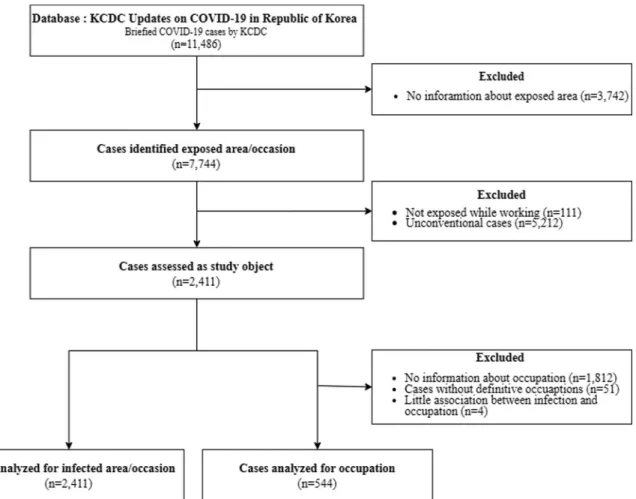
기간 동안 발생한 확진자 중 해당 기간 정례브리핑 자 료에서 확인 가능한 정보들을 추출하였다. 1) 감염 발생 장소, 및 2) 확진자의 직업을 확인할 수 있는 사례를 추 출한 절차는 Figure 1과 같다. 11,486명의 COVID-19 확진자 사례 중 감염 장소에 관한 정보가 없는 3,742건 의 사례를 제외하고 남은 7,744건의 사례 중 아파트 단 지 내의 집단감염, 성지 순례 등 근로 사업장과 관련이 없는 사례 111건과 특정 교회발 감염 5,212건을 제외하 여, 총 2,411건의 사례에 대하여 감염 발생 장소를 분석 하였다. 감염 장소 정보가 있는 2,411명 중 직업 정보가 있는 경우는 599명이었다. 이 중 감염된 노동자 수를 정 확히 알 수 없거나(n=51), 확진자의 직업이 감염 경로와 는 무관한 경우(n=4)를 제외한 총 544명에 대하여 직업 을 분석하였다.
2) 장소 및 직업 분류 기준
확진자의 감염 장소는 1) 종교 시설, 2) 의료 기관, 3) 대면 서비스 시설, 4) 비대면 서비스 시설, 5) 취식 가능 시설, 6) 집단 생활시설로 구분하였다. 2차 감염자 의 경우, 1차 감염자가 COVID-19에 감염된 장소를 기 준으로 분류하였다.
직업은 제7차 한국표준직업분류(Korean Standard Classification of Occupations, KSCO)(KOSTAT, 2020)에 따라 1) 보건⋅사회복지 및 종교 관련직, 2) 조리 및 음식 서비스직, 3) 돌봄⋅보건 및 개인 생활 서 비스직, 4) 교육 전문가 및 관련직, 5) 경영⋅금융전문 가 및 관련직, 6) 판매 및 고객 서비스 관리직, 7) 상담
⋅안내⋅통계 및 기타 사무직, 8) 운송 관련 단순 노무 직, 9) 경영 및 회계 관련 사무직, 10) 매장 판매 및 상 품 대여직, 11) 운송 및 여가 서비스직, 12) 군인으로 분류하였다.
Figure 1. Procedure for identifying cases included in the analysis for areas, occasions or occupations
3) 국내외 생물학적 유해인자 관리지침 비교
본 연구는 현 국내 사업장을 대상으로 한 생물학적 유해인자 관리지침 및 COVID-19 지침을 해외 기관의 지침과 비교, 고찰하고자 하였다. 생물학적 유해인자 관 리지침의 경우, KOSHA의 생물학적 유해인자 편람연구 (Rim & Park, 2013)의 편람을 OSHA의 Safety and Health Topic - Biological Agent, EU-OSHA의 Directive 2000/54/EC와 비교하였다. COVID-19 지침 은 우리나라 고용노동부의 COVID-19 예방 및 확산방지 를 위한 사업장 대응 관리지침과 OSHA의 Guidance on Preparing Workplaces for COVID-19(OSHA, 2020), WHO의 Considerations for public health and social measures in the workplace in the context of COVID-19(WHO, 2020), EU-OSHA COVID-19: Back to the workplace(EU-OSHA, 2020)와 비교 및 분석하였다.
Ⅲ. 결과 및 고찰
1. COVID-19 감염에 취약한 노동활동 장소
Table 1은 장소분석 대상자 2,411명을 대상으로 COVID-19에 감염된 장소 및 장소별 코로나 발생률을 추산한 결과이다. 장소는 COVID-19에 감염에 영향을 주는 1) 감염원과의 접촉 여부, 2) 타인과의 접촉 여부, 3) 마스크를 착용 여부 등 노동특성에 따라 총 6가지로 분류하였다. 감염원과 직접 접촉할 우려가 있는 병원, 의원 등은 의료기관으로 묶었다. 불특정 다수의 사람과
접촉이 불가피한 상점, 부동산, PC방 등 14곳은 대면 서비스 제공 사업장으로 분류했으며, 불특정인과의 접 촉이 적은 사업장인 콜센터, 물류업 등은 비대면 서비스 제공 사업장으로 분류하였다. 그 외에 마스크를 벗는 행 위가 이루어지는 취식 가능 사업장, 집단이 숙식하는 집 단 생활 시설로 분류하였다. 분류 과정에서 타인과 접촉 이 잦을 뿐만 아니라, 마스크 미착용, 취식의 가능성이 있는 종교단체는 따로 분리하였다.
발생장소에 대한 정보가 있는 전체 COVID-19 확진 자의 33.6%는 대면 서비스를 제공해야 하는 사업장에 서 발생하였고, 의료기관(25.0%), 비대면 서비스 제공 사업장(14.5%), 종교시설(13.2%), 취식 행위가 가능한 장소 혹은 사업장(12.8%), 집단이 숙식하는 집단생활 시설(0.9%) 순이었다. 전체의 25%가 의료기관에서 감 염되었는데, 이는 상대적으로 철저하고 보수적인 방역 이 이루어짐에도 감염원과의 직접적인 접촉 가능성 때 문이었을 것이다. 대면 서비스 제공 사업장에서 감염된 확진자는 전체의 33.6%로 바이러스와 직접 접촉하는 의료기관보다 많았다. 감염된 장소는 상점, 부동산, PC 방 등 14곳으로 다양한 업종에서 발생하였다. 비대면 서비스 제공 사업장은 타인과 접촉이 필요하지 않으며, COVID-19 확진자 혹은 사망자를 다루는 직무가 아님 에도, 7곳에서 총 350명이 확진 되었다. 이는 마스크를 벗고 음식을 먹는 취식 가능 시설이나 타인과 접촉이 잦은 교회보다도 많은 수치였다. 박 등(Park et al.
2020)은 콜센터 집단감염에 대한 연구에서 콜센터 건 물에서 발생한 확진자의 96.9%(n=94)가 한 층에서 감
Categories N Areas No. of cases(%)
Religious facility 1 Church 319 (13.2)
Health facility 2 Hospital, Other Health care facility 603 (25.0)
Face-to-face service 14
Sanatorium, Social welfare facility, Silver town, Sport facility, Karaoke, PC café, Spa, Sauna and Steam baths, Store, Real estate, Kindergarten, Fire station, Hotel, Private educational institute
810 (33.6)
Non face-to-face service 7 Help-line call center, Distribution center, Company building,
Laboratory, Government offices, Power facilities 350 (14.5) Food and dining facility 6 Club, Pub, Wine bar, Buffet, Restaurant, Entertainment 308 (12.8) Group life facility 3 Prison, Army training school, Army station 21 (0.9)
Total - 2,411 (100.0)
Table 1. Places/occasions of COVID-19 infection in Korea, 20 January - 31 may, 2020 and rate of COVID-19 infection per
100,000 workers
염되었다는 것에 주목하였다. 콜센터를 포함한 비대면 업무는 타인과의 접촉은 적지만, 한정된 공간의 밀도 높 은 노동환경으로 인해 집단감염의 가능성이 큰 것으로 판단하였다. COVID-19 의심자와 확진자를 직접 다루 는 의료기관뿐만 아니라, 대면 및 비대면 서비스를 제공 하는 사업장 역시 감염의 위험이 큰 것으로 확인되었다.
이 결과는 미국산업안전보건청(OSHA)이 직업 환경에 따라 COVID-19 감염 위험성을 구분한 것과는 차이를 보인다. OSHA는 COVID-19 감염이 의심되거나 감염 된 환자 또는 사망자를 다루는 환경을 위험성 매우 높 음과 높음으로, 감염 여부와는 상관없이 타인과 잦은 접 촉이 요구되거나 가깝게 위치하는 직업을 중간, 그 외의 직업을 낮음으로 분류한 바 있다(OSHA, 2020).
2. COVID-19 확진자의 직업 분포
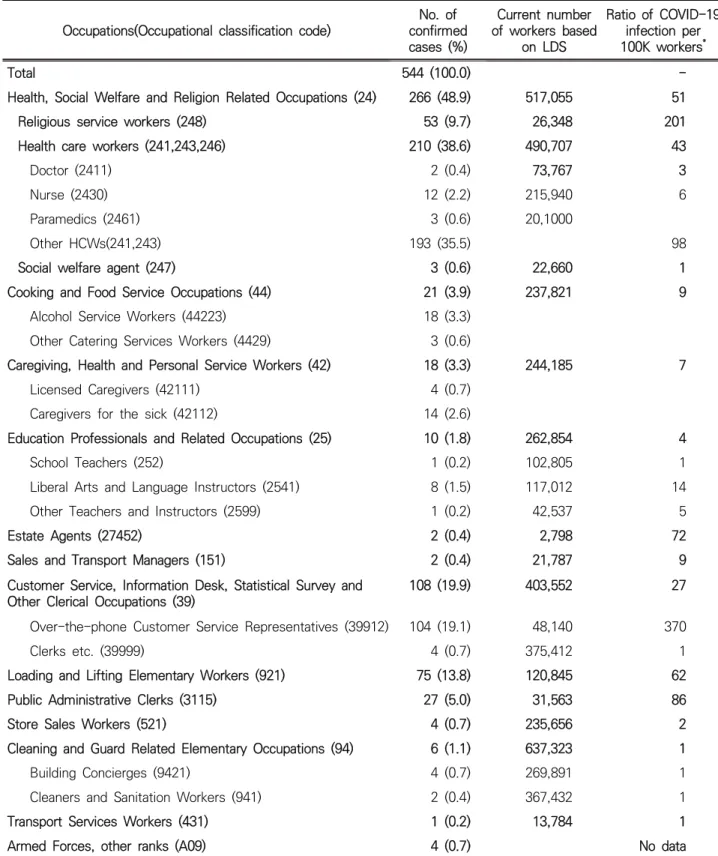
직업정보가 확인가능한 대상자 544명의 직업분포는 Table 2와 같다. 보건⋅사회복지 및 종교 관련직이 266명(48.9%)으로 가장 많았고, 기타(20.8%), 경영 및 회계 관련 사무직(19.9%), 조리 및 음식 서비스직 (3.9%), 돌봄⋅보건 및 개인 생활 서비스직(3.3%), 교육 전문가 및 관련직(1.8%), 매장 판매 및 상품 대여직 (0.7%) 등 순이었다. 직업별로는 의사, 간호사, 기타 의 료인을 포함한 의료종사자가 35.5%(n=193)으로 가장 많았으며, 비대면 서비스 제공 노동자인 전화 상담원 19.1%(n=104), 하역 및 적재 단순 종사자 13.8%
(n=75)순이었다.
직종별 COVID-19 감염위험을 비교하기 위하여, 해 당 직업군별 COVID-19 확진자의 10만인율 (10만명당 확진자 수)을 도출하였다(Table 2). 10만인율을 구하기 위한 직업별 종사자 수는 고용노동부가 집계한 2020년 직종별 사업체 노동력 조사 자료를 활용하였다(MoEL, 2020). 전화상담원은 10만명당 370명으로, 전 직업 중 가장 높은 수치였으며, 종교 종사자(10만명당 201명), 기타 의료종사자(10만명당 98명), 공공행정 사무종사 자(10만명당 86명), 부동산 판매업자(10만명당 72명), 하역 및 적대 단순 종사자(10만명당 62명) 등 순이었 다. 종교 종사자의 경우, 확진자 수는 53명으로 많지 않았지만, 종교 종사자의 10만인율 201명으로, 적지 않은 수준이었다. 이는 종교종사자의 작업 환경이 COVID-19 감염에 취약하다는 것을 시사한다. 텔레마 케터(10만명당 370명)는 비대면 서비스 업종임에도 불
구하고, COVID-19에 직접적으로 노출되는 의료종사 자(10만명당 98명)보다 3배가 넘는 수준이었다. 사무직 의 경우, 텔레마케터나 공공 행정 사무원의 비율은 높았 지만, 기타 사무직과 합쳐서 계산한 비율은 그리 높지 않았다(10만명당 27명). 이는 밀폐 사무환경에서의 집 단감염이 원인인 것으로 보인다.
장소분석 결과와 비교했을 때, 의료종사자는 공통적 으로 COVID-19에 취약한 직업이었다. 세계 경제 포 럼(The World Economic Forum)은 타인과의 접촉, 신체적 근접성, 질병과 감염의 노출 3가지 요소로 COVID-19 감염 위험을 분류했는데 간호사, 물리치료 사, 치과의사 등을 포함한 보건 계열의 노동자들이 가장 위험한 직업군이었다(Lu, 2020). 미국, 스페인, 이탈리 아 세 나라에서 여성 의료종사자의 COVID-19 감염률 이 더 높은 것으로 나타났는데(UN Women, 2020), 이 는 COVID-19 감염 위험이 성별에 따라 다를 수 있음 을 시사한다. 본 연구에서는 간호사 12명, 사회복지사 24명, 기타 보건 의료 전문가 193명, 상담사 104명으 로, 총 확진자의 61%(n=333)를 차지했다(Table 2). 우 리나라 제5차 근로환경조사에 따르면, 간호사(97%), 사 회복지사(86%), 기타 보건 의료 전문가(의료종사자) (68%), 상담사(79%)가 여성 노동자 비율이 높은 직업이 었으며 대부분이 보건계열과 서비스계열 노동자였다.
확진자의 성별을 사례별로 확인할 수 있는 정보가 없어 성별 감염위험을 비교하기는 어려우나, 의료종사자, 사 회복지사, 상담사에 종사하는 여성의 비율이 높은 것과, 해당 종사자들의 높은 COVID-19 감염률의 결과를 미 루어 봤을 때, 보건계열과 상담 등의 서비스계열의 직업 을 가진 여성 노동자들이 특히 COVID-19에 취약할 수 있음을 추정할 수 있다.
의료 종사자들을 제외하고, 대면 서비스 제공 노동자 의 감염은 비대면 서비스 제공 노동자보다 낮았다. 전국 의 학교와 학원은 비대면 온라인 교육으로 대체하는 등 재택근무를 시행하였고, 교사와 학생의 직접적인 접촉 이 없었기 때문에 대표적인 대면 서비스 제공 노동자인 교사와 강사의 COVID-19 감염률이 낮은 것으로 판단 된다. 반면에, 전화 상담원과 하역 및 적재 단순 종사자 등의 비대면 서비스 제공 노동자는 COVID-19에 취약 한 직업이었다. 이들은 재택근무가 불가능하고 노동자 간의 밀도 높은 근무환경 때문에 집단감염의 위험에 노 출되어 있었다.
Occupations(Occupational classification code)
No. of confirmed cases (%)
Current number of workers based
on LDS
Ratio of COVID-19 infection per 100K workers
*Total 544 (100.0) -
Health, Social Welfare and Religion Related Occupations (24) 266 (48.9) 517,055 51
Religious service workers (248) 53 (9.7) 26,348 201
Health care workers (241,243,246) 210 (38.6) 490,707 43
Doctor (2411) 2 (0.4) 73,767 3
Nurse (2430) 12 (2.2) 215,940 6
Paramedics (2461) 3 (0.6) 20,1000
Other HCWs(241,243) 193 (35.5) 98
Social welfare agent (247) 3 (0.6) 22,660 1
Cooking and Food Service Occupations (44) 21 (3.9) 237,821 9
Alcohol Service Workers (44223) 18 (3.3)
Other Catering Services Workers (4429) 3 (0.6)
Caregiving, Health and Personal Service Workers (42) 18 (3.3) 244,185 7
Licensed Caregivers (42111) 4 (0.7)
Caregivers for the sick (42112) 14 (2.6)
Education Professionals and Related Occupations (25) 10 (1.8) 262,854 4
School Teachers (252) 1 (0.2) 102,805 1
Liberal Arts and Language Instructors (2541) 8 (1.5) 117,012 14
Other Teachers and Instructors (2599) 1 (0.2) 42,537 5
Estate Agents (27452) 2 (0.4) 2,798 72
Sales and Transport Managers (151) 2 (0.4) 21,787 9
Customer Service, Information Desk, Statistical Survey and Other Clerical Occupations (39)
108 (19.9) 403,552 27
Over-the-phone Customer Service Representatives (39912) 104 (19.1) 48,140 370
Clerks etc. (39999) 4 (0.7) 375,412 1
Loading and Lifting Elementary Workers (921) 75 (13.8) 120,845 62
Public Administrative Clerks (3115) 27 (5.0) 31,563 86
Store Sales Workers (521) 4 (0.7) 235,656 2
Cleaning and Guard Related Elementary Occupations (94) 6 (1.1) 637,323 1
Building Concierges (9421) 4 (0.7) 269,891 1
Cleaners and Sanitation Workers (941) 2 (0.4) 367,432 1
Transport Services Workers (431) 1 (0.2) 13,784 1
Armed Forces, other ranks (A09) 4 (0.7) No data
*
COVID-19 confirmed cases with occupation record / Number of workers belongs to the occupation in Labor Demand Survey statistics
Table 2. Occupationally acquired COVID-19 among 544 occupation-identified cases of 11,486 confirmed cases in Korea
between 20 January and 31 May, 2020
직업 간 감염 위험률의 차이를 가르는 중요한 요인은 재택 근무의 가능 여부이다. 재택근무가 불가능하고 대 면 근무를 할 수밖에 없다는 점은 해당 노동자들의 감 염 취약성을 크게 높인다. 필수노동자(key workers, essential workers)는 팬데믹 상황에서도 필수로 서비 스를 제공해야 하는 산업군의 노동자로 정의된다 (McNicholas & Poydock, 2020). 의료 종사자, 국방 및 보안, 버스 기사, 캐셔, 운송 및 물류, 육체노동 노동자가 대표적인 필수노동자이다. 이들 중 다수는 낮은 임금을 받는 사회 경제적으로 소외된 집단이며, 그 중의 70% 이 상은 재택근무가 불가능한 최일선의 노동자(frontline workers)이다(Blau, 2020). 이들의 COVID-19 감염위 험은 노동시간에 비례하며, 따라서 이들에 대한 위험보 호조치와 위험수당 지급도 함께 고려되어야 한다 (Semple & Cherrie, 2020).
필수노동자들의 사회경제적인 소외는 2차 피해의 원 인이 되기도 한다. Koh(2020)는 감염에 대한 보호뿐만 아니라, 위험에 응당 하는 실업 수당, 육아 보조, 유급 병가 등의 사회적 지원 등을 통해 2차 피해에 대한 지 원이 필요함을 언급했다. Tomer & Kane(2020)은
“최일선의 노동자, frontline workers”의 분류가 모호 함을 지적하며 팬데믹에서 발생하는 사회경제적 지원 에서 누락되는 노동자가 있을 수 있음을 우려하였다.
Rosemberg(2020)는 호텔 청소부가 다른 직업에 비해 보건상으로 취약하며, 격리 장소로 사용된 호텔에서 일 하는 경우, 가정으로의 전파에 대한 스트레스가 심각할 수 있음을 우려했다. 또한, 이들의 건강상 위험뿐만 아 니라 위험에 대한 보상이 부재함을 지적했다.
Dsouza et al.(2020) 등은 인도에서 3월부터 5월까 지 발생한 69건의 자살 중 20명이 ‘COVID-19 감염 우려에 의한 공포’, 3명이 ‘COVID-19에 의한 직무 스 트레스’, 8명이 ‘COVID-19 검사 결과 양성’에 의한 것 이었다고 보고하며, COVID-19과 관련된 심리적 스트 레스에 대한 방안을 마련해야 함을 주장했다. 또한 Temash et al.(2020) 등이 사우디의 한 대학병원의 의료 종사자들을 대상으로 설문한 결과, 감염된 환자를 돌보는 과정과 가정으로의 질병 전파에 대한 걱정으로 불안과 스트레스를 받는다고 하였다. 이러한 스트레스 는 COVID-19 팬데믹 상황에서의 2차 피해가 원인으 로 판단되며, 이전 메르스 사태 때보다 더 큰 영향력을 끼치고 있는 것으로 보인다. COVID-19에 취약한 노동
자의 건강과 2차 피해를 줄이기 위해, 감염에 취약한 직업을 선정하기 위한 Checklist와 이들에 대한 사회경 제적인 지원이 이뤄져야 한다고 판단된다.
3. 국내외 사업장 내 생물학적 유해인자 지침 비교
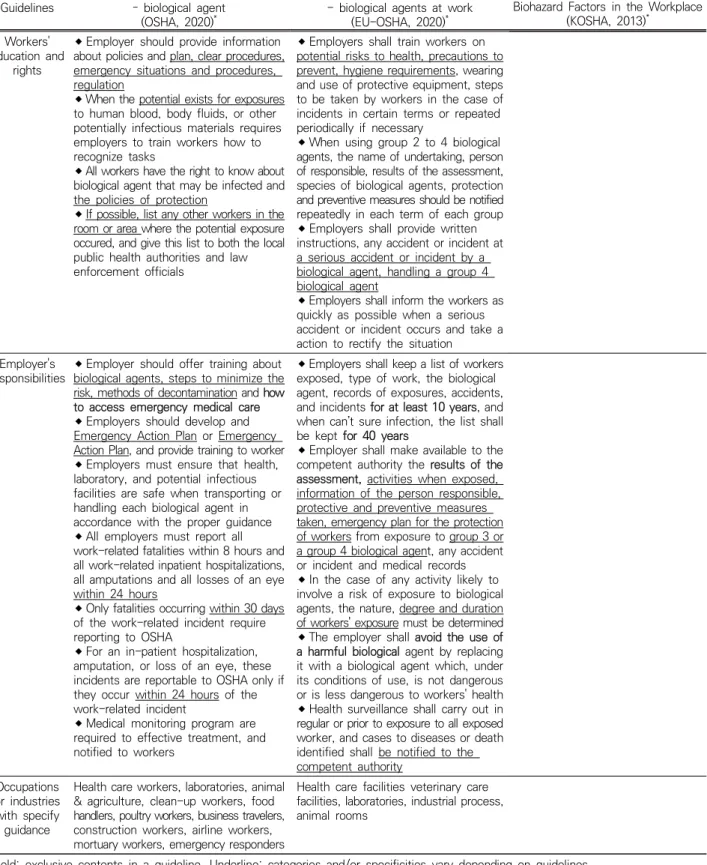
Table 3은 OSHA와 EU-OSHA를 포함한 국내외 기 관들에서 고시한 사업장 내 생물학적 유해인자 관리지 침을 비교한 것이다. 우리나라 고용노동부에는 공식적 으로 생물학적 유해인자 관리지침이 존재하지 않아, 산 업안전보건공단(Korea Occupational Safety and Health Agency, KOSHA)에서 발간한 “생물학적 유해 인자 편람 연구(KOSHA, 2013)”의 내용을 정리하였다.OSHA는 전체 직업군에 대한 공통적인 지침이 있었으 며, 유해인자를 13종류로 나눈 후, 각 유해인자 종류에 따른 지침을 고시하고 있었다. 일부 유해인자의 지침은 CDC나 WHO의 지침으로 대체되기도 하였다. 또한, 각 유해인자별 취약한 직업에 대해 세부적인 지침을 추 가로 제시하고 있었다. EU-OSHA는 생물학적 유해인 자를 노출 위험과 회복 가능의 여부를 기준으로 삼은 4 개의 위험 그룹으로 분류하여 지침을 제공하고 있었다.
주 내용은 사업장 내 생물학적 유해인자를 대상으로 하 는 지침에 들어가야 하는 내용에 대한 안내였으며, 동물 관련, 경작 농업, 의료종사자, 폐수 처리장 노동자 등에 대해 추가적인 지침을 추가하였다. 생물학적 유해인자 지침은 크게 예방 및 취급, 개인 보호구, 정보 제공, 교 육 및 훈련에 대한 고용주의 책임, 노동자의 권리에 관 한 내용으로 나누어 비교했다.
세 기관의 지침 모두 지침마다 특징이 존재했다.
OSHA는 사업장과 관련된 13종, EU는 전체적인 생물 학적 유해인자와 직업별 세부지침, KOSHA의 편람연구 에서는 60종의 생물학적 유해인자에 대한 지침을 고시하 고 있었다. 예방 및 개인 보호구(Personnel Protective Equipment, PPE)에 대한 지침은 세 기관에서 공통으 로 다루고 있었는데, 기관별로 해상도에 큰 차이가 있었 다. 세 기관 중 OSHA에서 제시한 예방 및 개인 보호구 지침이 가장 구체적이었다. 사업장 내 소독의 경우, OSHA는 유해인자별로 필요한 소독제 종류뿐만 아니 라, 적정한 소독 시간을 명시했다. 반면에 EU는 전체 생물학적 지침과 직업별 세부 지침 모두에 소독의 필요 성만 언급하였으며, KOSHA 편람 연구에서는 소독제의 종류만 제시했고, 적절한 소독 시간 등의 자세한 내용은
Guidelines
OSHA, Safety and Health Topics – biological agent
(OSHA, 2020)*
Directive 2000/54/EC - biological agents at work
(EU-OSHA, 2020)*
A Study on the Manual of Biohazard Factors in the Workplace
(KOSHA, 2013)*
Objectives All industries All industries All industries
Biological agents
Bacteria, viruses, fungi, other microorganisms and their associated toxins
Micro-organisms, including those which have been genetically modified, cell cultures and human end parasites, which may be able to provoke any infection, allergy or toxicity
Viruses, fungi, other microorganisms, and related toxic
Prevention and control
Hand hygiene consists of washing with soap and water, Sanitary facilities should be highly accessible
When cleaning contaminated environmental surfaces, products as appropriates, procedures, method should be concerned in each biological agent
Effective vaccines and antibiotics products are necessary to develop an immune response if using the vaccine as a preventive measure
Follow measurements for enhanced contact or engineering controls and hygiene, depending on the workplace environment of a specific work
To prevent infection, using engineering and administrative controls, safer work practices, and PPE suitable for result of assessment
In case of biological agents that cause waterborne infection, to prevent growth and introduction of bacteria in to the air, cooling towers, evaporative condensers, and fluid coolers use water evaporation and water systems should be controlled
When identifying symptoms of infection, the exposed and suspected exposed should be quarantined
Workers involved in handling, treatment, transport, and disposal of medical, laboratory and other waste must be protected
Workers do not eat or drink in working areas, special protective measures may be required
When necessary, effective vaccines should be made available for workers
Health and veterinary care facilities other than diagnostic laboratories specifying appropriate decontamination, disinfection procedures, implementing procedures enabling contaminated waste to be handled, disposed of without risk
To reduce risk of exposure, keeping as low as possible the number of workers exposed, design of work processes and engineering control minimize the exposing, collective protection measures, hygiene measures, biohazard signs, accidents plans, testing, secure and identifiable containers to storage, safe handling and transport should be used
In the case of activities involving exposure to several groups of biological agents, the risk shall be assessed on the basis of the danger presented by all hazardous biological agents
It is necessary to create a working environment that minimizes the risk of exposure to harmful factors
Effective products for disinfection have been presented for each hazardous biological agent and must be observed
A suitable vaccine should be inoculated to prevent infection before handling biological agents if possible
Facilities and facilities dealing with each group of biological agent require safety measures suitable for each biosafety level
Personal protective equipment
PPE on the situation and tasks involved, including to the degree of contamination, risk of exposure, exposure pathway, and anticipated level of exposure based on the worst case of scenario
Proper decontamination and removing procedures or if necessary, change need after using PPE
To use proper respiratory protection, appropriate respirator, information, respiratory protection standard and so on needed
Training for workers required to use PPE includes when to use PPE, what PPE is necessary, how to properly put on, use, and take off PPE, how to dispose of or disinfect, inspect for damage and maintain PPE, the limitations of PPE
Workers are provided with appropriate and adequate washing and toilet facilities, which may include eye and/or skin washes and appropriate protective clothing or other appropriate special clothing
Properly stored in a well-defined place, checked and cleaned if possible before, and in any case, after, each use, be repaired, where defective, or be replaced before further use and be ensured that such clothing and protective equipment is decontaminated and cleaned or, if necessary, destroyed
Working clothes and protective equipment must be removed on leaving the working area and kept separately from other clothing
PPE should be equipped considering working characteristics and each biological agent
When handling biohazard, biosafety cabinets should be used according to biohazardous levels
Table 3. Guidelines for biological hazards at workplaces by OSHA, EU-OSHA and KOSHA
Guidelines
OSHA, Safety and Health Topics – biological agent
(OSHA, 2020)*
Directive 2000/54/EC - biological agents at work
(EU-OSHA, 2020)*
A Study on the Manual of Biohazard Factors in the Workplace
(KOSHA, 2013)* Workers'
education and rights
Employer should provide information about policies and plan, clear procedures, emergency situations and procedures, regulation
When the potential exists for exposures to human blood, body fluids, or other potentially infectious materials requires employers to train workers how to recognize tasks
All workers have the right to know about biological agent that may be infected and the policies of protection
If possible, list any other workers in the room or area where the potential exposure occured, and give this list to both the local public health authorities and law enforcement officials
Employers shall train workers on potential risks to health, precautions to prevent, hygiene requirements, wearing and use of protective equipment, steps to be taken by workers in the case of incidents in certain terms or repeated periodically if necessary
When using group 2 to 4 biological agents, the name of undertaking, person of responsible, results of the assessment, species of biological agents, protection and preventive measures should be notified repeatedly in each term of each group
Employers shall provide written instructions, any accident or incident at a serious accident or incident by a biological agent, handling a group 4 biological agent
Employers shall inform the workers as quickly as possible when a serious accident or incident occurs and take a action to rectify the situation
Employer's responsibilities
Employer should offer training about biological agents, steps to minimize the risk, methods of decontamination and how to access emergency medical care
Employers should develop and Emergency Action Plan or Emergency Action Plan, and provide training to worker
Employers must ensure that health, laboratory, and potential infectious facilities are safe when transporting or handling each biological agent in accordance with the proper guidance
All employers must report all work-related fatalities within 8 hours and all work-related inpatient hospitalizations, all amputations and all losses of an eye within 24 hours
Only fatalities occurring within 30 days of the work-related incident require reporting to OSHA
For an in-patient hospitalization, amputation, or loss of an eye, these incidents are reportable to OSHA only if they occur within 24 hours of the work-related incident
Medical monitoring program are required to effective treatment, and notified to workers
Employers shall keep a list of workers exposed, type of work, the biological agent, records of exposures, accidents, and incidents for at least 10 years, and when can’t sure infection, the list shall be kept for 40 years
Employer shall make available to the competent authority the results of the assessment, activities when exposed, information of the person responsible, protective and preventive measures taken, emergency plan for the protection of workers from exposure to group 3 or a group 4 biological agent, any accident or incident and medical records
In the case of any activity likely to involve a risk of exposure to biological agents, the nature, degree and duration of workers' exposure must be determined
The employer shall avoid the use of a harmful biological agent by replacing it with a biological agent which, under its conditions of use, is not dangerous or is less dangerous to workers' health
Health surveillance shall carry out in regular or prior to exposure to all exposed worker, and cases to diseases or death identified shall be notified to the competent authority
Occupations or industries with specify
guidance
Health care workers, laboratories, animal
& agriculture, clean-up workers, food handlers, poultry workers, business travelers, construction workers, airline workers, mortuary workers, emergency responders
Health care facilities veterinary care facilities, laboratories, industrial process, animal rooms
*Bold: exclusive contents in a guideline, Underline: categories and/or specificities vary depending on guidelines This table is available in Korean via website link(http://www.kiha.kr/main/journal_search.htm)
Table 3. Continued
부족했다. 사업장 내 유해인자 소독은 노출과 감염의 위 험성을 최소화하기 위해 필수적이므로, 구체적인 지침 제시가 필요해 보인다. 유해인자에 알맞은 백신 접종에 관한 내용은 세 기관 모두 공통으로 다루고 있었다.
OSHA와 KOSHA의 편람연구에서는 각 유해인자에 알 맞은 백신의 종류를 제시했지만, EU에서는 필요시 백신 을 사용해야 한다는 지침만 있을 뿐, 백신의 종류는 언 급하지 않았다. 개인 보호구 지침에서 OSHA의 경우, 각 유해인자에 대한 보호구의 종류, 규격, 보관방법, 적 절한 보호구 선정 등 구체적인 지침을 제시했다. EU는 직업별 세부 지침을 통해 직업별 보호구 종류를 제시했 고, 규격에 관한 내용은 없었다. KOSHA의 편람 연구 에서는 보호구 착용에 관한 내용은 있었지만, ‘마스크 필요’, ‘장갑 착용’과 같은 정도로만 표기되는 등 자세한 보호구 종류나 규격에 관한 내용은 없었다. 이는 개인 보호구를 직접 착용하는 노동자들에게 혼란을 줄 수 있 으므로, 구체적인 가이드라인이 필요하다고 판단된다.
KOHSA의 편람 연구에서는 생물학적 유해인자에 대 한 노동자의 권리, 사업장 내 교육의 의무, 고용주의 책 임에 관한 내용이 없었다. OSHA, EU-OHSA는 노동자 의 생물학적 유해인자에 대한 정보 접근의 권리나 고용 주가 노동자를 대상으로 실행해야 하는 교육과 훈련에 관한 내용을 포함하였다. 해당 교육의 내용으로는 예방 을 위한 절차, 알맞은 개인 보호구 착용방법, 유해인자 취급 및 운송 과정에서 생물학적 유해인자에 노출되지 않기 위한 절차 등이 있었다. KOHSA의 이러한 생물학 적 유해인자 교육 미실시와 교육에 대한 책임의 부재는 노동자들의 생물학적 유해인자에 대한 전반적인 이해와 주의의 부족을 일으킬 수 있다. 따라서 노동자의 안전과 권리를 위해 생물학적 유해인자에 대한 구체적인 가이 드라인이 요구된다.
4. 국내외 기관들에서 고시한 사업장 내 COVID-19 지 침 비교
COVID-19로 인한 팬데믹 사태가 심각해짐에 따라, OSHA, EU-OSHA, WHO, 고용노동부는 사업장 내 COVID-19 지침을 고시했다. 지침의 주요 내용은 크게 노출 위험 평가 기준, 예방 및 관리, PPE, 기타 노동자 보호 조치, 노동자 복지 및 지원, 상태 유지를 위한 조 치, 노출 위험이 높은 직업군으로 구성됐다(Table 4).
세 기관 모두 손 위생과 마스크 착용, 감염 예방을 위한
거리 두기 등의 지침이 공통으로 존재했지만, 우리나라 고용 노동부의 지침에는 PPE 관리와 교육에 관한 내용 이 없었다. COVID-19은 전염력이 강한 바이러스로, PPE 표면에 잔존할 수 있으므로 PPE 관리에 대한 알 맞은 교육이 필요하다고 판단된다. 또한, 전파력이 높은 COVID-19의 특성상 확진자 및 의심자 2주간 격리, 타 인과의 접촉 자제, 손 위생과 전파 방지를 위한 공학적 조치에 대한 내용이 강조되었다. 모든 기관에서 노동자 의 복지에 관한 내용이 언급되었는데, 주요 내용으로 부 담없는 병가와 자택 근무의 지원에 대한 내용이 언급되 었다. 특히 우리나라 고용노동부의 경우, 유급 휴가비 나 생활지원비 등 금전적인 지원에 대한 내용이 구체 적이었다. COVID-19 감염된 경우, 실직의 가능성이 크고 이로 인해 경제적으로 심각한 타격을 입게 되므 로, 노동자의 경제적 상황을 고려하는 내용은 필수적 이라고 판단된다. 2020년 1∼4월까지의 실직자 중 가 족의 생계유지에 직접적인 가구주는 86만 6천명 (41.7%)으로, 지난해 같은 기간보다 24.4% 늘었다. 이 중 52만 3천명은 비자발적 실직자였다(Kim, 2020). 이 러한 현상은 COVID-19의 확산에 따라 노동자들의 경 제적 어려움이 크게 가중되었음을 보여준다.
우리나라 고용노동부 지침은 고용주의 의무와 취약 직업의 지침에 대한 내용이 부족했다. 고용노동부의 지 침은 감염 예방에 대한 교육 이행에 관한 내용뿐이었지 만, 타 기관의 지침에는 감염 예방을 위한 교육, 정보 자료 제공, 위험평가 결과에 따른 조치 세분화에 대한 내용이 있었다. OSHA는 타인과의 접촉률과 감염원과 의 접촉 가능성을 고려하여, 사업장의 COVID-19 노출 위험도를 4단계로 나누었으며, WHO 또한 동일한 기준 으로 사업장의 노출 위험도를 3단계로 나누었다.
EU-OSHA에서는 COVID-19에 취약한 직업을 선정하 였으며, 건설, 소매상, 음식, 운동, 유지보수 및 국내 서 비스, 레저 및 유흥, 교육, 미용, 의료 보건, 치안, 국가 기관 등을 뽑았다. 우리나라 고용노동부는 집단감염 사 례인 콜센터 내의 세부 지침을 고시했지만, COVID-19 에 취약한 직업을 선정한 자료는 없었다(MoEL, 2020).
본 연구 결과 보건⋅사회복지 및 종교 관련직, 상담⋅
안내⋅통계 및 기타 사무직, 운송 관련 단순 노무직이 COVID-19 감염에 취약한 것으로 나타났으며, 더 다양 한 직종의 노동자가 COVID-19에 취약할 가능성이 있 다(Table 2).
Guidelines Guidance on Preparing Workplaces for COVID-19
(OSHA, 2020)
*COVID-19 : Back to the workplace
(EU-OSHA, 2020)
*Considerations for public health and social measures in the workplace in the context of COVID-19 (WHO, 2020)
*Response Guidance of Businesses to prevent and
control the spread of COVID-19 (MoEL, 2020)
*Exposure risk
assessment
Divided in very high, high, medium, lower as the requirement of frequent and/or close contact with (i.e., within 6 feet of) other people or surfaces that may be infected with SARS‑CoV-2
Divided in high, medium, low depends on probability of coming less than 1 metre) or frequent contact with people who may be infected with COVID-19 and through contact with contaminated surfaces and objects
Prevention and Control
*
Hand washing, stay home if they are sick, respiratory etiquette, provide public with tissues and trash receptacles, flexible worksites and work hours, social distancing strategies should be used
Discourage workers from using other workers, follow the instructions for use of all cleaning and disinfection products that registered in EPA
Provided face mask on a patient should not confused with PPE for worker
When can’t remove the hazard in workplace, isolating employees, actions by the worker or employer, Safe Work Practices, PPE are used for prevent and control
To prevention, high-efficiency air filters Increasing ventilation rates, physical barriers are used as engineering controls
Prevention and response plans should be established in consideration of the level of risk of exposure
The level of risk depends on industry type, exposed elements of exposure sources in individuals and spaces
Supply soap and water or appropriate hand sanitizer to clean hands and area and provide good ventilation if possible
Carry out only essential work, reducing physical contact, isolate workers who can, ask vulnerable workers to work from home
When delivering goods, do so through pick-up or delivery outside the premises
Reduce contact between different parts of your business at the start and end of shifts
If close contact is unavoidable, keep it to less than 15 minutes
Place an impervious barrier between workers, especially if they are not able to keep a two-meter distance from each other
Arrange the timing of meal breaks to reduce the number of people sharing a place
Ensure there is only one worker at a time in bathrooms and changing rooms
Provide workers with tissues and waste bins lined with a plastic bag so that they can be emptied without contacting the contents
Respiratory etiquette, ensure that medical face masks and paper tissues are available, it is very important to ensure safe and proper use, care and disposal
Handwashing with soap and water or hand hygiene with alcohol-based hand-rub before starting work, before eating, frequently during the work shift, especially after contact others or contaminated objects
After cleaning, selection of disinfectants should align with the local authorities, high-touch surfaces should be priority disinfection in indicated solution, no large scale spraying in indoor or of people
Keep a distance of at least 1 metre between people and avoid direct physical contact, strict control over external access, queue management
Thermal screening at the workplace should be considered only for prevention and control of COVID-19 and along with risk communication
Jobs at medium and high risk should enhance cleaning, disinfection, distancing, hygiene, and personnel protective measurement
Reduce density of people in the building, physical spacing at least 1 metre apart for work stations and common spaces, where congregation or queuing of employees or visitors/clients might occur
Employers and managers, should carry out and regularly update the risk assessment for COVID-19
Enhance personal hygiene management by washing hands and provide enough sinks and hygiene-related products such as hand sanitizers, disinfectants, disposable towels and tissue paper
Clean and disinfect basins, door knobs, railings, sinks and others and avoid the sharing of cups, plates and spoons and ventilate the workplace on a regular basis
Clean the furniture and rooms in company-provided dormitories and use towels and beddings separately
Delivery must be non-face- to-face
Businesses dealing with customers are recommended to establish their own plans to monitor and respond to customers
Health officers should fully inform other employees of this guidance and monitor their implementation
When there are suspected or confirmed cases, quarantine cases, inform to all workers, disinfect the area exposed to the infected patient
Collective facilities, multi- purposed facilities should regularly monitor to detect any sign
Workers responsible for disinfection should wear personal protective equipment when cleaning
Personnel Protection Equipment
Materials or various of PPE should be selected based upon the hazard, properly fitted, properly worn when required
Training workers easily who need to use protecting clothing and equipment how to put it on, use/wear it, and take it off correctly
The types of PPE required will be based on the risk of infection while working and regularly cared, inspected, maintained, and replaced, as necessary
Workers, including those who work within 6 feet of patients need to use respirators
If you have identified a risk of infection despite having applied all feasible safety measures, then provide all necessary PPE
It is important to train workers in correct use of PPE
Levels of exposure risk should be considered when apply different types, disinfection, prices, materials of personal protective equipment
Provide personal protective equipment and training on its proper use at medium risk
Workers dealing with the
suspected COVID-19 patient
should wear a mask or PPE
Table 4. Guidance or measures for COVID-19 at workplaces by OSHA, EU-OSHA, WHO and MoEL
Guidelines Guidance on Preparing Workplaces for COVID-19
(OSHA, 2020)
*COVID-19 : Back to the workplace
(EU-OSHA, 2020)
*Considerations for public health and social measures in the workplace in the context of COVID-19 (WHO, 2020)
*Response Guidance of Businesses to prevent and
control the spread of COVID-19 (MoEL, 2020)
*Other worker
protection
Encouraging sick workers to stay at home, minimizing contact, establishing alternating days or extra shifts, discontinuing nonessential travel, and developing emergency communications plans
Employers should develop policies and procedures for isolating people who infected or have symptoms of COVID-19, and train restricted no. of workers to contact them
Protect workers in close or repeated contact with a sick person by using additional practices
Post handwashing signs in restrooms
Workers are encouraged or obliged to work from home if the nature of their job allows it
Allow workers to take equipment, IT equipment and software that they use at work home on a temporary basis, guidance on setting at home, ensure that there is good communication
Do not underestimate the risk of workers feeling isolated and under psychologic pressure
Facilitate workers’ use of individual rather than collective transport
If a member of staff or a worker feels unwell while at work, provide a medical mask so that they may get home safely and quarantined for 14 days
Standard operating procedures should be prepared to manage a person who are sick or suspected at the workplace
Cancel non-essential travel, provide hand sanitizer to workers who must travel, advise worker comply with instruction when arrive and return
It is important to contact the local health authorities and to keep attendance and meeting records in order to facilitate or undertake contact-tracing
When there are suspected cases of COVID-19 in the workplace, check for symptoms, ask them to wear a masks, and immediately report to the public health center or call the KCDC Call Center
Flex-time work, work from home, remote work are entitled to the flexible work arrangement
Employees planning to travel overseas should be fully informed of precautions and 2 weeks quarantine after traveling overseas, and after returning from abroad
Make full preparation to ensure a smooth supply of protective equipment and hygiene-related products Worker’s
welfare and support
Employers should be aware that more employees may need to stay at home to care sick family members
Provide worker about health and safety, proper hygiene practices and the use of any workplace controls, up-to-date education and training on COVID-19 risk factors and protective behaviors
Put in place policies on flexible leave and remote working to limit presence at the workplace, when needed
Be aware that your employee may have a someone who is also teleworking or someone who may need care
Avoid excessive workload on cleaning staff by taking appropriate measures
Older people, and those with underlying medical problems like high blood pressure, heart problems or diabetes, are more likely to develop serious illness need caring
Carry out only essential work
Workplaces should develop action plans for prevention and mitigation of COVID-19
The employers should take preventive and protective measures, such as engineering and administrative controls, personal protective equipment for occupational safety and health
Occupational health services should strengthen their capacity to carry out risk assessment, prevention and control, and medical surveillance and organize mental health and psychosocial support in the context of COVID-19
There must be no discrimination in the access of workers to protective measures of COVID-19
Flex time work, vacation measurements should be used for social distancing strategies
Put up leaflets or posters to promote personal hygiene tips at workplace
Vacation and economical supply for family care should be provided
Expense for paid leave, living support should be paid
Hygienic measurement, respiratory etiquette, putting on mask should be with when manage commuter bus
Maintaining measurements
Provide appropriate training, education, and informational material about business-essential job functions
Update your risk assessment, carry out adaptations for prevent, inform workers about the changes, contact your occupational health service and health and safety advisor consider stress and anxiety when closed
The absence of a substantial number of workers, ensuring that workers are not overburdened, consider whether staff need additional training and support when changing, cross train and train of interim staff
Re-opening of workplaces should be carefully planned in advance and all possible risks for health and safety should be properly assessed and controlled
The plan should also include measures for protecting health, safety, and security in re-opening, closing, and modifying workplaces and work arrangements
The action plan and preventive measures put in place should be monitored and updated in case of changes in local epidemiological trends, new cases of COVID-19 at the workplace, or lack of compliance by workers, visitors, and clients or customers
Employers should plan to keep their business and prepare for a mass leave plan
Businesses designate a team or persons in charge of preparing plan to respond to and deal with a mass leave of workers
High exposure risk worker
Healthcare workers, Healthcare delivery and support staff, Medical transport workers, mortuary workers
Construction, retail, food, transport, maintenance and domestic services, leisure and entertainment, education, hairdressing, health and care services, policing and prisons, national compilation
Jobs or work tasks with high potential for close contact with people who are known or suspected of having COVID-19, as well as contact with objects and surfaces possibly contaminated with the virus
*Bold: exclusive contents in a guideline, Underline: categories and/or specificities vary depending on guidelines