• 검색 결과가 없습니다.

Fabrication of Sintered Compact of Fe-TiB<sub>2</sub> Composites by Pressureless Sintering of (FeB+TiH<sub>2</sub>) Powder Mixture

N/A
N/A
Protected

Academic year: 2021

Share "Fabrication of Sintered Compact of Fe-TiB<sub>2</sub> Composites by Pressureless Sintering of (FeB+TiH<sub>2</sub>) Powder Mixture"

Copied!
5
0
0

로드 중.... (전체 텍스트 보기)

전체 글

(1)

Fabrication of Sintered Compact of Fe-TiB 2 Composites by Pressureless Sintering of (FeB+TiH 2 ) Powder Mixture

Xuan-Khoa Huynh

a

, and Ji Soon Kim

b,

*

a

School of Materials Science and Engineering, Hanoi University of Science and Technology, No 1, Dai Co Viet Street, Hanoi City, Vietnam

b

School of Materials Science and Engineering, University of Ulsan, 93 Daehak-ro, Nam-gu, Ulsan 44610, South Korea (Received August 3, 2016; Revised August 8, 2016; Accepted August 10, 2016)

···

Abstract A sintered body of TiB

2

-reinforced iron matrix composite (Fe-TiB

2

) is fabricated by pressureless-sintering of a mixture of titanium hydride (TiH

2

) and iron boride (FeB) powders. The powder mixture is prepared in a planetary ball-mill at 700 rpm for 3 h and then pressurelessly sintered at 1300, 1350 and 1400

o

C for 0-2 h. The optimal sintering temperature for high densities (above 95% relative density) is between 1350 and 1400

o

C, where the holding time can be varied from 0.25 to 2 h. A maximum relative density of 96.0% is obtained from the (FeB+TiH

2

) powder compacts sin- tered at 1400

o

C for 2 h. Sintered compacts have two main phases of Fe and TiB

2

along with traces of TiB, which seems to be formed through the reaction of TiB2 formed at lower temperatures during the heating stage with the excess Ti that is intentionally added to complete the reaction for TiB

2

formation. Nearly fully densified sintered compacts show a homogeneous microstructure composed of fine TiB

2

particulates with submicron sizes and an Fe-matrix. A maximum hardness of 71.2 HRC is obtained from the specimen sintered at 1400

o

C for 0.5 h, which is nearly equivalent to the HRC of conventional WC-Co hardmetals containing 20 wt% Co.

Keywords: iron boride, titanium hydride, planetary ball, pressureless sintering, Fe-TiB

2

···

1. Introduction

Adding refractory particles to the Fe matrix as disper- soid improves mechanical properties of the matrix and increases wear resistance. Among various ceramic particu- lates, TiB

2

is considered to be one of the best reinforce- ments for steel matrix. Fe-TiB

2

composite has attracted much attention due to its excellent mechanical properties.

Various methods for the synthesis of TiB

2

phase have been reported and can be summarized as follows: laser cladding [1,2], plasma transferred arc (PTA) [3,4], aluminothermic reduction [5], spark plasma sintering (SPS) [6], and self- propagating high temperature synthesis (SHS) [7-10].

These reports indicate that TiB

2

particles can be formed in situ via different routes from various initial materials.

The technique of in situ synthesis is widely used for fabricating composites. In general the in situ processes involve synthesizing the reinforcing phase within a matrix

during composite fabrication by a chemical reaction between elements or their compounds. In situ formation process normally leads to the clean particle-matrix inter- faces with higher interfacial strength (improved wettabil- ity), fine reinforcement size and homogeneous particle- size distribution (improved mechanical properties) [11].

We also reported already a result on in situ fabrication of Fe-TiB

2

nanocomposite powder having TiB particulates smaller than 5 nm by planetary ball-milling and subse- quent heat-treatment of (FeB+TiH

2

) powder mixture [12].

For a further application of the Fe-TiB

2

nanocomposite powder, a sintering is inevitable. Pressureless sintering is a simple and easy consolidation method that can pro- duce a wide range of sintered geometries. However, for nanocomposite powders it should be performed that the grain growth or coarsening of reinforcement particulates will not occur or can be minimized.

In this work the feasibility of pressureless-sintering for

*Corresponding Author: Ji Soon Kim, TEL: +82-52-259-2244, FAX: +82-52-259-1688, E-mail: [email protected]

<PM리뷰>
(2)

the fabrication of Fe-TiB

2

composites is investigated from the experimental results of sintered density, microstruc- ture and hardness.

2. Experimental Procedures

A composite powder with a composition of Fe-40 wt.%

TiB

2

(55 vol.%) was fabricated from commercial iron boride (FeB) powder with 19 wt.% of boron and TiH

2

starting powders. FeB and TiH

2

powders were mixed for 2h in a turbular mixer and then high-energy milled in a planetary ball mill (AGO-2) at 700 rpm for 3 hours. The detailed high-energy milling process is given in our previ- ous work [12].

The as-milled powder mixture was compacted by dou- ble-acting compaction using 10 mm cylindrical tool-steel die at pressure of 100 MPa. The green compacts were pressureless-sintered in a tube furnace (ThermVac., South Korea) under flowing Ar gas. Sintering conditions of tem- perature and time were chosen from a series of prelimi- nary experiments: 1300

o

C, 1350

o

C and 1400

o

C for 0-2 hours. The sintered density was measured by ASTM B962.

Phase analysis for the sintered body was performed by X-ray diffractometer (XRD) using CuK α radiation. The microstructure was observed and analyzed by using field emission scanning electron microscope (FE-SEM) and energy-dispersive X-ray spectroscope (EDS). Hardness of all the sintered composites was measured by Vickers method using 2 kg load (19.6N, HV

2

) and the values were converted to Rockwell Hardness (HRC).

3. Results and Discussion

3.1. Sintered density vs. sintering temperature and time

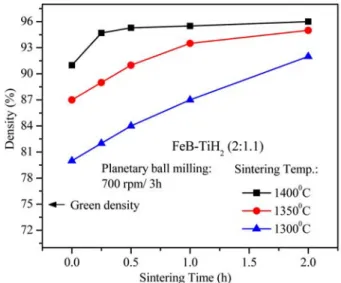
Fig. 1 shows the change of sintered density as a func- tion of sintering temperature and time. The powder mix- ture of (FeB+TiH

2

) was easily compacted at 100 MPa to give the green density of 75% theoretical. At 1400

o

C, the sintered density reaches to 95% even for short holding time of 0.25 h (15min). Further increase of holding time brings only a slight increase in sintered density (96.0%).

At 1300

o

C, the effect of holding time on densification is evident. The density increases with holding time from 80.1% to 91.2%. At 1350

0

C, the sintered density increases

steadily from 87.0% to 93.1% up to the holding time of 1 hour. A further increase in holding time to 2 hours leads to the sintered density of 95.5%. From these results it can be concluded that the optimal sintering temperature is in a range of 1350

o

C and 1400

o

C. For most ferrous materi- als, the pressureless-sintering is carried out in the temper- ature range of 1100

o

C and 1300

o

C or to achieve the higher density the materials should sinter at higher tem- perature, up to 1350

o

C [13]. The remarkably high sinter- ing temperature in this study seems to be due to a high amount of TiB

2

(55 vol.%). As reported already in our previous work [12], the in situ synthesis reaction of nanos- cale TiB

2

between Ti from TiH

2

and B in FeB occurs at 749

o

C under the following equation.

2FeB(s) + TiH

2

(s) → 2Fe(s) + TiB

2

(s) + H

2

(g)

The nanoscale TiB

2

particulates homogeneously dis- persed in the Fe-matrix seem to retard the densification of Fe-TiB

2

composite powder, even though it is expected that the exothermic reaction between Ti and B to form TiB

2

phase during the sintering process may enhance the densification by a thermal contribution.

3.2. XRD phase analysis

XRD patterns of selected sintered bodies are shown in

Fig. 2. It is evident that as expected, two main phases of

Fe and TiB

2

are present in all patterns. Similarly to our

Fig. 1. Change in sintered density of (FeB+TiH

2

) powder

compacts as a function of sintering temperature and time.

(3)

previous results from the in situ fabrication of Fe-TiB

2

nanocomposite powder from (FeB+TiH

2

) powder mixture [12], it seems that both of two phases keep unchanged after the formation at 749

o

C through the whole remained sintering process.

XRD pattern for the sintered compacts at 1350 and 1400

o

C for 2 hours reveal that there is TiB phase as a minor phase. The peak intensity of TiB increases on the compact sintered at 1400

o

C for 2h. According to other reports [7, 8], the following reaction can occur when the excess titanium exists:

Ti + TiB

2

→ 2TiB ΔG

1300K

= - 53 kJ.mol

-1

It seems that the excess Ti which was intentionally added for a complete reaction of TiB

2

formation reacts again at high temperature with the TiB

2

formed at lower temperature during heating stage.

3.3. Microstructure of sintered compacts

Fig. 3 shows the SEM images of (FeB+TiH

2

) powder compacts sintered at 1350

o

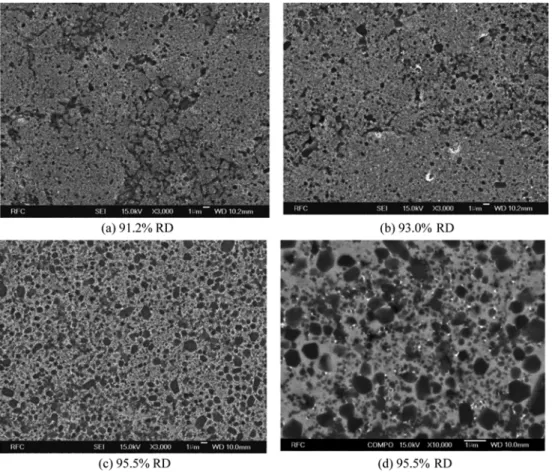
C for 0.5, 1 and 2 hours. The polished cross-section of sintered compact reveals many pores and incompletely densified regions up to the hold- ing time of 1 hour (Fig. 3(a-b)). The increase in holding time to 2 hours results in nearly fully dense microstruc- Fig. 2. XRD pattern of (FeB+TiH

2

) powder compacts sintered

at 1300

o

C for 0.25 h (bottom), at 1350

o

C for 2 hours (middle) and at 1400

o

C for 2 hours (top).

Fig. 3. SEM images of (FeB+TiH

2

) powder compacts sintered at 1350

o

C for (a) 0.5h, (b) 1h, (c) 2h (x3,000), and (d) 2h ( ×10,000,

compo-image).

(4)

ture with 95.5% relative density (Fig. 3(c)). It should be noted here that the dark-grey TiB

2

particulates can be dis- cerned from the Fe-matrix. The high magnification compo- image ( ×10,000)(Fig. 3(d)) shows this more clearly. The size of the TiB

2

particulates is extremely scattered from several tens nanometer to micron. It is evident that a rapid growth of nanoscale TiB

2

particulates occurs between the holding time of 1 and 2 hours at 1350

o

C.

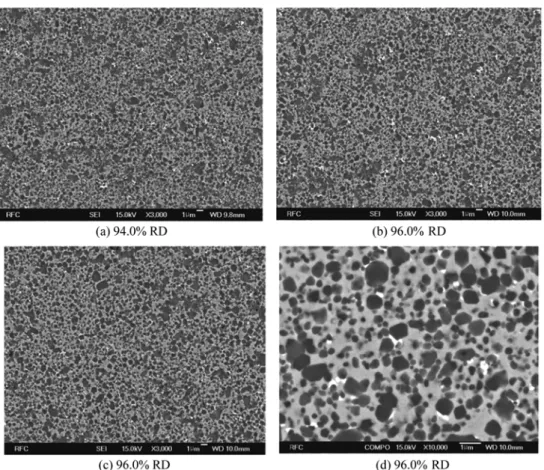
Fig. 4 shows the SEM images of (FeB+TiH

2

) powder compacts sintered at 1400

o

C for 0.5, 1 and 2 hours. All of them show a similar microstructure with Fig. 3(c) described just before. But they have higher sintered den- sities and reveal more homogeneous microstructure in the particulate size. The number of fine particulates with sev- eral tens nanoscale is drastically reduced. The average size of TiB

2

particulates seems to be shifted unimodal to submicron or micron. The overall microstructure is also very homogeneous. Fine TiB

2

particulates are evenly dis- tributed in the Fe-matrix, which cannot be obtained from a conventional powder metallurgy process or other

approaches. It is reported that the size of TiB

2

in the composites fabricated by these methods is in the range of several to tens micrometers.

3. 4. Hardness

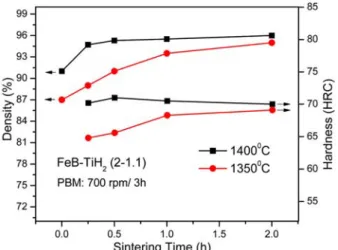
Fig. 5 shows the change of hardness as a function of

sintering temperature and time. In case of the sintering

temperature of 1350

o

C, it is evident that the increase in

sintered density leads to the increase in hardness from

64.8 HRC to 69.1 HRC. The densification effect seems

more dominant than the effect of microstructural defects

like pores. For the sintering at 1400

o

C the longer hold-

ing time do not result in the increase in sintered density

but only the growth of TiB

2

particulates. This affects the

hardness negatively. Maximum hardness of 71.2 HRC for

0.5 h is slightly decreased to 70.0 HRC for 2 hours, which

is nearly equivalent to the HRC of a conventional WC-Co

Hardmetals containing 20 wt.% Co [14]. Even though the

hardness of TiB

2

is higher than WC, it is very remarkable

that the Fe-TiB

2

composite with 60 wt.% Fe exhibits such

Fig. 4. SEM images of (FeB+TiH

2

) powder compacts sintered at 1400

o

c for (a) 0.5h, (b) 1h, (c) 2h ( ×3,000), and (d) 2h (×10,000,

compo-image).

(5)

a high hardness value. It is because of the homogeneous distribution of TiB

2

particulates with relatively fine size of submicron and the sound interface between TiB

2

particu- lates and Fe matrix. If we use a novel sintering method for restraining from grain growth such as the spark-plasma sin- tering, the hardness will be surely increased also with the same composition here.

4. Conclusion

Sintered body of the TiB

2

-reinforced iron matrix com- posite (Fe-TiB

2

) was fabricated by pressureless-sintering of the mixture of titanium hydride (TiH

2

) and iron boride (FeB) powders. From the results of sintered density, X-ray phase analysis, observation and analysis of microstructure with use of FE-SEM and EDS, and hardness measure- ments the followings can be concluded:

(1) The optimal sintering temperature for high density above 95% relative density is between 1350-1400

o

C, where the holding time can be varied from 0.25-2 hours.

Maximum 96.0% relative density is obtained from the (FeB+TiH

2

) powder compacts sintered at 1400 for 2 hours.

(2) In case of sintering at 1300

o

C, the sintered density increases with holding time, while the sintering at 1400

o

C shows almost no change in sintered density after the hold- ing time of 0.5 h.

(3) Sintered compacts have two main phases of Fe and

together with trace of TiB which seems to be formed through the reaction of TiB

2

formed at lower tempera- ture during heating stage and the excess Ti which was intentionally added for a complete reaction of TiB

2

for- mation.

(4) Nearly fully densified sintered compacts show homogeneous microstructure composed of fine TiB

2

par- ticulates with submicron size and Fe-matrix.

(5) Maximum hardness of 71.2 HRC is obtained from the specimen sintered at 1400 for 0.5 hour which is nearly equivalent to the HRC of a conventional WC-Co Hardmet- als containing 20 wt.% Co.

Acknowledgements

This work was supported by the National Research Foundation Grant funded by the Korean Government (NRF-2012R1A1A2044930).

References

[1] B. Du, Z. Zou, X. Wang and S. Qu: Appl. Surf. Sci., 254 (2008) 6489.

[2] B. Du, Z. Zou, X. Wang and S. Qu: Mater. Lett., 62 (2008) 689.

[3] M. Darabara, G.D. Papadimitriou and L. Bourithis: Surf.

Coat. Technol., 201 (2006) 3518.

[4] W. Xibao, W. Xiaofeng and S. Zhongquan: Surf. Coat.

Technol., 192 (2005) 257.

[5] A. Anal, T.K. Bandyopadhyay and K. Das: J. Mater. Pro- cess. Technol., 172 (2006) 70.

[6] B. Li, Y. Liu, H. Cao, L. He and J. Li: J. Mater. Sci., 44 (2009) 3909.

[7] O.K. Lepakova, L.G. Raskolenko and Y.M. Maksimov:

Combust. Explos. Shock Waves, 36 (2000) 575.

[8] C.C. Degnan and P.H. Shipway: Metall. Mater. Trans. A, 33 (2002) 2973.

[9] L. Gai and M. Ziemnicka-Sylwester: Inter.J. Refract. Met.

Hard Mater., 45 (2014) 141.

[10] O.K. Lepakova, L.G. Raskolenko and Y.M. Maksimov: J.

Mater. Sci., 39 (2004) 3723.

[11] R.M. Aikin: JOM, 49 (1997) 35.

[12] X.K. Huynh, S.W. Bae and J.S. Kim: Korean J. Met.

Mater., To be published in 55 (2017).

[13] R.M. German: Powder Metallurgy of Iron and Steel, John Wiley & Sons Inc., New York (1998) 192.

[14] K.J.A. Brooks: World Directory and Handbook of Hard- metals and Hard Materials, International Carbide Data, Hertfordshire, (1996) 96.

Fig. 5. Change in sintered density and hardness of (FeB+TiH

2

)

powder compacts as a function of sintering temperature and

time.

수치

Fig. 1 shows the change of sintered density as a func- func-tion of sintering temperature and time
Fig. 3. SEM images of (FeB+TiH 2 ) powder compacts sintered at 1350 o C for (a) 0.5h, (b) 1h, (c) 2h (x3,000), and (d) 2h ( ×10,000, compo-image).
Fig. 4 shows the SEM images of (FeB+TiH 2 ) powder compacts sintered at 1400 o C for 0.5, 1 and 2 hours
Fig. 5. Change in sintered density and hardness of (FeB+TiH 2 ) powder compacts as a function of sintering temperature and time.

참조

관련 문서

1 John Owen, Justification by Faith Alone, in The Works of John Owen, ed. John Bolt, trans. Scott Clark, &#34;Do This and Live: Christ's Active Obedience as the

Sang - pil Yoon, Hyeok - jung Kwon, Han - sung Kim, Yong - sub Cho, Bo - hyun Chung, Kyung - tae Seol, Young - gi Song, Dae - il Kim, and Yi - sub Min(KAERI). Current Design

Consequently, the Stress Coping Training Program is effective for improving children's school adjustment and sub-factors of school adjustment such as

Second, as a result of the IPA analysis of the sub-factors of audience perception, the factors of entry route were located in the first quadrant, the

The fabrication of transparent spinel using LiF as a sintering aid by hot pressing process was investigated in this study.. Spinel is widely regarded as one of the

Third, looking at the sub-factors in terms of textbooks and software by priority, they were in the order of development of textbooks and learning tools

For the gender, while training and direction, democratic direction, positive regard, and autocratic direction of leadership type sub-factors were perceived as high in

Fourth, for the sub-factors of personality traits according to weight lifters’ education, while there was a high difference in neuroticism and agreeableness