1. Introduction
Rationalism was the name preferred in particular by the Italian architects who first formed the ‘Gruppo 7’ in 1926. They sought to achieve a new and more rational synthesis between the nationalistic values of Italian Classicism and structural logic of the machine age. Giuseppe Terragni(1904-1943) was one of the founding member and a leading Italian Rationalist.
In a career that lasted only 13 years, he created a small but remarkable group of designs; nearly all of them can be found in Como in Italy which was then the center of modern Italian architecture. In 1939 he received the commission for a four-story apartment house in Como, the Casa Giuliani Frigerio; his last major work. The commission came to him just before he was called to serve in the army, thus only allowing him to make a limited number of preliminary sketches before his departure. However, the bulk of the design work was done in his free time while on active duty. Luigi Zuccoli, Terragni’s architectural assistant and pupil, who completed the working drawings and supervised the construction had to interpret his intentions from sketches and drawings on graph paper mailed to him from
various military locations.
It is true that Casa Giuliani Frigerio have been reflected less attention than the Casa del Fascio. However, Woo(1994) pointed out that Casa Giuliani Frigerio expressed freely used the means of transformation of form away from social ideals, and Han(2006) revealed ambiguity resulted in abundant interpretations from the dissolution of building corners and roofs. In addition, Schumacher(1991) regarded it as the last commission to complete the entire design of Terragni. Eisenman(2003) was interested in the autonomous construction of Terragni and started his house series such as House I(1967), House II(1969), House III(1970), House VI(1987), and made his own architectural foundation.
Also, Reyner Banham(1922~1988) described it has play of sunscreen and balcony frame as found in Rietveld Schr der House(1924) and it ö is a fashionable structure and evaluated it as the prototype of Italian suburbs collective housing built in post-war Italy.
In this way, Casa Giuliani Frigerio influenced contemporary architects and theorists. It brings value to study this house and suggests a great deal to the history and theory of modern architecture.
* Assistant Professor, Div. of Architecture and Urban Design, Incheon National University, 22012, Corresponding author([email protected])
A Study on Facade Composition of Casa Giuliani Frigerio of Giuseppe Terragni
Kim, Jinho
*Abstract :
Giuseppe Terragni was one of the founding member and a leading Italian Rationalist
pursued a new and more rational synthesis between the nationalistic values of Italian Classicism and
structural logic of the machine age. Casa Giuliani Frigerio, a four-story apartment housing in Como,
is one of his last major work and is worth to investigate the composition of facades in terms of
ambiguity. Unlike the Casa del Fascio, it is never possible to read an priori whole and to allow
static and unified readings in a traditional alignment. Due to its misalignments found within the
facades of Casa Giuliani Frigerio, it is evident to present unstable and disjunctive readings. These
distinctive facades are read as layers applied onto some equally unstable underlying layer and form
an ensemble of unexpected unity.
2. Background
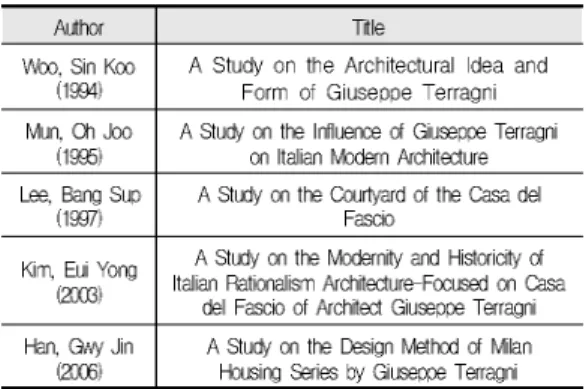
The subject of the research papers on the Terragni’s architecture can be summarized in three categories most.(Table 1) First, an analysis of the Italian tradition tendency based on the modern architecture movement that Terragni pursued. Second, the analysis of the internal courtyard and the elevation studies of Casa del Fascio. Lastly, a study on the form and space composition of Terragni's general architecture. Despite the importance of Casa Giuliani Frigerio collective housing, however, there are few studies that systematically investigate its architectural characteristics in detail.
Table 1. Literature review regarding Terragni’s architecture
It is meaningful to compare Casa del Fascio in Como, Terragni’s well-known masterpiece with Casa Giuliani Frigerio (Figure 1) to reveal few similarities between two works. Like Casa del Fascio Casa Giuliani Frigerio have four different facades. However, they hardly look like the work of the same architect. These differences would be attributed to conventional various factors: first, a difference in program- the former is an institutional building, the latter a housing block(Figure 3); second, a difference in site-the former is on a public square (Figure 2), the latter on a typical residential street; and finally, a difference of intention on the part of the architect-the Casa del Fascio makes some associations between modernism and the Fascist
state, whereas the Casa Giuliani Frigerio does not specifically speak to the social condition of dwelling in the Fascist state. Terragni utilizes the typology of the courtyard house and the Renaissance palazzo in Casa del Fascio to reinforce these relationships between historical archetypes and Fascism. However, it is hard to find any identification as either Fascist or rationalist in conception in Casa Giuliani Frigerio. Since it was neither related nor monumental to the Fascist regime, it was not necessary to symbolize transcendental content that was real and liberated. Rejecting any reference to external meaning and focusing only on the composition and transformation of forms. Therefore, its significance lies in its historically atypical strategies.
Figure 1. Casa del Fascio front view
Figure 2. Casa del Fascio
Figure 3. Casa Giuliani Frigerio
3. Typical floor plan
The apartment plans of the Casa Giuliani
Frigerio show a compact and efficient layout
(Figure 4): the three structural bays, the core
on an exterior wall, and a split-level access
gallery shifting the southern apartment to a
slightly lower level. The practical purpose of the split-level is to obscure an eye-level view to the adjacent rooms from the access gallery.
On the southern side, there is the largest apartment with a three-bedroom unit. The north end holds the next largest apartment, also a three-bedroom unit whose corner room may be used as a study, a dining room, or a bedroom. In the center, on the same level as the northern apartment, has a two-bedroom unit with through-ventilation afforded by the external access gallery. As one exits the elevator, they descend four steps to the access gallery or ascend four steps to the two northern units. The long horizontal openings in the central section of the east fa ade allow a ç direct external view over the access gallery from the kitchen and small bedroom of the middle unit. There is also a small kitchen balcony that overlooks the gallery.
Figure 4. Casa Giuliani Frigerio Floor plan
4. Analysis of the four facades Although the Casa Giuliani Frigerio is literally free-standing, it possesses four very different facades.(Figure 5&6) Because of the disjunctive corners, Casa Giuliani Frigerio’s facades appear as additive and planar, like a series of false fronts or stage sets thrown up to trap the volume of space that is inside their perimeter.
The four facades are expressed between eroded
solid and a sequence of planes with a corresponding suppression of both reticulated and striated readings using different materials:
steel, glass, and concrete.
Figure 5. Casa Giuliani Frigerio axonometric view
Figure 6. Casa Giuliani Frigerio four facades
Three dwelling units are also expressed in the equal bay divisions; the split-level is shown at the top of the fa ade. (Figure 7) Terragni ç employed the alley fa ade to reveal the ç circulation of this building. Instead of using ribbon windows found mostly in other facades, the vertical pattern of the windows appears at the ground level on the fa ade and stair tower ç to express the interior structure; a passageway to the house. Moreover, the vertical element is expressed denser at the stair tower to protect the privacy from the outside than at the ground level. (Figure 8) Yet the ribbon window is retained for continuity, rather than changed for functional expression.
Figure 7. East facade
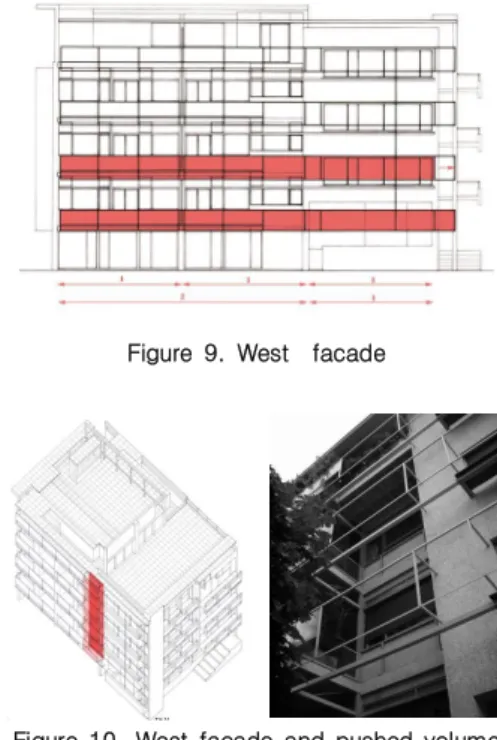
The west fa ade is hard to figure out at ç first glance of the frontal drawings. The configuration of thin steel outriggers, balconies, windows, and solids does not suggest clear readings for the viewer. Because, most of all, the thin steel outriggers disguise the internal structure: half-level floor. They extend to the right edge of the facade to express the continuity of horizontal elements. Also, the three equal-dimension bays correspond to the
dwelling units and the two left bays contain deep balconies; therefore, they tend to be read as 1:1:1 as well as 2:1. (Figure 9) As the third bays are pushed inside, it makes this reading unstable, however. (Figure 10)
Figure 9. West facade
Figure 10. West facade and pushed volume
In this fa ade a two-part division appears ç with six window bays, three in front and three in back of the column line. The three bays of the right segment are pushed forward from the building line, while the three bays of the left segment remain aligned with the outline of the building envelop. The glazing pattern in the three left bays is sequence of A-B-A-B-A-B, while the balcony rails have a C-C1-C pattern.
(Figure 11) It is articulated as a solid-void-solid relationship. That is, the recessed central bay does not actually cover a balcony; thus permitting the placement of a bathroom behind the fa ade. (Figure 12) ç
Figure 8. Exterior and interior view of stair tower
Figure 11. West facade
Figure 12. West facade: six window bays
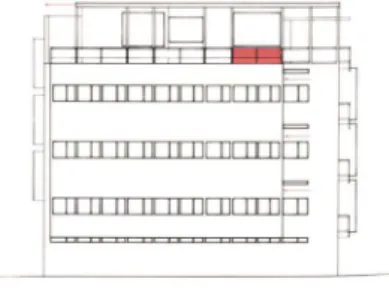
The north fa ade displays a projected volume ç shifted to the left. The shifted rectangular figure reflects the idea of the shifted floors.
On the contrary, the bent frame at the top of the north facade does not move in the same way. Instead the two balcony-rails at the rightmost have void shots. (Figure 13&14) This provides a dynamic view that can be seen from the street with the middle volume moved to the left but the others did not.
Figure 13. North facade
Figure 14. North facade’s two balcony rails