DOI:10.5229/JKES.2011.14.2.110
−
110
−캐소드 루테늄 촉매의 전기화학적 환원 처리가 고분자 전해질 연료전지 성능에 미치는 영향
최종호*
경일대학교 신재생에너지학과 (2011년 5월 20일 접수 : 2011년 5월 27일 채택)
Effect of Electrochemical Reduction of Ruthenium Black Cathode Catalyst on the Performance of Polymer
Electrolyte Membrane Fuel Cells
Jong-Ho Choi*
Dept. of New and Renewable Energy, Kyungil University,
33 Buho-ri, Hayang-eup, Gyeongsan-si, 712-701, Gyeongsangbuk-do, Korea (Received May 20, 2011 : Accepted May 27, 2011)
초 록
Ru black
을고분자전해질 연료전지용cathode
촉매로 사용했을때초기에는연료전지성능이낮게나타났으나
,
일련의실험을거치는동안연료전지 성능이점차증가되는것이관찰되었다.
이는
Ru black
의전기화학적환원으로인한것으로판단되는대, Ru black
촉매에외부에서가해지는전압과그전압을가하는시간을변화시켜본결과
0.1V
를30
분이상가하게되면Ru black
의성능향상이극대화되었다
.
성능향상원인을확인해보기위해 수소분위기하에서환원된Ru black
과XRD patterns
을비교한결과, Ru black
촉매가전기화학적환원처리를통해완전히metallic Ru
으로전환되었다고판단하기는어려웠다.
또한Ru black
을이용해전기화학적환원처리전후의
CO stripping voltammetry
를비교해본결과, Ru black
중에일부는metallic Ru
으 로환원되었지만,
일부의Ru
이반대편전극으로제거됨을확인할수있었다.
이과정중에제거된Ru
이연료전지성능에나쁜영향을미칠 수있을 것이라생각된다.
따라서,
본연구에서제시된Ru black
의전기화학적처리과정을통해서일부의Ru
은반대쪽전극으로제거되고,
산화된상태로존재하는일부의
Ru
이metallic Ru
으로변화됨으로서연료전지성능이향상된것으로사료된다.
Abstract :
Ru black was used for cathode catalyst in polymer electrolyte membrane fuel cell which showed low performance at the initial test. However, it was observed that the performance of Ru black cathode was dramatically enhanced after certain kind of experiment compared with initial one. It might be due to an electrochemical treatment in which a voltage was applied to the Ru cathode for constant period time. When a constant potential of 0.1 V was applied to Ru cathode for 30 min, the fuel cell performance of Ru cathode showed the best results. In order to investigate the effect of electrochemical treatment on the performance enhancement, the char- acteristics of electrochemically treated Ru black was compared with that of Ru black which was reduced under H
2atmosphere. From XRD results, it was turned out that Ru black was not completely converted to metallic Ru by electrochemical treatment, but it is sufficient to be one
*E-mail: [email protected]
of reasons for the performance enhancement. According to the results of CO stripping volta- mmetry, it was observed that some Ru was removed from Ru electrode by electrochemical treatment which might have a bad effect on the fuel cell performance. The removal of some Ru from as-received Ru black by electrochemical treatment is also another reason for the enhancement of fuel cell performance.
Keywords :
Ruthenium black, Oxygen reduction reaction, Electrochemical reduction, Fuel cell
고분자전해질연료전지
(Polymer Electrolyte Membrane Fuel Cell, PEMFC)
는수송용,
휴대용,
건물용전원공급장치로서 최근많은각광을받고있다
.
하지만이러한PEMFC
가상용화되기위해서는여러가지문제점들이해결되어야하지만그중에서도연료전지의가격과내 구성문제의해결이가장중요하게대두되고있다
.
가격저감 문제는수송용이나 건물용전원 공급장치로서의 고출력연료전지발전시스템의개발과연결되지만내 구성문제는휴대용을포함한모든연료전지의상용화 성공여부와밀접하게연관되어있다
.
이러한응용분야에이용될수있는
PEMFC
에서는전극촉매로사용되는백금의가격이높은연료전지가격형성의주된원인으 로작용하고있다
.
따라서백금과같은귀금속촉매가아니면서도촉매의 활성이 좋고비교적가격이 싼촉 매의 개발이절실히요구되는상황이다
.
1-4)이와함께
,
수소가가지는저장및이송의불편을해 소하기위해액체인메탄올을연료로사용하는직접메 탄올 연료전지(Direct Methanol Fuel Cell, DMFC)
도끊임없는연구와개발이진행되어왔다
.
5-7)DMFC
는소 형화가가능하기때문에노트북컴퓨터나휴대폰과같은 휴대용전자기기의전원,
전기자전거나스쿠터,
군사용전원으로의사용가능성이아주높을것으로예상되고 있다
.
이러한DMFC
도환원극(cathode)
에서일어나는산 소환원반응용(Oxygen Reduction Reaction, ORR)
촉매 로백금을사용하고있는데,
이경우는촉매의가격적인문제외에고려되어야할사항이하나더있다
. DMFC
에 사용된고분자전해질은액체인메탄올이전혀통과할수없는물질이아니기때문에산화극
(anode)
에서산화되어야할메탄올이고분자전해질을통해
cathode
로넘어오는메탄올크로스오버
(methanol crossover)
현상이발 생하게된다.
메탄올크로스오버현상이발생하게되면cathode
촉매로사용된백금이메탄올을산화시키기때문에혼합전위
(mixed potential)
가발생하여연료전지성능과효율을낮추게된다
.
8-13)따라서DMFC
에서는백금과는달리메탄올에대한활성이전혀없거나활성이아
주낮은대체
ORR
촉매의개발이필요하다.
현재까지개발된비백금계
ORR
촉매는크게금속산화물,
전이금속칼코겐화합물
,
전이금속과고분자의복합체등이있다
.
14-19)페롭스카이트형태의금속산화물이ORR
촉매로많이연구된바있으나
Pt
촉매에비해성능이너무낮다는 단점이 있으며
,
14) 전이금속과 고분자의 복합체연구는
R. Bashyam
et al.에보도된바있는데코발트-
폴 리피롤-
탄소의복합체(Co-PPy-C)
를합성했을때Pt
보 다는 연료전지 성능이 많이 낮지만 전이금속 촉매를 사용하였음에도불구하고높은안정성을가진다고보 고하였다.
15)Ru chalcogenide
는전이금속칼코겐화합물의 대표적인 예로서, N. Alonso-Vante
et al.에의해 처음ORR
반응에대한활성이 있다고보고된이후도많은연구가진행되었음에도불구하고아직납득할만한수
준의연료전지성능을보고한연구가없었으나
C. M.
Johnston
et al.에의해수용액상태에서셀레늄(Se)
으로 표면처리된Ru
촉매가Pt
촉매의40%
정도의성능을나타내는것으로보고된바있다
.
16-19)본연구역시전이금속칼코겐화합물을이용한촉매개발을연구하기 위해 루테늄 블랙
(Ruthenium black)
촉매와 셀레늄(Selenium)
을 사용하여 새로운 물질을 합성하던 중에Ru black
을환원시키는방법을 찾다가나온 결과로부터시작된연구이다
.
또한백금
-
루테늄 블랙(Pt-Ru black)
은메탄올산화반응에대한활성이아주우수하기때문에
DMFC anode
촉매로가장널리사용되고있다
.
하지만Pt-Ru black
역 시메탄올크로스오버현상과마찬가지로연료전지운전을하게 되면
Pt-Ru
중에서일부Ru
이녹아나와고분자전해질을통해넘어와서
cathode
촉매로사용된Pt
표면에흡착되는
Ru crossover
현상이보고된 바있다
.
20-22)이러한현상이발생하면cathode
촉매인Pt
가부분적으로
Ru
으로덥히게되어ORR
에대한활성이 떨어져궁극적으로연료전지성능이감소되기때문에이러한
Ru crossover
현상은완전히방지되거나적어도최소화해야만한다
.
이를방지하기위한방법으로Pt-Ru black
촉매를이용하여MEA
로제조할때,
제조전이나 후에황산을이용한산처리를하거나고온에서열처리하 는등의방법을통해crossover
될가능성이있는Ru
를 미리제거하기위한시도가보고된바있으나그효과가 미비하거나혹은재현성이부족하였다.
이에 반해Ru
crossover
현상을 효과적으로제거하기위한 방법으로전기화학적환원처리 방법이보고된바있다
.
23-26)따라서본연구에서는
Pt
을대신할ORR
촉매를찾기위한연구의일환으로
Ru black
을사용했을때초기에는 연료전지성능이비교적낮았으나,
시간이지남에따라연료전지성능이향상된것을발견하였다
.
이러한성능 향상의 원인이 전기화학적 환원 처리 때문일 것이라판단하고
, Ru black
을수소분위기하에서환원처리된것과비교하면서전기화학적환원처리가연료전지성 능에 미치는영향이무엇인지확인하려고 한다
.
2. 실험방법
2.1. MEA
제조 및 연료전지 테스트Membrane-electrode assembly(MEA)
는Nafion® 1135
전해질막에한쪽에상용
Pt black
촉매(anode)
를직접코팅하고다른한쪽에상용
Pt black
또는상용Ru black
촉매
(cathode)
를직접코팅하여제조하였다.
촉매잉크는 증류수에 일정량의Pt black
또는Ru black
과5%
Nafion®
을첨가하여90
초동안초음파분쇄기를이용하여분산시킨후
hand-painting
을통해직접전해질막에코팅하였다
.
사용된MEA
의활성면적은5cm
2이었으며,
각각의촉매사용량은
5mg cm
−2로통일하였다.
제조된MEA
를기체확산층과함께연료전지측정셀에체결한후연료전지 성능평가및
CO stripping voltammetry
를측정하였다
.
본연구의연료전지성능평가에사용된
MEA
는anode
촉매로는
Pt black
이 사용되었고, cathode
촉매는Ru
black
이사용되었다.
연료전지성능곡선은연료전지평가장치를이용해기록되었으며수소와공기의유량은각각
300sccm (sccm =standard cubic centimeter per minute),
466sccm
이었고,
수소와공기는모두충분히가습된상태로공급되었다
.
연료전지장기성능측정의경우0.4V
를가해면서 시간에따른 전류의변화를측정하였다
. 2.2. Ru black
촉매의 전기화학적 환원 처리 및 수소 분위기 하에서의 환원 처리Ru black
촉매의 전기화학적 환원처리를 위해서는Pt black
을anode
촉매로사용하고Ru black
를cathode
촉매로 사용한
MEA
를 장착한연료전지를 대상으로, anode
에수소300 sccm, cathode
에질소466 sccm
를상 압,
상온에서흘려주었다. 30
분이상경과후cathode
에 가해 주는 전압(0.1V, 0.2V, 0.3V, 0.4V)
과 시간(10
초, 50
초, 200
초, 600
초, 1800
초)
을변화시키며Ru black
의환원정도를다르게조절해보았으며그에따른연료전 지성능을비교해보았다
.
전기화학적환원처리된Ru black (potential-treated Ru)
과의비교를 위해서,
또다른Ru black
촉매를250
도수소분위기하에서2
시간동안환원시킨후
(H
2-reduced Ru)
동일한제조방법에따라MEA
를제조한후연료전지성능을평가해보았다.
2.3. CO stripping voltammetry
전기화학적환원처리방법을 통한
Ru black
촉매의변화를관찰해보기위해
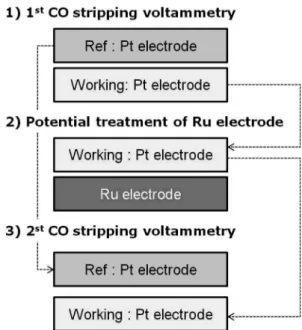
Fig. 1
에나타낸것처럼전극을준비하여
,
서로다른2
개의Pt electrode
의CO stripping voltammetry
를 측정해 보았다. Reference Pt electrode
의 경우Nafion® 1135
한 쪽면에만Pt black
이코팅된반쪽
MEA 2
개를제조한후연료전지셀에장착하는힘에의해 접합하여한 쪽
Pt electrode
의CO stripping voltammetry
를 측정한다(1
stCO stripping voltammetry).
이에반해
test Pt electrode
의경우reference Pt electrode
에서
CO stripping voltammetry
측정에 사용된Pt electrode
를갖는반쪽MEA
에Ru black
이한쪽면에 코팅된반쪽MEA
와결합하고, Ru black electrode
에전압을 가하여 전기화학적 환원처리가 수행 하였다
.
그후연료전지를다시 분해하여
Pt electrode
를갖는 반쪽MEA(test Pt electrode)
만을 취하였다. Test Pt electrode
를갖는이반쪽MEA
를또다른Pt electrode
를갖는반쪽
MEA
와결합한후test Pt electrode
쪽의CO stripping voltammetry
를측정하였다(2
ndCO stripping voltammetry).
3. 결과 및 고찰
본연구에사용된
Ru black
을cathode
촉매로사용한MEA
의연료전지성능평가결과를Fig. 2
에나타내었다.
우선
,
아무처리하지않은Ru black
을촉매로사용한Fig. 1. Experimental procedure for CO stripping
voltammetry.
연료전지 성능결과를살펴보면 그성능이
Pt black
을cathode
촉매로사용한연료전지성능결과에비해현격히떨어짐을 알 수 있었다
.
하지만Ru black
을 사용한MEA
의 경우 며칠 동안 연료전지 성능평가와cyclic
voltammetry
를이용한 촉매활성평가를 거치는동안연료전지성능이눈에띄게증가함을확인할수있었다
.
특히
Ru black
촉매의CO
내피독성을 테스트해보는CO stripping voltammetry
측정이후에연료전지성능이 크게증가됨을확인하였다.
선행연구에따르면DMFC anode
촉매로사용되는Pt-Ru black
촉매의Ru crossover
현상을줄이기위한방법으로
Pt-Ru black
촉매에일정시간 동안전압을 가해줌으로 인해
crossover
될 가 능성이있는Ru
을미리제거할수있다고보고된바있다
.
25,26)따라서, Ru black
촉매의경우도CO stripping
voltammetry
를측정하는동안crossover
될가능성이있는Ru
이제거되기때문에연료전지성능증가가초래될수도있다고생각한다
.
또한상용Ru black
의경우금속상태의Ru
만존재하는것이아니라상당부분은산화물 또는수산화물 형태로존재하므로
,
전기화학적환원처리를 통해이런산화물또는수산화물상태의Ru
이metallic
상태로바뀌면서연료전지성능이크게증가했다고볼수 도있다
.
따라서Ru black
촉매의연료전지성능향상원인을찾아보기위해다양한조건으로
Ru black
촉매에외부 전압을가해주면서 연료전지 성능이어떻게 변 화하는지 관찰해보았다
.
Fig. 3
은Ru black
을cathode
촉매로사용한MEA
를 제조한후,
연료전지테스트전에cathode
연료로air
대 신 질소를흘려주면서0.1 V (
vs.NHE)
부터0.4 V
까지0.1V
간격으로10
분동안전압을각각가한뒤에연료전지성능을측정한결과를나타낸다
.
앞서언급한대로아무런처리를하지않은
Ru black
촉매를사용한경우연료전지성능이매우낮게나타났다
.
하지만전기화학적 환원처리라고표현할수있는과정을통해0.4 V
의전 압이가해진경우에는연료전지성능에큰차이가없지 만0.3V, 0.2V, 0.1V
로전압이감소함에따라연료전지성능이차례대로증가됨을알수있었다
.
특히0.2V
가가해진경우급격한성능증가를보였으며
, 0.1V
를가하면조금더성능이향상됨을확인할수있었다
.
즉, 0.3V
이하의전압이가해지면
Ru black
의구조에상당한변화가발생하기시작하고
, 0.2V
이하의전압이가해지면그변화가더욱두드러짐을알수있다
.
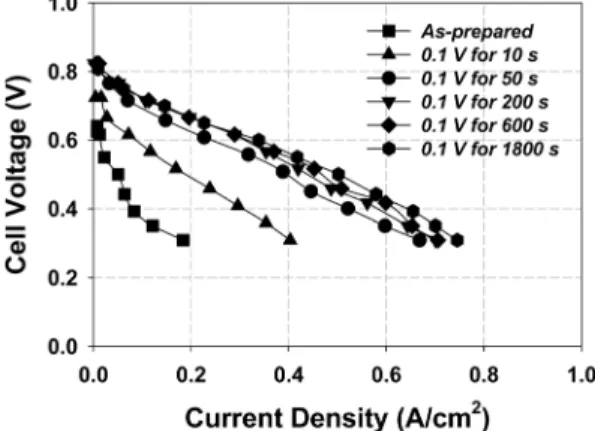
전압뿐만아니라일정전압
(0.1 V)
하에서그전압을가해 주는 시간을변화시킨후그에따른연료전지성능결과를
Fig. 4
에나타내었는데
,
전압의변화와마찬가지로전압을가해Fig. 2. Polarization curves of MEAs with different cathode catalysts, Ru black cathode and Pt black cathode, respectively. Anode : Pt black, Membrane : Nafion® 1135, Cell temperature:80
oC, H
2flow:300sccm, air flow 466sccm.
Fig. 3. Polarization curves of Ru cathode catalysts with different electrochemical reduction potential for 10 min.
Anode : Pt black, Membrane : Nafion® 1135, Cell temper- ature : 80
oC, H
2flow : 300 sccm, air flow : 466 sccm.
Fig. 4. Polarization curves of Ru cathode catalysts with different electrochemical reduction time at 0.1 V
vs.NHE.
Anode : Pt black, Membrane : Nafion® 1135, Cell temper-
ature : 80
oC, H
2flow : 300 sccm, air flow : 466 sccm.
주는시간에따라서도연료전지성능이변화하는것으로 나타났다
.
가해주는시간이10
초, 50
초, 200
초를증가했을때연료전지성능이크게증가했으며
, 600
초, 1800
초 로증가했을경우성능증가폭이감소하긴했으나여전 히성능이증가하는것으로나타났다.
즉, 0.1V
의전압이 가해지더라도Ru black
이상당한구조적변화를보이기위해서는
1800
초이상의시간이필요함을알수있었다.
위의 두가지 실험을통해
Ru black
을cathode
촉매로사용한경우연료전지테스트하기전에
0.1V
근처의전압을
1800
초이상가해주게되면연료전지성능이크게향상됨을확인할수있었다
.
이는부분적으로산화 된Ru
입자를전기화학적 처리방법에의해환원시킴 으로연료전지성능이크게향상되었다고만판단할수도 있다.
하지만단순히환원처리만에의한결과인지,
아니면앞서제시한대로일부
Ru
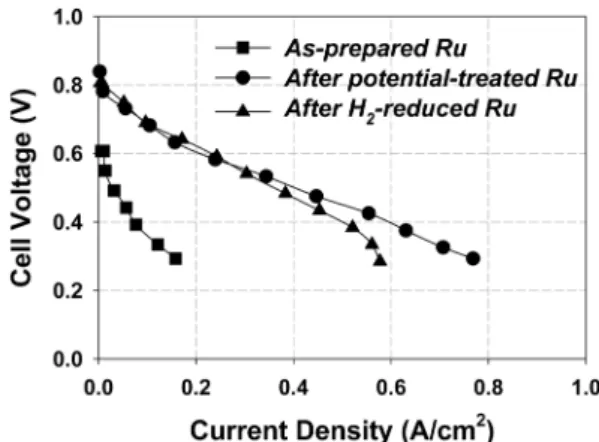
이제거됨에따른결과인지 를확인해보기위해몇가지분석을더실시해보았다. Fig. 5
는전기화학적환원처리과정을거친Ru black
을
cathode
촉매로사용한MEA
와수소분위기하에서환원처리된
Ru black
을cathode
촉매로사용한MEA
의 연료전지성능결과를나타낸것이다.
두가지방법에의 해처리된Ru black
의경우,
아무처리도하지않은Ru
black
에비해성능이높게나타나는것은쉽게확인할수있었다
.
하지만두가지환원방법에따른성능차이를 살펴보면,
촉매의활성차이에의한성능차이가확연히 드러나는저전류밀도영역에서는성능의차이가크게나 지않았으나,
연료의확산에의해성능의차이가드러나는 고전류밀도 영역에서 약간의성능 차이가확인되었다.
위실험을통해
Ru black
을전기화학적환원처리를하게되면수소분위기하에서환원처리를한
Ru black
보다 성능이훨씬더우수하다고표현할 수는없지만
수소분위기하에서처리된만큼의성능향상효과는가 져올수있음을확인하였다
.
이러한결과를바탕으로두Ru black
입자의구조를분석해보기위해실시한XRD
결과를
Fig. 6
에나타내었다.
앞서언급한것과같이 아무처리도하지않는
Ru black
입자의 경우metallic Ru
과일부산화물형태로존재하기때문에
Fig. 6(a)
에나타난것처럼metallic Ru
의 특성피크들이broad
하게나타났지만Fig. 6(c)
의 수소 분위기에서처리된Ru black
의경우metallic Ru
의특성피크들이매우
sharp
하면서도명확히나타났다.
이에반해
Fig. 6(b)
에해당되는전기화학적으로처리된Ru black
의경우에는아무처리하지않은
Ru black
에비해좀더환원처리가진행된거같아보이지만
,
수소분위기에서처리된
Ru black
의경우처럼metallic Ru
의특성피크들이뚜렷하게나타나지는않았다
.
즉,
전기화학적으로환원처리된
Ru black
을 사용한MEA
의 성능증가 현상을전적으로부분적으로산화되어있는
Ru black
이metallic Ru
으로환원되었기때문에성능이향상되었다고보기에는설명이불충분해보인다
.
따라서앞서성능향상요인 의하나일것이라고제시한,
성능에나쁜영향을미칠 수있는일부Ru
성분의제거에대한증거를찾기위해실험을수행해보았다
.
앞서제시한
Fig. 1
은일부Ru
이제거되었을것이란가정을확인하기위한실험절차에대해나타내었고
,
이를 다시한번설명하면다음과같다.
우선anode, cathode
모두
Pt black
을Nafion® 1135
에코팅한후MEA
로 체결하여working electrode
로서Pt electrode
의1
stCO stripping voltammetry
를측정한 후, MEA
를분리하여reference electrode
로표시된Pt electrode
대신에Ru electrode
와다시MEA
를제작한다.
그런다음그MEA
의Ru electrode
에전기화학적환원처리라고표현한방법대Fig. 5. Polarization curves of potential-treated Ru cathode and H
2-reduced Ru cathode. Anode : Pt black, Membrane : Nafion® 1135, Cell temperature : 80
oC, H
2flow: 300 sccm,
air flow : 466 sccm. Fig. 6. XRD Patterns of H
2-reduced Ru catalyst, potential-
treated Ru catalyst, and as-received Ru catalyst.
로
30
분동안0.1V
를가하면이과정동안Ru electrode
중에일부는환원이되고그중일부의
Ru
입자들은반대쪽
working electrode
라고표시된Pt electrode
로이동할 것이라고가정한다.
마지막으로MEA
를다시분리해서Ru electrode
를 제거하고맨 처음사용했던reference electrode
인Pt electrode
와결합하여, working electrode
인Pt electrode
의2
ndCO stripping voltammetry
를측정하여 그결과를Fig. 7
에나타내었다.
Fig. 7
의점선으로 표시된1
stCO stripping
결과는아무런 조치도하지 않은
Pt electrode
의CO stripping voltammetry
결과이므로CO
탈착 피크는0.7 V
이상 에서 나타났다.
하지만Ru electrode
와 결합한후 전 기화학적 처리과정을 거친 후 다시CO stripping voltammetry
측정한2
ndCO stripping
결과를 살면보면
CO
탈착 곡선이0.5 V
정도에서부터 나타나기시작하고 최고피크값 역시
0.6 V
근처에서 나타났다.
또한탈착곡선의모양도
sharp
한탈착곡선이아니라broad
한탈착곡선이나타남을알수있다. CO stripping
voltammetry
는전극의표면조성에아주민감한결과를나타내주는 것으로
, CO
탈착곡선의피크값이어느전압에서 나타나느냐를통해 촉매 표면의
Pt
와Ru
의비율을 구할수있는것으로알려져있다
.
27,28)따라서Fig. 7
의결과에따르면CO
의탈착곡선이0.1 V
이상저전압 영역으로이동되어있음을통해
Pt electrode
표면이
Ru
입자에의해일부분덥혀있음을알수있고,
여기에있는
Ru
은결국Ru electrode
의전기화학적환원 처리 과정 동안 반대편 전극으로 일부 넘어 왔음을 확인할수있다.
이상의결과를통해
Ru black
을cathode
촉매로사용하여연료전지를평가했을때전기화학적환원처리법을 거치게되면연료전지성능이많이증가함을확인할수 있는대이때성능증가의요인중하나는부분적으로
산화된
Ru
입자들이metallic Ru
으로 환원되기 때문 이며,
또다른하나는성능에안좋은영향을미칠수있는일부
Ru
성분들이제거되기때문인것으로판단 된다.
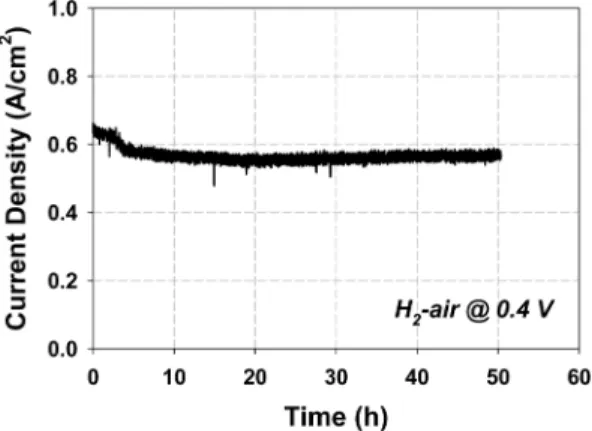
위와같은방법으로전기화학적으로처리된Ru black
을cathode
촉매로 사용하게되면일시적인성능 증가현상이아니라그성능이비교적오랜시간에걸쳐유지될수있다는 것을
Fig. 8
을통해 알수있었다.
4. 결 론
Ru black
입자를고분자 전해질 연료전지cathode
촉매로사용을하였고
,
예상치 않은성능증가현상이 발견되어그원인을찾기위해Ru
전극에다양한전압 과그전압이가해지는시간을바꾸어가며성능변화를관찰해보았다
. Ru black
촉매의효과적인처리를위해서는
0.1 V
전압을30
분동안 가해준 결과 최고의성능향상을보여주었다
.
이러한성능향상의원인을찾아보기위해수소분위기하에서환원처리된
Ru black
과연료전지성능및
XRD
결과를분석해본결과일부Ru
의환원이확인되기는했으나이것이성능향상요인의 전부가아닌것으로나타났다.
또한전기화학적처리방법으로
Ru black
를 처리하기 전과 후의CO stripping
voltammetry
측정해 봄으로써 전기화학적 처리 과정동안
Ru electrode
에서반대편electrode
로일부의Ru
이 이동하였음을확인하였다.
이러한결과를바탕으로Ru black
을cathode
촉매로사용하여비교적높은성능을얻기위해서는전기화학적처리과정이필요하며
,
그과정 동안일부산화되어있는Ru
은metallic Ru
으로환원이 되고,
연료전지성능에나쁜영향을미칠수있는일부Ru
성분들은반대편 전극으로제거되는 것으로파악된다
.
이를잘활용한다면Pt
보다가격이저렴한Ru
을Fig. 7. Carbon monoxide stripping voltammetry from Pt electrode in cells which is counter electrode during the electrochemical reduction of Ru electrode.
Fig. 8. Long-term performance test of a potential-treated
Ru cathode in PEMFC. Cell voltage 0.40 V; cell temperature
80
oC; H
2flow 300 sccm; air flow 466 sccm.
연료전지용 촉매로서의 이용을 현실화 할 수 있을 것 으로 기대된다.
감사의 글
본 연구는 경일대학교 신임교원정착연구비 지원으로 수행되었으며, 이에 감사 드립니다.
참고문헌
1. S. Arico, S. Srinivasan, and V. Antonucci. ‘DMFCs: From Fundamental Aspects to Technology Development’ Fuel Cells ,
1, 133 (2001).
2. K. Kordesch and G. Simader, “ Fuel Cells and their Applications ” Wiley-VCH, Weinheim (1996).
3. S. Wasmus and A. Kuver, ‘Methanol oxidation and direct methanol fuel cells: a selective review’ J. Electroanal.
Chem. ,
461, 14 (1999).
4. M. P. Hogarth and G. A. Hards, ‘Direct Methanol Fuel Cells : Technological Advances and Further requirements’
Plat. Met. Rev. ,
40, 150 (1996).
5. D. Chu and S. Gilman, ‘The Influence of Methanol on O
2Electroreduction at a Rotating Pt Disk Electrode in Acid Electrolyte’ J. Electrochem. Soc. ,
141, 1770 (1994).
6. P. S. Kauranen and E. Skou, ‘Mixed methanol oxidation/
oxygen reduction currents on a carbon supported Pt catalyst’
J. Electroanal. Chem. ,
408, 189 (1996).
7. S. C. Thomas, X. Ren, S. Gottesfeld, and P. Zelenay,
‘Direct methanol fuel cells: progress in cell performance and cathode research’ Electrochim. Acta ,
47, 3741 (2002).
8. B. Wang, ‘Recent development of non-platinum catalysts for oxygen reduction reaction’ J. Power Sources ,
152, 1 (2005).
9. L. Zhang, J. Zhang, D. P. Wilkinson, and H. Wang,
‘Progress in preparation of non-noble electrocatalysts for PEM fuel cell reactions’ J. Power Sources ,
156, 171 (2006).
10. A. K. Shukla, R. K. Raman, and K. Scott, ‘Advances in Mixed-Reactant Fuel Cells’ Fuel Cells ,
5, 436 (2005).
11. S. C. Barton, T. Pattern, E. Wang, T. F. Fuller, and A. C.
West, ‘Mixed-reactant, strip-cell direct methanol fuel cells’
J. Power Sources ,
96, 329 (2001).
12. R. W. Reeve, P. A. Christensen, A. J. Dickinson, A.
Hamnett, and K. Scott, ‘Methanol-tolerant oxygen reduction catalysts based on transition metal sulfides and their application to the study of methanol permeation’
Electrochim. Acta ,
45, 4237 (2000).
13. K. -W. Park, Y. -M. Kim, B. -K. Kwon, J. -H. Choi, I. -S.
Park, and Y. -E. Sung, ‘Characterization of Methanol Crossover through Nafion Membranes by Direct Cell Performance Measurement’ J. Kor. Electrochem. Soc. ,
5, 226 (2002).
14. M. Hayashi, H. Uemura, K. Shimanoe, N. Miura, and N.
Yamazoe, ‘Reverse Micelle Assisted Dispersion of Lanthanum Manganite on Carbon Support for Oxygen Reduction Cathode’ J. Electrochem. Soc. ,
151, A158 (2004).
15. R. Bashyam, P. Zelenay, ‘A class of non-precious metal
composite catalysts for fuel cells’ Nature ,
443, 63 (2006).
16. N. AlonsoVante, P. Bogdanoff, and H. Tributsch, ‘On the Origin of the Selectivity of Oxygen Reduction of Ruthenium-Containing Electrocatalysts in Methanol- Containing Electrolyte’ J. Cat ,
190, 240 (2000).
17. T. J. Schmidt, U. A. Paulus, and H. A. Gasteiger, N.
Alonso-Vante, R. J. Behm, ‘Oxygen Reduction on Ru
1.92Mo
0.08SeO
4, Ru/Carbon, and Pt/Carbon in Pure and Methanol-Containing Electrolytes’ J. Electrochem. Soc. ,
147
, 2620 (2000).
18. M. Lefèvre, J. P. Dodelet, and P. Bertrand, ‘O
2Reduction in PEM Fuel Cells: Activity and Active Site Structural Information for Catalysts Obtained by the Pyrolysis at High Temperature of Fe Precursors’ J. Phys. Chem. B ,
104