증포 천마 발효물의 항산화 활성 및 성분변화
도은수1#, 유지현2, 길기정1*
1 : 중부대학교 한방제약과학과, 2 : (재)금산국제인삼약초연구소
Antioxidant Activity and Component Change of Steaming-Drying and Fermented Gastrodiae Rhizoma
Eun-Soo Doh
1#, Ji-Hyun Yoo
2, Ki-Jung Kil
1*1 : Department of Herbal pharmaceutical Science, Joongbu University Geumsan 312-702, Korea 2 : International Ginseng and Herb Research Institute Geumsan 312-804, Korea
ABSTRACT
Objectives : The objective of this study is to evaluate antioxidant activity and the main component content change of steaming-drying fermented Gastrodiae rhizoma extract.
Methods : The antioxidant activities were determined for total polyphenol, flavonoid contents, SOD-like activity, electron donating activity, nitrite scavenging ability and major functional components(gastrodin and 4-hydroxybenzyl alcohol content) were also measured.
Results : The polyphenol content of fermented Gastrodiae rhizoma by S. cerevisiae were higher than those of fermented Gastrodiae rhizoma by A. oryzae, and when the fermentation period is extended. SOD like activity of fermented Gastrodiae rhizoma showed to be increased by fermentation with S. cerevisiae than fermentation by A. oryzae. Electron donating activity of fermented Gastrodiae rhizoma were increased at almost parallel level as vitamin C, by fermentation. Notably, fermentation by A. oryzae was moderately better than fermentation by S.
cerevisiae. Flavonoid content of Gastrodiae rhizoma showed to increasing by fermentation, particularly fermentation by S. cerevisiae was proven to be more effective than by A. oryzae.
The more steaming-drying or increased period of fermentation would be resulted in more gastrodin contents but under the same conditions, 4-hydroxybenzyl alcohol content of fermentation by A. oryzae in case of steaming and drying 1 time and 3 time was higher than control.
Conclusions : These results has strongly hint the possible applicability of fermentation might be effective to improve the diverse biological activities of Gastrodiae rhizoma and may further supports to develop a functional food materials.
Key words : Gastrodiae rhizoma, Fermentation, Stem-dried, Antioxidation, Components
서 론1)
천마(Gastrodiae rhizoma)는 난초과(Orchidaveae)에 속 하는 여러해살이풀인 천마(Gastrodia elata Blume) 및 동속
근연식물의 근경을 건조한 것으로 한국, 일본, 중국 등지에서 자생하며, 뿌리가 없고 엽록소가 없어 광합성이 불가능하고 뽕나무버섯(Armillaria mellea)과 편리공생을 통하여 영양을 섭취하며 땅속 괴경을 형성한다. 줄기는 원기둥 형태로 직립 하고 계란모양의 비늘잎이 드물게 붙어 있으며 붉은 밤색이 다. 줄기의 윗부분은 천마의 종류에 따라 노란색과 빨간색으
*Corresponding author : Ki-Jung Kil. Department of Herbal pharmaceutical Science, Joongbu University Geumsan 312-702 ·Tel : +82-41-750-6225 ·E-mail : [email protected]
#First author : Eun-Soo Doh. Department of Herbal pharmaceutical Science, Joongbu niversity Geumsan 312-702 ·Tel : +82-41-750-6722 ·E-mail : [email protected]
·Received:16 December 2014 ·Revised:20 January 2015 ·Accepted:20 January 2015
로 꽃이 핀다. 잎은 비늘 모양으로 막질이며 길이는 1~2cm 이고 가는 잎맥이 있으며 아래 부분은 짧은 칼집 모양이다.
보통 잎은 없고 비늘 조각 잎이 성기게 나며 하부의 것은 짧 은 잎집을 형성한다. 표면은 윤상의 비늘조각이 늘어선 형태 로 원기둥꼴로 곧추서며 황적색을 띤다. 지상부에 형성된 줄 기의 색깔에 따라서 홍천마(Gastrodia elata)와 녹천마 (Gastrodia gracillus)로 구분되어지고, 괴경과 줄기는 약용 으로 이용되고 있다1-6).
천마에 함유되어 있는 gastrodin, p-hydroxybenzyl alcohol, p-hydroxybenzyl aldehyde, vanillin 등의 약리성분은 체 내에서 다양한 생리활성을 가지며7-9), 그 중 phenolic glucoside 인 gastrodin은 천마추출물의 중요하고 풍부한 생체활성요소 로 알려져 있다10). 천마 근경에 있는 gastrodin은 혈액 속에 서 gastrodin의 aglycone인 4-hydroxybenzyl alcohol로서 주로 존재하며11), 그것이 인체에 영향을 미치는 주요 활성요 소로 알려져 있지만, 약물학적 작용은 gastrodine 하나만으 로는 설명되지 않으며 천마 근경에 함유되어 있는 gastrodin 과는 다른 생리활성 화합물이 있다고 보고되었고12), 천마의 유효성분인 p-hydroxy benzyl alcohol, vanillin, gastrodin 등은 항산화작용, serotonergic receptor antagonist작용, GABA agonist작용, glutamate저해작용이 있다고 알려져 있 다13-16).
이와 같이 천마의 효능이나 이용성에 관해 여러 연구자들 에 의해 다양한 연구결과가 보고되고 있지만 천마의 독특한 맛과 향으로 인한 불편성이나 독성 및 자극성 등의 부작용이 있어 식품으로의 이용성이 제한되고 있다17). 따라서 적절한 가공과정을 통하여 천마 고유의 불쾌감을 주는 냄새 등의 문 제점을 해결할 필요가 있는데, 김 등18)은 천마에 액화효소 alpha amylase와 당화효소 glucoamylase를 첨가하여 천마 전분을 당화함으로써 천마 고유의 불쾌치가 많이 감소하였음 을 보고한 바 있다.
따라서 본 연구에서는 식품재료로서의 한계성을 가지는 천 마를 기능성 식품으로의 개발 및 그 활용성을 증대하고자 gastrodin과 4-hydroxybenzyl alcohol 등 유효성분의 함량 증가를 위하여 증포를 통한 가공과 적절한 균주를 이용한 발 효를 실시하고 gastrodin과 4-hydroxybenzyl alcohol 등의 함량 및 항산화활성 등을 조사하여 기능성 식품으로 활용될 수 있는 자료를 제공하고자 하였다.
재료 및 방법
1. 재료
1) 약재본 실험에 사용한 천마(Gastrodiae rhizoma)는 전북 무주 군 안성면에서 2010년도에 수확한 것을 구입하였으며, 물에 잘 수세하여 먼지나 이물질 등을 제거한 후 덩이줄기를 쪄서 건조한 후 사용하였다.
2) 사용 균주 및 배지
발효에 사용된 균주는 Saccharomyces cerevisiae KCCM 50549와 Aspergillus oryzae KCCM 60241을 사용하였으
며, 한국종균협회 한국미생물 보존센터에서 분양받았다. 공시 균주의 생육배지로 S. cerevisiae는 YM Agar와 YM Broth, A. oryzae는 Malt Extract Agar를 사용하였다.
2. 방법
1) 증포 횟수별 천마 제조
천마를 60℃에서 4시간 증숙하고 100℃에서 24시간 동안 건조한 다음, 다시 50℃에서 4시간 증숙하고 90℃에서 24시 간 동안 건조하는 방법으로 1, 3, 5 및 7회 실시하여 증포 횟수별 천마를 제조하였다. 증포횟수별로 제조된 천마를 60%
EtOH과 1:10(W/V)의 비율로 혼합한 다음 실온에서 24시간 동안 진탕하여 추출하였다. 추출 후 거즈로 1차 거른 후 여과 지(Whatman No.2)로 여과하고 rotary vacuum evaporator 를 이용하여 45±1℃ 수욕상에서 농축하여 사용하였다.
2) 천마 추출물의 발효
1, 3, 5 및 7증포한 천마를 60% EtOH 추출 후 농축한 천마농축액에 증류수와 조효소를 넣어 auto clave 50℃에서 2시간 동안 효소반응을 시켰다. 그 후 95℃에서 10분간 멸균 처리 후 실온에서 충분히 식힌 다음 발효균주인 S. cerevisiae 와 A. oryzae를 4% 농도로 처리하여 S. cerevisiae는 30±
1℃, A. oryzae는 25±1℃에서 각각 3, 5, 7일간 배양하였 다. 배양액을 여과 한 후 rotary vacuum evaporator를 이 용하여 농축한 다음 동결건조 하여 검정 및 분석 시료로 사용 하였다.
3) 총 폴리페놀 함량 측정
총 폴리페놀 함량은 Folin-Denis법19)을 응용하여 측정하였다.
시료 1 mg을 95% 에탄올 1 mL에 용해시키고 Folin-Ciocalteau 1 mL를 첨가하여 27℃ 수욕조에서 혼합하였다. 5분 정도 경 과 후 10% Na2CO3 용액 1 mL를 가하여 혼합한 다음, 실온 에서 1시간 동안 반응 후 분광광도계(UV/VIS spectrophotometer, Shimadzu Co., Japan)를 사용하여 725 ㎚에서 흡광도를 측정하고, 표준물질 tannic acid를 이용하여 작성한 표준곡선 으로부터 총 폴리페놀 함량을 구하였다.
4) Superoxide dismutase(SOD) 유사활성능 측정 SOD 유사활성능은 Marklund와 Marklund의 방법20)에 따라 과산화수소(H2O2)로 전환시키는 반응을 촉매하는 pyrogallol 의 생성량을 측정하였다. 시료 0.2 mL에 pH 8.5로 보정한 tris-HCl buffer(50mM tris [hydroxy methyl] amino- methane+10 mM EDTA) 3 mL와 7.2 mM pyrogallol 0.2 mL를 가하여 실온에 10분간 방치 후, 1 N HCl 1 mL 로 반응을 정지시켰다. 이 반응액을 분광광도계 420 nm에서 흡광도를 측정하여 시료첨가 및 무첨가구 간의 흡광도 차이를 백분율로 나타내었다.
SOD 유사활성(%)= ( 1 – 시료 첨가군의 흡광도
) × 100 시료 무첨가군의 흡광도
5) 전자공여능(Electron donating activity, EDA) 측정 전자공여능은 Blois의 방법21)에 따라 각 추출물의 DPPH (2,2-diphenyl-1-picryl-hydrazyl)에 대한 전자공여 효과 로써 각 시료의 환원력을 측정하였다. 에탄올에 용해한 100 µM의 DPPH 용액 900 µL와 시료 용액 100 µL를 혼합하여 잘 교반한 후 암소에서 30분간 반응시켰다. 이 반응액을 분 광광도계를 사용하여 517 ㎚에서 흡광도를 측정한 다음 시료 첨가구와 무첨가구 사이의 흡광도의 차이를 백분율(%)로 나타 내었다.
전자공여능(%)= ( 1 – 시료 첨가군의 흡광도
) × 100 시료 무첨가군의 흡광도
6) 총 플라보노이드 함량 측정
총 플라보노이드 함량은 Nieva 등22)의 방법에 의해 측정하 였다. 각 시료 100 µL를 취하여 10% aluminum nitrate와 1 µM potassium acetate를 함유하는 80% ethanol 4.3 mL에 혼합하여 실온에서 40분 방치한 뒤 415 nm에서 흡광 도를 측정하였다. 이때 total flavonoid 함량은 quercetin을 이용하여 작성한 표준곡선으로부터 함량을 구하였다.
7) 아질산염 소거능(nitrite-scavenging ability) 측정 아질산염 소거능은 Kato 등23)의 방법에 따라 측정하였다.
1 mM의 NaNO2 용액 1 mL에 시료 추출물을 첨가하고 0.1 N HCl (pH 1.2)과 0.1 M citrate buffer를 사용하여 반응 용액의 pH를 각각 2.5와 4.2로 보정하여 반응용액의 부피를 10 mL로 하였다. 이를 37℃에서 1시간 동안 반응시킨 후 1 mL씩 취하여 2% acetic acid 5 mL와 Griess 시약 0.5 mL 를 첨가하여 혼합 후 실온에서 15분간 방치시켰다. 반응시킨 시료를 분광광도계를 사용하여 520 nm에서 흡광도를 측정하 였다. 대조구는 Griess 시약 대신 증류수 0.1 mL를 가하여 상기와 동일한 방법으로 측정하여 추출물을 첨가 한 경우와 첨가하지 않은 경우의 아질산염 소거율을 다음과 같은 공식을 적용하여 백분율(%)로 나타내어 BHT처리구와 비교하였다.
N(%) = [1 −(A −C) / B] ×100 N: Nitrite scavenging ability
A: Absorbance of 1 mM NaNO2 added sample after standin for 1 hour B: Absorbance of 1 mM NaNO2
8) Gastrodin과 4-hydroxybenzyl alcohol 함량 분석 동결 건조된 시료 각각 100 mg씩을 0.45 µm, 13 mm의 nylon 또는 PVDF 실린지 필터로 여과한 여액을 UPLC (Waters, USA) 분석을 위한 시료로 사용하였다. 컬럼은 (Chemco-bond ODS-H 3.5 µm, 100Å, 4.6 mm×150 mm, Chemco, Japan)사용하였고, 이동상으로 사용한 용매 는 0.1% 인산을 포함하는 증류수를 A용매로 하고, 아세토니 트릴을 B용매로 사용하였다. B용매의 %를 시간에 따라 높이 는 기울기 용리방법을 이용하여 0% B(0~5 min), 0~100%
B(5~20 min), 100% B(20~25 min)로 하고, 유속은 0.7 mL/min로 하였다. 검출기는 PDA 검출조건으로 하여 190~400 nm까지 스캔하도록 하였고 특정 파장으로 210 nm, 254
nm, 270 nm를 별도 선정하여 gastrodin과 4-hydroxybenzyl alcohol 함량을 분석하였다.
3. 통계처리
모든 실험은 독립적으로 3회 이상 반복 실시하였으며, 분 석결과는 측정치의 평균과 표준편차(mean±S.D.)로 표시하 였고, 실험군 간의 유의성 검정은 Duncan's multiple range test를 실시하였다.
결 과
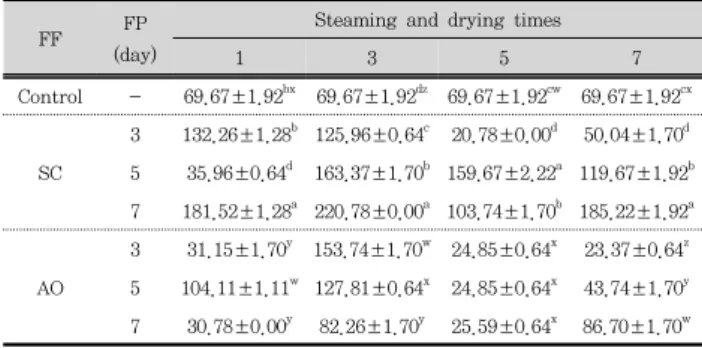
1. 폴리페놀 함량
폴리페놀함량은 천마를 발효할 경우 발효균주, 발효기간 및 증포횟수에 따라 약간의 차이는 있으나 대조구(건조천마) 보다 높은 경향이었고, 발효균주와 관계없이 3회 증포한 것이 가장 높게 나타났다. SC균주에 의한 발효천마는 AO균주에 의한 발효천마 보다 폴리페놀 함량이 높게 나타났으며, 발효 균주의 발효기간에 따라서 약간의 차이는 있었는데, SC균주 는 5~7일, AO균주는 3~5일 발효천마에서 함량이 가장 높았 다. 7증포의 경우 SC 및 AO균주 모두 발효기간이 길어질수 록 폴리페놀 함량이 증가하는 경향을 나타냈으며, 반면에 3증 포에서는 발효기간이 길어질수록 AO균주에 의한 발효천마의 경우 감소하였으나 SC균주에 의한 발효천마는 증가하였다 (Table 1).
Table 1. Polyphenol content of fermented Gastrodiae rhizoma according to fermented period and steaming and drying times(mg/mL)
FF FP
(day)
Steaming and drying times
1 3 5 7
Control - 69.67±1.92bx 69.67±1.92dz 69.67±1.92cw 69.67±1.92cx
SC
3 132.26±1.28b 125.96±0.64c 20.78±0.00d 50.04±1.70d 5 35.96±0.64d 163.37±1.70b 159.67±2.22a 119.67±1.92b 7 181.52±1.28a 220.78±0.00a 103.74±1.70b 185.22±1.92a
AO
3 31.15±1.70y 153.74±1.70w 24.85±0.64x 23.37±0.64z 5 104.11±1.11w 127.81±0.64x 24.85±0.64x 43.74±1.70y 7 30.78±0.00y 82.26±1.70y 25.59±0.64x 86.70±1.70w
FF: Fermentation fungi, SC: S. cerevisiae, AO: A. oryzae. FP:
Fermented period(day). Steaming at 60℃ during 4hr and drying at 100℃ during 24hr at the first times, and steaming at 50℃ during 4hr and drying at 90℃ during 24hr after that time. Values represent mean±SD(n=3). Different letters in each column indicate significant differences according to DMRT(p<0.05). The letter a, b, c, d and w, x, y, z compared with control, respectively.
2. SOD 유사활성능
발효천마의 SOD 유사활성능은 대조구인 건조천마 보다 낮 게 나타나는 경향이었으며, 발효균주, 발효기간 및 증포횟수 에 따라 차이를 보였다. 증포횟수에 따라 약간의 차이는 있으 나, SC균주에 의한 발효천마는 발효기간이 길어질수록 SOD 유사활성능이 증가한 반면, AO균주에 의한 발효천마는 발효 기간이 5일 까지는 증가하였으나 7일 발효에서는 감소하는 경향이었다. 발효천마의 SOD 유사활성능은 비교적 낮은 정도
이었으며, 3회 중포에서 비교적 높았다(Table 2).
Table 2. Superoxide dismutase like activity of fermented Gastrodiae rhizoma according to fermented period and steaming and drying times(%)
FF FP
(day)
Steaming and drying times
1 3 5 7
Control - 13.59±0.60b,x 13.59±0.60b,w 13.59±0.60ab,w13.59±0.60ab,x
SC
3 9.02±0.75d 7.76±0.95c 9.67±0.99c 11.90±0.58b 5 11.11±0.60c 14.53±1.21b 16.07±1.04a 14.16±0.58a 7 18.17±0.46a 19.47±0.60a 12.02±0.60bc 8.49±0.82c
AO
3 3.26±0.82y 12.28±0.99w 4.57±0.60z 4.31±0.39z 5 16.86±1.04w 12.15±0.39w 10.45±0.60x 7.58±0.46y 7 0.84±0.98y 6.79±0.23x 7.32±0.60y 15.81±0.60w
FF: Fermentation fungi, SC: S. cerevisiae, AO: A. oryzae. FP:
Fermented period(day). Steaming at 60℃ during 4hr and drying at 100℃ during 24hr at the first times, and steaming at 50℃ during 4hr and drying at 90℃ during 24hr after that time. Values represent mean±SD(n=3). Different letters in each column indicate significant differences according to DMRT(p<0.05). The letter a, b, c, d and w, x, y, z compared with control, respectively.
3. 전자 공여능(Electron donating activity, EDA)
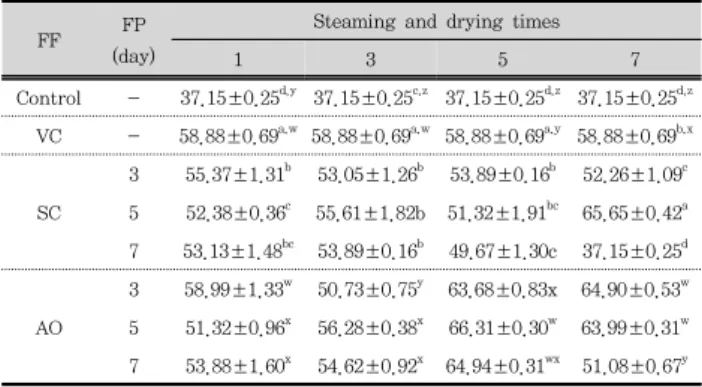
발효천마의 발효기간, 발효균주 및 증포횟수에 따른 전자 공여능을 조사한 결과, 발효기간이나 증포횟수에 관계없이 대 조구인 건조천마 보다 높았고 vitamin C와 거의 같은 수준으 로 나타났으며, 발효기간에 따른 차이가 거의 없는 것으로 나 타났다. 증포횟수가 많을수록 SC균주에 의한 발효천마는 차 이가 거의 없었으나, AO균주에 의한 발효천마는 전자공여능 이 약간 증가하는 것으로 나타났다(Table 3).
Table 3. Electron donating activity of fermented Gastrodiae rhizoma according to fermented period and steaming and drying times(%)
FF FP
(day)
Steaming and drying times
1 3 5 7
Control - 37.15±0.25d,y 37.15±0.25c,z 37.15±0.25d,z 37.15±0.25d,z VC - 58.88±0.69a,w 58.88±0.69a,w 58.88±0.69a,y 58.88±0.69b,x
SC
3 55.37±1.31b 53.05±1.26b 53.89±0.16b 52.26±1.09c 5 52.38±0.36c 55.61±1.82b 51.32±1.91bc 65.65±0.42a 7 53.13±1.48bc 53.89±0.16b 49.67±1.30c 37.15±0.25d
AO
3 58.99±1.33w 50.73±0.75y 63.68±0.83x 64.90±0.53w 5 51.32±0.96x 56.28±0.38x 66.31±0.30w 63.99±0.31w 7 53.88±1.60x 54.62±0.92x 64.94±0.31wx 51.08±0.67y
FF: Fermentation fungi, SC: S. cerevisiae, AO: A. oryzae. FP:
Fermented period(day). Steaming at 60℃ during 4hr and drying at 100℃ during 24hr at the first times, and steaming at 50℃ during 4hr and drying at 90℃ during 24hr after that time. Values represent mean±SD(n=3). Different letters in each column indicate significant differences according to DMRT(p<0.05). The letter a, b, c, d and w, x, y, z compared with control, respectively.
4. 플라보노이드 함량
발효기간, 발효균주 및 증포횟수에 따른 플라보노이드 함 량 결과, 대조구인 건조천마에 비하여 천마발효물의 함량이 증가하였으며, 발효기간이나 증포횟수가 많아질수록 SC균주 및 AO균주에 의한 발효천마는 모두 5~7일간 발효하고 7회
증포하는 것이 가장 높았다. SC균주에 의한 발효물이 AO균 주에 의한 발효천마 보다 플라보이드 함량이 증가하였다.
3포 및 7포에서는 SC 및 AO균주에 의한 발효천마는 발효 기간 길어질수록 플라보노이드 함량이 증가하였으며, AO균주 에 의한 발효천마는 증포횟수가 많아질수록 함량이 증가하는 것으로 나타났다(Table 4).
Table 4. Flavonoid content of fermented Gastrodiae rhizoma according to fermented period and steaming and drying times(mg/mL)
FF FP
(day)
Steaming and drying times
1 3 5 7
Control - 4.37±0.06d,z 4.37±0.06d,y 4.37±0.06c,y 4.37±0.06c,z
SC
3 11.85±0.17b 4.33±0.11c 17.22±0.00b 20.66±0.11b 5 7.73±0.06c 16.51±0.13b 19.81±0.06a 20.92±0.07b 7 15.37±0.13a 18.51±0.17a 17.59±0.13b 34.55±0.11a
AO
3 5.33±0.11y 8.51±0.06x 10.33±0.11x 10.33±0.11y 5 8.15±0.06w 9.00±0.12w 12.48±0.06w 16.96±0.17x 7 6.96±0.07x 9.11±0.00w 12.18±0.17w 23.22±0.11w
FF: Fermentation fungi, SC: S. cerevisiae, AO: A. oryzae. FP:
Fermented period(day). Steaming at 60℃ during 4hr and drying at 100℃ during 24hr at the first times, and steaming at 50℃ during 4hr and drying at 90℃ during 24hr after that time. Values represent mean±SD(n=3). Different letters in each column indicate significant differences according to DMRT(p<0.05). The letter a, b, c, d and w, x, y, z compared with control, respectively.
5. 아질산염 소거능
아질산염 소거능을 조사한 결과, SC균주에 의한 발효천마 는 전반적으로 대조군 보다 낮았고, AO균주에 의한 발효천마 의 경우 3일 및 5일간 발효 7회 증포시에는 건조천마인 대조 군 보다 높게 나타났으나, 발효기간이나 증포횟수에 따른 뚜 렷한 변화는 없었다(Table 5).
Table 5. Nitrite scavenging ability of fermented Gastrodiae rhizoma according to fermented period and steaming and drying times(%)
FF FP
(day)
Steaming and drying times
1 3 5 7
Control - 8.20±0.35a,x 8.20±0.35a,y 8.20±0.35a,x 8.20±0.35a,y
SC
3 1.57±0.35c 2.07±0.70c 3.03±0.00c 5.87±1.10b 5 4.07±0.55b 1.97±0.58c 5.57±0.90b 4.73±0.23b 7 2.37±0.42c 4.50±0.35b 3.77±0.40c 0.87±0.40c
AO
3 1.40±0.00z 12.00±0.00x 8.26±1.02x 11.13±0.75x 5 3.13±0.29y 3.67±0.71z 10.43±1.10x 11.47±0.23x 7 3.43±0.46y 4.03±1.33z 8.87±1.55x 6.50±0.17z
FF: Fermentation fungi, SC: S. cerevisiae, AO: A. oryzae. FP:
Fermented period(day). Steaming at 60℃ during 4hr and drying at 100℃ during 24hr at the first times, and steaming at 50℃ during 4hr and drying at 90℃ during 24hr after that time. Values represent mean±SD(n=3). Different letters in each column indicate significant differences according to DMRT(p<0.05). The letter a, b, c, d and x, y, z compared with control, respectively.
6. Gastrodin 함량
발효기간, 발효균주 및 증포 횟수별에 따른 gastrodin 함 량을 분석한 결과, 전반적으로 발효균주나 발효기간 및 증포 횟수에 관계없이 모두 대조구인 건조천마 보다 낮게 나타났
다. SC균주에 의한 발효기간이 질어짐에 따라 gastrodin의 함량이 감소하였고, AO균주에 의한 발효천마는 일정한 경향 은 없었으나, 5 및 7회 증포에서는 발효기간이 길어짐에 따 라 증가하는 경향이었다(Table 6).
Table 6. Change of gastrodin content of fermented Gastrodiae rhizoma according to fermented period and steaming and drying times (µg/mL)
FF FP
(day)
Steaming and drying times
1 3 5 7
Control - 1,713.68±1.22aw1,713.68±1.22aw1,713.68±1.22ax1,713.68±1.22aw
SC
3 340.65±1.68b 289.67±0.80b 124.54±0.49b 245.17±0.92b 5 130.54±2.40d 263.02±2.25c 122.22±2.89bc 218.37±0.26c 7 158.52±2.53c 192.41±0.48d 112.45±0.45c 206.52±0.24d
AO
3 296.47±0.35x 452.66±0.27x 266.63±0.49z 345.27±0.51z 5 184.23±0.55y 340.15±0.18y 272.28±2.89yz 363.51±0.16y 7 119.54±0.49z 267.51±0.53z 355.49±2.81y 412.07±0.19x
FF: Fermentation fungi, SC: S. cerevisiae, AO: A. oryzae. FP:
Fermented period(day). Steaming at 60℃ during 4hr and drying at 100℃ during 24hr at the first times, and steaming at 50℃ during 4hr and drying at 90℃ during 24hr after that time. Values represent mean±SD(n=3). Different letters in each column indicate significant differences according to DMRT(p<0.05). The letter a, b, c, d and w, x, y, z compared with control, respectively.
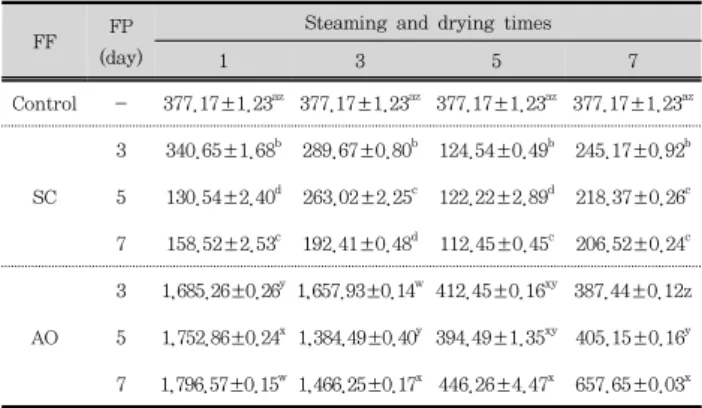
7. 4-hydroxybenzyl alcohol 함량
발효기간 및 증포 횟수별 4-hydroxybenzyl alcohol 함량 을 분석한 결과는 Table 7과 같다. SC균주에 의한 발효천마는 대조군에 비하여 4-hydroxybenzyl alcohol함량이 적었고 발 효기간이 길어짐에 따라서 감소하는 경향이었다. AO균주에 의 한 발효천마는 대조군에 비하여 4-hydroxybenzyl alcohol 함 량이 증가하였고, 특히 5~7회 증포 보다 1~3회 증포하는 것 이 현저히 증가하였으며 증포 횟수가 많아질수록 감소하였다.
Table 7. Change of 4-hydroxybenzyl alcohol content of fermented Gastrodiae rhizoma according to fermented period and steaming and drying times(µg/mL)
FF FP
(day)
Steaming and drying times
1 3 5 7
Control - 377.17±1.23az 377.17±1.23az 377.17±1.23az 377.17±1.23az
SC
3 340.65±1.68b 289.67±0.80b 124.54±0.49b 245.17±0.92b 5 130.54±2.40d 263.02±2.25c 122.22±2.89d 218.37±0.26c 7 158.52±2.53c 192.41±0.48d 112.45±0.45c 206.52±0.24c
AO
3 1,685.26±0.26y 1,657.93±0.14w 412.45±0.16xy 387.44±0.12z 5 1,752.86±0.24x 1,384.49±0.40y 394.49±1.35xy 405.15±0.16y 7 1,796.57±0.15w1,466.25±0.17x 446.26±4.47x 657.65±0.03x
FF: Fermentation fungi, SC: S. cerevisiae, AO: A. oryzae. FP:
Fermented period(day). Steaming at 60℃ during 4hr and drying at 100℃ during 24hr at the first times, and steaming at 50℃ during 4hr and drying at 90℃ during 24hr after that time. Values represent mean±SD(n=3). Different letters in each column indicate significant differences according to DMRT(p<0.05). The letter a, b, c, d and w, x, y, z compared with control, respectively.
고 찰
천마는 신농본초경, 약성론 등의 한의학 서적에 무독하며 상품의 생약으로 분류하고 있고24), 일찍부터 우리나라의 민간 에서는 두통과 현기증, 수족마비, 중풍, 간질치료제 등을 치 료하는데 이용하여 왔다. 천마의 임상적 효능은 본초학, 동의 보감, 향약집성방을 비롯한 여러 본초문헌에 기록되어 있는 데, 그 효능은 음중지양아(陰中止揚也), 구복익기력(九服益氣 力), 경신증년(經身增年), 소옹종(消癰腫), 조양기(助陽氣), 통 혈맥(通血脈), 장음비건(長陰肥建), 귀주(鬼疰), 주제풍습비(主 鑇風濕痺) 등으로 기록되어 있으며, 고혈압, 두통, 마비, 신경 성질환, 당뇨병 등의 성인병과 스트레스, 피로, 항산화, 항간 질 및 항경련작용 등의 증상에 대해서도 효과가 있는 것으로 알려져 있다2,6,25-26).
중국 등의 동양권에서는 천마의 약리적 효능에 대한 과학 적 연구가 활발하게 이루어지고 있지만 아직 성분이나 약리적 작용에 대한 연구는 미흡한 편이다27). 본 연구는 천마의 증포 를 통한 가공과 적절한 균주를 이용하여 발효를 실시하고 gastrodin과 4-hydroxybenzyl alcohol 등의 함량 및 항산 화활성을 평가하였다.
폴리페놀 화합물은 식물계에 존재하는 대표적인 항산화물 질로서 다양한 구조와 분자량을 가지며 단백질 및 거대분자들 과 쉽게 결합할 수 있는 phenolic hydroxyl 그룹의 존재로 항산화 및 항암 등의 다양한 생리활성 기능을 가진다28). 천마 를 발효할 경우 SC균주에 의한 발효천마는 AO균주에 의한 발효천마 보다 폴리페놀 함량이 높게 나타났으며, 3증포에서 는 발효기간이 길어질수록 AO균주에 의한 발효천마 경우 감 소하였으나 SC균주에 의한 발효천마는 증가하는 경향을 나타 내었다. 향후 천마를 발효할 경우 AO균주에 의한 발효천마 보다 SC균주에 의한 발효천마가 보다 항산화능이 증가시킬 것으로 기대되며, 발효에 의해 천마의 생리활성이 증가하는 가능한 기전에 대한 연구는 지속적으로 이루어져야 할 것으로 판단된다.
생체 내에 존재하는 항산화 효소인 SOD(superoxide dismutase)는 신체의 산화적 손상을 막고 노화를 억제하며 체내로부터 자유 라디칼을 제거하는 것으로 알려져 있으며, 현재 항염증제나 피부노화방지를 위한 화장품 재료 등에 이용 되고 있다29,30). 또한 체내에 활성산소가 과다 생성되었을 때 에 다른 항산화제보다 자유라디칼음이온 제거에 우수한 효과 를 나타내어31) 활성산소와 SOD반응의 특이성은 라디칼의 관 련여부의 증명지표로 활용된다32). 발효천마의 SOD 유사활성 능은 SC균주에 의한 발효천마 1~3 증포에서 발효기간이 길 어질수록 SOD 유사활성능이 증가한 반면, AO균주에 의한 발효천마는 발효기간이 5일 까지는 증가하였으나 7일에서는 감소하는 경향이었다.
발효천마의 전자공여능을 조사한 결과, 발효기간에 따른 차이가 거의 없었으며, 증포횟수가 많을수록 SC균주에 의한 발효천마는 차이가 거의 없었으나, AO균주에 의한 발효천마 는 전자공여능이 약간 증가하는 것으로 나타났다. 허 등2)은 천마 추출물의 hydroxyl radical활성의 경우 기존의 항산화 제인 Trolox, BHA, BHT보다는 전반적으로 활성이 낮게 나 타나지만, DPPH radical 소거능은 기존의 항산화제인 Trolox, BHA, BHT 보다 활성이 높아 천마의 항산화활성은
매우 뛰어나다고 보고하였다. 따라서 발효균주, 발효기간 및 증포횟수에 따라 차이가 있는 것으로 생각되며 추후 자세한 검토가 필요할 것으로 사료된다.
Flavonoid는 주로 anthocyanidins, flavonols, flavones, cathechins 및 flavanones 등으로 구성되어 있고, 구조에 따라 몇 가지 형태의 flavonoid는 항산화작용 및 항생작용을 가지는 것으로 보고되고 있다33,34). AO균주 및 SC균주에 의 한 발효천마는 발효기간 및 증포횟수가 많아질수록 플라보노 이드 함량이 높았으며, AO균주에 의한 발효천마 보다 SC균 주에 의한 발효천마가 발효기간이 길어질수록 플라보노이드 함량은 증가하였다.
질산염이 많이 함유된 식품을 다량 섭취하면 아질산염과 제 2급 및 제 3급 아민의 nitroso화 반응이 위장내의 낮은 산성조건에서 쉽게 일어나서 발암물질인 nitrosamine을 생성 하며, Caffeic acid, ferulic acid 등의 phenolic acids와 catechol 등의 phenol류 그리고 ascorbic acid와 erythorbic acid와 같은 환원물질이 아질산염과 반응하게 되면 nitrosamine의 생성을 억제한다는 보고가 있다35). 따라서 천 마를 5~7회 증포하여 AO균주에 의해 5일 발효하는 것이 효 과적이며, 아질산염 소거능이 높아 nitrosamine 생성 저해에 효과가 있을 것으로 사료된다.
천마의 페놀성 물질로는 gastrodin, p-hydroxybenzyl alcohol, vanillyl alcohol, vanillin와 비페놀성 화합물로 circiumaldehyde 등이 있으며, 이 중에서 gastrodin이 가장 많이 함유되어 있다고 알려져 있다36). Gastrodin은 천마추출 물의 중요하고 풍부한 생체활성요소로10) 항산화 작용, 항경련 작용, 항비만 및 항염증 작용에 효과가 있으며, 쥐의 혈관 뇌 관문을 통과하여 p-hydroxybenzyl alcohol로 분해된다고 보 고되고 있다37). 발효기간, 발효균주 및 증포 횟수별에 따른 gastronin 함량을 분석한 결과, 전반적으로 발효균주나 발효 기간 및 증포횟수에 관계없이 모두 대조구인 건조천마 보다 낮게 나타나는 경향을 보였다. Gastrodin을 목표로 할 경우 증포나 발효의 경우 함량이 많이 감소하게 되므로 건조천마를 이용하는 것이 합당한 것으로 판단되었다.
AO균주에 의한 발효천마는 SC균주 보다 증포횟수나 발효기 간과는 관계없이 4-hydroxybenzyl alcohol 함량은 증가하였 고, 특히 1회 증포에서 가장 많은 함량을 증가하는 경향을 나타 내었지만, 증포횟수가 많아질수록 감소하는 경향이었다. 이러한 것은 발효나 증포 횟수에 따라 gastrodin이 4-hydroxybenzyl alcohol로 점자 변화됨을 의미하는 것으로 추론되며, 이는 Lu 등11)이 언급한 것처럼 혈액 속에서는 gastrodin의 aglycone 인 4-hydroxybenzyl alcohol로서 주로 존재한다는 것과 관 련이 있을 것으로 생각되나 추후 이에 대한 자세한 검토가 있 어야 할 것으로 사료된다.
본 연구를 종합해 보면 발효천마의 발효기간, 발효균주, 증 포횟수별에 따라 gastrodin과 4-hydroxybenzyl alcohol 함 량에 차이가 있고, 항산화 활성이 증가하는 것으로 나타났다.
특히 증포와 발효에 의해 4-hydroxybenzyl alcohol 함량이 현저히 증가하므로 이러한 성분을 이용한 천마의 기능성 식품 소재개발로 부가가치를 증대시킬 수 있을 것으로 사료된다.
결 론
천마의 유효성분인 gastrodin과 4-hydroxybenzyl alcohol 의 함량 증대와 식품재료로서의 한계성을 가지는 천마의 이용 성을 넓히기 위해 증포를 통한 가공과 미생물을 이용한 발효 를 실시하였고, 항산화 활성과 주요성분 함량 변화를 분석하 였다.
1. 폴리페놀 함량은 발효천마의 증포방법 및 횟수에 따라 서 증가하는 경향이었으며, AO균주 보다 SC균주에 의 해 증가하였으며, 발효기간이 길어질수록 대조군에 비 하여 높았다.
2. SOD 유사활성은 발효에 의해 증가하였으며, AO균주 보다 SC균주에 의한 발효천마의 활성이 높았다. SC균 주에 의한 발효기간이 길어질수록 SOD 유사활성이 증 가하는 경향이며, AO균주에 의해서는 발효 5일까지는 증가하나 그 이후는 감소하는 경향이었다.
3. 전자공여능은 발효에 의해 vitamin C와 거의 같은 수 준으로 증가하였고, AO균주에 의한 발효천마가 SC균 주에 의한 것보다 약간 좋았다.
4. 플라보노이드 함량은 SC균주에 의한 발효천마가 AO균 주에 의한 것 보다 높았으며, 발효기간이 길어질수록 그리고 증포횟수가 많을수록 함량이 증가하였다.
5. 아질산염소거능은 SC균주에 의한 발효천마는 전반적으 로 대조군 보다 낮았으며 AO균주에 의한 발효천마는 5 및 7회 증포의 경우 대조군보다 높았다.
6. 증포나 발효에 의해 gastrodin 함량은 감소하는 반면 에, 4-hydroxybenzyl alcohol 함량은 SC균주 보다 는 AO균주에 의한 발효천마는 증포횟수나 발효기간과 관계없이 현저히 증가하였고 특히 1회 및 3회 증포시 함량이 높았다.
따라서 본 연구 결과들로 볼 때 천마는 증포 및 발효에 의 해 항산화활성이 증가되며, gastrodin 함량은 감소하는 반면, 4-hydroxybenzyl alcohol 함량은 증가하여 이용하고자 하는 목적에 따른 식품소재로서의 활용 가능성이 있음을 제시한다.
References
1. Kim SH, Kim IH, Kang BH, Lee SH, Lee JM.
Optimization of ethanol extraction conditions for effective components from Gastrodia elata Blume.
Korean J Food Preserv. 2006 ; 13(4) : 506-12.
2. Heo JC, Park JY, An SM, Lee JM, Yun CY, Shin HM, Kwon TK, Lee SH. Anti-oxidant and anti-tumor activities of crude extracts by Gastrodia elata Blume. Kor J Food Preserv. 2006 ; 13(1) : 83-7.
3. Lee YM. In Oriental medicine dictionary. Seoul : Sammundang. 1990 : 814.
4. Sin KG. In Sinssi herbology Seoul : Sumunsa. 1980 : 88-290.
5. Chung HS, Ji GE. Composition and functionality of Chonma. Korean J Food Sci Technol. 1996 ; 28(1) : 53-7.
6. Kim CM, Sin M.K, An DK, Lee KS. In Zoungyank dictionary. Seoul : Jungdam. 1997 : 4105-10.
7. Lee JM, Kim IH, Kim SH. Optimal steaming condition of Gastrodia elata Blume (chunma) using response surface methodology. J Kor Soc Appl Biol Chem.
2003 ; 46(2) : 107-12.
8. Taguchi H, Yosioka I, Yamasaki K, Kim IH. Studies on the constituents of Gastrodia elata Blume.
Chem Pharm Bull. 1981 ; 29(1) : 55-62.
9. Zhou J, Pu X, Tang Y, Tsungren Y. The chemistry of G. elata Blume. Acta Botanica Yunnanica. 1983
; 5 : 443-8.
10. Zhou J, Yang YB, Yang TR. The chemistry of Gastrodia elata BL. The isolation and identification of chemical constituents of Gastrodia elata BL (Chinese). Acta Chemica. 1979 ; 37 : 183-9 11. Lu G, Zhou Y, Mo Q. The absorption, distribution,
metabolism and excretion of 3H- gastrodin(3H-ρ -hydroxymethylphenyl-β-D-glucopyranoside).
Acta Pharm Sin. 1985 ; 20 : 167-72.
12. Junhua H, Guilian W. Comparision studies on pharmacological properties of injection Gastrodia elata, gastrodin-free fraction and gastrodine (Chinese). Acta Academiae Medicinae Sinicae. 1989
; 11 : 147-50.
13. Kim HJ, Lee SR, Moon KD. Ether fraction of methanol extracts of Gastrodia elata, medicinal herb protects against neuronal cell damage after transient global ischemia in gerbils. Phytother Res. 2003 ; 17(8) : 909-12.
14. Huang NK, Lin YL, Cheng JJ, Lai WL. Gastrodia elata prevents rat pheochromocytoma cells from serum-deprived apoptosis: the role of the MAPK family. Life Sci. 2004 ; 75(13) : 1649-57.
15. Xu X, Lu Y, Bie X. Protective effects of gastrodin on hypoxia-induced toxicity in primary cultures of rat cortical neurons. Planta Med. 2007 ; 73(7) : 650-4.
16. Yu SJ, Kim JR, Lee CK, Han JE, Lee JH, Kim HS, Hong JH, Kang SG. Gastrodia elata Blume and an active component, p-hydroxybenzyl alcohol reduce focal ischemic brain injury through antioxidant related gene expressions. Biol Pharm Bull. 2005 ; 28(6) : 1016-20.
17. Lee JW, Kim YG. Volatile flavor constituents in the rhizoma of Gastrodia elata. J Kor Soc. Appl
Biol Chem. 1997 ; 40(5) : 455-8.
18. Kim HJ, Kwak IS, Lee BS, Lee HC, Lee EM, Lim JY, Yun YS, Chung BW. Methods of pretreatment for decrease of discomfortable odor of Gastrodia elata Blume. J Engineer Res. 2004 ; 35 : 135-40.
19. Swain T, Hillis WE. The phenolic constituents of Prunus domestica. I.—The quantitative analysis of phenolic constituents J Sci Food Agric. 1959 ; 10(1) : 63-8.
20. Marklund S, Marklund G. Involvement of the superoxide anion radical in the autoxidation of pyrogallol and a convenient assay for superoxide dismutase. Eur J Biochem. 1974 ; 47(3) : 469-74.
21. Blois MS. Antioxidant determinations by the use of a stable free radical. Nature. 1985 ; 181 : 1199-200.
22. Moreno MI, Isla MI, Sampietro AR, Vattuone MA.
Comparison of the free radical-scavenging activity of propolis from several regions of Argentina. J Ethropharmacol. 2000 ; 71(1-2) : 109-14.
23. Kato H, Lee IE, Chuyen NV, Kim SB, Hayase F.
Inhibitory of nitrosamine formation by nondilyzable melanoidins. Agric Biol Chem. 1987 ; 51 : 1333-8.
24. O J. Sinnong herbs. Beiging : Inmin Hygiene Publishing Co. 1986 : 200-1.
25. Chung HS, Ji GE. Composition and functionality of Chonma. Korean J Food Sci Technol. 1996 ; 28(1) : 53-7.
26. Feng XZ, Chen YW, Yang JS. Studies on constituents of Tian-Ma. Gastrodia elata Bl. Acta Chimica Sinica. 1979 ; 37 : 183-8.
27. Lee BY, Choi HS, Hwang JB. Analysis of food components of Gastrodiae Rhizoma and changes in characteristics at the various drying conditions.
Korean J Food Sci Technol. 2002 ; 34(1) : 37-42.
28. Kuhnau J. The Flavonoids: a class of semiessential food components: their role in human nutrition.
World Rev Nutr Diet. 1976 ; 24 : 117-91.
29. McKersie BD, Murnaghan J, Jones KS, Bowley SR.
Iron superoxide dismutase expression in transgenic alfalfa increase winter survival without a detectable increase in photosynthetic oxidative stress tolerance.
Plant Physiol. 2000 ; 122(4) : 1427-37.
30. Donnelly JK, McLellan KM, Walker JK, Robinson DS. Superoxide dismutase in foods. A Review Food Chem. 1989 ; 33 : 243-70.
31. Kim YH, Lee CE, Kim BS. Study on cytotoxicity test and anti-oxidant activity of herb complex (Phellinus linteus, Glycyrrhiza uralensis and Centella asiatica). J Kor Soc Cosm. 2011 ; 17(3) : 441-6.
32. Ko KS. A study on antioxidant effect of methanol extract from Viola mandshurica. J Kor Soc Cosm.
2012 ; 18(5) : 1082-6.
33. Lam LKT, Zhang J, Hasegawa S. Citrus limonoid reduction of chemically induced tumorigenesis. Food Technol. 1994 ; 48(11) : 104-8.
34. Miller EG, Gonzales-Sanders AP, Couvillion AM, Binnie WH, Hasegawa S, Lam LKL. Citrus limonoids as inhibitors of oral carcinogenesis. Food Technol.
1994 ; 48 : 110-4.
35. Gray JI, Dugan JLR. Inhibition of N-nitrosamine formation in model food system. J. Food Sci.
1975 ; 40(5) : 981-4.
36. Liu CL, Liu MC, Ahu PL. Determination of gastrodin,p-hydroxybenzyl alcohol, vanillyl alcohol,p-hydroxylbenzaldehyde and vanillin in tall gastrodia tuber by high-performance liquid chromatography. Chromatographia. 2002 ; 55(5-6) : 317-20.
37. Kim HT, Park EJ. Change of major functional components of Gastrodia elata Blume with cultivation conditions and harvest times. Korean J Med Crop Sci. 2013 ; 21(4) : 282-8.