Online ISSN: 2288-7253 DOI: https://doi.org/10.14579/MEMBRANE_JOURNAL.2020.30.5.293
1. Introduction 1)
Demand for clean freshwater is increasing as the consequences of climate change continue to take its toll
around the world and more and more contaminants are finding their way into water sources. There has been great potential to improve the performance of semi- permeable membranes to filter water as a portion of
†
Corresponding author(e-mail: [email protected], http://orcid.org/0000-0002-3820-141X)
양자점이 합체된 복합 박막을 이용한 정수의 최근 발전
박 신 영ㆍ라즈쿠마 파텔
*
,†연세대학교 언더우드국제대학 융합과학공학부 나노과학공학,
*
연세대학교 언더우드국제대학 융합과학공학부 에너지환경과학공학(2020년 10월 8일 접수, 2020년 10월 21일 수정, 2020년 10월 22일 채택)
Recent Progress in Qantum Dots Containing Thin Film Composite Membrane for Water Purification
Shinyoung Park and Rajkumar Patel *
,†Nano Science and Engineering, Integrated Science and Engineering Division (ISED), Underwood International College, Yonsei University, 85 Songdogwahak-ro, Yeonsu-gu, Incheon 21983, South Korea
*Energy and Environmental Science and Engineering (EESE), Integrated Science and Engineering Division (ISED), Underwood International College, Yonsei University, 85 Songdogwahak-ro, Yeonsu-gu, Incheon 21983, South Korea
(Received October 8, 2020, Revised October 21, 2020, Accepted October 22, 2020)
요 약: 물 부족을 포함한 기후 변화의 해로운 결과는 효과적인 정수에 대한 관심을 가져왔다. 또한, 수질 오염 수준이 높 아지고 환경 파괴 수준이 심해지면서 오염 물질을 제거하려는 방안들이 요구되고 있다. 물을 정화하기 위해 반투막을 통한 삼투압 절차들을 사용할 수 있으며, 최근 연구에 따르면 탄소 양자점(CQD), 그래핀 양자점(GQD) 및 산화 그래핀 양자점 (GOQD)을 포함한 나노입자를 복합 박막(TFC)에 합체하면 유사한 수준의 염 거부율을 유지하면서 물흐름을 증가시킬 수 있 다. 이러한 효과 외의 여러 가지 효과가 있지만 그 중에서도 친수성을 높이고, 살균 성질을 보이고, 방오 특성으로 인해 박테 리아 및 기타 미생물의 축적을 방지하면서 막의 효과가 감소하는 것을 막는 것을 보여준다. 이 보고서는 양자점이 합체된 정 수용 복합 막에서 양자점의 제조 과정, 응용, 기능성, 성질 및 역할을 논의한다.
Abstract: Increasing harmful effects of climate change, such as its effect on water scarcity, has led to a focus on developing effective water purification methods to obtain pure water. Additionally, rising levels of water pollution is increasing levels of environmental degradation, calling for sources of water treatment to remove contaminants. To purify water, osmotic processes across a semipermeable membrane can take place, and recent studies are showing that incorporating nanoparticles, including carbon quantum dots (CQDs), graphene carbon dots (GQDs), and graphene oxide quantum dots (GOQDs) are making thin film composite (TFC) membranes more effective by increasing water flux while maintaining similar levels of salt rejection, increasing the hydrophilicity of the membrane surface, showing bactericidal properties, exhibiting antifouling properties to prevent accumulation of bacteria or other microorganisms from reducing the effectiveness of the membrane, and more. In the review, the synthesis process, applications, functionality, properties, and the role of several types of quantum dots are discussed in the composite membrane for water purification.
Keywords: thin film composite membrane; carbon quantum dots, graphene quantum dots; desalination, hollow
fiber membrane
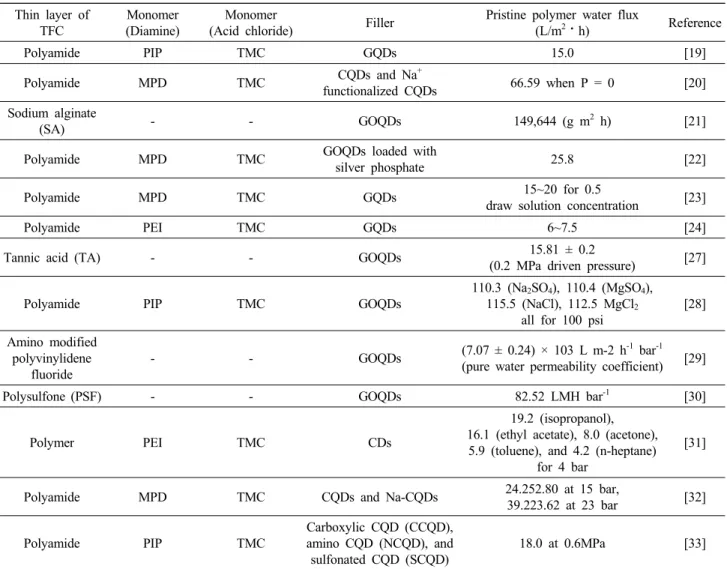
the nanoparticles studied before had shown to be not very compatible nor have good dispersibility in the pol- yamide (PA) layer of thin film nanocomposite (TFN) membranes[1-19]. TFC membranes, the precursor to TFN membranes before quantum dot (QD) loading, can be formed through the interfacial polymerization method using both trimesoyl chloride (TMC) and piperazine (PIP). CQDs, GQDs, or GOQDs, are generally found to be synthesized through the direct pyrolysis or heat- ing of citric acid (CA) and would then be incorporated onto TFC membranes at differing weight percentages to determine the effectiveness of the newly-formed TFN membranes regarding a variety of factors compared to the initial TFC membranes.
TFN membranes can be used in water purification by a variety of membrane separation processes including forward osmosis reverse osmosis. Forward osmosis has the benefit of being a natural process where the water flows through the membrane because of a natural con- centration gradient, but the effectiveness in the solute separation from pure water could be lower than reverse osmosis. Reverse osmosis has the benefit of being able to force water through a membrane to separate it from the solutes initially dissolved in it regardless of con- centration gradient, but it requires high pressure; thus, it requires much more energy than forward osmosis processes. After the incorporation of QDs onto mem- branes for a certain membrane separation process, the performance of the membrane generally improved. To give an example, for an ultrafiltration (UF) process, one type of QDs, GOQDs, was shown to act as good nano- fillers based on the antifouling capability, permeability, and hydrophilicity on polysulfone (PSF) UF membranes after GOQD loading[30]. Additionally, by changing the process in which CQDs are made, the size and the functional groups of CQDs can differ, making them have different properties. According to which proper- ties are desired for a certain application, one can adjust the synthesis process to get the desired size and prop- erties of CQDs. The incorporation of quantum dots in- to the PA layer has shown unique characteristics in changing the properties of the membrane, such as de-
creasing the roughness of the surface, increasing hy- drophilicity of the PA layer, increasing the water flux, and displaying improved antifouling performance over- all when graphene quantum dots (GQDs) are incorpo- rated into the membrane, indicating the potential of quantum dots in this area[19]. Functionalizing CQDs with Na
+ions were shown to have even better pure water permeability and water flux than regular CQDs while maintaining a similar percentage of salt rejection.
QDs are so versatile that they are finding applications in other areas besides water filtration. Not only can QDs be used in water treatment, but when applied to TFN hollow fiber membranes in pressure retarded os- mosis (PRO), it has displayed better osmotic power generation[20]. Greater power density was reported for TFC membranes incorporated with Na-CQDs than ones without them. QDs also found application in solvent-re- sistant nanofiltration for the separation of organic mix- tures and in direct methanol fuel cells (DMFCs) to im- prove their performance. DMFCs with CQDs showed increased peak power density, electro-chemical selectivity, proton conductivity, and more compared to their coun- terparts without CQDs. One category of QDs, GOQDs, have polar functional groups that are oxygenated, and can be even used for dehydration[21]. Loading silver ions (Ag
+) with GOQDs onto a PA layer was also shown to improve the bactericidal property of the membrane [22], even though incorporation of QDs already made the membrane less prone to antifouling.
2. Quantum Dots
Quantum dots are 0D nanoparticles that are less than 10 nm in size and exhibit novel properties.
2.1. Graphene quantum dots
For the synthesis of GQDs that would be incorporated
into TFN membranes, CA was decomposed thermally
by putting it into a crucible and heating it for 15 min
at 200°C in an electric oven[19]. The solid citric acid
turned into liquid during thermal treatment and GQDs
formed through certain forces operating at the nano-
Fig. 1. Schematic diagram of the quantum dots embedded thin film composite membrane.
scale from the molecules that were decomposed from citric acid. For the membranes, initially poly(ether sul- fone) support membranes were prepared through non-sol-
vent induced phase separation (NIPS). These membranes were then turned into several different PIP - TMC TFN membranes with varying levels of GQD incorporation through the method of interfacial polymerization. This method of polymerization was done at the interface of PIP and TMC to create a PA layer. More specifically, the support membranes were first immersed into aque- ous solutions that had 0.1% PIP by weight percentage (wt) and varying amounts of GQDs. Then, the mem- branes were taken out and any excess liquid was re- moved. After this, the membranes were dipped in a 0.1 wt% TMC/n-heptane solution for two minutes, forming a polyamide layer. To evaporate the n-heptane fully and
Thin layer ofTFC
Monomer (Diamine)
Monomer
(Acid chloride) Filler Pristine polymer water flux
(L/m2ㆍh) Reference
Polyamide PIP TMC GQDs 15.0 [19]
Polyamide MPD TMC CQDs and Na+
functionalized CQDs 66.59 when P = 0 [20]
Sodium alginate
(SA) - - GOQDs 149,644 (g m2 h) [21]
Polyamide MPD TMC GOQDs loaded with
silver phosphate 25.8 [22]
Polyamide MPD TMC GQDs 15~20 for 0.5
draw solution concentration [23]
Polyamide PEI TMC GQDs 6~7.5 [24]
Tannic acid (TA) - - GOQDs 15.81 ± 0.2
(0.2 MPa driven pressure) [27]
Polyamide PIP TMC GOQDs
110.3 (Na2SO4), 110.4 (MgSO4), 115.5 (NaCl), 112.5 MgCl2
all for 100 psi
[28]
Amino modified polyvinylidene
fluoride
- - GOQDs (7.07 ± 0.24) × 103 L m-2 h-1 bar-1
(pure water permeability coefficient) [29]
Polysulfone (PSF) - - GOQDs 82.52 LMH bar-1 [30]
Polymer PEI TMC CDs
19.2 (isopropanol), 16.1 (ethyl acetate), 8.0 (acetone), 5.9 (toluene), and 4.2 (n-heptane)
for 4 bar
[31]
Polyamide MPD TMC CQDs and Na-CQDs 24.252.80 at 15 bar,
39.223.62 at 23 bar [32]
Polyamide PIP TMC
Carboxylic CQD (CCQD), amino CQD (NCQD), and sulfonated CQD (SCQD)
18.0 at 0.6MPa [33]
Trimesoyl chloride (TMC); m-phenylenediamine (MPD); piperazine (PIP); polyethylenimine (PEI); graphene quantum dots (GQDs); carbon quantum dots (CQDs); graphene oxide quantum dots (GOQDs), carbon dots (CDs); carbon quantum dots (CQDs)