KOREAN JOURNAL OF APPLIED ENTOMOLOGY
한응곤지 51(2): 149~152 (2012) ⓒ The Korean Society of Applied Entomology
Kor. J. Appl. Entomol.
DOI: http://dx.doi.org/10.5656/KSAE.2012.02.0.02
단 보Larvicidal Activity of Constituents Identified in Piper nigrum L.
Fruit Against the Diamondback moth, Plutella xylostella
Il-Kwon Park*
Division of Forest Insect Pests and Diseases, Korea Forest Research Institute, Seoul 130-712, Republic of Korea
후추 열매 유래 화합물들의 배추좀나방 유충에 대한 살충 활성
박일권*
국립산림과학원 산림병해충연구과
ABSTRACT: The larvicidal activities of Piper nigrum fruit methanol extracts and its constituents against larvae of the diamondback moth, Plutella xylostella, were investigated using the leaf dipping method. Administering the P. nigrum methanol extract resulted in 100 and 97% mortality against diamondback moth larvae at 5.0 and 2.5 mg/mL concentrations, respectively. Larvicidal activities of the P.
nigrum fruit-derived piperidine alkaloids, piperine, and N-isobutylamide, as well as pellitorine, guineensine, pipercide, and retrofractamide A against P. xylostella varied according to test compound. Based on the 48 h LC
50values, the most toxic compound to diamondback moth larvae was guineensine (0.013 mg/mL) followed by retrofractamide A (0.020mg/mL), pipercide (0.033mg/mL), and pellitorine (0.046 mg/mL). The LC
50value of piperine was >0.5 mg/mL.
Key words: Piper nigrum, diamondback moth, piperine, pellitorine, guineensine, pipercide, retrofractamdie A
초 록 : 잎침지법을 이용하여 후추 열매 메탄올 추출물 및 분리된 화합물들의 배추좀나방(Plutellaxylostella) 유충에 대한 살충 활성을 검정하였다.
후추 열매 메탄올 추출물은 배추좀나방 유충에 대해 5.0과 2.5 mg/mL 농도에서 각각 100%와 97%의 살충 활성을 보였다. 후추 열매에서 유래된 화합물들의 배추좀나방에 대한 살충 활성을 조사한 결과, guineensine (LC
50=0.013 mg/mL)의 살충 활성이 가장 높았으며, 다음으로 retrofractamide A (0.020 mg/mL), pipercide (0.033 mg/mL) 그리고 pellitorine (0.046 mg/mL) 순이었다. Piperine의 반수치사농도는 0.5 mg/mL 이상이었다.
검색어: 후추 , 배추좀나방 , piperine, pellitorine, guineensine, pipercide, retrofractamdie A
*Corresponding author: [email protected]
Received January 13 2012; Revised February 1 2012 Accepted February 18 2012
Piper nigrum, known as black pepper, has been widely used as spices. Its taste is strongly pungent, and the odor is aromatic.
Black pepper is native to India, and harvested in East and West Indies, Brazil, United States, Taiwan, Indonesia, Malay peninsula, and China. The fruit of P. nigrum has been used for prescribing for cholera, dyspepsia, flatulence, diarrhoea, various gastric ailments, and paralytic and arthritic disorders (Si- ddiquiet al., 1997). As well as used as medicine, the Piperaceae
(Pepper family) has long been used in traditional agriculture as an insect-control agent (Schultes and Raffauf, 1990). This plant species has been known to be toxic to several insect species (Freeborn and Wymore, 1929; Lathrop and Keirstead, 1946;
Synerholmet al., 1945; Su, 1977; Scott and Mckibben, 1978;
Miyakado and Yoshioka 1979; Miyakado et al., 1979, 1989;
Park et. al., 2002). The insecticidal principles of black pepper such as pipercide, dihydropipercide, guineensine, pellitorine or retrofractamide A were identified in several studies (Miyakado and Yoshioka, 1979; Miyakado et al. 1979; Park et al., 2002).
This laboratory study examined the methanol extract of the fruit from P. nigrum for insecticidal constituents against the dia-
149
150 Kor. J. Appl. Entomol. 51(2): 149~152 (2012)
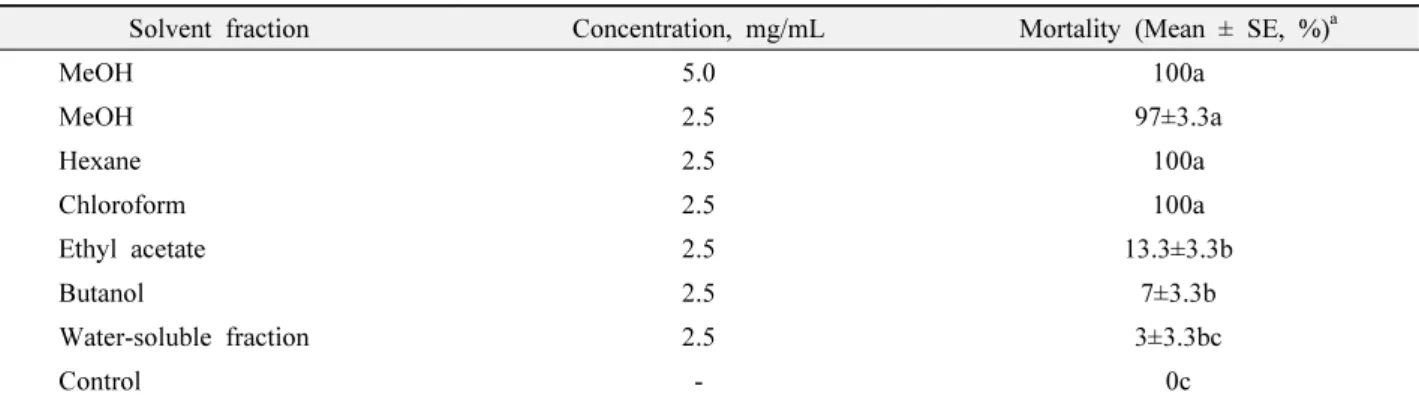
Table 1. Insecticidal activity of a methanol extract and solvent fractions of Piper nigrum fruit against Plutella xylostella larvae using the leaf dipping method, at 48 h
Solvent fraction Concentration, mg/mL Mortality (Mean ± SE, %)
aMeOH 5.0 100a
MeOH 2.5 97±3.3a
Hexane 2.5 100a
Chloroform 2.5 100a
Ethyl acetate 2.5 13.3±3.3b
Butanol 2.5 7±3.3b
Water-soluble fraction 2.5 3±3.3bc
Control - 0c
a
Means within a column followed by the same letter are not significantly different (P = 0.05, Scheffe test). The percentage mortality was transformed to arcsine square-root before ANOVA (SAS, 2004). Means (SE) of untransformed data are reported.
mondback moth, Plutella xylostella larvae.
Materials and Methods
Sample preparation. The fruits (3.6 kg) of Piper nigrum purchased as a commercially available product were powdered with a blender, extracted twice with methanol (20 L) at room temperature for 2 d and filtered (Toyo filter paper No. 2, Toyo Roshi, Japan). The combined filtrate was concentrated in vacuo at 35 ℃ to give a yield of 11% (based on the dry weight of the fruit). The extract (396 g) was sequentially partitioned into hexane (63.3 g), chloroform (249.5 g), ethyl acetate (19.8 g), butanol (13.8 g) and watersoluble (43.56 g) portions for subsequent bioassay with the insects used. The organic solvent portions were also concentrated to dryness by rotary evaporator at 35℃.
Chemicals and insects. In a primary screening, hexane and chloroform solvent portions showed potent insecticidal activity against diamondback moth larvae, Plutella xylostella (Table 1).
The chloroform fraction was selected as target fraction because of its relatively higher yield than the hexane fraction. Isolation of pellitorine, guineensine, pipercide, and retrofractamide A was well described in our previous study (Park et al., 2002).
Piperine was purchased from Sigma (St Louis, MO, USA). P.
xylostellalarvae (3rd instar) were used in this experiment. The larvae were reared on Brassi cacampestris subsp. napus var.
nippooleifera (MAKINO) seedlings. They have been main- tained in the laboratory without exposure to any insecticide at 24
±2℃, 50-60 relative humidity (RH), and a photoregime of 16 :
8 h (L : D).
Bioassay. Leaf dipping method was used to investigate the insecticidal activity. Chinese cabbage leaves were punctured with a cork borer (Ø3 cm), and test materials suspended in distilled water with Triton X-100 (Coseal Co., Seoul) added at the rate of 1 mL/Lwere used. Two concentrations, 5.0 and 2.5 mg/mL, for methanol extract were prepared, while the other organic fractions were tested at 2.5 mg/mL.Leaf discs were dipped in test solution for 30 sec. Controls received distilled water with Triton X-100 added at the rate of 1 mL/L. After evaporation in a draft for 2 h, twenty insects were separately placed onto the treated and the control leaf discs. Total replications were four times. Mortalities were determined 2 d after treatment. Seven to five doses (from 0.5 mg/mL to 0.007 mg/mL) of each compound were used to obtain LC
50values.
Statistical analysis. The insecticidal activity was determined and transformed to arcsine values for analysis of variance (ANOVA). Treatment means were compared and separated by Scheffe's test. Means ( S.E.) of untransformed data are reported.
LC
50values were calculated by probit analysis (SAS, 2004).
Results and Discussion
Table 1 showed the insecticidal activity of methanol extract and solvent fractions of P. nigrum against P. xylostella at 5.0 and 2.5 mg/mL concentration. Methanol extract of P. nigrum showed 100 and 96% insecticidal activityat 5.0 and 2.5 mg/ml, respectively. Hexane and chloroform fractions showed 100%
mortality at 2.5 mg/mL. However, ethyl acetate, butanol and
Larvicidal Activity of Constituents Identified in Piper nigrum L. Fruit Against the Diamondback moth, Plutella xylostella 151 Table 2. LC
50values of compounds from Piper nigrum fruit against Plutella xylostella larvae using the leaf dipping method, at 48 h.
Compound Slope (±SE) LC
50, mg/mL(95%CL
a) RT
bχ
2df
Piperine - 0.5> - - -
Pellitorine 1.79±0.28 0.046 (0.033-0.061) 1.0 1.78 3
Guineensine 1.46±0.18 0.013 (0.009-0.018) 3.5 2.59 5
Pipercide 0.92±0.15 0.033 (0.019-0.053) 1.4 1.03 3
Retrofractamide A 1.45±0.19 0.020 (0.013-0.028) 2.3 0.63 5
a
Confidence limit.
b