Vol. 21, No. 10 (2011)
568
†Corresponding author
E-Mail : [email protected] (D. S. Bae)
Fabrication of Y
2O
3doped ZrO
2Nanopowder by Reverse Micelle and Sol-Gel Processing
Hyun-Ju Kim and Dong Sik Bae
†School of Nano & Advanced Material Eng., Col. of Eng., Changwon National Univ., Gyeongnam 641-773, Korea (Received July 28, 2011 : Received in revised form September 20, 2011 : Accepted September 27, 2011)
Abstracts
The preparation of Y2O3-doped ZrO2 nanoparticles in Igepal CO-520/cyclohexane reverse micelle solutions is studied here. In this work, we synthesized nanosized Y2O3-doped ZrO2 powders in a reverse micelle process using aqueous ammonia as the precipitant. In this way, a hydroxide precursor was obtained from nitrate solutions dispersed in the nanosized aqueous domains of a microemulsion consisting of cyclohexane as the oil phase, with poly (oxyethylene) nonylphenylether (Igepal CO-520) as the non-ionic surfactant. The synthesized and calcined powders were characterized by thermogravimetry- differential thermal analysis (TGA-DTA), X-ray diffraction analysis (XRD) and transmission electron microscopy (TEM). The crystallite size was found to nearly identical with an increase in the water-to-surfactant (R) molar ratio. A FTIR analysis was carried to monitor the elimination of residual oil and surfactant phases from the microemulsion-derived precursor and the calcined powder. The average particle size and distribution of the synthesized Y2O3-doped ZrO2 were below 5 nm and narrow, respectively. The TG-DTA analysis showed that the phase of the Y2O3-doped ZrO2 nanoparticles changes from the monoclinic phase to the tetragonal phase at temperatures close to 530oC. The phase of the synthesized Y2O3-doped ZrO2 when heated to 600oC was tetragonal ZrO2.Key words
Y2O3 doped ZrO2, nanopowders, reverse micelle, sol-gel process.1. Introduction
Nanopowders have many excellent properties suited for various applications of ceramics such as gas sensors, re- chargeable batteries, fuel cells, and so on. In addition, they can significantly enhance sintering rates, decrease sintering temperature, and improve optical, electric, and magnetic properties compared to micrometer size powders.
1,2)Y
2O
3doped ZrO
2powder can be used in solid oxide fuel cell (SOFC) which operate at high temperature. As such, solid oxide fuel cells are attracting widespread attention due to their high-energy conversion efficiency and low pollution.
3,4)Interest has been growing in zirconium and its behavior, generated by the increased interest in solid oxide fuel cells (SOFC). The SOFC in its most basic form is a device for converting hydrogen and oxygen into water with a resulting electrical generation of power. The materials requirements of zirconium oxide for the highly demanding solid oxide fuel cell (SOFC) market have been outlined in the literature.
5)The current technology for SOFC applica- tions is based around zirconium oxide doped with varying amounts of yttrium oxide to give the required crystallo- graphic and mechanical properties required for the respective SOFC design and manufacturing processes.
6)Among the
traditional applications of ZrO
2and oxides derived from zirconium oxide are foundry ceramics, refractory, paint pigments and solid electrolyte in oxygen sensors, fuel cells, etc. These oxides are characterized by high thermal resistivity and ionic conductivity, properties that can be enhanced by additives. ZrO
2has three crystalline phases, stable at different temperatures; the monoclinic phase is thermodynamically stable from room temperature to about 1200
oC, crystallizing as a tetragonal phase from 1100
oC to 1900
oC and a cubic phase from 1900
oC.
7-9)The chemical and physical properties of ZrO
2can be modified by adding cation of lower valence than 4+, such as Y
3+, La
3+, Mg
2+and Ca
2+. These dopants stabilize the cubic or tetragonal phase of ZrO
2at room temperature, forming a solid solution in which the replacement of the cation Zr
4+by cations of lower valence leads to the formation of oxygen vacancies in the ZrO
2lattice to maintain electroneutrality.
The presence of these oxygen defects permits the ionic conductivity to be raised, since they play the role of ionic carriers.
10)The reverse micelle and microemulsion techniques
have a further (potential) advantage which is yet to be
investigated. That is, depending on the location within the
phase diagram, the microemulsion may assume a variety of
structures: spherical, cylindrical, lamellar,etc. Thus besides the
size, one can even control the morphology of the particles.
11)The reverse micelle method has the unique advantage that
the numerous nano-scale water pools existing in the micelle suspension are ideal micro-reactor for synthesizing nano- particles.
12)In other words, this method allows the synthesis of particles with uniform small size and narrow size distribution because the reaction volume is limited to the size of the water droplets (typically a few nm). Compared to other methods, the reverse micelle method is one of the most promising wet chemistry synthesis approaches. This method provides a favorable microenvironment for con- trolling the chemical reaction. As such the reaction rate can be easily controlled, and it is possible to obtain a narrow nanoparticle size distribution.
13)Reverse micelle solutions are a transparent, isotropic, thermodynamically stable water-in-oil microemulsion in which the aqueous phase is dispersed as nanosized droplets surrounded by a monolayer of surfactant molecules in a continuous polar organic phase.
13,14)The surfactant-stabilized water pools provide a microenvironment for the preparation of ultrafine particles by exchanging their contents via a fusion-redispersion process and by preventing excess particle aggregation.
15-17)Therefore, the particles ob- tained in such a medium are very fine and monodispersed.
Zirconium oxide is a well known material which has super- ior properties such as high mechanical strength, chemical durability, alkali resistance, heat resistance against oxidations and refractoriness. Y
2O
3doped ZrO
2nanoparticles were obtained in reverse micelles followed by in situ hydrolysis and condensation in the micro-emulsion. The average size of the cluster was found to depend on the micelle size, the nature of the solvent, and the concentration of reagent.
Ternary system of cyclohexane/Igepal CO-520/water offers certain advantages: they are spheroidal and mono-disperse aggregates where water is readily solublized in the polar core, forming a ‘water pool’ characterized by the molar ratio of water to surfactant concentration (R). Another im- portant property of reverse micelle is their dynamic character;
the ‘water pool’ can exchange their contents by collision process. The molar ratio of water to surfactant can deter- mine the size of the micro-emulsion water core.
18)There- fore, the R-value can control the diameter of the nano- particle in the micro-emulsion. Nucleation and growth of Y
2O
3doped ZrO
2nanoparticles is likely to be a diffusion- controlled process through interaction between micelles, but it can be influenced by many other factors such as phase behavior and solubility, average occupancy of reacting species in the aqueous pool, and the dynamic behavior of the micro-emulsion.
19)Metal-organic derivatives within the micro-emulsion reaction matrix undergo a hydrolysis reac- tion and two possible condensation reactions.
14)As a first approximation, it may be assumed that the reverse micelle aggregates present in the solution are not affected by the addition of ZTP (Zirconium IV propoxide, Zr(OC
4H
9)
4) molecules or by subsequent reactions and in particular that the aggregation numbers of the micelles remain unchanged.
The ZTP propoxide molecules would then interact rapidly with the water molecules inside the reverse micelles, forming partially hydrolyzed species.
The object of this study was to prepare Y
2O
3doped ZrO
2nanoparticles through a combination of reverse micelle and sol-gel processing.
2. Experimental Procedure
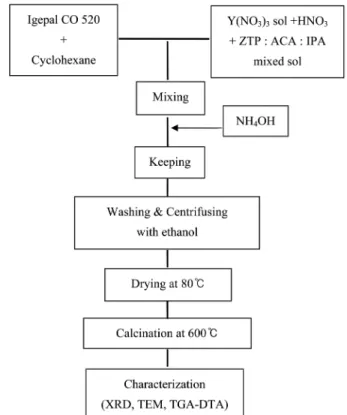
Fig. 1 shows a schematic illustration of the reverse micelle and sol-gel method used to prepare Y
2O
3doped ZrO
2particles. Microemulsions were prepared from cyclohexane (Sigma-Aldrich, HPLC grades), poly (oxyethylene) nonylphenyl ether (Aldrich Chemical Co. LTD.), generally known as Igepal CO 520 (Aldrich, 98% used without
further purification), and aqueous solutions of yitrium nitrate (Aldrich Chemical). Microemulsions of total volume 80 mL consisting of 16.4 g of Igepal[poly (oxyethylene) nonylphenly ether (Igepal CO-520, Aldrich Chemical Co.)], 40 mL of cyclohexane (Sigma-Aldrich, HPLC grades), 2.6- 5.2 mL of 0.02M Y(NO
3)
3solution in add 1-2 drop of HNO
3. The average of the synthesized particles was con- trolled by varying the ratio R = [water]/[surfactant]. After nanosize water droplets formed while stirring, ZTP (Zirconium IV propoxide, Sigma-Aldrich, 70 wt% solution in 1-propanol) : ACA (acetylacetone, Sigma-Aldrich, ≥ 99%) : IPA (isopropylalcohol, Aldrich Chemical) mixed sol (0.32
Fig. 1. Experimental flow chart of synthesis of the Y2O3-ZrO2 powders by a reverse micelle and sol-gel process.
-0.64 ml) was added into the stirred microemulsion. ACA used control the ZTP reaction velocity, and IPA used as a solvent. ZTP : ACA : IPA molar ratios of about 1:1:6M.
NH
4OH was Injected into the microemulsion to accelerate the condensation reaction of metal alkoxide precursors. The microemulsion was then centrifuged to extract the particles, which were subsequently washed by ethanol to remove any residual surfactant and water. The structure, size, and morphology of the resulting particles were examined by transmission electron microscopy (TEM). For TEM studies, samples were prepared by adding drops of freshly prepared cluster solution on a carbon film supported on a Cu grid.
The recovered powders were analyzed for phase compos- ition using X-ray diffraction (Mac Science, MO3XHF) over the 2 theta range from 20-80
oat a rate of 2.5
o/min. The synthesized Y
2O
3doped ZrO
2particles were characterized by thermogravimetry-differential thermal analysis (TGA- DTA) and Fourier transform infrared spectroscopy (FT-IR).
3. Results and Discussion
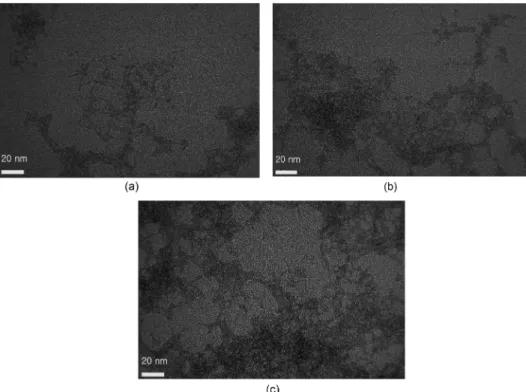
Fig. 2 shows a transmission electron micrograph (TEM) of the Y
2O
3doped ZrO
2nanoparticles obtained at room temperature with different molar ratio of water to surfactant (R). It follows that the average size of the nanopowders almost same with increasing R value. The average size and distribution of the synthesized particles was below 5 nm and narrow, respectively. An increase in the domain size of aqueous droplets, due to an increase in aqueous content in
the micro emulsion, will lead to an apparent increase in the size of the particles.
20)The nucleation and growth of the nanoparticles is likely to be diffusion-controlled process through interaction between micelles, but it can be influ- enced by many other factors such as phase behavior and solubility, average occupancy of reaction species in the aqueous pool and the dynamic behavior of the micro emul- sions.
21)Fig. 3 shows an X-ray diffraction pattern of the synthesized particles. From the X-ray analysis, the crystal- line phase of the synthesized particles was found to be
Fig. 2. TEM images of Y2O3 doped ZrO2 nanoparticles synthesized as a function of R: (a) 4, (b) 6 and (c) 8 at H = 100, x = 1.
Fig. 3. XRD patterns of synthesized Y2O3-ZrO2 powders as a function of molar ratio (calcination : 600oC, holding time: 30 min).
tetragonal ZrO
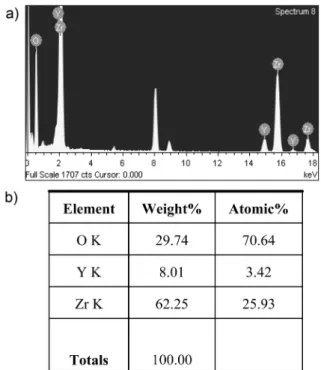
2. Fig. 4 shows the spectrum of Y
2O
3doped ZrO
2nanoparticles by TEM-EDS analysis. The particles appear yttrium and zirconium pattern peaks. Thermal behavior of the precursor at R = 4 value determined by TG- DTA in oxygen up to 600
oC at a heating rate of 10
oC/min is shown in Fig. 5. Decomposition started below 100
oC with a weight loss of 5% corresponds to crystallization water. In the temperature region between 100-252
oC, the main decomposition occurs with a weight loss of 17.7%.
The final weight loss (~15.3%) on the TG curve was ob- served in the temperature range 252-420
oC is due to the removal of residual organics. The thermal decomposition behavior is associated exothermic effects in the DTA curve.
The first decomposition step assignable to removal of adsorbed and chemisorbed water is indicated by broad endothermic peak in the range 50-60
oC on the DTA curves.
Exothermic peaks in the temperature range 200-410
oC in the DTA curve are due to the pyrolysis processes occurring during further heating of the precursor. A clear exothermic peak in the temperature range 500-550
oC corresponds to Y
2O
3-ZrO
2crystallization. From the TG-DTA analysis of Y
2O
3doped ZrO
2nanoparticles, the overall reduction in weight was 33.7% up to ~600
oC and water of crystalli- zation was dehydration at 320
oC. Also it shows that phase transition of change monoclinic phase to tetragonal phase at near 530
oC.
As shown in Fig. 6, the presence of these organic re- sidual in the as-dried precursor is indicated by the two sharp bands over the wavenumber 500 and range of 1300-
1400 and 1600-1700 cm
−1, which corresponds to Zr-O-Zr and C-H and C=C stretching vibrations, respectively. These functional groups were not completely eliminated when the precursor was repeatedly washed and subsequently dried at 80
oC. As expected, the hydroxide nature of the as-dried precursor was indicated by a relatively broad vibrational band over the range of 3200-3700 cm
−1.
4. Conclusion
Y
2O
3doped ZrO
2nanoparticles have been synthesized using a reverse micelle technique in conjunction with a sol- gel process, involving the hydrolysis and condensation of organometallic precursors. Average particle size and distri- bution of the synthesized Y
2O
3doped ZrO
2were below 5 nm, and agglomeration, respectively. XRD shows that the phase of the synthesized Y
2O
3doped ZrO
2with heating at 600
oC was tetragonal ZrO
2. TG-DTA analysis shows that phase of Y
2O
3doped ZrO
2nanoparticles change from monoclinic phase to tetragonal phase at near 530
oC.
Fig. 5. TG-DTA analysis of Y2O3 doped ZrO2 nanoparticles. (Tem- perature : 600oC, holding time: 30 min).
Fig. 6. FT-IR spectra of Y2O3 doped ZrO2 particles synthesized through a reverse micelle and sol-gel process.
Fig. 4. TEM-energy dispersive spectroscopy (EDS) mapping of Y2O3 doped ZrO2 nanoparticles; a) peak of element spectrum and b) amount of element.
Acknowledgment
This study was financially supported by a Research Grant (2011-0004448) from the National Research Foundation, Korea.
References
1. H. Hahn, J. Logas and R. S. Averback, J. Mater. Res., 5, 609 (1990).
2. Y. C. Zhou and M. N. Rahaman, J. Mater. Res., 8, 1680 (1993).
3. E. C. Subbarao and H. S. Maiti, Solid State Ionics, 11, 317 (1984).
4. B. C. H. Steele, J. Power Sourc., 49, 1 (1994).
5. K. Foger and S. P. S. Badwal, Mater. Forum, 21, 187 (1997).
6. F. T. Ciacchi, K. M. Crane and S. P. S. Badwal, Solid State Ionics, 73, 49 (1994).
7. H. Teterycz, R. Klimkiewicz and M. Laniecki, Appl.
Catal. Gen., 249, 313 (2003).
8. J. M. Calderon-Moreno and M. Yoshimura, Solid State Ionics, 154-155, 125 (2002).
9. T. Yamaguchi, Catal. Today, 20, 199 (1994).
10. J. D. A. Bellido and E. M. Assaf, Appl. Catal. Gen., 352, 179 (2009).
11. D. S. Bae, S. W. Park, K. S. Han and J. H. Adair, Met.
Mater. Int., 7, 399 (2001).
12. M. P. Pileni, Structure and Reactivity in Reverse Micelles, p. 25, Elsevier, Amsterdam (1989).
13. B. K. Paul and S. P. Moulik, J. Dispersion Sci. Technol., 18, 301 (1997).
14. K. Osseo-Asare and F. J. Arriagada, Ceram. Trans., 12, 3 (1990).
15. M. P. Pileni, J. Phys. Chem., 97, 6961 (1993).
16. M. Yoshida, M. Lal, N. D. Kumar and P. N. Prasad, J.
Mater. Sci., 32, 4047 (1997).
17. D. Zhang, L. Qi, J. Ma and H. Cheng, J. Mater. Chem., 12, 3677 (2002).
18. Ph. Monnoyer, A. Fonseca and J. B. Nagy, Colloid.
Surface. Physicochem. Eng. Aspect., 100, 233 (1995).
19. T. Li, J. Moon, A. A. Morrone, J. J. Mecholsky, D. R.
Talham and J. H. Adair, Langmuir, 15, 4328 (1999).
20. J. Fang, J. Wang, S. -C. Ng, C. -H. Chew and L. M. Gan, Nanostruct. Mater., 8, 499 (1997).
21. D. S. Bae, B. I. Kim and K. S. Han, Mater. Sci. Forum, 510-511, 786 (2006).