- 797 -
Browning and Moisture Sorption Characteristics of Rubus coreanus Prepared by Different Drying Methods
Hun-Sik Chung, Jong-Hwan Seong1, Young-Guen Lee1, Han-Soo Kim1, Joo-Baek Lee2 and Kwang-Sup Youn3†
Food & Bio-Industry Research Institute, Kyungpook National University, Daegu 702-701, Korea
1
Department of Food Science and Technology, Pusan National University, Miryang 627-706, Korea
2Department of Hotel Cooking & Beverage, Daegu Health College, Daegu 702-722, Korea
3†
Department of Food Science and Technology, Catholic University of Daegu, Gyeongsan 712-702, Korea
건조방법에 따른 복분자 분말의 갈변 및 흡습 특성
정헌식․성종환1․이영근1․김한수1․이주백2․윤광섭3†
경북대학교 식품생물산업연구소, 1부산대학교 식품공학과, 2대구보건대학 호텔외식조리계열,
3†대구가톨릭대학교 외식식품산업학부
Abstract
The effects of drying methods on the browning and moisture sorption characteristics of Rubus coreanus were studied.
Fruits were steamed for 5 min at 100℃, dried by sun drying, infrared drying, or freeze drying, and powdered to a size of 20 mesh. Color values were measured and equilibrium moisture contents (EMC) were determined at 20℃, over a range of water activity (aw) from 0.11 to 0.90. The browning indices L* and a* values were higher and lower, respectively, in freeze-dried Rubus coreanus compared with other samples. The b* value was greatest in freeze-dried Rubus coreanus. EMC tended to increase with increasing aw values, and a particularly sharp increment was observed above 0.75 aw. The EMC of freeze-dried Rubus coreanus was significantly higher compared with the EMC of sun-dried and infrared-dried fruit at constant aw. The moisture sorption isotherms showed a typical sigmoid shape, and the Halsey, Kuhn, and Oswin models were the best fits for the sun-dried, infrared-dried, and freeze-dried powder isotherms, respectively. With respect to monolayer moisture content, the Guggenheim-Anderson-Boer (GAB) equation showed that the various drying methods yielded very different results, with monolayer moisture contents of 0.005 g H2O/g dry solid in infrared-dried and 0.019 g H2O/g dry solid in sun- and freeze-dried powders, respectively. These results indicate that the drying method affects the browning and moisture sorption characteristics of Rubus coreanus.
Key words:Rubus coreanus, browning, sorption isotherm, modelling, monolayer moisture content
Introduction
1)
Rubus coreanus are commonly preserved and distributed in dried form due to the poor storability of fresh fruit, and used as a material for processed food and traditional medicine in Korea (1). Its biological activities and therapeutic effects such as antimicrobials and similar action of estrogen(1,2), antioxidation(3), immunomodulation(4), antitumour(5),
†Corresponding author. E-mail:[email protected], Phone:82-53-850-3209, Fax:82-53-850-3209
antinociceptive and antiinflammatory(6) have been reported.
Due to their perceived health-stimulating properties and medicinal effects, today the use of Rubus coreanus is widespread and growing in the healthy food industry.
Rubus coreanus has been generally dried under the sun or hot-air drying after harvest. However, these conventionally dried products have some undesirable quality properties in comparison with infrared and freeze drying(7). Efficient drying process ofRubus coreanus which can restrained the loss of quality is demanded when processing of Rubus coreanus. Drying technology in food processing is done by
lowering the moisture content related to microbial spoilage and enzymatic deterioration, but also for the development of new food types(8). In spite of these advantages, the drying process may cause physicochemical alterations of the food and finally degrade its quality. The properties such as chemical components, texture, density, porosity, color and sorption characteristics are known to be readily affected by the drying process(9-12). These property changes induced by drying process depend upon drying methods as well as plant materials. Thus, previous studies have to be conducted to determine the optimum methods for each plant materials.
The quality properties of dried food are affected by their physical, chemical and microbiological stability. This stability is mainly a consequence of the relationship between the equilibrium moisture content(EMC) and water activity(aw) at a constant temperature and pressure. Color change such as browning may be the major quality deterioration of foods and considered as index of severity of the developed chemical reactions during drying(13). The moisture sorption isotherms, consisting of a graphical representation of awagainst EMC, are unique for individual foods, and the knowledge of that is useful to solve food processing design problems, predict energy requirements, and determine proper storage and transportation conditions. Prediction of moisture sorption is based on fitting various sorption models to the experimental data. Many mathematical models are developed to describe the sorption behaviour of fruits and vegetables including apples(12), garlic(14), raisins, currants, figs, prunes and apricots(15), potatoes(16), onions(17), and ginger(18).
However, investigations on the color changes and the moisture sorption isotherms of Rubus coreanus as affected by the drying methods have not been carried out.
The objectives of this study were to determine the browning degree and the moisture sorption isotherms of Rubus coreanus, to establish a sorption isotherms model to fit the data in order to predict the moisture sorption isotherms and to calculate the content of water in the monomolecular layer.
Materials and Methods
Plant materials
Unripe fruits ofRubus coreanuswere harvested on 15 July 2007 from a hill in the Jiri mountain region of Korea, transported immediately to the laboratory, graded according to size and defects, and kept at 4℃ until use.
Drying methods
Rubus coreanus was steamed for 5 min and dried using sun, infrared or freeze drying methods. In sun drying, the raw materials were exposed to sun for about 20 days until the moisture content reached a constant level. For infrared and freeze drying, the raw materials were put into a cabinet-type infrared dryer(IRD-250, Woori Sci., Korea) kept at 60℃ air temperature with constant airflow rate or a freeze dryer(FreeZone, Labconco., USA), respectively, and dried until the moisture content of the samples reached 1 to 3%.
The dried products were ground by a mill(J-NCM, JISICO, Korea) and sieved to size of 20 mesh.
Color measurement
The color of powdered samples was measured with a colorimeter(CR-200, Minolta Co., Osaka, Japan) fitted with CIE illuminant C and 8 mm diameter measuring aperture, which had been calibrated with a standard white plate(L*=97.79, a*=-0.38, b*=2.05). Three reading of L*
(lightness), a* (+, redness; -, greenness), and b* (+, yellowness; -, blueness) were recorded for each sample.
Experimental procedure for sorption isotherms
The equilibrium moisture contents of Rubus coreanuswere determined at 20℃ by a static gravimetric method. A sample of 2 g was placed in a petri-dish inside desiccators containing saturated salt solution of water activity from 0.11 to 0.90.
The desiccators were placed in a temperature controlled incubator. The samples were allowed to equilibrate until there was no discernible mass change, as evidenced by constant mass values. The moisture content of each sample was determined gravimetrically by drying in a convection oven at 105℃ for 24 hr. Each experiment was carried out in triplicate.
Analysis of data
The relationship between the experimental data for the equilibrium moisture content and water activity was adjusted to the following six equations(19-24). The coefficients in each equation were obtained using linear and non-linear least squares regression analyses.
Bradley equation ln
Caurie equation ln
Halsey equation
Henderson equation
Kuhn equation
Oswin equation
where M is the equilibrium moisture content, aw is the water activity, and other alphabets are the constants.
The suitability of the equations has been evaluated and compared using the coefficient of determination(R2) and the mean relative percentage deviation modulus(P) was used, P is defined by
│where Miis the experiment equilibrium moisture content, Mpi is the predicted equilibrium moisture content, and n is the number of data points. In general, when the value of P is below 10%, the model should be considered as acceptable(25).
The moisture content in the monolayer was determined by the following Brunauer-Emmett-Teller(BET) equation(26) and Guggenheim-Anderson-Boer(GAB) equation(27).
BET equation
GAB equation
where awis the water activity, m is the equilibrium moisture content, and m1is the monolayer moisture content. While C and k are the constants.
Results and discussion
Comparison of browning
The color of foods is important to their acceptability. It is well known that the measurement of L* and a* values can be used as a suitable method for the evaluation of browning degree in fruits and vegetables(28). Lower L*and higher a*values indicate that the produces is more brownish.
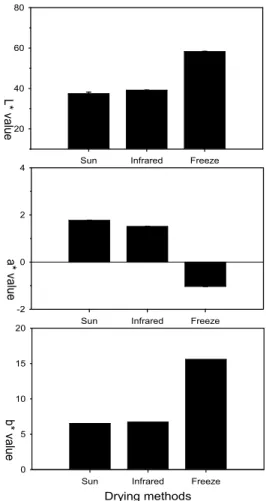
The L*, a* and b* values of sun-dried, infrared-dried, or freeze-dried Rubus coreanus are shown in Fig. 1. The L*
value of the freeze-dried powder was largely higher when compared to the values of both infrared-dried and sun-dried powder. And the L* value of infrared-dried powder was
slightly higher than that of sun-dried powder. The a* value showed a minus value in the freeze-dried powder but a plus value in sun-dried and infrared-dried powder. The a* value of sun-dried powder was higher than that of infrared-dried powder. These results may be due to preventing of certain reactions related to browning development such as enzymatic browning and non-enzymatic browning reactions by a freeze drying(13). The b* value of the freeze-dried Rubus coreanus was about two times higher in comparison with the values of both sun-dried and infrared-dried Rubus coreanus. This result is similar to that ofPonciri fructusin relation to drying methods(29). The above results suggested that the drying method significantly affected the browning reactions that occurred during sun drying, and freeze drying had prevented the effect of browning development during the drying of Rubus coreanus.
Sun Infrared Freeze
L* value 20
40 60 80
Sun Infrared Freeze
a* value
-2 0 2 4
Drying methods
Sun Infrared Freeze
b* value
0 5 10 15 20
Fig. 1. Color values of Rubus coreanus in relation to drying methods.
Sorption isotherms
The sorption isotherms relating aw and EMC of Rubus coreanusat 20℃ as affected by drying methods are plotted
in Fig. 2. The sorption isotherms were typical sigmoid shape and resembled the isotherms observed in fruits and vegetables such as apples, garlic, raisins, currants, figs, prunes and apricots, potatoes, onion, and ginger(12,14-18). The EMC of all samples tended to increase with increasing aw, especially the EMC sharply increased at above 0.75 aw. These may be due to an inability of the food materials to maintain the vapor pressure at unity with decreasing moisture content. Rao et al.(30) reported that the steep acceleration of sorption during high water activities in case of chhana podo could be due to the solubilization of sugars. At constant water activity, the EMC of the freeze-dried Rubus coreanus was significantly higher when compared to the values of the sun-dried and infrared-dried. That is, the EMC of the freeze-dried, infrared-dried and sun-dried increased from 0.03, 0.02 and 0.01(d.b.) at 0.11 awto 0.22, 0.18 and 0.18(d.b.) at 0.90 aw, respectively. These results may be caused by more porous structure of the freeze-driedRubus coreanus than the sun-dried and infrared-dried. It is well known that the freeze-dried foods have strong water binding capacity for high pore texture(9).
0.00 0.05 0.10 0.15 0.20 0.25
0.11 0.33 0.53 0.75 0.9
Water Activity
Equilibrium Moisture Content(d.b.)
SD IR FD
Fig. 2. Experimental sorption isotherms for Rubus coreanus. SD: sun drying, IR: infrared drying, FD: freeze drying.
Fitting of sorption isotherm models
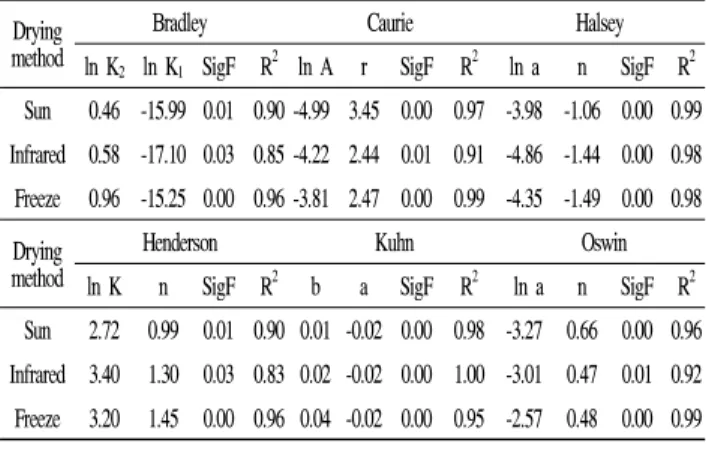
Bradley, Caurie, Halsey, Henderson, Kuhn, and Oswin models were fitted for describing the moisture sorption isotherm of Rubus coreanusat 20℃. The values of coefficients obtained by a regression analysis in each equation are presented in Table 1. Among the fitted models, Caurie, Halsey, Kuhn and Oswin equations were found to be good in predicting the experimental moisture sorption data and to characterize the sorption behaviour for the entire range of water activity and the Rubus coreanus dried by all drying methods, as exhibited by high R2values. Generally the fitness of the models depends upon the chemical components of foods(31). In case of the dried Rubus coreanus, we suggest
that the suitability of the models is related to drying methods.
The P values of the Caurie, Halsey, Kuhn and Oswin models were calculated by the above mentioned equations and are shown in Table 2. Generally, Halsey model was the best model to describe the experimental sorption data for Rubus coreanusthroughout the entire range of water activity.
Table 1. Estimated coefficients of sorption equations fitted to experimental sorption data of Rubus coreanus
Drying
method Bradley Caurie Halsey
ln K2 ln K1 SigF R2 ln A r SigF R2 ln a n SigF R2 Sun 0.46 -15.99 0.01 0.90 -4.99 3.45 0.00 0.97 -3.98 -1.06 0.00 0.99 Infrared 0.58 -17.10 0.03 0.85 -4.22 2.44 0.01 0.91 -4.86 -1.44 0.00 0.98 Freeze 0.96 -15.25 0.00 0.96 -3.81 2.47 0.00 0.99 -4.35 -1.49 0.00 0.98 Drying
method Henderson Kuhn Oswin
ln K n SigF R2 b a SigF R2 ln a n SigF R2 Sun 2.72 0.99 0.01 0.90 0.01 -0.02 0.00 0.98 -3.27 0.66 0.00 0.96 Infrared 3.40 1.30 0.03 0.83 0.02 -0.02 0.00 1.00 -3.01 0.47 0.01 0.92 Freeze 3.20 1.45 0.00 0.96 0.04 -0.02 0.00 0.95 -2.57 0.48 0.00 0.99
Table 2. Mean relative percentage deviation modules of sorption equations fitted to experimental sorption data ofRubus coreanus
Drying
method P (%)
Caurie Halsey Kuhn Oswin
Sun 6.85 3.63 6.03 6.13
Infrared 9.25 5.03 0.74 8.87
Freeze 1.88 3.25 12.20 1.36
Average 5.99 3.97 6.32 5.45
Halsey model gave P values ranging from 3.25% to 5.03%, with average values of 3.97%. There was difference in the P values among the drying methods. That is, P values of Caurie, Halsey and Oswin models were lowest in the freeze-driedRubus coreanusand highest in the infrared-dried.
However, the P value of Kuhn model was the lowest in the infrared-driedRubus coreanusand highest in the freeze-dried.
The P value of 12.20% in the case of freeze drying means that the Khun model cannot represent the sorption isotherm of the freeze-dried Rubus coreanus. In comparison of the sorption isotherm models according to P values, Halsey model was the best fit model in the case of the sun-dried Rubus coreanus, Khun model was the best fit model in case of the infrared-dried, and Oswin model was the best fit sorption model in case of the freeze-dried.
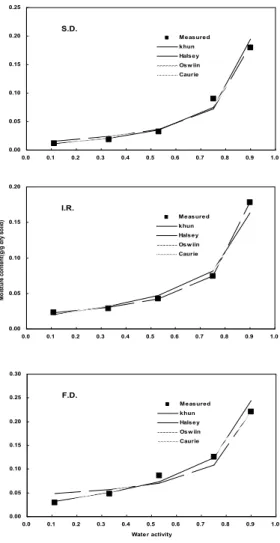
Experimental data forRubus coreanus were compared to sorption isotherms predicted by the Caurie, Halsey, Kuhn
and Oswin models as shown in Fig. 3. All models, with the exception of the Kuhn model in case of freeze drying, graphically gave good fits to experimental data over the range of water activities investigated regardless of drying methods.
0.00 0.05 0.10 0.15 0.20
0.0 0.1 0.2 0.3 0.4 0.5 0.6 0.7 0.8 0.9 1.0
Moisture content(g/g dry solid) Measured
khun Halsey Osw iin Caurie I.R.
0.00 0.05 0.10 0.15 0.20 0.25
0.0 0.1 0.2 0.3 0.4 0.5 0.6 0.7 0.8 0.9 1.0
Measured khun Halsey Osw iin Caurie S.D.
0.00 0.05 0.10 0.15 0.20 0.25 0.30
0.0 0.1 0.2 0.3 0.4 0.5 0.6 0.7 0.8 0.9 1.0
Water activity Measured khun Halsey Osw iin Caurie F.D.
Fig. 3. Comparison of the experimental sorption data and sorption isotherms of Rubus coreanus fitted by sorption models. Symbols represent experimental values, lines represent the predicted isotherm.
SD: sun drying, IR: infrared drying, FD: freeze drying.
Content of monolayer moisture content
The moisture content in the monolayer is determined as index of optimum water content for the stability of various dried foods. Monolayer moisture contents calculated from BET and GAB equations are presented in Table 3. According to R2 values, BET equation could be used only for infrared-dried Rubus coreanus. However, GAB equation could be used for allRubus coreanus dried by three methods.
Monolayer moisture content of infrared-dried Rubus coreanus was slightly lower than the value from the both sun-dried and freeze-dried Rubus coreanus. This lower in monolayer
moisture contents can be explained by considering the structural difference induced by the drying methods(32).
Iglesias and Chirife(33) reported that monolayer moisture content is closely related with the number of active sites available of foods for binding water. This result suggested that drying methods affect the monolayer moisture content of Rubus coreanus.
Table 3. Coefficients and monolayer moisture contents ofRubus coreanus determined by BET and GAB equations
Drying
Method BET equation GAB equation
C m1 SigF R2 C k m1 SigF R2
Sun 6.18 0.02 0.02 0.86 -1.89 0.64 0.02 0.00 0.99 Infrared -28.01 0.02 0.00 0.99 -1.88 0.75 0.01 0.02 0.98 Freeze -9.85 0.03 0.02 0.88 -1.92 0.65 0.02 0.00 0.99
In conclusions, the browning degree of freeze-driedRubus coreanus was lower compared to that of dried with other methods. The moisture sorption isotherms ofRubus coreanus obtained at 20℃ showed a sigmoid shape depend on the drying methods. The best fit model was affected by the drying methods. That is, Halsey, Khun, and Oswin models gave the best fit with experimentally determined data of sun-dried Rubus coreanus,infrared-dried, and freeze-dried, respectively.
Monolayer moisture contents determined from GAB model were lower in infrared-driedRubus coreanusthan in the both sun-dried and freeze-dried.
요 약
건조방법이 복분자 분말의 갈변 및 흡습 특성에 미치는 영향을 조사하기 위하여, 신선 복분자를 천일, 적외선 및 동결 건조한 다음 분쇄하고 이 분말의 색도와 수분활성도 (aw) 0.11-0.90 범위에서 평형수분함량(EMC)을 각각 측정 하였다. 갈변지표인 L*값과 a*값은 동결 건조한 복분자 분말이 다른 방법으로 건조한 분말보다 높고 낮은 값을 나타내었고, 황색도인 b*값은 동결 건조 분말에서 가장 높 은 수준을 보였다. EMC는 aw의 증가와 함께 증가하는 경향 을 보였으며 특히, 0.75 aw이상에서 급격하게 증가하였다.
동일한 aw에서 분말의 EMC는 동결건조품이 천일과 적외선
건조품 보다 유의적으로 높게 나타났다. 복분자 분말의 흡 습곡선은 전형적인 sigmoid 형태를 보였고, 천일건조 분말 은 Halsey model, 적외선 건조 분말은 Kuhn model, 그리고 동결 건조 분말은 Oswin model이 적합도가 가장 높았다.
단분자층 수분함량은 GAB 방정식으로 설명할 수 있었으 며, 적외선 건조 분말에서 0.005 g H2O/g dry solid, 천일
및 동결 건조 분말에서 0.019 g H2O/g dry solid를 각각 나타 내었다. 이로써 건조방법은 복분자 분말의 갈변과 흡습 특 성에 영향을 미치는 것으로 확인되었다.
References
1. Kim, H.C. and Lee, S.L. (1991) Comparison of functional effects of geni Rubus. Korean. J. Herbol., 6, 3-11 2. Costantino, L., Albasini, A., Rasteli, G. and Benvenuti,
S. (1992) Activity of polyphenolic crude extracts as scavengers of superoxide radicals and inhibitors of xanthine oxidase. Planta Med., 58, 342-345
3. Kim, S.H., Chung, H.G., Jang, Y.S., Park, Y.K., Park, H.S. and Kim, S.C. (2005) Characteristics and screening of antioxidative activity for the fruit by Rubus coreanus Miq. clones. J. Korean For. Soc., 94, 11-15
4. Park, J.H., Lee, H.S., Mun, H.C., Kim, D.H., Seong, N.S., Jung, H.G., Bang, J.K. and Lee, H.Y. (2004) Effect of ultrasonification process on enhancement of immuno-stimulatory activity of Ephedra sinica stapf and Rubus coreanus Miq. Korean J. Biotechnol. Bioeng., 19, 113-117
5. Lee, M.K., Lee, H.S., Choi, G.P., Oh, D.H., Kim. J.D., Chang, Y.Y. and Lee, H.Y. (2003) Screening of biological activities of the extracts fromRubus coreanus Miq. Korean J. Med. Crop Sci., 11, 5-12
6. Choi, J., Lee, K.T., Yun, S.Y., Ko, C.D., Jung, H.J. and Park, H.J. (2003) Antinociceptive and antiinflammatory effects of nigaichigoside F1 and 23-hydroxytormentic acid obtained fromRubus coreanus. Biol. Pharm. Bull., 26, 1436-1441
7. Chung, H.S., Hwang, S.H. and Youn, K.S. (2005) Extraction characteristics of Rubi Fructus in relation to drying methods and extraction solutions. Korean J. Food Preserv., 12, 436-441
8. Mujumdar, A.S. and Menon, A.S. (1995) Drying of solids: principles, classification, and selection of dryers.
In: Handbook of Industrial Drying, Mujumdar, A.S.(Editor), Marcel Dekker, New York, USA, p.1-39 9. Krokida, M.K. and Maroulis, Z.B. (1997) Effect of drying method on shrinkage and porosity. Drying Technol., 10, 1145-1155.
10. Krokida, M.K., Maroulis, Z.B. and Saravacos, G.D.
(2001) The effect of the method of drying on the colour of dehydrated products. Int. J. Food Sci. Technol., 36, 53-59
11. Yang, C.S.T. and Atallah, W.A. (1985) Effect of four drying methods on the quality of immediate moisture lowbush blueberries. J. Food Sci., 50, 1233-1237.
12. Saravacos, G.D. (1967) Effect of the drying method on the water sorption of dehydrated apple and potato. J.
Food Sci., 32, 81-84.
13. Krokida, M. and Maroulis, Z. (2000) Quality changes during drying of food materials. In: Drying Technologyin Agriculture and Food Sciences, Mujumdar, A.S.(Editor), Science Publishers, NH, USA, p.77-87
14. Kim, H.K., Jo, K.S., Kang, T.S. and Shin, H.S. (1987) Browning and sorption characteristics of dried garlic flakes with relative humidity and storage temperature.
Korean J. Food Sci. Technol., 19, 176-180
15. Tsami, E., Maroulis, Z.B., Morunos-Kouris, D. and Saravacos, G.D. (1990) Water sorption isotherms of raisins, currants, figs, prunes and apricots. J. Food Sci., 55, 1594-1597
16. Mclaughlin, C.P. and Magee, T.R.A. (1998) The determination of sorption isotherm and the isosteric heats of sorption for potatoes. J. Food Eng., 35, 267-280 17. Sukumar, D., Hermavathy, J. and Bhat, K.K. (2002)
Moisture sorption studies on onion powder. Food Chem., 78, 479-482
18. Shin, H.K., Hwang, S.H. and Youn, K.S. (2003) Absorption characteristics and prediction model of ginger powder by different drying methods. Korean J. Food Sci.
Technol., 35, 211-216
19. Bradley, R.S. (1936) Polymolecular adsorbed films. Part I. The adsorption of argon on salt crystals at low temperatures and the determination of surface fields. J.
Am. Chem. Soc., 77, 1467-1474
20. Caurie, M. (1981) Derivation of full range moisture isotherms. In: Rockland, L.B. and Stewart, G.F. (Editor), Water Activity: Influences on Food Quality, Academic Press, New York, USA, p.63-87
21. Halsey, G. (1948) Physical adsorption in non-uniform surfaces. J. Chem. Physi., 16, 931-937
22. Henderson, S.M. (1952) A basic concept of equilibrium moisture. Agric. Eng., 33, 29-32
23. Kuhn, I.J. (1964) A new theoretical analysis of adsorption phenomena. Introductory part: The characteristics expression of the main regular types of adsorption isotherms by a single simple equation. J. Colloid Sci., 19, 685-698
24. Oswin, C.R. (1946) The kinetics of package life. III. The isotherm. J. Soc. Chem.. Indus., 65, 419-421
25. Lomauro, C.J., Bakshi, A.S. and Labuza, T.P. (1985) Evaluation of food moisture sorption isotherm equations.
Part I. Fruit, vegetable and meat products. LWT, 18, 111-117
26. Brunauer, S., Emmett, P.H. and Teller, E. (1938) Adsorption of gases in multimolecular layers. J. Am.
Chem. Soc., 60, 308-319
27. Anderson, R. (1946) Modifications of the BET equation.
J. Am. Chem. Soc., 68, 689-691
28. Castaner, M., Gil, M. I., Ruiz, M. V. and Artes, F. (1999) Browning susceptibility of minimally processed Baby and Romaine lettuces. Eur. Food Res. Technol., 209, 52-56 29. Chung, H.S., Hwang, S.H. and Youn, K.S. (2005) Physicochemical characteristics of Ponciri fructus in relation to drying treatment. Korean J. Food Preserv., 12, 449-454
30. Rao, K.J., Dhas, P.H.A., Emerald, M.E., Ghosh, B.C., Balasubramanyam, B.V. and Kulkarni, S. (2006) Moisture sorption characteristics of chhana podoat 5℃
and 35℃. J. Food Eng., 76, 453-459
31. Boquet, R., Chirife, J. and Iglesia, H.A. (1978) Equatins for fitting water sorption isotherms of foods. J. Food Technol., 13, 319-329
32. Westgate, P., Lee, J.Y. and Ladisch, M.R. (1992) Modeling of equilibrium sorption of water vapor on starch materials. Trans. ASAE., 35, 213-219
33. Iglesias, H.A. and Chirife, J. (1976) A model for describing the water sorption behavior of foods. J. Food Sci., 41, 984-992
(접수 2009년 6월 25일, 채택 2009년 11월 6일)