1. Introduction
접 수 일 : 2016.08.22 심사완료일 : 2016.08.26 게재확정일 : 2016.08.29
* 유창호 : 전북대학교 융합기술공학과 조교수 [email protected] (주저자)
김성훈 : 원광대학교 전자융합공학과 조교수 [email protected] (교신저자)
※ 본 연구는 2015년 정부(교육부)의 재원으로 한국연구
재단의 지원을 받아 수행된 기초연구사업임
(2015R1D1A1A01059525, 2015R1D1A1A01057463).
Since the discovery of the compass, magnetic phenomena have become an inseparable feature of human life, most noticeably used in medical and advanced information technology applications [1-3]. Furthermore, magnetic actuation has been extensively explored in biomedical fields. The development of different materials and of microfabrication and nanofabrication techniques have led to the emergence of multi-scale magnetic actuators and sensors, which have been widely used for therapy, diagnosis, target drug
자기 메카트로닉스 : 차세대 의공학 및 재활 기기 개발을 위한 센서와 액추에이터의 새로운 접근방법
Magneto-Mechatronics : A New Approach to Sensors and Actuators for Next-Generation Biomedical and Rehabilitation Devices
유창호*, 김성훈 C. H. Yu, S. H. Kim
요 약
자기 센서와 액추에이터는 산업과 의료 분야에서 광범위하게 사용되고 있다. 센서와 액추에이터의 기반의 통합 시스템은 기계 및 전자 기기들의 일반적인 조합으로써 메카트로닉스로 정의된다. 최근에 자기 무선 센서와 액추에 이터가 개발되어지고, 다양한 분야에서 사용되고 있다. 특히 이 메커니즘은 자성 물질 및 물리적 현상에 관한 것 으로 자기의 세기의 따라 달라진다. 그러나 이들 연구의 경계는 명확하지 않다. 따라서, 자기 마이크로 로봇, 자기 액추에이터 및 센서들을 포함한 새롭고 정확한 정의가 필요하다. 본 연구에서는 의공학 및 재활을 위한 자기 메카 트로닉스의 진보되고 확장된 개념을 혈관 재활을 위한 무선 펌프 시스템과 모션 감지 시스템을 중심으로 소개하 고자 한다.
ABSTRACT
Magnetic sensors and actuators have been widely used in industry and medical fields. Integrated systems based on sensors and actuators are defined as mechatronics that is the general combination of mechanics and electronics.
Recently, magnetic wireless sensors and actuators have been developed and used at a systematic level. In particular, their mechanisms depend on magnetic, such as magnetic material and physical phenomena. However, their research boundary has not been clear. Researchers talk of magnetic micro-robots, magnetic actuators and sensors. Therefore, a new and correct definition is required. In this study, we introduce the advanced and extended concept of mechatronics, which is a magneto-mechantronics for biomedical and rehabilitation. Among various applications, we focused on wireless pump and sensing system for blood vessel rehabilitation and local motion capture, respectively.
Keyword : Magneto-mechatronics, Magnetic wireless actuator and sensor, Medical rehabilitation, Magnetic torque, Magnetic force
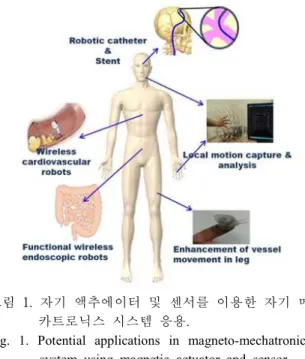
delivery, u-TAS, the navigation systems of blood vessels, and rehabilitation [4-8]. Figure 1 shows the potential applications of wireless magnetic actuators and sensors for biomedical and rehabilitation devices. Such magnetic devices used in medical fields are operated wirelessly and without batteries; however, they can only be used in restricted spaces. Wireless magnetic actuators face another potential problem: a low degree of freedom (DoF) for shape and motion. To overcome these problems, magnetic, mechanical, and electrical engineering have been synergistically integrated.
In general, the definition of mechatronics has evolved since its original definition by the Yaskawa Electric Corporation. In trademark application documents, Yaskawa defines mechatronics as follows: mecha is derived from mechanism and tronics from electronics. In the future, technologies and developed products will incorporate electronics into their mechanisms more and more, intimately and organically, making it impossible to tell where one ends and the other begins [9-11]. Conventional mechatronics includes reconstructing the unit components using various materials to reach system level and are able to fulfill their purpose [12-13]. However, wireless magnetic actuators and sensors cannot be easily integrated or reconstructed due to magnetic phenomena.
Therefore, in this paper, we introduce a new approach to magnetic actuators and sensors for biomedical and rehabilitation devices. Magnetic actuators that use an external magnetic field were applied to a medical micro-robot and a wireless blood pump. One of application of a wireless blood pump is used in rehabilitation; in this paper, we focused on the rehabilitation of the leg.
The wireless blood pump used in this paper had two functions: circulating blood and enhancing blood vessel movement. In addition, a wireless magnetic-sensing system was applied for local motion capture and analysis.
그림 1. 자기 액추에이터 및 센서를 이용한 자기 메 카트로닉스 시스템 응용.
Fig. 1. Potential applications in magneto-mechatronics system using magnetic actuator and sensor.
2. Principles and methods
2.1 Principle of wireless magnetic manipulation
A new solution was defined for the synergistic integration of magnetic, mechanical, and electrical engineering: controlling actuators and sensors using magnetic fields. The control method using an electromagnetic system is classified by gradient, alternating, and rotating magnetic fields.
A permanent magnet for wireless manipulation creates translational and rotational motion in magnets, as shown in Figure 2 (a) and (b). In particular, these magnetic fields control magnetic force or torque, depending on the magnetic materials. For instance, hard magnetic materials with alternating and rotating magnetic fields are suitable for magnetic torque control, whereas soft magnetic materials with a gradient magnetic field are appropriate for magnetic force control.
Magnetic force and torque can be expressed as follows:
× (1)
∙ ∇ (2)
where M is the magnetic moment, is the applied external magnetic field density, and T and F denote magnetic torque and force, respectively.
These wireless control methods are an advantage of magneto-mechatronics systems, which are suitable for use in restricted spaces since they use local magnetic fields.
그림 2. 자기 액추에이터 및 센싱의 원리 : (a) 영구 자석 조작 원리, (b) 전자기 조작 원리, (c) 자기 유도를 이용한 센싱 방법.
Fig. 2. Principle of magnetic actuation and sensing:
(a) permanent magnet manipulation, (b) electromagnetic manipulation, and (c) sensing method using magnetic induction.
The basic technology of wireless magnetic sensing utilizes magnetic induction based on Faraday’s law, as shown in Figure 2 (c). The magnetic induction method, in which the induced magnetic field generates voltage and currents in a coil, has been widely used for magnetic sensors.
The generated voltage from the induced magnetic field can be expressed as follows:
(3)
where V is the induced voltage, N is the
number of turns in the wound coil, B is the magnetic flux density of the magnetic impeller, A is the area of the coil, and is the angle between the magnetic flux density direction and the coil.
Magneto-mechatronics includes all magnetically driven mechanical devices and sensors, such as magnetic robots, pumps, and local motion capture systems. These devices and systems use independent components to complete their respective tasks; for example, the magnetic blades in pump housing are controlled by magnetic torque, and they generate pressure energy. In other words, the combination of a magnetic physical phenomenon (i.e., magnetic torque) and a mechanical apparatus allows the pump to function without using conventional motors [14].
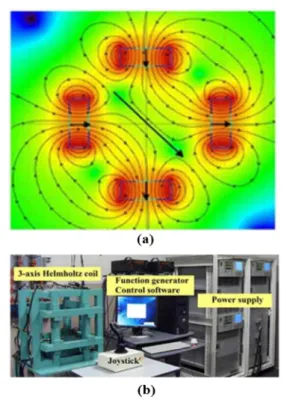
그림 3. (a) 자기력 제어를 위한 영구 자석 시스템 의 구성 : 4개의 영구 자석을 이용한 자기력 에 바탕을 둔 스티어링 방법, (b) 자기 토크 제어를 위한 3축 헬름홀츠 코일을 이용한 전자기 시스템.
Fig. 3. (a) Configuration of a permanent magnet system for control of magnetic force: steering method based on magnetic force using four permanent magnets and (b) electromagnetic system, which uses a three-axis Helmholtz coil for magnetic torque control.
Figure 3 shows the actual manipulating system,
which uses permanent magnets and an electromagnetic system based on a three-axis Helmholtz coil. Because of the constant magnetic flux density from the permanent magnets, the permanent magnet method has lower controllability than that of an electromagnetic system. An electromagnetic system can change the driving frequency and magnitude of a current.
Therefore, electromagnetic systems have been widely used for biomedical applications.
2.2 Wireless magnetic actuator and sensor for biomedical and rehabilitation devices
2.2.1 Wireless magnetic actuators and application
The basic control methods for wireless magnetic actuators are magnetic torque and force controls. External magnetic fields for micro-robot control are divided into three types: gradient, alternating, or rotating. A gradient magnetic field is suitable for translating wireless magnetic actuators. In this case, wireless magnetic actuators (micro-robots) are driven by a magnetic force. To generate a gradient magnetic field, two magnetic circuit methods have been widely used as controls: one based on an electromagnetic system and the other based on a permanent magnet system (Figure 3). In general, an electromagnetic system for wireless magnetic actuators is composed of Helmholtz coils and Maxwell coils. Under this configuration, the Helmholtz coils are used to align the magnetic micro-robots using magnetic torque, and the Maxwell coils impart a magnetic force (translation) to the robots [15].
The other method is magnetic torque control using rotating and alternating magnetic fields.
Magnetic torque is generated by the relationship between external magnetic fields and a magnetic moment on the magnets. It is the tendency of a force to rotate a magnet according to the field direction. Figure 3 (b) shows an electromagnetic system that uses a three-axis Helmholtz coil system for magnetic torque control. For actuators,
the alternating magnetic field generally results in oscillation or vibration, whereas the rotating magnetic field generally results in rotation.
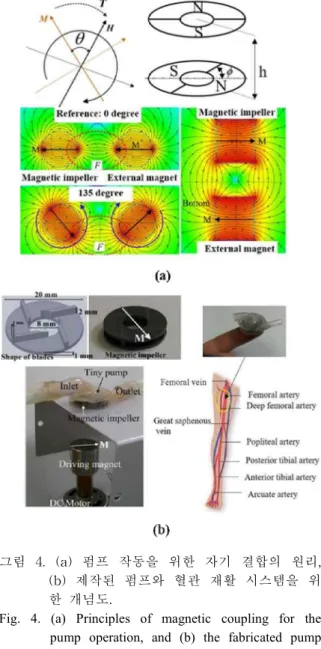
그림 4. (a) 펌프 작동을 위한 자기 결합의 원리, (b) 제작된 펌프와 혈관 재활 시스템을 위 한 개념도.
Fig. 4. (a) Principles of magnetic coupling for the pump operation, and (b) the fabricated pump and conceptual of application for blood vessel rehabilitation.
Typically, wireless magnetic actuators have the critical problem of a low DoF for shape and motion due to their magnetization and magnetic properties, such as magnetic torque and interaction force. These problems are solved by fusing multiple research fields. For the fabrication of a magnet, a rotating magnetic field and injection molding are required to improve the DoF for shape and motion, as using the rotating magnetic field method to control the wireless
magnetic actuator can potentially lead to the development of a mechanical mechanism. General 2-D rotation using a rotating magnetic field can be easily converted to various motions depending on the mechanical mechanism.
Figure 4 shows the application of a pump driven by permanent magnets and electromagnets based on the concept of wireless magnetic manipulation for rehabilitation devices. As diabetic foot ulcers and peripheral artery disease cause decreased blood flow and the hardening of blood vessels in the leg, the purpose of the magnetic pump is to support the circulation of blood in rehabilitating hardened arteries in the legs, as the pump can enhance the blood circulation and movement (flexibility) of the blood vessels using hydrodynamics.
In addition, Figure 4 (a) shows synchronous axial and radial coupling for rotation. The fabricated impeller, which is a magnet that uses the injection-molding method, includes backward-curved blades. Therefore, the rotation of the external magnet causes the rotation of the magnetic impeller due to the magnetic coupling.
Figure 4(b) shows the fabricated pump and experimental apparatus, which use synchronous magnetic axial coupling. In axial coupling, the magnetic force of the Z-axis can be expressed as follows [16]:
(4) where and are the number of mesh variables and ( ′, ′) represents the coordinate variables. denotes the magnetization, is the axial coupling distance, and denotes the angular displacement. The summing point charges on the surface mesh become the surface area (∆ ). and are the inner and outer radii, respectively. Thus, the driving torque can be expressed as follows:
(6)
where ′ is the displacement vector from the original coordinate system.
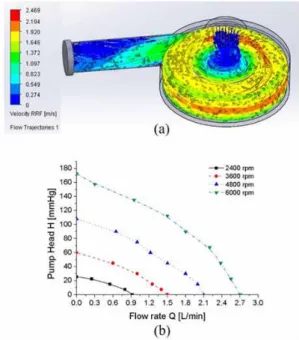
Because of magnetic force and torque, the magnetic pump is wireless and battery-free operation is enabled. In addition, the wireless pump can provide a smaller size and a more simple structure. To apply the pump for leg rehabilitation, it must satisfy the hydrodynamic performance of a femoral artery, i.e., a maximum flow rate of up to 2.51 L/min at diameter of 5.
The developed pump produces a flow rate of up to 2.71 L/min and a pump head of up to 172.5 mmHg.
그림 5. (a) 펌프의 유동 시뮬레이션 : 유도의 궤적, (b) H-Q 곡선 : 실험을 통한 결과.
Fig. 5. (a) Flow simulation of the pump: flow trajectory and (b) H-Q curves: experimental results.
Figure 5 shows the flow simulation from the rotation of the magnetic impeller and the hydrodynamic performance and flow rate of the pump head in H-Q curves. The pump adopts a centrifugal flow mechanism; in particular, the pump does not include a shaft or mechanical bearings. Therefore, the pump can avoid typical issues seen in conventional pumps, such as the generation of heat or abrasion from the shaft and bearings.
2.2.2 Wireless magnetic sensing: Solution and application
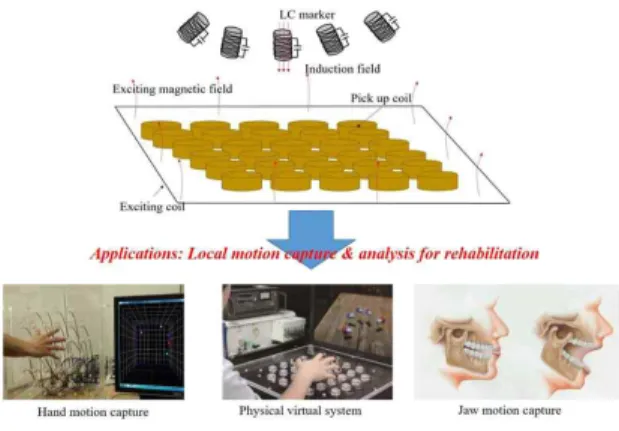
Typically, motion capture and analysis systems have been widely used in rehabilitation and large-scale motion analysis. In general, motion capture systems utilize vision cameras and markers for large spaces; however, they are generally high in price and influenced by their environment, such as by the brightness of a room. To avoid these issues, magnetic sensing has been proposed[17]. However, magnetic sensing utilizes wired controls to acquire data from the magnetic sensors, which restricts movement. Thus, a wireless magnetic-sensing system is more suitable for motion capture[18].
A wireless magnetic-sensing system requires LC markers, a pick-up coil array, an exciting coil, and a data acquisition system, as shown in Figure 6. The LC marker consists of a ferrite core with a wound coil and a capacitor for LC resonance. The LC markers are excited by the resonance frequency of the exciting coil, which uses electromagnetic induction. Thus, the induced resonance frequency of the LC marker also excites the pick-up coil, and the induced signals in the pick-up coil are acquired by the data acquisition system.
Figure 6 shows a hand motion capture system and its application using a wireless magnetic-sensing system. For hand motion capture, LC markers are attached on the fingertips without a vision camera or any other sensors. Therefore, the system remains unaffected by optical noise and brightness. Although the system is not suitable for large-scale motion capture because of the local magnetic field, it is suitable for the local motion capture of the body, such as the hands, jaw, etc.
그림 6. 무선 자기 센싱의 방법과 응용 원리
Fig. 6. Principle of a wireless magnetic sensing method and applications
3. Discussion and conclusion
Mechatronics is the integration of mechanical and electronical product development. While many researchers have developed magnetic micro-robots, micro-pumps, and sensor systems using external magnetic fields for medical and rehabilitation applications, their definitions of magneto-mechatronics differ according to their goals. This work defined the new research field of magneto-mechatronics as the synergistic integration of magnetic, mechanical, and electrical engineering.
All components based on magneto-mechatronics are controlled by an external gradient, alternating, and/or rotating magnetic field. This work analyzed wireless magnetic actuators and sensors for wireless blood pumps, medical micro-robot control methods, and wireless magnetic motion capture; the proposed wireless magnetic actuators are driven by the direct application of a rotating magnetic field for pump operation. In addition, synchronized actuation from 2-D rotation is applied in the functional blood pump, and 3-D rotation and converted linear motion from 2-D rotation is applied in robotic mechanisms relative to the increase in the DoF of motion and shape.
Thus, the developed actuators are classified according to the type of rotation.
For sensing systems, we utilized magnetic and electromagnetic induction based on Faraday’s law,
as wireless-sensing systems are not influenced by brightness and are applicable for local motion capture. In particular, the system utilizes a physical-to-virtual system that is useful in rehabilitation training and robotic and assistive devices. In addition, wireless magnetic actuators and sensors do not require electrical power generated by power cables. Further, as wireless magnetic solutions are applicable in relatively small spaces, magnetic phenomena have a high potential for use in biomedical and rehabilitation devices. Hence, these methods can be applied to local control, sensing, and analysis.
REFERENCES
[1] D. H. Kim, et al., Biofunctionalized magnetic-vortex microdiscs for targeted cancer-cell destruction, Nature Materials 9, 165-171, 2010.
[2] C. Chappert, A. Fert, and F. N. Van Dau, The emergence of spin electronics in data storage, Nature Materials 6, 813-824, 2007.
[3] R. Hergt, S. Dutz, R. Muller, and M. Zeisberger, Magnetic particle hyperthermia: nanoparticle magnetism and materials development for cancer therapy, Journal of Physics: Condensed Matter 18, 2919-2934, 2006.
[4] G. Dogangil, O. Ergeneman, J. J. Abbott, S.
Pane, H. Hall, S. Muntwyler, and B. J. Nelson, Toward Targeted Retinal Drug Delivery with Wireless Microrobots, IEEE/RSJ Int. Conf.
Intelligent Robots and Systems, 1921-1925, 2008.
[5] M. Sendoh, K. Ishiyama, K. I. Arai, Direction and individual control of magnetic micromachine, IEEE Transactions Magnetics 39, 3232-3234, 2003.
[6] S. Nishijima, F. Mishima, T. Terada, S. Takeda, A study on magnetically targeted drug delivery system using superconducting magnet, Physica C:
Superconductivity and its applications 1311, 463-465, 2007.
[7] D. R. Reyes, D. Iossifidis, P. A. Auroux, and A.
Manz, Micro total analysis systems. 1.
Introduction, theory, and technology, Analytical Chemistry 74, 2623-2636, 2002.
[8] K. Belharet, D. Folio, and A. Ferreira, Endovascular navigation of a ferromagnetic
microrobot using MRI-based predictive control, IEEE/RSJ International Conference on Intelligent Robots and Systems, 2804-2809, 2010.
[9] N. Kyura and H. Oho, Mechatronics – An individual perspective, IEEE/ASME Transactions on Mechatronics 1, 10-15, 1996.
[10] T. Mori, Mechatroincs, Yasakawa Internal Trademark Application Memo 21, 1, 1969.
[11] F. Harashima, M. Tomizuka, and T. Fukuda, Mechatronics – “What is it, Why, and How?, IEEE/ASME Transactions on Mechatronics 1, 1-4, 1996.
[12] S. M. Song, C. H. Yu, K. Kim, J. J. Kim, W.
K. Song, C. U. Hong, T. K. Kwon, Evaluation of human body effects during activities of daily living according to body weight support rate with active harness system, Journal of rehabilitation welfare engineering & assistive technology 10, 47-57, 2016.
[13] S. M. Song, C. H. Yu, K. Kim, J. J. Kim, W.
K. Song, C. U. Hong, T. K. Kwon, Study on lower extremities activities pattern of ADL and treadmill gait according to harness body-weight support percentages, Journal of rehabilitation welfare engineering & assistive technology 9, 319-329, 2015.
[14] S. H. Kim, S. Hashi, K. Ishiyama, Actuation of novel blood pump by direct application of rotating magnetic field, IEEE Transactions Magnetics 48, 1869-1874, 2012.
[15] H. Choi, J. Choi, S. Jeong, C. Yu, J. O. Park and S. Park, Two-dimensional locomotion of a microrobot with a novel stationary electromagnetic actuation system, Smart Materials and Structures 18, 115017, 2009.
[16] S. H. Kim, C. H. Yu, K. Ishiyama, Tiny magnetic wireless pump: Fabrication of magnetic impeller and magnetic wireless manipulation for blood circulation in legs, Journal of Applied Physics 117, 17B311 2015.
[17] T. Molet, Z. Huang, R. Boulic, D. Thalmann, An Animation Interface Designed for Motion Capture, Computer Animation 97, 77-85, 1997.
[18] S. Hashi, M. Toyoda, S. Tanukami, K. Ishiyama, Y. Okazaki, K. I Arai, Wireless Magnetic Motion Capture System for Multi-Marker Detection, IEEE Transactions on Magnetics 4, 3279-3281, 2006.
유 창 호(Chang Ho Yu) 2016년 4월 - 현재 전북대학교 융
합기술공학과 조교수 2012년 4월 - 2016년 3월 전북대
학교 바이오메디컬공학부 연구교수
2012년 3월 일본 동북대학교 의공 학과 졸업(박사)
Interest: Rehabilitation Engineering, Hemodynamics, Biomechanics, Healthcare & Wellness devices, Sport Science, Biomechanics
김 성 훈(Sung Hoon Kim) 2015년 3월 - 현재 원광대학교 전
자융합공학과 조교수 2012년 4월 – 2015년 2월 일본 동
북대학교 조교수
2012년 3월 일본 동북대학교 전기 통신공학과 졸업(박사) 2010년 4월 –2012년 3월 일본
JSPS특별연구원 Interest: Bio & magneto-mechatronics,
Medical devices, Magnetic actuators and sensors, Biorobotics