3년산 북방전복,
Haliotis discus hannai
의 해상가두리 양성 시 적정 수용밀도이시우, 김병학, 김태익, 손맹현 국립수산과학원 남서해수산연구소
Optimum Stocking Density of 3-year-old Pacific Abalone, Haliotis discus hannai Reared in Net Cage Culture
Si-Woo Lee, Byeong-Hak Kim, Tae-Ik Kim and Maeng-Hyun Son
Southwest Sea Fisheries Research Institute, NFRDI, Yeosu 556-823, KoreaABSTRACT
The effects of different stocking densities on the growth and survival rate of the 3-year-old pacific abalone, Haliotis
dicus hannai were investigated in marine net cage for a year. Stocking densities in net cage (2.4 × 1.2 m) was set15, 30, 45 and 60 percentage (= per)/sq m (square meter, m
2) with share to cross-sectional area per shelter. The water temperature during the testing period was 8.2℃-22.1℃, and salinity is 33.5 ± 0.6 psu, and dissolved oxygen is 7.87 ± 0.86 mg/L. In the shell length (initial size : 71.50 ± 2.28 mm) growth and shell breadth (initial size : 46.43
± 2.28 mm) of the test abalones, the absolute growth rate (ARG), daily growth rate (DGR) and specific growth rates (SGR) of the 15 per/sq m and 30 per/sq m were higher than those of 45 per/sq m and 60 per/sq m density group (P < 0.05). Also in the weight (initial weight : 35.7 ± 8.1 g), it showed the same results. In survival rates, it were that 15 per/sq m and 30 per/sq m is significantly higher than 45 per/sq m and 60 per/sq m. Therefore, it was that the 15 per/sq m is optimized stocking density in marine net cages about the 3-year-old pacific abalone over 70 mm size. The result shown that total cross-sectional area under the shelter is based on 15 per/sq m (2.4 × 2.4 m, 354 number in a net cage) is suitable for fast growth and survival. But if the economy consider, optimized stocking density would be appropriate to accept 30 per/sq m (2.4 × 2.4 m, 710 number in a net cage).
Keywords: 3-year-old Abalone, Haliotis discus hannai, Stock density, Marine net cage culture, Growth
performance, Survival rate
서 론
전복류는 한국, 중국, 일본 등 아시아에서 중요한 수산식품 으로서, 국내에서는 1970년대부터 인공종묘생산기술이 연구되 어 1980년대부터 종묘생산기술을 보급함으로서 본격적으로 시작되었으며 (한, 1998), 2014년 국내 전복생산량은 8,928
톤, 생산금액은 2,968억 원에 이르고 있다 (KOSIS, 2015).
앞으로도 전복류는 아시아를 중심으로 지속적인 소비 증가가 예상되고 있어 안정적인 생산량 확보와 증대가 요구되고 있다.
이런 요구에 따라 정부에서는 2011년부터 전복류를 수산물수 출 전략품목 육성사업으로 선정하여 지원하고 있으며 (국립수 산과학원, 2015a), 국립수산과학원에서는 북방전복 (Haliotis discus hannai) 을 중심으로 생산량 향상을 위한 연구가 2012년부터 진행하고 있다 (국립수산과학원, 2015b).
전복류를 생산하는데 있어 하나의 사육시설에서 다양한 요 인이 작용한다 (Mgaya and Mercer, 1995). 전복류는 유수량 (Fleming et al., 1997; Higham et al., 1998; Wassnig et al., 2010), 수심 (Liu and Chen, 1999), 수질다양성과 용존 산소 (Leitman, 1992; Harris et al., 1999), pH (Harris et al., 1998a), 질소노폐물 (Harris et al., 1998b), 먹이공급량 과 질 (Hooker and Morse, 1985; La Touche et al., 1993;
Received: June 23, 2015; Revised: June 25, 2015;
Accepted: June 29, 2015
Corresponding author : Son, Maeng-Hyun Tel: +82 (61) 690-8970 e-mail: [email protected] 1225-3480/24571
This is an Open Access article distributed under the terms of the Creative Commons Attribution Non-Commercial License with permits unrestricted non-commercial use, distribution, and reproducibility in any medium, provided the original work is properly cited.
Mercer et al., 1993; Fleming et al., 1998; Tahil and Juinio-Menez, 1999), 수조시설 (Hindrum et al., 1995;
Loipersberger, 1997), 수용밀도 (Koike et al., 1979;
Flassch and Aveline, 1984) 에 따라 성장과 생산량에 영향 을 준다. 특히 수용밀도는 수산양식에 있어 성장에 영향을 주 는 것이 오랫동안 증명되어 왔으며 (Ahmed et al., 2013), 전 복과 복족류에도 성장에 직접적인 영향을 미친다는 다양한 연 구가 보고되고 있다 (Koike et al., 1979; Peck, 1983;
Flassch and Aveline, 1984; Parsons and Dadswell, 1992; Mgaya and Mercer, 1995; Capinpin et al., 1999;
Fermin and Buen, 2001; Park et al., 2008; Lloyd and Bates, 2008). 또한 수산양식에 있어 수용밀도는 양식생산의 단가절감, 효율적인 양식과 경영면에서 필수적이며 (Yoon et al., 2004), 전복류와 같은 고착성 동물에게 있어서는 수용밀 도로 인한 제한적인 먹이와 공간으로 밀도 의존적 성장 (density-dependent growth) 이 나타나 (Ahmed et al., 2013), 효율적인 양식생산을 위해서 수용밀도는 고려되어야 할 중요한 요인이다. 또한 국내 연안의 제한적인 양식면적으로 대량생산을 위해서는 고밀도 양식이 필요한 곳에서는 양식 대 상종의 크기별 또는 시기별 적정 수용밀도를 구명하는 것은 생 산성 향상을 위해서는 필수적이라 할 수 있다.
전복류는 어류와 달리 바닥면에 부착 후 먹이를 섭취하는 동 물로서 서식범위가 부착될 수 있는 면적으로 한정되어 있어 부 착될 수 있는 공간이 확보되어야 한다.따라서 어류를 사육하는 개념으로는 적정 수용밀도를 산출하기는 어렵고, 부착면적을 기준으로 밀도를 적절히 조절하여 사육하는 것이 바람직하다 (한, 1998; Kim et al., 1998; 2013; 2014). 특히 북방전복을 중심으로 출하 크기까지 성장시키는 해상가두리에서는 그물 외에 단단히 부착될 수 있는 은신처 (shelter) 로 부착면적이 한정될 수 있으며, 가변적이지만 먹이로 공급되는 해조류 자체 에 북방전복이 부착할 수 있어 해상가두리 내 적정수용밀도에 대한 다각적인 연구가 필요하다.
국내에 수용밀도에 따른 전복류 양성에 관한 연구로는 1년 산과 2년산 북방전복치패의 해상가두리와 실내 육상수조 내 적정 수용밀도 및 연구 (Kim et al., 2013; 2014), 해상가두리 내 사육밀도에 따른 성장과 생존율 (Yoon et al., 2004), 수하 식 양성 (채롱) 에 의한 참전복 치패의 수용밀도와 성장 (Jee et al., 1988), 참전복 치패 성장에 미치는 수조형태 및 사육밀 도 (Jeong et al., 1994) 그리고 폐쇄 순환 여과 시스템에서의 전복 치패 사육밀도와 성장 (Park, 1995) 등의 연구가 보고되 고 있다. 그러나 기존 연구는 치패와 중간육성 크기를 중심으 로 한 수용밀도 연구로 한정되어 있으며, 특히 해상가두리에서 는 북방전복이 최대 2년산까지의 적정 수용밀도만 보고되어 있어 (Yoon et al., 2004; Kim et al., 2014), 만 3년 이상 사
육된 출하 크기의 북방전복의 해상가두리 내 적정 수용밀도에 따른 연구는 미흡한 실정이다. 특히 3년 이상 사육된 북방전복 은 높은 가격으로 거래되어 고수익을 보장할 수 있지만 매년 성패를 중심으로 한 폐사율 증가로 다년간 사육한 전복상품 생 산을 기피하고 있어 3년 이상 장기간 사육된 전복의 생존율 향 상을 위한 연구가 필요하다.
따라서 본 연구는 3년산 북방전복의 해상가두리 내 생산성 을 향상시키기 위해 성장에 중요한 요인인 적정수용밀도를 구 명하고자, 완도에 위치한 해상가두리에서 1년 동안 양식어업인 이 시행하는 양식순기를 기준으로 3년산 북방전복의 수용밀도 를 설정하여 성장 및 생존율 조사하였다.
재료 및 방법
1. 실험시설 및 생물
해상가두리 실험은 2014년 4월부터 2015년 4월까지 약 12 개월 (365일) 동안 전남 완도군 노화읍 삼마리 앞바다에 설치 된 해상가두리에서 실시하였다. 3년산 북방전복은 2011년에 종묘 생산하여 3년간 가두리에서 양성된 전복 (각장 평균 71.50 ± 0.74 mm, 평균 중량 35.6 ± 8.1 g) 을 실험에 사용 하였다. 실험가두리는 전남 완도군 연안에서 주로 사용되는 PE (polyethylene) 전복 해상가두리 (2.4 × 2.4 m) 를 PE 그물 (36합16절) 로 반으로 나눈 실험가두리 (1.2 × 2.4 m) 를 사용하였다. 또한 PC (polycarbonate) 재질로 셀터 (Shelter, 100 × 90 cm) 를 각 가두리 당 3개씩 설치하여 연 결된 것을 사용하였으며, 셀터의 총 단면적은 2.7 m2로 하였 다.
2. 실험구 설정
실험구의 수용밀도는 Kim et al. (1998; 2013; 2014) 및 Yoon et al. (2004) 결과를 참고로 아래 식에 따라 산출하였다.
수용밀도 (%) = 전복 점유면적 (m2) / 전복 shelter 단면적 (m2) 전복점유면적 (%/m2) = (각장 × 각폭) × 0.7 × 수용개체 수
실험구는 셀터 단면적당 점유율 (percentage (%)/square meter (m2), per/sq m)로 하여 15 per/sq m, 30 per/sq m.
45 per/sq m, 60 per/sq m로 설정하였다. 각 실험구당 3년산 전복을 177 (15 per/sq m), 355 (30 per/sq m), 533 (45 per/sq m) 및 710 (60 per/sq m) 마리를 수용하였으며 모든 실험구는 2반복으로 실시하였다.
3. 먹이공급 및 환경조사
실험 기간 중 먹이 공급은 완도지역 전복 해상가두리 양식어
업인과 동일한 방법으로 3월부터 9월까지는 생다시마, 9월부 터 10월까지는 소량의 건다시마 및 염장미역 그리고 11월부터 2014년 4월 실험 종료 시까지 생미역을 공급하였다. 먹이 공 급량은 일간공급율이 전복 총 중량의 10% 이상 되도록 충분히 공급하였다.
실험기간 중의 사육수온은 자연수온에 의존하였고 매월 중 순에 수온과 염분, 용존산소를 수질측정기 (YSI-85, Yellow Springs Instruments Inc., Ohio, USA) 로 측정하였다.
4. 성장 및 생존율
성장 조사는 실험개시 시에는 실험전복 100마리를 무작위로 선택하여 각장 (shell length), 각폭 (shell breadth), 총 중량 (total weight) 을 측정하였다. 매월 중순에 각 실험구 당 30 마리를 무작위로 체포하여 각장, 각폭을 측정하였으며, 실험 종료 시에는 30마리의 각장, 각폭과 총 증량을 측정하였다. 각 장과 각폭은 디지털 버니어 켈리퍼스를 이용하여 0.01 mm까 지 측정하였고, 총 중량은 디지털 이동식 저울 (MW-II, AND Korea co. ltd., Chungcheongbuk-do, Korea) 을 이용하여 0.1 g까지 측정하였다. 각 실험구의 총 중량을 각장을 이용하 여 아래 식에 따라 절대성장률 (absolute growth rate, ARG), 일간성장률 (daily growth rate, DGR), 순간성장률 (specific growth rate, SGR) 을 산출하였고, 각폭 역시 각장 과 같은 방식으로 ARG, DGR, SGR을 산출하였다. 측정된 전 중은 증중률 (weight gain, WG), 일간 증중율 (daily weight gain, DWG), 순간증중율 (specific weight gain, SWG) 을 산출하였다.
절대성장율 (AGR, %) = (Le – Li) / Li × 100 또는 (We – Wi) / Wi × 100
일간성장율 (DGR, %/day) = (Le – Li) / (T - t) × 100 또는 (We – Wi) / (T - t) × 100
순간성장율 (SGR, %/day) = (lnLe – lnLi) / (T - t) × 100 또는 (lnWe – lnWi) / (T - t) × 100
증중률 (WG, %) = (We – Wi) / Wi × 100
일간중증률 (DWG, %/day) = (We – Wi) / (T - t) × 100 순간증중율 (SWG, %/day) = (lnWe – lnWi) / (T - t) × 100
여기서, Le과 Li는 각각 최종평균각장과 최초평균각장, We와 Wi는 각각 최종평균각폭와 최초평균각폭이며, We와 Wi는 각각 최초평균중량과 최종평균중량을 나타낸다. (T - t) 는 사육일수 를 나타낸다.
또한 생존율 (survival rate, SR) 은 아래식을 이용해 산출 하였다.
생존율(SR, %) = (Ni – Ne) / NI × 100
여기서, Ne와 Ni는 각각 최종생존개체수와 최초생존개체수 를 나타낸다.
5. 통계처리
성장 및 생존율 실험 결과는 2회 반복한 평균치로 나타내었 으며, 통계프로그램인 SPSS (Statistical Package for Social Sciences) PASW Base ver. 21 (IBM Co. Ltd., New York, USA) 를 이용하여 one way ANOVA를 P <
0.05 수준에서 실시하였으며, 유의성이 나타난 결과에 대해서 는 Duncan`s multiple range test (Duncan, 1955) 로 평균 간의 유의성을 사후 검정하였다.
결 과
1. 환경 (수온, 염분, 용존산소) 변화
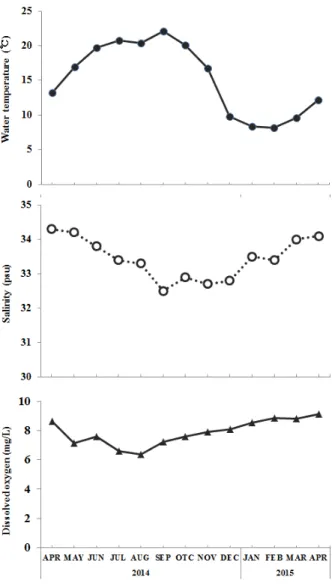
3년산 북방전복을 전라남도 완도 노화읍 연안 해상가두리에 서 서로 다른 수용밀도로 사육하는 1년 동안 매월 수온, 염분, 용존산소 변화를 Fig. 1에 나타내었다. 수온에서 2014년 12월 부터 2015년 3월까지는 저수온기로 8-10℃ 범위였으며, 2015 년 2월에 8.2℃로 최저 수온을 나타내었다. 고수온기는 2014 년 7월부터 9월까지로 20-22℃ 범위이었으며, 최고 수온은 9 월에 22.1℃로 나타났다. 사육기간 동안 염분은 평균 33.5 ± 0.6 psu으로 2014년 9월이 32.5 psu로 최저 염분으로 나타 났고, 2014년 4월이 34.3 psu로 최고 염분을 나타내었다. 용 존산소에서는 사육기간 동안 평균 7.87 ± 0.86 mg/L로 2014 년 8월이 6.34 mg/L로 최저 농도를 보였고, 2015년 4월이 9.1 mg/L로 최고 농도를 나타내었다.
2. 성장특성
3년산 북방전복을 해상가두리에서 서로 다른 수용밀도로 수 용하여 1년간 사육한 월별 각장변화는 Fig.2에 나타내었다. 양 성 1개월인 2014년 5월부터 15 per/sq m, 30 per/sq m가 45 per/sq m, 60 per/sq m보다 높게 나타났으나 2014년 6월 까지 유의적 차이는 없으며, 양성 3개월차인 2014년 7월부터 양성 7개월차인 2014년 10월까지 15 per/sq m, 30 per/sq m가 45 per/sq m, 60 per/sq m보다 유의적으로 높았다 (P
< 0.05). 이후 2014년 11월부터 2015년 3월까지 유의적 차이 가 없었으며, 2015년 4월에 다시 15 per/sq m, 30 per/sq m 가 45 per/sq m, 60 per/sq m보다 유의적으로 높게 나타났다 (P < 0.05).
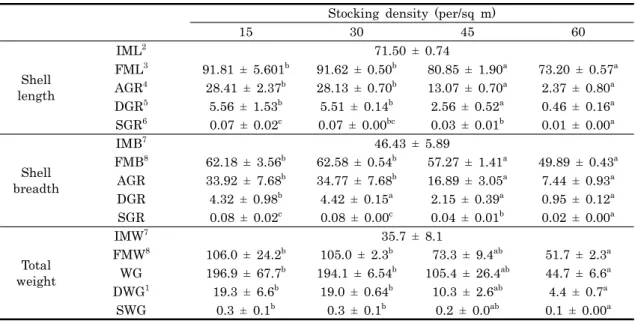
각장과 각폭, 중량에 대한 성장특성은 Table 1에 나타내었 다. 각장의 FML, AGR, DGR, SGR의 15 per/sq m와 30
per/sq m는 유의적 차이가 없었으며, 45 per/sq m, 60 per/sq m보다 높았다 (P < 0.05). 각폭에 대한 FML, AGR, DGR, SGR에서도 15 per/sq m, 30 per/sqr는 각각 45 per/sq m, 60 per/sq m보다 유의적으로 높았으며, 특히 60 per/sq m는 모든 실험구보다 낮았다 (P < 0.05). 중량에 대한 FMW, WG, DWG, SWG에서도 15 per/sq m와 30 per/sq m, 45 per/sq m는 유의적 차이가 없었으며, 15 per/sq m와 30 per/sq m는 60 per/sq m보다 유의적으로 높았다 (P <
0.05).
3. 생존율
3년산 북방전복을 해상가두리에서 서로 다른 수용밀도로 수 용하여 1년간 사육 후 생존율은 Fig. 3에 나타내었다. 15
per/sq m가 60%이상으로 모든 실험구보다 유의적으로 높았 고 (P < 0.05), 30 per/sq m 역시 생존율이 50%를 보이면서 45 per/sq m와 60 per/sq m보다 유의적으로 높았으며 (P <
0.05), 45 per/sq m와 60 per/sq m는 유의적 차이가 없었다.
고 찰
본 연구는 완도군 노화읍 해상가두리에서 3년산 북방전복을 2014년 4월부터 2015년 4월까지 1년간 양식순기에 따라 서 로 다른 수용밀도로 사육하였으며, 성장이 집중되어 있는 5월 부터 10월까지의 사육 환경은 수온이 18-22℃사이였으며, 염 Fig. 1. Monthly changes of water temperature, salinity and
dissolved oxygen in net cage culture during experiment period.
Fig. 2. Changes of shell length (mm) of 3-year-old abalone, Haliotis discuss hannai reared with different stocking density in net cage culture for a year. *Spuare meter (m2)
Fig. 3. Survival rate (%) 3-year-old abalone, Haliotis discuss hannai reared with different density in net cage culture for a year. Bar indicates standard deviation (n = 2). Bars with different letter differ significantly (P < 0.05).
분은 32-33 psu, 용존산소는 6-8 mg/L로 나타났다. Sakai (1962) 는 북방전복이 수온에 따른 일간섭식률에 차이를 보 여 성장에 영향을 주게 되고 보통 7℃ 이하에서는 먹이 활동 이 둔해지며 성장 적수온은 20℃전후라고 보고하였다. 또한 Yoo et al. (2004) 은 해상가두리에서 1년간 사육한 북방전복 역시 수온 18-22℃의 수온기간 동안 용존산소는 6.50-7.35 mg/L이었으며, 이 시기에 높은 일간성장율을 보고하였다.
Kim et al. (2013; 2014) 도 해상가두리에서 수온 20℃ 전후 에서 높은 각장 성장과 성장률을 보고하여 본 연구와 일치하 는 결과를 나타내었다. 또한 Shin et al. (2011) 은 북방전복 의 염분 내성은 20.1-28.2 psu의 염분내성범위를 가지며, 20.1 psu이상이면 생리적인 활동이 유지된다고 보고하여 본 연구에서 나타나 염분 농도는 전복 생리적 대사에 영향을 주 지 않은 것으로 보인다.
개방형 환경 (open sea environment) 에서 사육되는 전복
의 경우 폐쇄적인 환경보다 환경 조건이 성장률에 유의적인 영 향을 주지 않으며, 가두리와 같은 개방형 환경은 높은 수온과 다양한 수질변화로 인한 유리한 사육 조건을 가지고 있어 높은 수용밀도에도 개방된 환경 때문에 수질악화가 가속화되지 않 는다 (Wu et al., 2009). 그러므로 개방형 환경에서는 폐쇄적 환경과 같이 고밀도 수용으로 인해 사육수의 암모니아와 용존 산소의 변화로 전복류 성장에 영향을 주지 않을 수 있다 (Harris et al., 1999; Huchette et al., 2003b). 그러나 Wu et al. (2009) 은 북방전복이 개방형 환경에서도 전복 성장에 유의적인 영향을 있다고 보고하였고, McShane and Naylor (1995) 이 개방된 환경에서 사육한 Haliotis iris 밀도 의존적 성장에서 차이가 없다고 보고한 기존 연구와 상반된 결과가 나 타난 것은 낮은 수용밀도 (0.3-15 개체/m2, 전장 = 22-165 mm) 에 의한 것으로 설명될 수 있다고 하였다. 가두리와 같은 개방형 환경 내에서 내 수용밀도 증가로 성장률에 부정적인 영 Stocking density (per/sq m)
15 30 45 60
Shell length
IML2 71.50 ± 0.74
FML3 91.81 ± 5.601b 91.62 ± 0.50b 80.85 ± 1.90a 73.20 ± 0.57a AGR4 28.41 ± 2.37b 28.13 ± 0.70b 13.07 ± 0.70a 2.37 ± 0.80a DGR5 5.56 ± 1.53b 5.51 ± 0.14b 2.56 ± 0.52a 0.46 ± 0.16a SGR6 0.07 ± 0.02c 0.07 ± 0.00bc 0.03 ± 0.01b 0.01 ± 0.00a
Shell breadth
IMB7 46.43 ± 5.89
FMB8 62.18 ± 3.56b 62.58 ± 0.54b 57.27 ± 1.41a 49.89 ± 0.43a AGR 33.92 ± 7.68b 34.77 ± 7.68b 16.89 ± 3.05a 7.44 ± 0.93a DGR 4.32 ± 0.98b 4.42 ± 0.15a 2.15 ± 0.39a 0.95 ± 0.12a SGR 0.08 ± 0.02c 0.08 ± 0.00c 0.04 ± 0.01b 0.02 ± 0.00a
Total weight
IMW7 35.7 ± 8.1
FMW8 106.0 ± 24.2b 105.0 ± 2.3b 73.3 ± 9.4ab 51.7 ± 2.3a WG 196.9 ± 67.7b 194.1 ± 6.54b 105.4 ± 26.4ab 44.7 ± 6.6a DWG1 19.3 ± 6.6b 19.0 ± 0.64b 10.3 ± 2.6ab 4.4 ± 0.7a
SWG 0.3 ± 0.1b 0.3 ± 0.1b 0.2 ± 0.0ab 0.1 ± 0.00a
1Values (mean ± S.D of two replications) with a different Superscripts within the same row are significantly different (P < 0.05).
2Initial mean shell length. Unit is mm
3Final mean shell length. Unit is mm
4Absolute growth rate. Unit is %
5Daily growth rate. Unit is %/day
6Specific growth rate. Unit is %/day
7Initial mean shell breadth. Unit is mm
8Final mean shell breadth. Unit is mm.
9Initial mean total weight. Unit is g.
10Final mean total weight. Unit is g.
11Weight gain. Unit is %.
12Daily weight gain. Unit is %/day.
13Specific weight gain. Unit is %/day.
Table 1. Growth performance of shell length, shell breadth and total weight of 3-year-old abalone, Haliotis discuss hannai reared with different density in net cage culture for a year
향을 주는 연구는 북방전복을 포함한 다양한 전복류에서도 보 고되고 있다 (Jee et al., 1988; Mgaya and Mercer, 1995;
Capinpin et al., 1999; Yoon et al., 2003; Viera et al., 2014; Kim et al., 2013; 2014). 본 연구에서도 3년산 북방전 복을 부착면적의 45%이상의 고밀도로 수용한 해상가두리보다 30%이하로 수용한 해상가두리에서 높은 성장효과가 확인되어 기존 연구와 일치하였다. 즉 가두리와 같은 개방된 환경 역시 과도한 수용밀도는 성장에 영향을 미칠 수 있으며 오히려 Wu et al. (2009) 의 전복 수용밀도 (7.04 % - 11.65 %) 보다 면 적대비 수배이상 높게 수용한 본 연구에서는 3년산 전복을 60% 수용한 해상가두리는 성장지표에서 30%이하를 수용한 해상가두리와 비교해 각장의 절대성장률 (AGR) 과 일간성장 율 (DGR) 에서 10배 이상의 성장차이를 보였다. Wu et al.
(2009) 은 30-40 mm 북방전복의 수용밀도에 대한 각장의 일 간성장율 (DGR) 이 고밀도 수용구가 저밀도 수용구보다 낮았 으나 그 차이는 최대 2배 정도였으며, Kim et al. (2014) 이 36 mm에서 55 mm의 1-2년산 북방전복을 해상가두리에서 다른 수용밀도로 사육하였을 때, 저밀도 수용구 (15, 30
%/m2) 와 고밀도 수용구 (45. 60 %/m2) 의 각장에 대한 AGR 과 DGR이 15%정도를 나타내었다. 또한 Viera et al. (2014) 는 30 mm 이상의 Haliotis tuberculata coccinea (Reeve) 를 결합형 전복 (또는 어류) 연안 해양양식 시설 (Combined fish/abalone offshore mariculture system) 에서 고밀도 (60 개체/m2) 와 저밀도 (30 개체/m2) 로 24주동안 사육 시 각장의 일간 성장 (daily growth, DG) 은 고밀도가 15%정도 낮은 수준으로 보고하여 본 연구와 고밀도와 저밀도간의 성장 에서 큰 차이를 보였다. 이러한 결과는 3년이상 사육된 70 mm이상의 북방전복을 해상가두리와 같은 개방형 환경에서 사 육 시 30-50 mm의 크기의 1-2년된 북방전복 또는 다른 전복 류보다 수용밀도에 대한 영향이 큰 것으로 보여진다. 전복류를 포함하여 패류 양식에서 수용밀도의 증가는 성장률이 감소될 수 있지만 (Koike et al., 1979; Peck, 1983; Hadley and Manzi, 1984; Allan and Maguire, 1992; Parsons and Dadswell, 1992; Holliday et al., 1993; Mgaya and Mercer, 1995), 石田 (1993) 은 북방전복을 사육하는 데 있어 종묘의 질, 질병, 수온, 수질, 사료의 질 및 사육밀도 등도 중요 한 요인으로 작용하고, 특히 수용밀도는 제한된 사육수조에서 한계생물체량을 파악하고 적정 수용밀도를 정확히 구명하는 것은 수온, DO 등의 수질환경적인 요인과 개체크기, 건강상태 등의 생물적인 요인 그리고 사육 환경에 대한 스트레스 (사육 수조 크기, 형태, 유수량, handling) 도 영향을 주기 때문에 쉽게 결정되기 어렵다고 하였다. 하지만 사육수조의 부착면적 이 작을수록 수용된 생물의 활동 범위가 좁아지고 결국 개체간 공간 및 먹이경쟁이 스트레스 상승으로 이어지면서 전복류의
성장저하를 유발 시킬 수 있다 (Foster and Stiven, 1996;
Hechette et al., 2003a; Lloyd and Bates, 2008). 즉 본 연 구에서 사용된 3년산 대형 전복들도 최초 수용 시부터 개체당 부착필요면적이 평균 30 cm2 이상이 필요하면서 고밀도의 수 용 시에는 각장 30 mm-50 mm 크기보다 성장에 따른 부착면 적이 빠르게 잠식되면서 공간과 먹이경쟁이 소형이나 중형크 기의 전복보다 장기화되면서 스트레스가 증가해 각장 성장이 저하되고 결국 성장률에서 높은 차이가 발생된 것으로 보인다.
또한 본 연구에서 고밀도 수용으로 나타난 성장저하 외에도 생 존율에서 저밀도 수용구 (15 per/sq m, 30 per/sq m) 가 고 밀도 수용구 (15 per/sq m, 30 per/sq m) 와 비교해 3배 이 상의 높은 생존율을 보여 수용밀도가 전복류 생존에는 영향을 미치지 않는다는 기존 연구보고 (Mgaya and Mercer, 1995;
Nie et al., 1996; Capinpin et al., 1999; Jarayabhand et al., 2010; Viera et al., 2014) 와 다른 결과를 보였으며 먹이 와 사육환경 조건에서 차이가 없는 만큼 결국 고밀도 수용으로 인한 스트레스가 폐사를 발생시키면서 생존율 차이에 직접적 인 영향을 준 것으로 보인다. 따라서 3년산 북방전복의 해상가 두리 사육 시 적정 밀도를 수용하는 것은 1-2년산보다 필요하 며 대형 크기에 대한 폐사량 저감과 생산량 향상에 중요한 요 인이 될 수 있다. 특히 3년 이상 사육된 북방전복은 산란활동 이 활발하여 산란기 이후 체력저하 및 영양결핍이 나타나고, 수컷에서 방출된 정충 즁 수정되지 못한 대부분의 개체들이 가 두리 내에서 패각에 부착되어 고수온기에 부패되면서 수질악 화로 이어져 (MOF and KIMST, 2014), 고밀도 수용 시 급 격한 대량 폐사가 발생될 수 있어 3년 이상 사육된 북방전복의 수용밀도 조정은 필수적으로 이루어져야 한다.
본 실험결과 70 mm 이상의 3년산 북방전복의 해상가두리 양식에 적정 수용밀도는 1년 양성기간 동안 셀터 총 단면적 기준으로 15 per/sq m (2.4 × 2.4 m, 1칸 당 354마리) 가 빠 른 성장과 생존율을 위한 적정한 수용밀도로 나타났지만, 경제 성을 고려할 경우 30 per/sq m (2.4 × 2.4 m, 1칸 당 710마 리) 수용하는 것이 적정할 것으로 판단되며 산란기와 고수온 기에 고밀도 사육 시 대량폐사가 발생될 수 있어 적정 수용밀 도를 유지하는 것이 필요하다. 아울러 전복 가두리양식 생산성 향상을 위해서는 가두리 내 셀터 단면적을 높여 전복 수용력을 증대시키고 조류 흐름 등을 개선하는 연구가 수행되어야 한다.
요 약
본 연구는 3년산 북방전복을 해상가두리에서 1년 동안 수용 밀도별로 양식순기에 따라 사육하여 성장 및 생존율 조사를 통 해 적정 수용밀도를 구명하고 생산성을 향상시키고자 수행하 였다. 해상가두리 (2.4 × 1.2 m) 내 수용밀도는 셀터 단면적
(square meter, m2, sq m) 당 점유율로 15, 30, 45, 60 percentage (= per)/sq m로 설정하여 2반복으로 실시하였다.
사육기간 동안 수온은 8.2℃-22.1℃, 염분은 평균 33.5 ± 0.6 psu, 용존산소는 평균 7.87 ± 0.86 mg/L이었다. 월별 각장변 화에서는 2014년 5월, 7월부터 10월, 2015년 4월에 15 per/sq m, 30 per/sq m가 45 per/sq m, 60 per/sq m보다 유의적으로 높았다 (P < 0.05). 각장의 FML, AGR, DGR, SGR과 각폭의 FMB, AGR, DGR은 15 per/sq m와 30 per/sq m는 45 per/sq m, 60 per/sq m보다 유의적으로 높았 고 (P < 0.05), 각폭의 SGR에서 60 per/sq m는 모든 실험구 보다 낮았다 (P < 0.05). 중량에 대한 FMW, WG, DWG, SWG에서도 같은 결과를 나타내었다 (P < 0.05). 생존율에서 는 15 per/sq m, 30 per/sq m가 50%이상으로 45 per/sq m, 60 per/sq m 보다 유의적으로 높았다 (P < 0.05). 따라서, 본 실험결과 70 mm 이상의 3년산 북방전복의 해상가두리 내 적 정 수용밀도는 셀터 총 단면적 기준으로 15 per/sq m (2.4 × 2.4 m, 1칸 당 354마리) 가 빠른 성장과 생존율을 위한 적정 수용밀도지만 경제성을 고려할 경우 30 per/sq m (2.4 × 2.4 m, 1칸 당 710마리) 수용해야 한다.
사 사
본 연구는 국립수산과학원 (전복 가두리양식 생산성향상 및 표준화 연구 15-AQ-51) 지원으로 수행되었습니다.
REFERENCES
Ahmed, F., Koike Y., Strüssmann C.A. and Watanabe S.
(2013) Effect of density on growth and feed consumption of the abalones Haliots discus discus, H. gigantea, H. madaka and their hybrids.
Aquaculture International, 21: 969-986.
Allan, G.L. and Maguire G.B. (1992) Effects of stocking density on production of Penaeus monodon Fabricius in model farming ponds. Aquaculture, 107: 49-66.
Capinpin, Jr. E.C., Toledo J.D., Encena II V.C. and Doi M. (1999) Density dependent growth of the tropical abalone Haliotis asinina in cage culture.
Aquaculture, 171: 227-235.
Duncan, D.B. (1955) Multiple range and multiple F-tests. Biometrices, 11: 1-42.
Fermin, A.C. and Buen S.M. (2001) Feeding, growth and survival of abalone (Haliotis asinina Linnaeus 1758) reared at different stocking densities in suspended mesh cages in flow-through tanks. Philippines Science, 39: 31-41.
Flassch, J.P. and Aveline C. (1984) Production de jeunes ormeausx à la station expérimentale d’ Argenton.
Publ. C.N.E.X.O. Rapp. Scient. Tech., 50: 68.
Fleming A.E., Van Barneveld R.J., Hone P.W. Hone, Vandepeer M.E. and Kruk J.A. (1998) Complementary additivity of the digestibility coefficients of feed ingredients fed to juvenile greenlip abalone (Haliotis laevigata). Journal of Shellfish Research, 17: 641-647.
Fleming, A., Hone P., Higham J. (1997) The effect of water velocity on consumption and growth of green lip abalone in tanks. In: Hone P.W., Fleming A.
(eds) Proceedings of the 4th annual abalone aquaculture workshop, Port Fairy, Victoria, FRDC.
Canberra, Australia, pp. 16-23.
Forster, B.A. and Stiven A.E. (1996) Experimental effects of density and food on growth and mortality of the Southern Appalachian land Gastropod, Mesodon normalis (pilsbry). Am. Midl. Nat., 136:
300-314.
Hadley, N.H. and Manzi. J.J. (1984) Growth of seed clams, Mercenaria mercenaria, at various densities in a commercial seale nursery system, Aquaculture, 36:
369-378.
Harris, J.O., Maguire G.B. and Edward S.J. and Hindrum S.M. (1998a) Effect of pH on growth rate and oxygen consumption rate of juvenile greenlip abalone, Haliotis laevigata and blacklip abalone, Haliotis rubra. In: Hone P.W. (ed) Proceedings of the 5th abalone aquaculture workshop, Hobart, FRDC.
Canberra, Australia.
Harris, J.O., Maguire G.B. and Edward S.J. and Hindrum S.M. (1998b) Effect of ammonia on growth rate and oxygen consumption rate of juvenile greenlip abalone, Haliotis laevigata Donovan.
Aquaculture, 160: 259-272.
Harris, J.O., Maguire G.B. and Edwards S.J. (1999) Low dissolved oxygen reduces growth rate and oxygen consumption rate of juvenile greenlip abalone, Haliotis laevigata Donovan. Aquaculture, 174:
265-278.
Higham J., Hone P., clarke S. Baudinette R. and Geddes M. (1998). The effect of flow on growth in juvenile greenlip abalone, Haliotis laevigata (Donovan). In Hone P.W. (Ed.), Proceedings of the 5th annual abalone aquaculture workshop. Hobart. FRDC, Canberra, Australia, pp. 115-122.
Hindrum, S.M., Cropp M. and Maguire G.B. (1995) Evolution of abalone growth tank design at Marine Shellfish hatcheries, Bicheno, Tasmania. In:
Propceedings 2nd annual FRDC/CRC workshop on abalone culture, CSIRO Marine Laboratories, Hobart, FRDC, Canberra.
Holliday, J.E., Allan G.L. and Nell. J.A. (1993) Effects of stocking density for nursery culture of Sydney rock oysters (Saccostrea commercialis). Aquaculture, 96:
7-16.
Hooker, N. and Morse D.E. (1985) Abalone: the emerging development of commercial cultivation in the United States. In: Huner J.V. and Brown E.E.
(eds) Crustaceans and mollusk aquaculture in the United States. AVI Publishing co., Westport.
Huchette, S.M.H., Koh C.S. and Day W.R. (2003a) The effects of density on the behaviour and growth of juvenile blacklip abalone (Haliotis rubra).
Aquaculture International, 11: 411-428.
Huchette, S.M.H., Koh C.S. and Day W.R. (2003b) Growth of juvenile blacklip abalone (Haliotis rubra) in aquaculture tanks: effect of density and ammonia.
Aquaculture, 219: 457-470.
Jee, Y.J., YOO, S.K., Rho, S and Kim, S.H. (1988) The stocking density and growth of young abalone, Haliotis discus hannai Ino cultured in the hanging net cage. Bulletin of National Fisheries Research and Development Agency, 42: 59-69. (in Korean)
Jarayabhand, P., Kruiroongroj W. and Chaisanit C.H.
(2010) Effect of stocking density on growth performance of Thai abalone, Haliotis asinina, Linnaeus 1758, reared under a semiclosed recirculating land-based system. Journal of Shellfish Research, 29: 593-597.
Jeong, S.C., Jee, Y.T. and Son, P.W. (1994) Indoor tank culture of the abalone Haliotis discus hannai II.
Effects of diets on growth of young abalone. Journal of Aquaculture, 7: 77-87. (in Korean)
Kim, B.H., Lee, S.M., Go, C.S., Kim, J.W. and Myeong, J.I. (1998) Optimum stocking density of juvenile abalone (Haliotis discus hannai) fed formulated diet of macro-algae (Undaria). Journal of Korean Fisheries Society, 31(6): 869-874. (in Korean)
Kim, B.H., Park, M.W., Shon M.H., Kim T.I, Cho J.K.
and Myeong J.I. (2013). A Study on the Optimum Stocking Density of the Juvenile Abalone, Haliotis discus hannai net Cage Culture or Indoor Tank Culture. Korean Journal of Malacology, 29(3):
189-195. (in Korean)
Kim, B.H., Park M.W., Son M.H., Kim T.I. and Lee S.W. (2014) A Study on the Optimum Stocking Density of Abalone, Haliotis discus hannai, reared in Net Cage Culture. Korean Journal of Malacology, 30(3): 219-226. (in Korean)
KOSIS (2015) Korea National Statistical Office. KOSIS Statistical DB, Daejeon, Korea.
Koike, Y., Flassch, J.P. and Mazurier. J. (1979) Biological and ecological studies on the propagation of the ormer, Halotis tuberculata Linnaeus: II.
Influence of food and density on the growth of junveniles. La Mer., 17: 43-52.
La Touche, B., Moylan K. and Twomey W. (1993) Abalone on-growing manual. Aquacult Expl., 14: 39.
Leitman A. (1992) The effects of gas supersaturation on the behaviour, growth and mortality of red abalone, Haliotis rufescens (Swainson). In: Shepherd S.A., Tegner M.J., Guzman del. Proo. S.A. (eds) Abalone of the world: biology, fisheries and culture. Fishing New Books, Oxford.
Liu, K.M. and Chen W.K. (1999) Examining the effects of stocking density and depth on growth of intensive cultured abalone, Haliotis diversico,or supertexta Lischki, Journal of Fisheries Society. Taiwan, 26:
23-33.
Lloyd, M.J. and Bates A.E. (2008) Influence of density-dependent food consumption, foraging and stacking behaviour on the growth rate of the Northern abalone, Haliotis kamtschatkana.
Aquaculture, 277: 24-29.
Loipersberger, M. (1997) SAABDEV tank report. In:
Hone P.W. (ed) Proceedings of the 4th annual abalone aquaculture workshop, Port Fairy, Victoria, FRDC, Canberra, Australia.
McShane, P.E. and Naylor J.R. (1995) Density independent growth of Haliotis iris Martyn (Mollusca: Gastropoda). Journal of Experimental Marine Biology and Ecology, 190: 51-60.
Mercer, J.P., Mai K.-S. and Donlon J. (1993) Comparative studies on the nutrition of two species of abalone, haliotis tuberculata Linnaeus and Haliotis discus hannai Ino: I. Effects of algal diets on growth and biochemical composition. Invertebr Reprod. Dev., 23: 75-88.
Ministry of Oceans and Fisheries (MOF), Korea Institute of Marine Science & Technology Promotion (KIMST) (2014) Oecans and Fisheries Science & Technology Fair 2014. Ministry of Oceans and Fisheries : 283-293.
Nie, Z., Ji M. and Yan J. (1996) Preliminary studies on increased survival and accelerated growth of overwintering juvenile abalone, Haliotis discus hannai Ino. Aquaculture, 140: 177-186.
Park, J.H, Kim H.B, Kim P.K. and Jo J.Y. (2008) The growth of disk abalone, Haliotis discus hannai at different culture densities in a pilot-scale recirculating aquaculture system with a baffled culture tank. Aquacultural Engineering, 38: 161-170.
Park, M.E., Rho S. and Song C.B. (1995) Density Effect on the Growth of Juvenile Abalones (Haliotis discus hannai) Reared in the Closed Recirculating Water System. Bull. Mar. Res, Inst. Cheju Nat. Univ., 19:
93-102. (in Korean)
Parson, G.C. and Dadswell M.J. (1992) Effect of stocking density on growth, production and survival of the giant scallop, Placopecten magellanicus, held in intermediate suspension culture in Passamaquoddy Bay, New brunswick. Aquaculture, 103: 291-309.
Peck, L.S. (1983) An investigation into the growth and early development of the ormer, Haliotis tuberculata, L. Ph. D. Dissertation, Portsmouth Polytechnic, Portsmouth, UK.
Sakai, S. (1962) Ecological studies on the abalone, Haliotis discus hannai Ino – I. Experimental sudies on the food habit. Bulletin of the Japanese Society of Scientific Fisheries, 28: 766-779. (in Japenese)
Shin, Y.K., Jun J.C., Im J.H., Kim D.W., Son M.H. and Kim E.O. (2011) Physiological Responses in Abalone Haliotis discus hannai with Different Salinity.
Korean Journal of Malacology, 27(4): 283-289. (in Korean)
Tahil, A.S. and Juinio-Menez M.A. (1999) Natural diet, feeding periodicity and functional response to food density of th abalone, Haliotis asinina L.
(Gstropoda). Aquaculture Research. 30: 95-107.
Viera, M.P., Vicose G.C., Fernández-Palacios H. and Izquierdo M. (2014) Grow-out culture of abalone Haliotis teverculata coccinea Reeve, fed land-based IMTA produced macroalgae, in a combined fish/abalone offshore maricultre system: effect of stocking density. Aquaculture research, : 1-11.
Wassing, M., R. Roberts, R.D., Krshinich A. and Day R.W. (2010) Effects of water folw rate on growth rate, mortality and biomass return of abalone in slab tanks. Aquaculture Research, 41: 839-846.
Wu, F., Liu X., Zhang G. and Wang C. (2009) Effects of the initial size, stocking density and sorting on the growth of juvenile Pacific abalone, Haliotis discus
hannai Ino. Aquaculture Research, 40: 1103-1110.
Yoon, H.S., Rha, S.J., Cha, Y.B., Cho, J.H. Kim, K.Y.
and Choi. S.D. (2004) Growth and Survival Rate on Density of Haliotis disucs hannai in Cage Culture.
Journal of Korean Fisheries Society, 37(4): 287-294.
(in Korean)
국립수산과학원 (2015a) 전복 가두리양식 생산성 향상 및 표준 화 연구. www.nfrdi.re.kr, 국립수산과학원. 부산.
국립수산과학원 (2015b) 2015년 수산물 수출전략품목 육성사업 설계서. pp. 85-109. 국립수산과학원. 부산.
한석중, (1998) 전복양식. pp. 9-14. 구덕출판사. 부산.
石田 修, (1993) クロアワビにの成長に及ぼす飼す飼育密度の影 響. 水產增殖 41(4): 431-433.