263
This is an Open-Access article distributed under the terms of the Creative Commons Attribution Non-Commercial License (http://creativecommons.org/licenses/by-nc/3.0) which permits unrestricted non-commercial use, distribution, and reproduction in any medium, provided the original work is properly cited.
J. Mushrooms 2014 December, 12(4):263-269 http://dx.doi.org/10.14480/JM.2014.12.4.263 Print ISSN 1738-0294, Online ISSN 2288-8853
© The Korean Society of Mushroom Science
*Corresponding author E-mail : [email protected]
Tel : +82-43-871-5718, Fax : +82-43-871-5702 Received November 4, 2014
Revised November 18, 2014 Accepted November 30, 2014
고온기 표고 톱밥재배용 재배사 내의 환경 제어시스템과 버섯생육 온도
전창성·공원식·박혜성·조재한·이강효*
농촌진흥청 국립원예특작과학원 인삼특작부 버섯과
Mushroom growth and cultivation environment at cultivation house of vinyl bag cultivation Shiitake mushroom on
high-temperature period
Chang-Sung Jhune, Won Sik Kong, Hye-Sung Park, Jae-Han Cho and Kang-Hyo Lee*
Mushroom research Division, Department of Herbal Crop Research, National Institute of Horticultural & Herbal Science, RDA, Suwon 441-707, Korea,
ABSTRACT: Although sawdust cultivation of shiitake (Lentinula edodes) is becoming more common, it is insufficiently competitive in spring and autumn, the best time to breed shiitake. Thus, it is urgently needed to develop a technique for all year round cultivation of shiitake using mushroom growing beds. In the present study, the temperature changes according to the location of shiitake cultivation facilities were investigated. We confirmed that a refrigerator, an air conditioner, triple membranes, shiitake cultivation beds, fog nozzles which were installed in the shiitake cultivation facilities play an important role in keeping the low temperature. Bag cultivation of shiitake was tested in temperature variation from 14
oC to 29
oC with a 3
oC interval to know its cultivating temperature range in hot summer season. In summary, the sawdust cultivation of shiitake is possible when the temperature difference between top and bottom is maintained below 1
oC. And the temperature of the shiitake cultivation facilities should be maintained below 23
oC in the induction period for fruitbody formation.
KEYWORDS: Shiitake mushroom, Cultivation house, Cultivation environment, Temperature
서 언
표고 재배는 원목가격의 상승, 높은 노동강도, 장기간의 수확소요기간 등의 단점과 사회적으로 재배인력이 노령화
되면서 재배방식이 원목재배방법에서 봉지재배로 전환되 어가고 있는 추세이다. 하지만 아직까지는 재배적기인 봄 가을에 봉지재배로 버섯생산을 하는 경우 버섯가격이 낮 아 생산비가 높은 봉지재배는 경쟁력이 매우 취약한 상태 이다.
우리나라의 표고 톱밥재배의 경우 배양은 인공적으로 환경제어 시설 내에서 균사생장과 갈변과정을 시행하고 있으나, 버섯 생산과정은 차광막 및 약간의 보온재료를 활용하여 간이시설을 이용한 자연재배방식이 주를 이루고 있고, 병재배 방식과 동일하게 환경제어 시설내에서 주년 재배 생산하는 전업형태는 일부 농가에서 시도를 하였으 나 큰 효과를 얻지 못하고 있다.
이런 문제점을 개선하기 위해서는 1차적으로 연중생산 이 가능해야 하며, 생산효율 및 단위면적당 생산성이 증 대되어야 하며, 최종적으로는 배지생산부터 버섯을 생산 할 수 있는 일관체계로 변환되어가야 할 것이다. 버섯가 격이 높은 혹서기 및 혹한기에 버섯을 생산할 수 있는 연
중재배 방법의 개발이 절실하며, 일정한 표고재배 시설 내에 버섯생산량을 증가시키기 위하여 지면재배보다는 균 상재배의 필요성이 높아진 상태이다.
현재까지의 톱밥재배 연구는 적합품종의 육성(Bak et al 2010; Bak et al 2013; Jang et al 2009; Ryu et al 2009), 배지재료(Kim and Jeon 2002; Min, 1994; Yoon, 2002; Seo et al 2012; Yoon 2005), 배지수분함량(Koo et al 1999), 제조방법(Koo et al 2012), 갈변(Koo 2013), 재 배환경(Jung 2000; Koo et al 2009; Koo et al 2013;
Park et al 2001; Park et al 2002; Seo and Koo 2009, Jung and Choi 2000) 재배생리(Lee et al 2014, Baek et al 2013)등 안정적인 재배를 위한 다양한 연구가 시도되 었다.
하지만 지금까지의 연구방향이 톱밥재배용 품종육성, 생산성 향상을 위한 배지조성, 변화하는 환경에 따른 버 섯생산 향상 및 품질유지에 관한 것이었다면 앞으로는 연 중 생산을 위해 필요한 재배사 내의 환경제어 기반기술의 필요성이 높아져 가고 있다. 이에 기초자료가 될 수 있는 현재 농가가 사용하고 있는 재배사의 구조와 재배사 내의 온습도의 변화, 환경을 제어하기 위하여 사용하고 있는 시설과 장비종류, 재배온도별 버섯발생, 온도별 품질의 변 화를 조사하여 그 결과를 보고하고자 한다.
재료 및 방법
표고 재배사의 특성을 조사하기 위하여 공주, 논산, 정 읍 등 3개 지역 내 5개의 표고 재배 농가를 방문하여 균 상재배, 지면재배, 단상, 4단 이상 등 재배방식, 재배사의 크기, 피복재료의 종류 및 적용방법, 온도조절을 위한 시 설 및 장비종류를 조사하였으며, 1개 농가에서는 24시간 동안 재배사내의 온습도를 측정하여 내외부 및 상하단의 온도 편차를 조사하였다.
재배사내의 기상조건을 조사하는 농가의 재배사는 2중 구조의 차광막을 재배사로 상하단과 내외부의 온습도의 변화를 24시간동안 조사하였다.
버섯을 재배온도별 재배적 특성을 조사하기 위하여 용
인의 A 농장에서 구입한 배지를 각각 14, 17, 20, 23, 26, 30oC 조절한 재배사에 각각 100개의 배지를 입상하여 2 차에 걸쳐 버섯을 수확하였으며, 버섯에 대한 품질을 평 가하기 위하여 형태적 특성으로는 갓크기, 갓두께, 대길이 대굵기 등을 조사하였고, 수확시 주기별로 측정하였다. 품 질 결정에 중요한 역할을 하는 갓과 대의 색변화를 조사 하기 위하여 색차계(미놀타 CR-400)를 이용하여 L, a, b, 값을 주기별로 5개의 버섯에 대해 갓과 대를 조사하였다.
결과 및 고찰
표고 톱밥재배 농가의 배지 형태는 원형, 장타원형, 직 사각형의 배지가 생산되고 있으나 가장 많이 사용되는 배 지는 직경 120 mm, 높이 150~220 mm, 1~1.5 kg 내외의 짧은 타원형 배지이며, 통상적으로 장타원형의 배지는 직 경 120~150 mm, 길이 300~350 mm, 2.5~3 kg로 장타원 형 모양을 갖고 있으며, 주로 중국에서 수입되는 배지가 이에 해당된다. 직사각형의 배지는 높이 150 mm, 폭 120 mm, 길이 200 mm 크기로 2.4~2.5 kg 내외의 무게를 갖고 있다. 그 외에도 3 kg 이상의 원형배지, 상자배지, 균 상재배용 배지 등 다양한 형태, 크기의 배지가 사용되고 있었다. 재배사의 균상의 형태에는 초기부터 사용되어왔 던 지면형, 그 이후에 작업의 편리성 및 효율성을 강조되 면서 단상형, 균상형 등의 방식으로 개선되어가고 있다 (Fig. 1).
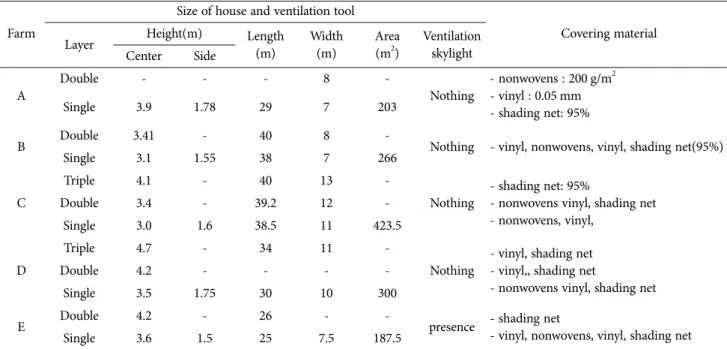
표고톱밥재배 농가 재배사의 형태적 특징을 조사한 결 과, 피복의 형태는 2, 3중의 형태를 갖고 있었으며, 재배 사 내부 중심부의 높이는 3~3.6 m, 측면의 1.5~1.78 m, 내부 폭은 7~11 m 내외이었다. 내부 면적은 187.5~423.5 m2로 재배농가마다 각기 다른 면적을 보이고 있으나 대개 의 경우 면적이 165 m2(50평)과 330 m2(100평)을 건축하 는 것을 기본으로 하는 것으로 보인다.
피복의 형태는 차광막, 비닐, 부직포 등으로 구성하고 있으며, 설치하는 순서는 재배농가 마다 각기 다르게 설 치하고 있다. 개폐기는 측면에 해당하는 직선부분과 상부 의 곡선부분은 차광막 부분에 설치하고 있으며, 측면 부
Fig. 1. Classification of cultivated forms of shiitake bag cultivation.
분은 통풍, 상부 곡선부분은 겨울동안에 햇빛을 받아들여 온도유지 및 눈피해를 막기 위한 목적으로 사용한다고 하 였다(Table 1). 차광막은 주로 95%를 사용하고, 비닐은 0.05 mm 비닐하우스용, 부직포는 보온재로 사용하고 있 었으며, 사용 농가에서도 그 규격에 대해 정확히 알지 못 하는 경우가 많았다. 재배사의 형태적 특성은 산림청에서 2010년도에 공시한 표고 재배시설 신규모델 설계도의 지 면2형과 3형에 유사한 형태로 건축된 것으로 추정된다.
표고재배사의 재배환경 조절, 작업을 위한 시설 및 장비 조사 결과, 일반적으로 봄가을 재배를 목적으로 하는 농 가는 대부분 냉동기를 설치하고 있지 않으나 최근에 설치 된 재배사들은 연중재배를 목적으로 냉동기를 설치한 농 가는 4개 농가였다. 환기팬을 설치한 농가는 3곳이며, 모 든 농가가 미니스프링클러나 포그노즐을 설치하였고, 미 니스프링클러는 배지의 수분공급, 포그노즐을 설치한 2개 농가는 재배사 내부의 온도 제어를 목적으로 설치하고 있
었다. 포그노즐은 10-30초 적용시 2-2.5oC 온도가 하강하 였다. C농가는 내부 온도를 낮추기 위하여 지하수를 이용 한 물콘을 사용하여 외부온도가 32oC 이상을 보이는 시기 에 비교적 양호한 버섯을 수확하고 있었다(Table 2).
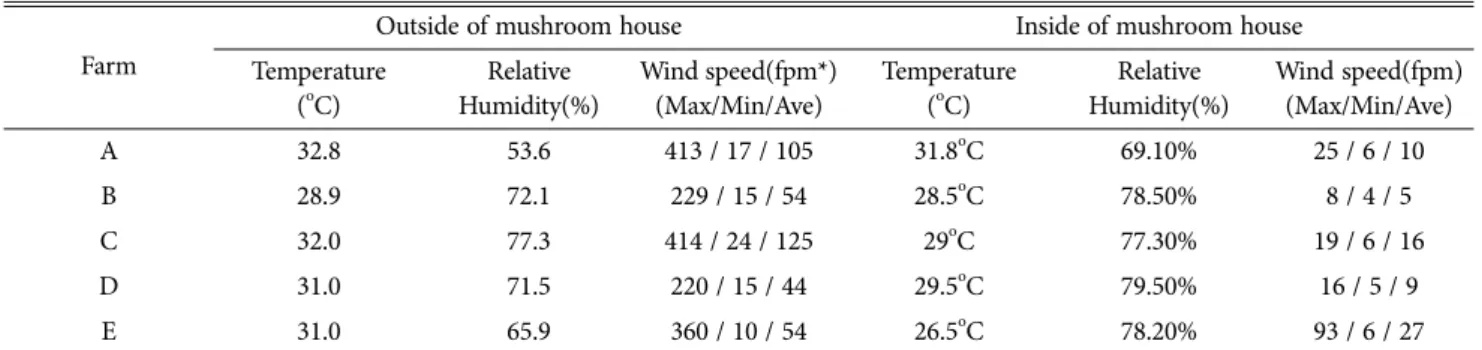
조사한 표고 재배사 내외의 기상환경을 비교하였을 때 에 내외부의 온도 차이는 0.4~4.5oC 였고, 이와 같이 큰 온도 차이를 보이지 않는 것은 차광막에 의해 태양광이 차단되며, 측면에 차광막을 통하여 외부의 공기가 환기되 기 때문으로 판단된다. 온도편차가 4.5oC로 가장 차이가 많은 재배사는 버섯생육시 냉동기를 사용하지 않고, 버섯 발생시기에만 사용하며, 상충부에 환기창이 있어 내부 풍 속이 27 fpm(feet per minute)이며 최대 풍속도 93 fpm으 로 가장 높았다. 재배사의 습도의 차이는 0~15.5%로 가 장 차이가 없었던 C농가는 3중재배사에 재배사 내부에 물콘을 적용하였으며, 온도도 3oC 차이가 많은 편이었다 (Table 3). 풍속은 내부가 외부에 비하여 절대적으로 낮은
Table 1. The size and materials of mushroom house for sawdust bag cultivation
Farm
Size of house and ventilation tool
Covering material
Layer Height(m) Length
(m)
Width (m)
Area (m
2)
Ventilation skylight Center Side
A
Double - - - 8 -
Nothing
- nonwovens : 200 g/m
2- vinyl : 0.05 mm - shading net: 95%
Single 3.9 1.78 29 7 203
B Double 3.41 - 40 8 -
Nothing - vinyl, nonwovens, vinyl, shading net(95%)
Single 3.1 1.55 38 7 266
C
Triple 4.1 - 40 13 -
Nothing
- shading net: 95%
- nonwovens vinyl, shading net - nonwovens, vinyl,
Double 3.4 - 39.2 12 -
Single 3.0 1.6 38.5 11 423.5
D
Triple 4.7 - 34 11 -
Nothing
- vinyl, shading net - vinyl,, shading net
- nonwovens vinyl, shading net
Double 4.2 - - - -
Single 3.5 1.75 30 10 300
E Double 4.2 - 26 - -
presence - shading net
- vinyl, nonwovens, vinyl, shading net
Single 3.6 1.5 25 7.5 187.5
Table 2. Facilities and equipment for regulating temperature and humidity of shiitake mushroom house
Farm Refrigerator Electric installation Ventilation fan Mini sprinkler Significant report
A 2 4 none 1 m interval Tristichous - High density mushroom fly
B none none 1 1.5 m interval Bifarious - High density mushroom fly
C 1 none 10 2.6 m interval Bifarious
- Day temperature: 28
oC, - Fog watering : down temp. 2
oC - Underground water chiller - Excellent cultivation
D 5 20 none 1 m interval Bifarious
- Fog watering :down temp. 2.5
oC - Mushroom bed : second stage - Excellent cultivation
E 1 none 1 24 ea - Ventilation skylight
- Mushroom bed : second stage
Table 3. Comparison of the weather conditions on the inside and outside of shiitake mushroom house
Farm
Outside of mushroom house Inside of mushroom house Temperature
(
oC)
Relative Humidity(%)
Wind speed(fpm*) (Max/Min/Ave)
Temperature (
oC)
Relative Humidity(%)
Wind speed(fpm) (Max/Min/Ave)
A 32.8 53.6 413 / 17 / 105 31.8
oC 69.10% 25 / 6 / 10
B 28.9 72.1 229 / 15 / 54 28.5
oC 78.50% 8 / 4 / 5
C 32.0 77.3 414 / 24 / 125 29
oC 77.30% 19 / 6 / 16
D 31.0 71.5 220 / 15 / 44 29.5
oC 79.50% 16 / 5 / 9
E 31.0 65.9 360 / 10 / 54 26.5
oC 78.20% 93 / 6 / 27
*Feet per minute
Fig. 2. Shape of shiitake mushroom house and application equipment.
Fig. 3. Day and night temperature variation within shiitake mushroom house.
수준을 보였으며, 가장 높은 평균 풍속을 보이는 농가는 E농가로 상부 환기창이 원인으로 추정되며, 재배사의 상 부 환기창의 유무 재배사와 비교시험이 필요하며, 유용도 에 대한 평가가 필요하다고 사료된다.
조사한 재배사에 시설 및 장비의 내용을 보면 차광시설 재배사. 냉동기, 지하수 활용 냉각장치(underground water chiller), 포그노즐(fog nozzle) 등을 사용하여 여름재배에 서 버섯을 수확하기 위해 많은 노력을 하고 있으며, 아직 은 효과적인 결과는 얻지 못하고 있었다(Fig. 2).
표고지면재배를 하고 있는 재배사에서 24시간동안 재배
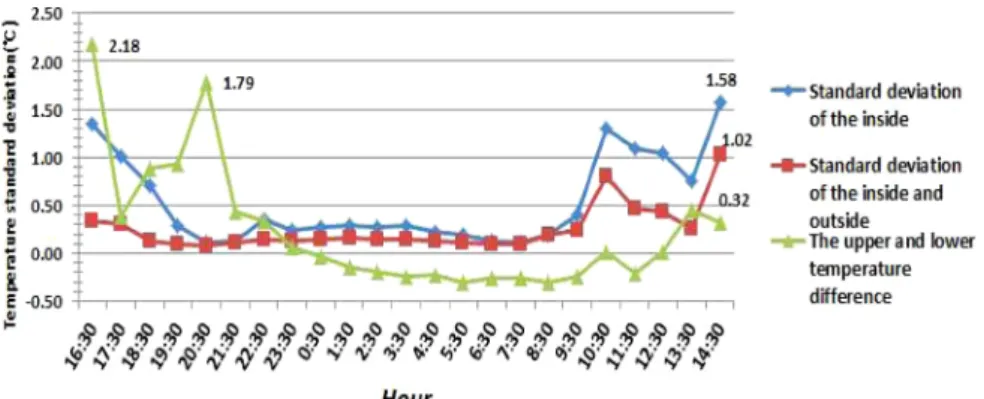
사 위치별 온습도를 경시적으로 조사한 결과, 내부의 위 치별 조사에서 재배사 중앙부위에 배지높이와 2 m 높이 상부의 온도차이는 오후 2:30분경이 2.18oC로 가장 차이 가 크며, 20:30분부터 익일 6:30까지는 상부보다 배지부 위의 공기온도가 약간 낮게 나타났다. 전체 측정지점의 온도편차에서는 14:30과 16:30 시간대가 ±1.35~1.58oC로 가장 높으며, 내부의 온도편차에서는 2:30 조사에서만
±1.02oC로 1oC 이상 편차가 나는 시간대가 없었다(Fig.
3). 이와 같이 상하단 온도의 차이가 크지 않으므로 균상 재배를 하는 경우에도 상단과 하단의 차이가 크지 않으므
Fig. 4. The temperature difference and standard deviation between the upper and lower by the results of day and nigh
temperature variation within shiitake mushroom house.Fig. 5. Comparison of morphological characteristics of the shiitake mushrooms by different growth-t.
Fig. 6. Comparison of the pileus and stem color of shiitake mushrooms by different growth-temperatureemperature.
로 버섯재배에는 큰 무리가 없을 것으로 추정된다.
표고의 발이 및 자실체 생육이 가능한 온도를 확인하기 위하여 14oC부터 29oC까지 3oC간격으로 재배한 결과, 23oC까지는 발이 및 버섯을 수확할 수 있었으나 26oC부 터는 버섯이 발생되지 않아 버섯을 전혀 수확하지 못하였 다(Fig. 4).
버섯을 수확한 자실체의 형태적 특성 및 갓과 대의 색 깔의 변화를 조사한 결과, 재배온도 증가에 따라 갓크기 는 1차 수확에서는 서서히 감소하였으나 2차에서는 증가 하였다. 대길이는 온도가 증가하면서 길어지는 추세이며, 갓두께는 1차 수확에서는 서서히 감소하지만 2차는 빠르 게 증가하였다. 이는 1차에서는 발생개체수가 많아 서서 히 증가 또는 감소되지만, 2차 수확에서는 발생 개체수가 감소되어 전반적으로 자실체의 크기가 커지는 현상을 보 이는 것으로 추정된다(Fig. 5)
갓과 대의 색깔의 변화에서는 재배온도가 증가되면서 갓의 명도 값은 증가하였고, 갓의 채도 a값은 서서히 감소 하였으나 채도(b)값은 온도에 따른 큰 변화가 없었다. 대 채도(a, b)값 모두 서서히 감소하였고, 감소하는 정도가 미약하여 육안으로도 차이를 확인하기 어려웠다 (Fig. 6).
적 요
표고 재배방법이 원목재배에서 톱밥재배로 전환되어가 고 있는 추세이다. 하지만 재배적기인 봄가을의 버섯생산 은 톱밥재배는 경쟁력이 매우 취약한 상태이다. 이를 개 선하기 위하여 연중재배 방안의 개발이 절실하며, 균상재 배에 대한 필요성이 높아진 상태이다. 농가 재배사의 위 치별 온도변화와 시설 및 장비에 대한 조사와 재배온도별 버섯발생 및 자실체의 형태적 특성을 조사하였다.
그 결과, 재배사 내의 온도는 외부 온도가 34oC일 때에 내부온도는 30~31oC이었으며, 상하단의 온도 편차는 1oC 이내였고, 밤의 온도는 외부온도가 22~21oC 일 때에 내부 는 22~23oC 수준으로 1oC 높았다. 전체적으로 보면 24oC 미만은 버섯 발생 및 생육이 가능한 온도대의 시간은 22:30부터 아침 7:30분까지이며, 습도는 온도와는 반대로 낮에는 55~65% 내외이나 밤에는 85~95%내외를 유지하 였다.
재배사 시설들은 냉동기, 물콘, 3중막 표고재배사, 미스 트 및 포그노즐 등이었으며, 재배자들은 낮은 온도를 유 지하기 위하여 많은 노력을 하고 있었다.
봉지배배에서 혹서기에 재배가능한 온도를 확인하기 위 하여 14oC부터 29oC 까지 3oC 간격으로 항온상태에서 버 섯재배사에서 재배한 결과 23oC까지는 버섯이 발이 또는 생산되었으나 26oC부터는 버섯생산이 불가능하였다. 버섯 품질을 결정하는 버섯 색깔과 형태적 특성변화에서 명도 값은 온도가 증가하면서 증가하였고, 대의 채도(a, b)값은 서서히 감소하였으며, 갓에서는 채도(b)값은 온도에 따른
큰 변화가 없었으나, 채도 (a)값은 감소하였다. 형태적 특 징 중에서 갓크기는 1차 수확에서는 온도 증가에 따라 서 서히 감소하였으나 2차 수확에서는 증가하였다. 대길이는 재배온도가 높아지면 대길이가 길어지며, 갓두께는 1차 수확에서는 서서히 감소하지만 2차 수확은 1차보다 빠르 게 증가하였다.
위의 내용을 종합해보면 표고톱밥 재배사내에 상하단의 온도편차가 1oC 이내로 균상재배가 가능하며, 버섯 발생 유도기간에 온도는 23oC 이하에서만 가능할 것이다.
감사의 말씀
이 연구는 농촌진흥청 연구사업인 식용버섯의 재배환경 및 추출방법 개선을 통한 기능성 향상 과제에서 시행한 연구결과입니다.
References
Baek IS, Lee YH, Jang MJ, Jeoung YK, Lee HB, Chi JH.
2013. Effects of cultural characteristics of Lentinula edodes according to LED wavelength with sawdust substrate cultivation. J. Mushroom Sci. Prod. 11(4):226- 229
Bak WC, Lee BH, Ka KH. 2010. Characteristics of new shiitake strain “Sanlim No. 7” produced di_mon hybridization method. Kor. J. Mycol. 38(1):25-28.
Bak WC, Park YA, Lee BH, Ka KH and Park JH. 2013.
Kor. J. Mycol. 41: 28-32.
Jang, MJ, Lee YH, Lee HB, Liu JJ and Ju YC. 2009.
Studies on breeding and cultivation characteristics of Lentinula edodes strains for sawdust cultivation. Kor. J.
Mycol 9(3):105-109
Jung ES, Choi WS. 2000. Analysis of climatic Factors during growing period of high-quality oak mushroom Lentinus edodes(Berk) Sing). J. of Bio-Environment Control, 9(2):115-119
Jung ES. 2000. thermal and ventilative characteristic of single-span oak mushroom production facility as affected by area of roof openings and shading rates. J. Bio- Environment Control, 9(2):120-126
Kim WS and Cheol Jeon. 2002 Effect of medium composition on yield and qualities of fruitbody in sawdust medium cultivation of Lentinus edodes. J. Life Sci. &
Nat. Res 24:63-71
Koo CD, Kim JS, Cho NS, Min DS. 1999. Effect of water content in oak saw-dust on the mycelial growth of Lentinula edodes . Jour. Korean For Soc., 1999(0):87-88 Koo CD, Kim JS, Lee HY, You SR, You CH. 2009.
Dynamic of temperature and humidity changes in Lentinula edodes sawdust cultivation sheds. Jour. Korean For. Soc. 98(6):748-756.
Koo CD, Lee HY, Lee G. 2012. Effects of sterilization and cultivation temperatures of oak sawdust medium on Lentinula edodes hyphal growth. Jour. Korean For. Soc.
101(1):77-82
Koo CD, Lee SJ, Lee HY. 2013. Morphological characteristic of decomposition and browning of oak sawdust medium for ground bed cultivation of Lentinula edodes. Kor. J. Mycol. 41(2):85-90.
Lee WH, Kim IY, Ko HG, Kim SC, Choi SG, Noh JH and Park HS. 2014. Cultural characteristics and formation of fruiting body in Lentinula edodes. J. Mushrooms 12(1):
24-28
Min DS. 1994. Oak mushroom cultivation on Larch(Larix leptolepis Gorden) sawdust and its economic efficiency.
Jour. Korean For Soc. 83(4):512-520.
Park KS, Son JE, and Kim JM. 2001. Effect of wind treatment on quality of oak mushroom and moisture content of sawdust medium Kor. J. Hort. Sci. & Technol.
Supplement 2001(1):38-38
Park KS, Son JE, Lee BS, Yun NK. 2002. Effect of wind, sucrose and irrigation treatments on quality of oak mushroom and moisture content of sawdust medium. Kor.
J. Hort. Sci. & Technol. Supplement1 2002(1):35-35
Ryu SR, Bak WC, Koo CD and Lee BH. 2009. Studies on breeding and cultivation characteristics of Lentinula edodes strains for sawdust cultivation. Kor. J. Mycol.
37(1):65-72
Seo DS, Koo CD 2009. Effect of temperature to rooting of Lengtinula edodes in surface cultivation. Jour. Korean For. Soc. 2009(0):519-521
Seo DS, Park YW, Koo CD, Lee HY. 2012. C, N components and hyphae amount change according to fruiting body develop stage in Lentinula edodes sawdust culture medium. Jour. Korean For. Soc. 2012(0):509-511 Yoon KH Park H, Bak WC, Ka KH. 2005. Sawdust-based
cultivation of Lentinula edodes by use of recycled log used for the cultivation of the mushroom. Jour. Korean For. Soc. 2005(0):415-417
Yoon KH. 2002. Investigation of appropriate nutrients for major hardwood species to develope the sawdust media for the cultivation of Lentinula edodes. Dept. of Forest Resources Graduate School, Kookmin University