• 검색 결과가 없습니다.

Nutritional composition and antioxidant activity of pink oyster mushrooms (Pleurotus djamor var. roseus) grown on a paddy straw substrate

N/A
N/A
Protected

Academic year: 2021

Share "Nutritional composition and antioxidant activity of pink oyster mushrooms (Pleurotus djamor var. roseus) grown on a paddy straw substrate"

Copied!
12
0
0

로드 중.... (전체 텍스트 보기)

전체 글

(1)

189 This is an Open-Access article distributed under the terms of the Creative Commons Attribution Non-Commercial License (http://

creativecommons.org/licenses/by-nc/3.0) which permits unrestricted non-commercial use, distribution, and reproduction in any medium, provided the original work is properly cited.

J. Mushrooms 2020 September, 18(3):189-200 http://dx.doi.org/10.14480/JM.2020.18.3.189 Print ISSN 1738-0294, Online ISSN 2288-8853

© The Korean Society of Mushroom Science

Jegadeesh(Researcher), Hariprasath Lakshmanan(Professor), Kab-Yeul Jang(Agricultural research officer), Minji Oh(Agricultural researcher), Youn-Lee Oh(Agricultural researcher), Ji-Hoon Im(Agricultural researcher)

*Corresponding author

E-mail : [email protected] Tel : +82-10-8231-0501, Fax : + Received July 20, 2020 Revised August 3, 2020 Accepted September 22, 2020

Nutritional composition and antioxidant activity of pink oyster mushrooms (Pleurotus djamor var. roseus) grown on a paddy straw substrate

Jegadeesh Raman

1,

*, Hariprasath Lakshmanan

2

, Kab-Yeul Jang

1

, Minji Oh

1

, Youn-Lee Oh

1

, and Ji-Hoon Im

1

1

Mushroom Research Division, National Institute of Horticultural and Herbal Science, Rural Development Administration, Eumseong, Republic of Korea

2

Department of Biochemistry, Karpagam Academy of Higher Education, Coimbatore 641021, India

ABSTRACT:

Pleurotus djamor var. roseus is an edible mushroom isolated from the wild and cultivated on paddy straw substrates.

The present study was carried out to compare the nutritional composition and antioxidant properties of P. djamor var. roseus at different growth stages (primordia, basidiomata, and mycelia). The protein content was is in the range of 31.48 to 35.50 g/100g dw. The crude fiber content ranged from 8.0 to 14.60 g, and that of total carbohydrates ranged from 44.75 to 48.90 g. Sodium, magnesium, and calcium reached the maximum levels in basidiomata, and selenium was detected in basidiomata and mycelia (0.47 - 0.22 mg/Kg). The amino acid profile showed that all essential and nonessential amino acids and glycine showed maximum levels in basidiomata and 15.98 ± 0.01 g/100g. The fatty acid profile showed the presence of saturated and unsaturated fatty acids; the unsaturated fatty acid content was maximum in all of the samples, ranging from 76 – 40.41%. The total phenol and flavonoid contents as well as the scavenging (DPPH), ferric thiocyanate (FTC), and thiobarbituric acid (TBA) activities in the context of methanol and water extracts from primordia, basidiomata, and mycelium were determined. Among them, basidiomata and mycelial methanol extracts exhibited significant antioxidant activity. Overall, these findings show that P. djamor var. roseus can be used as a functional food for daily consumption.

KEYWORDS: Mushroom, Pleurotus, Proximate composition, Antioxidant, Medicinal food

INTRODUCTION

Culinary mushrooms are consumed as part of their food habits in many countries, as they are nutritious and delicious compared to their conventional foods.

Mushrooms are a rich source of digestible proteins,

which is essential for nutritive foods. The protein content is four times more than orange, twice than the vegetables and higher than wheat, but less than meats and milk (FAO, 2006; Mallavadhani et al. 2006). Apart from digestible proteins, the mushrooms are also a good source of carbohydrates, dietary fibers, vitamins, minerals, unsaturated fatty acids and phenolic compounds that fit the definition of food supplements (Jegadeesh et al., 2018, Atri et al. 2012, Kumari et al. 2011).

Mushroom fruiting body and mycelium are sources of nutrients with highly desirable flavor and aroma that would find possible food processing (Sun et al., 2019;

Menaga et al., 2012). Most edible mushrooms contain a

fat content range of 2 - 8% of dry weight (Mallavadhani

et al. 2006). Mushrooms have been successfully proved

to be a food supplement for cardiac patients, and the

low concentration of sodium and the high percentage of

potassium can reduce blood pressure (Raman et al.,

2014, Vetter, 2003, Manzi et al., 1999). On the other

hand, most edible mushrooms are poor sources of

calcium and iron (Chang and Buswell 1996). Selenium

(2)

exists in the form of selenoproteins in our body, a useful constituent of many mushrooms (Li et al. 2004).

The known essential micronutrient minerals present in the edible mushrooms are essential in the enzyme catalytic processes of different systems such as endocrine, metabolic and immune systems (Keen et al., 2004). While the fungal essential and nonessential amino acids are considered as an alternative source of protein, they provide structural stability to cells and organs. Amino acids are essential for growth and cell repair mechanisms (Wani et al., 2010; Mukhopadhyay &

Guha, 2015). Moreover, edible mushrooms are excellent sources of vitamins such as thiamine, riboflavin, ascorbic acid, nicotinic acid and biotin (Mattila et al., 2001). Pleurotus species, also known as oyster mushrooms, distributed mostly in the subtropical and tropical forests, can be cultivated easily. Pleurotus species is the leading commercially cultivated mushroom in many countries (Chang and Wasser 2017). Pleurotus djamor var. roseus is a culinary mushroom of the family Pleurotaceae in the order Agaricales. It can be grown at 26°C to 35°C and with relative humidity above 80%. It is commonly called roseus mushroom and pink salmon oyster because of its pink sporophore, large-sized fruit bodies and delicious flavor. The present study is aimed to evaluate the proximate composition, micro and macro elements, vitamins, fatty acids and amino acid content.

Mushrooms could be an alternative source of natural antioxidants and have a balanced nutritive composition.

They might be used in food supplements to protect the human body against oxidative stress (Kozarski et al., 2014). Particularly delay/preventing deterioration process food and preserve the food quality. Recent studies have shown that mushrooms are rich sources of antioxidants and can be used in commercial food products (Titas et al., 2019, Hosseinifar et al., 2019, Khatua et al., 2013).

In Asia, various edible and medicinal mushrooms are consumed as food and medicine for centuries.

Mushroom fruiting bodies consist of various antioxidant compounds, such as phenol, polysaccharide, vitamins and minerals. Apart from the mushroom fruiting bodies, their mycelia also possess antioxidant qualities and can produce an extensive amount in a limited time (Cai et al., 2019). Nevertheless, mushroom accumulated different secondary metabolites, polysaccharides and polyketides.

Among them, phenolic compounds are the most attractive antioxidant agents associated with other metabolites (Hosseinifar et al., 2019, Gasecka et al.,

2016). Besides, selenium is one of the potential sources of nutrients that worked as a cofactor in antioxidants (Mironczuk-Chodakowska et al., 2019). The standardization process of antioxidant dietary supplementary of edible/

commercial mushroom and finding the novel antioxidant agents are still in progress. Therefore, this study also focused on estimating the in vitro antioxidant potential of methanol and water extracts of the P. djamor var.

roseus at different growth stages and the activity was correlated to total phenol and flavonoid contents.

MATERIALS AND METHODS

Materials and chemicals

P. djamor var. roseus primordia and fresh fruiting bodies were harvested from the paddy straw substrate, Centre for Advanced Studies (CAS) in Botany, University of Madras, Chennai, India. The inoculum was prepared by growing the P. djamor var. roseus in a 2500 mL Erlenmeyer flasks containing 500 mL of potato dextrose broth (PDB). The culture was incubated for 18 days in stationary condition at 242°C in the dark. The dry weight of the harvested primordia, basidiomata and mycelium were measured after washing with sterile distilled water and dried at 60°C. 1,1-diphenyl-2- picrylhydrazyl (DPPH), ferric thiocyanate (FTC), thiobarbituric acid (TBA), gallic acid, quercetin and methanol were purchased from Hi-Media Laboratories Ltd., Mumbai, India and Sigma Chemicals (St. Louis, USA) suppliers.

Proximate analysis

Proximate analysis, the total ash (AOAC 2003), total lipid (Folch et al., 1956), crude fiber (Maynard 1970), total protein (Bradford 1976) and carbohydrate were determined according to the respective methods.

Thiamine and riboflavin were estimated by the methods of The United States Pharmacopoeia (2004) and Indian Pharmacopoeia (1996), respectively.

Elemental analysis

The elemental composition is often an essential part of the information needed to assess its properties and the micro, and macro elements were analyzed by using ICP- OES (Optima 5300 DVICP-OES, Perkin Elmer).

Amino acid analysis

The amino acid profile was determined according to

(3)

Bach et al., 2017. Reverse-phase chromatography was carried out using a 30 L injection volume and 1.0 mL min

-1

flow rate in a HPLC (Shimadzu Corp, Kyoto, Japan). The amino acid standard was also run to calculate the amino acid concentration depending on the standard chromatogram. The results were expressed as grams of amino acid per 100 g of protein and performed in duplicate

Fatty acid analysis

Fat and fatty acids are extracted from samples by hydrolytic methods. Pyrogallic acid is added to minimize the oxidative degradation of fatty acids during analysis. Triglyceride, triundecanoin, is added as an internal standard. Fat is extracted into ether, then methylated to fatty acid methyl esters (FAMEs) using

BF3 in methanol. FAMEs are quantitatively measured by GC-MS, against internal standards. Total fat is calculated as the sum of individual fatty acids expressed as triglyceride equivalents. Saturated and monounsaturated fats are calculated as the sum of the respective fatty acids. Monounsaturated fat includes only the cis form.

Extract preparation

For obtained extracts, the dried primordia, fruiting body and mycelium samples were used. Each sample was milled into coarse powder (20 g, each) and the extract was prepared by maceration method by soaking the powder in methanol 1:10 (w/v). The flask was kept at room temperature for 72 h with occasional shaking.

The filtrate was collected into a clean flask using

Whatman No. 4 filter paper. A rotary evaporator (Buchi,

Fig. 1. Extraction of methanol and water extracts from Pleurotus djamor var. roseus.

(4)

Switzerland) was used to concentrate the filtrate at 45°C under reduced pressure (Figure 1). The water extract was prepared by boiling the mushroom powder (20 g, each) soaked with distilled water (1:10 w/v) at 60°C for 30 minutes with continuous agitation (Wuilloud et al., 2004). After cooling, the contents were filtered to a clean flask using a filter gauze and further centrifuged at 10,000 rpm, 4°C for 30 minutes. The collected supernatant was concentrated using a freeze dryer (Figure 1). Both methanol and water extracts were stored in a refrigerator at 4 ± 2°C until use.

Determination of total phenolic and flavonoid content in methanol and water extracts

The total phenolic content of each mushroom sample was determined according to the method of Singleton et al., (1999). Separately each extract (0.5 mL) in a volumetric flask was diluted with distilled water (4.5 mL). The total phenolic content was determined by adding Folin-Ciocalteu reagent (0.2 mL) to 0.5 mL of the extract. After mixing, 2% of Na

2

CO

3

was added and the volume of the flask was made up to 5 mL with distilled water. The flasks were incubated in the dark for 60 minutes at room temperature. The absorbance of the reaction mixture read at 725 nm using a spectrophotometer.

Total phenolic content was expressed as gallic acid (mg GAE/g). The concentration of total flavonoids in methanol and water extracts was determined as described previously (Choi et al., 2006; Lin and Tang, 2007). A total of 250 µL of methanolic and water extract (each separately) were mixed with 1.25 mL of distilled water and 75 µL of 5 % NaNO

2

solution. After 5 min, 150 µL of 10 % AlCl

3

was added. After the next 6 min, 4 mL of 4 % sodium hydroxide (NaOH) was added. The mixture was diluted immediately with deionized water (2.5 mL) and the absorbance of pink color was measured at 510 nm. The total flavonoid contents were measured by plotting quercetin standard calibration curve and determined as mg of quercetin equivalents/g dry matter.

DPPH radical scavenging activity

The free radical-scavenging (DPPH) activities of mushroom extract were determined using Brand- Williams et al., (1995). Assays were performed in 1.5 mL reaction mixtures containing 1 mL of 0.2 mM DPPH ethanol solution and 1 mL of different concentrations (1 – 10 mg/mL) of methanol and water

extracts of P. djamor var. roseus primordia, basidiomata and mycelia (1-10 mg/mL) were determined and 0.5 mL ethanol used as a control. After 30 min of incubation at 37°C under dark condition, the absorbance of the reaction mixtures was measured at 517 nm. The inhibitory effect of DPPH was calculated according to the following formula: Inhibition (%) = [(absorbance control – absorbance sample)/ absorbance control] x 100. A standard graph was plotted to determine the inhibitory concentration (IC

50

).

Lipid peroxidation activity

Ferric thiocyanate assay (FTC) was used for the initial stage of lipid peroxidation and thiobarbituric acid test (TBA) assay for the end stage of lipid peroxidation according to the references Kikuzaki et al., 1991, Kikuzaki and Nakatani, 1993. The same samples as prepared for the FTC method were used in this test and 20% of trichloroacetic acid (2 mL) and TBA solution (2 mL) were added to 1 mL of the sample solution. This mixture was then placed in a boiling water bath for 10 minutes After cooling, it was then centrifuged at 3000 rpm for 20 minutes. The absorbance of the supernatant was then measured at 532 nm. The inhibition percentage was determined based on absorbance on the final day.

Standard antioxidants such as ascorbic acid and α- tocopherol were used as a positive control.

Statistical analysis

All tests were performed in triplicates and data were expressed as mean SD. One-way Analysis of Variance (ANOVA) was performed to determine the significance of individual differences at p < 0.05 level. Duncan’s multiple range test was performed to compare significant means. The SPSS statistical package (SPSS, Version 25, SPSS Inc., Chicago, USA) was used as a data analysis tool.

RESULTS AND DISCUSSION

Proximate analysis of P. djamor var. roseus

In the present study, the proximate and fatty acid composition of mycelium, primordia and basidiomata were investigated. The proximate composition of the P.

djamor on a DWB are shown in Table 1 - 3. Analytical

reports on proximate composition showed significant

variation from species to species, often in the same

species as well. The protein, fat and crude fiber content

(5)

was observed maximum in P. djamor var. roseus basidiomata (35.50, 1.72 and 14.60 g/100g). While primordia showed high ash content (8.40 g/100g), the carbohydrate content was recorded high in mycelia 948.90 g/100g. Followed by carbohydrates, we observed high protein content in all the three stages of maturation, ranging between 31.48 – 35.50 g/100g (Table 1). Carbohydrate content in various edible mushrooms

was reported in the range between 20.54 – 64.78%

(Odoh et al., 2017). Even though humans cannot utilize a large portion of the carbohydrate as a nutrient, it could function as a roughage. Pleurotus species showed varying protein content among species (Lavelli et al., 2018). Interestingly, B complex vitamins were abundantly present in the basidiomata of P. djamor followed by primordia and mycelial mat (0.02 and 1.96 mg

-1

100 g dw). Lavelli et al., (2018) reported that B complex vitamins inadequate dietary intake might cause various diseases in developing countries. Mushrooms are one of the best sources of B group vitamins. and vitamin D. The wild and cultivated mushrooms can be exposed to ultraviolet are grown in sunlight; they can generate vitamin D (Cardwell et al., 2018).

Essential and non-essential elemental content in P.

djamor var. roseus

Pleurotus djamor var. roseus considered a good source of minerals, interestingly 13 different minerals were detected. The zinc (Zn) content was estimated in all the three stages viz., matured basidiomata (12.1 mg), Table 1. Proximate composition of P. djamor var. roseus.

Name of the princi-

ple Primordia Basidiomata Mycelia Protein

*

31.48 1.97

d

35.50 1.78

g

33.30 1.51

d

Carbohydrate

*

46.58 2.57

e

44.75 2.02

h

48.90 2.02

e

Fat

*

1.63 0.03

ab

1.72 0.03

bc

1.53 0.02

a

Total ash

*

8.40 0.17

c

5.90 0.05

e

4.03 0.03

b

Crude fiber

*

8.00 0.82

c

14.60 0.43

f

11.80 0.86

c

Thiamine

#

0.980 0.01

ab

1.18 0.08

ab

0.014 0.001

a

Riboflavin

#

1.26 0.02

ab

2.82 0.03

cd

0.31 0.01

a

Pyridoxine

#

2.6 0.05

b

3.55 0.05

d

0.98 0.01

a

Cyanocobalamin

#

BDL 0.6 0.02

ab

BDL

Niacinamide

#

0.059 0.00

a

0.064 0.03

a

0.010 0.00

a

Each value is an average of three replicate, values are mean standard deviation, the same alphabets in the line are not differ significantly by Duncan test (p < 0.05).

*
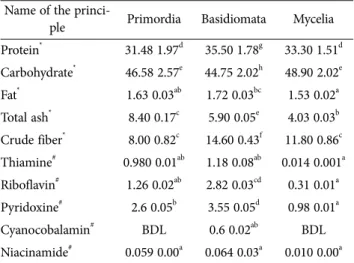
Represent g/100g of dry powder;

#

mg/100g of dry powder. BDL – Below Detectable Level.

Table 2. Essential and non-essential element content in P.

djamor var. roseus.

Elements Content (mg/Kg)

Primordia Basidiomata Mycelia Iron 19.1 0.01

d

17.32 0.03

f

7.32 0.02

e

Sodium 47.5 0.1

f

67.12 0.02

h

42.72 0.02

g

Potassium 2300.17 0.29

i

2218.33 0.58

k

1148.15 0.3

j

Magnesium 120.8 0.1

g

167.37 0.55

i

86.28 0.01

h

Phosphorous 672.7 0.1

h

503.1 0.1

j

622.57 0.60

i

Calcium 20.47 0.03

e

49.67 0.04

g

8.77 0.00

f

Zinc 1.07 0.00

a

1.21 0.00

d

0.38 0.01

bc

Manganese 2.52 0.02

b

1.34 0.01

d

0.62 0.01

c

Selenium BDL 0.47 0.01

bc

0.22 0.01

ab

Chromium 0.13 0.01

a

0.10 0.01

ab

0.16 0.01

ab

Cadmium 0.06 0.00

a

0.02 0.00

a

0.02 0.00

a

Arsenic 0.42.02

a

0.72 0.01

c

0.43 0.01

bc

Copper 6.77 0.01

c

3.37 0.01

e

1.02 0.01

d

Each value is an average of three replicate, values are mean standard deviation, the same alphabets in the line are not differ significantly by Duncan test (p < 0.05).

Table 3. Essential and non-essential amino acid profile of P.

djamor var. roseus (g/100 g proteins).

Amino acids Primordia Basidiomata Mycelia

Threonine 5.11 0.003

h

5.29 0.01

j

4.53 0.02

h

Valine 5.33 0.01

i

4.30 0.01

i

3.81 0.01

g

Methionine 3.44 0.005

g

7.65 0.01

n

7.65 0.005

k

Isoleucine 1.14 0.005

b

1.39 0.005

c

1.18 0.005

c

Leucine 3.44 0.005

g

3.66 0.002

f

3.51 0.01

f

Phenylalanine 3.28 0.006

f

3.96 0.006

g

3.15 0.01

e

Histidine 2.52 0.01

e

3.21 0.006

e

2.68 0.01

d

Lysine 5.94 0.01

j

4.02 0.015

h

5.47 0.006

i

Arginine 9.87 0.006

o

9.94 0.005

q

9.13 0.008

n

Tryptophan 1.25 0.005

d

1.32 0.01

b

1.18 0.01

c

Aspartate 9.42 0.005

m

7.06 0.006

l

8.44 0.005

l

Serine 9.79 0.006

n

8.86 0.005

o

10.77 0.005

p

Glutamate 11.73 0.005

q

9.61 0.005

p

11.91 0.01

q

Proline 0.43 0.002

a

1.54 0.01

d

0.86 0.002

b

Glycine 6.90 0.02

k

15.98 0.01

r

6.32 0.01

j

Alanine 10.04 0.006

p

5.65 0.005

k

9.53 0.003

o

Cysteine 1.19 0.003

c

0.92 0.015

a

0.85 0.005

a

Tyrosine 8.23 0.005

l

7.11 0.01

m

8.91 0.01

m

Each value is an average of three replicate, values are mean standard

deviation, the same alphabets in the line are not differ significantly

by Duncan test (p < 0.05).

(6)

primordia (11.0 mg) and mycelial mat (3.8 mg) Kg

-1

dry weight. An earlier study has shown that the Zn content in four edible mushrooms compared ranged between 9.44 – 1.58 mg/100g on DWB (Mallikarjuna et al., 2013). The iron (Fe) content was recorded maximum in primordia 19.1 mg/Kg and minimum in mycelia 7.3 mg/

Kg DWB. Regula et al., (2016) reported that iron from an oyster mushroom supplement with cereal products is considered a functional food. Phosphorus (P) content was recorded maximum in primordia (672.7 mg/Kg), followed by the matured basidiomata (503.1 mg/Kg) and mycelial mat (622.6 mg/Kg). Bamidele and Fasogbon (2020) reported that the phosphorus (224.6 mg/100g) and other elements were high in oyster mushrooms compared to Zea mays. As the recommended daily intake of phosphorus in humans (above 18 years) is 700 mg/day (Demirci 2006; Yamamoto et al., 2013), it is safe to be consumed as a functional food. The level of other elements like sodium (Na), calcium (Ca) and magnesium (Mg) level, were high in basidiomata (67.12, 49.67, 167.37 mg/Kg). In comparison, the level of potassium (K), phosphorous, manganese (Mn) and copper (Cu) (2300.17, 2.52 and 6.77 mg/Kg) was recorded maximum in primordia (Table 2). There is a right balance between K high content and Na low content curing high blood pressure (Manzi et al., 1999).

The microelements statutory limits for the metals in edible mushrooms were established in many countries.

The mean mercury (Hg), cadmium (Cd) and lead (Pb) content (mg/100 g, dry mass) ranged from 0.009 - 47, 0.40 – 0.01, and 0.22 – 0.07 mg/100 g, respectively (Arvay et al., 2014; Yamamoto et al., 2013; Gebrelibanos et al., 2016). Mushrooms collected from unpolluted areas showed no risk of toxicity and are suitable for daily consumption (Mironczuk-Chodakowska et al., 2019). Even though the environmental pollutions significantly affect the elemental content in mushrooms, particularly the non-essential trace elements Hg, Cd and Pb have been highly accumulated in their fruiting bodies (Mleczek et al., 2016; Brzezicha-Cirocka et al., 2019).

In the present study, chromium, cadmium and arsenic were determined at the negligible level in P. djamor var.

roseus basidiomata 0.10, 0.02 and 0.72 mg/Kg, respectively (Table 2). However, the toxic element Hg was not detected. The essential element Se was detected in basidiomata and mycelium was range from 0.047 - 0.022 mg/Kg. However, in contrast with earlier studies on P. djamor the Se bioavailability was 0.11 mg/100g

on a dry weight basis (Mallikarjuna et al., 2013). The essential trace elements Se, Cu, Zn and Mn, which have important biological functions and are involved in various metabolic processes in the human body.

Considering the nutritional value of Cu and Se, the fruiting bodies of different mushrooms have been explored for high Cu and Se content that can potentially be used during the deficiency of these elements. For instance, the Se levels ranging from 13.3 to 0.26 mg/Kg dry matter of fruiting bodies were observed in cultivated Agaricus and some wide species, such are Armillaria mellea, Boletus edulis, B. subtomentosus, Cantharellus cibarius and Xerocomus chrysenteron (Mironczuk- Chodakowska et al., 2019). Mostly the heavy metals were accumulating in mushroom through soil or cultivated substrates. Interestingly, mushroom highly accumulated Se due to the presence of sulfuric amino acids (Bhatia et al., 2013). Da Silva et al. (2010) reported that Se enhanced P. ostreatus considered an alternative Se enhanced food for humans and showed good bioavailability in vivo.

Essential and non-essential amino acid content in P.

djamor var. roseus

The amino acid compositions of primordia, basidiomata and mycelia of P. djamor var. roseus were analyzed by the HPLC method. Interestingly, 18 amino acids were present in P. djamor var. roseus and out of 18, 10 were essential amino acids and eight were non- essential amino acids. The analysis revealed that the level of essential amino acids such as threonine, methionine, isoleucine, leucine, phenylalanine, histidine, arginine and tryptophan recorded a maximum of 5.29, 7.65, 1.39, 3.66, 3.96, 3.21, 9.94 and 1.32 g/100 g, respectively in basidiomata compared to mycelia and primordia (Table 3). In contrast, maximum valine and lysine content (5.33, 5.94 g/100 g) was recorded in primordia. The non-essential amino acids aspartate (9.42 g/100 g), alanine (10.04 g/100 g) and cysteine (1.19 g/100 g) were recorded maximum in primordia.

However, the proline (1.54 g/100 g) and glycine (15.98 g

/100 g) were observed in maximum in basidiomata and

glutamate (11.91 g/100 g), serine (10.77 g/100 g) and

tyrosine (8.91 g/100 g) were maximum in mycelia (Table

3). Many of the detailed studies illustrated the amino

acid content of mushrooms, their quality and predicted

the nutritional value (Gupta et al., 2013; Dundar et al.,

2008). Considering that only about 25-30 % of the total

(7)

amino acids occur as free amino acids, the remaining about 70-75% occur in conjugation with a protein. Lin et al. (2017) reported that the broth developed from P.

eryngii might be used as a functional food. While other metabolites like free amino acid, sugar are a presence in the centrifuged broth. Pleurotus species are reported to contain free amino acids and are responsible for the mushroom umami-taste and flavor (aspartic acid and glutamic acid) (Feng et al., 2016). Few amino acids, such as cysteine, alanine, glycine and tryptophan showed a synergistic antioxidant effect with vitamin E (Carlotti et al. 1997). Thus, the vitamins and amino acids could be excellent sources of mushroom nutraceuticals and might be used directly in the human diet and used as a functional food.

The fatty acid content in P. djamor var. roseus The fatty acid composition was different in all the three stages of P. djamor var. roseus. Among them, basidiomata show a high fatty acid profile. The unsaturated fatty acid 9,12-octadecenoic acid (z,z)-, methyl ester (conjugated linoleic acid) was recorded maximum in all the samples (76 – 40.41%). In contrast, the saturated fatty acid, hexadecanoic acid, methyl ester (palmitic acid) was recorded from 29.48 to 15.42%

(Figure 2). Among the unsaturated fatty acid level was higher than saturated fatty acid in P. djamor var. roseus.

The study proved that the cultivated mushroom has rich nutrition and the best food for daily consumption. In previous work, considered the unsaturated fatty acid in P. oyster (42.0 – 46.6%) and Armillaria mellea (49.6%) recorded was lower than the present study (Yilmaz et al., 2006). The 9-octadecenoic acid, methyl ester (oleic acid) 7.02 – 6.14%, nonanoic acid, 9-oxo-, methyl ester (nonanoic acids) 6.9 – 4.83% and octadecanoic acid, methyl ester (stearic acid) 4.01 – 1.86% were detected in basidiomata and mycelium, respectively. Besides, the medium-chain fatty acid, octanoic acid, methyl ester (caprylic acid) and other fatty acids were detected in trace amount in P. djamor var. roseus. The nutritional aspect of the research, both saturated and unsaturated fatty acids are essential. The linoleic acid is an essential fatty acid, they cannot synthesize by humans and they showed potential lipid radical scavenging and neuritogenic activity (Phan et al., 2014). The major sterol produced by edible mushroom is ergosterol, which showed antioxidant activity (Guillamon et al., 2010).

However, polyunsaturated fatty acid reduced atherosclerosis by interacting with High-density lipoprotein (HDL) in the blood. The presence of abundant volatile aroma compounds such as terpenes, isoprene hydrocarbons, and saturated and unsaturated fatty acids in mushrooms gives the required culinary flavor (Sanmee et al., 2003).

Pleurotus consumption as food by hypertension patients

Fig. 2. Fatty acid composition of P. djamor var. roseus.

(8)

has shown a positive treatment due to the presence of high essential fatty acids and potassium (Ganesan and Xu, 2018; Guillamon et al., 2010).

Phenol and flavonoid content in P. djamor var.

roseus

The phenolic component in Pleurotus species is variable and they are most related to antioxidants and phytonutrients (Piska et al., 2017; Newell et al., 2010).

Phenolic compounds are highly soluble in water and organic solvents (Gasecka et al., 2016). In the present study, the total phenol content ranged from 6.75±0.29 to 1.48±0.23 mg/g of extracts and from various growth stages of P. djamor var. roseus showed no significant difference (p > 0.05) between the extracts (Table 4).

These results are different from Boonsong et al. 2016, reported water and ethanol extracts higher concentration in P. eous and P. sajor-caju (20.31 - 16.46 36.19 and 14.03 - 12.34 mg GAE/g dw), respectively. The present results show that the total phenol content was higher in methanol extract 6.75±0.23, 5.75±0.08 and 5.6±0.18 mg GAE/g compared to water extract 3.23±0.09, 0.63±0.03 and 0.44±0.06 mg GAE/g dw in basidiomata, mycelium and primordia, respectively. However, in contrast, with earlier reported that were estimated phenol (41.81 – 46.55 mg TAE/g dw) and flavonoid (5.38 – 8.42 mg GE/g dw) content was maximum in ethanol extract of P.

djamor var. roseus. Besides, the flavonoid is a group of phenolic compounds widely distributed plant and fungi as a secondary metabolite (Sun et al., 2018). They are naturally occurring phytochemicals that have been shown strong antioxidant activity due to their inhibition of certain enzymes (Amic et al., 2007). The phenol and flavonoid are significantly present in all mushrooms, although the content was variable among the species and the extracts (Palacios et al., 2011). In the present study, total flavonoid content was compared with different growth stages of P. djamor var. roseus, by the two different extracts. The methanol extract presented

the highest flavonoid content and the order follows:

basidiomata (1.2±0.07) > mycelia (0.95±0.06) > primordia (0.8±0.08). The mean values of total phenol and flavonoid content compared to methanol and water extract are shown in Table 4. The methanol extracts of all the three mushroom stages showed high (p < 0.05) phenolic and flavonoid content compared to water extracts. The results indicated that the total phenol and flavonoid content were varies depending on the growth stages. According to Arbaayah and Umi Kalsom (2013), phenol and flavonoid content were unaltered during the yield of P. djamor species.

In vitro antioxidant activity of P. djamor.

The phenolic compounds play a key role in scavenging free radicals and is evident from various publications made so far (Gasecka et al., 2016;

Guillamon et al., 2010). The methanol extracts showed higher scavenging abilities on DPPH radicals than water extracts. The maximum inhibition percentage of methanolic extracts of basidiomata, mycelia and primordia 64.3%, 62.77% and 60.8% at 5 mg/mL, respectively. The IC

50

values in ascending order were α- Table 4. Phenol and flavonoid content in P. djamor var. roseus.

Samples

Methanol extract Water extract

Total Phenol (mg GAE/g dw)

Flavonoid (mg QE/g dw)

Total Phenol (mg GAE/g dw)

Flavonoid (mg QE/g dw)

Primordia 5.60.18

d

0.80.08

C

1.480.23

a

0.440.06

A

Basidiomata 6.750.23

e

1.20.07

E

3.230.09

c

0.760.05

C

Mycelia 5.750.08

d

0.950.06

D

2.330.40

b

0.630.03

B

Data are expressed as means S.D. of triplicate measurements. Means with different lower case letters (a - e) and upper case letter (A - E) in the same column are not significantly different (p < 0.05).

Fig. 3. DPPH radical scavenging activity of methanol and

water extracts of P. djamor var. roseus. Values are mean

standard deviation, the same alphabets are not significantly

changed (p < 0.05).

(9)

tocopherol > basidiomata > mycelia > primordia (5.14 - 3.09 mg/mL) (Figure 3). The inhibition percentage of water extracts of basidiomata, primordia and mycelia were 54%, 49.3% and 53%, respectively. However, the scavenging abilities of α-tocopherol was 91.3% at 3 mg/

mL. According to Vamanu and Nita (2013), the methanol and water extract prepared from the fruiting bodies of wild Boletus edulis showed an IC

50

value of 0.73 and 0.57 mg/mL, respectively. Similarly, the inhibition percentage of DPPH radical in Agaricus bisporus, P. eryngii, P. ferulae and P. ostreatus fruit bodies was 46.6 - 68.4% at 5 mg/mL (Lo, 2005). The IC

50

values of ethanolic extract from P. djamor var.

roseus was 7.50 mg/mL and P. djamor var. djamor was 5.50 mg/mL, respectively (Arbaayah and Umi Kalsom, 2013). It was interesting to note that P. djamor var.

roseus basidiomata and mycelial scavenging ability were more effective than those mentioned above.

Lipid peroxidation has been defined as the biological damage caused by free radicals formed under oxidative stress (Lobo et al., 2010). Oxygen reacted with unsaturated lipids produces a wide variety of oxidation products. Due to the oxidative stress, they may lead to damage of proteins, DNA and lipid that is associated with chronic diseases (Sanchez, 2017). A large number of mushrooms have been investigated for their antioxidant properties (Gasecka et al., 2016; Kumari et al., 2011; Vamanu and Nita 2013). In the present study, the FTC method was used to measure the peroxides formed during the initial stages of lipid oxidation.

During the oxidation process, peroxide was gradually decomposed into lower molecular weight compounds.

The degradation products were then measured using the TBA method. Thus, both the FTC and TBA methods were used to measure the concentration of free radicals present at the end of the eighth day. Figure 4 shows the lipid peroxidation activity of the P. djamor var. roseus at the highest concentration (6 mg/mL). The methanolic extracts of primordia, basidiomata and mycelia show FTC value of 58.79%, 68.79%, 62.64%, whereas, water extracts 53.76%, 59.14% and 56.99%, respectively.

However, the TBA values of methanol extract 60.12%, 74.93% and 64.86%, whereas, water extracts 50.79%, 70.11% and 61.7% in primordia, basidiomata and mycelia, respectively. Compared the three stages of P.

djamor var. roseus, basidiomata showed higher activity followed by mycelia and primordia. However, the TBA method showed a similar pattern of results, when

compared to the FTC method. The methanol and water extracts showed high antioxidant activities that are not significantly (p < 0.05) different from α-tocopherol. The results demonstrated that the methanol and water extract of P. djamor var. roseus could inhibit lipid peroxidation significantly more important than the reported Pleurotus species. The previous literature revealed that most pronounced antioxidant activity by free radical scavenging (DPPH) and lipid peroxidation (FTC or TBA) methods, shown that most of them contain phenol and flavonoids (Sanchez, 2017; Butkhup et al., 2017).

Pleurotus djamor var. roseus methanol extract contains a significantly higher concentration of phenol and flavonoids than water extract. Also, the synergistic e?ect of phenol, flavonoids and other compounds of P. djamor var. roseus may respond to antioxidant activity.

Micronutrient (Se and Zn) enriched Pleurotus species

contrary effect on antioxidant properties can activate the

synthesis of antioxidant compounds (Phenol and

ascorbic acid) and they showed better antioxidant

activity (Gasecka et al., 2016). Nevertheless, the

Fig. 4. Antioxidant activities of methanol and water extracts

of P. djamor var. roseus as measured by the FTC and TBA

methods. Values are mean standard deviation, the same

alphabets are not significantly changed (p < 0.05).

(10)

mushroom clusters showed variable antioxidant activity due to positive and negative synergistic effects (Queiros et al., 2009).

CONCLUSION

In conclusion, this study constitutes the first report on the chemical composition of P. djamor var. roseus, showed a high level of carbohydrate, proteins and crude fibers. Besides, they contain all essential b-group vitamins, microelements, amino acids and unsaturated fatty acids. We evaluated in vitro antioxidant activity, and for healthy options, this mushroom contains low lipid and sodium. Nevertheless, the high nutritional quality and antioxidant activity of P. djamor var. roseus will protect against free radical damage and prevent various chronic diseases and aging. A significant advantage in bioactive compounds extraction from fruiting body, mycelia, or primordia can be manipulated to produce active compounds in a short period of time.

The chemical composition and antioxidant results showed that P. djamor var. roseus as healthy food for daily consumption. However, they considered alternatives that should be incorporated into the human diet.

ACKNOWLEDGEMENT

The first author thankful to the Mushroom Research Division, Genetics and Breeding lab (Project No. PJ01419 604), NIHHS, Rural Development Administration, Republic of Korea, for the postdoctoral fellowship.

Conflict of interest

Authors declare that they do not have any conflict of interests.

REFERENCES

Amic D, Davidovic-Amic D, Beslo D, Rastija V, Lucic B, Trinajstic N. 2007. SAR and QSAR of the antioxidant activity of flavonoids. Curr Med Chem 14: 827-845.

AOAC. 2003. Official methods of analysis of AOAC International.

Association of Official Analytical Chemists, Rockville, Maryland, USA. 17th edition. 2nd revision.

Arbaayah HH, Umi KY. 2013. Antioxidant Properties in the Oyster Mushrooms (Pleurotus spp.) and Split Gill Mushroom (Schizophyllum commune) Ethanolic Extracts. Mycosphere 4:

661-673.

Árvay JT, Tomáš J, Hauptvogl M, Kopernická M, Kováčik A,

Bajčan D, Massányi P. 2014. Contamination of wild-grown edible mushrooms by heavy metals in a former mercury- mining area. J Environ Sci Health B 49: 815-827.

Atri NS, Sharma SK, Joshi R, Gulati A, Gulati A. 2012. Amino Acid Composition of Five Wild Pleurotus Species Chosen from North West India. Eur J Biol Sci 4: 31-34.

Bamidele OP, Fasogbon BM. 2020. Nutritional and functional properties of maize-oyster mushroom (Zea mays - Pleurotus ostreatus) based composite flour and its storage stability.

Open Agric 5: 40-49.

Bach F, Helm CV, Bellettini MB, Maciel GM, Haminiuk CWI.

2017. Edible mushrooms: A potential source of essential amino acids, glucans and minerals. Int J Food Sci Technol 52:

2382-2392.

Bhatia P, Aureli F, D’Amato M, Prakash R, Cameotra SS, Nagaraja TP, Cubadda F. 2013. Selenium bioaccessibility and speciation in biofortified Pleurotus mushrooms grown on selenium-rich agricultural residues. Food Chem 140: 225-230.

Boonsong S, Klaypradit W, Wilaipun P. 2016. Antioxidant activities of extracts from five edible mushrooms using different extractants. Agric Nat Resour 50 :89-97.

Bradford MM. 1976. A rapid and sensitive method for the quantitation of microgram quantities of protein utilizing the principle of protein-dye binding. Anal Biochem 72: 248-254.

Brand-Williams W, Cuvelier ME, Berset CLWT. 1995. Use of a free radical method to evaluate antioxidant activity. LWT Food Sci Technol 28: 25-30.

Brzezicha-Cirocka J, Grembecka M, Grochowska I, Falandysz, J, Szefer P. 2019. Elemental composition of selected species of mushrooms based on a chemometric evaluation. Ecotoxicol Environ Saf 173: 353-365.

Butkhup L, Samappito W, Jorjong S. 2018. Evaluation of bioactivities and phenolic contents of wild edible mushrooms from northeastern Thailand. Food Sci Biotechnol 27: 193-202.

Cai C, Ma J, Han C. Ji Y, Zhao G, He X. 2019. Extraction and antioxidant activity of total triterpenoids in the mycelium of a medicinal fungus, Sanghuangporus sanghuang. Sci Rep 9:

7418.

Cardwell G, Bornman JF, James AP, Black LJ. 2018. A review of mushrooms as a potential source of dietary vitamin D.

Nutrients 10: 1498.

Carlotti ME, Gallarate M, Gasco MR, Morel S, Serafino A, Ugazio E. 1997. Synergistic action of vitamin C and amino acids on vitamin E in inhibition of the lipoperoxidation of linoleic acid in disperse systems. Int J Pharm 155: 251-261.

Chang ST, Buswell JA. 1996. Mushroom nutriceuticals. World J Microbiol Biotechnol 12: 473-476.

Chang ST, Wasser SP. 2017. The cultivation and Environmental impact of mushrooms. Oxford Research Encyclopaedia, Environmental Science (c), Oxford University Press, USA. 43.

Choi Y, Lee SM, Chun J, Lee HB, Lee J. 2006. Influence of heat treatment on the antioxidant activities and polyphenolic compounds of Shiitake (Lentinus edodes) mushroom. Food Chem 99: 381-387.

da Silva MCS, Naozuka J, Oliveira PV, Vanetti MCD, Bazzolli DMS, Costa NMB, Kasuya MCM. 2010. In vivo bioavailability of selenium in enriched Pleurotus ostreatus mushrooms. Metallomics 2: 162-166.

Demirci M. 2006. Gida Kimyasi. Kelebek Matbaacılık, San. Tic.

Ltd., Topkapı-İstanbul. 233-241.

(11)

Dundar A, Acay H, Yildiz A. 2008. Yield performances and nutritional contents of three oyster mushroom species cultivated on wheat stalk. Afr J Biotechnol 7: 3497-3501.

FAO. 2006. Global Forest Resources Assessment 2005: Progress towards sustainable forest management. FOA Forestry Paper 147. Available from: http://www.fao.org (accessed October 2007). United Nations Food and Agriculture Organization (FAO), Rome.

Feng T, Bing F, Yang Y, Zhuang H, Ye R, Li X, Xu Z, Wang K.

2016. Discrimination of edible fungi varieties and evaluation of their umami intensities by using an electronic tongue method. Int J Food Sci Technol 51: 1393-1400.

Folch J, Lees GH, Stanley GHS. 1957. A simple method for the isolation and purification of total lipides from animal tissues.

J Biol Chem 226: 497-509.

Ganesan K, Xu B. 2018. Anti-Obesity Effects of Medicinal and Edible Mushrooms. Molecules 23: 2880.

Gąsecka M, Mleczek M, Siwulski M, Niedzielski P. 2016. Phenolic composition and antioxidant properties of Pleurotus ostreatus and Pleurotus eryngii enriched with selenium and zinc. Eur Food Res Technol 242: 723-732.

Gebrelibanos M, Megersa N, Taddesse AM. 2016. Levels of essential and non-essential metals in edible mushrooms cultivated in Haramaya, Ethiopia. Int J Food Contam 3: 2.

Guillamón E, García-Lafuente A, Lozano M, D'Arrigo M, Rostagno MA, Villares A, Martínez JA. 2010. Edible Mushrooms: Role in the Prevention of Cardiovascular Diseases. Fitoterapia 81: 715-723.

Gupta A, Sharma S, Saha S, Walia S. 2013. Yield and nutritional content of Pleurotus sajor caju on wheat straw supplemented with raw and detoxified mahua cake, Food Chem 141: 4231- 4239.

Hoseinifar SH, Zou HK, Paknejad H, Hajimoradloo A, Doan HV.

2019. Effects of dietary white-button mushroom powder on mucosal immunity, antioxidant defense, and growth of common carp (Cyprinus carpio). Aquaculture 501: 448-454.

Indian Pharmacopoeia. 1996. Government of India, Ministry of Health and Family Welfare. Controller of Publications, Delhi, India. 2: 448.

Jegadeesh R, Lakshmanan H, Kab-yeul J, Sabaratnam V, Raaman N. 2018. Cultivation of Pink Oyster mushroom Pleurotus djamor var. roseus on various agro-residues by low cost technique. J Mycopathol Res 56: 213-220.

Keen CL, Uriu-Adams JY, Ensunsa JL, Gershwin ME. 2004. Trace Elements/Minerals and Immunity. In M.E. Gershwin, P.

Nestel & C.L. Keen (ed.), Handbook of Nutrition and Immunity, Humana Press. USA.

Khatua S, Paul S, Acharya K. 2013. Mushroom as the potential source of new generation of antioxidant: A review. Res J Pharm Technol 6: 496-505.

Kikuzaki H, Nakatani N. 1993. Antioxidant Effects of Some Ginger Constituents. J Food Sci 58: 1407-1410.

Kikuzaki H, Usuguchi J, Nakatani N. 1991. Constituents of Zingiberaceae. I. Diarylheptanoids from the Rhizomes of Ginger (Zingiber officinale Roscoe) Chem Pharm Bull 39: 120- 122.

Kozarski MS, Klaus AS, Nikšić MP, van Griensven LJLD, Vrvić MM, Jakovljević DM. 2014. Polysaccharides of higher fungi:

Biological role, structure, and antioxidative activity. Hemijska Industrija 68: 305-320.

Kumari D, Reddy MS, Upadhyay RC. 2011. Antioxidant activity of three species of wild mushroom genus Cantharellus collected from North Western Himalaya, India. Int J Agric Biol 13: 415-418.

Lavelli V, Proserpio C, Gallotti F, Laureati M, Pagliarini E. 2018.

Circular reuse of bio-resources: the role of Pleurotus spp. in the development of functional foods. Food Funct 9: 1353- 1372.

Li H, Stampfer MJ, Giovannucci EL, Morris JS, Willett WC, Gaziano JM, Ma J. 2004. A prospective study of plasma selenium levels and prostate cancer risk. J Natl Cancer Inst 96: 696-703.

Lin JY, Tang CY. 2007. Determination of total phenolic and flavonoid contents in selected fruits and vegetables, as well as their stimulatory effects on mouse splenocyte proliferation.

Food Chem 101: 140-147.

Lin SD, Wu YT, Lo YC, Mau JL. 2017. Quality characteristics of centrifuged broth from blanched Pleurotus eryngii and its application as instant drink. J Food Process Preserv 42: 1-8.

Lo SH. 2005. Quality evaluation of Agaricus bisporus, Pleurotus eryngii, Pleurotus ferulae and Pleurotus ostreatus and their antioxidant properties during postharvest storage. Masters Thesis, National Chung-Hsing University, Taichung, Taiwan.

Lobo V, Patil A, Phatak A, Chandra N. 2010. Free radicals, antioxidants and functional foods: Impact on human health.

Pharmacogn Rev 4: 118-126.

Mallavadhani UV, Sudhakar AVS, Satyanarayana KVS, Mahapatra A, Li W, VanBreeman RB. 2006. Chemical and analytical screening of some edible mushrooms. Food Chem 95: 58-64.

Mallikarjuna SE, Ranjini A, Haware DJ, Vijayalakshmi MR, Shashirekha MN, Rajarathnam S. 2013. Mineral composition of four edible mushrooms. J Chem 2013: 1-5.

Manzi P, Grambelli L, Marconi S, Vivanti V, Pizzoferrato L. 1999.

Nutrients in edible mushrooms: an inter-species comparative study. Food Chem 65: 477-482.

Mattila P, Könkö K, Eurola M, Pihlava JM, Astola J, Vahteristo L, Hietaniemi V, Kumpulainen J, Valtonen M, Piironen V. 2001.

Contents of vitamins, mineral elements, and some phenolic compounds in cultivated mushrooms. J Agric Food Chem 49:

2343-2348.

Maynard AJ. 1970. Extraction methods and separation processes.

In A.M. Joslyn (ed.), Methods of Food Analysis. (2nd edition), Academic Press, New York, USA. 115-156.

Menaga D, Mahalingam PU, Rajakumar S, Ayyasamy PM. 2012.

Evaluation of phytochemical characteristics and antimicrobial activity of Pleurotus florida mushroom. Asian J Pharm Clin Res 5: 102-106.

Mirończuk-Chodakowska I, Socha K, Zujko ME, Terlikowska KM, Borawska MH, Witkowska AM. 2019. Copper, Manganese, Selenium and Zinc in Wild-Growing Edible Mushrooms from the Eastern Territory of “Green Lungs of Poland”: Nutritional and Toxicological Implications. Int J Environ Res Public Health 16: 3614.

Mleczek M, Magdziak Z, Gasecka M, Niedzielski P, Kalač P, Siwulski M, Rzymski P, Zalicka S, Sobieralski K. 2016.

Content of selected elements and low-molecular-weight organic acids in fruiting bodies of edible mushroom Boletus badius (Fr.) Fr. from unpolluted and polluted areas. Environ Sci Pollut Res 23: 20609-20618.

Mukhopadhyay R, Guha AK. 2015. A comprehensive anlysis of

(12)

the nutritional quality of edible mushroom Pleurotus sajor- caju grown in deproteinized whey medium. LWT Food Sci Technol 61: 339-345.

Newell AM, Yousef GG, Lila MA, Ramírez-Mares MV, de Mejia EG. 2010. Comparative in vitro bioactivities of tea extracts from six species of Ardisia and their effect on growth inhibition of HepG2 cells. J Ethnopharmacol 130: 536-544.

Odoh R, Ugwuja DI, Udegbunam IS. 2017. Proximate composition and mineral profiles of selected edible mushroom consumed in northern part of Nigeria. Acad J Sci Res 5: 349-364.

Palacios I, Lozano M, Moro C, D’Arrigo M, Rostagno MA, Martínez JA, García-Lafuente A, Guillamón E, Villares A.

2011. Antioxidant properties of phenolic compounds occurring in edible mushrooms. Food Chem 128: 674-678.

Phan CW, David P, Tan YS, Naidu M, Wong KH, Kuppusamy UR, Sabaratnam V. 2014. Intrastrain comparison of the chemical composition and antioxidant activity of an edible mushroom, Pleurotus giganteus, and its potent neuritogenic properties. Sci World J 2014: 378651.

Piska K, Sułkowska-Ziaja K, Muszyńska B. 2017. Edible mushroom Pleurotus ostreatus (oyster mushroom) - its dietary significance and biological activity. Acta Sci Pol Hortorum Cultus 16: 151-161.

Queirós B, Barreira JC, Sarmento AC, Ferreira IC. 2009. In search of synergistic effects in antioxidant capacity of combined edible mushrooms. Int J Food Sci Nutr 60: 160-172.

Raman J, Nanjian R, Lakshmanan H, Ramesh V, Srikumar R.

2014. Hypolipidemic effect of Pleurotus djamor var. roseus in experimentally induced hypercholesteromic rats. Res J Pharm Biol Chem Sci 5: 581-588.

Regula J, Suliburska J, Siwulski M. 2016. Bioavailability and Digestibility of Nutrients from the Dried Oyster Culinary- Medicinal Mushroom, Pleurotus ostreatus (Agaricomycetes):

In Vivo Experiments. Int J Med Mushrooms 18: 681-688.

Sánchez C. 2017. Reactive oxygen species and antioxidant properties from mushrooms. Synth Syst Biotechnol 2: 13-22.

Sanmee R, Dell B, Lumyong P, Izumori K, Lumyong S. 2003.

Nutritive value of popular wild edible mushrooms from northern Thailand. Food Chem 82: 527-532.

Singleton VL, Orthofer R, Lamuela-Raventós RM. 1999. Analysis of total phenols and other oxidation substrates and antioxidants by means of Folin-Ciocalteu reagent. Methods Enzymol 299: 152-178.

Sun L, He W, Xin G, Cai P, Zhang Y, Zhang Z, Wei Y, Sun B, Wen X. 2018. Volatile components, total phenolic compounds, and antioxidant capacities of worm-infected Gomphidius rutilus. Food Sci Hum Well 7: 148-155

Sun LB, Zhang ZY, Xin G, Sun BX, Bao XJ, Wei YY, Zhao XM, Xu HR. 2020. Advances in umami taste and aroma of edible mushrooms. Trends Food Sci Technol 96: 176-187.

The United States Pharmacopoeia. 2004. 27, NF 22 Revision.

United States Pharmacopeial Convention, Inc., Rockville, Maryland, USA.

Titas G, Aparajita S, Arpita D. 2019. Nutrition, Therapeutics and environment impact of oyster mushrooms: A low cost proteinaceous source. J Gynecol Women’s Health 14: 555876.

Vamanu E, Nita S. 2013. Antioxidant capacity and the correlation with major phenolic compounds, anthocyanin, and tocopherol content in various extracts from the wild edible Boletus edulis mushroom. Biomed Res Int 2013: 313905.

Vetter J. 2003. Chemical composition of fresh and conserved Agaricus bisporus mushroom. Eur Food Res Technol 217: 10- 12.

Wani BA, Bodha RH, Wani AH. 2010. Nutritional and medicinal importance of mushrooms. J Med Plants Res 4: 2598-2604.

Wuilloud RG, Kannamkumarath SS, Caruso JA. 2004.

Multielemental Speciation Analysis of Fungi Porcini (Boletus edulis) Mushroom by Size Exclusion Liquid Chromatography with Sequential On-line UV-ICP-MS Detection. J Agric Food Chem 52: 1315-1322.

Yamamoto KT, Robinson-Cohen C, de Oliveira MC, Kostina A, Nettleton JA, Ix JH, Nguyen H, Eng J, Lima JAC, Siscovick D, Weiss NS, Kestenbaum B. 2013. Dietary phosphorus is associated with greater left ventricular mass. Kidney Int 83:707-714.

Yilmaz N, Solmaz M, Türkekul İ, Elmastaş M. 2006. Fatty acid

composition in some wild edible mushrooms growing in the

middle Black Sea region of Turkey. Food Chem 99: 168-174.

수치

Table 2. Essential and non-essential element content in P.
Fig. 3. DPPH radical scavenging activity of methanol and water extracts of P. djamor var

참조

관련 문서

To measure antioxidant effects of the yuzu seed oil, DPPH radical scavenging and lipid peroxidation were investigated... DPPH radical scavenging

Fresh samples were immediately tested for antioxidant activity, and antioxidant activity was compared according to gestational age and measured the difference

Of average biomass of zooplankton, Southern East-Sea having the highest water temperature and salinity, showed the highest biomass, as well as relatively high

As a result of reviewing status of the salvage industry in the neighbored country China and Japan as well as their own SCOPIC and SCR system, China had

GDP impact of COVID-19 spread, public health response, and economic policies. Virus spread and public

1 John Owen, Justification by Faith Alone, in The Works of John Owen, ed. John Bolt, trans. Scott Clark, &#34;Do This and Live: Christ's Active Obedience as the

The concentration of the dissolved metal as well as that of the adsorbed to solid particles depends mainly on the concentration of the metal in the inflow water

Micro- and nano-sized pores were formed on the surface of the alloy using PEO and anodization methods, and the pore shape change according to the Zr
