Species of Korean Furniture in the Late Choseon Dynasty (I)
Ji-Ae Song
1, Won-Kyu Park
†2ABSTRACT
The purpose of this study was to analyze the species of 82 furniture in the late Choseon Dynasty (mainly, 19th century), which are housed in the Seoul Museum of History. Total of 22 species were found. The species shared 43% as hard pine(Diploxylon), 9% as Zelkova serrata Makino, 7% as Paulownia spp., 7% as Tilia spp., 6% as soft pine(Haploxylon), 5% as Ginkgo biloba Linn., 4% as Cedrela sinensis A. Juss., 3% as Diospyros spp., 3% as Abies spp., 2% as Alnus spp., 2% as Picea spp., 1% as bamboo, 1% as Populus spp., 1% as Betula spp., 1% as Juglans spp.
The other minor ones were Torreya nucifera Sieb. et Zucc., Pyrus spp., Castanea spp., Ulmus spp.
and Kalopanax oictuse (Thunb.) Nakai. Thirty seven furniture (45% in total) was made of single species, 19 (23%) of two species, 16 (20%) of three species and 10(12%) of 4 to 6 species. For frames and panels, hard and strong woods, such as hard pines, Zelkova and Cedrela, were used. For drawer, however, light woods having low shrinkage, such as Paulownia and Tilia, were used. The origin of woods could be specified by the habitats of the species identified. Both Hwanghaedo- and Parkcheon- Chests used basswood (Tilia), which grow in the cold regions, indicating the origin of woods as North Korea.
Key words: Furniture, Choseon Dynasty, species, wood anatomy, identification, origin of woods.
요 약
서울역사박물관 소장 후기 조선시대 (주로 19 세기) 목가구 82 점에 사용된 수종을 목재해부학적으로 식별한 결과, 총 22 종의 수종이 나왔다. 침엽수는 소나무류, 잣나무류, 전나무속, 은행나무, 가문비나무속, 비자나무, 편백나무속, 외래산소나무로 8 종이 분석되었으며, 활엽수는 느티나무, 피나무속, 오동나무속, 오리나무속, 참죽나무, 가래나무속, 감나무속, 배나무속, 자작나무속, 밤나무속, 사시나무속, 느릅나무속, 음나무 등 13 종이, 그리고 외떡잎식물로 대나무 1 종이 확인되었다. 수종의 점유율로 보면 소나무류(43%), 느티나무(9%), 오동나무속(7%), 피나무속(7%) 순이었다. 한 수종만 쓰인 가구가 37 점(45%)으로 가장 많았으며 최대 6 수종까지 한 가구를 제작하는데 사용되었다. 지역별 반닫이에 사용된 수종의 특징을 조사한 결과, 북부지방에서 제작된 반닫이는 피나무속과 소나무류가, 중남부지역에서 제작된 반닫이는 모두 공통적으로 소나무류와 느티나무가 사용되었다. 부재 용도에 따라 골재와 판재에는 소나무류, 느티나무, 참죽나무 등 대체로 단단하고 강도가 강한 목재가, 그리고 화장재로는 아름다운 무늬를 가지거나 독특한 재색을 가지거나, 가공하기 용이한 산공재 등 다양한 수종이 사용되었다. 서랍재의 재료는 가볍고, 변형이
Received for publication: Jul 17, 2010 ; Reviewed: Aug 15, 2010 ; Accepted: Nov 17, 2010.
1) Cultural Heritage Conservation Science Center, National Research Institute of Cultural Heritage, Daejeon 305-380, Republic of Korea.
2)
Department of Wood and Paper Science, Chungbuk National University, Cheongju 361-763, Republic of Korea.
†Corresponding author: Won-Kyu Park (E-mail: [email protected]).
적어야 하므로 비중이 낮고, 변형률이 적은 오동나무속 또는 피나무속이 사용되었다. 황해도 반닫이와 박천 반닫이에는 추운 지역에서 자라는 피나무속이 사용되어 산지가 북한임이 제시되었다.
1. INTRODUCTION
Most of the Choseon Dynasty furniture has been made of woods. The species of furniture in Choseon Dynasty was classified mainly in aids of naked eyes by furniture professionals with their experience (Kim, 1994). Only anatomical observation on the microscopic characteristics of wood tissue can produce reliable results about the species (Park et al., 1987). The present study is a first species identification research done by wood anatomical structure for Korean furniture.
The purpose of this study was to identify the species of 82 furniture which are housed in the Seoul Museum of History. They belong to the late Choseon Dynasty, mainly 19th century as determined by the previous dendrochronological study (Song et al., 2007). The summary of the present study has been shown in Song et al. (2007). We want to present here the full paper in order to examine the composition of furniture species, the origin of furniture woods and their quality.
2. MATERIAL and METHODS
We analyzed the species of 82 wood furniture for the species analysis (Table 1). Samples were taken in a pieces of small parts (less than 3 mm). Thin sections of three dimensions were made by hand section. In some cases, thin sections were taken directly from the surfaces of the furniture using a razor blade in order to minimize the damage on furniture. Without staining, thin sections were mounted on the micro-slide with glycerine solution. Microscopic features were observed by using an optical microscope (Nikon, ECLIPSE 80i). The small size of samples prevented from making regular process of staining, dehydration and permanent mounting as described in Barefoot et al. (1982).
Table 1. The numbers of furniture for the species identification
Furniture Number Furniture Number
Cabinet 17 Board 2
Box 11 Wardrobe 1
Chest with a flap door 14 Cosmic case 1
Chest with turnover door 6 Book case 1
Table 6 Chair 1
Stationary case 5 Dry measure 1
Open-side cabinet 5 Small dining table 1
Rice chest 3 Chess board 1
Kitchen board 3 Wooden mandarin duck 1
Treasure chest 2 Total 82
3. RESULTS and DISCUSSION
3-1 Species CompositionAs a result, 21 woody (8 softwood and 13 hardwood) and 1 bamboo species were found in 82 furniture. The species share 43% as hard pine, 9% as Zelkova serrata Makino, 7% as Paulownia spp., 7% as Tilia spp., 6% as soft pine, 5% as Ginkgo biloba Linn., 4% as Cedrela sinensis A. Juss., 3% as Diospyros spp., 3% as Abies spp., 2% as Alnus spp., 2% as Picea spp., 1% as bamboo, 1% as Populus spp., 1% as Betula spp., 1% as Juglans spp. and the others Torreya nucifera Sieb. et Zucc., Chamaecyparis spp., Pyrus spp., Castanea spp., Ulmus spp. and Kalopanax oictuse (Thunb.) Nakai.
Hard pine, Zelkova, Paulownia, Tilia and soft pine have been most frequently used. Among them, hard pine was a dominant species for the furniture in late Choseon Dynasty. In Figure 1, only major species were shown for quick comparison of species composition. Minor ones were used for only one or two furniture. Microscopic characteristics of individual species will be briefly described in the next section.
Fig. 1. Species composition of furniture woods.
3-2 Anatomic features of individual species identified 3-2-1 Pinus (Diploxylon: Hard Pine) – Pinaceae
Wood rays consist of ray parenchyma cell only. Ray tracheids possess dentate thickening.
Cross-field pitting is window-like. Uniseriate and fusiform ray are observed in tangential section. It has longitudinal and transverse resin canals.
Fig. 2. Hard pine (C, R, T: cross, radial and tangential sections from the left).
3-2-2 Zelkova serrata (Thunb.) Makino – Ulmaceae
Etc.9%
Spruce 2%
Alnus 2%
Abies 3%
Persimmon 3%
43%
Hard Pine
Cedrela 4%
Ginkgo 5%
Soft Pine 6%
Tilia 7%
Paulow ian 7%
Zellkova 9%
It is ring-porous wood with pore zone of 1 layer. Ray consists of uniseriate ray and multiseriate ray of 2~9. Rays are mainly heterocellular or occasionally homocellular, having crystals. Latewood vessels have distinctive spiral thickening.
Fig. 3. Zelkova serrata (Thunb.) Makino(C, R, T).
3-2-3 Paulownia spp. – Scrophulariaceae
It is ring-porous wood with pore zone of 1~4 layers, having abundant tylosis. Homocellular rays consist of uniseriate and multiseriate rays of 2~4 in width. Aliform and confluent parenchyma are abundant.
Fig. 4. Paulownia spp. (C, R, T).
3-2-4 Tilia spp. – Tiliaceae
It is diffuse-porous wood. Diffuse-in-aggregate parenchyma and spiral thickening in vessels with simple perforation plate are distinct. Rays are 1~3 seriates, homocellular ray or occasionally heterocellular.
Fig. 5. Tilia spp. (C, R, T).
3-2-5 Haploxylon(soft pine)- Pinus, Pinaceae
Its structure is similar to that of hard pine except for the gradual earlywood/latewood transition.
Particular feature of soft pine is window-like pitting which is similar to hard pine. However, there is
no dentate thickening in ray tracheids of soft pine.
Fig. 6. Soft pine (C, R, T).
3-2-6 Ginkgo biloba Linn. – Ginkgoaceae
Tracheids are circlular in cross section. Ray has only ray parenchyma cell and cross-field pitting is cupressoid. Idioblasts in axial parenchyma are obvious.
Fig. 7. Ginkgo biloba Linn. (C, R, T).
3-2-7 Cedrela sinensis A. Juss. – Melizceae
It is ring-porous wood with pore zone of 1~2 layers with simple perforation. Latewood vessels are solitary and thick walled. Rays are heterocellular or occasionally heterocellular and 2~5 seriates.
Fig. 8. Cedrela sinensis A. Juss. (C, R, T).
3-2-8 Diospyros spp. – Ebenaceae
It is diffuse porous wood. Solitary pore or pore multiple of 2~3 in radial direction have thick walls and abundant cell inclusions. Rays are heterocellular, 1~3 seriates and storied.
Fig. 9. Diospyros spp. (C, R, T).
3-2-9 Abies spp.- Pinaceae
Ray parenchyma cells have thick walls, nodular end walls. Cross-field pitting is taxodioid of 1~4 per field. There are no resin ducts. The heights of uniseriate rays are less than 15.
Fig. 10. Abies spp. (C, R, T).
3-2-10 Alnus spp. – Betulaceae
Diffuse-porous wood with radial multiples of 2~5. It has aggregate and uniseriate rays. Rays are mostly heterocellular. It has scalariform perforation plate with 11~20 bars.
Fig. 11. Alnus spp. (C, R, T).
3-2-11 Picea spp. – Pinaceae
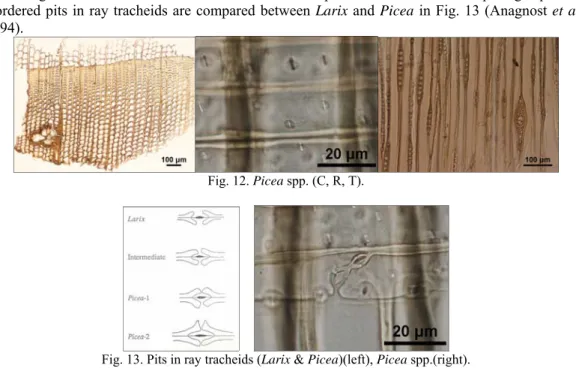
Longitudinal and transverse resin canals has thick epithelial cells. Cross-field pitting is piceoid.
Bordered pits in ray tracheids are compared between Larix and Picea in Fig. 13 (Anagnost et al., 1994).
Fig. 12. Picea spp. (C, R, T).
Fig. 13. Pits in ray tracheids (Larix & Picea)(left), Picea spp.(right).
3-2-12 Ponderosa-type hard pine -Pinus, Pinaceae
We could not observe its cross section due to small size of the sample. They have resin ducts.
Rays consist of both ray tracheid and ray parenchyma cells. Cross-field pits are pinoid of 2~5 per field. Walls of ray tracheid have dentate thickening. It belong to Ponderosa-type pine (Barefoot et al., 1982).
Fig. 14. Ponderosa type hard pine (R, R. T).
3-2-13 Populus spp.- Salicaceae
It is diffuse porous wood with radial pore multiples. Rays are mainly homocellular and exclusively uniseriate. The shape of vessel-ray pitting are circular or oval.
Fig. 15. Populus spp. (C, R, T).
3-2-14 Betula spp. – Betulaceae
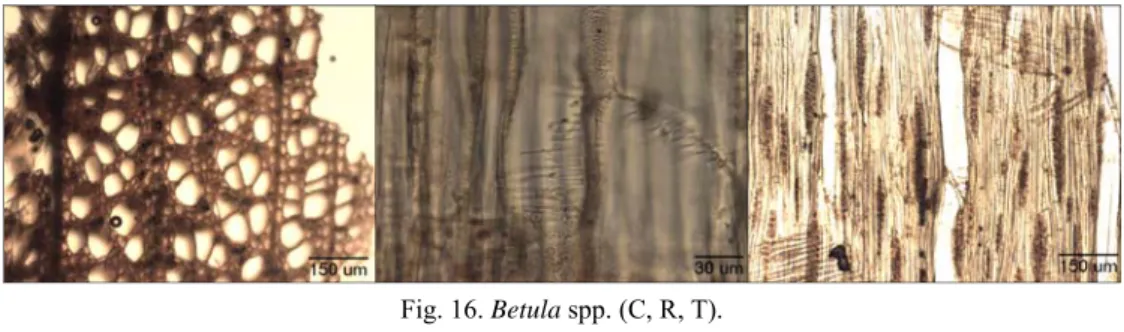
It is diffuse-porous wood with solitary or pore cluster of 2~6. Rays (1~3 seriates) are mainly homocellular. It has scalariform perforation with more than 10 bars.
Fig. 16. Betula spp. (C, R, T).
3-2-15 Juglans spp. – Juglandaceae
It is semi ring-porous wood with solitary pores. Longitudinal parenchyma cells distribute in
reticulate or diffuse-in-aggregate. Rays (3~5 seriates) are mainly homocellular and sometimes
heterocellular Ⅲ.
Fig. 17. Juglans spp. (C, R, T).
3-2-16 Torreya nucifera Sieb. et Zucc. – Taxaceae
Rays consist of ray parenchyma cell only. Axial tracheid has spiral thickening in pair.
Cross-field pits are usually cupressoid. Ray parenchyma cells have indenture.
Fig. 18. Torreya nucifera Sieb. et Zucc. (C, R, R).
3-2-17 Chamaecyparis spp. – Cupressaceae
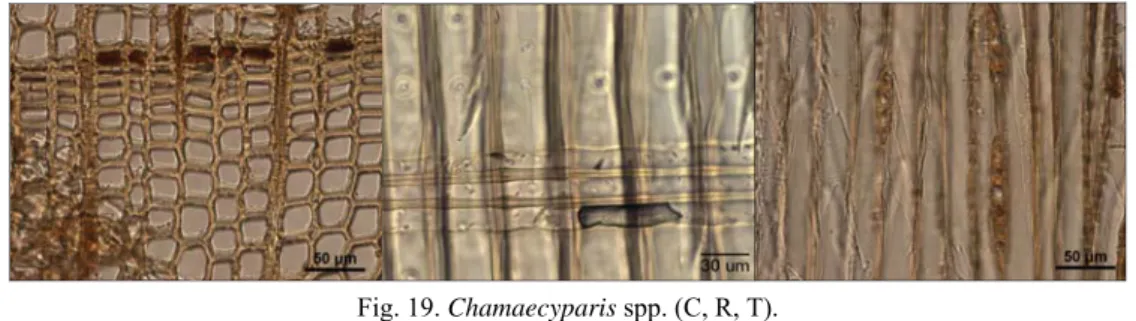
It has abundant axial parenchyma cells, but no resin ducts. Rays consist of ray parenchyma with thick wall. Cross-field pitting is cupressoid.
Fig. 19. Chamaecyparis spp. (C, R, T).
3-2-18 Pyrus spp.- Pomoideae, Rosaceae
We could not observe a complete annual ring. It is a diffuse-porous wood with solitary pores.
Rays are mainly homocellular with 1~3 seriates. Vessels have fine spiral thickening.
Fig. 20. Pyrus spp. (C, R, T).
3-2-19 Castanea spp. – Fagaceae
It is ring-porous wood with latewood pores in flame-like pattern. Rays are exclusively uniseriate and mostly homocellular. It has simple perforation.
Fig. 21. Castanea spp. (C, R, T).
3-2-20 Ulmus spp. - Ulmaceae
It is ring-porous wood with pore zone of 1~2 layers. Rays are mainly homocellular and 4~6 seriates. Latewood vessels have distinctive spiral thickening.
Fig. 22. Ulmus spp. (C, R, T).
3-2-21 Kalopanax oictuse (Thunb.) Nakai – Araliaceae
It is ring-porous wood with pore zone (1 layer). Latewood pores are clustered. Rays, 3~4
seriates, are mostly heterocellular Ⅲ type. It has simple perforation.
Fig. 23. Kalopanax oictuse (Thunb.) Nakai (C, R, T).
3-2-22 A kind of bamboo – Bambusoideae, Gramineae
It has atactostele, that is, without secondary xylem but vascular bundles. The ground tissues are mainly parenchyma cells. Thick-walled sheath fibers, which surround vascular bundles, are obviously observed in the cross section.
Fig. 24. A bamboo (C, R, R).
3-3 Number of species used in one furniture and their uses
The number of species used for single furniture is important to know how well the carpenters compose the furniture according to the quality and figures of woods. Most of furniture were made of more than two kinds of woods, up to 6 species. Thirty seven furniture (45% in total) was made of single species, 19 (23%) of two species, 16 (20%) of three species and 10(12%) of 4 to 6 species.
Figure 25 shows an example of 19th-century furniture, in which five species were used.
Table 2 shows the uses of individual species as grouped in three main parts; frame, board and
decorative panel. Only hard pine and Zelkova were used for all three parts. The furniture with highly
decorative panels was composed of various species. Major species for decorative panels were
Zelkova, Diospyros, Pyrus, Ulmus, Juglans, Castanea and Kalopanax. They are ring-porous or
semi-ring porous woods having beautiful grain and/or colorful figures. Two softwood species
(Ginkgo and Torreya) and four ring-diffuse woods (Alnus, Tilia, Betula and Populus) were also
used for decorative panels together with ring-porous or semi-ring porous woods. For the frame and
panel, hard and strong woods, such as hard pine, Zelkova and Cedrela as well as moderately strong
woods such as soft pine, Abies and Picea were used. For drawer, however, soft and low shrinkage
woods such as Paulownia and Tilia were used. The quality of Korean woods is well documented in
Lee (1997). Bamboo was used for fixing pin in lock folder (gojung-gae).
Top panel Drawer face
Zelkova serrata (Thunb.) Makino Drawer side
Side Leg Drawer bottom
Bottom
Diploxylon
Soi-mok Dong-ja Bottom-stick
Cedrela sinensis A. Juss.
Bottom
(repair part) Ginkgo biloba Linn.
(A.D. 1839 as dated by tree rings)
Leg-still Soft Pine
Fig. 25. An example of species used for furniture (Seo # 2356).
Table 2. Uses of individual species for furniture Uses
Species Frame Board Decorative panel Etc.
Hard Pine ○ ○ ○
Soft Pine ○ ○
Abies spp. ○
Ginkgo biloba Linn. ○ ○ Picea spp. ○ ○
Torreya nucifera Sieb. et Zucc. ○ Chamaecyparis spp. ○
Zelkova serrata
(Thunb.) Makino ○ ○ ○
Tilia spp. ○ ○
Paulownia spp. ○ ○
Alnus spp. ○
Cedrela sinensis A. Juss. ○ ○
Juglans spp. ○
Diospyros spp. ○ ○
Pyrus spp. ○
Betula spp. ○
Castanea spp. ○ ○
Populus spp. ○
Ulmus spp. ○
Kalopanax oictuse (Thunb.) Nakai ○
Bamboo ○