서론
최근 우리나라의 여성 암 조발생률과 유병율 중 유방암 이 10만명 당 20.5% 및 21.1%로 1위와 2위에 해당하고, 여성의 35∼64세 연령대에서 조발생률은 29.3%로 1위이며, 주요 암종 5년과 10년의 상대생존율은 93.3%와 88.3%로 1위를 차지하여 다른 악성신생물보다 생존율이 높은 것으 로 나타났다[1]. 유방암은 우리나라뿐 아니라 세계 여성들 에게 진단되는 암 중에서 가장 높으며, 악성신생물로 인 한 사망의 주된 원인이다[2].
유방암의 발생률이 증가하고 유방암 환자의 생존율이 증가함에 따라 다양한 치료 방법들이 제시되고 있다. 유 방암 치료는 유방 전절제술 및 유방 보존적 절제술 등의
외과적 수술법, 항암 화학요법, 표적치료 및 내분비 요법, 방사선요법 등 암에 대한 전이 및 재발을 방지하기 위하 여 다양하게 접근하고 있으나 이러한 항암치료 및 보전적 치료들은 유방암환자의 림프부종, 통증, 근력 약화, 감각 변화, 가동범위의 제한, 삶의 질 저하, 우울 및 스트레스 등과 관련하여 신체 및 정신적인 측면에서 심각한 영향을 미친다[3-6].
유방암에 대한 외과적 시술 후에 약 20∼40%의 환자 에게서 림프부종이 유발되며 통증, 팔 감각 저하, 위팔의 근력 저하 등을 유발하게 되며, 유방암절제술로 인하여 신체의 변화 및 여성적인 미의 상실에 의해 유방암 환자 들의 삶의 질에 영향을 미치고 극심한 스트레스를 유발할 수 있다[7-10]. 스트레스는 신경과 호르몬 반응이 내부와
https://doi.org/10.14474/ptrs.2021.10.2.141
eISSN 2287-7584 pISSN 2287-7576
Phys Ther Rehabil Sci 2021, 10(2), 141-146
www.jptrs.org
The Effect of Manual Lymphatic Drainage on the Stress and Pain in Patient with Postoperative Breast Cancer
Mingyun Ko
aa
Department of Physical Therapy, Gwangju Health University, Gwangju, Republic of Korea
Objective:
This study was at investigated the effects of manual lymphatic drainage (MLD) on stress and pain in patients with postoperative breast cancer.Design:
A randomized controlled trial.Methods:
A total of twenty-two patients with postoperative breast cancer voluntarily participated in the study. Subjects were randomly assigned to the MLD groups (n=12) and rest groups (n=12). The intervention was conducted in each group for twenty minutes a day, five times a week, for four weeks. Before and after the intervention, the participants measured sympathetic nerve, parasympathetic nerve, and pain by using a sphygmograph and short-form McGill pain questionnaire.An independent t-test was used to analyze pretest and posttest changes between the groups, a paired t-test was used to analyze pre-posttests within each group.Results:
After analyzing, the MLD group has been shown a significant decrease in the sympathetic nervous system (p<0.05), a significant increase in the parasympathetic nervous system (p<0.05), and a significant increase in pain (p<0.05). However, the rest group was no significant difference between pre and post.Conclusions:
The results of this study confirmed that MLD techniques are an effective method in reducing stress and pain in patients with postoperativebreast cancer. And it is thought that can be used as basic data and to develop programs on stress and pain management reduction for patients with breast cancer.Key Words:
Breast cancer, Stress, Pain, Sympathetic nervous system, Parasympathetic nervous systemReceived: May 7, 2021 Revised: May 31, 2021 Accepted: Jun 2, 2021
Corresponding author: Mingyun Ko(ORCID https://orcid.org/0000-0001-8058-4138) Department of Physical Therapy, Gwangju Health University
73, Bungmun-daero 419beon-gil, Gwangsan-gu, Gwangju, Republic of Korea Tel: +82-62-958-7762 Fax: +82-62-958-7768 E-mail: [email protected]
This is an Open-Access article distributed under the terms of the Creative Commons Attribution Non-Commercial License (http://creativecommons.org/licenses/
by-nc/4.0) which permits unrestricted non-commercial use, distribution, and reproduction in any medium, provided the original work is properly cited.
Copyright © 2021 Korean Academy of Physical Therapy Rehabilitation Science
외부 환경자극에 대하여 상호작용으로 나타나는 정신생리 학적인 반응이다[11]. 만성적인 스트레스는 대뇌 및 시상 하부와 자율신경계 같은 신경 내분비 계통의 비활성화 및 활성에 대한 패턴을 초래하여 피부저항을 감소시켜 혈관 을 수축시키고 혈관 내피세포의 기능 저하, 호르몬의 불 균형, 염증, 면역체계의 기능 저하 등을 야기하여 유방암 환자들의 악성신생물 재발을 유발하고 쉽게 다른 질병에 노출되게 만든다[12-13].
물리치료적 요법 중 림프부종과 교감신경의 활성을 감 소시키고 피부저항을 증가시키기 위한 방법으로 도수림프 배출(manual lymphatic drainage; MLD)기법이 사용된 다. MLD 기법은 피부표면에서 림프관을 따라 통증이나 자극없이 시행하는 방법으로 신체를 이완하여 교감신경의 감소를 조절하고 조직의 섬유성 변성을 방지하며 림프의 순환을 증가시켜 정체되어 있는 림프액이나 과도한 사이 질액을 제거하거나 감소하기에 효과적인 기법이다[14-16].
또한, 마사지 방법이 간단하고 쉬우며 특별한 기구가 필 요하지 않기 때문에 누구나 적용할 수 있다. 이러한 MLD 기법은 의학 및 미학 등 여러 분야에서 응용되고 있으며, 그에 관한 연구가 이뤄지고 있다[17-20].
최근에는 유방암 환자의 생존율이 높아지면서 림프부 종과 부종감소의 목적으로 MLD의 적용에 관한 연구들에 관심이 고조되고 있지만, 유방암 환자의 수술 및 치료 후 의 스트레스 및 통증 완화와 관련된 연구는 아직도 미흡 하다. 이에 본 연구의 목적은 유방암 환자에게 MLD 기 법을 적용하여 자율신경계의 변화와 통증감각을 비교 분 석함으로써 유방암 환자의 스트레스 및 통증을 감소시키 기 위한 기초자료 및 효과적인 접근 방법을 제시하고자 한다.
연구 방법
연구 대상
본 연구는 전라남도 담양에 위치한 M요양병원의 유 방암으로 입원환자 중 연구참여에 대한 동의서에 서명한 22명을 대상으로 실시하였다. 본 연구를 위한 대상자의 선정에 대한 조건은 다음과 같다. 첫째, 1년 이내에 유방 암 진단 후 수술을 받은 자. 둘째, 방사선치료 및 항암치 료를 마친 자. 셋째, 신경학적인 질환이 없는 자로 하였 다. 연구 대상의 제외에 관한 조건은 다음과 같다. 첫째, 피부염이 있는 자. 둘째, 급성 혈전증 및 심부전이 있는 자. 셋째, 악성 림프부종이 있는 자. 넷째, 팔에 혈관장애 및 마비가 있는 자. 다섯째, 본 연구와 유사한 연구를 최 근 1년 이내에 참여한 자로 하였다. 본 연구에 진행하기 전모든 대상자들은 연구에 대한 목적 및 내용과 참여방 법 등에 관하여 충분하게 설명을 들은 후에 연구참여동
의서에 자발적으로 서명한 동의자들만 연구에 참여하였 으며, 연구를 진행하는 동안 코로나19 방역 대책을 준수 하였다.
연구 절차
본 연구는 두 집단 사전-사후검사 설계로, 연구대상자 의 선정에 대한 편견의 최소화를 위해 무작위로 배정하여 MLD적용그룹(n=11)과 휴식그룹(n=11)으로 분류하였다.
본 연구에서 중재는 1일 1회, 주 3회로 4주 동안 진행하 여 총 12회를 실시하였으며, 1회 중재 시 20분을 적용하 였다[21]. 연구를 진행하기에 앞서 사전검사로 대상자의 일반적인 특성 및 자율신경계 변화량과 통증감각을 측정 하였고, 4주 후 동일한 방법으로 사후검사를 측정하였다.
중재 방법
연구 대상자는 바로누운자세에서 엉덩관절이 70° 굽힘 이 되게 무릎 밑을 베개로 받쳐 전신의 근육이 최대한 이 완되는 자세를 취하게 하였다. MLD 적용그룹의 중재는 MLD 교육과정을 이수한 물리치료사에 의해 시행되었으 며, 대상자에게 시술자가 두 손을 최대한 밀착시킨 상태 에서 부드럽고 가볍게 20분간 실시하였다. MLD 기법의 적용은 Dr. Vodder의 방법을 기초로 시행되었다[22]. MDL 기법의 적용 부위에 대한 순서는 우선 위팔에서 목 림프 절, 뒤통수부위, 아래턱부위, 위등세모근, 어깨뼈봉우리 순 으로 목 부위를 적용하였고, 위팔에서 어깨세모근, 등세모 근, 어깨 올림근, 마름근, 가시위근, 가시아래근 순으로 등 부위를 적용하였다.
휴식그룹은 MLD 적용그룹과 동일한 자세에서 20분간 눈을 감고 편안한 자세를 취하게 하였다.
측정방법 및 도구 스트레스(Stress)
연구 대상자의 스트레스에 대한 변화를 측정하기 위하 여 비침습적 맥파측정기(uBioClip v70, Biosense Creative Co. ltd., Korea)를 사용하였다. 최근 스트레스에 대한 자율 신경계의 변화를 모니터 하는 방법으로 광전용적맥파(Photo plethysmography) 통한 심박변이도(heart ratevariability) 의 변화 양상을 분석하는 방법이 많이 이용되고 있다. 비 침습적 맥파측정기는 LED 적외선 광원을 검지손가락의 모세혈관에 비추어 그 빛에 대한 헤모글로빈의 반사농도 를 수광부의 센서를 통하여 광전용적맥파 신호로 변환한 뒤 파동을 분석하는 방법이다. 심박변이도에 대한 데이터 중 교감신경의 활성도를 반영하는 저주파수 전력(Low Frequency power; LF)과 부교감신경이나 미주신경의 활
성도를 반영하는 고주파수 전력(High Frequency power;
HF)은 파워스펙트럼 밀도(power spectrum density)를 이 용하여 분석해서 계산하였다[23-24].
LF와 HF를 측정하기 위해 연구 대상자는 5분간 의자 에서 안정된 자세를 취한 후, 테이블위에 본인의 심장 높 이로 팔을 올려둔 상태에서 오른쪽 검지손가락에 맥파계 의 펄스옥시미터를 착용하고 2분 30초간 측정하였으며, 동일한 방법으로 3회 측정하여 평균값을 적용하였다.
통증(pain)
통증의 측정을 위하여 단축맥길통증척도(short form McGill pain questionnaire; SF-MPQ)를 사용하였다. SF-MPQ는 11개 항목의 감각영역과 4개 항목의 정서영역으로 구성되 어 있으며, 통증 감각과 더불어 정서적인 감각까지 평가 할 수 있다[25]. 문항 당 0점에서 3점까지 총 4점 척도의 리커드식으로 되어 있으며, 점수가 통증감각이 높을수록 합산한 점수가 높다.
연구 대상자들은 SF-MPQ의 작성법에 대한 설명을 듣 고 충분히 인지한 후에 안정된 상태에서 자가평가를 실시 하였으며, 환자가 이해하지 못한 문항에 관해서는 물리치 료사가 설명을 해주었다.
자료 분석
본 연구의 수집된 자료는 SPSS Statistics(ver. 20.1, IBM Co., USA) 프로그램을 사용하여 분석하였다. 연구 대상자 들의 일반적 특성은 기술 통계를 이용하였고, Shapiro-Wilk 검정을 이용해 정규성 검정을 확인하였다. 독립표본 t검정 (independent t-test)을 이용하여 각 그룹 간 중재 전과 중 재 후를 비교하였으며, 대응표본 t검정(Paired t-test)을 이 용하여 각 그룹내의 중재에 따른 변화를 비교하였다. 모 든 자료의 통계학적 유의수준은 α=0.05로 하였다.
연구 결과
연구대상자의 일반적 특성
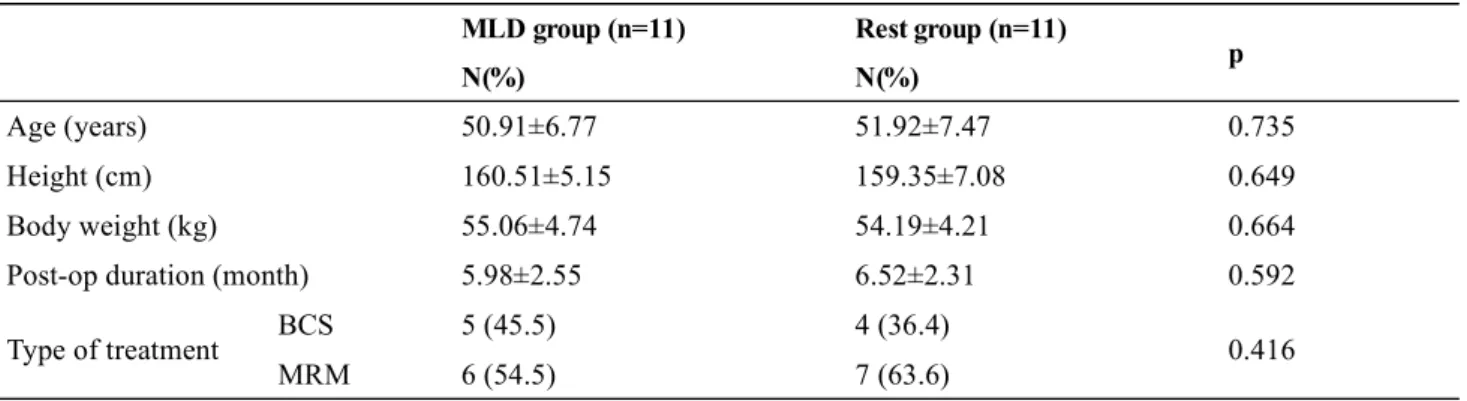
본 연구에 참여한 대상자는 22명으로 평균 연령은 51.41
±6.99세(최소 37세, 최대 65세), 평균 신장은 159.93±6.08 cm, 평균 체중 54.89±4.41kg, 수술 후 기간은 6.25±2.40 개월이었다. 수술형태로는 40.91%가 유방보존술을 받았으 며, 50.09%가 변형 근치적 유방절제술을 받았다(Table 1).
대상자들에 대한 동질성 분석 결과, 두 그룹은 동일한 그 룹임을 확인하였다.
교감신경 전 ‧ 후 변화
교감신경의 변화에 대한 각 그룹 내 중재 전 ‧ 후의 LF 활성도를 비교한 결과 MLD 그룹에서 중재 후에 통계적 으로 유의한 차이가 있었으며(p<0.05), 휴식그룹에서는 유의한 차이가 없었다. 그룹 간 중재 후의 차이를 비교한 결과 유의한 차이가 있었다(p<0.05)(Table 2).
부교감신경 전 ‧ 후 변화
부교감신경의 변화에 대한 각 그룹 내 중재 전 ‧ 후의 HF활성도를 비교한 결과 MLD 그룹에서 중재 후 통계적 으로 유의한 차이가 있었으며(p<0.05), 휴식그룹에서는 유의한 차이가 없었다. 중재 후에 두 그룹 간의 차이를 비 교한 결과 통계적으로 유의한 차이가 있었다(p<0.05) (Table 3).
통증감각 전 ‧ 후 변화
통증감각의 변화에 대한 각 그룹 내 중재 전 ‧ 후를 비 교한 결과 MLD 그룹에서 중재 후 통계적으로 유의한 차 이가 있었으며(p<0.05), 휴식그룹에서는 유의한 차이가
MLD group (n=11) Rest group (n=11)
N(%) N(%) p
Age (years) 50.91±6.77 51.92±7.47 0.735
Height (cm) 160.51±5.15 159.35±7.08 0.649
Body weight (kg) 55.06±4.74 54.19±4.21 0.664
Post-op duration (month) 5.98±2.55 6.52±2.31 0.592
Type of treatment BCS 5 (45.5) 4 (36.4)
0.416
MRM 6 (54.5) 7 (63.6)
The values are presented Mean±SD
MLD: manual lymph drainage, BCS: breast conserving surgery, MRM: Modified Radical Mastectomy.
Table 1.
General Characteristics of Subjects (n=22)없었다. 중재 후에 두 그룹 간의 차이를 비교한 결과 통계 적으로 유의한 차이가 있었다(p<0.05)(Table 4).
고찰
자율신경계는 외부 환경 및 신체 내부의 변화에 대하여 심장근과 민무늬근, 일부 내분비샘과 외분비샘을 통제하 여 신체의 기능을 통제하고 조절한다. 신체가 스트레스에 노출되면 교감신경은 심장박동수 및 혈압, 신진대사율, 정 신활동 등을 증가시키는데, 스트레스 자극에 의한 과도한 교감신경의 활성은 신체 신진대사의 이상을 초래한다[26].
이에 신체는 항상성을 유지하고자 교감신경에 대해 길항
작용을 일으키는 부교감신경의 활성을 유도해 신체를 이 완상태로 회복시킨다[27]. 이와 같이 자율신경계의 균형 있는 조절은 자극에 대하여 적절히 반응하여 신체에 긍정 적인 효과를 제공하며 스트레스로 인해 유발되는 문제를 방지할 수 있다. 유방암 환자들은 림프부종 및 통증과 같 은 생리적 변화와 수술 및 치료 후의 자신의 변화된 외적 모습으로 인한 심한 스트레스를 겪게 되는데[9, 28], 이에 본 연구는 MLD 기법이 유방암 환자의 스트레스와 통증 에 미치는 영향을 알아보기 위해 실시하였다.
본 연구의 결과 MLD 기법을 적용한 그룹에서 교감신경 을 나타내는 LF 값이 유의하게 감소하였고(p<0.05), 부교 감신경을 나타내는 HF 값이 유의하게 증가하였다(p<0.05).
MLD group (n=11) Rest group (n=11) t(p)
LF
Pre 7.55±0.57 7.49±0.69 0.002 (0.845)
Post 6.79±0.40 7.38±0.73 -2.448 (0.023)*
∆ 0.75±0.42 0.11±0.27 4.357 (0.001)**
t(p) 6.063 (0.001)** 1.452 (0.174) The values are presented Mean±SD
*p<0.05, **p<0.01
LF: power in low frequency range, MLD: manual lymph drainage.
Table 2.
Comparison of Sympathetic Nerve (n=22)MLD group (n=11) Rest group (n=11) t (p)
HF
Pre 5.72±0.65 5.87±0.52 -0.596 (0.557)
Post 6.54±0.54 5.96±0.51 2.923 (0.008)**
∆ -0.82±0.44 -0.042±0.14 -5.797 (0.001)**
t (p) -6.415 (0.001)** -1.050 (0.316) The values are presented Mean±SD
*p<0.05, **p<0.01
HF: power in high frequency range, MLD: manual lymph drainage.
Table 3.
Comparison of Parasympathetic Nerve (n=22)MLD group (n=11) Rest group (n=11) t (p)
SF-MPQ
Pre 9.00±2.45 8.33±1.87 0.749 (0.462)
Post 5.83±1.80 8.00±2.25 -2.600 (0.016)*
∆ 3.17±1.53 0.33±0.65 5.911 (0.001)**
t (p) 7.181 (0.001)** 1.773 (0.104) The values are presented Mean±SD
*p<0.05, **p<0.01
SF-MPQ: pshort-form McGill pain questionnaire, MLD: manual lymph drainage.
Table 4.
Comparison of Pain (n=22)이는 MLD 기법이 부드럽고 리듬감 있는 기계적 자극을 제공함으로써 신체 피부와 근육의 이완을 유도하고, 이는 뇌에 스트레스 자극을 보내는 구심성 경로를 차단함으로 써 시상하부에 대한 스트레스 자극을 감소시켜 교감신경 의 활성을 억제하고 부교감 신경을 활성화를 유발하는 것 으로 생각된다. Shim 등[29]의 연구에서 MLD 기법을 적 용 후 뇌파를 분석한 결과 α파는 증가하였고, β파와 γ파 는 감소하였다고 보고하였다. 이러한 선행연구를 바탕으 로 MLD에 의한 자극은 상향식 조절에 의해 안정파인 α 파의 증가와 스트레스 및 흥분상태와 관련된 β파와 γ파를 감소시켜 미주신경 등 부교감신경의 활성화 및 교감신경 의 활성의 억제를 유도했다고 생각된다. Kim[30]은 스트 레스가 있는 성인을 대상으로 MLD 적용한 결과 HF 값 이 감소하고 LF 값이 증가한 것으로 보고하여 본 연구에 대한 결과를 뒷받침하였다.
본 연구에서 MLD 기법을 적용한 그룹에서 통증감각 의 유의한 변화가 있었다(p<0.05). Keser와 Esmer[31]의 연구에서 건강한 성인에게 MLD 기법을 적용한 결과 통 증 역치 및 내성이 유의하게 증가였다고 보고하였고, Kim[30]의 연구에서도 통증역치가 증가하였다고 보고하 여 본 연구의 결과와 일치하였다. 이러한 결과는 피부의 통각 수용체에 대한 MLD 기법의 가볍고 부드러운 기계 적 자극이 관문조절설에 의해 교양질 세포를 활성화하여 통증의 전달을 차단하고, 부교감신경의 증가로 따른 스트 레스 반응의 감소 및 이완반응의 증가가 복합적으로 작용 하여 통증감각이 감소한 것으로 생각된다.
본 연구의 제한점은 연구를 진행하는 데 있어 외부 변 수에 대한 통제의 미흡과 측정변수와 연구대상자의 수가 적다는 점에서 한계가 있었다. 이에 앞으로의 연구에서는 대상자의 수를 늘리고 다양한 변수의 측정 및 외부 변수 들을 통제하여 진행할 것으로 생각된다.
결론
본 연구는 유방암 환자를 대상으로 MLD 기법이 스트 레스 및 통증감각에 미치는 영향에 대하여 알아보고자 하 였다. MLD 기법은 유방암 환자의 부교감신경을 활성화 시키며 교감신경의 활성화 및 통증감각을 감소하는데 유 의한 효과를 보였다.
이에 본 연구의 결과를 통해 유방암 환자의 스트레스 및 통증 감소에 MLD 기법이 효과적인 중재법임을 확인 하였고, 유방암 환자들의 스트레스 관리 및 통증 감소에 관한 프로그램을 개발 시에 기초 자료로 활용할 수 있을 것으로 생각된다.
이해충돌
본 연구의 저자는 연구, 저자권, 및 출판과 관련하여 잠재적인 이해충돌이 없음을 선언합니다.
참고문헌