. Introduction
Ⅰ
Cause-related marketing (CRM), the actions by firms of donating a specific amount to a particular non-profit effort, is an effective way
Corresponding author: Yang Sujin, Tel. +82-2-2076-7212, Fax. +82-2-2076-6987 E-mail: [email protected]
This work was supported by the National Research Foundation of Korea Grant funded by the Korean Government(NRF-2011-35C-B00185)
to accomplish corporate social responsibility (Bronn & Vrioni, 2001). CRM can help a brand differentiate itself from its competitors, improve its image and increase consumers’ purchase intention of its products or services (Hyllegard,
The Effect on Korean Consumers' Brand Preference, Trust and Purchase Intention for Donation Amount
Information of Luxury Fashion Brands
Choi Yunjung ․ Yang Sujin⁺ ․ Yoon Soyeon Design and Environmental Analysis, Cornell University
Business Operation, Cheil Industry⁺
Abstract
This study attempts to explain the unique patterns in Korean consumer behavior regarding the luxury fashion brands’ donation activities by exploring the moderating effects of corporate ability (CA) and subjective norm (SN) on the relationship between donations and consumers’ brand preference, brand trust, and purchase intention. A total of 209 completed questionnaires, collected from online surveys, were analyzed using moderated multiple regression. The result shows that donation amount information positively influences consumers’ brand preference, brand trust and purchase intention toward luxury fashion brands. Next, CA strengthens the relationships between donation amount information and consumers’ brand trust and purchase intention. SN from the opposite gender compensates for the negative effect of negative donation amount information on consumers’ trust toward luxury fashion brands, whereas SN from the same gender does not influence those relationships. This study provides a deeper understanding of luxury fashion brands’
donations and consumer responses in South Korea-one of the important test markets for luxury fashion brands to expand their business to Asian countries.
Key words : corporate ability, donation amount information, luxury fashion brands, subjective norm
Ogle, Yan, & Attmann, 2010). The donation magnitude has been an important issue in CRM studies. The donation amount information can be used by consumers to make assumptions about a company or a product (Ellen, Lois, &
Deborah, 2000). The attributions that consumers make of large donation amounts may lead them to form a positive image of a company.
In recent years, several luxury fashion brands have been perceived as showing considerably less concern about CRM in Korea compared to Western countries. Major luxury fashion brands including Fendi Korea, Louis Vuitton Korea and Ferragamo Korea donated a very small proportion of their total sales: 0.01% in 2010 (Financial Supervisory Service, 2012). The combined social contribution by the top 10 major luxury fashion brands was just about US$0.9 million, 0.14% of their net profit between 2006 and 2011 (Y. Kim, 2012). By contrast, these brands have engaged in superior CRM activities in Western markets. For example, LVMH (Louis Vuitton Moët Hennessy) has continued to support an international music academy in Switzerland while donating to and patronizing young artists in France (LVMH, 2012). Fendi has announced its donation plan for a US$2.93 million restoration of the Trevi Fountain, one of the famous attractions in Rome (Davies, 2013).
Although mass media has repeatedly reported defensive donation actions by luxury fashion brands in South Korea (K. Kim & Moon, 2013), Korean consumers’ spending on luxury goods has continued to increase (E. Choi, Hong, &
Lee, 2010; Y. Kim, 2012). In general, rapidly developing countries such as Korea experience imbalance between economic growth and citizenship awareness (U. Kim & Park, 2006).
One such indication can be observed by people prioritizing purchasing luxury brand items over
making donation. Some Koreans have raised a critical voice to the country’s consumers of luxury fashion brands, who seem to have no concern about the brands’ defensive donations (Chung, 2012). Are Korean consumers less interested than Western consumers in CRM?
What factors affect Korean consumers’
responses to CRM activities by luxury fashion brands? To answer these questions, this study explores the effect of the donation amount information of luxury fashion brands on consumer responses in South Korea, which is a representative of developing countries.
Previous CRM studies have focused on Western consumers (Boenigk & Schuchardt, 2013; Bronn & Vrioni, 2001; Strahilevitz, 1999).
Considering the cultural differences, consumer perceptions about luxury CRM in Asian markets could be different from those in Western markets (Subrahmanyan, 2004). However, no research has fully explored luxury CRM in Asian markets even though Asia has become one of the biggest markets in luxury goods (Boenigk &
Schuchardt, 2013). Korean consumers seem especially poised to become the next luxury powerhouse in Asia, even overtaking Japan (Luxe Brand Advisors, 2012). In addition, Korean consumers have a fashion leadership to other Asian markets (Cayla & Eckhardt, 2007; Wang &
Lee, 2012). Thus, examining luxury CRM in Korean markets could provide valuable insights for research in fashion marketing. A better understanding of luxury consumer behavior in Korea should benefit the luxury fashion industry by helping fashion marketers improve their marketing strategies for luxury fashion brands in one of the most sought-after markets in Asia.
Donation magnitude, a key characteristic of CRM, has been widely discussed as an important antecedent to companies’ performance
(Dahl & Lavack, 1995; Olsen, Pracejus & Brown, 2003). Although the influence of donation magnitude on consumer behavior has been explored in many studies (Cho, Park, & Park, 2010; Strahilevitz, 1999), empirical research on the donation amount information by luxury brands is lacking. Several studies investigated the influence of donation amount information on consumer attitudes toward hedonic or high-priced offerings (Cho et al., 2010;
Strahilevitz, 1999), which does not correctly focus on luxury offerings. Especially, as high CRM donation amounts can ameliorate consumers’ feelings of guilt generated from luxurious consumption (Boenigk & Schuchardt, 2013), it is important for luxury brands to hurdle the negative attitudes through CRM activities and let consumers open the wallet for high priced products. Thus, our study tried to fill this gap by exploring the influence of donation actions by luxury fashion brands on not only attitudes but also behaviors like purchase intention regarding donation magnitudes.
Consumer responses to CRM involves various potential moderating variables including corporate ability (CA) (Berens, Van Riel, & Van Rekom, 2007), product categories (Strahilevitz &
Meyers, 1998), types and proportions of donations (Olsen et al,, 2003), and consumers’
individual traits (Ross, Larry, & Marry, 1992). In this study, we focus on CA and subjective norm (SN) to examine luxury consumer behavior in Korea. As market leaders, luxury fashion brands have superior CA, which can be defined as aspects of corporate performance such as high product quality, craftsmanship or level of services (Fionda & Moore, 2009). CA is defined as “the company’s expertise in producing and delivering its outputs" (Brown & Dacin, 1997, p.
68), and it includes both intrinsic attributes such
as product or service quality and extrinsic attributes such as consumer profile and innovation. In addition, several studies that explored Korean consumer behavior (C. Lee &
Youm, 2011; Hierang Park & Hahn, 2006) demonstrate the influence of SN on consumers’
attitude toward luxury brands and buying intention. That is referred to as "the perception that most people who are important to an individual influence the individual’s purchasing behavior" (Fishbein & Ajzen, 1975, p.302). Based on their close relationships with luxury consumption in South Korea, CA and SN can be expected to play an important role in Korean consumers’ attitude toward donation actions by luxury fashion brands.
The main purpose of this study is to explore the influence of the donation amount information of luxury fashion brands on consumer responses such as brand preference, trust and purchase intention. Specifically, we focus on two important moderating variables that affect the relationship between donation amount information and consumer responses: (a) the superior CA of luxury fashion companies and (b) the SN of consumers derived from the high visibility of luxury products.
. Theoretical Background and
Ⅱ
Hypotheses
1. Luxury Fashion Brands
Luxury has been conceptualized from the side of consumption or from the branding perspective. In the former perspective, the main characteristics of luxury include scarcity, exclusivity, status and quality (Atwal & Williams,
2009). In the latter perspective, luxury brands can be associated with exclusivity with a well-known brand identity, a high level of brand awareness and perceived quality, sales-level retention and consumer loyalty (Phau &
Prendergast, 2000). Narrowing down to more practical triats, Moore, Fernie, and Burt (2000) define the characteristics of luxury fashion brands as the following: (a) holding a regular fashion show in one of four major fashion cities (i.e., Paris, Milano, London or New York), (b) having a fashion business in two or more countries for at least two years, and (c) having outlets bearing the representative designer’s or an associate’s name. We selected luxury fashion brands for the study based on Moore et al.’s (2000) defining characteristics of luxury fashion brands.
2. Donation Amount Information and Consumer Responses
Previous studies reported that the magnitude of donations positively influenced companies’
performance (Dahl & Lavack, 1995; Olsen et al., 2003). Strahilevitz (1999) identified that when the level of a company’s donation was high, consumers were willing to pay more for their hedonic products such as luxury items than for utilitarian products. Cho et al. (2010) showed that if the price ranges are equal, Korean consumers expected the providers of hedonic and high-priced products to have a relatively higher donation rate than those that offer utilitarian and low-priced products. Narrowing their focus to luxury brands, Boenigk and Schuchardt (2013) identified that the donation magnitude information provided by luxury brands positively influenced consumers’ purchase intention in Germany.
This study focuses on the impact of CRM donations by luxury fashion brands on three outcome variables: brand preference, trust and purchasing intention. Brand preference and trust are important variables to lead and maintain positive relationships between brands and their consumers (Chaudhuri & Holbrook, 2001).
Consumer preference is a core element of consumer response to marketing (Keller, 1993).
Brand trust is an effective tool in reducing the perceived risk of purchase decisions and ultimately has a positive impact on consumers’
product and corporate evaluations (H. Kim &
Lee, 2011). Consumers’ brand preference, trust, and purchase intention have also been explored to predict consumer luxury behavior in many studies (Jaejin Lee & Yoon, 2011; Jaejin Lee, N.
Ryu, & Kahn, 2013; Song, Hur, & Kim, 2012).
In the context of South Korea, Jaejin Lee and Yoon (2011) showed that donation campaigns positively influenced consumer preferences for luxury fashion brands. Although luxury CRM studies on brand trust in Korea are lacking, we found several researches that show the positive relationship between the donation activity by fashion brands and consumers’ brand trust (M.
Choi & Yoon, 2010; Jungim Lee & Shin, 2010).
Next, Jaejin Lee et al. (2013) reported that CRM positively influenced Korean consumers’
purchase intention of luxury products. These results imply that Korean consumers might perceive that luxury fashion brands, which are characterized by hedonic and very expensive products, should have a high donation rate.
Therefore, we propose the following hypothesis:
H1a. The donation amount information of luxury fashion brands has a positive influence on consumers’ brand preference.
H1b. The donation amount information of
luxury fashion brands has a positive influence on consumers’ brand trust.
H1c. The donation amount information of luxury fashion brands has a positive influence on consumers’ purchase intention.
3. CA as a Moderator
S. Choi (2003) discussed that the high quality of luxury fashion products was an important factor in explaining the hedonic value of luxury consumption in South Korea. However, empirical research on the relationship between donations and CA with luxury consumption offerings is lacking. Rather, we have found some theoretical links from previous cross-national studies that make reference to a CRM-CA trade-off in other industries. Superior CA may enhance consumers’
behavioral intentions toward company when the CRM is strong enough. Berens et al. (2007) reported that the superior CA of a financial service company strengthens the positive relationship between CRM information and consumer intention to invest financial products with the company in the Netherlands. This finding implies the positive moderating role of CA on the effect of CRM. Otherwise, even high level of CA cannot compensate for weakness in CRM. Folkes and Kamins (1999) revealed that the superior CA of a telephone manufacturer does not improve consumers’ preferences for a company’s unethical actions in the United States. When the CA of a retailer is poor, CRM does not enhance consumers’ trust in the company in Canada (Handelman & Arnold, 1999). Therefore, we propose the following hypothesis based on the close relationship between the superior CA of luxury fashion brands and CRM donations:
H2a. When CA is higher, the relationship between the donation amount information of luxury fashion brands and consumers’ brand preference is stronger.
H2b. When CA is higher, the relationship between the donation amount information of luxury fashion brands and consumers’ brand trust is stronger.
H2c. When CA is higher, the relationship between the donation amount information of luxury fashion brands and consumers’ purchase intention is stronger.
4. SN as a Moderator
The theory of planned behavior emphasizes the importance of SN in the formation of a person’s attitude toward a behavior (Ajzen &
Fishbein, 1980). SN refers to “the person’s perception that most of the people who are important to him think he should or should not perform the behavior in question” (Fishbein &
Ajzen, 1975, p. 302). The “people who are important” can be family members, friends or co-workers. This model posits that the importance of SN depends on the type of behavior and the nature of the situation, in this case, product category (Armitage & Conner, 2001). Specifically, SN’s influence is stronger in forming an attitude toward high-priced luxury products (Gao, Norton, Zhang, & To, 2009;
Summers, Belleau, & Xu, 2006).
Previous studies have suggested that SN has a close relationship with luxury consumers’
brand preferences (C. Lee & Youm, 2011), brand trust (Song et al., 2012), and purchase behaviors (Hierang Park & Hahn, 2006). The relationship between the consumption of luxury products and SN can be explained as the Veblen effect (Phau, Teah, & Lee, 2009). People
are motivated by a desire to display their ability to purchase luxury products. For these people, the main driver of luxury product purchases is others’ approval of their ability and choice.
Specifically, C. Lee and Youm (2011) reported that others’ approval of luxury consumption positively influences Korean consumers’
preferences for advertisements for luxury brands.
Song et al. (2012) showed that others’
disapproval of luxury consumption was negatively related with Korean consumers’ trust for luxury brands. Furthermore, Hierang Park and Hahn (2006) reported the positive relationship between SN and the luxury product purchases of Korean consumers. Considering that donation information is one type of information about a company, we posit that SN also plays an important role in the formation of consumer responses (i.e., preference, trust, and purchase intention) to donation actions.
SN is measured as individuals’ perception of their reference group’s expectation regarding a particular behavior (Heesum Park & Smith, 2007). The influence of a reference group on individuals’ perception of SN can vary, depending on the type of member (Hsu, Kang,
& Lam, 2006; Pentina, Prybutok, & Zhang, 2008). Even though there is little research on the direct relationship between luxury consumer behavior and different types of SN in South Korea, a few studies in other countries imply that consumers’ luxury shopping behavior can be affected by the type of reference group to which the consumer wants to belong (Yang, He,
& Lee, 2007). For example, Mandel (2006) reported that the image of a successful other of the same gender had a greater positive influence on consumers’ preferences for luxury brands than images of the opposite gender.
Spry, Pappu and Cornwell (2011) suggested the
positive relationship between endorser credibility and consumers' luxury brand trust.
H3a. When SN from the same gender is higher, the relationship between the donation amount information about luxury fashion brands and consumers’ brand preference is stronger.
H3b. When SN from the same gender is higher, the relationship between the donation amount information about luxury fashion brands and consumers’ brand trust is stronger.
H3c. When SN from the same gender is higher, the relationship between the donation amount information about luxury fashion brands and consumers’ purchase intention is stronger.
Summers et al. (2006) also implied the existence of a relationship between luxury consumers’ intent to purchase and gender differences in the impact of SN. These results imply the positive moderating effect of SN from the same gender and the negative moderating effect of SN from the opposite gender on the consumers’ responses to donation campaigns.
The evidence of the different gender effect of SN on the relationship between donations and brand trust is lacking. Considering a similar pattern in the relationship between donations provided by luxury fashion brands and three consumer outcome variables (i.e., brand preference, trust, and purchase intention), the moderating effect of SN on consumers’ brand trust for luxury CRM could also vary according to the gender. Based on this logic, we explore the influence of SN on the opposite and same gender separately, and we propose:
H4a. When SN from the opposite gender is higher, the relationship between the donation amount information about luxury fashion brands
and consumers’ brand preference is weaker.
H4b. When SN from the opposite gender is higher, the relationship between the donation amount information about luxury fashion brands and consumers’ brand trust is weaker.
H4c. When SN from the opposite gender is higher, the relationship between the donation amount information about luxury fashion brands and consumers’ purchase intention is weaker.
. Methodology
Ⅲ
1. Sampling Procedure
Using snowball sampling, we recruited luxury brand buyers who live in Seoul and are in their 20s and 30s, ages that are emerging targets of luxury brands in Korea (Hyejung Park, Rabolt, &
Jeon, 2008; O. Park & Ryu, 2008). We sent emails that included an online survey link to potential participants among their acquaintances.
We also asked them to invite other participants via email under the procedure of snowball sampling (Atkinson & Flint, 2001). The participants received a $5 coffee gift card as an incentive for their participation. We provided them with a brief explanation about the study and received their consent for participation in the survey. Then, we assigned participants to one of two different scenarios (i.e., negative or positive donation amount information). After reading the scenario, the participants were asked to answer the items on the questionnaire.
Among the 307 questionnaires collected, some incomplete responses were eliminated, and a total of 209 questionnaires (positive donation n=97; negative donation n=112) were used for the analysis.
2. Scenario Development
We developed two scenarios about luxury fashion brands for this study. Scenario method is recommended for CSR studies in order to reduce social desirability bias (Berens et al., 2007). According to the characteristics of luxury fashion brands defined by Moore et al. (2000), 36 luxury fashion brands that are distributed in South Korea were selected to be presented in a list. The participants were asked to select their favorite brand among these luxury fashion brands. The selected brand was then used in all questions and in the scenario with the donation information. This procedure was designed to identify the influence of negative donation information more objectively. Consumers who prefer a particular brand tend to be more tolerant of the negative donation information or CA information for that brand than other consumers (Berens et al., 2007). If the negative donation information influences those who have a favorable opinion of the brand, the result might have greater reliability and be more generalizable. Next, two scenarios relating negative and positive donation information about the brand were developed. The two scenarios were presented in the form of news articles about the luxury fashion brand, as follows:
Negative donation information scenario: O brand has earned millions of U.S. dollars in Korea during the past few years. Despite its huge sales revenues, it has a poor record of donating to charitable causes. According to the Korean Financial Supervisory Service, O brand reported domestic sales of US$276 million last year. However, its charitable donations last year totaled US$3,631, which is less than the price of one O handbag.
Positive donation information scenario: O brand has earned millions of U.S. dollars in Korea during the past few years. A part of its mission statement is that “Corporate social responsibility is the best investment for a sustainable future.” According to the Korean Financial Supervisory Service, O brand reported domestic sales of US $276 million last year, more than 10% of which was donated to organizations dedicated to the arts and social solidarity.
After developing the two scenarios, the face validity of the direction of donation information was confirmed by five fashion experts, each with a doctorate in clothing and textiles. In the main survey, a manipulation check for the direction of donation information in the scenario was conducted using a 7-point Likert scale (ranging from 1 = strongly disagree to 7 = strongly agree) to answer the item after reading the scenario: “This article includes positive information of donation activities by the brand.”
As a result of the independent t-test of the scale, the former scenario was perceived to contain positive information (M = 5.28, SD = 1.38) and the latter one was perceived to contain negative information (M = 2.01, SD = 1.35, t-value = 17.20, df = 207, p < .001).
3. Measures
The questionnaire consisted of questions regarding the moderating variables (CA, SN), dependent variables (brand preference, trust and purchase intention) and demographic information (sex, age, marital status, job, and education level). Except for the demographic information, all items were measured using a 7-point Likert scale ranging from 1 (strongly disagree) to 7
(strongly agree).
Based on Fionda and Moore (2009), we conceptualized CA as aspects of corporate performance such as high product quality and level of services. CA was measured by modifying four items of H. Kim and Lee (2011) related to product and service quality. SN was measured using four items from Hierang Park and Hahn (2006). In the exploratory factor analysis, SN was composed of two factors: SN from the same gender and SN from the opposite gender. We measured consumers’
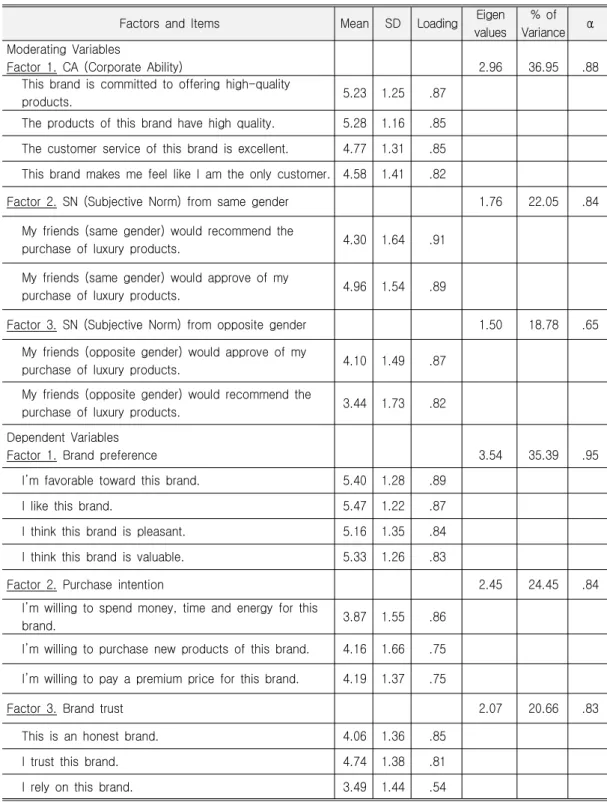
responses toward donation information by using four modified brand-preference items developed by Low and Lamb (2000), three brand-trust items from Chaudhuri and Holbrook (2001) and three purchase-intention items from H. Kim and Lee (2011). The descriptive and reliability statistics of all items are shown in Table 1. In the exploratory factor analysis, all factor loadings were between .74 and .93, above the recommended minimum value of .5 in a sample of more than 100 respondents (Hair, Black, Babin, Anderson, & Tatham, 2010). Cronbach’s alpha for each factor was higher than .6, and the reliability of the measurement was confirmed (Hair et al., 2010).
4. Data Analysis Procedure
The data were analyzed using moderated multiple regression (MMR) models with the dummy variable (1=positive, 0=negative) representing the direction of donation amount information. Other variables including CA, SN, brand preference, brand trust and purchase intention in the regression models used its
Table 1. Descriptive Statistics and Reliability Test of All Items
Factors and Items Mean SD Loading Eigen
values
% of Variance α Moderating Variables
Factor 1. CA (Corporate Ability) 2.96 36.95 .88
This brand is committed to offering high-quality
products. 5.23 1.25 .87
The products of this brand have high quality. 5.28 1.16 .85 The customer service of this brand is excellent. 4.77 1.31 .85 This brand makes me feel like I am the only customer. 4.58 1.41 .82
Factor 2. SN (Subjective Norm) from same gender 1.76 22.05 .84
My friends (same gender) would recommend the
purchase of luxury products. 4.30 1.64 .91
My friends (same gender) would approve of my
purchase of luxury products. 4.96 1.54 .89
Factor 3. SN (Subjective Norm) from opposite gender 1.50 18.78 .65
My friends (opposite gender) would approve of my
purchase of luxury products. 4.10 1.49 .87
My friends (opposite gender) would recommend the
purchase of luxury products. 3.44 1.73 .82
Dependent Variables
Factor 1. Brand preference 3.54 35.39 .95
I’m favorable toward this brand. 5.40 1.28 .89
I like this brand. 5.47 1.22 .87
I think this brand is pleasant. 5.16 1.35 .84
I think this brand is valuable. 5.33 1.26 .83
Factor 2. Purchase intention 2.45 24.45 .84
I’m willing to spend money, time and energy for this
brand. 3.87 1.55 .86
I’m willing to purchase new products of this brand. 4.16 1.66 .75 I’m willing to pay a premium price for this brand. 4.19 1.37 .75
Factor 3. Brand trust 2.07 20.66 .83
This is an honest brand. 4.06 1.36 .85
I trust this brand. 4.74 1.38 .81
I rely on this brand. 3.49 1.44 .54
factor score. We analyzed participants’
evaluations of the three types of consumer responses (brand preference, brand trust and purchase intention) separately. According to Aguinis (1995), MMR was conducted by comparing two regression equations. The first equation shows the main effects for predicting a dependent variable Y (i.e., consumer responses) from a predictor X (i.e., donation amount information) and moderators Z (i.e., CA and SN from the same and opposite genders). In the second equation, interaction terms, namely the product between a predictor and moderators (X Z), are added to the first equation. To test for
ⅹ
the statistical significance of the moderating
Table 2. Moderated Multiple Regression Results for H 1, 2, 3 and 4
Model Preference Trust PI
β β β
Main effect (1stmodel)
(Constant)
Donation amount .25*** .22*** .12*
CA (Corporate Ability) .35*** .48*** .35***
SN (Subjective Norm) from
same gender .17** .05 .21***
SN from opposite gender .10 .08 .07
AdjustedR2 .24*** .29*** .22***
Two-way (2ndmodel)
(Constant)
Donation amount .25*** .21*** .12*
CA .42*** .63*** .46***
SN (same) .22** .07 .20*
SN (opposite) - .01 - .03 - .01
Donation amount × CA .15 .28*** .20*
Donation amount × SN
(same) - .06 - .01 - .03
Donation amount × SN
(opposite) - .19* - .22** - .16
AdjustedR2 .26*** .33*** .24***
.02(1.45) .04(4.21**) .02(1.14)
effect, the F-value is computed by comparing squared multiple correlation coefficients (R2)for equation1 and R2 for equation 2. If the F-value of ΔR2 is significant at the .05 level, it indicates the presence of an X Z interaction.ⅹ
. Results
Ⅳ
1. Respondents profile
In this sample, 160 participants were female (76.6%), 118 participants were married (56.5%) and all participants were university educated.
The age ranges of the sample were 20-
24(4.3%), 25 - 29 (19.6%), 30 - 34 (56.5%), and 35 - 39 (19.6%) years; the mean age was 31.6 years. The sample consisted of housewives (10.5%), office workers (76.1%), students (9.6%), and other (3.8%). As a result of the chi square test of demographics between the positive and negative donation amount information groups, except for the gender (χ
2=13.59,p < .001), there were no significant differences in the ages (χ2=3.14,p = .37), marital status (χ2=1.18,p = .56), and professions (χ
2=7.95,p = .16) between the two groups.
2. Effects of donation amount information on consumers’ preference, trust and purchase intention toward luxury brands
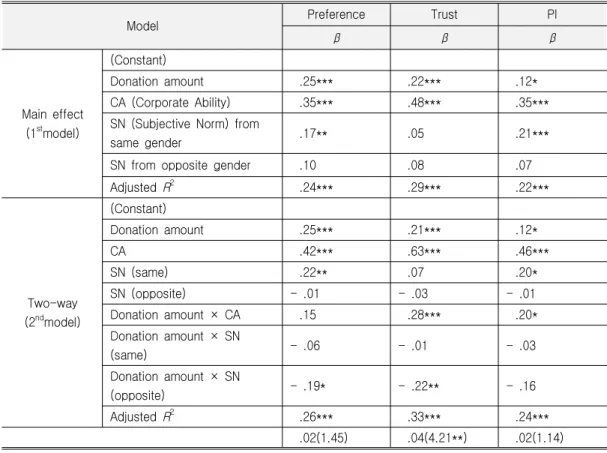
The results of the regressions are shown in Table 2. All regression models are significant (p
< .001). We found strong positive effects of donation amount information on consumers’
preference, trust and purchase intention toward luxury brands. Therefore, Hypotheses 1a, 1b, 1c are supported. In addition, CA has a positively significant effect on consumers’ preference, trust and purchase intention toward luxury brands. In all three types of consumer responses, the effects of CA (β in preference = .35, β in trust
= .48, β in purchase intention = .35) are larger than those of the donation amount (β in preference = .25, β in trust = .22, β in purchase intention = .12). The SN from the same gender positively influenced brand preference and purchase intention, whereas the SN from the opposite gender has no significant influence on brand preference, trust, and purchase intention.
The effect of the SN from the same gender on purchase intention (β = .21) is larger than that of the donation amount information (β = .12).
3. Moderating effect of CA and SN on the relationship between donation amount information and brand trust
For brand trust only, the F-value of ΔR2 is significant at the .01 level (F (3,199) = 4.21, p
< .01). It indicates that there is a moderating effect in brand trust, but not in brand preference and purchasing intention. Table 2 shows that there are significant interactions in brand preference between donation amount information and the SN from the opposite gender and purchase intention between donation amount information and CA. However, the F-values of Δ R2 in brand preference and purchase intention do not show that there are significant interactions in brand preference and purchase intention. In other words, the interaction found in brand preference or purchase intention is too small to increase the perdition of brand preference or purchase intention, and thus the discussion of the interaction is meaningless.
Specifically, we discovered a positive moderating effect of CA on the relationship between donation amount information and consumers’
brand trust. Therefore, Hypothesis 2b is supported. Regarding the consumers’ brand trust, there is a significant interaction between CA and donation amount information (β = .28, p
< .001). The interaction shows that CA strengthens the positive relationship between donation amount information and consumers’
brand trust.
The SN from the opposite gender was found to negatively moderate the relationship between the donation amount and consumers’ trust in luxury fashion brands, whereas the SN from the same gender did not influence the relationship.
Therefore, Hypotheses 3a, 3b, and 3c are rejected and Hypothesis 4b is accepted. For
consumers’ brand trust, there is a significant interaction between the SN from the opposite gender and donation amount information (β = -.22, p < .01). These interactions show that the SN from the opposite gender compensates for the negative influence of negative donation amount information on consumers’ brand trust.
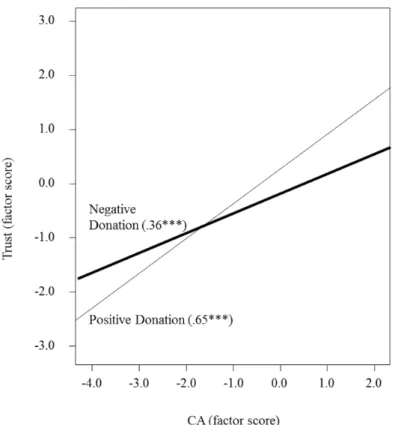
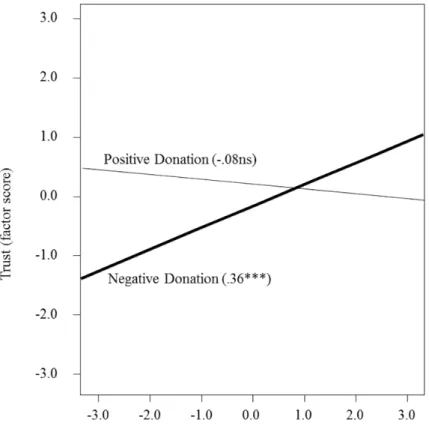
To better understand the moderating effects, we plot the relationship between moderators (i.e., CA and SN from the opposite gender) and brand trust for positive and negative donation amount information in Figures 1 and 2. We follow Aiken and West (1991) in calculating simple slope coefficients and show them in the graphs. Figure 1 shows that the effect of CA on
Figure 1. Plot of the Moderating Effect for CA Notes. ( ) means a slope coefficient and its significance level
***p < .001
consumers’ brand trust is larger when donation amount information is positive (B= .65, p <.001) than when it is negative (B= .36, p <.001). In other words, when there is positive donation amount information about a company, consumers expect the company to have much better performance in order to trust the brand.
The moderating effects of the SN from the opposite gender show a somewhat different pattern than that of CA. Figure 2 suggests that donation amount information complements the effect of the SN from the opposite gender on brand trust. In the case of negative donation amount information, the SN from the opposite gender positively influenced brand trust (B= .36,
p < .001). Otherwise, the effects of the SN from the opposite gender on brand trust was no longer significant (B = -.08, p = .41), when the donation amount information is positive.
Interestingly, even though people are exposed to negative donation amount information about luxury fashion brands, if they perceive their opposite-gender friends to have positive thoughts about luxury brands, they tend to rather tolerate the negative donation amount information with forming trust on brands.
Figure 2. Plot of the Moderating Effect for SN from the Opposite Gender Notes. ( ) means a slope coefficient and its significance level
***p < .001, ns = not significant
. Conclusion and Discussion
Ⅴ
This study extends the literature on the influence of CRM on consumers’ brand preference, trust, and purchase intention by highlighting the positive impact of donation activities in the specific context of the Korean luxury fashion market. The result supports the notion of previous studies that addressed a strong positive relationship between donations and consumer behavior in hedonic product
categories (Boenigk & Schuchardt, 2013;
Strahilevitz, 1999), therefore contributing to building a vigorous theory on the CRM effect. At the same time, these results underscore the importance of CRM donations by luxury marketers in South Korea by showing a significant relationship between donation amount information and various consumer responses such as brand preference, trust and purchasing intention. In accordance with previous studies in other countries (Boenigk & Schuchardt, 2013;
Ellen et al., 2000), these results show that the donation magnitude by luxury fashion brands is also a meaningful antecedent for predicting consumer behavior in Korea.
Next, this study contributes to luxury consumption theory by providing an expanded understanding of the moderating role of CA and SN on consumer responses to luxury CRM. This study attempts to explain the unique patterns in Korean consumer behavior regarding the luxury fashion brands’ donation activities by exploring the influence of moderating variables on the relationship between donations and consumers’
brand preference, trust, and purchase intention.
The results show that the roles of CA and SN in the relationship between donation amount information and consumers’ brand trust are important because their moderating effects from each other move in different directions.
Specifically, CA strengthens the effect of positive donation amount information on consumers’ brand trust. This result can be meaningful to luxury brand marketers in Korea because it shows that when Korean consumers form their trust for luxury fashion brands, CA and donation information do not compensate for each other. For Korean luxury consumers, good CA cannot excuse negative donation amount information. In the case of negative donation
amount information, Korean consumers’
perception of CA positively influenced their brand trust. The Korean luxury market continues to grow and become more competitive (Joo, 2012). In competitive circumstances, even a luxury fashion brand famous in Western markets such as Gucci or Dior makes a serious effort to understand Korean consumers (Y. Kim, 2012).
Luxury fashion brands should realize that Korean consumers want them to have superior CA and be involved in large donations.
In contrast, the SN from the opposite gender has been found to compensate for the influence of negative donation amount information on Korean consumers’ trust for luxury fashion brands. The SN from the same gender, however, has no significant influence on the relationship between the donation amount information of luxury fashion brands and brand trust. The result distinguishes this study from previous studies that simply explore the relationships between SN and consumer responses toward luxury brands.
This study is the first to identify these relationships among SN, donation amount information and consumers’ brand trust. This might be why the relatively small donations by luxury fashion brands in South Korea have not affected consumers’ trust for them. Previous studies have reported the important role of the SN on consumers’ trust for luxury brands or purchase intention of luxury products in Korea (Hierang Park & Hahn, 2006; Song et al., 2012).
As Wong and Ahuvia (1998) pointed out, relative to Western consumers, Southeast Asians tend to depend heavily on the views of important in-groups for their purchase of luxury products.
The results of the study show that the SN from the opposite gender can also be an important variable to explain Korean consumers’ brand trust toward donation activities by luxury fashion
brands. To form brand trust in the case of negative donation amount information, luxury marketers could take advantage of advertising campaigns to display the lifestyle of the aspirational reference group with models of the opposite gender. The aspirational reference group, a positive reference group which individuals want to be affiliated with and gain membership to, plays an important role in evoking consumers’ hidden wants and needs (Solomon, 2012). Policymakers in consumer organizations or the South Korean government should focus on this result to raise public concern about whether their purchases of luxury products were unconsciously due to the influence of reference groups. One example would be a public campaign to promoting the importance of independent decision-making when shopping for luxury items in terms of self-realization and sustainable growth for our society.
It is interesting that the influence of SN on Korean consumers’ brand trust in the negative donation amount information provided by luxury fashion brands varies according to the gender of the source. In the negative donation amount information, the SN from the opposite gender positively influenced brand trust, whereas the effect of the SN from the same gender on brand trust was no significant. Although further research is needed, the difference between the SN from the same gender and that from the opposite gender can be partly inferred from personal motives in consuming luxury products.
Depending on the reference group, consumers can make a decision to present their unique identity to the members or to obtain group affiliation (Joo, 2012). The perception of the opposite gender’s approval of luxury fashion brands seems to reflect a motive to appeal to
their taste, whereas approval from the same gender means the motive is to conform.
Similarly, Sundie, Kenrick, Griskevicius, Tybur, Vohs and Beal (2011) pointed out that luxury products could be used for men to attract their romantic partners. For Korean consumers, luxury fashion brands are important for consumers in showing their attractiveness to important persons of the opposite gender; therefore, it can compensate for negative donation amount information in forming individual attitudes toward luxury fashion brands.
This study focuses on the donation amount information of luxury fashion products in the context of the Korean market. Under snowball sampling, the study, which used a survey method utilizing a conveniently recruited sample, cannot perfectly overcome the error of generalization. Nevertheless, by verifying the strong positive influence of donation actions in luxury fashion brands on consumers’ brand preference, trust, and purchase intention, this study supports the notion of previous research suggesting that the donation magnitude influence on consumer behavior depends on product categories. In addition, this study encompassed both the negative and positive types of donation activities. This can help scholars and marketers better understand the donation effect. However, the negative CRM donation of luxury fashion brands posited in this study does not reflect harmful activities, but rather donations of small amounts. In future studies, the level or types of negative activities by a luxury fashion brand could be manipulated to include harmful activities such as child exploitation or clothing waste. In addition, by including a control group with no information about cause-related marketing, future researches can emphasize the effects of positive and negative information at
the same time.
This study shows the meaningful complementary influence of the SN from the opposite gender on brand trust when Korean consumers are exposed to negative donation amount information. Further research should focus on this relationship. Previous studies show that, for Korean consumers’ purchases of fashion products, SN has greater influence on women than men (Joo, 2012; L. Lee, Kweon, &
Yoo, 2010). However, little attention has been paid to the difference based on the reference group types (i.e., gender, age, desirability).
Thus, the validity and generalizability of our findings could be enhanced by research on the influence of different reference groups on the relationship between donation amount information and consumers’ brand trust in fashion that includes other social-psychological moderating factors, such as personal motives (conformity or individuality). After acknowledging the study’s limitation of focusing on only Korean consumers, future researchers should conduct cross-cultural experiments to confirm the uniqueness of the influence of SN on the relationship between luxury CRM donation amount information and consumers’ brand trust in South Korea.
References
Aguinis, H. (1995). Statistical power with moderated multiple regression in management research. Journal of Management, 21(6), 1141-1158.
Aiken, L. S., & West, S.W. (1991). Multiple regression: Testing and interpreting interactions. London: Sage Publications.
Ajzen, I., & Fishbein, M. (1980). Understanding
attitudes and predicting social behaviour.
Upper Saddle River, NJ: Prentice Hall.
Armitage, C. J., & Conner, M. (2001). Efficacy of the theory of planned behaviour: A meta‐
analytic review. British Journal of Social Psychology, 40(4), 471-499.
Atkinson, R., & Flint, J. (2001). Accessing hidden and hard-to-reach populations:
Snowball research strategies. Social research update, 33(1), 1-4
Atwal, G., & Williams, A. (2009). Luxury brand marketing The– experience is everything!
Journal of Brand Management, 16(5/6), 338-346.
Berens, G., Van Riel, C. B. M., & Van Rekom, J.
(2007). The CSR-quality trade-off: When can corporate social responsibility and corporate ability compensate each other? Journal of Business Ethics, 74(3), 233-252.
Boenigk, S., & Schuchardt, V. (2013). Cause‐
related marketing campaigns with luxury firms:
An experimental study of campaign characteristics, attitudes, and donations.
International Journal of Nonprofit and Voluntary Sector Marketing, 18(May), 101-121.
Bronn, P. S., & Vrioni, A. B. (2001). Corporate social responsibility and cause-related marketing: An overview. International Journal of Advertising, 20(2), 207-222.
Brown, T. J., & Dacin, P. A. (1997). The company and the product: Corporate associations and consumer product responses. Journal of Marketing, 61(1), 68-84.
Cayla, J., & Eckhardt, G. M. (2007). Asian brands without borders: Regional opportunities and challenges. International Marketing Review, 24(4), 444-456.
Chaudhuri, A., & Holbrook, M. B. (2001). The chain of effects from brand trust and brand affect to brand performance: The tole of