중량식 라이시미터에서 물관리에 따른 배추, 옥수수의 적정 및 최소 물 필요량 산정
옥정훈
1
⋅한경화1
⋅허승오1
⋅황선아1
⋅김동진1*
1) 농촌진흥청 국립농업과학원 토양비료과(2020년 8월 31일 접수; 2020년 9월 27일 수정; 2020년 9월 28일 수락)
Estimation of Optimal and Minimal Water Requirement for Chinese Cabbage and Maize on Water Management using
Weighable Lysimeters
Jung-hun Ok
1
, Kyung-hwa Han1
, Seoung-oh Hur1
, Seon-Ah Hwang1
, Dong-Jin Kim1*
1
Division of Soil and Fertilizer, National Institute of Agricultural Sciences, Rural Development Administration, Wanju, Jeonbuk 55365, Republic of Korea(Received August 31, 2020; Revised September 27, 2020; Accepted September 28, 2020)
ABSTRACT
In this study, we performed to evaluate the water balance during the cultivation of Chinese cabbage and maize according to the soil type and water management method using weighable lysimeters, and to estimate the crop water stress coefficient and minimal water requirement by considering crop productivity and water deficiency. In 2018, Chinese cabbage cultivation period was not irrigated due to frequent rainfall two weeks after planting, so there was no difference in irrigation amount between the non-irrigated and the irrigated and little difference in crop yield. Excluding the Chinese cabbage cultivation in 2018, in the cultivation of Chinese cabbage and maize, the crop yield of irrigated plots was higher than that of non-irrigated plots. The evapotranspiration of irrigated plots was also generally higher than non-irrigated plots. Crop yield and evapotranspiration are closely related, and transpiration is active as biomass increases. The crop water stress coefficients in the middle and the late stage were 0.8 and 0.8 for Chinese cabbage and 0.8 and 0.5 for maize, respectively. The minimal water requirements for Chinese cabbage and maize were 82.0% and 68.8%, respectively, compared to the optimal water requirements (239.4 mm for Chinese cabbage and 466.9 mm for maize). These results can be used as basic data for water management for crop cultivation by securing the minimum amount of irrigation in case of water deficiency.
Key words: Water requirement, Water stress coefficient, Weighable lysimeter, Chinese cabbage, Maize
* Corresponding Author : Dong-Jin Kim ([email protected])
ⓒ Author(s) 2020. CC Attribution 3.0 License.
I.
서 론가뭄 빈도와 강도 증가, 온도 상승 등의 기후변화로 물 부족 현상이 심화되고 있는 것이 사실이며 이에 따라 수자원 확보의 중요성이 강조되고 있다(Hanjra and Qureshi, 2010; Vermeulen et al., 2014). 특히, 농업분야에서 물은 필수 요소이며 농업용수는 전체 물 공급량의 약 62%를 차지할 정도로 매우 중요한 자원 으로 물 부족은 농업생산성 감소로 이어지며(Hanjra and Qureshi, 2010; MOLIT, 2011), 가뭄 조건에서 콩 과 감자의 생산량이 감소하는 것으로 보고된 바 있다 (Lee et al., 2018; Lee et al., 2019). 따라서 물의 효율 적 관리가 중요하며 이를 위하여 작물별 물 필요량, 농업용수량 등을 보다 정확하게 산정하고 이를 효율적 으로 활용하기 위한 노력이 이루어지고 있다 (Vargas-Amelin and Pindado, 2014; Seo et al., 2016;
Ok et al., 2018).
밭작물 재배에서 물수지 산정과 농업용수량 산정은 강수량, 온도, 일사량 등의 기상인자와 증발산량, 지하 유출량, 유거수량 등 물수지 인자, 그리고 토양특성 인자 등을 함께 고려하여 산정해야 하며 이들 중에서 도 증발산량과 지하유출량 산정은 보다 정확하게 산정 할 필요가 있다. 증발산량 산정은 기준증발산량과 작 물계수의 자료가 필요하며 기상조건에 많은 영향을 받 는다(Allen et al., 1998). 기상 데이터와 함께 다양한 기준증발산량 산출 공식들이 수분이용 평가에 활용되 어져 왔으며, 온도나 복사열 데이터를 이용한 Hargreaves 공식과 일사량, 풍속, 온도, 습도 등 다양 한 기상 데이터를 이용한 FAO Penman-Monteith 공 식 등이 대표적이다(Hargreaves and Samani, 1985;
Allen et al., 1998; Hargreaves and Allen, 2003). 밭토 양에서 지하유출량 산정에서 수분의 수직이동은 토양 의 구조, 용적밀도, 토성, 입도분포 등 토양특성에 많은 영향을 받는다(Durner, 1994; Hillel, 1998; Assouline, 2006; Jung et al., 2015). 최근 토양을 통하는 물과 용질의 이동을 자연적인 토양구조 그대로 정밀하게 직 접 측정할 수 있는 비교란 중량식 라이시미터를 활용한 연구가 증가하고 있다(Meißner et al., 2010; Anapalli et al., 2016; Seo et al., 2016; Ok et al., 2018). 중량식 라이시미터는 정밀도 및 정확도가 높아서 증발산량 산 정, 물 이동 분석 연구에 많이 활용되고 있으며, 비교 란 상태의 토양은 토양수분의 수직이동 양상 해석을 큰 도움이 된다(Seo et al., 2016; Ok et al., 2018).
동절기 사양토에서 온도와 경반층에 따른 토양수분이 동 및 토성에 따른 토양수분함량 변화 연구(Seo et al., 2016), 밭작물 재배시 물관리 방법에 의한 물수지 및 양분수지 분석, 물 필요량 산정 (Lee et al., 2017; Ok et al., 2018, 2019) 등 라이시미터를 활용한 연구가 지속적으로 이루어지고 있다. 따라서 본 연구에서는 밭토양 중량식 라이시미터에서 배추와 옥수수 재배시 물관리 방법에 따른 물수지를 비교 분석하였으며, 작 물계수와 수분스트레스 계수를 활용하여 적정 및 최소 물 필요량을 산정하였다.
II.
재료 및 방법2.1. 연구시설 및 시험토양
국립농업과학원(전라북도 완주군)에 설치된 비교란 중량식 라이시미터(UGT, Germany)는 북위 35° 49′
29″, 동경 127° 02′46″, 해발 33 m 에 위치하며, 표면적 1 m
2
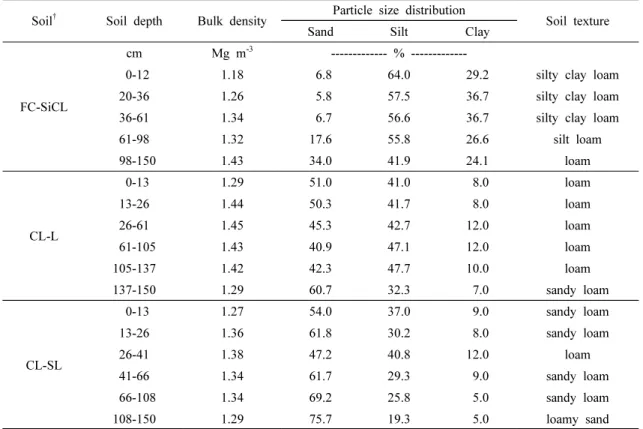
, 깊이 1.5 m 의 원통코어형으로 여러 연구 에 사용되었다 (Lee et al., 2017; Ok et al., 2018; Ok et al., 2019; Kim et al., 2019). 중량변화를 측정할 수 있는 로드셀(최소 10 g 감지)은 라이시미터 베셀 바닥에 설치되어 있어 물의 증감에 따른 무게 변화를 정밀하게 측정할 수 있고, 티핑카운터(tipping counter) 로 지하유출량을 측정하며 측정된 데이터는 1 시간단 위 평균 데이터로 자동 저장된다. 토양은 식질-미사질 식양토(fine clayey-silty clay loma, FC-SiCL), 사양질- 양토(coarse loamy-loam, CL-L), 사양질-사양토 (coarse loamy-sandy loam, CL-SL)를 사용하였고 토 양구조를 파괴하지 않은 비교란 상태로 채취하였다.깊이별 토양의 물리적 특성은 Table 1 에 나타내었다.
토성은 Gee and Bauder(1986)의 비중계법에 따라 모 래, 미사, 점토 비율을 산정 후 미국농무성의 토성삼각 표(soil texture triangle)에 따라 결정하였다. 용적밀도 는 Blake and Hartge(1986)이 제안한 코아법에 따라 분석하였다.
2.2. 작물 재배, 물 및 양분 관리
시험 작물은 배추, 옥수수로 품종은 각각 춘광과 일 미찰이었고, 2017 년, 2018 년 2 개년간 배추는 4 월 상순(2017 년 4 월 5 일, 2018 년 4 월 9 일)에 정식하 고 6 월 상순(2017 년 6 월 8 일, 2018 년 6 월 4 일)에 수확하였다. 옥수수는 6 월 중순(2017 년 6 월 13 일, 2018 년 6 월 18 일)에 정식하여 8 월 상순(2017 년 8
월 7일, 2018 년 8 월 13 일) 에 수확하였다. 비료는 작물별 비료사용처방(NIAS, 2017)의 표준시비량을 기준으로 밑거름과 웃거름으로 나누어 투입하였으며 정식 후 약 30 일뒤에 웃거름을 주었다. 물관리는 무관 개 시험구와 적습관개 시험구로 나누어 각 단일 처리 구로 수행하였다. 정식 후 약 2 주간은 모든 시험구에 동일한 관수량을 관개하였으며, 이후 적습관개구의 관 개는 밭작물 물관리 기준을 참고로(Eom et al., 1999) 강우 상황과 토양의 수분장력값을 고려하여 배추는 -30 kPa, 옥수수는 -50 kPa 의 토양수분상태에 해당하 면 관개를 실시하였다.
2.3. 작물 재배기간 중 기상 데이터 분석 기상자료는 중량식 라이시미터 시설에 설치된 기상 관측장비(Weather Information System, WIS, STA Co., Korea)로부터 수집하였고, 2017 년과 2018 년의 기상을 평년(1981-2010)과 비교하기 위해 평년 기상 자료는 라이시미터 시설이 인접한 전주지역의 전주기 상대 데이터(KMA, 2020)를 수집하여 활용하였다.
2.4. 작물수지, 수분스트레스 계수, 물량 산정 중량식 라이시미터에 설치되어 있는 중량센서를 이 용하여 무게변화에 따라 물의 유입량(강우량, 관개량) 과 유출량(증발산량, 지하유출량, 지표유출량)을 계산 하였으며 물수지는 아래의 Eq. 1 로 산출하였다.
Klammler and Fank(2014)가 제안한 방법을 적용하였다.
(Eq. 1)
여기에서 ΔSW 는 토양수분변화량(mm), P 는 강 우량(mm), I 는 관개량(mm), ET 는 증발산량(mm), D 는 지하유출량(mm), R 은 지표유출량(mm)이다.
적정 물 필요량(Eq. 2)은 2017 년, 2018 년, 평년 (1981∼2010) 기상데이터를 바탕으로 하여 FAO Penman-Monteith 공식(Eq. 3)으로 계산한 기준증발 산량(reference evapotranspiration)에 작물계수를 곱 하여 작물생육단계별 물량과 총 물 필요량을 산정하였 다. 최소 물 필요량(Eq. 4)은 적정 물 필요량에 작물생 Soil
†
Soil depth Bulk density Particle size distributionSoil texture
Sand Silt Clay
FC-SiCL
cm Mg m
-3
--- % ---0-12 1.18 6.8 64.0 29.2 silty clay loam
20-36 1.26 5.8 57.5 36.7 silty clay loam
36-61 1.34 6.7 56.6 36.7 silty clay loam
61-98 1.32 17.6 55.8 26.6 silt loam
98-150 1.43 34.0 41.9 24.1 loam
CL-L
0-13 1.29 51.0 41.0 8.0 loam
13-26 1.44 50.3 41.7 8.0 loam
26-61 1.45 45.3 42.7 12.0 loam
61-105 1.43 40.9 47.1 12.0 loam
105-137 1.42 42.3 47.7 10.0 loam
137-150 1.29 60.7 32.3 7.0 sandy loam
CL-SL
0-13 1.27 54.0 37.0 9.0 sandy loam
13-26 1.36 61.8 30.2 8.0 sandy loam
26-41 1.38 47.2 40.8 12.0 loam
41-66 1.34 61.7 29.3 9.0 sandy loam
66-108 1.34 69.2 25.8 5.0 sandy loam
108-150 1.29 75.7 19.3 5.0 loamy sand
†
FC-SiCL, fine clayey-silty clay loam; CL-L, coarse loamy-loam; CL-SL, coarse loamy-sandy loam.Table 1. Soil physical properties of profiles used in this study
육단계별 수분스트레스 계수를 반영하여 산정하였으 며 작물별로 산정된 물량은 평년 자료와 비교하였다.
적정 물 필요량 산정 공식은 Eq. 2 와 같다(Allen et al., 1998).
(Eq. 2)
여기에서 OWR 은 적정 물 필요량(mm), ET
0
는 기 준증발산량(mm), CC 는 작물계수이다.Allen et al.(1998)이 제안한 FAO Penman-Monteith 공식은 Eq. 3 과 같다.
(Eq. 3)
여기에서 ET
PM
는 기준증발산량(mm day-1
), Δ 는 수증기압곡선 기울기(kPa ℃-1
), Rn 은 지표피복 상 태 태양복사열(MJ m-2
day-1
), G 는 토양열 유동밀도 (MJ m-2
day-1
), γ 는 건습계 상수(kPa ℃-1
), T 는 지상 2 m 높이의 일 평균온도(℃), u2 는 지상 2 m 높이의 풍속(m s-1
), es 와 ea 는 각각 포화수증기압(kPa), 실제 수증기압(kPa)을 나타낸다.최소 물 필요량 산정 공식은 Eq. 4 와 같다(Allen et al., 1998).
(Eq. 4)
MWR 는 최소 물 필요량(mm), ET
0
는 기준증발산 량(mm), CC 는 작물계수, WSC 는 수분스트레스 계 수이다. 수분스트레스 계수는 작물 재배시 물관리에 따른 작물 수확량 비교를 통하여 산정할 수 있다. 본 연구에서는 무관개구와 적습관개구의 관개방법에 따 라 최종 작물 수확량이 20∼30% 차이가 발생한 배추 2017 년, 옥수수 2018 년의 시기를 선택하여 이들 시 기의 일별, 생육단계별 증발산량 데이터를 각각 분석 하여 수분스트레스 계수를 산정하였다. 2017 년 옥수 수 및 2018 년 배추 재배시기에는 여러 차례 강우이벤 트 발생 등 기상여건으로 처리구간 관개의 차이를 보 이지 않았다.III.
결과 및 고찰3.1. 밭작물 재배기간 동안 기상 특성
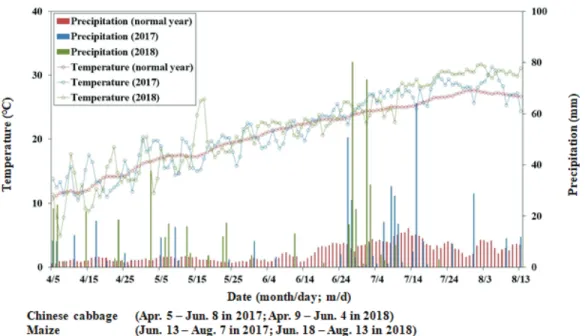
2017 년과 2018 년 배추, 옥수수 재배기간 동안 기 상특성을 전주 평년(1981∼2010) 기상(KMA, 2020)
Fig. 1. Daily variation of precipitation and temperature from April 5 to August 13 in normal year (1981-2010), 2017 and 2018.
†
The meteorological data of Jeonju in normal year (1981-2010) collected from KMA (2020).자료와 비교하였다(Fig. 1). 2017 년과 2018 년의 일 평균온도 변화는 평년 온도와 비교하여 비슷한 경향이 었으나 6 월 중순 이후 높게 나타났다. 강우량은 평년 대비 2017 년 4 월, 5 월, 6 월, 7 월, 8 월에 각각 21%, 54%, 47%, 22%, 5% 낮게 나타났고, 2018 년 4 월, 5 월, 8 월에는 각각 30%, 30%, 8% 높게, 6 월, 7 월에 는 각각 20%, 58% 낮게 나타났다. 배추 재배기간 동안 누적 강우량은 2017 년(4 월5 일 - 6 월8 일) 107.5 mm, 2018 년(4 월 9 일 - 6 월 4 일) 173.2 mm 였고, 옥수수 재배기간 동안 누적 강우량은 2017 년(6 월 13 일 - 8 월 7 일) 316.7 mm, 2018 년(6 월 18 일 - 8 월 13 일) 247.7 mm 를 기록하였다. 전주지역 평년 강우량은 6-7 월에 468 mm 로 장마철에 집중되었으며, 2017 년 6-7 월 강우량은 323 mm, 2018 년 6-7 월 강우량은 261 mm 로서 평년보다 낮게 나타났다. 2017 년과 2018 년 6-8 월 강우는 장기간 보다 하루 60-100 mm 가 내리 는 폭우 양상이었다. 2017 년과 2018 년의 기온과 강우 는 평년과 비교하여 뚜렷한 차이가 나타났다.
3.2. 배추, 옥수수 생육 특성
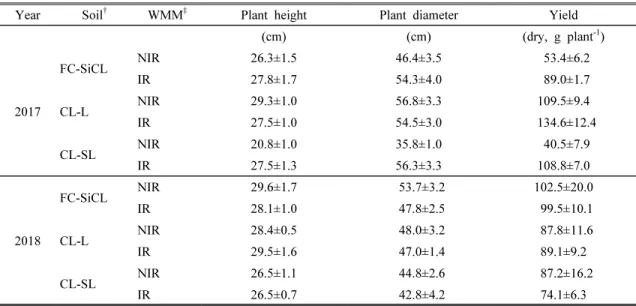
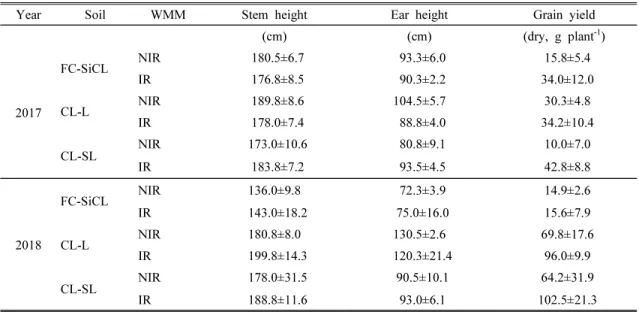
2017 년과 2018 년 배추와 옥수수의 생육 특성을 토양 및 물관리 방법에 따라 조사하였으며, 배추 생육 특성은 Table 2 에, 옥수수 생육 특성은 Table 3 에 나
타내었다. 2017 년 배추 생육 특성을 살펴보면, 토양 및 물관리 방법에 따라 구고와 구폭은 CL-SL 무관개 구를 제외하고 전반적으로 차이가 없었으나 생산량은 적습관개구에서 높았으며, 적습관개구의 CL-L 처리 구에서 가장 높게 나타났다. 2018 년 배추 생육 특성은 토양 및 물관리 방법에 따라 구고, 구폭, 생산량에 뚜 렷한 경향의 차이는 확인할 수 없었다(Table 2). 2017 년은 무관개구와 적습관개구의 관개량 차이가 있었으 나 2018 년에는 정식 2 주 후 빈번한 강우 발생으로 적습관개구에 별도의 관개를 실시하지 않아 무관개구 와 적습관개구의 관개량 차이는 없었다. 이로 인하여 2018 년은 무관개와 적습관개의 시험구 차이를 보기 어렵고 생산량 차이가 없었던 것으로 판단된다. 2017 년과 2018 년의 옥수수 생육 특성을 살펴보면, 간장과 착수고는 2018 년 FC-SiCL 처리구가 다소 낮은 결과 를 보인 것을 제외하고 전반적으로 뚜렷한 차이가 없 었으나 이삭 생산량은 적습관개구가 무관개구보다 높 게 나타났다. 그리고 토양별로 살펴보면, FC-SiCL 의 이삭 생산량이 CL-L 과 CL-SL 보다 현저히 낮게 나타 났으며(Table 3), 이러한 생육 차이는 옥수수 증발산량 산정 결과에 영향을 미칠 것으로 판단된다.
Year Soil
†
WMM‡
Plant height Plant diameter Yield(cm) (cm) (dry, g plant
-1
)2017
FC-SiCL NIR 26.3±1.5 46.4±3.5 53.4±6.2
IR 27.8±1.7 54.3±4.0 89.0±1.7
CL-L NIR 29.3±1.0 56.8±3.3 109.5±9.4
IR 27.5±1.0 54.5±3.0 134.6±12.4
CL-SL NIR 20.8±1.0 35.8±1.0 40.5±7.9
IR 27.5±1.3 56.3±3.3 108.8±7.0
2018
FC-SiCL NIR 29.6±1.7 53.7±3.2 102.5±20.0
IR 28.1±1.0 47.8±2.5 99.5±10.1
CL-L NIR 28.4±0.5 48.0±3.2 87.8±11.6
IR 29.5±1.6 47.0±1.4 89.1±9.2
CL-SL NIR 26.5±1.1 44.8±2.6 87.2±16.2
IR 26.5±0.7 42.8±4.2 74.1±6.3
†
FC-SiCL, fine clayey-silty clay loam; CL-L, coarse loamy-loam; CL-SL, coarse loamy-sandy loam.‡
WMM, water management method; NIR, non-irrigated after rooting stage; IR, irrigated by furrow irrigation.Table 2. Plant growth and yield of Chinese cabbage in different upland soils by different water management methods
3.3. 배추, 옥수수의 물수지
2017 년과 2018 년 배추 재배기간 동안 토양 및 물 관리 방법에 따른 물수지를 산정하였으며, 그 결과는 Table 4 와 같다. 2017 년 배추 재배는 적습관개구가 무관개구보다 총유입량과 총유출량 모두 높게 나타났 다. 적습관개구의 관개 실시로 인하여 관개량이 높아 총유입량이 높게 나타났고, 적습관개구의 증발산량이 높아 총유출량이 높게 나타났다. 적습관개구가 무관개 구보다 상대적으로 생산량이 높아 증발산량이 높은 것 으로 판단된다. 토양에 따른 지하유출을 살펴보면, 무 관개구에서 FC-SiCL 은 14.2 mm 의 지하유출량이 나 타났으나 CL-L 과 CL-SL 은 지하유출이 나타나지 않 았고, 적습관개구 역시 FC-SiCL 에서 지하유출량이 24.2 mm 나타난 반면 CL-L 과 CL-SL 은 지하유출이 나타나지 않았다. 토양에 따른 증발산은 무관개구에서 FC-SiCL(197.2 mm) ≥ CL-L(194.6 mm) > CL-SL(179.9 mm)이었고, 적습관개수에서는 CL-L(269.8 mm) >
CL-SL(240.4 mm) > FC-SiCL(226.3 mm)이었다.
2018 년 배추 재배는 무관개구와 적습관개구의 관개 량이 비슷하였고 정식 후 2 주간 관개량이며, 이후 강 우 발생으로 인하여 적습관개구의 관개가 실시되지 않 았다. 토양에 따른 지하유출량을 살펴보면, 무관개구에서 FC-SiCL(57.3 mm) ≥ CL-L(54.7 mm) > CL-SL(6.0 mm) 이었고, 적습관개구에서는 FC-SiCL(78.5 mm) ≥
CL-SL(78.4 mm) > CL-L(51.8 mm)이었다. 토양에 따른 증발산은 무관개구에서 CL-SL(292.2 mm) >
CL-L(249.4 mm) > FC-SiCL(239.8 mm)이었고, 적습 관개수에서는 CL-L(237.4 mm) > CL-SL(218.9 mm)
> FC-SiCL(205.7 mm)이었다. 2018 년 배추 적습관개 구의 물수지 자료는 Ok et al.(2018)의 연구에서 활용 된 바 있다.
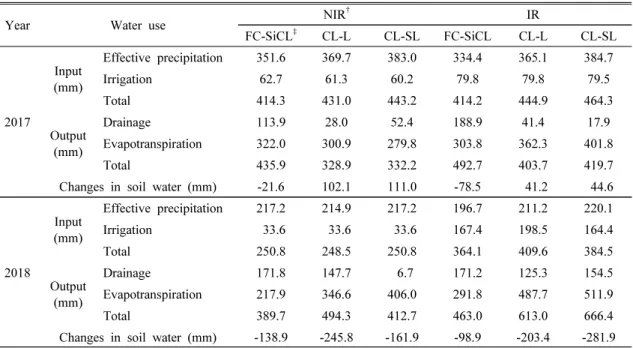
2017 년과 2018 년 옥수수 재배기간 동안 토양 및 물관리 방법에 따른 물수지를 산정하였고, 그 결과를 Table 5 에 나타내었다. 2017 년 옥수수 재배는 적습관 개구가 무관개구보다 관개량이 높았다. 지하유출량은 무관개구와 적습관개구 모두 FC-SiCL 에서 각각 113.9 mm, 188.9 mm 로 높게 나타났고, 증발산량은 무관개구의 경우 FC-SiCL 이 322.0 mm 로 높게 나타 났고, 적습관개구의 경우 CL-SL 에서 401.8 mm 로 높 게 나타났다. 2018 년 옥수수 재배는 적습관개구의 관 개량이 무관개구보다 5 배 이상 높았다. 지하유출량은 무관개구와 적습관개구 모두 FC-SiCL 에서 각각 171.8 mm, 171.2 mm 로 높게 나타났고, 증발산량은 무 관개구와 적습관개구 모두 CL-SL 에서 각각 406.0 mm, 511.9 mm 로 높게 나타났다. 2017 년 FC-SiCL 을 제 외하고 증발산량이 높은 적습관개구의 이삭 생산량이 높게 나타났다. 배추와 옥수수 재배 토양 중 FC-SiCL 이 점토가 함량이 상대적으로 높음에도 지하유출량이
Year Soil WMM Stem height Ear height Grain yield
(cm) (cm) (dry, g plant
-1
)2017
FC-SiCL NIR 180.5±6.7 93.3±6.0 15.8±5.4
IR 176.8±8.5 90.3±2.2 34.0±12.0
CL-L NIR 189.8±8.6 104.5±5.7 30.3±4.8
IR 178.0±7.4 88.8±4.0 34.2±10.4
CL-SL NIR 173.0±10.6 80.8±9.1 10.0±7.0
IR 183.8±7.2 93.5±4.5 42.8±8.8
2018
FC-SiCL NIR 136.0±9.8 72.3±3.9 14.9±2.6
IR 143.0±18.2 75.0±16.0 15.6±7.9
CL-L NIR 180.8±8.0 130.5±2.6 69.8±17.6
IR 199.8±14.3 120.3±21.4 96.0±9.9
CL-SL NIR 178.0±31.5 90.5±10.1 64.2±31.9
IR 188.8±11.6 93.0±6.1 102.5±21.3
†
FC-SiCL, fine clayey-silty clay loam; CL-L, coarse loamy-loam; CL-SL, coarse loamy-sandy loam.‡
WMM, water management method; NIR, non-irrigated after rooting stage; IR, irrigated by furrow irrigation.Table 3. Plant growth and yield of maize in different upland soils by different water management methods
Year Water use NIR
†
IRFC-SiCL
‡
CL-L CL-SL FC-SiCL CL-L CL-SL2017
Input (mm)
Effective precipitation 123.0 123.3 123.1 123.3 123.7 121.3 Irrigation 13.3 12.7 12.8 117.2 117.2 117.4
Total 136.3 136.0 135.9 240.5 240.9 238.7
Output (mm)
Drainage 14.2 0.0 0.0 24.2 0.0 0.0
Evapotranspiration 197.2 194.6 179.9 226.3 269.8 240.4
Total 211.4 194.6 179.9 250.5 269.8 240.4
Changes in soil water (mm) -75.1 -58.6 -44.0 -10.0 -28.9 -1.7
2018
Input (mm)
Effective precipitation 177.9 175.0 174.8 175.5 175.4 175.7 Irrigation 36.7 36.7 37.4 36.0 37.3 38.4
Total 214.6 211.7 212.2 211.5 212.7 214.1
Output (mm)
Drainage 57.3 54.7 6.0 78.5 51.8 78.4 Evapotranspiration 239.8 249.4 292.2 205.7 237.4 218.9
Total 297.1 304.1 298.2 284.2 289.2 297.3
Changes in soil water (mm) -82.5 -92.4 -86.0 -72.7 -76.5 -83.2
†
NIR, non-irrigated after rooting stage; IR, irrigated by furrow irrigation.‡
FC-SiCL, fine clayey-silty clay loam; CL-L, coarse loamy-loam; CL-SL, coarse loamy-sandy loam.∮
The water balance data of IR plot in 2018 used in Ok et al. (2018).Table 4. Water balance for Chinese cabbage cultivation in different upland soils by different water management methods
Year Water use NIR
†
IRFC-SiCL
‡
CL-L CL-SL FC-SiCL CL-L CL-SL2017
Input (mm)
Effective precipitation 351.6 369.7 383.0 334.4 365.1 384.7
Irrigation 62.7 61.3 60.2 79.8 79.8 79.5
Total 414.3 431.0 443.2 414.2 444.9 464.3
Output (mm)
Drainage 113.9 28.0 52.4 188.9 41.4 17.9
Evapotranspiration 322.0 300.9 279.8 303.8 362.3 401.8
Total 435.9 328.9 332.2 492.7 403.7 419.7
Changes in soil water (mm) -21.6 102.1 111.0 -78.5 41.2 44.6
2018
Input (mm)
Effective precipitation 217.2 214.9 217.2 196.7 211.2 220.1 Irrigation 33.6 33.6 33.6 167.4 198.5 164.4
Total 250.8 248.5 250.8 364.1 409.6 384.5
Output (mm)
Drainage 171.8 147.7 6.7 171.2 125.3 154.5
Evapotranspiration 217.9 346.6 406.0 291.8 487.7 511.9
Total 389.7 494.3 412.7 463.0 613.0 666.4
Changes in soil water (mm) -138.9 -245.8 -161.9 -98.9 -203.4 -281.9
†
NIR, non-irrigated after rooting stage; IR, irrigated by furrow irrigation.‡
FC-SiCL, fine clayey-silty clay loam; CL-L, coarse loamy-loam; CL-SL, coarse loamy-sandy loam.Table 5. Water balance for maize cultivation in different upland soils by different water management methods
높은 것은 동절기 동안 토양 내 수축 및 팽창이 반복적 으로 발생하여 대공극과 균열이 많아졌기 때문으로 생 각된다(Keith and Germann, 1982; Ok et al., 2018;
Ok et al., 2019). 배추와 옥수수 모두 생산량이 상대적 으로 높았던 적습관개구의 증발산량이 높게 나타났다.
생산량과 증발산량이 관계가 있는 것으로 보이며, Anapalli et al.(2016)의 연구에서 역시 옥수수의 바이 오매스와 엽면적이 높을수록 증발산량이 증가하였다.
3.4. 배추, 옥수수의 적정 물 필요량, 수분스트레 스 계수, 최소 물 필요량
배추, 옥수수 재배시 생육단계별 작물계수와 적정 물 필요량을 산정하였고, 배추, 옥수수 재배의 무관개 구와 적습관개수에서 수량이 20∼30% 감소되는 시기 를 고려하여 수분스트레스 계수 및 최소 물 필요량을 산정하였다. 배추와 옥수수의 생육단계별 작물계수와
적정 물 필요량은 Table 6 과 Table 7 에, 작물별 수분 스트레스 계수와 최소 물 필요량은 Table 8 에 나타내 었다. 배추의 생육단계별 작물계수는 후기에 1.13 으 로 가장 높았고, 적정 물 필요량은 평년 210.2 mm, 2017 년 239.4 mm, 2018 년 192.9 mm 로서 평년 (1981-2010) 대비 2017 년은 13.9% 증가하였고, 2018 년은 8.2% 감소하였다(Table 6). Ok et al.(2019) 은 가을배추 물 필요량을 135.5∼147.2 로 제시하였으 며, 봄배추가 가을배추보다 물 필요량이 높은 것을 확 인할 수 있었다. 옥수수의 생육단계별 작물계수는 개 화기와 결실기에 1.20 으로 가장 높았고, 적정 물 필요 량은 평년 403.4 mm, 2017 년 378.8 mm, 2018 년 466.9 mm 로서 평년 대비 2017 년은 6.1% 감소하였 고, 2018 년은 15.7% 증가하였다(Table 7). 배추와 옥 수수의 수분스트레스 계수는 배추 중기 0.8, 후기 0.8, 옥수수 중기 0.8, 후기 0.5 이었다. 배추와 옥수수의
Growth stage Initial stage Middle stage End stage Total
Crop coefficient 0.69 1.11 1.13
Water requirement
(mm)
Normal year 23.9 118.3 68.0 210.2
2017 23.2 125.9 90.3 239.4
2018 34.8 108.9 49.3 192.9
Table 6. Crop coefficient and water requirement for Chinese cabbage cultivation according to growth stage
Growth stage S1
†
S2 S3 S4 S5 TotalCrop coefficient 0.68 1.09 1.20 1.20 0.75
Water requirement
(mm)
Normal year 62.0 127.0 83.6 61.2 69.7 403.4
2017 36.7 83.9 115.7 68.9 73.5 378.8
2018 28.0 98.5 146.4 94.2 99.8 466.9
†
S1, seedling stage; S2, elongation stage; S3, blooming stage; S4, bearing stage; S5, ripening stage.Table 7. Crop coefficient and water requirement for maize cultivation according to growth stage
Upland crops
Water stress coefficient Minimal water requirement Growth stage
Middle stage
†
End stage (mm)Chinese cabbage in 2017 0.8 0.8 196.2
Maize in 2018 0.8 0.5 321.0
†
Middle stage, the late May to early June for Chinese cabbage and the middle May to early July for Maize;End stage, the middle June to late June for Chinese cabbage and the middle July to middle August for Maize.
Table 8. Water stress coefficient and minimal water requirement for Chinese cabbage and maize
최소 물 필요량은 적정 물 필요량과 비교하여 각각 82.0%, 68.8% 수준(Table 8)으로 나타났다. 이러한 산 정 결과는 물부족 시기에 최소 관수량을 확보하여 작 물 재배를 위한 물관리의 기초자료로 활용할 수 있을 것으로 생각된다.
적 요
본 연구에서는 중량식 라이시미터를 이용하여 토양 및 물관리 방법에 따라 배추와 옥수수 재배기간 동안 물수지를 평가하였으며, 작물 생산성과 물 부족 상황 을 고려하여 작물 수분스트레스 계수와 최소 물 필요 량을 산정하였다. 2018 년 배추 재배는 정식 2 주 후 빈번한 강우로 인해 관개가 실시되지 않아 무관개구와 적습관개구의 관개량 차이가 없었으며, 생산량 차이 또한 나타나지 않았다. 2018 년 배추 재배를 제외하고 배추와 옥수수 재배에서 적습관개구가 무관개구보다 생산량이 높게 나타났으며 대체적으로 증발산량 또한 높게 나타났다. 생산량과 증발산량은 밀접한 관련이 있으며 바이오매스 증가에 따라 증산작용이 활발해짐 을 알 수 있었다. 작물 수분스트레스 계수는 배추 중기 0.8, 후기 0.8, 옥수수 중기 0.8, 후기 0.5 로 산정되었다.
배추와 옥수수의 최소 물 필요량(2017 년 배추 196.2 mm, 2018 년 옥수수 321.0 mm)은 적정 물 필요량(배추 239.4 mm, 2018 년 옥수수 466.9 mm) 대비 각각 82.0%, 68.8% 수준으로 나타났다. 이러한 산정 결과 는 물부족 시기에 최소 관수량을 확보하여 작물 재배 를 위한 물관리의 기초자료로 활용할 수 있을 것으로 생각된다.
Acknowledgement
This work was supported by the “Cooperative Research Program for Agriculture Science &
Technology Development (Project No. PJ01426203),”
Rural Development Administration, Republic of Korea.
REFERENCES
Allen, R. G., L. S. Pereira, D. Raes, and M. Smith, 1998: Crop evapotranspiration: Guidelines for computing crop requirements. Irrigation and
Drainage Paper 56, United Nations-Food and Agricultural Organization (FAO), Rome, Italy.
Anapalli, S. S., L. R. Ahuja, P. H. Gowda, L. Ma, G. Marek, S. R. Evett, and T. A. Howell, 2016:
Simulation of crop evapotranspiration and crop coefficients with data in weighing lysimeters.
Agricultural Water Management 177, 274-283.
Assouline, S, 2006: Modeling the relationship between soil bulk density and the hydraulic conductivity function. Vadose Zone Journal 5(2), 697-705.
Blake, G. R., and K. H. Hartge, 1986: Bulk density in methods of soil analysis. In: A. Klute (ed.).
Method of soil analysis. Part 1. (2nd edition).
American Society of Agronomy, Madison, Wisconsin, USA.
Durner, W., 1994: Hydraulic conductivity estimation for soils with heterogeneous pore structure. Water Resource Research 30(2), 211-223.
Eom, K. C., D. S. Oh, K. C. Song, I. S. Jo, and D.
W. Seo, 1999: A guide book for water management of upland crops. National Institute of Agricultural Science and Technology, RDA, Suwon, Korea.
Gee, G. W., and J. W. Bauder, 1986: Particle size analysis. In: A. Klute (ed.). Method of soil analysis. Part 1. (2nd edition). American Society of Agronomy, Madison, Wisconsin, USA.
Hanjra, M. A., and M. E. Qureshi, 2010: Global water crisis and future food security in an era of climate change. Food Policy 35, 365-377.
Hargreaves, G. H., and R. G. Allen, 2003: History and evaluation of Hargreaves evapotranspiration.
Journal of Irrigation and Drainage Engineering 129(1), 53-63.
Hargreaves, G. H., and Z. A. Samani, 1985: Reference crop evapotranspiration from temperature. Applied Engineering in Agriculture 1(2), 96-99.
Hillel, D., 1998: Environmental soil physics: fundamentals, applications, and environmental considerations.
Academic Press, California, USA.
Jung, Y. S., H. D. Sa, S. Kang, S. B. Oh, and J. S.
Lee, 2015: Soil water characteristic curve using volumetric pressure plate extractor incorporated with TDR system. Journal of the Korean Geotechnical Society 31(8), 17-28.
Keith, B., and P. Germann, 1982: Macropores and water flow in soils. Water Resource Research 18(5), 1311-1325.
Kim, D. J., K. H. Han, Y. S. Zhang, H. R. Cho, S.
A. Hwang, and J. H. Ok, 2019: Verification of reference evapotranspiration estimated weighable lysimeters and its applicability. Korean Journal of
Soil Science and Fertilizer 52(3), 284-296.
Klammler, G., and J. Fank, 2014: Determining water and nitrogen balances for beneficial management practices using lysimeters at Wagna test site (Austria). Science of the Total Environment 499, 448-462.
KMA (Korea Meteorological Administration), 2020:
https://data.kma.go.kr/cmmn/main.do.
Lee, Y. H., H. S. Cho, J. H. Kim, W. G. Sang, P.
Shin, J. K. Baek, and M. C. Seo, 2018: Effect of carbon dioxide concentration, temperature, and relative drought on growth responses and yield in spring potato (Solanum tuberosum L.). Korean Journal of Agricultural and Forest Meteorology 20(2), 149-158.
Lee, Y. H., W. G. Sang, J. I. Cho, and M. C. Seo, 2019: Duration of drought stress effects on soybean growth characteristic and seed yield distribution patterns. Korean Journal of Agricultural and Forest Meteorology 21(4), 269-276.
Lee, Y. J, K. H. Han, S. B. Lee, J. K. Sung, Y. S.
Song, and D. B. Lee, 2017: Nutrient leaching and crop uptake in weighing lysimeter planted with soybean as affected by water management. Korean Journal of Environmental Agriculture 36(3), 147-153.
Meißner, R., M. N. V. Prasad, G. Du Laing, and J.
Rinklebe, 2010: Lysimeter application for measuring the water and solute fluxes with high precision.
Current Science 99(5), 601-607.
MOLIT, 2011: Water resource long-term plan (2011∼
2020). Ministry of Land, Infrastructure and Transport, Gwacheon, Korea.
NIAS, 2017: Fertilization standard on crops (3rd edition). National Institute of Agricultural Sciences, RDA, Wanju, Korea.
Ok, J. H., K. H. Han, Y. J. Lee, Y. S. Zhang, H.
R. Cho, S. A. Hwang, S. S. Kim, J. H. Lee, and D. J. Kim, 2018: Water balance for Chinese cabbage in spring season with different upland soils evaluated using weighable lysimeters. Korean Journal of Soil Science and Fertilizer 51(4), 555-563.
Ok, J. H., K. H. Han, Y. S. Zhang, H. R. Cho, S.
A. Hwang, and D. J. Kim, 2019: Weighable lysimeter study for water balance estimation of Chinese cabbage in the fall season. Korean Journal of Soil Science and Fertilizer 52(4), 325-333.
Seo, M. J, K. H. Han, K. H. Jung, H. R. Cho, Y.
S. Zhang, and S. Y. Choi, 2016: Effect of temperature and plow pan on water movement in monolithic weighable lysimeter with paddy sandy loam soil during winter season. Korean Journal of Soil Science and Fertilizer 49(4), 300-309.
Vargas-Amelin, E., and P. Pindado, 2014: The challenge of climate change in Spain: Water resources, agriculture and land. Journal of Hydrology 518, 243-249.
Vermeulen, S. J., E. Grainger-Jones, and X. Yao, 2014: Climate change, food security and small-scale producers. CCAFS Info Brief, CGIAR Research Program on Climate Change, Agriculture and Food Security, Wageningen, Netherlands.