DOI: 10.5532/KJAFM.2012.14.4.254
ⓒ Author(s) 2012. CC Attribution 3.0 License.
제주도 난대림에서 노루 뿔의 성장과정에 의한 어린나무 박피에 관한 연구
김은미1,2·박영규1*·권진오1·김지은1·강창완3·이치봉1
1국립산림과학원난대·아열대산림연구소
,
2제주대학교생물학과,
3
(
사)
한국조류보호협회제주지회(2012
년11
월30
일접수; 2012
년12
월30
일수정; 2012
년12
월30
일수락)
Peeling Damage of Sapling caused by the Developing Process of Roe Deer Antlers in Warm-temperate Forests of Jeju Island
Eun Mi Kim
1,2, Youngkyu Park
1*, Jino Kwon
1, Ji Eun Kim
1, Chang Wan Kang
3and Chi Bong Lee
11
Warm-Temperate & Subtropical Forest Research Center, Korea forest Research Institute, Seogwipo 697-050, Korea
2
Department of Biology, Jeju National University, Jeju 690-756, Korea
3
The Korea Association For Bird Protection Jeju Branch, Seogwipo 697-340, Korea (Received November 30, 2012; Revised December 30, 2012; Accepted December 30, 2012)
ABSTRACT
Peeling damage of trees is usually caused by Cervidae such as deer, roe deer because of the lack of food in forests. However, it happens as part of the developing of antlers in Jeju Island when the roe deer try to remove the Velvet -the skin of the antlers. The research area is the Hannam experimental forest (400 m up to 500 m above sea level) of Korea Forest Research Institute in Jeju Island, and the survey was carried out along the 6 km long of forest road with 5 m width on both sides. Twenty five tree species (total 267 stands) are damaged by peeling; 18 (134 stands) deciduous broad-leaved species, 5 (71 stands) in evergreen broad-leaved species, 2 (62 stands) coniferous species. The most common damaged species are in order of Daphniphyllum macropodum , Cryptomeria japonica , Lindera erythrocarpa , Clerodendrum trichotomum , Zanthoxylum schinifolium. Mainly damaged trees are approximately 3~4 years old saplings, and they show the mean height 120.7
±42.4 cm, diameter measured at 5 cm height 1.5
±0.5 cm. The Lowest peeling beginning height is 22.1
±10.1 cm, and the mean length of peeling is 27.5
±10.6 cm. Once the peeling damage happens, the saplings are infected by fungi secondly, and are distorted or dead, therefore the future structure of warm-temperate forests could be in influenced in species.
Warm-temperate forest landscape and species change related to the climate change is a rising issue in Jeju Island. However the changes caused by peeling damage also could be an important issue in the natural process of forest environment, afforestation, local nursery and sustainable forest management of Jeju Island.
Key words : Peeling damage, Roe deer, Sapling, Warm-temperate forest, Natural process I. 서 론
제주도의 한라산국립공원내 노루 개체수는 2002년도 에 ha당 평균 0.06마리, 2003년도에 0.056마리로 나
타났으며 2004년도 0.081마리/ha, 2005년도 0.077마 리/ha로 증가하였다는 보고가 있어(Oh, 2006) 뿔의 성장과정에 의한 나무의 피해가 증가할 가능성이 높고, 경제적인 목적으로 숲에 나무를 식재하거나 조경수로
* Corresponding Author : Youngkyu Park ([email protected])
판매하기위해나무 식재가증가하면서노루 뿔에의 한직접적인피해가예상된다
.
나무껍질이벗겨지는피해는노루를비롯하여우제 목사슴과에속하는포유류에서빈번히발생하고있는 데유럽에서는붉은사슴에의해생산을목적으로관리 되는숲에서의침엽수의피해가심각한문제로대두되 고 있고
(Reimoser, 2003; Verheyden
et al., 2006),
일본에서는꽃사슴에의한피해사례가보고되고있다
(Ueda
et al., 2002; Jiang
et al., 2005).
이런 피해는 주로 먹이부족이 주요원인이며
(McIntyre, 1972;
Welch
et al., 1987; Miquelle and Van Ballenberghe,
1989; Gill, 1992)
먹이자원이부족한지역에서더빈번히 발생하는 것으로 보고되고 있다
(Welch
et al.,
1987; Miquelle and Van Ballenberghe, 1989).
하지 만제주도에서도나무껍질이벗겨지는피해사례가목격 되고있지만그원인에있어서다른양상을나타낸다.
제주도에서나무껍질이벗겨지는피해는주로뿔의 성장과정에의해서발생하고 있는데
(Oh, 2006),
노루 는뿔을 가지고있는포유류로,
뿔이녹각이되는 과 정에서벨벳을벗겨 내거나영역을표시할때나무를 문지르거나 비비면서 식물에 영역을 표시하며(Johansson
et al., 1995; Carranza and Mateos-Quesada,
2000)
이과정에서나무껍질이벗겨지는피해를입히게된다
.
나무껍질이벗겨지면이차적으로균류의침입을받 게 되며 이로 인해 나무의외형이변하거나 죽게 되 어 심각한 피해를야기한다
(Vasiliauskas, 2001; Welch and Scott, 2008).
이런피해목이증가함으로써전체적으 로산림의종구성이달라지고(Akashi and Nakashizuka, 1999; Radeloff
et al., 1999)
이로 인해 산림경영에 영향을미치게된다.
따라서 본연구에서는 노루 뿔의 성장과정에의한 피해 수종 및피해목에 대해 파악함으로써조림이나 천연갱신시 묘목의초기 보호와조림한 나무의활착 및정상적인생육을위한대상수종을파악하고보호계 획을수립하는데활용하고자한다
.
II. 재료 및 방법
2.1. 조사지역
제주도는 지리학적 위치로는 동경
126
o08'
에서126
o58'
까지,
남북으로는 북위33
o06'
에서34
o00'
까지이다
.
제주도의 총면적은1,848.5km
2이며1950m
의 한라산을 중심으로 펼쳐진산림은 섬 면적의48%
에달한다
.
식물의수직분포는해발200m
까지해안식물,
해발
800m
까지난대성식물,
해발1400m
까지 온대성식물
,
그리고정상까지고산성식물이차지한다(KFRI, 2010).
산림청에서는산림경영및장기생태연구를목적으로 제주도에 서귀포시험림한남시험림을 소유하고 있다
.
서귀포시험림은해발
450m-1000m
의서귀포시동홍동에위치하며
1,550ha
의 면적을가진다.
한남시험림은해발
320m-780m
의 서귀포시 남원읍에 위치하며1,203ha
의면적을가진다.
이번조사는한남시험림에서실시하였으며한남시험림은한라산의남동사면에위치 하며 지역 내 사려니오름
,
거인악,
마분악등을 제외 하고는대체로완만하다.
연강수량은3,000mm
정도로많은 편이며해발고도에따라온대와난대
,
아열대의 기후 특성을함께가지며주요 임상으로붉가시나무,
구실잣밤나무
,
흰새덕이,
굴거리나무등상록활엽수와 서어나무,
졸참나무,
때죽나무등낙엽활엽수가혼효되 어있으며인공림인삼나무조림지가곳곳에남아있 다(KFRI, 2009).
2.2. 조사방법
노루뿔의성장과정에의한피해유형및피해정도를
파악하기위해
2011
년8
월31
일예비조사를실시하였으며
9
월9
일부터10
월4
일까지맑은날을택하여본 조사를 실시하였다.
나무에 문지르는 빈도는 임도와 하천 등 영역의 경계선으로판단되는 지역에서 가장 높다는(Johansson and Liberg, 1996)
연구결과를 참고하여 해발
400m
에서500m
사이에위치하며6km
구간의 임도를 따라 걸어가면서 임도 주변
5m
까지조사하였다
.
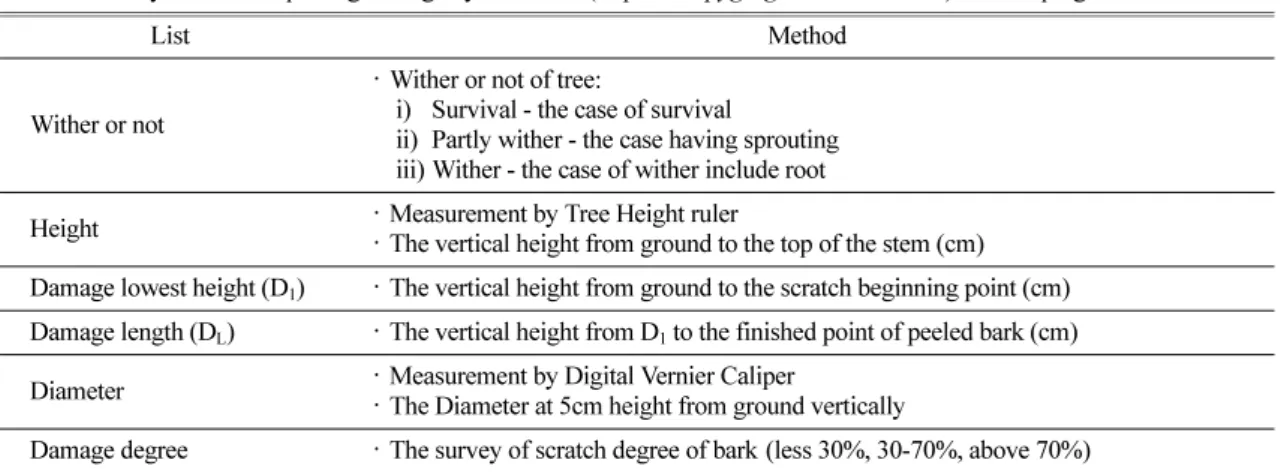
조사항목은다음표와같다.
2.3. 분석
수고와피해저점그리고나무직경과피해저점
,
피해 유형과피해정도와의상관관계를알아보기위해상관 계수를산출하였고노루가뿔을 긁은나무로가장선호하는수종들에 대한 수고 비교는
t-test
를이용하여수고가현저히낮은굴거리나무와삼나무를다른
3
종 과 비교하였고,
나무직경과피해저점,
피해길이 등에대한주요수종간비교는
ANOVA
분석을하였으며통계프로그램으로
SPSS12.0
을이용하였다.
III. 결 과
3.1. 피해수종현황
조사구간에서노루가뿔로나무껍질을긁은수종은 총
25
종이었고267
본이조사되었다.
이들수종중낙 엽활엽수가18
종134
본이었고상록활엽수가5
종71
본,
나머지
2
종은62
본으로침엽수였다.
가장선호하는수종은 굴거리나무
( Daphniphyllum macropodum Miq.),
삼나무
( Cryptomeria japonica (L.f.) D.Don),
비목( Lindera erythrocarpa Makino),
누리장나무( Clero- dendrum trichotomum Thunb.),
산초나무( Zanthoxylum schinifolium Siebold & Zucc.)
순이었다(Fig. 1).
나무껍질이벗겨지는피해를 입은 나무의평균 수 고는
120.7
±42.4cm
였고,
지상에서부터5cm
높이의 나무직경은1.5
±0.5cm
였다(Table 2).
피해저점은지 상에서부터평균22.1
±10.1cm
지점이었고,
피해길이 는 평균27.5
±10.6cm
였다(Table 2).
피해정도는70%
이상벗겨진 경우가64%
로가장 높았고 나머지는 비슷한수치를 나타냈다
(Fig. 2).
피해 유형을살펴보면
,
부분고사가38%
로가장많았고그다음으로생존이
33%
를차지하였다(Fig. 3).
수고와 피해저점 그리고 나무직경과 피해저점 사이에는 거의 상관이 없는 것으로 나타났다(two-tailed Pearson correlation;
r=0.282, p=0.01; r=0.342, p=0.01).
그리고 피해 유형과 피해 정도 간에는 약한 상관이 있는 것으로 확인되었다(two-tailed Spearman correlation; r
s=0.454, p=0.01).
Fig. 1.
Tree species of bark peeling damage by Roe Deer ( Capreolus Pygargus tianschanicus )’s developing antlers (Dm: Daphniphyllum macropodum Miq., Crj: Cryptomeria japonica (L.f.) D.Don,, Le: Lindera erythrocarpa Makino, Ct: Clerodendrum trichotomum Thunb., Zs: Zanthoxylum schinifolium Siebold & Zucc., Pt: Pinus thunbergii Parl., Ap: Alangium platanifolium var. trilobum (Miq.) Ohwi, Zp: Zanthoxylum piperitum (L.) DC., Saj: Sapium japonicum (Siebold & Zucc.) Pax & Hoffm., Ns: Neolitsea sericea (Blume) Koidz., Na: Neolitsea aciculata (Blume) Koidz., Stj: Styrax japonicus Siebold & Zucc., Vo: Viburnum odora- tissimum var. awabuki (K.Koch) Zabel ex Rumpler, Mm:
Meliosma myriantha Siebold & Zucc., Ae: Aralia elata (Miq.) Seem., Oj: Orixa japonica Thunb., Vd: Viburnum dilatatum Thunb., Rc: Rubus croceacanthus H.Lev., Ve:
Viburnum erosum Thunb., Cm: Callicarpa mollis Siebold &
Zucc., Cij: Cinnamomum japonicum Siebold ex Nees, Mf:
Maackia fauriei (H.Lev.) Takeda, Zc: Zanthoxylum coreanum Nakai, Caj: Callicarpa japonica Thunb., Sc: Smilax china L.).
Table 1.
Survey list of bark peeling damage by Roe Deer ( Capreolus pygargus tianschanicus )'s developing antlers
List Method
Wither or not
·
Wither or not of tree:
i) Survival - the case of survival
ii) Partly wither - the case having sprouting iii) Wither - the case of wither include root
Height
·Measurement by Tree Height ruler
·
The vertical height from ground to the top of the stem (cm) Damage lowest height (D
1)
·The vertical height from ground to the scratch beginning point (cm) Damage length (D
L)
·The vertical height from D
1to the finished point of peeled bark (cm) Diameter
·Measurement by Digital Vernier Caliper
·
The Diameter at 5cm height from ground vertically
Damage degree
·The survey of scratch degree of bark (less 30%, 30-70%, above 70%)
Table 2.
Measured values of bark peeling damage by Roe Deer ( Capreolus pygargus tianschanicus )'s developing antlers
Height
(cm) Damage lowest height
(cm)
Damage length
(cm)
Diameter (cm)
Average 120.7 22.1 27.5 1.5
SD 42.4 10.1 10.6 0.5
Max. 274 58 81 3.3
Min. 54 5 4 0.7
3.2. 주요피해수종간비교
노루가 뿔을 긁은 나무로 가장 선호한 수종들 중 굴거리나무와삼나무의수고가다른
3
개의수종에비 해 낮게 나타났다(t-test; t=-7.852 p<0.05, Fig. 4).
그리고지상에서부터
5cm
높이에서의나무직경은주요 수종 간에 유의한 차이를 나타냈다
(ANOVA;
F
4,204=2.910 p<0.05, Fig. 5).
피해저점(ANOVA; F
4,204= 1.336 p>0.05),
피해길이(ANOVA; F
4,204=1.161 p>0.05)
등은주요수종간에유의한차이가없었다
.
주요피해수종의수형을살펴보면
,
줄기가곧게자라는형태로지상에서일정한정도높이에서처음으로 가지가분지되어나오고잔가지가거의없으며가지가 하늘을향해 서있는형태였다
.
그리고 가지를둘러싸 고 있는 잎은 소형이거나 가지에 빽빽하게 나 있지 않고드문드문나있는형태였다.
IV. 고 찰
나무직경은보통흉고직경을측정하지만본연구에 서는나무의수고가흉고직경에못미치는것이많기 때문에흉고직경측정은의미가없을것이라판단하였 다
.
따라서예비조사를통해 노루 뿔의성장과정으로 인해벗겨지기시작한피해저점높이가지상에서부터5cm
이상이라는것을확인하고지상에서5cm
높이에 서 나무직경을 측정하였다.
그리고 임도 가장자리를 중심으로5m
까지 조사범위를 제한한 것은5m
이상숲내부로들어갈수록치수발생이낮아노루가이용하 기에적합한나무가감소하기때문이다
.
2001
년부터2005
년까지노루의생태학적특징을밝히기위해한라산중산간을중심으로한기존의조사 에서껍질이벗겨지는비율이
70%
이상일때고사율이 가장높고지속적으로피해를주어나무의성장과고사에영향을준다
(Oh, 2006)
고보고하였는데이번조사에서는
70%
이상 껍질이 벗겨진경우가64%
인데 비해고사한경우는29%
로나타나기존의보고와다른결과를나타냈다
.
이는이번조사에서피해유형을 뿌리까지완전히죽은고사와뿌리는생존하여맹아가 Fig. 2.Individual number by bark peeling damage degree.
Fig. 3.
Ratio by bark peeling damage pattern (orange section:
partial death, green section: survive, red section: perfect death).
Fig. 4.
Height of main five tree species of bark peeling damage by antlers (Dm: Daphniphyllum macropodum Miq., Crj: Cryptomeria japonica (L.f.) D.Don,, Le: Lindera erythrocarpa Makino, Ct: Clerodendrum trichotomum Thunb., Zs: Zanthoxylum schinifolium Siebold & Zucc).
Fig. 5.
Diameter of main five tree species of bark peeling damage by antlers (Ct: Clerodendrum trichotomum Thunb., Dm:
Daphniphyllum macropodum Miq., Le: Lindera erythrocarpa
Makino, Zs: Zanthoxylum schinifolium Siebold & Zucc,
Crj: Cryptomeria japonica (L.f.) D.Don).
출현하는부분고사를나누어서기록하였기때문에껍 질이
70%
이상벗겨졌다고해도뿌리가생존하여맹아가출현함으로써고사율이상대적으로낮게나타났다
.
그리고피해정도와피해유형간에약한상관관계가있 어피해정도가심할수록고사나부분고사할가능성이 높다는것을알수있었다
.
이번조사에서피해를입은나무들중상록활엽수나 침엽수가종수에서차지하는비율은
30%
정도로한남 시험림의식생분포중상록활엽수와침엽수의비율과비슷한양상을나타낸다
(KFRI, 2004). 2010
년한남시험림에서실시한식생조사자료에의하면방형구
(25m
×
25m)
내에가장많이분포하는나무는새덕이였으며전체 수종 중 약
50%
를차지하였고 노루가뿔을 긁은나무중삼나무
,
굴거리나무,
비목등은아주적은 수를나타냈다.
따라서노루가뿔을긁은나무들은한남시험림에많이분포하는나무가아니라뿔을긁기에 적합한나무를선택적으로이용한다는것을알수있 었다
.
노루가뿔을긁는나무로선호한나무는굴거리나무 등
5
종이었고 이들 나무들의 측정치 사이에 차이가있는지여부를파악하기위해 수종간비교분석을한 결과
,
수고와 직경에 있어 수종 간 차이를 보였는데이는나무가성장하면서형성되는수형과관련이있어 보인다
.
노루가뿔을 긁는시기는3
월부터8
월까지로 잎이무성하게줄기와가지를덮는시기로가지와잎 은노루가뿔을긁는데방해물로작용한다.
삼나무인 경우,
성장함에 따라지상과가까운가지가 쇠퇴하여 떨어져나가는형태를보이지만일정정도이상의수 고로자라게되면지상과가까운가지가옆으로퍼지 고 굵어지면서 뿔을 들이대기에적합치 않은 형태로 생육한다.
또한굴거리나무인경우성장하면서하단부에서분지되는가지가새로이출현하게되고 일정정 도 이상의 수고가 되면 분지된 가지가 뿔을 긁는데 방해물로작용하는듯하다
.
따라서이들두종의나무 는 노루가 뿔로 긁기 적합한 수고가 비슷한 것으로 판단된다.
나머지종들은성장과정에서가지들이위로 향하거나 가지의 굵기 성장이 미미하기 때문에뿔을 긁기에적합한두께를나타내는평균수고인150cm
로종들 간에 비슷하다고판단된다
.
지상5cm
높이에서 의나무직경인경우,
비목이다른나무들의중간치를나타냈고굴거리나무
,
누리장나무가직경이다소굵은 반면,
산초나무와삼나무가 다소얇은 것으로나타났는데
,
산초나무와삼나무는줄기에가시와같은 돌출 부가 있기 때문에노루가뿔로 긁을 때 이돌출부를 고려하여 다소 얇지만 이들 나무를 이용하는 것으로 판단된다.
이번노루뿔의성장과정에의해나무껍질이벗겨지 는피해는주로 어린나무들에서 발생하고있었다
.
평균수고가
120cm
정도이고,
지상에서부터5cm
높이에서의나무직경은
1.5cm
정도로수종간에다소차이가 있지만3-4
년생 나무들이었다.
이들 나무들은 수고가1m
가 채 되지 않는 것에서부터2m
가 훨씬 넘는 나 무들까지다양하였으며나무직경에있어서는0.7cm
에서부터
3.3cm
까지 넓은 범위에걸쳐 측정되었다.
다양한 범위의 수고와직경을 나타냈기 때문에 수고가 높고직경이굵은나무들은뿔을긁기시작하는위치 가그렇지않은나무들보다높을것이라생각했었는데 그렇지않았다
.
즉,
피해저점 위치와수고,
직경 간에 는관련성이없었다.
따라서노루는이번에조사한범 위 내의 나무들을 뿔을 긁는 대상으로 선택하며 그 이상이거나그이하의수고나직경을가진나무들에는 가해를하지 않는다고판단된다.
따라서묘목을식재할 시노루가뿔로 긁을 가능성이 있는 나무들에대 한보호대책을마련할때이들 정보가유용하게사용 될수있을것이라본다
.
또한
,
난대림에서노루 뿔의 성장과정에서나무껍 질이벗겨지는피해에대한조사는이번이처음시도 되는것이기때문에향후난대림에서유사한산림피 해에대한연구의자료로활용성이높다고생각된다.
제주도는우리나라의가장남쪽에위치하고있어기 후변화로 인해 가장 먼저 영향을 받는 곳으로 수종 변화 가능성이가장 크다
.
난대림의북상이예상되고 있고이에대한연구가진행되고있는시점에서노루 의 활동과 같은 기후변화 이외의 요인에 의한 난대 수종의 변화는 기후 변화로 인한 수종 변화 연구를 수행할시직·간접적으로영향을미칠수있다.
따라 서기후변화이외의요인에대한연구가선행될필요 성이제기되고이들정보가기후변화와관련하여유용 하게이용될수있다고판단된다.
적 요
산림에서나무껍질이벗겨지는피해는노루를비롯 한사슴과에속하는포유류에의해발생하며먹이부
족이 주요 원인이다
.
그러나제주도에서는 뿔이녹각 으로되는 과정에서벨벳을벗겨내는행동에의해나 무껍질이벗겨지는피해가발생하여이들을살펴보았 다.
국립산림과학원 한남시험림내의 해발400m
에서500m
사이에위치한6km
구간의임도주변5m
지역을대상으로
2011
년9
월9
일부터10
월4
일까지 맑은날 을택하여본조사를실시하였다.
노루가뿔로긁은피해목은 총
25
종, 267
본이었으며 낙엽활엽수가18
종134
본,
상록활엽수가5
종71
본,
나머지2
종62
본은 침엽수였다.
뿔긁기로가장선호하는수종은굴거리나 무( Daphniphyllum macropodum ),
삼나무( Cryptomeria japonica ),
비목( Lindera erythrocarpa ),
누리장나무( Clerodendrum trichotomum ),
산초나무( Zanthoxylum schinifolium )
순이었다.
피해목은 주로3~4
년생의 어 린나무이며 평균 수고는120.7
±42.4cm
이었고,
지상5cm
높이에서의 직경은1.5
±0.5cm,
피해 시작점(
최 저점)
은지상에서부터평균22.1
±10.1cm
지점이었고,
피해길이는평균