접수일자: 2012년 4월 20일 심사(수정)일자: 2012년 10월 8일 게재확정일자 : 2012년 10월 9일
이 논문은 2012년 정부(교육과학기술부)의 재원으로 한국연 구재단의 지원을 받아 수행된 연구임(No. 2012014088).
본 논문은 2012년도 지능시스템학회 춘계학술대회 우 수논문으로 선정되어 본 논문지에 게재됨.
분산 제약을 갖는 비선형 시스템의 최적 퍼지 필터 Optimal Fuzzy Filter for Nonlinear Systems
with Variance Constraints
노선영*․박진배*․주영훈**
Sun Young Noh, Jin Bae Park and Young Hoon Joo
*연세대학교 전기전자공학과
**군산대학교 제어로봇공학과
요 약
본 논문에서는 추정 분산 제약을 갖는 비선형 이산시간에 대한 최적의 퍼지 필터에 대한 내용을 다루고자 한다. 필터를 설 계할 때, 추정오차의 분산값은 필터의 성능이 결정하는 변수중 하나다. 이런 분산값에 더욱 강인한 필터를 설계하고자, 분 산 제약 조건을 주어 필터를 설계하고자 한다. 먼저, 비선형 모델을 Tagaki-Sugeno 퍼지 모델을 이용하여 선형 모델로 변 형한 후, 이 모델을 기반으로 선형 필터를 디자인한다. 이때 필터설계 과정 중 필터의 각 파라미터값을 구하기 위해 상태 추정오차 값은 평균제곱에 제한되며, 상태오차의 정상상태 분산값은 각각의 미리 정한 상한 제한 값 보다 작은 조건에서 필터를 설계하여 선형행렬부등식과 대수 이차 행렬부등식을 이용하여 파라미터값을 구한다. 이렇게 설계된 퍼지 필터는 트 럭트레일러 시뮬레이션을 통해 설계 과정과 성능을 보여준다.
키워드 : 최적퍼지필터, 분산제약, T-S 퍼지모델, 비선형성, 선형행렬부등식, 대수이차행렬부등식 Abstract
In this paper, we consider the optimal fuzzy filter of nonlinear discrete-time with estimation error variance constraint.
First, the Takagi and Sugeno(T-S) fuzzy model is employed to approximate the nonlinear system. Next, the error state is mean square bounded, and the steady state variance of the estimation error of each state is not more than the individual predefined value. It is shown that, the addressed problem can be carried out by solving linear matrix inequality(LMI) and some algebraic quadratic matrix inequalities. Finally, some examples are provided to illustrate the design procedure and expected performance through simulations..
Key Words : Optimal fuzzy filter, Variance constraints, linear matrix inequality (LMI), T-S fuzzy model., algebraic quadratic matrix inequalities
1. Introduction
The well-known Kalman filter provides a recursive algorithm to minimize the variance of the state estimation error when the measurement noise is known. This estimation approach may not be robust against moldering uncertainty and disturbances[1,2].
In recent year, there has been considerable attention to robust estimation and ∞filtering problems for
dynamic systems[3]. For example, a robust Kalman filtering problem with bounded parameter uncertainty was considered only in the state matrix [4]. The ∞ filtering approach aims at minimizing the ∞ norm of the transfer function from noises to the estimation error, while the robust filtering approach guarantees an upper bound to the quadratic cost in spite of various parameter uncertainties, and then minimizes this upper bound locally[5]. On the other hand, the robust filtering problem for T-S fuzzy systems has been investigated in the past decades [6]. Based on the T-S fuzzy model, the ∞ fuzzy filtering design for the dynamic systems can be characterized in terms of minimizing the attenuation level subject to some LMIs[7]. It requires a common solution to a set of Ricatti equations. Based on the T-S fuzzy model, motivated by the above observations, we develop a robust fuzzy filter of nonlinear
discrete-time with estimation error variance constraint. A state estimation approach called error covariance assignment theory was first proposed in [8] and then extended to the nonlinear case. This theory provides an alternative, more straightforward technique to meet the prespecified estimation error variance constraints. The main idea is to design a filter which directly assigns the prespecified steady-state estimation error covariance. However, there are few papers developing the robust estimation technique for uncertain systems subject to the simultaneous achievement of error variance upper-bound constraint and ∞ disturbance attenuation constraint.
In this paper, we consider the optimal fuzzy filter of nonlinear discrete-time with estimation error variance constraint. An error variance constrained filter admits the system to have invariant measurement noise with intensity as large as possible. First, the Takagi and Sugeno(T-S) fuzzy model is employed to approximate the nonlinear system. Next, the error state is mean square bounded, and the steady state variance of the estimation error of each state is not more than the individual prespecified value. It is shown that, the addressed problem can be carried out by solving linear matrix inequality (LMI) and some algebraic quadratic matrix inequalities. This paper is organized as follows: Section 2 formulate the problem under consideration. Optimal fuzzy filtering is introduced in Section 3. Simulation results is presented in Section 4, and finally we conclude the paper in Section 5.
2. Problem Statement
The system plant with missing measurements is represented by th T-S fuzzy model. This is described by the following IF-THEN rules and will be employed here to deal with the estimation design problem for the nonlinear system. The th rule of the fuzzy linear model for the nonlinear system is of the following form:
and and
(1)
where is fuzzy set of in ; denotes the th fuzzy rule; denotes the vector of the outputs; are the premise variables. and
are uncorrelated stationary zero mean white noise sequences with respective covariance and . Using the center average defuzzifer, product inference, and singleton fuzzifier, the out put of fuzzy
systems is inferred as follows:
(2)
where
and is the grade of membership of in . For For notational convenience in the following discussions, we denote that
(3)
Based on the fuzzy model (2), in this paper, the following fuzzy estimator is adopted
(4)
where stands for the state estimate, and are filter parameters to be designed.
Defined the estimation error and the estimation error covariance, respectively, as follows.
(5)
(6) Then, it follows from (2) and (4) and from (6) and (7) that
(7) Define
(8)
(9)
(10)
(11)
(12)
Considering (2) and (4), we obtain the following augmented system.
(13)
where stands for a zero mean Gaussian white noise sequence with covariance .
3. Optimal Fuzzy Filtering
In this section, a solution to the variance constrained state estimation problem formulated in the previous section will be obtained. The purpose of this paper is to design the filter parameters , , and
. The following requirements are met simultaneously.
1) The state of the augmented system (13) is mean square bounded.
2) The steady-state erro covariance meets
≤ (14) where means the steady-state variance of the
th error state, and
denotes the prespecified steady-state error estimation variance constraint on the th state.
The following lemma is useful in the proof of main results.
Lemma 1(Schur complement):Given constant matrices , where and
,then, is and only if
or
(15) Lemma 2: [9] For a given negative definite matrix
, there always exists a matrix ∈ × ≤
such that .
Lemma 3 (Matrix Inverse Lemma): Let and be given matrices of appropriate dimension with , and being invertible;
hold.
Lemma 4 [10]: Let a positive scalar and a positive definite matrix be such that
Then, we have that
≤ (16) Using the statistics of the noise ,
defined in (12) is found to satisfy.
We know from [11] that, if the state of (13) is mean square bounded, the steady-state covariance of (13) defined by
lim
→∞
(17)
exists and satisfied the following discrete-time modified Lyapunov equation:
(18) Theorem 1 Assume that there exists a positive scalar such that following two quadratic matrix inequalities:
(19)
(20) respectively have positive-definite solutions and , where
(21) And by using Lemma 2, ∈ × ≤ and
∈ × is an arbitrary orthogonal matrix. Then, the fuzzy estimatorr (4) with the parameters determined by (21) and
(22) P roof : Since is assumed to be nonsingular.
We set
Then, by means of Lemma 4, it is easily verified that
(23) where
(24)
(25)
·
(26)
It follows from the matrix inverse Lemma 3 that
and, therefore, equation (19) of Theorem1 implies that
.
And substituting the expression of in (21) into (25) leads to easily.
Next, we will consider . First, for presentation convenience, we denote
(27)
(28)
(29)
By using the definitions (27)-(29), we can rearrange (26) as follow:
×
×
(30)
Noticing the expression of in (22) and the fact , we obtain
(31) And it follows from (30), the definition of the matrix
and equation (20) of Theorem 1 that
(32)
The proof is completed.
4. Simulation results
In this section is present a example. This is the same example as that considered in [10]. The vehicle dynamics and measurements can be approximated by the following equations. The following noisy fuzzy model can be used to represent the system:
i f
(33)
The membership function are defined as
and ± . The membership grades
exp
×
exp
We use the following system parameters:
, The steady-state error covariance meets
≤ ≤
By using the Schur Lemma 1, we can convert (19) into the following linear matrix inequality(LMI) and then we solve , and the standard Riccati-like matrix inequality for equation (20) for . We get a solution:
One of the fuzzy estimator parameter, is calculated form (21) as follows:
To obtain another parameter , we choose . Then, it follows from (22) that
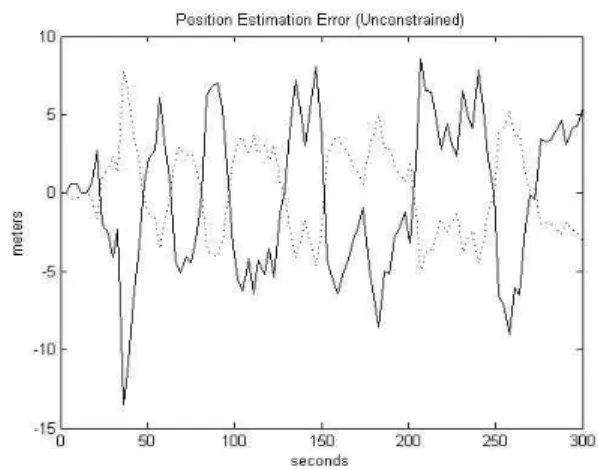
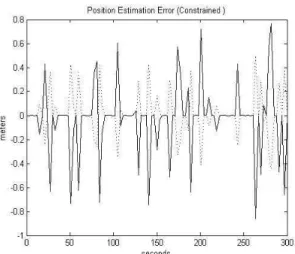
Fig. 1 shows the position estimation error of the unconstrained Kalman filter, and Fig. 2 shows the position estimation error of the proposed method. It can be seen that the proposed constrained filter results in much more accurate estimates than unconstrained filter.
Fig. 1. Variance unconstrained position errors of 100 Monte Carlo simulations (Dotted line is north
position, solid line is east position).
Fig. 2. Variance constrained position errors of 100 Monte Carlo simulations (Dotted line is north
position, solid line is east position).
5. Conclusion
In this paper, we have considered the optimal fuzzy filter of nonlinear discrete-time with estimation error variance constraint. An error variance constrained filter admits the system to have invariant measurement noise with intensity as large as possible. First, the T-S fuzzy model has been employed to approximate the nonlinear system. Next, the error state was mean square bounded, and the steady state variance of the estimation error of each state was not more than the individual prespecified value. It has been shown that, the addressed problem can be carried out by solving linear matrix inequality (LMI) and some algebraic quadratic matrix inequalities.
References
[1] D. O. Brian, Anderson, and John B. Moore, Optimal Filtering, Dover Publications, Inc. 1979.
[2] H.Dan Simon, Optimal State Estimation, Wiley \&
Sons, Inc. 2006.
[3] L. Xie, L. Lu, D. Zhang, and H. Zhang “Improved robust and ∞ filtering for uncertain dis- crete-time systems," Automatica, vol. 40, no. 5, pp.
873-880, 2004.
[4] W. NaNacara and E. Yaz, “Linear and nonlinear estimation with uncertain observations,“ In Proc.
Amer. Contr. Conf., Maryland, 1994.
[5] U. Shaked, L. Xie, and Y. C. Sho, “New ap- proaches to robust minimum variance filter de- sign," IEEE Trans. Signal Processing, vol. 49, no.
4, pp. 2620-2629, 2001.
[6] B. Chen, C. Tseng, H. Uang. “Mixed /∞ fuzzy
output feedback control design for nonlinear dy- namic systems: an LMI approach," IEEE Trans.
Fuzzy Syst., vol. 8, no. 3, pp. 249-265, 2000.
[7] S. Boyd, L. El Ghaoui, E. Feron, and V.
Balakrishnan,Linear Matrix Inequalities in System and Control Theory, Philadelphia, PA:SIAM, 1994.
[8] Y. Y. Cao and P. M. Frank, “Robust ∞ dis- turbance attenuation for a class of uncertain dis- crete-time fuzzy systems," IEEE Trans. Fuzzy Syst., vol. 8, pp. 406-415, 2000.
[9] Z. Wang and B. Huang, “Robust ∞ filtering for linear systems with error variance constraints,"
IEEE Trans. Signal Processing, vol. 48, no. 10, pp.
2463-2467, Aug. 2000.
[10] Y. Wang, L. Xie, and C. E. de Souza, “Robust con- trol of a class of uncertain nonlinear systems,"
Syst., Contr. Lett., vol. 19, no. 2, pp. 139-149, 1992.
[11] D. Simon, “Kalman filering for fuzzy discrete time dynamic systems," Applied soft computing, vol. 3 pp. 191-207, 2003.
저 자 소 개
노선영(Sun Young Noh) 1999년 2월 : 명지대학교 공학사 2005년 9월 : 연세대학교 공학석사 현재 : 연세대학교 박사과정
관심분야 : 목표 추적 시스탬, 지능형 필터, 지능 시스템 Phone : 02-2123-2773
Fax : 02-362-4539 E-mail : [email protected]
박진배(Jin Bae Park)
1977년 : 연세대학교 전기공학과 공학사 1985년~1990년 : Kansas State University
전기 및 컴퓨터 공학과 졸업 공학박사
1990년~1991년 : Kansas State University 전기 및 컴퓨터 공학과 조교수
2012년 1월 ~ 현재 : 제어로봇시스템학회 차기회장 현재 : 연세대학교 전기전자공학과 교수
관심분야 : 제어 이론, 지능제어, 로보틱스, 신재생에너지 Phone : 02-2123-2773
E-mail : [email protected]
주영훈(Young Hoon Joo)
1982년 : 연세대학교 전기공학과 졸업 1984년 : 연세대학교 대학원 전기공학과 1995년 : 동대학원 전기공학과 졸업 박사졸업 1986년~1995년 8월 : 삼성전자(주) 생산기술
센터 자동화연구소
책임연구원 2009년 : 한국지능시스템학회 회장
2011년 1월~현재 : 대한전기학회 정보제어부문 부회장 1995년 9월~현재 : 군산대 공대 제어로봇공학과 교수 관심분야 : 퍼지 모델링, 유전자 알고리즘, 퍼지 웨이블렛
시스템, TS 퍼지 시스템, 지능형 디지털 재설계 Phone : 063-469-4706
E-mail : [email protected]