- 1724 -
완화된 Non-Quadratic 안정화 조건을 기반으로 한 이산 시간 Takagi-Sugeno 퍼지 시스템의 최적 제어
이동환*, 박진배*, 양한진**, 주영훈**
* 연세대학교 전기전자공학과, ** 군산대학교 전자정보공학부
Optimal Control for Discrete-Time Takagi-Sugeno Fuzzy Systems Based on Relaxed Non-Quadratic Stabilization Conditions
Lee Dong Hwan*, Park Jin Bae*, Han Jin Yang**, and Young Hoon Joo**
* Electrical and Electronic Engineering, Yonsei University
** School of Electronics and Information Engineering, Kunsan National University Abstract - In this paper, new approaches to optimal controller
design for a class of discrete-time Takagi-Sugeno (T-S) fuzzy systems are proposed based on a relaxed approach, in which non-quadratic Lyapunov function and non-parallel distributed compensation (PDC) control law are used. New relaxed conditions and linear matrix inequality (LMI) based design methods are proposed that allow outperforming previous results found in the literature. Finally, an example is given to demonstrate the efficiency of the proposed approaches.
1. Introduction
Over the past few years, there have been significant research efforts devoted to the analysis and control design of Takago-Sugeno (T-S) fuzzy systems [1]-[11]. Among them, the relaxation of stability and stabilization conditions for T-S fuzzy systems have gained tremendously inceasing attention and have been discussed in [5]-[11].
Very recently, [11] developed a non-parallel distributed compensation (PDC) control law which is associated with the non-quadratic Lyapunov function for stabilizing discrete-time T-S fuzzy systems.
They proved that the non-quadratic approach results always contain common and weighting-dependent quadratic Lyapunov function case [10] and give better ersults than classical results.
On the other hand, in many practical situations, an optimal controller is desired that can minimize certain performance criterion and satisfy some physical constraints at the same time. In [2], they attempted to develop optimal control of nonlinear systems based on the T-S fuzzy framework. By using PDC controller, some sufficient conditions for the stabilization and performance of a system were stated in terms of the feasibility of a set of linear matrix inequalities (LMIs). However, there are no research efforts for the optimal fuzzy control by employing non-quadratic approach [11] and using relaxed stability and stabilization conditions [6], [7].
Motivated by aforementioned observation, in this paper, we presents an optimal control of discrete-time T-S fuzzy systems via non-PDC control law and non-quadratic Lyapunov function. The main contribution of this paper is derivation of a sufficient condition, in terms of LMIs, for the stabilization and optimal performance of discrete-time nonlinear systems. Finally, a numerical example will be given to show the effectiveness of the method.
2. Discrete-Time T-S fuzzy Systems
Consider a discrete-time T-S fuzzy model with its th rule described as
: IF is ,…, is
THEN
(1)
where ∈, ∈, ∈, ∈ … , denotes the th fuzzy rule, is the th premise variable, and , ∈×, is the fuzzy set if in . Using the center-average defuzzification, product inference and singleton fuzzifier, its global dynamics is inferred as (2)
where , , and ⊂→ is the membership function of on the compact set . For the sake of notational convenience, for a matrix , the following notations will be adopted: , . 3. Improved Oprimal Control of Discrete-Time T-S Fuzzy Systems In this section, a improved scheme of fuzzy optimal control will be presented. We consider the following non-PDC control law [11] for the fuzzy systems (2). . (3)
The objective of this paper is to design a non-PDC control law (3) such that minimize the performance index ∞ , (4)
where ≻ and ≻ . Theorem 1 : Consider the system (2) and controller (3). For the prescribed initial condition , suppose that the matrices ≻ , , , , with , , , , and , ∈ are optimal solutions to minimize subject to ∗ ≥ , (5)
≺ , ∈, (6)
≺ , ∈, (7)
≥ , ∈, (8) where
∗ ∗ ∗
∗ ∗
∗
, 2009년도 대한전기학회 하계학술대회 논문집 2009. 7. 14 - 17
- 1725 -
⋯
⋯
⋯
⋯
⋮ ⋮ ⋮ ⋮ ⋱ ⋮ ⋮
⋯
⋯
,
Then, the closed-loop system of (2) and (3) is asymptotically stable, and the upper bound of performance index (4) is minimized.
Proof: Proof is omitted due to the lack of space.
4. Numerical Example
Consider the T-S fuzzy model (1) with the same membership functions as “Example 1” in [11] and
,
,
,
. In this simulation, the performance index is chosen as
∞ .
Table 1 summarizes the minimum values of the performance index by solving the LMIs in Theorem 1 with a given fixed and initial states . It can be seen that increases as increases.
with Theorem 1
1.4 0.2350
1.5 0.3544
1.6 0.8751
1.7 3.4775
Table I. Computed by Theorem 1 For Different
For and initial states , by applying Theorem 1, we have:
, ,
,
,
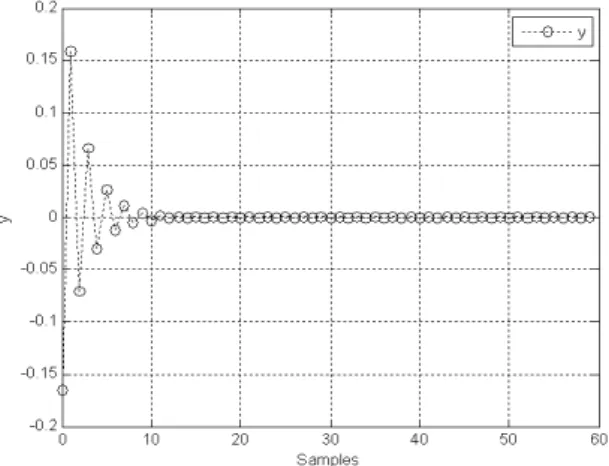
Figures 1 and 2 illustrate the output response for the closed-loop (2) and (3) and the control input, respectively. In this case, measured performance index is .
Figure 1. The output response for the closed-loop systems of (2) and (3).
Figure 2. The control input for the closed-loop systems of (2) and (3).
5. Conclusion
In this paper, we have studied improved optimal control for discrete-time T-S fuzzy systems. To do this, based on the non-PDC control law and non-quadratic Lyapunov funtion, a sufficient condition for the existence of the optimal controller, which minimize the performance index, has been obtained in an LMI form.
The given numerical example has shown the effectiveness of the proposed method.
Acknowledgement. This work has been supported by Yonsei University Institute of TMS Information Technology, a Brain Korea 21 program and by KESRI, which is funded by MMK (Ministry of Knowledge Economy)
References
[1] J. Li, H. O. Wang, D. Niemann and K. Tanaka, “Parallel distributed compensation for Takagi-Sugeno fuzzy models:
multi-objective controller design”, in Proc. America Control Conference, San Diago, CA, pp. 1832-1836.
[2] J. Li, H. O. Wang, L. Bushnell, Y. Hong and K. Tanaka, “A fuzzy logic approach to optimal control of nonlienar systems”, Int.
J. Fuzzy Syst., vol. 2, no. 3, 2000.
[3] K. Tanaka and H. O. Wang, Fuzzy Control Systems and Analysis, Ed John Wiley and Sons, New York, USA, 2001.
[4] H. O. Wang, K. Tanaka and M. Griffin, “An approach to fuzzy control of nonlinear systems: Stability and Design Issues”, IEEE Trans. Fuzzy Syst., vol. 4, no. 1, pp. 14-23, 1996.
[5] K. Tanaka, T. Ikeda and H. O. Wang, “Fuzzy regulators and fuzzy observers: relaxed stability conditions and LMI-based designs”, IEEE Trans. Fuzzy Syst., vol. 6, no. 2, pp. 250-265, 1998.
[6] E. Kim and H. Lee, “New approaches to relaxed quadratic stability condition of fuzzy control systems”, IEEE Trans. Fuzzy Syst., vol. 8, no. 5, pp. 523-534, 2000.
[7] X. Liu and Q. Zhang “Approaches to quadratic stability conditions and ∞ control designs for T-S fuzzy systems”, IEEE Trans.
Fuzzy Syst., vol. 11, no. 6, pp. 830-839, 2003.
[8] C. H. Fang, Y. S. Liu, S. W. Kau, L. Hong and C. H. Lee, “A new LMI-based approach to relaxed quadratic stabilization of T-S fuzzy control systems”, IEEE Trans. Fuzzy Syst., vol. 14, no. 3, pp. 386-397, 2006.
[9] K. Tanaka, T. Hori and H. O. Wang, “A multiple Lyapunov function approach to stabilization of fuzzy control systems”, IEEE Trans. Fuzzy Syst., vol 11, no. 4, pp. 582-589, 2003.
[10] D. Choi and P. Park, “∞ state-feedback controller design for discrete-time fuzzy systems using fuzzy weighting-dependent Lyapunov functions”, IEEE Trans. Fuzzy Syst., vol. 11, no. 2, pp.
271-278, 2003.