• 검색 결과가 없습니다.

Traditional Knowledge of Plants Used for River Fishing in Local Communities of North Jeolla Province, Korea

N/A
N/A
Protected

Academic year: 2021

Share "Traditional Knowledge of Plants Used for River Fishing in Local Communities of North Jeolla Province, Korea"

Copied!
7
0
0

로드 중.... (전체 텍스트 보기)

전체 글

(1)

Korean J Community Living Sci 26(4) : 675~681, 2015 http://dx.doi.org/10.7856/kjcls.2015.26.4.675

전북 지역사회에서 천렵에 이용된 식물들의 전통지식에 관한 연구

천 인 옥ㆍ송 미 장ㆍ김 현

1)†

ㆍ이 기 훈

2)

ㆍ유 영 준

전주대학교 대학원 생명자원융합과학과ㆍ전주대학교 대체건강관리학부

1)

ㆍ전주대학교 경영학과

2)

Traditional Knowledge of Plants Used for River Fishing in Local Communities of North Jeolla Province, Korea

Inok CheonㆍMi-Jang SongㆍHyun Kim

1)†

ㆍKi Hoon Lee

2)

ㆍYoung Joon Yoo

Dept. of Integrated Bio-Resource Science, General Graduate School of Jeonju University, Jeonju, Korea School of Alternative Medicine and Health Science, Jeonju University, Jeonju, Korea

1)

Dept. of Business Administration, Jeonju University, Jeonju, Korea

2)

1)

ABSTRACT

This study investigates traditional knowledge of plants used for river fishing in local communities of North Jeolla Province, Korea. Data were collected using the participatory rural appraisal method based on interviews, informal meetings, open and group discussions, and overt observations with semi-structured questionnaires. Field investigations were conducted at 19 sites from July 2008 to April 2010. Interviews included 37 key informants (16 men and 21 women) who lived more than 50 years in the area. The average age of the informants was 83 (range = 60 to 96). The analysis recorded seven species, namely Albizia julibrissin Durazz., Juglans mandshurica Maxim., Perilla frutescens var. japonica (Hassk.) H. Hara, Nelumbo nucifera Gaertn., Persicaria hydropiper (L.) Spach, Zanthoxylum piperitum (L.) DC., and Styrax japonicus Siebold and Zucc..

Key words: traditional knowledge, participatory rural appraisal, plants for river fishing

I. 서론

천렵(川獵)은 고대 수렵사회(水獵社會)와 어렵사 회(漁獵社會)의 습속이 후대에 여가를 즐기는 풍속으

로 변모된 것으로 이해할 수 있다(Editorial Department of Encyclopedia of Korean Culture 1991). 무라야마 지준(村山智順)의 “조선의 향토오락”에는 경남지방의 17곳을 비롯하여 전국에서 천렵이 행해졌다고 기술

This research was supported by grants from the Rural Development Administration (No. PJ009566012015).

접수일: 2015년 9월 3일 심사일: 2015년 10월 27일 게재확정일: 2015년 11월 11일

Corresponding Author: Hyun Kim Tel: +82-63-220-2516 E-mail: [email protected]
This is an Open-Access article distributed under the terms of the Creative Commons Attribution Non-Commercial

License (http://creativecommons.org/licenses/by-nc/3.0) which permits unrestricted non-commercial use, distribution,

and reproduction in any medium, provided the original work is properly cited.

(2)

하고 있다(Park 1992).

어류를 기절시키는 천연마취제 역할을 하는 천렵용 식물은 열매, 뿌리, 잎 등을 짓찧어 물에 풀어 이용함 과 동시에 약용, 식용 등 다른 용도로도 활용되고 있 다. 예를 들면, 때죽나무( Styrax japonicus Siebold &

Zucc.)는 열매를 빻아서 물고기를 잡는데 사용하였으 며 민간에서는 진통제로써 사람의 인후통과 치통 등 에 쓰였다. 또한 여뀌[ Persicaria hydropiper (L.) Spach]는 잎과 줄기를 으깨어 개울물에 풀어 물고기를 잡았으며, 한편으로는 음식의 양념으로도 쓰였다(Im et al. 2012). 가래나무( Juglans mandshurica Maxim.) 는 덜 익은 열매를 찧어서 강에 풀어 물고기가 물에 뜨면 잡았고, 민간약으로 광견병, 단독, 복통, 종기 등 에 쓰였으며 잎은 무좀에 사용하였다(Choi 1997). 그 리고 초피나무[ Zanthoxylum piperitum (L.) DC.]는 수피를 건조시킨 분말로 물고기를 잡는데 이용하였다 (Jeong 1980).

외국의 경우, 아프리카대륙에서는 식물의 독성을 이용하여 낚시를 하는 것은 매우 일반적이었고, 이에 이용되는 식물은 71과 183속 325종이 조사되었다 (Neuwinger 2004). 이탈리아 민간어업에서는 Gossypium sp . pl., Laurus nobilis L., Olea europaea L. 등 식물 6종을 이용하고 있고(Valentina et al. 2013), 브라질 남부지방에서는 Schinus terebinthifolia Raddi, Gochnatia polymorpha (Less.) Cabrera, Handroanthus heptaphyllus (Vell.) Mattos, Terminalia australis Cambess., Sebastiania schottiana (Müll. Arg.) Müll.

Arg. 등 17종의 식물을 물고기를 잡는데 이용하였다 (Marcela 2013).

한편 전북에서 자생하는 천렵에 활용되었던 식물 에 관한 연구는 기능성이나 효능에 관한 것으로, Jang et al.(2006)의 초피나무 추출물의 항산화, 항염 증 및 항혈전 효능에 관한 연구, Bae & Park(2012)의 민간약 때죽나무의 생약학적 연구, Lee et al.(2011) 의 가래나무( Juglans mandshurica Maxim.) 추출물 의 면역조절 활성, Zhang et al.(2012)의 자귀나무 줄 기껍질의 트리페르테노이드 및 기타성분 등이 보고 되고 있으나 천렵용도에 관한 연구는 전무하다.

전통지식은 나고야의정서의 전문에 의하면 “토착

및 지역사회에서 생물다양성의 보전 및 지속가능한 이용에 적합한 풍부한 문화적 유산이 반영된 구전, 문헌 그리고 다른 형태의 지식들”로 정리하고 있다.

현재는 거의 70세 이상의 고령층만이 자생식물에 대 한 전통지식을 보유하고 있을 뿐이어서, 이들의 사망은 곧 이 지역의 식물자원에 대한 구전 전통지식이 영원히 사라진다는 것을 의미한다(Martin 1995; Cotton 1996;

Balick and Cox 1999).

최근에 전북지역의 해안가를 거의 포함하는 세계 최대의 새만금방조제의 완공과 함께 식물에 대한 전 통지식은 더욱 빨리 소실되는 위험에 처해있어, 이러 한 어려운 상황은 더욱 가속화되고 있다. 이러한 사실 들에 비추어 이 지역의 식물에 대한 구전 전통지식을 조사하고 정리하는 것은 매우 중요함을 알 수 있다.

따라서 이 연구의 목적은 전북지방에서 천렵에 이 용되는 식물의 전통지식을 조사하였다.

II. 연구방법

1. 조사지역

전라북도는 한반도 서남부에 위치하고 있으며 지 리적으로는 북위 35° 17′ 45″~36° 09′ 15″, 동경 125°

58′ 05″~127° 54′ 50″에 있고, 행정구역은 6개의 시와 8개의 군으로 구성되어 있다. 전체 면적은 8,067.12㎢

로 전국 면적의 8.1%를 차지하고 있으며 2011년 총 인구는 1,895,882명이다. 기후의 특징은 남북의 차이 보다 동서의 차이가 큰데 이는 동쪽은 산악지대로 높 고 서쪽은 평야지대로 낮은 지형적 영향을 크게 받기 때문이며 연 평균 기온은 약 13.1℃이고, 강수량은 21,399.5㎜이다(North Jeolla Province 2012).

2. 조사방법

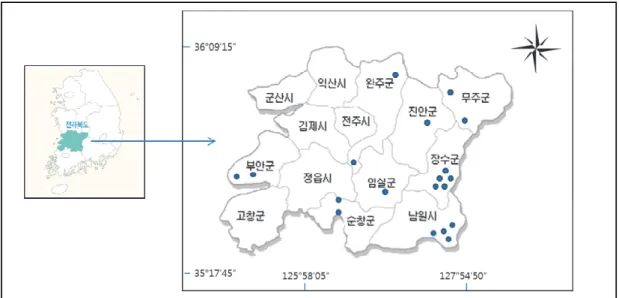
현지조사는 2008년 7월부터 2010년 4월까지 19개 지역에서 이루어졌다(Fig. 1). 정보제공자는 조사지역 에서 적어도 50년 이상 거주한 37명(남자 16명, 여자 21명)의 지역주민들로 평균나이는 83세(60~96세)이다.

조사는 기본적으로 정보제공자가 동시에 조사자가

되는 participatory rural appraisal(PRA) 기법을 이용

(3)

Fig. 1. Investigation sites Gender

Male 16(43%)

Female 21(57%) Age

60~69 3( 8%)

70~79 11(30%) 80~89 17(46%)

90~99 6(16%)

Table 1. Demographic characteristics

하였으며, 비공식적인 만남, 정상적인 인터뷰, 공개된 다수의 토론 그리고 정확한 관찰 등을 통해 기록되었 다(Kim & Song 2008). 반구조식 설문지는 Kim &

Song(2008)과 Martin(1995)의 설문지 구성방법을 토 대로 작성되었으며, 내용은 식물에 대한 다양한 민족 전통식물학적인 특징 즉, 지역명칭, 이용부위, 이용방 법 등으로 구성되었다(Poonam & Singh 2009). 증거 표본은 정보제공자가 언급한 이용부위를 중심으로 정확한 동정이 끝나면, 화기나 혹은 결실기에 채집하 여 정상적인 표본제작방법(Martin 1995)을 거쳐 표본 으로 만들어 보관하였다.

식물의 동정은 Lee(1980)와 Lee(2002)를 이용하였 으며 학명은 국가생물종지식정보시스템(http://www.

nature.go.kr)을 이용하여 정리하였다.

3. 정량적 분석

충실도는 조사 대상자들이 특정용도에 이용하였던 가장 중요한 식물의 종을 결정하기 위하여 이용하였 다. 공식은 FL(%)=N

p

×100/N 이다. 여기서 N

p

는 특정 용도에 이용된 식물의 종을 언급한 정보제공자의 수 이고 N은 어떤 용도에라도 쓰인 식물을 이용한 정보 제공자의 수이다(Alexiades 1996; Ali-Shtayeh et al.

2000).

III. 결과 및 고찰

1. 민족지학적 분석

전체 37명의 정보제공자들(남자 16명, 여자 21명) 은 19개 조사지역의 마을회관, 노인복지회관, 전통시 장에서 임의로 선정하였다. 정보제공자들의 평균연 령은 83세(60~96세)이며, 80대가 전체의 46%를 차지 하였다(Table 1).

2. 민족전통식물학적 분석

전북지역에서 채록된 천렵에 이용된 식물은 7과 7 속 7종으로 온라인자료에서 확인된 종류는 4종류이 며, 온라인자료(http://www.naver.com, http://www.

daum.net, http://www.google.com)에 언급되어 있

(4)

Family Scientific name Korean name Used part Preparation Source

Fabaceae Albizia julibrissin Durazz. Jagwinamu Leaf Maceration Field

Juglandaceae Juglans mandshurica Maxim. Garaenamu Stem Maceration Field, on-line Lamiaceae Perilla frutescens var. japonica (Hassk.) H. Hara Deulkkae Seed Grind Field Nymphaeaceae Nelumbo nucifera Gaertn. Yeonkkot Stem Maceration,

power Field

Polygonaceae Persicaria hydropiper (L.) Spach Yeokkwi Stem, whole

part Maceration Field, on-line Rutaceae Zanthoxylum piperitum (L.) DC. Chopinamu Fruit, leaf

bark, seed

Maceration, powder

Field, on-line Styracaceae Styrax japonicus Siebold & Zucc. Ttaejungnamu Fruit, leaf Maceration,

powder

Field, on-line Amaryllidaceae Lycoris radiata (L'Her.) Herb. Seoksan Root Maceration On-line Polygonaceae Persicaria filiformis (Thunb.) Nakai ex Mori Isangnyeokkwi Leaf, stem Maceration On-line Polygonaceae Persicaria longiseta (Bruijn) Kitag. Gaeyeokkwi Leaf, stem Maceration On-line Styracaceae Styrax obassia Siebold & Zucc. Jjokdongbaek

namu Leaf, pericarp Maceration On-line Polygonaceae Persicaria thunbergii (Siebold & Zucc.) H.Gross Gomari Leaf, stem Maceration On-line Bignoniaceae Campsis grandifolia (Thunb.) K.Schum. Neungsohwa Flower Maceration On-line Table 2. Plant species for river fishing in communities of North Jeolla province

지만 이번 조사에서 확인되지 않은 종류는 6종류이 었다(Table 2). 이러한 결과는 외국의 경우, 이탈리 아에서는 Gossypium sp . pl., Laurus nobilis L. 등 6종(Valentina et al. 2013)이 조사되어 이 연구의 결 과와 비슷한 반면에, 브라질 남부지방에서는 Schinus terebinthifolia Raddi, Gochnatia polymorpha (Less.) Cabrera 등 17종(Marcela et al. 2013)으로 많이 이 용되고 있는 것으로 조사되었다. 식물의 독성을 이 용하여 낚시를 하는 것이 매우 일반적인 아프리카대 륙에서는 71과 183속 325종(Neuwinger 2004)으로 가장 많이 조사되었다. 이렇게 아프리카대륙에서 천 렵용식물이 많이 이용된 이유는 지리적 및 기후적 특성으로 아프리카대륙에서 자생하는 식물의 종수가 우리나라보다 더 많기 때문인 것으로 사료된다.

조사된 종들의 분포를 보면 초피나무는 전체 이용 의 45%(34번 언급)를 차지하고 있고, 다음으로는 때 죽나무, 여뀌, 연꽃, 자귀나무로 26%(20번 언급), 17%(13번 언급), 5%(4번 언급), 3%(2번 언급) 등을 차지하였다(Fig. 2). 그리고 조사된 종들 중, 자귀나무

는 천렵이외에도 타박상, 골절, 류마티즘, 어혈 등 약

용으로 이용되고, 들깨는 만성위염, 기침, 해소, 옻 오

른데, 위산과다, 감기, 피부병 등 약용, 장아찌, 쌈,

들깨강정 등 식용으로 이용되고, 연꽃은 연근정과, 연

근죽, 연밥, 연꽃차 등 식용, 폐결핵, 지혈, 각혈 등 약용

으로 이용되고 있다(Choi 1997). 초피나무는 타박상,

단독, 종기, 해독 등 약용, 장아찌, 조미료, 나물 등 식용

으로 이용되고 있다(Choi 1997). 가래나무는 광견병,

단독, 복통, 종기, 무좀 등 약용, 기름, 나물 등 식용으로

이용되고, 여뀌는 피부병, 위궤양 등 약용으로 이용되

고 있다(Publishing company of encyclopedia of

science 1999). 그리고 때죽나무는 등유, 머릿기름 등

염료용과 향장용으로 이용되었고, 복통, 가래, 이뇨제

등 약용으로도 이용되고 있다(Publishing company of

encyclopedia of science 1999). 이와 같이 조사된 식물

7종은 천렵용 이외에도 약용, 식용 등으로 다양하게

이용되고 있음을 알 수 있다.

(5)

Scientific name Korean name

Total number of informants using plants

(N)

Number of informants mentioning specific

plant species for river fishing (Np)

FL (%)

Albizia julibrissin Durazz. Jagwinamu 7 2 28.5%

Juglans mandshurica Maxim. Garaenamu 4 2 50.0%

Perilla frutescens var. japonica (Hassk.) H. Hara Deulkkae 21 1 4.7%

Nelumbo nucifer a Gaertn. Yeonkkot 9 7 77.7%

Persicaria hydropiper (L.) Spach Yeokkwi 14 13 92.8%

Zanthoxylum piperitum (L.) DC. Chopinamu 76 26 34.2%

Styrax japonicus Siebold & Zucc. Ttaejungnamu 37 19 51.3%

Table 3. Fidelity levels of plants for river fishing Fig. 2. The most common plant species

Fig. 3. Used plant-parts of plants for river fishing

천렵용으로서의 이용부위는 전체 7가지가 활용되 고 있었다. 이 중에서 열매가 전체의 42%(32번 언급) 로 가장 많이 이용되었으며, 다음으로는 식물전체

14%(11번 언급), 줄기 13%(10번 언급), 잎 12%(9번 언급), 수피 11%(8번 언급) 등으로 이용되었다(Fig.

3). 이용 방법을 보면 자귀나무, 가래나무, 그리고 여 뀌는 찧어서 이용하고, 연꽃, 초피나무, 그리고 때죽나 무는 찧거나 말린 후 가루내서 이용하고, 들깨는 갈아 서 천렵에 이용한다. 또한 생육지역을 보면 연꽃은 물 에서 자라고, 여뀌는 습지에서, 자귀나무, 가래나무, 초피나무, 때죽나무는 야산에서 자라고 있다. 조사된 식물 중 재배종은 들깨이고, 나머지는 야생종이다.

3. 충실도(Fidelity level; FL)

충실도는 조사 대상자들이 특정 용도에 이용하였 던 식물들 중 가장 중요한 식물의 종을 결정하기 위 하여 이용하였다. 일반적으로 FL값이 100%인 종류는 이 종류에 대한 모든 이용이 동일한 방법이었음을 의 미한다(Srithi et al. 2009). 따라서 여뀌가 92.8%로 충실도가 가장 높았고, 4.7%인 들깨는 충실도가 낮 았다(Table 3). 이는 여뀌가 들깨보다 천렵용으로 많 이 이용된 것으로 볼 수 있다.

4. 천렵용 식물의 성분 및 효능

Table 4와 같이, 조사된 식물 중 초피나무의

Xanthoxin, Campesterol, Dimethyleter, 때죽나무의

Egosaponin, 여뀌의 Tannin 등의 성분으로 인해 피

라미, 메기, 꺽지 등 물고기가 경련, 마비를 일으키며

일시적으로 기절한다(Information Center for Agriculture

and Life Sciences 2015; Ministry of Food and Drug

(6)

Korean name Component Chemical

formula Efficacy

Chopinamu Xanthoxin C

15

H

22

O

3

Bruise, erysipelas, boil, detoxification Campesterol C

28

H

48

O

Dimethyleter C

2

H

6

O

Ttaejungnamu Egosaponin C

59

H

102

O

33

Abdominal pain, sputum, diuresis Yeokkwi Tannin C

27

H

24

O

18

Skin diseases, gastric ulcer

Garaenamu Juglone C

10

H

6

O

3

Erysipelas, abdominal pain, boil, Athlete’s foot Tannin C

27

H

24

O

18

Deulkkae I-Perillaldehyde C

10

H

14

O Gastritis, cough, common cold, skin diseases I-Limonen C

10

H

16

Jagwinamu Tannin C

27

H

24

O

18

Bruise, fracture, rheumatism, extravasated blood Yeonkkot Tannin C

27

H

24

O

18

Pulmonary tuberculosis, hemostasis, haemoptysis Table 4. Components, chemical formula, and efficacy of plants for river fishing

Safety 2015). 이들 중 Xanthoxin에는 종자의 발아를 억제시키는 작용 및 매운맛을 내는 성분이 있고, Campesterol은 콜레스테롤수치를 낮추어 관상심장질 환의 위험을 줄여주는 작용을 한다. 그리고 Egosaponin 은 기름때를 없애주는 성분이 있고, Tannin은 떫은맛 을 내는 성분과 소염증, 진통, 지혈 등의 수렴작용을 하고, Juglone에는 항생 및 살균효과가 있다.

IV. 요약 및 결론

우리 선조들이 여름철에 강이나 냇가에서 고기를 잡을 때 주변에 서식하는 초본과 목본 등의 식물들을 이용하여 물고기를 잡는 천렵은 초복, 중복, 그리고 말복 사이의 더위를 보내기 위해 오래전부터 내려온 풍속이다.

이 연구는 전북 지역사회에서 천렵에 활용되는 식 물들에 대한 전통지식을 조사연구하였으며, 그 결과 7과 7속 7종으로 조사되었다. 이러한 결과는 71과 183속 325종이 조사된 아프리카에 비해 현저히 적은 양이다. 이는 전국적으로 조사한 것이 아닌 전북지역 에서만 조사했기 때문인 것으로 사료된다. 이는 온라 인 자료(http://www.naver.com, http://www.daum.

net, http://www.google.com)에서만 추가로 확인된 종류가 6종인 것으로도 알 수 있다. 그리고 조사된 식물은 천렵용 이외에도 타박상, 골절, 류마티즘, 어

혈 등 약용, 장아찌, 조미료, 나물 등의 식용으로도 이용되고 있다. 또한 조사된 식물들의 효능은 경련, 마비를 일으키는 성분 외에도 Xanthoxin에는 종자의 발아를 억제시키는 작용 및 매운맛을 내는 성분, Campesterol은 콜레스테롤 수치를 낮추어 관상심장 질환의 위험을 줄여주는 작용을 하며 Egosaponin은 기름때를 없애주는 성분 등이 함유되어 있고, 이러한 관련 약성을 검증하면 약용 식물로 이용 가능성이 높 아지고, 추가적인 연구를 통해 새로운 천연마취제로 개발될 수 있을 것이다. 그리고 이러한 독성에 의해 물고기가 죽는 것이 아니라 잠시 기절하는 것으로 무 분별한 낚시로 생태계를 파괴하는 것이 아닌 자연을 보호하며 함께 할 수 있을 것이다. 특히 급속한 산업 화로 인하여 우리의 전통문화와 전통방식 등 옛 것이 많이 사라져가고, 현대인들의 다양한 여가활동의 일 환으로 낚시를 하는데 있어 대부분의 사람들이 도구 를 이용하여 물고기를 잡고 있어 식물의 독성을 이용 하여 물고기를 잡는 일이 드문 이러한 시점에서 천렵 에 이용되는 식물의 전통지식을 조사하는 것은 매우 의미 있는 연구라고 생각한다.

이 연구결과, 천렵용으로 이용되는 식물들을 활용

하면 천렵 생태여행과 같은 마을특성에 맞는 맞춤식

농촌체험을 운영하여 농가의 소득향상에 기여할 뿐만

아니라 추가적인 연구를 통해 천연마취제를 개발함으

로써 어류선별이나 이동시 신진대사 기능저하로 받는

(7)

스트레스를 줄여 폐사율을 낮추는 것은 물론 산업화를 통한 수입대체 및 수출효과 등을 기대할 수 있을 것이다.

References

Alexiades MN(1996) Selected guidelines for ethnobotanical research-afield manual. Advances in economic botany, 10. The New York Botanical Garden

Ali-Shtayeh MS, Yaniv Z, Mahajna J(2000) Ethnobotanical survey in the palestinian area: a classification of the healing potential of medicinal plants. J Ethnopharmacol 73, 221-232

Bae JY, Park JH(2012) Pharmacognostical Studies on the Korean Folk Medicine “DdaeJukNaMu”. Korean J pharmacogn 43(3), 198-200

Balick MJ, Cox PA(1999) Plants, people and culture: the science of ethnobotany. New York: Scientific American Library

Choi YJ(1997) Folk plant of Korea. Seoul: Academy Book Co. pp17-263

Cotton CM(1996) Ethnobotany: principles and applications.

London: John Wieley & Sons Inc.

Editorial department of Encyclopedia of Korean Culture (1991) Encyclopedia of Korean Culture. Seoul: The Academy of Korean Studies

Im JA, Lee GC, Kim YH, Kim CC, Park JY(2012) A transportation method and a natural anesthesia composition for fish using a snowbell extracts. Daejeon:

Korean Intellectual Property Office. pp1-13 Information Center for Agriculture and Life Sciences (2015)

Ingredient analysis of Persicaria hydropiper (L.) Spach. Available from http://icals.snu.ac.kr/ fplant [cited 2015 Julyl 10]

Jang MJ, Lee SJ, Jo SH, U MH, Choi JH(2006) A study on the antioxidative, anti-inflammatory and anti- thrombogenic effects of Zanthoxylum piperitum DC.

Extract. J Korean Soc Food Sci Nutr 35(1), 21-27 Jeong MH(1980) Phytochemistry. Seoul: Samsung Publishing

Company. p37

Kim H, Song MJ(2008) Ethnobotany. Seoul: World Science Com. pp190-245

Lee GJ, Jeong FG, Kim HY, Kim GH, Jo BU, Heo Ng, Park IJ, Jang HG(2011) Immunomodulatory Effects of Manchurian walnut(Juglans mandshurica) Extracts.

2011 International symposium and annual meeting 10, 360-360

Lee TB(1980) Illustrated flora of Korea. Seoul: Hyangmunsa Lee YN(2002) Flora of Korea. Seoul: Kyohak Publishing

Co.

Marcela B, Marcelo R, Ulysses A, Coelho-de-Souza G, Mara R(2013) Traditional botanical knowledge of artisanal fishers in southern Brazil. J Ethnobiol Ethnomed 9(54), 1-16

Martin GJ(1995) Ethnobotany: a conservation manual.

London: Champman & Hall

Ministry of Food and Drug Safety(2015) Ingredient analysis of Zanthoxylum piperitum (L.) DC. and Styrax japonicus Siebold & Zucc. Available from http://fse.foodnara.go.kr [cited 2015 April 15]

Neuwinger HD(2004) Plants used for poison fishing in tropical Africa. Toxicon 44, 417-430

North Jeolla Province(2012) Statistical yearbook of Jeollabuk- do. Jeonju: MDshop

Park JY(1992) Folk entertainment of Joseon. Seoul:

Jibmundang

Poonam K, Singh GS(2009) Ethnobotanical study of medicinal plants used by the Taungya community in Terai Arc Landscape, India. J Ethnopharmacol 123, 167-176

Publishing Company of Encyclopedia of Science(1999) Medicinal plant and ingredient of Joseon. Seoul:

Bijo Publishing Co.

Srithi K, Balslev H, Wangpakapattanawong P(2009) Medicinal plant knowledge and its erosion among the Mien (Yao) in northern Thailand. J Ethnopharmacol 123, 335-342

Valentina S, Arianna LR, Giulia C, Fabio R, Laura, C(2013) Plants used in artisanal fisheries on the Western Mediterranean coasts of Italy. J Ethnobiol Ethnomed 9(9), 1-14

Zhang YW, Lin H, Bao YL, Wu Y, Yu CL, Huang YX, Li YX(2012) A new triterpenoid and other constituents from the stem bark of Juglans mandshurica.

Biochem Syst Ecol 44, 136-140

수치

Table  1.  Demographic  characteristics
Table  3.  Fidelity  levels  of  plants  for  river  fishingFig.  2.  The  most  common  plant  species

참조

관련 문서

NISSAN Leaf

A maceration of the wood of Hedera helix shows two vasicentric tracheids (vertical) as well as a number of libriform fibers. The vasicentric tracheids have bordered pits,

A tangential section of the common ivy, Hedera helix, shows some vasicentric tracheids to the left of the vessel, which is the white space at right.. A maceration of the wood

The design method for the optimization of FRP leaf spring is proposed by applying design method of experiment in order to improve the characteristics of

○ Furthermore along with obtaining fundamental data on power network system in Korea and related-data on demand, supply, transmission of Russia and North

Days to emergence and heading, duration of growth, leaf traits and stem diameter of sweet sorghum as affected by soils. Soil type Days

The seven steps can be organized in order of selecting local cultural resources of Fujian Province, selecting local design prototypes for character

A Method for Line Parameter Estimation of Unbalanced Distribution System based on Forward/Backward Sweep Using..