Background and Purpose The aim of this study was to survey the expert opinions on treat- ments for convulsive status epilepticus (CSE) and nonconvulsive status epilepticus (NCSE) in adults.
Methods Forty-two South Korean epileptologists participated in this survey. They completed an online questionnaire regarding various patient scenarios and evaluated the appropriateness of medications used to treat CSE and NCSE.
Results Initial treatment with a benzodiazepine (BZD) followed by either a second BZD or an antiepileptic drug (AED) monotherapy was the preferred treatment strategy. More than two-thirds of the experts used a second BZD when the first one failed, and consensus was reached for 84.8% of the survey items. The preferred BZD was intravenous (IV) lorazepam for the initial treatment of status epilepticus. IV fosphenytoin and IV levetiracetam were chosen for AED monotherapy after the failure of BZD. The treatments for NCSE were similar to those for CSE. Continuous IV midazolam infusion was the treatment of choice for iatrogenic coma in refractory CSE, but other AEDs were preferred over iatrogenic coma in refractory NCSE.
Conclusions The results of this survey are consistent with previous guidelines, and can be cau- tiously applied in clinical practice when treating patients with CSE or NCSE.
Key Words consensus, treatment, status epilepticus, nonconvulsive status epilepticus.
Treatments for Convulsive and Nonconvulsive Status Epilepticus in Adults: An Expert Opinion Survey in South Korea
INTRODUCTION
Status epilepticus (SE) is a medical and neurological emergency that requires immediate treatment.
1The International League Against Epilepsy (ILAE) established two time points relevant for the definition of SE based a seizure duration 1) that is abnormally prolonged (t
1) and 2) that can result in significant neuronal damage (t
2).
1The t
1time points for convulsive status epilepticus (CSE) and nonconvulsive status epilepticus (NCSE) are 5 and 10–15 min- utes, respectively, while the t
2time point is 30 minutes for CSE but unknown for NCSE.
1The early recognition of SE and its prompt treatment crucially affect the outcome. All of the treatment protocols for SE use a staged approach depending on the treatment re- sponse.
2,3A benzodiazepine (BZD) is commonly used as a first-line therapy, but approxi- mately 40% of CSE cases do not respond to BZDs,
4,5which is then defined as established SE. Reportedly 31–47% of cases of established SE are not controlled with conventional an- tiepileptic drugs (AEDs),
6,7and so are defined as refractory SEs. Due to limited prospective randomized controlled trials, the treatment protocol and guidelines for SE are often based on an expert opinion. Several trials related to SE are being conducted, but their findings can-
Jung-Ick Byuna, Dong Wook KimbKeun Tae Kimc, Kwang Ik Yangd Soon-Tae Leee, Jong-Geun Seof Young Joo Nog
Kyung Wook Kangh
Daeyoung Kimi, Yong Won Choc Jae-Moon Kimi, on behalf of the Drug Committee of Korean Epilepsy Society
a Department of Neurology, Kyung Hee University Hospital at Gangdong, Kyung Hee University, School of Medicine, Seoul, Korea
b Department of Neuroloy, Konkuk University School of Medicine, Seoul, Korea
c Department of Neurology,
Keimyung University School of Medicine, Daegu, Korea
d Department of Neurology, Soonchunhyang University
College of Medicine, Cheonan Hospital, Cheonan, Korea
e Department of Neurology, Seoul National University Hospital, Seoul National University College of Medicine, Seoul, Korea
f Department of Neurology, School of Medicine,
Kyungpook National University, Daegu, Korea
g Department of Neurology,
Samsung Noble County, Yongin, Korea
h Department of Neurology,
Chonnam National University Hospital, Chonnam National University School of Medicine, Gwangju, Korea
i Department of Neurology,
Chungnam National University Hospital, Daejeon, Korea
pISSN 1738-6586 / eISSN 2005-5013 / J Clin Neurol 2021;17(1):20-25 / https://doi.org/10.3988/jcn.2021.17.1.20
Received April 13, 2020 Revised July 27, 2020 Accepted July 29, 2020 Correspondence Yong Won Cho, MD, PhD Department of Neurology,
Keimyung University School of Medicine, 1095 Dalgubeol-daero, Dalseo-gu, Daegu 42601, Korea
Tel +82-53-258-7832 Fax +82-53-258-4380 E-mail [email protected] Jae-Moon Kim, MD, PhD Department of Neurology, Chungnam National University Hospital, 282 Munhwa-ro, Jung-gu, Daejeon 35015, Korea
Tel +82-42-220-7801 Fax +82-42-252-8654 E-mail [email protected]
cc This is an Open Access article distributed under the terms of the Creative Commons Attribution Non-Com- mercial License (https://creativecommons.org/licenses/by-nc/4.0) which permits unrestricted non-commercial use, distribution, and reproduction in any medium, provided the original work is properly cited.
JCN
Open AccessORIGINAL ARTICLE
Byun JI et al.
JCN
not be directly applied in clinical practice. Moreover, there is in- sufficient evidence to make evidence-based decisions on specif- ic situations in SE, such as the use of a second BZD or how to treat febrile infection-related epilepsy syndrome (FIRES). The choice of medication can also vary between countries, and only a few studies have been reported for Asian countries.
8Because NCSE can also result in poor cognitive and func- tional outcomes,
9it is undisputed that this condition needs timely treatment. However, there is even less evidence relevant to NCSE, and the treatment recommendations remain con- troversial.
10Only guidelines from the European Federation of Neurological Societies (EFNS) included recommendations for treating NCSE, and they state that NCSE should be treat- ed in the same manner as CSE depending on its etiology.
11Moreover, no expert opinion survey has been performed for NCSE.
This survey aimed to determine an expert opinion of South Korean neurologists who specialize in epilepsy about adult CSE and NCSE treatments using the same survey format as in a previous study.
12We surveyed the preference for treat- ment in each clinical situation that represented a different SE stage, and evaluated the presence of consensus among the included experts.
METHODS
The experts
The 42 experts who participated in this survey represent a geographic cross section of South Korea, and all of them had participated in our previous survey related to adult epi- lepsy treatment.
13This study was approved by the Kyung Hee University Hospital at Gangdong Institutional Review Board (IRB No. 2019-09-005).
The survey
The present survey was based on the expert opinion survey of SE performed in the United States in 2001.
12The clinical scenarios and questions were translated into the Korean lan- guage and modified for different clinical situations. Mem- bers of the Drug Committee of the Korean Epilepsy Society independently checked and discussed the wording before modifying it accordingly. Treatment choices were investigated regarding the two main types of SE (CSE and NCSE), which were further divided into the following four subtypes accord- ing to the ILAE semiological classification of SE
1: generalized convulsive status epilepticus (GCSE), myoclonic SE, focal SE, NCSE with coma, and NCSE without coma. We asked two types of questions for each SE subtype: 1) the overall approach to treatment, which allowed multiple responses for each step, and 2) the preference for specific treatment modalities on a
9-point scale (1=least appropriate and 9=extremely appro- priate). Moreover, we added questions regarding FIRES, which is a refractory SE that occurs from 24 hours to 2 weeks follow- ing febrile infection,
14which was diagnosed based on the his- tory, neuroimaging, and blood workup. Questions on the rec- tal administration of BZDs were not included in this survey because this is not widely applied to adult epilepsy patients in South Korea. Moreover, questions regarding intravenous (IV) lacosamide and IV clonazepam were also not included in the survey because they were not available in South Korea when the survey was performed. The survey was performed online using the Survey Monkey website (San Mateo, CA, USA).
Statistics
Data were presented as frequencies and means, like in the previous study.
13Each medication was categorized as the treatment of choice or the first-, second-, or third-line treat- ment in the same manner.
15In short, when a medication was scored as 9 (extremely appropriate) by more than half of our experts, it was considered to be the treatment of choice.
We calculated the 95% confidence interval (CI) for each medi- cation and categorized it as first, second, or third line accord- ing to a lower CI limit of >6.5, 3.5–6.5, or <3.5, respectively.
If chi-square tests indicated that the distribution of responses appeared random, we considered that there was no consen- sus among the experts.
RESULTS
The consensus was reached for 84.8% of the survey items.
Details of the questions and responses are presented in the Supplementary Materials (in the online-only Data Supple- ment).
Overall treatment strategy
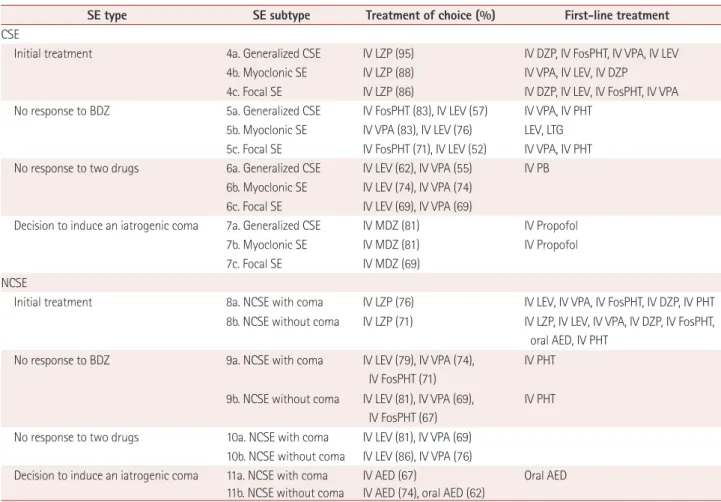
Our experts unanimously chose IV intramuscular (IM) BZD as the preferred treatment strategy for CSE. When the first BZD did not control SE, 71.4% of the experts chose us- ing a second BZD. The overall initial treatment strategy for NCSE was similar to that for CSE, with 66.7% of the experts recommending using a second BZD for the NCSE (Fig. 1).
Initial treatment
IV lorazepam was considered the treatment of choice by
most of our experts regardless of CSE subtype: by 95%, 88%,
and 86% of them for GCSE, myoclonic SE, and focal SE, re-
spectively. IV lorazepam was also considered the treatment of
choice for NCSE patients with (76%) or without (71%) coma.
Expert Opinion on Status Epilepticus Treatment
JCN
No response to benzodiazepine
For GCSE and focal SE, IV fosphenytoin (83% and 71%, re- spectively) and IV levetiracetam (57% and 52%) were con- sidered the treatments of choice after the failure of BZD, while IV valproate and IV phenytoin were considered as first-line treatments. For myoclonic SE, IV valproate (83%) and IV le- vetiracetam (76%) were selected as the treatments of choice.
For NCSE with and without coma, IV levetiracetam (79% and 81%, respectively), IV valproate (74% and 69%), and IV fos- phenytoin (71% and 67%) were selected as the treatments of choice after the failure of BZD.
No response to two drugs
IV levetiracetam (62%, 74%, and 69% for GCSE, myoclonic SE, and focal SE respectively) and IV valproate (55%, 74%, and 69%, respectively) were considered as the treatments of choice regardless of the SE subtype after the failure of BZD and phenytoin. These two drugs were also considered the treat- ments of choice for NCSE with and without coma (81% and 86%, respectively, for IV levetiracetam, and 69% and 76% for
IV valproate).
Decision to induce an iatrogenic coma
Continuous IV midazolam infusion was considered the treat- ment of choice for iatrogenic coma therapy for CSE regardless of the SE subtype (81%, 81%, and 69% for GCSE, myoclonic SE, and focal SE, respectively). IV propofol infusion was se- lected as the first-line treatment for convulsive and myoclonic SE, and IV pentobarbital was chosen as the second-line treat- ment regardless of the SE subtype. For refractory NCSE, the experts preferred IV or oral AEDs over iatrogenic coma ther- apy (Table 1, Fig. 1).
Continuous IV midazolam infusion (73%) was chosen for the treatment of choice for FIRES, while IV immunoglobu- lin (IVIg) and IV methylprednisolone pulse were considered as first-line treatments.
DISCUSSION
We surveyed South Korean epileptologists for their opinions
Table 1. Treatment choices for CSE and NCSE
SE type SE subtype Treatment of choice (%) First-line treatment
CSE
Initial treatment 4a. Generalized CSE IV LZP (95) IV DZP, IV FosPHT, IV VPA, IV LEV
4b. Myoclonic SE IV LZP (88) IV VPA, IV LEV, IV DZP 4c. Focal SE IV LZP (86) IV DZP, IV LEV, IV FosPHT, IV VPA No response to BDZ 5a. Generalized CSE IV FosPHT (83), IV LEV (57) IV VPA, IV PHT
5b. Myoclonic SE IV VPA (83), IV LEV (76) LEV, LTG 5c. Focal SE IV FosPHT (71), IV LEV (52) IV VPA, IV PHT No response to two drugs 6a. Generalized CSE IV LEV (62), IV VPA (55) IV PB
6b. Myoclonic SE IV LEV (74), IV VPA (74) 6c. Focal SE IV LEV (69), IV VPA (69)
Decision to induce an iatrogenic coma 7a. Generalized CSE IV MDZ (81) IV Propofol
7b. Myoclonic SE IV MDZ (81) IV Propofol
7c. Focal SE IV MDZ (69)
NCSE
Initial treatment 8a. NCSE with coma IV LZP (76) IV LEV, IV VPA, IV FosPHT, IV DZP, IV PHT 8b. NCSE without coma IV LZP (71) IV LZP, IV LEV, IV VPA, IV DZP, IV FosPHT,
oral AED, IV PHT No response to BDZ 9a. NCSE with coma IV LEV (79), IV VPA (74),
IV FosPHT (71)
IV PHT
9b. NCSE without coma IV LEV (81), IV VPA (69), IV FosPHT (67)
IV PHT
No response to two drugs 10a. NCSE with coma IV LEV (81), IV VPA (69) 10b. NCSE without coma IV LEV (86), IV VPA (76)
Decision to induce an iatrogenic coma 11a. NCSE with coma IV AED (67) Oral AED 11b. NCSE without coma IV AED (74), oral AED (62)
AED: antiepileptic drug, BDZ: benzodiazepine, CSE: convulsive status epilepticus, DZP: diazepam, FosPHT: fosphenytoin, IV: intravenous, LEV: leveti- racetam, LTG: lamotrigine, LZP: lorazepam, MDZ: midazolam, NCSE: nonconvulsive status epilepticus, PB: phenobarbital, PHT: phenytoin, SE: status epilepticus, VPA: valproate.
Byun JI et al.
JCN
on the treatments for adult CSE and NCSE. The experts pre- ferred treating SE first with a BZD followed by either a second BZD or an AED monotherapy. Around two-thirds of the ex- perts (71.4% for CSE and 66.7% for NCSE) preferred using the second BZD when the first one failed. IV lorazepam was the preferred BZD. IV fosphenytoin and IV levetiracetam were chosen for AED monotherapy after the failure of BZD. For iatrogenic coma, continuous IV midazolam infusion was pre- ferred, followed by IV propofol infusion. For patients with FIRES, immunotherapy with IVIg or IV methylprednisolone was the preferred treatment after continuous IV midazolam infusion. The treatment of choice for NCSE was similar to that for CSE: IV lorazepam followed by IV levetiracetam, val- proate, and fosphenytoin. However, for those with refractory NCSE, the experts preferred IV or oral AED rather than induc- ing an iatrogenic coma.
BZDs were chosen as an initial therapy for both CSE and NCSE, like in the previous literature and guidelines. Our ex- perts preferred lorazepam over diazepam due to its longer duration of action.
16However, there is no evidence for the su- periority of either particular drug.
17IV clonazepam has also been recommended for the initial treatment of SE,
18but its IV
formulation is currently not available in South Korea. We only surveyed medications for which IV administration was possible; however, when IV access is not available, IM mid- azolam has been demonstrated to be equally effective.
19Guidelines allow the use of a second BZD when the first one fails.
2More than two-thirds of the experts preferred using a second BZD. However, one study suggested that repeated doses of BZDs are less effective than the first dose and are as- sociated with a higher risk of respiratory depression.
20Unde- ruse of BZDs may be the reason for recommending a second dose,
21and so a second BZD might not be found to be nec- essary when the initial dose is sufficient.
When BZDs fail, the IV infusion of longer-acting AEDs is recommended.
3IV phenytoin has traditionally been widely used as the second-line treatment, but there is only weak evi- dence for its treatment efficacy.
22,23Our experts chose IV fos- phenytoin (a prodrug of phenytoin that has better tolerability and bioavailability) and IV levetiracetam as their treatment of choice. However, there is a lack of evidence for the superi- ority of any particular AED. IV levetiracetam was preferred in BZD-resistant SE by several groups due to its safety and lack of drug–drug interactions.
24,25Guidelines from Hong Kong
Fig. 1. Overall treatment strategy and drug of choice for patients with CSE and NCSE. Each box indicates the treatment strategy for each step (in- cluding the percentage of experts who chose the strategy for the corresponding step, with multiple responses allowed) and the medication that was chosen as the treatment of choice. AED: antiepileptic drug, BZD: benzodiazepine, CSE: convulsive status epilepticus, FosPHT: fosphenytoin, IM:intramuscular, IV: intravenous, LEV: levetiracetam, LZP: lorazepam, MDZ: midazolam, NCSE: nonconvulsive status epilepticus, VPA: valproate.
2nd IV, IM BZD (71.4)
2nd AED (45.2)
2nd AED (40.5) BZD and AED simultaneously
(16.7)
BZD and AED simultaneously
(33.3) Iatrogenic coma
(anesthesia) (33.3) IV MDZ
Iatrogenic coma (anesthesia)
(16.7) IV, IM BZD
(100) IV LZP
IV, IM BZD (97.6) IV LZP
2nd IV, IM BZD (66.7)
Step 1 Step 2 Step 3 Step 4 CSE
NCSE
AED monotherapy (33.3) IV FostPHT, LEV, VPA
AED monotherapy (40.5) IV LEV, VPA, FostPHT
AED monotherapy (47.6)
AED monotherapy (45.2) 2nd AED
(31.0) IV LEV, VPA
2nd AED (38.1) IV LEV, VPA
Expert Opinion on Status Epilepticus Treatment
JCN
favored the use of medications other than phenytoin.
8A recent randomized double-blinded trial comparing IV fosphenytoin, levetiracetam, and valproate in BZD-refractory SE found that they had similar efficacies in stopping seizures within 1 hour and similar adverse events.
7It may be reasonable to choose from among IV fosphenytoin, levetiracetam, and valproate de- pending on the characteristics of individual patients, as rec- ommended by the Neurocritical Care Society.
3For refractory SE, more-aggressive continuous IV infusions of coma-inducing drugs are recommended.
18Our experts chose continuous IV midazolam infusion as the treatment of choice and propofol as the first-line treatment. This was in line with a previous survey of international experts finding that 52% chose midazolam, 32% chose propofol, and 8% chose barbiturates.
26However, a previous survey in the United States indicated that pentobarbital was the treatment of choice.
12Currently there is insufficient evidence for evaluating whether one drug is more effective than another for refractory SE. A systematic review of the literature suggested that pentobarbi- tal provided better short-term treatment outcomes than did midazolam and propofol, although pentobarbital was more likely to result in hypotension.
27A prospective clinical trial found no differences between propofol and barbiturates, al- though it was terminated early.
28It might be reasonable to start with high-dose continuous IV midazolam infusion (maxi- mum 0.4 mg/kg/hour), which produced fewer cases of break- through seizure and mortality than when using lower doses,
29and add propofol in cases of superrefractory SE.
FIRES is a subcategory of new-onset refractory status epi- lepticus (NORSE), which is proceeded by fever or febrile in- fection.
14For FIRES our experts also chose continuous IV midazolam infusion as the treatment of choice, but instead of propofol or barbiturates, they chose immunotherapy includ- ing IVIg and a methylprednisolone pulse as the first-line treat- ment. High-dose steroids with IVIg improved outcomes in patients with NORSE,
30and other immunotherapies such as tocilizumab are suggested as a treatment option for patients with FIRES.
31Immunotherapy is used in NORSE due to the possibility of underlying pathogenic or proinflammatory an- tibodies.
32However, there is still controversy, since one expert survey found that 18%, 29%, and 42% of the included experts would never consider using steroids, IVIg, or steroid-sparing immunosuppressants, respectively, when treating NORSE pa- tients.
33It is necessary to diagnose and manage NCSE promptly.
However, most guidelines and evidence has focused on CSE, and hence there is a lack of evidence relevant to NCSE. The initial treatment strategy and medication for NCSE chosen by our experts were similar to those for CSE: IV lorazepam followed by IV levetiracetam, valproate, or fosphenytoin,
which is consistent with the EFNS guidelines.
11For refracto- ry NCSE, our experts did not reach consensus about induc- ing an iatrogenic coma, which remains controversial.
34Most experts recommended avoiding iatrogenic coma, instead us- ing IV AEDs that have not been administered previously.
10An observational cohort study of patients with SE, which in- cluded some with NCSE, found that the rate of complications was higher for iatrogenic coma therapy independently of other clinical cofactors.
35This means that whether the mor- bidity associated with iatrogenic coma outweighs the sequel- ae of NCSE itself needs to be judged in individual patients.
The results obtained in this study should be interpreted while considering its limitations. This study has provided only a snapshot of expert opinion among South Koreans epilep- tologists in 2019, and hence does not provide definitive in- formation for use in all scenarios. Moreover, only AEDs that were available for IV use in South Korea in 2019 were evalu- ated. IV lacosamide, which has shown promise in treating both CSE and NCSE,
36was released in South Korea in June 2019 and so was not included in the present survey.
In conclusion, this study has provided the expert opinion of South Korean epileptologists about the treatments for adult CSE and NCSE. The results were in accordance with previ- ous guidelines.
2,3,11However, there remains discordance be- tween the experts regarding whether to use a second BZD or induce an iatrogenic coma in NCSE. The results of this sur- vey can be cautiously applied to patients with SE on an indi- vidualized basis.
Supplementary Materials
The online-only Data Supplement is available with this arti- cle at https://doi.org/10.3988/jcn.2021.17.1.20.
Author Contributions
Conceptualization: all authors. Data curation: all authors. Formal analysis:
Jung-Ick Byun, Keun Tae Kim, Yong Won Cho. Investigation: all authors.
Methodology: Jung-Ick Byun, Dong Wook Kim, Keun Tae Kim. Supervi- sion: Dong Wook Kim, Yong Won Cho, Jae-Moon Kim. Validation: all au- thors. Visualization: Jung-Ick Byun. Writing—original draft: Jung-Ick Byun. Writing—review & editing: Jung-Ick Byun, Dong Wook Kim, Yong Won Cho, Jae-Moon Kim.
ORCID iDs
Jung-Ick Byun https://orcid.org/0000-0002-6224-4575 Dong Wook Kim https://orcid.org/0000-0003-4484-0602 Keun Tae Kim https://orcid.org/0000-0002-7124-0736 Kwang Ik Yang https://orcid.org/0000-0001-6343-6520 Soon-Tae Lee https://orcid.org/0000-0003-4767-7564 Jong-Geun Seo https://orcid.org/0000-0002-3944-5731 Young Joo No https://orcid.org/0000-0002-0145-5707 Kyung Wook Kang https://orcid.org/0000-0001-9362-8670 Daeyoung Kim https://orcid.org/0000-0001-9056-0017 Yong Won Cho https://orcid.org/0000-0002-6127-1045 Jae-Moon Kim https://orcid.org/0000-0002-5035-9877
Byun JI et al.
JCN
Conflicts of Interest
The authors have no potential conflicts of interest to disclose.
Acknowledgements None
REFERENCES
1. Trinka E, Cock H, Hesdorffer D, Rossetti AO, Scheffer IE, Shinnar S, et al. A definition and classification of status epilepticus--report of the ILAE Task Force on Classification of Status Epilepticus. Epilepsia 2015;56:1515-1523.
2. Glauser T, Shinnar S, Gloss D, Alldredge B, Arya R, Bainbridge J, et al. Evidence-based guideline: treatment of convulsive status epilepti- cus in children and adults: report of the guideline committee of the American Epilepsy Society. Epilepsy Curr 2016;16:48-61.
3. Brophy GM, Bell R, Claassen J, Alldredge B, Bleck TP, Glauser T, et al. Guidelines for the evaluation and management of status epilepti- cus. Neurocrit Care 2012;17:3-23.
4. Alldredge BK, Gelb AM, Isaacs SM, Corry MD, Allen F, Ulrich S, et al.
A comparison of lorazepam, diazepam, and placebo for the treatment of out-of-hospital status epilepticus. N Engl J Med 2001;345:631-637.
5. Treiman DM, Meyers PD, Walton NY, Collins JF, Colling C, Rowan AJ, et al. A comparison of four treatments for generalized convulsive status epilepticus. Veterans Affairs Status Epilepticus Cooperative Study Group. N Engl J Med 1998;339:792-798.
6. Mayer SA, Claassen J, Lokin J, Mendelsohn F, Dennis LJ, Fitzsim- mons BF. Refractory status epilepticus: frequency, risk factors, and impact on outcome. Arch Neurol 2002;59:205-210.
7. Kapur J, Elm J, Chamberlain JM, Barsan W, Cloyd J, Lowenstein D, et al. Randomized trial of three anticonvulsant medications for status epilepticus. N Engl J Med 2019;381:2103-2113.
8. Fung EL, Fung BB; Subcommittee on the Consensus Statement of the Hong Kong Epilepsy Society. Review and update of the Hong Kong Ep- ilepsy guideline on status epilepticus. Hong Kong Med J 2017;23:67-73.
9. De Marchis GM, Pugin D, Meyers E, Velasquez A, Suwatcharangkoon S, Park S, et al. Seizure burden in subarachnoid hemorrhage associated with functional and cognitive outcome. Neurology 2016;86:253-260.
10. Sutter R, Semmlack S, Kaplan PW. Nonconvulsive status epilepticus in adults-insights into the invisible. Nat Rev Neurol 2016;12:281-293.
11. Meierkord H, Boon P, Engelsen B, Göcke K, Shorvon S, Tinuper P, et al. EFNS guideline on the management of status epilepticus in adults.
Eur J Neurol 2010;17:348-355.
12. Karceski S, Morrell M, Carpenter D. The expert consensus guideline series: treatment of epilepsy. Epilepsy Behav 2001;2:A1-A50.
13. Byun JI, Kim DW, Kim KT, Yang KI, Lee ST, Seo JG, et al. Treatment of epilepsy in adults: expert opinion in South Korea. Epilepsy Behav 2020;105:106942.
14. Gaspard N, Hirsch LJ, Sculier C, Loddenkemper T, van Baalen A, Lan- crenon J, et al. New-onset refractory status epilepticus (NORSE) and febrile infection-related epilepsy syndrome (FIRES): state of the art and perspectives. Epilepsia 2018;59:745-752.
15. Shih JJ, Whitlock JB, Chimato N, Vargas E, Karceski SC, Frank RD.
Epilepsy treatment in adults and adolescents: expert opinion, 2016.
Epilepsy Behav 2017;69:186-222.
16. Greenblatt DJ, Divoll M. Diazepam versus lorazepam: relationship of drug distribution to duration of clinical action. Adv Neurol 1983;34:
487-491.
17. Brigo F, Bragazzi NL, Bacigaluppi S, Nardone R, Trinka E. Is intrave- nous lorazepam really more effective and safe than intravenous diaz- epam as first-line treatment for convulsive status epilepticus? A sys- tematic review with meta-analysis of randomized controlled trials.
Epilepsy Behav 2016;64:29-36.
18. Alvarez V, Lee JW, Drislane FW, Westover MB, Novy J, Dworetzky BA, et al. Practice variability and efficacy of clonazepam, lorazepam, and midazolam in status epilepticus: a multicenter comparison. Epi- lepsia 2015;56:1275-1285.
19. Silbergleit R, Durkalski V, Lowenstein D, Conwit R, Pancioli A, Palesch Y, et al. Intramuscular versus intravenous therapy for prehos- pital status epilepticus. N Engl J Med 2012;366:591-600.
20. Chin RF, Neville BG, Peckham C, Wade A, Bedford H, Scott RC.
Treatment of community-onset, childhood convulsive status epilepti- cus: a prospective, population-based study. Lancet Neurol 2008;7:696- 703.
21. Sathe AG, Tillman H, Coles LD, Elm JJ, Silbergleit R, Chamberlain J, et al. Underdosing of benzodiazepines in patients with status epilep- ticus enrolled in established status epilepticus treatment trial. Acad Emerg Med 2019;26:940-943.
22. Brigo F, Del Giovane C, Nardone R, Trinka E, Lattanzi S. Intravenous antiepileptic drugs in adults with benzodiazepine-resistant convulsive status epilepticus: a systematic review and network meta-analysis. Ep- ilepsy Behav 2019;101:106466.
23. Brigo F, Bragazzi NL, Lattanzi S, Nardone R, Trinka E. A critical ap- praisal of randomized controlled trials on intravenous phenytoin in convulsive status epilepticus. Eur J Neurol 2018;25:451-463.
24. Hall EA, Wheless JW, Phelps SJ. Status epilepticus: the slow and ago- nizing death of phenytoin. J Pediatr Pharmacol Ther 2020;25:4-6.
25. Zaccara G, Giorgi FS, Amantini A, Giannasi G, Campostrini R, Giovannelli F, et al. Why we prefer levetiracetam over phenytoin for treatment of status epilepticus. Acta Neurol Scand 2018;137:618-622.
26. Ferlisi M, Hocker S, Grade M, Trinka E, Shorvon S; International Steering Committee of the StEp Audit. Preliminary results of the glob- al audit of treatment of refractory status epilepticus. Epilepsy Behav 2015;49:318-324.
27. Claassen J, Hirsch LJ, Emerson RG, Mayer SA. Treatment of refrac- tory status epilepticus with pentobarbital, propofol, or midazolam: a systematic review. Epilepsia 2002;43:146-153.
28. Rossetti AO, Milligan TA, Vulliémoz S, Michaelides C, Bertschi M, Lee JW. A randomized trial for the treatment of refractory status epi- lepticus. Neurocrit Care 2011;14:4-10.
29. Fernandez A, Lantigua H, Lesch C, Shao B, Foreman B, Schmidt JM, et al. High-dose midazolam infusion for refractory status epilepticus.
Neurology 2014;82:359-365.
30. Gall CR, Jumma O, Mohanraj R. Five cases of new onset refractory status epilepticus (NORSE) syndrome: outcomes with early immuno- therapy. Seizure 2013;22:217-220.
31. Jun JS, Lee ST, Kim R, Chu K, Lee SK. Tocilizumab treatment for new onset refractory status epilepticus. Ann Neurol 2018;84:940-945.
32. Sakuma H, Tanuma N, Kuki I, Takahashi Y, Shiomi M, Hayashi M.
Intrathecal overproduction of proinflammatory cytokines and chemo- kines in febrile infection-related refractory status epilepticus. J Neurol Neurosurg Psychiatry 2015;86:820-822.
33. Cabrera Kang CM, Gaspard N, LaRoche SM, Foreman B. Survey of the diagnostic and therapeutic approach to new-onset refractory sta- tus epilepticus. Seizure 2017;46:24-30.
34. Jordan KG, Hirsch LJ. In nonconvulsive status epilepticus (NCSE), treat to burst-suppression: pro and con. Epilepsia 2006;47 Suppl 1:41-45.
35. Sutter R, Marsch S, Fuhr P, Kaplan PW, Rüegg S. Anesthetic drugs in status epilepticus: risk or rescue? A 6-year cohort study. Neurology 2014;
82:656-664.
36. Strzelczyk A, Zöllner JP, Willems LM, Jost J, Paule E, Schubert-Bast S, et al. Lacosamide in status epilepticus: systematic review of current evidence. Epilepsia 2017;58:933-950.