Article Info Received May 12, 2020 Revised June 12, 2020 Accepted June 15, 2020
Published online September 9, 2020 Corresponding Author Jae Youn Cheong
ORCID https://orcid.org/0000-0001-6246-1783 E-mail [email protected]
Soon Sun Kim
ORCID https://orcid.org/0000-0002-6862-1896 E-mail [email protected]
Young-Hwan Ahn and Heirim Lee contributed equally to this work as first authors.
Background/Aims: This study was performed to evaluate the efficacy of direct-acting antivirals (DAAs) in Korean patients with hepatitis C virus (HCV)-related hepatocellular carcinoma (HCC) and to investigate the risk factors associated with HCC recurrence.
Methods: A total of 100 patients with HCV-related HCC, who were treated with DAAs between May 2015 and December 2016, were recruited from seven university hospitals in Korea. Claim data of 526 patients with HCC obtained from the Health Insurance Review and Assessment Ser- vice in South Korea were used for external validation of the results.
Results: Among the 100 patients, 88% achieved a sustained virological response (SVR) 12 weeks after the end of DAA therapy (SVR12), and 37% experienced HCC recurrence after DAA therapy. Short last HCC treatment durability (<12 months) before DAA commencement was inde- pendently associated with HCC recurrence (hazard ratio [HR], 2.89; p=0.011). In the nationwide validation cohort, 20.3% of the patients experienced HCC recurrence. The last HCC treatment with a noncurative method, a short last HCC treatment durability (<12 months), and a longer total duration of HCC treatment (≥18 months) were independently related with HCC recurrence (HR 3.73, p<0.001; HR 3.34, p<0.001; and HR 1.74, p=0.006; respectively).
Conclusions: DAA therapy showed an acceptable SVR12 rate in patients with HCV-related HCC. Short last HCC treatment durability (<12 months) was associated with HCC recurrence after DAA therapy. This finding suggests that the last HCC treatment durability is an important predictor of HCC recurrence after DAA therapy. (Gut Liver 2021;15:410-419)
Key Words: Carcinoma, hepatocellular; Antiviral agents; Risk factors; Hepatitis C, chronic; Re- currence
INTRODUCTION
Chronic infection with hepatitis C virus (HCV) is a well-known risk factor for liver cirrhosis and hepatocel- lular carcinoma (HCC), which is one of the most common and fatal malignancies globally.
1,2Direct-acting antivirals
(DAAs) exhibit an excellent efficacy against HCV.
3-6While the pegylated interferon plus ribavirin therapy approved in 2001 shows a sustained virological response (SVR) of 42% to 46% in genotype 1 and 76% to 82% in genotypes 2 or 3,
7,8the success rate of DAA therapy is over 86%, even in patients with a decompensated or an advanced liver
Copyright © Gut and Liver.
This is an Open Access article distributed under the terms of the Creative Commons Attribution Non-Commercial License (http://creativecommons.org/licenses/by-nc/4.0) which permits unrestricted non-commercial use, distribution, and reproduction in any medium, provided the original work is properly cited.
See editorial on page 327.
pISSN 1976-2283 eISSN 2005-1212
Independent Risk Factors for Hepatocellular Carcinoma
Recurrence after Direct-Acting Antiviral Therapy in Patients with Chronic Hepatitis C
Young-Hwan Ahn
1, Heirim Lee
2,3, Do Young Kim
4, Hye Won Lee
4, Su Jong Yu
5, Young Youn Cho
5,6, Jeong Won Jang
7, Byoung Kuk Jang
8, Chang Wook Kim
9, Hee Yeon Kim
9, Hana Park
10, Hyo Jung Cho
1, Bumhee Park
2,3, Soon Sun Kim
1, and Jae Youn Cheong
1Departments of 1Gastroenterology, 2Biomedical Informatics, and 3Office of Biostatistics, Ajou Research Institute for Innovative Medicine, Ajou University School of Medicine, Suwon, 4Department of Internal Medicine, Yonsei University College of Medicine,
5Department of Internal Medicine and Liver Research Institute, Seoul National University College of Medicine, 6Department of Internal Medicine, Chung-Ang University Hospital, 7Department of Internal Medicine, College of Medicine, The Catholic University of Korea, Seoul, 8Department of Internal Medicine, Keimyung University School of Medicine, Daegu, 9Division of Hepatology, Department of Internal Medicine, Uijeongbu St. Mary's Hospital, College of Medicine, The Catholic University of Korea, Seoul, and 10Department of Internal Medicine, CHA Bundang Medical Center, CHA University, Seongnam, Korea
Original Article
disease.
9,10Consequently, DAAs have become an indis- pensable element of hepatitis C treatment. Recently, the World Health Organization has set a goal to treat 80% of the global hepatitis C cases, and reduce annual deaths due to viral hepatitis by 35%, by 2030.
11It is important to eluci- date reasonable study outcomes to reduce the uncertainty surrounding DAA therapy, and to allow more patients to be treated, including patients with HCV-associated HCC.
Reportedly, patients with HCC are more resistant to DAA therapy than those without HCC.
12-14SVR rates of 74.4% to 79% and 88% to 91.1% were recorded in American patients with and without HCC, respectively.
13,14However, little is known about the efficacy of DAA therapy in the Asian population. Recent studies have reported unexpect- edly high rates of HCC recurrence after a successful DAA treatment.
15-17While a meta-analysis showed no difference in HCC recurrence following DAA or interferon therapy af- ter adjusting for study follow-up time and patient age,
18the issue raises an uncertainty about the appropriate timing of treatment of HCV-infected patients with a history of HCC.
Therefore, it is important to identify risk factors associated with HCC recurrence in the DAA-treated patients.
The aim of this study was to evaluate the therapeutic efficacy of DAAs in Asian patients with a history of HCV- induced HCC, and investigate the risk factors for HCC recurrence after DAA therapy.
MATERIALS AND METHODS 1. Patient selection
We retrospectively recruited 100 patients with HCV- infected HCC from seven university hospitals in South Korea. Patients who achieved complete response (CR) af- ter HCC treatment and started the DAA therapy between August 2015 and December 2016 were enrolled. Chronic hepatitis C was defined as the presence of the anti-HCV antibody and HCV RNA for more than 6 months. HCC was diagnosed if the tumor had a minimum diameter ≥1 cm, and if typical features of HCC (arterial phase hyperen- hancement, washout in the portal venous or delayed phase, threshold growth, and capsule appearance) were observed using multiphase computed tomography and/or magnetic resonance imaging. If these criteria were present but there was a lack of a diagnostic certainty, a liver biopsy was per- formed to confirm the diagnosis of HCC.
19Patients were excluded if they met any of the following criteria: evidence of autoimmune hepatitis or viral co-infection, such as those with the hepatitis B virus or the human immunode- ficiency virus; alcohol consumption >210 g per week for males and >140 g per week for females; no CR after HCC
treatment prior to DAA therapy; liver transplantation be- fore DAA therapy; no tumor status assessment after start- ing DAA therapy; and/or treatment with interferon as part of DAA therapy. The patients were followed-up until HCC recurrence or until January 2018.
For external validation, we used data from patients with an HCV-infected HCC from the Korean Health Insurance Review and Assessment Service (HIRA)
20(Supplementary Fig. 1). HIRA data, which is generated in the process of reimbursing healthcare providers under National Health Insurance, contains specific, yet comprehensive informa- tion on the relevant healthcare services, such as proce- dures, surgeries, examinations, and treatment, including prescriptions and socio-demographic characteristics of patients. In South Korea, National Health Insurance cov- ers approximately 98% of the total population. Moreover, all healthcare providers are required to be covered under the National Health Insurance, which is based on fee- for-services.
20Subjects with HCC (C220 and C229) who were prescribed DAA therapy (638101ATB [daclatas- vir], 638001ACH [asunaprevir], 644401ATB [sofosbu- vir], 645800ATB [ledipasvir/sofosbuvir], 223604ACH, 223601ACH, and 223601ACH [ribavirin]) between August 2015 and December 2016 were extracted from the HIRA database using the International Classification of Diseases (10th edition).
21,22The exclusion criteria were as follows:
autoimmune hepatitis (K75.4) or viral co-infection, in- cluding those with the hepatitis B (B18.0, B18.10, B18.18, B18.1, and Z22.5) and the human immunodeficiency virus (Z21.X, Z86.X, B20.X, B21.X, B22.X, B23.X, and B24.X);
liver transplantation before DAA therapy; history of DAA therapy before or during HCC treatment. HCC recur- rence was defined as reinitiation of HCC treatment after DAA therapy. The patients were followed-up until HCC recurrence or until December 2016. The study protocol was approved by the Institutional Review Board of the Ajou University Hospital (IRB number: AJIRB-MED- MDB-17-031).
2. Definitions
Baseline characteristics, including age, liver function,
and the HCV RNA level, were documented at the start of
the DAA therapy. HCC treatment duration was defined as
the time between the initial HCC treatment and the last
HCC treatment before a DAA therapy. Last HCC treat-
ment durability was defined as the time between the final
HCC treatment and the start of a DAA therapy. HCC
recurrence time was calculated from the start of a DAA
treatment. The SVR was determined 12 weeks after the end
of a DAA treatment (SVR12). CR acquisition was defined
according to modified RECIST criteria, disappearance of
any intratumoral arterial enhancement in all target lesions on follow-up image study.
233. Statistics
Data management and analysis were performed us- ing the R statistical software (version 3.3.4; R Core Team [2014]; R: A language and environment for statistical computing; R Foundation for Statistical Computing, Vi- enna Austria; http://www.R-project.org/). Differences with p<0.05 were considered statistically significant. All statistical analyses were performed using two-tailed tests:
continuous variables were analyzed using the independent samples t-test while categorical data were compared using the Pearson chi-square test or the Fisher exact test. Cumu- lative probabilities of HCC recurrence were assessed by the Kaplan-Meier analysis. The Cox proportional hazard model was used to identify factors associated with HCC recurrence.
RESULTS
1. Baseline characteristics of the multicenter cohort The mean age of the subjects was 69.2±8.4 years, and 67% of them were male. The patients were the most com- monly infected with the HCV genotype 1b (66%), followed by the genotype 2 (32%), genotype 1a (1%), and genotype 4 (1%). Cirrhosis and diabetes mellitus were diagnosed in 79% and 33% of the patients, respectively. HCC in BCLC (Barcelona Clinic Liver Cancer) stages B or C was detected in 11% of the cohort, whereas modified Union for Inter- national Cancer Control stage III or IV disease was found in 12% of the patients; 23% of the subjects had previously received an interferon based therapy (Table 1).
Among the 100 subjects with an HCV-related HCC, 24 underwent radiofrequency ablation (RFA) therapy, 21 were treated with a transarterial chemoembolization (TACE), 19 experienced liver resection, two underwent radiation ther- apy, one received a transarterial radioembolization, and 33 were treated with multimodal therapy. Regarding the modality of the last HCC treatment, TACE (36%) was the most frequently used, followed by RFA (33%), liver resec- tion (21%), combination therapy (6%), and other therapies (4%). The median follow-up period after a DAA treatment start was 15.8 months (range, 4.4 to 29.9 months).
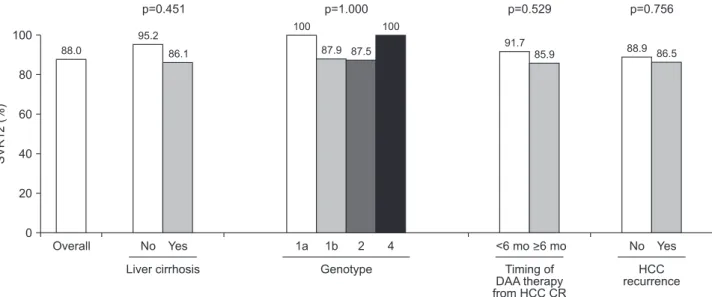
2. Efficacy of DAA therapy in patients with HCC The efficacy of DAA therapy in patients with HCC is summarized in Fig. 1. Among the 100 patients in the mul- ticenter cohort, 88 achieved SVR12 with DAA therapy.
Even in those who experienced HCC recurrence, the
SVR12 acquisition rate was as high as 86.5% (32/37).
SVR12 was achieved by 86.1% (68/79) of patients with liver cirrhosis and by 95.2% (20/21) of those without it.
The SVR12 rate was 87.9% (58/66) and 87.5% (28/32) with the genotypes 1b and 2, respectively. The only patient with genotype 1a and the only patient with genotype 4 acquired SVR12. Of the 36 patients who started the DAA therapy within 6 months of the last HCC treatment, 33 (91.7%) ob- tained SVR12. The SVR12 rate did not significantly differ between the groups (Fig. 1).
Table 1.
Table 1. Baseline Characteristics of 100 Multicenter Cohort Subjects
Characteristics Value (n=100)
Age, yr 69.2±8.4
Male sex 67 (67)
Diabetes mellitus 33 (33)
Liver cirrhosis 79 (79)
Child-Pugh
A 95 (95)
B 4 (4)
C 1 (1)
BCLC stage
0 34 (34)
A 55 (55)
B 7 (7)
C 4 (4)
mUICC stage
I 48 (48)
II 40 (40)
III 10 (10)
IV 2 (2)
Hemoglobin, g/dL 13.0±1.5
Platelet, ×103/μL 112.1±57.5
Creatinine, mg/dL 0.80±0.19
Albumin, g/dL 3.67±0.47
Total bilirubin, mg/dL 1.08±0.55
AST, IU/L 63.7±33.0
ALT, IU/L 46.5±30.6
INR 1.08±0.18
AFP, ng/mL 37.7±75.1
HCV genotype
1a 1 (1)
1b 66 (66)
2 32 (32)
4 1 (1)
Previous interferon-based treatment 23 (23)
HCV RNA, log10 IU/mL 5.42±0.92
DAA combination
Daclatasvir+asunaprevir 59 (59)
Sofosbuvir+ribavirin 33 (33)
Ledipasvir/sofosbuvir 8 (8)
Data are presented as the mean±SD or number (%).
BCLC, Barcelona Clinic Liver Cancer; mUICC, modified Union for International Cancer Control; AST, aspartate aminotransferase; ALT, alanine aminotransferase; INR, international normalized ratio; AFP, alpha-fetoprotein; HCV, hepatitis C virus; DAA, direct-acting antiviral agent.
3. Details of 37 patients with HCC recurrence after DAA therapy
During the median follow-up period of 15.8 months (range, 4.4 to 29.9 months), 37% of the study subjects ex- perienced HCC recurrence; the 1-year and 2-year cumula- tive recurrence rate was 28.4% and 61.3%, respectively. The median number and size of the recurrent tumors were 1 (range, 1 to 6) and 1.25 cm (range, 0.8 to 5.7 cm), respec- tively. Regarding the pattern of recurrence, a new intrahe- patic recurrence (62.2%) was most commonly detected, followed by a marginal recurrence (16.2%), and a marginal recurrence combined with a new intrahepatic recurrence (5.4%). Extrahepatic recurrence was not observed. The majority of the patients (67.6%) were treated with TACE, 16.2% underwent RFA, while 5.4% received RFA as well as TACE. Radiation therapy, TACE followed by radiation therapy, and TACE followed by sorafenib were used in 2.7%
of the cases each. After HCC recurrence, 58.8% of the pa- tients showed CR while 14.7% obtained a partial response.
Stable and progressive disease were observed in 5.9% and 20.6% of the cases, respectively.
4. Risk factors for HCC recurrence in the multicenter cohort
According to the univariate analysis, low platelet levels (p=0.040), HCC treatment with a noncurative method such as TACE, transarterial radioembolization, hepatic artery infusion chemotherapy, sorafenib and radiotherapy (p<0.001), last HCC treatment with a noncurative method (p<0.001), HCC treatment duration more than 18 months (p=0.009), and last HCC treatment durability less than 12 months (p=0.006) were related to HCC recurrence. In con-
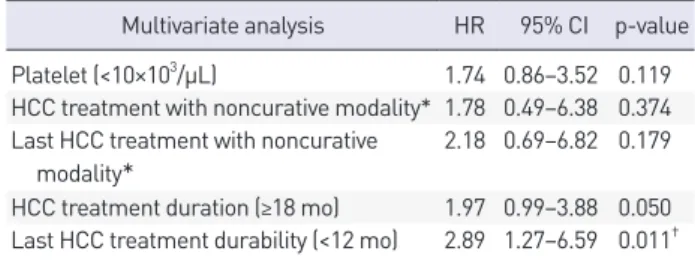
trast, age (p=0.127), liver cirrhosis (p=0.159), and SVR12 (p=0.934) were not associated with HCC recurrence (Table 2). Multivariate Cox regression analysis showed that short last HCC treatment durability (<12 months) was only in- dependently associated with HCC recurrence in patients with the HCV-related HCC after the DAA treatment (haz- ard ratio [HR], 2.89; 95% confidence interval [CI], 1.27 to 6.59; p=0.011) (Table 3, Fig. 2).
In subgroup analysis with patients who were treated with curative modality, mean HCC treatment durability (p=0.046) and last HCC treatment durability less than 12 months (p=0.036) were related to HCC recurrence. In age- and sex-adjusted multivariate Cox regression analysis, the relationship between last HCC treatment durability and HCC recurrence showed no statistical significance (p=0.058) (Supplementary Table 1).
5. External validation using the HIRA cohort
A total of 526 patients with HCV-related HCC and treated with DAAs were identified in the HIRA cohort.
Baseline characteristics of the validation cohort have been listed in Table 4. The mean age of the subjects was 66.9±9.6 years, and 63.7% of them were male. Cirrhosis and dia- betes were diagnosed in 87.1% and 70.5% of the cases, respectively, and 8% of the subjects had received a previ- ous interferon based therapy. Among the 526 patients, 107 (20.3%) experienced HCC recurrence.
In the univariate analysis, HCC treatment with a non- curative method, the last HCC treatment with a noncura- tive method, a long duration of the HCC treatment (≥18 months), and short last HCC treatment durability before a DAA therapy (<12 months) were related to HCC recur-
100
80
60
40
20
SVR12(%)
0
>6 mo
<6 mo
1a 1b 2 4
Yes No Overall
Liver cirrhosis Genotype Timing of
DAA therapy from HCC CR
Yes No
HCC recurrence 88.0
95.2 86.1
100
87.9 87.5 100
91.7
85.9 88.9 86.5
p=0.451 p=1.000 p=0.529 p=0.756
Fig. 1.
Fig. 1. Rates of the SVR 12 weeks after the end of DAA therapy (SVR12) in patients with hepatitis C virus-related HCC.
SVR, sustained virological response; DAA, direct-acting antiviral agent; HCC, hepatocellular carcinoma; CR, complete response.
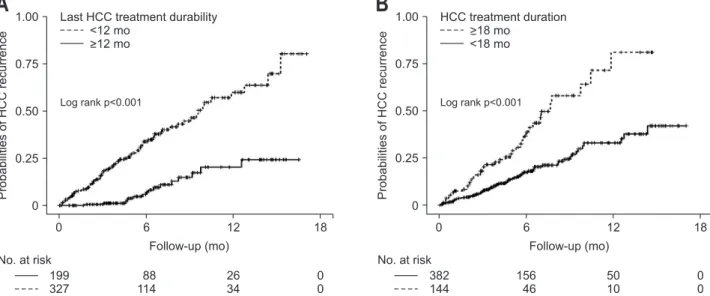
rence (Table 5). Moreover, the multivariate Cox regression analysis showed that the last HCC treatment with a non- curative method (HR, 3.73; 95% CI, 1.87 to 7.43; p<0.001), HCC treatment duration ≥18 months (HR, 1.74; 95% CI, 1.16 to 2.60; p=0.006), the last HCC treatment durability
< 12 months (HR, 3.34; 95% CI, 1.95 to 5.71; p<0.001) were independently associated with HCC recurrence (Table 5, Fig. 3).
Table 2.
Table 2. Univariate Analysis for Risk Factors for HCC Recurrence in the Multicenter Cohort
Variable Subjects without
HCC recurrence (n=63)
Subjects with
HCC recurrence (n=37) p-value
Age, yr 68.7±8.9 69.9±7.4 0.127
Male sex 42 (66.7) 25 (67.6) 0.926
Diabetes mellitus 22 (34.9) 11 (29.7) 0.594
Liver cirrhosis 47 (74.6) 32 (86.5) 0.159
Child-Pugh 0.377
A 60 (95.2) 35 (94.6)
B 3 (4.8) 1 (2.7)
C 0 1 (2.7)
Hemoglobin, g/dL 13.0±1.6 12.9±1.3 0.238
Platelet, ×103/μL 121.9±64.5 95.4±38.1 0.040†
Total bilirubin, mg/dL 1.06±0.57 1.11±0.53 0.399
Albumin, g/dL 3.7±0.5 3.6±0.4 0.208
AST, IU/L 62.4±30.7 66.0±37.0 0.831
ALT, IU/L 46.9±30.0 45.9±32.7 0.570
Creatinine, mg/dL 0.81±0.20 0.77±0.15 0.145
INR 1.07±0.19 1.10±0.18 0.823
AFP, ng/mL 30.4±65.0 50.1±90.0 0.405
HCV RNA, log10 IU/mL 5.42±0.99 5.42±0.79 0.091
Genotype 0.348
1a 1 (1.6) 0
1b 44 (69.8) 22 (59.5)
2 18 (28.6) 14 (37.8)
4 0 1 (2.7)
SVR 12 56 (88.9) 32 (86.5) 0.934
BCLC stage 0.248
0 23 (36.5) 11 (29.7)
A 35 (55.6) 20 (54.1)
B 2 (3.2) 5 (13.5)
C 3 (4.8) 1 (2.7)
mUICC stage 0.064
I 34 (54.0) 14 (37.8)
II 24 (38.1) 16 (43.2)
III 3 (4.8) 7 (18.9)
IV 2 (3.2) 0
HCC treatment using noncurative modality* 27 (42.9) 29 (78.4) <0.001†
Last HCC treatment using noncurative modality* 20 (31.7) 26 (70.3) <0.001†
HCC treatment duration (≥18 mo) 12 (19.0) 16 (43.2) 0.009†
Last HCC treatment durability (<12 mo) 32 (50.8) 29 (78.4) 0.006†
Last HCC treatment durability, day 528.7±661.9 271.5±319.6 0.009†
DAA combination 0.417
Daclatasvir+asunaprevir 39 (61.9) 20 (54.1)
Sofosbuvir+ribavirin 18 (28.6) 15 (40.5)
Ledipasvir/sofosbuvir 6 (9.5) 2 (5.4)
Data are presented as the mean±SD or number (%).
HCC, hepatocellular carcinoma; AST, aspartate aminotransferase; ALT, alanine aminotransferase; INR, international normalized ratio; AFP, alpha-fetoprotein; HCV, hepatitis C virus; SVR, sustained virologic response; BCLC, Barcelona Clinic Liver Cancer; mUICC, modified Union for In- ternational Cancer Control; DAA, direct-acting antiviral agent.
*Noncurative modality included transarterial chemoembolization, transarterial radioembolization, hepatic artery infusion chemotherapy, sorafenib and radiotherapy; †Statistically significant, p<0.05.
DISCUSSION
In the present study, short last HCC treatment durabil- ity before a DAA therapy (<12 months) was an indepen- dent predictor of HCC recurrence in both the multicenter cohort and the nationwide cohort from the Korean HIRA database. To the best of our knowledge, this is the first study to evaluate the risk factors for predicting HCC recur- rence after the DAA therapy in Korean patients with HCV- related HCC.
Short last HCC treatment durability (<12 months) was the only common independent risk factor for HCC re- currence in the both multicenter cohort and nationwide HIRA cohort. The last HCC treatment with a noncurative method and a long total duration of the HCC treatment (≥18 months) prior to the DAA therapy were independent risk factors in the HIRA cohort, but not in the multicenter cohort. This discrepancy may be explained by differences
in the two study populations. HIRA data, as national claims data, does not include information on the HCC stage or radiological findings, making it difficult to con- firm CR in patients. Therefore, the validation cohort was more heterogeneous than the test cohort, which may have contributed to different risk factors for HCC recurrence in the two study groups.
Table 4.
Table 4. Baseline Characteristics of 526 Subjects in the HIRA Cohort
Characteristics Value (n=526)
Age, yr 66.9±9.6
Male sex 335 (63.7)
Diabetes mellitus 371 (70.5)
Liver cirrhosis 458 (87.1)
Previous interferon-based treatment 42 (8.0) DAA combination
Daclatasvir+asunaprevir 327 (62.2)
Sofosbuvir+ribavirin 127 (24.1)
Ledipasvir/sofosbuvir 61 (11.6)
Sofosbuvir+daclatasvir 11 (2.1)
HCC treatment modality before DAA therapy
Resection 3 (0.6)
RFA 135 (25.7)
TACE 226 (43.0)
Multi-modality 146 (27.8)
Other therapies 16 (2.9)
Last HCC treatment modality before DAA therapy
Resection 4 (0.8)
RFA 185 (35.2)
TACE 296 (56.3)
Combination treatment 17 (3.2)
Other therapies 24 (4.6)
Data are presented as the mean±SD or number (%).
HIRA, Health Insurance Review and Assessment; DAA, direct-acting antiviral agent; HCC, hepatocellular carcinoma; RFA, radiofrequency ablation; TACE, transarterial chemoembolization.
Table 3.
Table 3. Multivariate Analysis for Risk Factors for HCC Recurrence in the Multicenter Cohort
Multivariate analysis HR 95% CI p-value Platelet (<10×103/μL) 1.74 0.86–3.52 0.119 HCC treatment with noncurative modality* 1.78 0.49–6.38 0.374 Last HCC treatment with noncurative
modality* 2.18 0.69–6.82 0.179
HCC treatment duration (≥18 mo) 1.97 0.99–3.88 0.050 Last HCC treatment durability (<12 mo) 2.89 1.27–6.59 0.011† HCC, hepatocellular carcinoma; HR, hazard ratio; CI, confidence in- terval.
*Noncurative modality included transarterial chemoembolization, transarterial radioembolization, hepatic artery infusion chemothera- py, sorafenib and radiotherapy; †Statistically significant, p<0.05.
0.75
0.50
0.25
ProbabilitiesofHCCrecurrence
Follow-up (mo) 0
No. at risk 63 37
6 12 18 24
49 33
33 23
11 6
2 2
<12 mo
>12 mo
Last HCC treatment durability
Log rank p=0.026
1.00
0.50
0.25
ProbabilitiesofHCCrecurrence
Follow-up (mo) 0
No. at risk 72 28
6 12 18 24
63 28
40 19
14 16
4 3
>18 mo
<18 mo
HCC treatment duration
Log rank p=0.006 0.75
A B
0 0
Fig. 2.
Fig. 2. Cumulative probabilities of a recurrence of hepatocellular carcinoma (HCC) according to the last HCC treatment durability (A) and the total duration of the HCC treatment (B) in the multicenter cohort.
Meanwhile, even if short last HCC treatment durabil- ity is an independent risk factor for HCC recurrence, it is difficult to interpret the finding that the delayed DAA therapy reduces the risk of HCC recurrence. Two recent meta-analyses and a large cohort study found that DAA therapy was not associated with an increased risk of HCC recurrence.
18,24,25One of the meta-analyses pointed out that factors associated with HCC recurrence included a his- tory of prior HCC recurrence and a short interval between HCC CR and initiation of the DAA treatment. The authors concluded that HCC recurrence rate was acceptable after the DAA therapy, particularly if the latter was delayed at least 6 months after HCC CR.
24However, a recent large cohort study that defined HCC recurrence time based on the timing of HCC CR showed that commencement of DAA therapy within 6 months of CR was not a risk factor
for overall or an early HCC recurrence.
25As mentioned above, there has been a debate on the optimal timing of starting DAA treatment after acquiring CR. Several studies calculated the time to HCC recurrence from the start of the DAA therapy, leading to an immortal time bias.
24The present study also cannot be free from this bias. Therefore, we could not clearly suggest an appropriate time point about initiation of DAA therapy for patients with HCC who achieved CR. It is more appropriate to describe “short last HCC treatment durability” rather than “short interval between last HCC treatment and DAA therapy” as a risk factor for HCC recurrence.
Other well-known risk factors for HCC development, including liver cirrhosis, diabetes mellitus, male gender, and old age, were not associated with an increased HCC recurrence.
26-29Our findings were found to be in line with
Table 5.
Table 5. Risk Factor Analysis for HCC Recurrence in the HIRA Cohort Risk factor
Subjects without HCC recurrence
(n=419)
Subjects with HCC recurrence
(n=107)
Univariate p-value
Multivariate analysis HR 95% CI p-value
Age, yr 66.8±9.8 67.4±8.9 0.867
Male sex 267 (63.7) 68 (63.6) 0.903
Diabetes mellitus 200 (71.6) 71 (66.4) 0.160
Liver cirrhosis 360 (85.9) 98 (91.6) 0.103
HCC treatment using noncurative modality* 290 (69.2) 96 (89.7) <0.001† 0.75 0.42–1.33 0.330 Last HCC treatment using noncurative modality* 244 (58.2) 93 (86.9) <0.001† 3.73 1.87–7.43 <0.001†
HCC treatment duration (≥18 mo) 100 (23.9) 44 (41.1) <0.001† 1.74 1.16–2.60 0.006†
Last HCC treatment durability (<12 mo) 236 (56.3) 91 (85.0) <0.001† 3.34 1.95–5.71 <0.001† Data are presented as the mean±SD or number (%).
HCC, hepatocellular carcinoma; HIRA, Health Insurance Review and Assessment; HR, hazard ratio; CI, confidence interval.
*Noncurative modality included transarterial chemoembolization, transarterial radioembolization, hepatic artery infusion chemotherapy, sorafenib and radiotherapy; †Statistically significant, p<0.05.
1.00
0.50
0.25
ProbabilitiesofHCCrecurrence
Follow-up (mo) 0
No. at risk 199 327
6 12 18
88 114
26 34
0 0
<12 mo
>12 mo
Last HCC treatment durability
Log rank p<0.001
A B
1.000.50
0.25
ProbabilitiesofHCCrecurrence
Follow-up (mo) 0
No. at risk 382 144
6 12 18
156 46
50 10
0 0
>18 mo
<18 mo
HCC treatment duration
Log rank p<0.001
0.75 0.75
0 0
Fig. 3.
Fig. 3. Cumulative probabilities of a recurrence of hepatocellular carcinoma (HCC) according to the last HCC treatment durability (A) and the total duration of the HCC treatment (B) in the nationwide Health Insurance Review and Assessment Service cohort.
a study with 59 patients who underwent a DAA therapy after HCC treatment who showed no significant differ- ences in these factors between patients with and without HCC recurrence.
15While liver cirrhosis, diabetes mellitus, male gender, and old age are well-established risk factors for HCC development in patients with chronic hepatitis C, their role in HCC recurrence is unclear. This may be due to the differences in follow-up period between patients with a new and a recurrent HCC.
A few studies have suggested that patients with HCC are resistant to the DAA therapy.
12-14In 2017, Beste et al.
13reported that, of the 17,487 recipients of an HCV treat- ment, the overall SVR12 rate was 91.1% in the non-HCC group and 74.4% in the HCC group. In another study, the SVR12 rate was 79% and 88% in patients with and without HCC, respectively.
14There are several proposed theories explaining the observation of relatively low SVR12 rates in patients with HCC. HCC may act as a reservoir for HCV replication.
12,30Moreover, the HCC cells, which are mainly supplied by branches of the hepatic artery,
31and exhibit downregulated levels of the membrane transporters essen- tial for the DAA uptake, such as OATP1B1,
12,32may have limited penetration of DAAs. Herein, the overall SVR12 rate after DAA therapy was 88%, which increased to 91.7%
in patients who underwent the DAA therapy within 6 months of the last HCC treatment. Considering the kind of DAA therapy in the current study (Table 1), an overall SVR12 rate of 88% is satisfactory. Further studies with more potent DAAs will be needed to confirm the efficacy of DAA therapy in patients with HCC.
The current study has several limitations. First, it did not include a control group, which made it difficult to ascertain whether DAA therapy itself could increase the risk of HCC recurrence. Second, this study included 46 patients who had received noncurative modality as last treatment. To secure as many patients as possible, patients with noncurative modality were also included. Consider- ing this limitation, a subgroup analysis was conducted on 54 patients treated with curative method. Subgroup analy- sis showed that last HCC treatment durability less than 12 months was not significantly associated with HCC recur- rence but tended to increase risk (p=0.058). Further, we did not define the HCC recurrence time based on the tim- ing of CR. The purpose of the current study was to define risk factors for HCC recurrence after the DAA therapy;
thus, we started the follow-up after commencement of the DAA therapy. Additionally, patients treated with heter- ogenous methods were recruited, and it was not possible to confirm CR in the HIRA cohort. As very few patients with an HCV-related HCC have been treated with DAAs in South Korea, we sought to recruit as many participants
as possible. We included patients who obtained a CR in the multicenter cohort, and confirmed the risk factors in the HIRA cohort, although the two cohorts partly overlapped.
In conclusion, the efficacy of DAA therapy was found to be acceptable in patients with an HCV-related HCC.
However, short last HCC treatment durability before the DAA therapy (<12 months) was associated with HCC recurrence. This finding suggests that the last HCC treat- ment response durability is an important predictor of HCC recurrence.
CONFLICTS OF INTEREST
No potential conflict of interest relevant to this article was reported.
ACKNOWLEDGEMENTS
This study was supported in part by the Scientific Research Fund of the Korean Liver Cancer Study Group (2017) and by a grant of the Korean Health Technology R&D Project through the Korea Health Industry Develop- ment Institute, funded by the Ministry of Health & Wel- fare, Republic of Korea (grant number: HI19C0872 and HI18C0531).
AUTHOR CONTRIBUTIONS
Study concept and design: S.S.K., J.Y.C. Data acquisition:
H.L., D.Y.K., H.W.L., S.J.Y., Y.Y.C., J.W.J., B.K.J., C.W.K., H.Y.K., H.P. Data analysis and interpretation: Y.H.A., H.L., H.J.C., B.P. Drafting of the manuscript: Y.H.A., S.S.K. Criti- cal revision of the manuscript for important intellectual content: S.S.K., J.Y.C. Statistical analysis: H.L., S.S.K. Ob- tained funding: S.S.K., J.Y.C. All authors approved the final draft of the manuscript submitted to the journal.
ORCID
Young-Hwan Ahn https://orcid.org/0000-0001-9920-1846
Heirim Lee https://orcid.org/0000-0002-1941-2238
Do Young Kim https://orcid.org/0000-0002-8327-3439
Hye Won Lee https://orcid.org/0000-0002-1626-6423
Su Jong Yu https://orcid.org/0000-0001-8888-7977
Young Youn Cho https://orcid.org/0000-0002-9384-5357
Jeong Won Jang https://orcid.org/0000-0003-3255-8474
Byoung Kuk Jang https://orcid.org/0000-0002-8950-0866
Chang Wook Kim https://orcid.org/0000-0003-1184-0358 Hee Yeon Kim https://orcid.org/0000-0001-9669-5705 Hana Park https://orcid.org/0000-0002-3917-9939 Hyo Jung Cho https://orcid.org/0000-0003-4792-8335 Bumhee Park https://orcid.org/0000-0002-5271-1571 Soon Sun Kim https://orcid.org/0000-0002-6862-1896 Jae Youn Cheong https://orcid.org/0000-0001-6246-1783
REFERENCES
1. El-Serag HB. Hepatocellular carcinoma: an epidemiologic view. J Clin Gastroenterol 2002;35(5 Suppl 2):S72-S78.
2. Bray F, Ferlay J, Soerjomataram I, Siegel RL, Torre LA, Jemal A. Global cancer statistics 2018: GLOBOCAN estimates of incidence and mortality worldwide for 36 cancers in 185 countries. CA Cancer J Clin 2018;68:394-424.
3. Zeuzem S, Ghalib R, Reddy KR, et al. Grazoprevir-elbasvir combination therapy for treatment-naive cirrhotic and non- cirrhotic patients with chronic hepatitis C virus genotype 1, 4, or 6 infection: a randomized trial. Ann Intern Med 2015;163:1-13.
4. Kowdley KV, Sundaram V, Jeon CY, et al. Eight weeks of ledi- pasvir/sofosbuvir is effective for selected patients with geno- type 1 hepatitis C virus infection. Hepatology 2017;65:1094- 1103.
5. Pol S, Bourliere M, Lucier S, et al. Safety and efficacy of daclatasvir-sofosbuvir in HCV genotype 1-mono-infected patients. J Hepatol 2017;66:39-47.
6. Luetkemeyer AF, McDonald C, Ramgopal M, Noviello S, Bhore R, Ackerman P. 12 Weeks of daclatasvir in combina- tion with sofosbuvir for HIV-HCV coinfection (ALLY-2 Study): efficacy and safety by HIV combination antiretrovi- ral regimens. Clin Infect Dis 2016;62:1489-1496.
7. Fried MW, Hadziyannis SJ. Treatment of chronic hepatitis C infection with peginterferons plus ribavirin. Semin Liver Dis 2004;24:47-54.
8. Manns MP, McHutchison JG, Gordon SC, et al. Peginter- feron alfa-2b plus ribavirin compared with interferon alfa-2b plus ribavirin for initial treatment of chronic hepatitis C: a randomised trial. Lancet 2001;358:958-965.
9. Lawitz E, Makara M, Akarca US, et al. Efficacy and safety of ombitasvir, paritaprevir, and ritonavir in an open-label study of patients with genotype 1b chronic hepatitis C vi- rus infection with and without cirrhosis. Gastroenterology 2015;149:971-980.
10. Charlton M, Everson GT, Flamm SL, et al. Ledipasvir and sofosbuvir plus ribavirin for treatment of HCV infection in patients with advanced liver disease. Gastroenterology 2015;149:649-659.
11. World Health Organization (WHO). Hepatitis C [Internet].
Geneva: WHO; c2020 [cited 2020 Jul 28]. Available from:
https://www.who.int/en/news-room/fact-sheets/detail/
hepatitis-c.
12. Soria A, Fabbiani M, Lapadula G, Gori A. Unexpected viral relapses in hepatitis C virus-infected patients diagnosed with hepatocellular carcinoma during treatment with direct- acting antivirals. Hepatology 2017;66:992-994.
13. Beste LA, Green PK, Berry K, Kogut MJ, Allison SK, Ioan- nou GN. Effectiveness of hepatitis C antiviral treatment in a USA cohort of veteran patients with hepatocellular carci- noma. J Hepatol 2017;67:32-39.
14. Prenner SB, VanWagner LB, Flamm SL, Salem R, Lewan- dowski RJ, Kulik L. Hepatocellular carcinoma decreases the chance of successful hepatitis C virus therapy with direct- acting antivirals. J Hepatol 2017;66:1173-1181.
15. Conti F, Buonfiglioli F, Scuteri A, et al. Early occurrence and recurrence of hepatocellular carcinoma in HCV-related cirrhosis treated with direct-acting antivirals. J Hepatol 2016;65:727-733.
16. Reig M, Mariño Z, Perelló C, et al. Unexpected high rate of early tumor recurrence in patients with HCV-related HCC undergoing interferon-free therapy. J Hepatol 2016;65:719- 726.
17. Yang JD, Aqel BA, Pungpapong S, Gores GJ, Roberts LR, Leise MD. Direct acting antiviral therapy and tumor recur- rence after liver transplantation for hepatitis C-associated hepatocellular carcinoma. J Hepatol 2016;65:859-860.
18. Waziry R, Hajarizadeh B, Grebely J, et al. Hepatocellular car- cinoma risk following direct-acting antiviral HCV therapy:
a systematic review, meta-analyses, and meta-regression. J Hepatol 2017;67:1204-1212.
19. Marrero JA, Kulik LM, Sirlin CB, et al. Diagnosis, staging, and management of hepatocellular carcinoma: 2018 practice guidance by the American Association for the Study of Liver Diseases. Hepatology 2018;68:723-750.
20. Kim JA, Yoon S, Kim LY, Kim DS. Towards actualizing the value potential of Korea Health Insurance Review and As- sessment (HIRA) data as a resource for health research:
strengths, limitations, applications, and strategies for optimal use of HIRA data. J Korean Med Sci 2017;32:718-728.
21. Abergel A, Rotily M, Branchoux S, et al. Chronic hepatitis C:
burden of disease and cost associated with hospitalisations in France in 2012 (The HEPC-LONE study). Clin Res Hepatol Gastroenterol 2016;40:340-348.
22. Ford MM, Desai PS, Maduro G, Laraque F. Neighborhood inequalities in hepatitis C mortality: spatial and temporal patterns and associated factors. J Urban Health 2017;94:746- 755.
23. Lencioni R, Llovet JM. Modified RECIST (mRECIST) as- sessment for hepatocellular carcinoma. Semin Liver Dis 2010;30:52-60.
24. Saraiya N, Yopp AC, Rich NE, Odewole M, Parikh ND, Sin- gal AG. Systematic review with meta-analysis: recurrence of hepatocellular carcinoma following direct-acting antiviral therapy. Aliment Pharmacol Ther 2018;48:127-137.
25. Singal AG, Rich NE, Mehta N, et al. Direct-acting antiviral therapy not associated with recurrence of hepatocellular carcinoma in a multicenter North American cohort study.
Gastroenterology 2019;156:1683-1692.
26. Chiba T, Matsuzaki Y, Abei M, et al. Multivariate analysis of risk factors for hepatocellular carcinoma in patients with hepatitis C virus-related liver cirrhosis. J Gastroenterol 1996;31:552-558.
27. Kanwal F, Kramer J, Asch SM, Chayanupatkul M, Cao Y, El- Serag HB. Risk of hepatocellular cancer in HCV patients treated with direct-acting antiviral agents. Gastroenterology 2017;153:996-1005.
28. Korean Association for the Study of the Liver (KASL). KASL clinical practice guidelines for management of chronic hepa- titis B. Clin Mol Hepatol 2019;25:93-159.
29. European Association for the Study of the Liver. EASL clini- cal practice guidelines: management of hepatocellular carci- noma. J Hepatol 2018;69:182-236.
30. Prenner S, Kulik L. Reply to: “Treatment failure after inter- feron-free treatment of hepatitis C as a clue of a yet unde- tected hepatocellular carcinoma”. J Hepatol 2018;68:213-214.
31. Saberi B, Dadabhai AS, Durand CM, et al Challenges in treatment of hepatitis C among patients with hepatocellular carcinoma. Hepatology 2017;66:661-663.
32. Prenner SB, Kulik L. Hepatocellular carcinoma in the wait- listed patient with hepatitis C virus. Curr Opin Organ Trans- plant 2018;23:237-243.