1. Introduction
The engine combustion process is exceedingly complex. Even in the conventional spark-ignition en- gine, where under many operating modes the fuel and air can be treated as premixed, the combustion process is initiated in a three-dimensional time-vary- ing turbulent flow, concerns a fuel which is a blend of hundreds of different organic compounds whose combustion chemistry is poorly understood, and takes place in a space confined by the combustion chamber walls whose shape varies with time and whose wall directly influence aspects of the process.
A number of engine combustion model classi- fications have been proposed. The most useful clas- sification follows from one proposed by Hyewood [1]. Its utility stems from the fact that different
classes of combustion model, because of their for- malism, are generally useful in examining different kinds of combustion related engine problems. These categories of combustion model are: 1) zero dimen- sional (sometimes called thermodynamics) model, 2) quasi dimensional (sometimes called entrainment) models, and 3) multidimensional (sometimes called detailed) models.
Zero dimensional and quasi dimensional models are structured around a thermodynamics analysis of the contents of the engine cylinder during the engine operation cycle [1].
Simulation of internal combustion engine proc- esses involves, developing a combustion model us- ing the combination of assumptions and equations for predicting the engine performance during the open period which involves suction and exhaust strokes and the closed period which comprises com- pression, combustion, and expansion stroke [2].
The objective of the present study is to develop a combustion model for a spark ignition engine run-
†To whom corresponding should be addressed.
Department of Mechanical & Automotive Engineering, Induk University, 12 Choansan-ro, Nowon-gu, Seoul 139-749, Korea.
Tel : 02-950-7545 E-mail : [email protected]
Theoretical Analysis of a Spark Ignition Engine by the Thermodynamic Engine Model
Sung Bin Han
Department of Mechanical & Automotive Engineering, Induk University (Received 7 May 2015, Revised 17 August 2015, Accepted 20 August 2015)
Abstract
Recent engine development has focused mainly on the improvement of engine efficiency and output emissions. The improvements in efficiency are being made by friction reduction, combustion improvement and thermodynamic cycle modification.
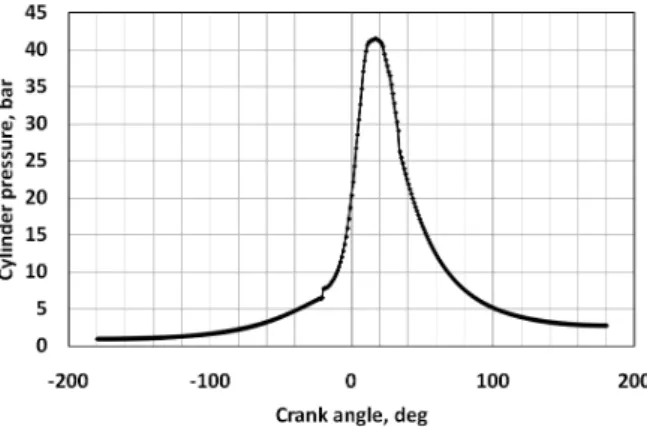
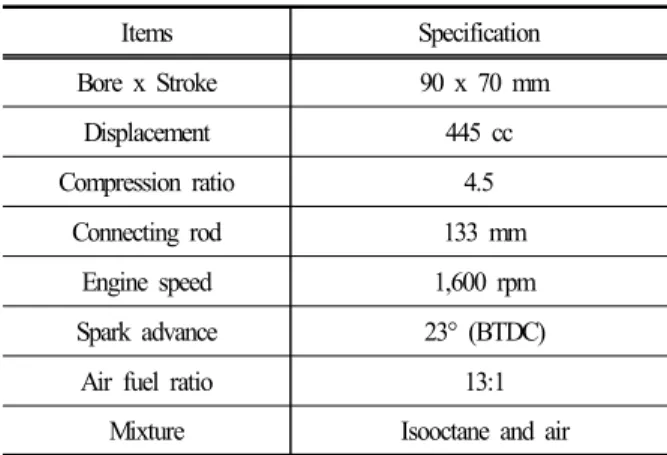
Computer simulation has been developed to predict the performance of a spark ignition engine. The effects of various cylinder pressure, heat release, flame temperature, unburned gas temperature, flame properties, laminar burning velocity, turbulence burning velocity, etc. were simulated. The simulation and analysis show several meaningful results. The objective of the present study is to develop a combustion model for a spark ignition engine running with isooctane as a fuel and predicting its behavior.
Key words : Spark ignition engine, thermodynamic engine model, compression, combustion, expansion, one-dimensional model, two-zone combustion model
http://dx.doi.org/10.5855/ENERGY.2015.24.3.055
ning with isooctane as a fuel and predicting its behavior.
2. Thermodynamic Engine Model
Thermodynamic model of the gasoline fueled en- gine is considered the closed system that both inlet and exhaust valves remain closed. The important events such as compression, combustion, and expan- sion take place during this period. The engine is re- duced to a thermodynamic system, which consist of a homogeneous mixture of air, gasoline, and residual gas from the previous cycle. The boundaries of the system are the cylinder walls, cylinder head, and top of the piston head. Work is added to or taken from the system through the motion of the piston and heat is transferred to or from the system through the boundary surfaces [2].
Thermodynamic models can be classified into two groups; one-zone model and multi-zone model. In one-zone model, the cylinder charge is assumed to be uniform in both composition and temperature and the first law of thermodynamics is used to calculate the mixture energy. One-zone model represents the unburned mixture ahead of the flame and one the burned mixture behind the flame.
In two-zone model, the cylinder mixture is div- ided into burned and unburned zones, which are separate from each other by a surface of dis conti- nuity. The composition and temperature of the burned and unburned gases are different and the pressure is uniform through out the combustion chamber. Two-zone model is used to calculate the mass fraction burned profile from measured cylinder pressure data [3].
In this model, the following assumptions have been used.
- The burnt and unburned gases are assumed to be ideal and non-reacting. The heat transfer from the burned to unburned gases is assumed to be negligible. The pressure is constant for both the zones. There is assumed to be no dissociation in the unburned gases prior to combustion.
- Cylinder volume at any instant consists of burned and unburned zones separated by a thin infinitesimal flame front. Flame propagates in a spherical pattern.
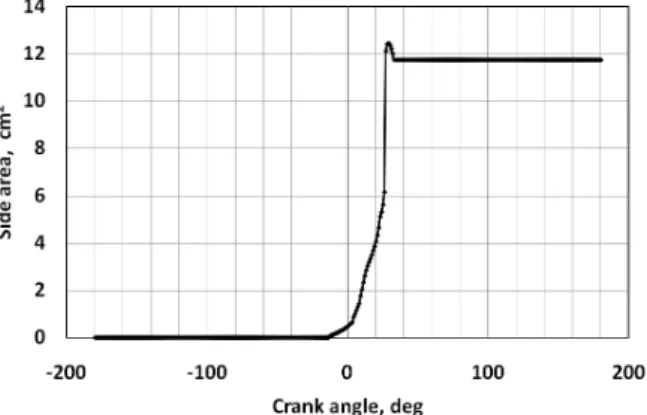
- The rate of heat transfer from gas to the wall depends on instantaneous heat transfer co- efficient, concerned surface area, and difference in temperature between the gas and wall.
- The charge in the cylinder at any instant con- sists of fuel-air mixture and residual gases. Ideal gas equation is assumed to be valid for the mix- ture of gases.
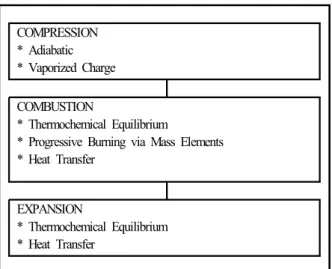
Figure 1 shows the general structure of the ther- modynamics model.
Thermodynamic engine model is based on the first law of thermodynamics expressed as [4, 5]:
The governing equation for the burned and un- burned gas zones can be written as:
where the subscripts u and b denote the unburned COMPRESSION
* Adiabatic * Vaporized Charge
COMBUSTION
* Thermochemical Equilibrium
* Progressive Burning via Mass Elements * Heat Transfer
EXPANSION
* Thermochemical Equilibrium * Heat Transfer
Figure 1. Block diagram of thermodynamic model.
and burned gases, respectively.
The following system of equations:
The unburned temperature is determined using the isentropic relationship in following equations:
In the model, heat from combustion is supplied using a Wiebe function:
Exp
Exp
With a=5 and m=2,
is the spark time at the be- ginning of combustion in crank angle and is the total combustion duration (x
b= 0 to x
b= 1).
The heat release rate is given by:
⋅