Res. Plant Dis. 18(2) : 93−100 (2012) © The Korean Society of Plant Pathology http://dx.doi.org/10.5423/RPD.2012.18.2.093
고추 유전자원의 탄저병(Colletotrichum acutatum) 저항성 평가
김상규·노나영*·허온숙·고호철·곽재균·허윤찬1 국립농업과학원 농업유전자원센터, 1국립원예특작과학원 채소과
Evaluation of Resistance to Colletotrichum acutatum in Pepper Genetic Resources
Sang Gyu Kim, Na-Young Ro*, On-Sook Hur, Ho-Cheol Ko, Jae-Gyun Gwag and Yun-Chan Huh1
National Agrobiodiversity Center, National Academy of Agricultural Science, Rural Development Administration, Suwon 441-853, Korea
1Vegetable Research Division, National Institute of Horticultural & Herbal Science, Rural Development Administration, Suwon 440-706, Korea
(Received on April 6, 2012; Revised on June 14, 2012; Accepted on June 15, 2012)
Resistance of pepper (Capsicum spp.) to anthracnose (Colletotrichum acutatum) was evaluated during regeneration of Capsicum spp. in National Agrobiodiversity Center. Disease severity of 896 pepper accessions (430 accessions of C. annuum, 219 accessions of C. baccatum, 14 accessions of C. chacoense, 153 accessions of C. chinense, 70 accessions of C. frutescens, 2 accessions of C. pubescens, and unidentified 8 accessions) was investigated at 14 days after inoculation in 28oC humid chamber. Forty nine accessions of pepper germplasm were resistant to C. acutatum. Among them, nine accessions were highly resistant to C. acutatum without wounding spray inoculation. Four accessions belonged to the species C. baccatum, one accession to C.
chacoense, and four accessions to C. frutescens. Forty two resistant candidate accessions were inoculated with pin-prick wounding using a syringe needle. Five accessions were resistant as a less than 3% of disease severity to C. acutatum with wounding inoculation 5 days after inoculation. All resistant accessions were C. baccatum.
These five pepper germplasm might be used as breeding resources for the anthracnose resistance breeding program.
Keywords : Anthracnose, Capsicum, Resistance, Resistant resources
서 론
고추(Capsicum spp.)는 가지과(Solanaceae)에 속하는 식 물로 원산지는 남미 아마존강 유역으로 추정이 되며 유 럽을 거쳐 우리나라에는 16세기 전후로 도입되어 국내 연 간 생산량이 약 12만 톤에 이르는 조미 채소 중 가장 중 요한 작물이다(Kim 등, 2008c; Pae 등, 2005; Yoon 등, 2004). 세계적으로 고추는 27종이 알려져 있고, 그 중 5종(C. annuum, C. chinense, C. frutescens, C. baccatum,
and C. pubescens)이 재배되고 있으며, C. annuum이 가장 널리 재배되고 있다(Yoon 등, 2004). 고추 재배기간 동안 에 다양한 병원균에 노출이 되어 피해를 입고 있으며, 특 히 고추 탄저병과 역병이 가장 심각한 피해를 일으키는 것으로 알려져 있다(Kim, 2004; Myung 등, 2006).
고추 탄저병(Colletotrichum spp.)은 국내외에서 고추 생 산에 있어서 많은 피해를 주는 병 중의 하나로서 5종의 탄저병균(C. gloeosporioides, C. acutatum, C. dematium, C. coccodes, and Glomerella cingulata)에 의해 발병되는 것으로 알려져 있다(Hong과 Hwang, 1998; Kang 등, 2009;
Park과 Kim, 1992). 이들 중 한국에서 고추의 수량과 품 질에 직접적인 영향을 미치는 균은 C. acutatum과 C.
gloeosporioides으로 알려져 있다(Park과 Kim, 1992). 1992
*Corresponding author
Phone)+82-31-299-1871, Fax) +82-31-294-6029 Email) [email protected]
Research Article Open Access
년 고추 포장에서 발병되어 분리되는 탄저병균은 C.
gloeosporioides이었으나, 최근 우리나라에서 분리되는 탄 저병균은 C. acutatum이 우점종으로 보고 되었다(Kim 등, 2008a).
고추 역병에 대한 저항성을 가진 상업용 품종은 2005 년도부터 농가에 보급되기 시작하여 현재까지 농가에서 재배 중이다(Kim 등, 2010a). 그러나 탄저병 저항성 계통 은 C. chinense ‘PBC932’와 C. baccatum ‘PBC80’과
‘PBC81’ 등이 보고되고 있으나, 현재까지 상업용으로 보 급된 품종은 없다(Kim 등, 2004; Mahasuk 등, 2009; Park 등, 2009; Sarath Babu 등, 2011; Yoon 등, 2004). 그 이유 는 병 저항성 유전자원의 부족과 병원균의 다양한 병원 성 분화가 일어났기 때문이다(Park 등, 2009). 뿐만 아니 라 국내외적으로 가장 많이 재배되고 있는 C. annuum 종 내에는 안정적인 저항성을 보이는 유전자원이 없는 것으 로 알려져 있다(Kim 등, 2010b).
이 연구는 농촌진흥청 농업유전자원센터에서 보존하고 있는 고추 유전자원에 대한 탄저병균 저항성 정도를 평 가하여 그 정보를 연구자에게 제공하고자 수행했으며 현 재까지 저항성이 보고되지 않은 새로운 저항성 자원을 선 발하여 탄저병 저항성 품종 육성을 위한 재료를 제공하 고자 수행하였다.
재료 및 방법
실험재료. 탄저병 저항성 평가를 위하여 47개 국가에 서 수집하여 농업유전자원센터에 보관 중인 C. annuum 430점, C. baccatum 219점, C. chacoense 14점, C. chinense 153점, C. frutescens 70점, C. pubescens 2점과 미동정
8점 등 총 896점을 분양받아 시험 재료로 이용하였다 (Table 1). 본 실험에서는 ‘마니따’를 감수성 대조품종으 로 이용하였다. 각각의 종자는 1% 차아염소산나트륨(NaOCl) 에서 1분간 표면살균하고 멸균수로 2회 세척 후 습실 처 리 된 filter paper를 깐 Petri-dish에 치상하고 25oC 항온 기에서 3일간 두어 발아시켰다. 발아한 종자는 플러그 묘 판(5×10)에 피트모스 배양토에 파종하여 비닐하우스에서 10주간 육묘하였다. 육묘된 묘는 2011년 5월 4일에 경기 도 평택시에 위치한 비닐하우스 정식하였고 농촌진흥청 표준재배법에 따라 재배하였다. 잡초발생을 억제하기 위 하여 검은색 비닐 멀칭하였다. 7월 말부터 다 자란 녹색 고추를 한 번에 300개체를 수확하여 탄저병을 저항성 실 험을 하였다.
병원균 배양. 고추 탄저병균(C. acutatum)은 농촌진흥 청 농업미생물 보존센터에 보관중인 KACC 40042를 분 양받아 실험에 이용하였다. 병원균을 potato dextrose agar(PDA) 배지에서 광상태 16시간, 암상태 8시간 주기 로 28oC에서 7일간 배양하였고 다 자란 배지에 멸균수를 부어 포자를 수거하여 거즈로 걸러서 균사를 제거하였으 며 hemacytometer로 포자 농도를 조사하여 실험에 이용 하였다.
병원균 접종. 무상처 분무 접종의 병원균 접종 시료는 다 자란 녹색 고추를 이용하였으며, 부패 방지를 위해 paper towel을 넣은 지퍼백(25×30 cm)에 자원 당 10개의 고추를 담고 분무기를 이용해 고추 과실 표면에 5.0×10⁵ conidia/ml의 농도로 조정한 탄저병균 포자를 분무하였다.
접종된 고추는 습도 유지를 위해 즉시 밀봉하였고 28oC 항온기에 넣어 발병을 유도하였으며 2일 후 지퍼백을 상 온에서 2시간 동안 개봉하여 과습으로 인한 부패를 방지 Table 1. Capsicum genetic resources for evaluation of resistance against anthracnose disease in this study
Species
(No. of accession) Originsa
C. annuum (430) 027 (1), ARG (1), BGR (95), BOL (1), CHN (187), COL (1), CSK (1), ECU (3), FRA (4), GEO (1), HUN (3), IND (1), ISR (1), JPN (3), KGZ (1), KOR (21), MDA (2), MEX (1), MMR (4), NPL (1), PER (1), PHL (1), RUS (6), THA (3), TKM (1), TUR (4), TWN (10), USA (2), UZB (14), VNM (1), unknown (54) C. baccatum (219) ARG (9), BOL (31), BRA (87), CHL (2), COL (3), CRI (13), ECU (15), GTM (1), HUN (1), JAM (1), MEX
(4), PER (23), PRY (16), TWN (1), URY (5), unknown (7) C. chacoense (14) AGR (4), BOL (5), DEU (1), GBR (2), USA (1), unknown (1)
C. chinense (153) BLZ (2), BOL (14), BRA (43), COL (12), CRI (9), ECU (10), GRD (1), GTM (1), HUN (2), MEX (14), PER (30), PRI (4), SUR (2), USA (2), VEN (5) , unknown (2)
C. frutescens (70) BOL (1), BRA (1), CHN (1), COL (7), CRI (29), ECU (3), GTM (6), HND (2), LAO (1), MEX (4), NPL (1), PER (2), SLV (3), unknown (9)
C. pubescens (2) ECU (1), GTM (1)
Unidentified (8) CHN (4), MMR (1), unknown (3)
aCountry codes (ISO 3166-1 alpha-3).
하였으며, 14일간 배양하면서 발병 상태를 관찰하였다.
무상처 접종처리에서 저항성으로 판단된 34점과 중도 저항성으로 판단되는 5점, 저항성이 예상되는 3점(800063, K157358, 709276)을 추가하여 총 42점에 대해 탄저병균 상처 접종을 실시하였다. 다자란 녹색고추를 수확 후 1%
차아염소산나트륨에 3분간 표면살균 후 멸균수로 2회 세 척하여 준비하였다. 탄저병 포자현탁액은 1.0×10⁶ conidia/
ml으로 맞추어 실험하였다. 고추 크기에 따라 1−3 부위 에 주사바늘로 상처(0.6 mm diameter×1.2 mm depth)를 내고 동시에 포자현탁액을 부위당 10 µl씩 접종하였다. 대 조구는 멸균수를 처리하였다. 접종한 고추는 paper towel 을 깔고 멸균수를 부은 플라스틱 용기(30×20×7 cm)에 놓고 습도를 유지하였으며 28oC에서 발병을 유도하였다.
병 저항성 평가. 무상처 분무 접종에 의한 탄저병 평 가는 발병 정도에 따라 6단계로 조사하였다. 즉, 병징이 전혀 관찰되지 않았을 때는 발병도 0으로, 2 mm 미만의 병반이 5개 미만일 때 발병도 1로, 4 mm 미만의 병반이 10개 이하일 때 발병도 2로, 6 mm 미만의 병반이 10개 미만일 때 발병도 3으로, 10 mm 미만의 병반이 10개 미 만일 때 발병도 4로, 10개 이상의 병반이 나타나거나 서 로 혼합하여 분생포자층을 형성할 때를 발병도 5로 조사
하였다. 발병도 0은 고도의 저항성, 발병도가 0.1보다 크 고 2보다 작은 발병을 나타낸 고추는 저항성으로, 발병도 2보다 크고 3보다 작은 고추는 중도저항성, 3보다 크고 5 보다 작은 고추는 감수성으로, 발병도 5는 고도의 감수성 으로 판단하였다.
상처 접종에 의한 탄저병은 병반의 크기(mm)를 자로 측정하였다. 측정한 병반의 크기는 과실의 크기에 대한 비율로 나타내었다. 병반 크기의 비율은 SAS(Ver. 9.1) 프 로그램을 이용하여 5% 수준에서 Duncan의 다중검정으로 유의성을 검정하였다.
결 과
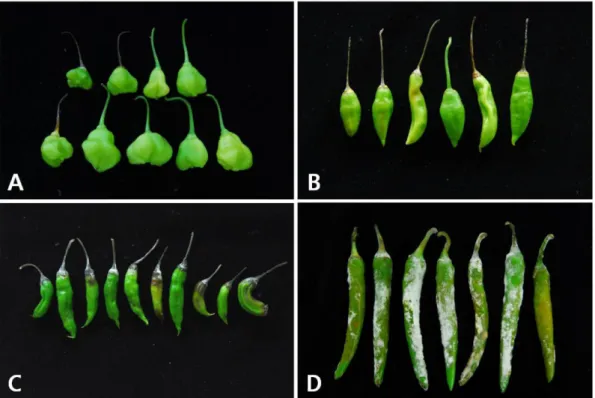
무상처 분무 접종에 의한 탄저병 저항성 검정. 탄저병 균 접종 4일 후부터 과실표면에 회백색의 수침상 병반이 나타나기 시작하여 균사가 표면을 덮었다. 감수성 고추는 균사가 고추 표면을 덮어 짙은 갈색으로 변하거나 흰색−
회갈색 균사로 덮었으며 심한 부위는 물러져 형태를 알 아볼 수 없었으나 고도의 저항성을 나타내는 고추는 과 육에 병반의 흔적이 없이 깨끗하였다(Fig. 1).
총 896자원의 고추에 대해 탄저병균을 무상처 분무 접
Fig. 1. The development of anthracnose symptoms on susceptible and resistant Capsicum accessions by non-wound spray inoculation with a concentration of 5.0×10⁵ conidia/ml of Colletotrichum acutatum. Typical symptoms developed on accession of Capsicum sp., anthracnose disease caused by C. acutatum at 14 days after inoculation. A and B: Resistant reaction of C. baccatum, C: Moderate resistant reaction of C. chinense, D: Susceptible reaction of C. annuum.
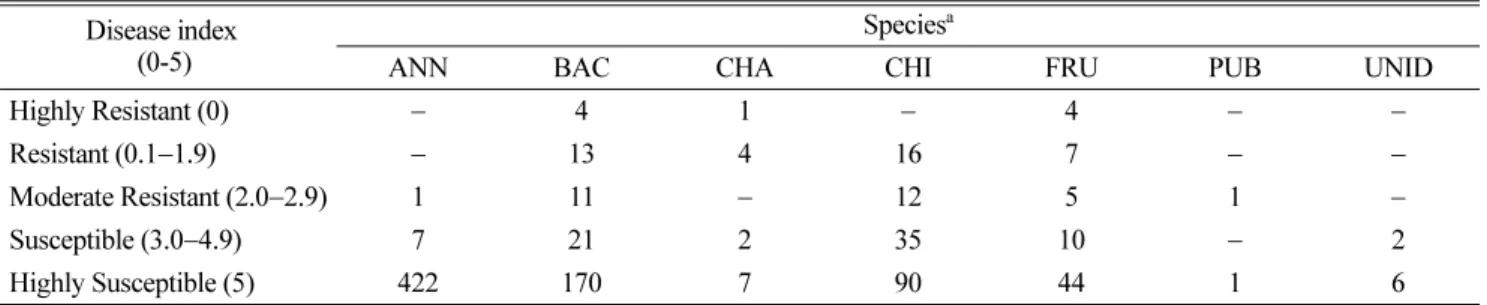
종하여 발병도에 따라 저항성의 정도를 판별하였으며, 9점이 발병도 0으로 고도의 저항성을 나타내었다(Table 2).
고추 종별로는 C. annuum은 총 430자원 중 1점 만이 중 도저항성으로 나타났으며, 7점이 감수성으로 422점이 고 도의 감수성인 것으로 나타났다. C. baccatum은 219점 중 1.8%에 해당하는 4점(IT 158578, IT 158609, K157547, 800066)이 전혀 발병하지 않아 고도의 저항성을 나타났 으며, 13점이 저항성, 11점이 중도저항성, 21점이 감수성, 170점이 고도의 감수성이었다. C. chacoense는 1점(K057228) 이 고도의 저항성, 4점이 저항성, 2점이 감수성, 7점이 고
도의 감수성이었다. C. chinense는 16점이 저항성, 12점이 중도저항성, 35점이 감수성 그리고 90점이 고도의 감수 성이었다. C. frutescens는 4점(IT 158413, IT 182545, 807320, 807328)이 고도의 저항성, 7점이 저항성, 5점이 중도저항성, 10점이 감수성 그리고 44점이 고도의 감수 성인 것으로 나타났다. C. pubescens는 각 1점씩 중도저 항성과 고도의 감수성을 나타내었으며, 미동정 고추는 2점이 감수성을 6점이 고도의 감수성을 보였다.
상처 접종에 의한 탄저병 저항성 검정. 과육에 주사바 늘로 상처를 내고 탄저병균을 접종한 고추는 3일 후부터 Table 2. Evaluation of 896 accessions of pepper germplasm for the disease severity of anthracnose caused by Colletotrichum acutatum
Disease index (0-5)
Speciesa
ANN BAC CHA CHI FRU PUB UNID
Highly Resistant (0) − 4 1 − 4 − −
Resistant (0.1−1.9) − 13 4 16 7 − −
Moderate Resistant (2.0−2.9) 1 11 − 12 5 1 −
Susceptible (3.0−4.9) 7 21 2 35 10 − 2
Highly Susceptible (5) 422 170 7 90 44 1 6
aANN: Capsicum annuum, BAC: C. baccatum, CHA: C. chacoense, CHI: C. chinense, FRU: C. frutescens, PUB: C. pubescens, UNID:
Unidentified.
Fig. 2. Anthracnose symptoms on susceptible and resistant Capsicum accessions. Typical symptoms were developed on accessions of Capsicum spp. by pin-prick wound inoculation. Anthracnose disease was observed by Colletotrichum acutatum at 5 days after inoculation. A and B: Resistant response of C. baccatum and C. chinense, C: moderate resistant response of C. frutescens, D: susceptible response of C. annuum. White arrows are inoculated with distilled water as a control.
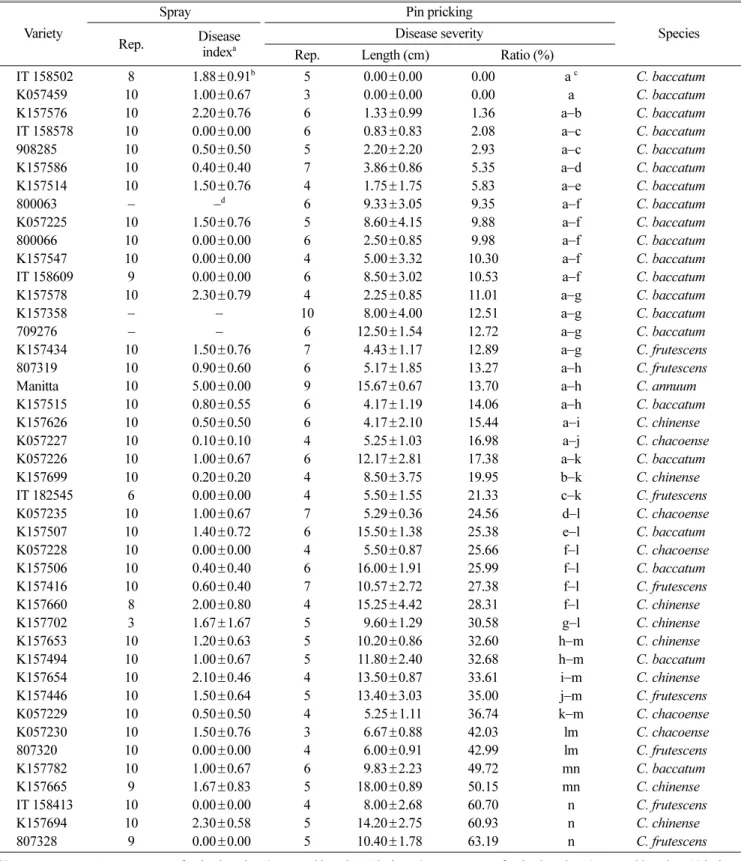
Table 3. Resistant pepper germplasm against Colletotrichum acutatum by non-wounding spray and pin-pricking wounding inoculation
Variety
Spray Pin pricking
Species Rep. Disease
indexa
Disease severity
Rep. Length (cm) Ratio (%)
IT 158502 8 1.88±0.91b 5 0.00±0.00 0.00 a c C. baccatum
K057459 10 1.00±0.67 3 0.00±0.00 0.00 a C. baccatum
K157576 10 2.20±0.76 6 1.33±0.99 1.36 a−b C. baccatum
IT 158578 10 0.00±0.00 6 0.83±0.83 2.08 a−c C. baccatum
908285 10 0.50±0.50 5 2.20±2.20 2.93 a−c C. baccatum
K157586 10 0.40±0.40 7 3.86±0.86 5.35 a−d C. baccatum
K157514 10 1.50±0.76 4 1.75±1.75 5.83 a−e C. baccatum
800063 − −d 6 9.33±3.05 9.35 a−f C. baccatum
K057225 10 1.50±0.76 5 8.60±4.15 9.88 a−f C. baccatum
800066 10 0.00±0.00 6 2.50±0.85 9.98 a−f C. baccatum
K157547 10 0.00±0.00 4 5.00±3.32 10.30 a−f C. baccatum
IT 158609 9 0.00±0.00 6 8.50±3.02 10.53 a−f C. baccatum
K157578 10 2.30±0.79 4 2.25±0.85 11.01 a−g C. baccatum
K157358 − − 10 8.00±4.00 12.51 a−g C. baccatum
709276 − − 6 12.50±1.54 12.72 a−g C. baccatum
K157434 10 1.50±0.76 7 4.43±1.17 12.89 a−g C. frutescens
807319 10 0.90±0.60 6 5.17±1.85 13.27 a−h C. frutescens
Manitta 10 5.00±0.00 9 15.67±0.67 13.70 a−h C. annuum
K157515 10 0.80±0.55 6 4.17±1.19 14.06 a−h C. baccatum
K157626 10 0.50±0.50 6 4.17±2.10 15.44 a−i C. chinense
K057227 10 0.10±0.10 4 5.25±1.03 16.98 a−j C. chacoense
K057226 10 1.00±0.67 6 12.17±2.81 17.38 a−k C. baccatum
K157699 10 0.20±0.20 4 8.50±3.75 19.95 b−k C. chinense
IT 182545 6 0.00±0.00 4 5.50±1.55 21.33 c−k C. frutescens
K057235 10 1.00±0.67 7 5.29±0.36 24.56 d−l C. chacoense
K157507 10 1.40±0.72 6 15.50±1.38 25.38 e−l C. baccatum
K057228 10 0.00±0.00 4 5.50±0.87 25.66 f−l C. chacoense
K157506 10 0.40±0.40 6 16.00±1.91 25.99 f−l C. baccatum
K157416 10 0.60±0.40 7 10.57±2.72 27.38 f−l C. frutescens
K157660 8 2.00±0.80 4 15.25±4.42 28.31 f−l C. chinense
K157702 3 1.67±1.67 5 9.60±1.29 30.58 g−l C. chinense
K157653 10 1.20±0.63 5 10.20±0.86 32.60 h−m C. chinense
K157494 10 1.00±0.67 5 11.80±2.40 32.68 h−m C. baccatum
K157654 10 2.10±0.46 4 13.50±0.87 33.61 i−m C. chinense
K157446 10 1.50±0.64 5 13.40±3.03 35.00 j−m C. frutescens
K057229 10 0.50±0.50 4 5.25±1.11 36.74 k−m C. chacoense
K057230 10 1.50±0.76 3 6.67±0.88 42.03 lm C. chacoense
807320 10 0.00±0.00 4 6.00±0.91 42.99 lm C. frutescens
K157782 10 1.00±0.67 6 9.83±2.23 49.72 mn C. baccatum
K157665 9 1.67±0.83 5 18.00±0.89 50.15 mn C. chinense
IT 158413 10 0.00±0.00 4 8.00±2.68 60.70 n C. frutescens
K157694 10 2.30±0.58 5 14.20±2.75 60.93 n C. chinense
807328 9 0.00±0.00 5 10.40±1.78 63.19 n C. frutescens
a0 = no symptoms, 1 = symptoms of a size less than 2 mm and less than 5 lesions, 2 = symptoms of a size less than 4 mm and less than 10 lesions, 3 = symptoms of a size less than 6 mm and less than 10 lesions, 4 = symptoms of a size less than 10 mm and less than 10 lesions, 5 = more than 10 lesions and lesion often encircling with acervuli.
bThe data represent means and standard error of each replicates.
cMeans separation with columns by Duncan’s multiple range test, P≤0.05.
d−, not tested.
접종부위가 함몰되기 시작하여 수침상 병반이 나타났으 며, 주황색의 윤문형 포자층을 형성하였으며, 상처를 내 고 증류수를 접종한 곳에서는 아무런 반응이 없었다(Fig.
2). 발병도는 탄저병균을 접종하고 5일 후에 병반의 길이 를 측정하여 고추 과육의 전체 길이에 대한 비율로 나타 내었다(Table 3). 침 접종에 의해 강한 저항성을 나타내는 품종은 대부분 C. baccatum이었다. 특히 2점(IT 158502, K057459)은 전혀 발병되지 않아 강한 저항성을 나타내었 으며, K157576, IT 158578 및 908285은 모두 전체 고추 길이의 3% 미만의 병반 길이를 나타내어 저항성을 나타 내었다(Table 3). K157576은 1.3 cm의 병반 길이를 나타 내어 전체 길이의 1.4%를 차지하였으며, IT 158578은 0.8 cm의 병반 길이를 나타내 2.1% 를 차지하였다. 908285 는 2.2 cm의 병반 길이를 나타내어 전체 고추의 2.9%를 차지하여 탄저병균에 저항성으로 판단하였다.
고 찰
농촌진흥청 농업유전자원센터에는 세계 각국에서 수집 한 7,800여 점의 고추를 보존하고 있으며, 매년 종자를 갱신하고 있으며 갱신하는 과정에서 고추의 배축색, 생육 최성기, 꽃의 색깔 및 모양, 과실의 특성 등 형질에 대한 특성 조사를 하여 연구재료로 일반 이용자에게 정보를 제 공하고 있다.
본 연구는 2011년 증식 대상인 고추 유전자원 896점에 대해 고추 과육에 탄저병균 C. acutatum을 무상처 분무 접종과 상처 접종을 통하여 저항성 정도를 판별하여 그 정보를 이용자에게 제공하고자 수행하였다.
많은 육종가와 농민들은 고품질의 품종 개발과 수확을 위해 노력하고 있으며, 특히 병 저항성 품종 개발과 보급 은 연구자와 재배 농가의 오랜 바람이다. 지금까지 알려 진 역병 저항성 재료는 PI163192, PI201232, PI201234 등 미국식물도입국 자원과 AC2258(=Mexican pepper ‘Line 29’), CM334(Criollo de Morales 334) 등이 알려져 있다 (Ares 등, 2005; Kim 등, 2010a; Ortega 등, 1991). 국내 에서도 이들 자원을 이용한 저항성 품종 육성이 이루어 져 현재 수십여 역병 저항성 품종들이 상업적으로 판매 되고 있다(Hwang과 Kim, 2002).
탄저병에 대해서는 C. chinense ‘PBC932’와 C. baccatum
‘PBC80’과 ‘PBC81’이 저항성을 가지는 것으로 알려져 있 다(Kim 등, 2004; Mahasuk 등, 2009; Park 등, 2009;
Sarath Babu 등, 2011; Yoon 등, 2004). 최근에는 C.
baccatum ‘PI594137’이 새로운 저항성 자원으로 알려지고 있다(Kim 등, 2008d). 국내에 많이 재배하고 있는 C.
annuum은 탄저병 저항성 유전자원이 없는 것으로 알려 져 있어, 병저항성을 가진 다른 종과의 종간 교잡으로 저 항성 유전자 도입을 시도하고 있다. 이종간의 교잡에서 C. chinense와 C. annuum은 종간 교잡으로 어느 정도 저 항성 개체를 획득하였으나, C. baccatum과 C. annuum의 교잡은 원활이 이루어 지지 않고 있다(Kim 등, 2008b;
Yoon 등, 2009).
본 연구에서 탄저병균(C. baccatum) 무상처 분무 접종 을 통해 C. baccatum 4점(IT 158578, IT 158609, K157547, 800066), C. chacoense 1점(K057228), C. frutescens 4점 (IT 158413, IT 182545, 807320, 807328)이 고도의 저항 성을 나타내었다. 이것은 기존에 알려진 C. baccatum과 C. chinense 외에 C. chacoense와 C. frutescens 자원에서 도 무상처 분무 접종에서 고도의 저항성을 나타내어 금 후 탄저병 저항성 관련 연구나 육종에 유용하게 이용되 리라 생각된다.
상처 접종에서 탄저병이 전혀 발병하지 않는 2점(IT 158502, K057459)과 3% 미만 발병 3점(K157576, IT 158578, 908285) 모두 C. baccatum으로 나타났다(Table 3).
C. baccatum은 C. chinense에 비해 다양한 탄저병균(C.
capsici, C. gloeosporioides, C. acutatum)에 안정적인 저항 성을 보이는 것으로 알려져 있다(Mahasuk 등, 2009;
Mongkolporn 등, 2010; Montri 등, 2009).
무상처 분무 접종에서 강한 저항성을 나타내었던 800066, K157547, IT 158609, IT 182545, K057228, 807320, IT 158413 및 807328은 상처 접종에서 10.0−63.2%의 발병 도를 보였다. 이는 각피 침입을 하는 탄저병의 경우 식물 의 큐티클층 및 세포벽 등 초기 방어에 의한 저항성이 배 제되었기 때문이다(Oh 등, 1999).
본 실험에서 무상처 분무 접종으로 저항성으로 판단되 는 34점을 선발하였으며, 특히 9점은 전혀 발병하지 않 아 탄저병균에 대해 강한 저항성으로 나타났다. 이들을 상처 접종으로 재검정한 바 그 중 5점이 3% 미만의 발 병을 나타내어 저항성을 나타내었고, 이 자원들은 탄저병 저항성 육종과 유전 연구를 위한 재료로서 이용이 기대된다.
요 약
농업유전자원센터에 보존하고 있는 896점의 고추(C.
annuum 430점, C. baccatum 219점, C. chacoense 14점, C. frutescens 70점, C. pubescens 2점, 미동정 8점)에 C.
acutatum을 접종 후 28oC에서 14일간 배양 후 탄저병 발 병 정도를 평가하였다. 무상처 분무 접종에서 총 49점이 C. acutatum에 저항성을 나타내었으며, 그 중 9점은 고도
의 저항성을 나타내었다. 고도의 저항성을 나타내는 자원 들은 C. baccatum 4점, C. chacoense 1점, C. frutescens 4점이었다. 무상처 분무 접종에서 탄저병 저항성을 나타 내는 자원 중 42점을 상처 접종법으로 탄저병균을 접종 하였다. 그 중 5점은 접종 5일 후에도 병반의 크기가 3%
미만으로 나타나 저항성을 나타내었으며, 이들은 모두 C.
baccatum이었다. 저항성을 보이는 5점은 탄저병 저항성 육성을 위한 자원으로 이용가능 할 것이다.
Acknowledgement
This study was supported by a grant (Project No:
PJ906987) from National Academy of Agricultural Science, Rural Development Administration, and by 2011 Postdoctoral Fellowship Program of National Academy of Agricultural Science, Rural Development Administration, Republic of Korea.
References
Ares, J. L. A., Martínez, A. R. and Paz, J. F. 2005. Resistance of pepper germplasm to Phytophthora capsici isolates collected in northwest Spain. Spain J. Agric. Res. 3: 429−436.
Hong, J. K. and Hwang, B. K. 1998. Influence of inoculum density, wetness duration, plant age, inoculation method, and cultivar resistance on infection of pepper plants by Colletotrichum coccodes. Plant Dis. 82: 1079−1083.
Hwang, H.-S. and Kim, B.-S. 2002. Breeding maintainer and restorer lines of cytoplasmic male sterility resistant to Phytophthora capsici in Capsicum pepper. J. Korean Soc.
Hort. Sci. 43: 143−150. (In Korean)
Kang, B. K., Kim, J., Lee, K. H., Lim, S. C., Ji, J. J., Lee, J. W.
and Kim, H. T. 2009. Effects of temperature and moisture on the survival of Colletotrichum acutatum, the causal agent of pepper anthracnose in soil and pepper fruit debris. Plant Pathology J. 25: 128−135.
Kim, B.-S., Kwon, T.-R., Hwang, J.-E., Lee, J.-M., Park, D.-G., Ahn, J.-H. and Kim, H.-Y. 2010a. Resistance to Phytophthroa blight of commercial pepper cultivars in Korea. Res. Plant Dis. 16: 141−147. (In Korean)
Kim, C.-H. 2004. Review of disease incidence of major crops in 2003. Res. Plant Dis. 10: 1−7. (In Korean)
Kim, J. T., Park, S.-Y., Choi, W., Lee, Y.-H. and Kim, H. T. 2008a.
Characterization of Colletotrichum isolates causing anthracnose of pepper in Korea. Plant Pathology J. 24: 17−23.
Kim, K.-H., Yoon, J.-B., Park, H.-G., Park, E. W. and Kim, Y. H.
2004. Structural modifications and programmed cell death of chili pepper fruit related to resistance responses to
Colletotrichum gloeosporioides infection. Phytopathology 94:
1295−1304.
Kim, S., Kim, K.-T., Chae, Y., Jamal, A. and Oh, D.-G. 2008b. A survey of genes differently expressed in response to Colletotrichum infection on chili pepper fruit. Korean J. Hort.
Sci. Technol. 26: 1−8. (In Korean)
Kim, S., Kim, K.-T., Kim, D.-H., Yang, E.-Y., Cho, M.-C., Jamal, A., Chae, Y., Pae, D.-H., Oh, D.-G. and Hwang, J.-K. 2010b.
Identification of quantitative trait loci associated with Anthracnose resistance in chili pepper (Capsicum spp.).
Korean J. Hort. Sci. Technol. 28: 1014−1024. (In Korean) Kim, S. H., Yoon, J. B., Do, J. W. and Park, H. G. 2008c. A major
recessive gene associated with anthracnose resistance to Colletotrichum capsici in chili pepper (Capsicum annuum L.).
Breed. Sci. 58: 137−141.
Kim, S. H., Yoon, J. B. and Park, H. G. 2008d. Inheritance of anthracnose resistance in a new genetic resource, Capsicum baccatum PI594137. J. Crop Sci. Biotechnol. 11: 13−16.
Mahasuk, P., Taylor, P. W. J. and Mongkolporn, O. 2009.
Identification of two new genes conferring resistance to Colletotrichum acutatum in Capsicum baccatum. Phyto- pathology 99: 1100−1104.
Mongkolporn, O., Montri, P., Supakaew, T. and Taylor, P. W. J.
2010. Differential reactions on mature green and ripe chili fruit infected by three Colletotrichum spp. Plant Dis. 94: 306−
310.
Montri, P., Taylor, P. W. J. and Mongkolporn, O. 2009. Pathotypes of Colletotrichum capsici, the causal agent of chili anthracnose, in Thailand. Plant Dis. 93: 17−20.
Myung, I.-S., Hong, S.-K., Lee, Y.-K., Choi, H.-W., Shim, H.-S., Park, J.-W., Park, K.-S., Lee, S.-Y., Lee, S.-D., Lee, S.-H., Choi, H.-S., Kim, Y.-G., Shin, D.-B., Ra, D.-S., Yeh, W.-H., Han, S.-S. and Cho, W.-D. 2006. Review of disease incidences of major crops of the south Korea in 2005. Res. Plant Dis. 12:
153−157. (In Korean)
Oh, B. J., Kim, K. D. and Kim, Y. S. 1999. Effect of cuticular wax layers of green and red pepper fruits on infection by Colletotrichum gloeosporioides. J. Phytopathol. 147: 547− 552.
Ortega, R. G., Español, C. P. and Zueco, J. C. 1991. Genetics of resistance to Phytophthora capsici in the pepper line ‘SCM- 334’. Plant Breed. 107: 50−55.
Pae, D.-H., Chae, Y., Wang, T.-C., Engle, L. M. and Shanmugasundaram, S. 2005. Selection of new breeding materials with resistance to Anthracnose in Capsicum annuum. J. Korean Soc. Hort. Sci. 46: 10−12.
Park, K. S. and Kim, C. H. 1992. Identification, distribution and etiological characteristics of anthracnose fungi of red pepper in Korea. Korean J. Plant Pathol. 8: 61−69.
Park, S.-K., Kim, S. H., Park, H. G. and Yoon, J. B. 2009.
Capsicum germplasm resistant to pepper anthracnose differentially interact with Colletotrichum isolates. Hort.
Environ. Biotechnol. 50: 17−23.
Sarath Babu, B., Pandravada, S. R., Prasada Rao, R. D. V. J., Anitha, K., Chakrabarty, S. K. and Varaprasad, K. S. 2011.
Global sources of pepper genetic resources against arthropods, nematodes and pathogens. Crop Prot. 30: 389−400.
Yoon, J. B., Do, J. W., Kim, S. H. and Park, H. G. 2009. Inheritance of anthracnose (Colletotrichum acutatum) resistance in
Capsicum using interspecific hybridization. Korean J. Hort.
Sci. Technol. 27: 140−144.
Yoon, J. B., Do, J. W., Yang, D. C. and Park, H. G. 2004.
Interspecific cross compatibility among five domesticated species of Capsicum genus. J. Korean Soc. Hort. Sci. 45: 324− 329.