Changes of Anthocyanidin Content and Brown Rice Yield in Three Pigmented Rice Varieties Among Different Transplanting and Harvesting Times
Sang-Kuk Kim*, Jong-Hee Shin*, Dong-Kyoon Kang**, Su-Yong Kim*, and Shin-Young Park***
†*Division of Crop Science, Gyeongsangbuk-do Provincial Agricultural Research & Research Services, Daegu 702-708, The Republic of Korea
**Division of Agriculture Environment, Gyeongsangbuk-do Provincial Agricultural Research & Research Services, Daegu 702-708, The Republic of Korea
***Department of Clinical Pathology, Jeju Halla University, Jeju Special Self-Governing Province, Jeju 690-708, Republic of Korea
28
†
Corresponding author: (Phone) +82-64-741-7403 (E- mail) [email protected]
<Received 4 September, 2012; Revised 18 October, 2012; Accepted 20 December, 2012>
한작지(Korean J. Crop Sci.), 58(1): 28~35(2013) DOI : http://dx.doi.org/10.7740/kjcs.2013.58.1.028
ABSTRACT Anthocyanin pigments from three pigmented rice varieties, Hongjinju, Sintoheugmi and Josaengheugchal pigmented by black color, were quantified to evaluate effects of transplanting and harvesting time during seed development.
Hongjinju, a rice variety of grains pigmented by red color, contains only two kinds of anthocyanins, delphinidin and cyanidin. Meanwhile, delphinidin, cyanidin, and pelargonidin were identified in Sintoheugmi and Josaengheugchal. Anthocyanidin contents in pigmented rice variety Hongjinju under different planting times were decreased with prolonged harvesting times.
The Sintoheukmi showed that cyanidin content was the highest among analyzed pigments during seed development. Two anthocyanins (cyanidin and pelargonidin) in Josaengheugchal recorded highest contents at 20 days after heading in three transplanting times. Cyanidin content was also slightly increased with prolonged transplanting time. Total anthocyanidin contents in Hongjinju were always lower than that of Sintoheukmi and Josaengheukchal. In two rice varieties, Sintoheugmi and Josaengheugchal, a* values were commonly slightly decreased by late transplanting and harvesting times. Changes of a* and b*
values in waxy rice varieties, Sintoheugmi and Josaengheugchal varied more than those in Hongjinju. In Josaengheugchal, early harvesting before maturity showed lower brown rice yield and late harvesting in the each transplanting times resulted in highest brown rice yield.
Keywords : pigmented rice, anthocyanidin, transplanting time
Rice (Oryza sativa L.) is one of the most important cereal crops in the world, especially in Asian countries. Pigmented rice such as black and red rice consumptions are rapidly
growing presently due to their healthy functional food ingredients in Korea. Pigmented rice or colored rice is distinguished by the rice grain having red brown or dark purple color in its covering layers. Pigments, which are located in the aleurone layer of rice grain, have been reported as a mixture of anthocyanin compounds, which belong to the family of flavonoids (Yawadio et al., 2007). For pigmented rice, the main substance of phenolic compounds has been reported as anthocyanins (Iqbal et al., 2005; Zhang et al., 2006; Yawadio et al., 2007). Anthocyanins in pigmented rice have been identified. They are cyanidin-3-glucoside and peonidin-3-glucoside (Hu et al., 2003); malvidin, pelargonidin-3, 5-diglucoside, cyanidin-3-glucoside and cyanidin-3, 5-diglucoside (Zhang et al., 2006); cyanidin-3-glucoside, pelargonidin-3-glucoside (Yawadio et al., 2007). Anthocyanins, a group of reddish or purple flavonoids, are reported to be the primary pigments in these rice varieties (Abdel-Aal & Huel, 1999; Mazza & Gao, 2005; Moreno et al., 2005). Anthocyanins have been recognized as health-promoting functional food ingredients due to their antioxidant activity (Nam et al., 2006; Philpott et al., 2006), anticancer (Hyun
& Chung, 2004; Zhao et al., 2004), and anti-inflammatory
effects (Tsuda et al., 2002), and these functions provide
synergic effects with various nutrients in vivo. At present,
red rice is commonly used as a food colorant in bread, ice
cream, and liquor (Yoshinaga, 1986). Anthocyanins are located
in certain layers of the rice grain, which could be separated
into anthocyanin-rich fractions for use as functional colorants
or functional food ingredients. Although an extensive scientific
literature (Francis, 2000; Mazza & Gao, 2005) on the composition
ISSN 2287-8432(Online)in black rice, but the minor ones were reported either malvidin- 3-glucoside (Yoon et al., 1995) or peonidin-3-glucoside (Pt3G) (Choi et al., 1994).
Recently, black rice was analyzed to contain a wide range of total anthocyanin content, with C3G being the most common anthocyanin (0~470 mg/100 g) in most of the 10 varieties studied, whereas Pt3G (0~40 mg/100 g) was the second dominant anthocyanin (Ryu et al., 1998). Researchers have reported that the contents of the functional components of pigmented rice were significantly increased according to the level of N-fertilizer, and normal planting conditions showed significantly higher effects than early or late plantings and the contents were different according to the planting region (Chung et al., 2003). The present study was aimed to investigate whether transplanting and harvesting times affect the different contents of pigment (delphinidin, cyanidin, and pelargonidin) components and brown rice yield in three pigmented rice varieties.
MATERIAL AND METHODS
The study was conducted to found the changes of anthocyanin pigment and pasting properties of starch in three pigmented rices with different transplanting time and harvesting times at experimental fields of Gyeongsangbuk-do Provincial Agricultural Research &
Extension Services, Daegu, Republic of Korea. The three pigmented rice varieties, Hongjinju, Sintoheugmi, and Joseongheukchal, were transplanted on June 10, 20 and 30. Planting distance was 30×14 cm and fertilizer amount was N-P
2O
5-K
2O = 9-4.5-5.7 kg/10a and fertilizer split application was basal-tillering stage-panicle initiation = 50-20-30 ratio. And in the other cultivation management, we observed rice standard culture of NICS. In order to analyze rice quality and pigment content from each variety, rice seeds were sampled 20, 30, 40, and 50 days after heading from each transplanting time.
For quantification and identification of anthcyanidin pigments, anthcyanidins were extracted from the samples by weighing 5.0g of pigmented rice seeds. The flours of pigmented rice grains were transferred into 50ml graduated cylinder and 5ml of extraction solution (80/20 acetonitrile/0.3% phosphoric acid in distilled water) was added. The samples were centrifuged for 10 min and added 200µl of concentrated HCl. The samples
isolated from pigmented rice flours. The anthocyanin mixtures (200 µl) in 100 µl of 2 N HCl were hydrolyzed under an atmosphere of nitrogen for 3 h at 98℃. The analysis of anthocyanins in pigmented rice seeds was carried out using a HPLC system (Waters 2487, USA) equipped with a C
18reverse phase column (4.6 mm × 250 mm). The extract (200 µl) was mixed with 100 µl of 2 N HCl in 40% methanol solution, and then incubated at 100℃. Samples were taken at various time periods prior to injection. HPLC was run by isocratic elution mode using 18% solvent B (0.4% TFA in acetonitrile) in solvent A (0.4% TFA in distilled water) at a flow rate of 1.0 ml/min. The elution profile was monitored by UV-detection at 530 nm. UV-Vis spectra of anthocyanin extract from pigmented rice seeds were obtained in buffer solutions with different pH values (Choung et al., 2001).
Small aliquots of the extract were diluted in either 200 mM phosphate : acetonitrile, 2:1 volume ratio, pH 1.5 or 30 mM borate, 100 mM SDS, pH 9.0. The spectrum was recorded in the range of 300 nm to 700 nm using a UV-Vis spectrophotometer (Shimadzu, Japan).
Color of dehusked grain was determined by Hunter-Lab (Ultrascan XE, Hunter-Lab, USA). Prior to color measurements, the instrument was calibrated with light tap and white calibration tile.
The colorimeter was set to an illuminant condition D65 and a 10° standard observer. Each sample was put in a cuvette and replaced in to the specular port site, the color parameters (a, b and L) were then read (Lamberts et al., 2007). Fifteen replicates for each sample were determined.
RESULTS AND DISCUSSION
The chromatogram of anthocyanins from pigmented rice (var. Sintoheugmi) was shown in Figure 1. Three authentic pigments were delphinidin (peak 2), cyanidin (peak 3) and pelargonidin (peak 4). Consequently, it was only quantified three anthocyanins from pigmented rices in this study.
Three pigmented rice varieties, Hongjinju, Sintoheugmi,
and Joseongheukchal as affected by different transplanting
time were sampled at 20, 30, 40, and 50 days after heading
to determine total anthocyanin contents. Anthocyanidin contents
Fig. 1. Chromatogram of anthocyanin pigments separated from pigmented rice variety, Sintoheugmi. Peak 1, acetonitrile; peak 2, delphinidin; peak 3, cyanidin;
peak 4, pelargonidin.
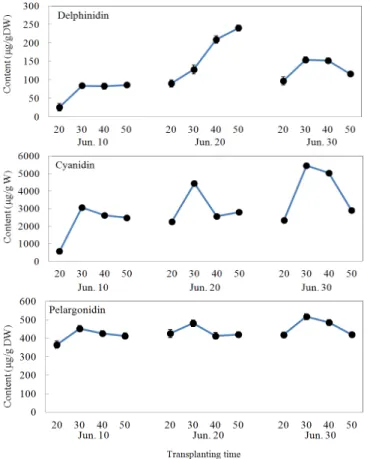
Fig. 2. Changes of delphinidin and cyanidin as affected by different transplanting and harvesting time in pigmented rice variety, Hongjinju. Vertical bar indicates means±SE (n=3).
Fig. 3. Changes of delphinidin, cyanidin, and pelargonidin as affected by different transplanting and harvesting time in pigmented rice variety, Sintoheugmi. Vertical bar indicates means±SE(n=3).
in Hongjinju under different planting times were decreased with prolonged harvesting times (Fig. 2). Cyanidin content was 16-20 times higher than that of delphinidin under both transplanting and harvesting time in Hongjinju. This variety pigmented by red color contained only two kinds of anthocyanins, delphinidin and cyanidin except for pelargonidin. It is known that dihydroflavonol 4-reductase (DFR) is a key enzyme in pelargonidin biosynthesis and color expression of husk, leaf, and flower (Nakamura et al., 2010). Expression of genes for DFR, which catalyzes dihydrokaempferol to leucopelargonidin in petunia mutants that are deficient in F3’H and F3’5’H,
results in pelargonidin production (Tanaka et al., 1995).
Therefore it suggests that the genes for DFR biosynthesis may absent or deficient in Hongjinju during grain development.
Unlike Hongjinju, Sintoheukmi showed that cyanidin content was the highest among analyzed pigments during seed development (Fig. 3). In change of delphinidin content, late transplanting time significantly increased delphinidin contents at 20 and 30 days after heading. Meanwhile, two anthocyanidins (cyanidin and pelargonidin) showed highest amounts only at 20 days after heading in all transplanting times.
Figure 4 presents the changes of anthocyanin pigments as affected by different transplanting time and harvesting time in Josaengheugchal. Two anthocyanins (cyanidin and pelargonidin) recorded highest contents at 20 days after heading in three transplanting times. Cyanidin content was also slightly increased with prolonged transplanting time.
Figure 5 shows changes of total anthocyanidin content as
Fig. 4. Changes of delphinidin, cyanidin, and pelargonidin as affected by different transplanting and harvesting time in pigmented rice variety, Josaengheugchal.Vertical bar indicates means±SE(n=3).
Fig. 5. Changes of total anthocyanidin pigment contents as affected by different transplanting and harvesting time in three pigmented rice varieties. Vertical bar indicates means± SE (n=3).
affected by different transplanting time in three pigmented rice varieties. In Hongjinju, total anthocyanidin contents were slightly decreased with late transplanting and harvesting time.
It showed that Sintoheukmi and Josaengheugchal recorded highest total anthocyanidin contents at 20 days after heading in all transplanting times. In particular, total anthocyanidin contents in Josaengheugchal were gradually increased with delaying transplanting times. Total anthocyanidin contents in Hongjinju were always lower than that of Sintoheukmi and Josaengheukchal. In Heugjinju and Heungnambyeo, pigment content especially cyanidin-3-glucoside (C3G) in brown rice is influenced by ambient temperature, and it varied by cultural environmental factors as well as variety (Chae et al., 2003). They reported that C3G content at 18℃ during seed ripening was lower. The C3G content of Heugjinju which was 1,837mg/100g brown rice at 24℃ during seed ripening was higher than that of Heugnambyeo. The production of C3G content at different ripening temperatures had a similar tendency
to the C3G contents. In our present study, Hongjinju showed highest anthocyanidin content in 20 days after harvesting at 24.8, 24.9, and 23.1℃ at transplanting time Jun. 10, Jun. 20 and Jun. 30, respectively. In particular, Josaengheugchal showed that lower ripening temperature produced higher anthocyanidin content at 30 days after harvesting time (Table 2).
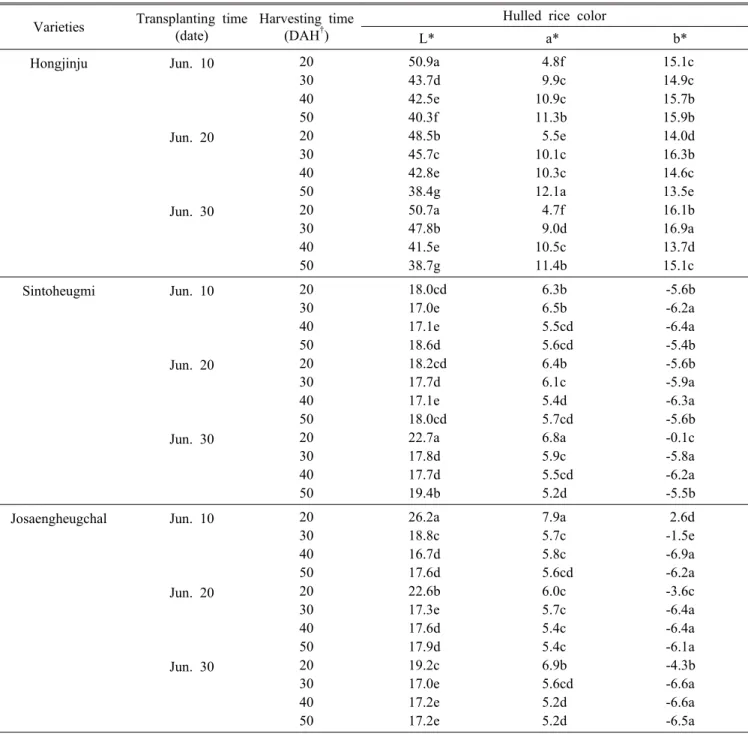
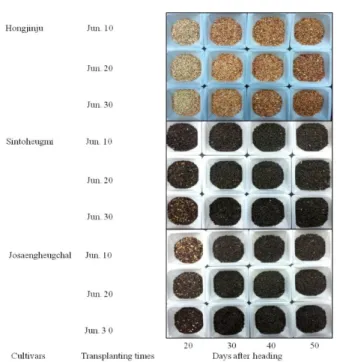
Table 3 and Figure 6 show the color parameters (L*, a*, and b*) of three pigmented brown rices and grain color degree as affected by different planting and harvesting times, respectively. The L* values, which expresses the brightness, were in the range of 38.4~50.9, 17.0~22.7, and 17.0~26.2 in Hongjinju, Sintoheukmi, and Josaengheugchal, respectively.
The a* values, which expresses the redness positively and
greenness negatively were in the range of 4.7~12.1, 5.2~6.8, and
5.2~7.9 in Hongjinju, Sintoheugmi, and Josaengheugchal,
respectively. In addition, the b values, which expresses the
yellowness positively and blueness negatively were in the range
of 13.5~16.3, -0.1~-6.4, and -1.5~-6.9 in Hongjinju, Sintoheugmi,
Table 1. Heading time, mean and accumulative temperature as affected by different transplanting and harvesting time in three pigmented rice varieties, Hongjinju, Sintoheugmi, and Josaengheugchal.
Varieties Transplanting time (date)
Harvesting time (DAH
♩)
Heading time (date)
Mean temp.
†(℃)
Accumulative temp.
‡(℃)
Hongjinju Jun.10
Jun.20
Jun.30
20 30 40 50 20 30 40 50 20 30 40 50
Aug. 16
Aug. 23
Aug. 28
24.8 24.7 24.0 22.7 24.9 24.5 23.2 22.0 23.1 21.3 20.5 19.5
496 742 958 1,137 498 734 928 1,099 462 640 818 973
Sintoheugmi Jun.10
Jun.20
Jun.30
20 30 40 50 20 30 40 50 20 30 40 50
Aug. 7
Aug. 15
Aug. 25
25.6 25.8 25.6 24.6 25.1 24.8 24.2 23.5 25.1 24.4 22.9 21.9
512 774 1,023 1,231 502 744 966 1,174 502 731 917 1,096 Josaengheugchal Jun.10
Jun.20
Jun.30
20 30 40 50 20 30 40 50 20 30 40 50
Aug. 28
Aug. 31
Sep. 1
25.6 23.8 22.2 21.3 24.7 23.0 21.5 20.5 24.2 22.6 21.3 20.3
512 714 887 1,063 493 690 859 1,025 484 678 850 1,014
†, ‡
Mean and accumulative temperatures were from heading time from harvesting time, respectively.
♩
Days after heading.
and Josaengheugchal, respectively.
In Hongjinju, L* values were significantly decreased with late transplanting and harvesting times. a* value was slightly increased and b value was reversely decreased by late transplanting and harvesting times. Consequently, it showed more red-brown
colors. In Sintoheugmi and Josaengheugchal, a* value was
commonly slightly decreased by late transplanting and harvesting
times. It can be noticed that a* and b* values in Sintoheugmi
and Josaengheugchal varied more than those in Hongjinju. It
was reported that the differences in the grain color of these
(date) (DAH ) L* a* b*
Hongjinju Jun. 10
Jun. 20
Jun. 30
20 30 40 50 20 30 40 50 20 30 40 50
50.9a 43.7d 42.5e 40.3f 48.5b 45.7c 42.8e 38.4g 50.7a 47.8b 41.5e 38.7g
4.8f 9.9c 10.9c 11.3b 5.5e 10.1c 10.3c 12.1a 4.7f 9.0d 10.5c 11.4b
15.1c 14.9c 15.7b 15.9b 14.0d 16.3b 14.6c 13.5e 16.1b 16.9a 13.7d 15.1c
Sintoheugmi Jun. 10
Jun. 20
Jun. 30
20 30 40 50 20 30 40 50 20 30 40 50
18.0cd 17.0e 17.1e 18.6d 18.2cd 17.7d 17.1e 18.0cd 22.7a 17.8d 17.7d 19.4b
6.3b 6.5b 5.5cd 5.6cd 6.4b 6.1c 5.4d 5.7cd 6.8a 5.9c 5.5cd 5.2d
-5.6b -6.2a -6.4a -5.4b -5.6b -5.9a -6.3a -5.6b -0.1c -5.8a -6.2a -5.5b Josaengheugchal Jun. 10
Jun. 20
Jun. 30
20 30 40 50 20 30 40 50 20 30 40 50
26.2a 18.8c 16.7d 17.6d 22.6b 17.3e 17.6d 17.9d 19.2c 17.0e 17.2e 17.2e
7.9a 5.7c 5.8c 5.6cd 6.0c 5.7c 5.4c 5.4c 6.9b 5.6cd 5.2d 5.2d
2.6d -1.5e -6.9a -6.2a -3.6c -6.4a -6.4a -6.1a -4.3b -6.6a -6.6a -6.5a
†