369
©The Korean Society of Food Science and Technology
호화전분의 쌍축형 압출성형에서 전분액화 및 체류시간 분포
김성욱·이승주*
동국대학교 식품공학과
Starch Liquefaction and Residence Time Distribution in Twin-Screw Extrusion of
α-Starch
Sung-Uk Kim and Seung Ju Lee*
Department of Food Science and Technology, Donggguk University
Abstract α-Waxy corn starch was used as a feed for twin-screw extrusion in order to enhance starch liquefaction with added thermostable α-amylase (derived from Bacillus licheniformis). The residence time distribution and starch liquefaction were investigated. The starch liquefaction was analyzed in terms of reducing sugar contents, molecular size from gel permeation chromatography (GPC), and microstructure from scanning electron microscopy (SEM). The use of α-starch contributed to the production of more reducing sugar than the use of raw starch use alone. From GPC, the effect of α- starch on the molecular size reduction was shown to be small. From SEM, irregular and damaged surface were observed on the extrudate from α-starch, as compared to those from raw starch. The spread of residence time distribution curves was greater with feed of α-starch than raw starch, indicating that α-starch was hard to flow forward during extrusion. This could be improved by increasing the feed moisture content and barrel temperature of extruder.
Key words: twin-screw extrusion, starch liquefaction, α-starch, residence time distribution
서 론
전분으로부터 당의제조는 일반적으로 전분을 호화시키고 산
또는효소로 액화(liquefaction) 시켜최종 당으로분해하는 과정
을 거친다(1,2). 압출성형은 전분의 호화와 액화를 동시에 얻을
수있는효율적인 공정으로 당제조의전처리 수단으로 활용된
바있다(3,4). 그러나압출성형기내체류시간이매우짧기때문에
충분한액화반응을일으키는데는 여전히어려움이남아있다.
그런데만약이미호화된전분을압출성형원료로사용한다면호 화과정이 생략되기때문에 액화가더 용이하게될것임을 가정 할수있다. 또한효소를함께첨가한다면더큰효과를기대할 수있다.
압출성형공정은 배럴(barrel) 안에서회전하는 스크루에 의하
여식품소재가 혼합되면서강력하게마찰되어층밀림(shear)과 동시에열을 받아소재의 성질을분자결합 수준까지도 바꿀수 있는일종의생물반응기로알려져있다. 즉, 열과기계적에너지 를동시에공급하고원료의 혼합기능이높아서, 변성전분제조에
효과적인방법으로적용된 바있다(5-7). 또한전분의압출성형에
내열성 효소를 첨가하여 액화 효과를 증가시킬 수 있었다(8,9).
그러나전분 액화를위하여 압출성형에 이미호화된 전분과함 께효소를 사용한 시도는전무하다. 한편, 압출성형에서 전분의
반응성을높이기위하여그원료로직접호화전분을사용하여변 성전분의 제조를 시도한바있다(7). 즉, 전분을 cationization 시 키기 위하여미리 호화시킨전분과 관련시약을 함께압출성형 한결과, 생전분을사용한경우보다 그반응성이크게 향상되었
다. 또한 Singh과 Rizvi(10)는초임계유체 압출성형에 전분계 생
고분자를제조하는데 호화전분을원료로사용한바있다.
압출성형조건은배럴온도, 스크루회전속도, 원료투입량, 수분 함량이며, 품질과 가장직결되는 측정변수는 배럴내 압력, 토출 구온도, SME(specific mechanical energy), 체류시간분포등을 들
수있다(11). 특히, 원료가호화전분과 같이고점질일경우압출
성형기내원료투입과압출이어렵게되어물질간체류시간에큰
변화가나타날수있다(10,12,13).
따라서, 본연구에서는압출성형에의한 전분의액화반응을 높
이기위하여직접호화전분을 효소와함께사용하였다. 그효과 는생전분과비교하여 환원당, 분자량 분포를측정하였으며 주사 전자현미형에 의한미세구조를 관찰하였다. 또한호화전분을 압 출성형 원료로직접 사용할경우 예상되는높은 점질성에따른 압출의어려움을 체류시간분포를통하여분석하였다.
재료 및 방법
재료
압출성형의원료로호화찰옥수수전분(α-waxy corn starch, Sewon Co. Ltd., Seoul, Korea) 또는 생찰옥수수전분(raw waxy corn starch, Sewon Co. Ltd.)을사용하였다. 또한효소로α-amylase (from Bacil- lus licheniformis; Sigma-Aldrich Co., St. Louis, MO, USA)를사용 하였다.
*Corresponding author: Seung Ju Lee, Department of Food Science and Technology, Dongguk University, Seoul 100-715, Korea Tel & Fax: 82-2-2260-3372
E-mail: [email protected]
Received April 14, 2009; revised July 9, 2009;
accepted July 11, 2009
mm long(4개), 20mm×40 mm(1개), 5 discs×20 mm(kneading block, 2개), 20 mm×20 mm(1개), 20 mm×40 mm(4개), 20 mm×20 mm (reverse screw, 2개), and 20 mm×40 mm(4개)로조립되었다. 2단 의전기히터, 냉각수에의한냉각기와 물공급장치가 장착되었
다. 물공급은큰용기에미리 5,000 mL 증류수에 10 mL의효소
액(500 SKB units)을혼합한후정량펌프로 구성된장치로공급
하였다.
압출성형기의 스크루 회전속도를 180 rpm으로 고정하고 원료
의투입속도는 두가지 전분 모두 325 g/mim, 압축부위의 온도 (80, 90, 100oC), 원료투입시수분함량(26, 33, 40%)의조건에서 압출물을채취하였다.
압출성형 체류시간 측정
압출성형기가정상상태에도달했을때적색2호색소 0.1 g을원 료투입구에투입한후사출구를통해나온압출성형물에적색이 보이지않을 때까지 5초간격으로 시료를 채취하여시간경과에 따른색도변화를색도계(CR-200, Minolta Co., Osaka, Japan) 이
용하여적색에해당하는 a 값을측정그래프에도시하였다(14).
환원당 측정
압출성형물을건조후분쇄하여 40 mesh 이하의시료 2 g을 50 mL 원심분리관에넣고 0.2 M acetate 완충용액(pH 3.5) 30 mL을 가한후 10분간 vortexing 한뒤 5000×g에서원심분리하여그상 등액에대하여 DNS(3,5-dinitrosalicylic acid)법으로 550 nm에서환
원당생성량을측정하였다(15).
Gel permeation chromatography
Gel로는 Sepharose(CL-2B, Pharmacia Co., San Francisco, USA)
및 eluent 용액으로는 0.2 N KOH를사용하였다. 시료제조는 2 N
KOH 10 mL에분말시료를 1%(w/v) 농도가되게 가한후 10분간
vortexing 하고 2시간동안정치시킨후다시 10분간 vortexing 하 였다. 이시료를 90oC로가열하여완전히녹인후 0.2 N KOH 용
액이되게 증류수로 희석하여 10분간 vortexing하고 10,000×g에 서 30분간원심분리하여전분이외의불순물을제거한상징액 2 mL를취하여 chromatography용 eluent로사용하였다. Eluent flow rate는 20 mL/hr로고정시켰으며 실험온도는 4oC를유지하고한
튜브당 3 mL씩 취하였다. 용출된 fraction은 phenol-sulfuric acid
법으로총당량에대한흡광도(490 nm)를측정하여전분분자의
상대적인크기분포로나타내었다(16,17).
미세구조 관찰
압출성형물의 미세구조를 JSM-6400 주사전자현미경(scanning electron microscope, JSM-6400, Jeol Ltd., Akishima-shi, Japan)으 로관찰하였다(15,17,19). 이미건조상태인압출성형물을추가적
으로상온에서 3일간 진공건조한시편을금박코팅후 20 kV에
서 2,000배로관찰하였다.
통계 처리
MS Excel 프로그램을 사용하였으며, 환원당에 대하여 반복이
있는이원분산분석(two-way ANOVA)를적용하였다. 압출성형온 도및수분함량에 대한주효과 및상호작용효과를분석하였다.
형의원료로사용하였다.
체류시간 분포
압출성형기 내부 체류시간의 분산도는 호화전분과 생전분 모 두 원료의 수분함량과 배럴온도가 높아질수록 작아지는 경향을 보였고, 호화전분이생전분보다더크게 나타났다(Fig. 1). 그러나 호화전분과 생전분의 사용에따른 차이는 수분함량과 배럴온도 가높아짐에따라점차 감소함을보였다. 분산도가크게되는 것 은원료가잘밀려가지않음을 의미하며, 압출이불균일하게 처
리되어 압출물의 품질이 떨어진다(11). 이로부터 호화전분의 사
용에따른 분산도가크게되는단점은수분함량과배럴온도를높 임으로서극복될 수있음을알수있었다.
한편 Seker(18)는전분의 압출성형에서 스크루 회전속도가 증
가함에 따라체류시간은 짧아지고그분산도는작아지며, 수분함 량에 따른 차이는 크지 않은 것으로 보고하였다. 또한 Singh와
Rizvi(10,12)는 초임계가스 CO2를주입하여 체류시간 및분산도
를개선할수있다는결과를보고하였다. Gautam과 Choudhury(13)
에따르면 쌀가루압출성형의 스크루 조합에 mixing elements의 위치 및수에 따라 체류시간 및그 분포가 크게영향을 줄 수 있다고하였다. 이로부터분산도를향상시키기 위한또다른방
법으로 스크루 회전속도, 초임계가스, 스크루에 mixing elements
의사용을추가적으로고려할수있을것으로생각된다.
환원당 생성량의 변화
환원당 생성량은 호화전분이 생전분의 경우보다 환원당생성 량이 많게나타났으나 압출성형 온도가증가함에 따라그차이 가감소하였다(Fig. 2). 또한 두가지전분모두 배럴온도와수분 함량이높아질수록환원당생성량이증가하였으나, 수분함량 33%
와 40%의차이는상대적으로작게나타났다. 이원분산분석의결
과온도및수분함량모두 주효과가유의적차이가 있으며(n=5,
p<0.05), 상호작용효과는 없는 것으로(p>0.05) 나타났다. Kim과
Park(15)은쌀전분이세균성 α-amylase에의하여고온에서더분
해된다고 보고한바있다. 이로부터압출성형 온도, 수분 및호 화전분사용의효과는효소작용의증가에기인하는것으로생각 된다. 그런데높은온도에서의 호화전분사용및수분함량의 효 과가 상대적으로 크지않은이유는 내열성효소의 사용에따른 온도효과가 크기때문이며, 단수분함량 26%의경우에는낮은 물공급에따른전분 질량당효소량이작았기때문으로생각된다. Gel permeation chromatography에 의한 분자크기 분포
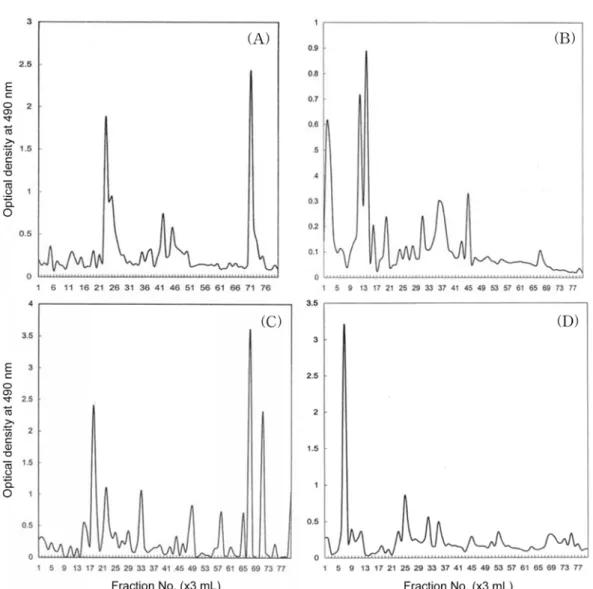
각시료의분자크기의분포는 Fig. 3과같다. 호화전분의압출 물이생전분의압출물보다효소의첨가없이 압출한경우에는그 래프에서후기의유출액에해당하는저분자획분이일부증가하 는경향을보였고, 효소를 첨가하고압출한경우에는차이를 볼
수 없었다. 전반적으로분자의 크기가 매우불균일하게 나타났
다. Sagar와 Merrill(17)은 전분을 압출성형할 때 분자량 변화를
gel permeation chromatography로분석한결과분자량이확연히감 소하였으며 이는분자사슬의 절단에의한 것임을확인하였다. 그
밖의여러연구자들에의해서도압출성형이전분의분자량감소 에유효하다는보고가된바있다(19-21). 본연구에서는호화전 분을 직접원료로 사용한경우압출성형의 전분 저분자화에 대
한효과는 뚜렷하지않았으나 효소를 사용하지않고 얻은압출 물에일부차이를보인점으로보아, 호화전분의 사용은효소에 의한저분자화 보다순수 압출성형효과에 의한저분자화에 작 용하는것으로 예상할수있었으나, 이에대한추후 연구가요구 된다.
주사전자현미경에 의한 미세구조
호화전분의압출물표면이생전분의경우보다더침식된것처 럼관찰되었다(Fig. 4). 주사전자현미경을통한압출물의전분미
세구조는그특징을찾아내고해석하는데매우모호함이따르는 것이 일반적이다. Pushpadass 등(22)은압출성형된전분의 주사전 자현미경사진에서그구조를생전분의알갱이형태가 보이지않 는형태라고표현하였다. Fig. 4에서생전분의압출물표면은알 갱이 구조보다는무정형(amorphous state)의모양으로보였으므로,
이는압출성형의 일반효과라고간주할수있었다. 그런데호화 전분의압출물표면은무정형이침식되어서큰공간이간헐적으 로생성된형태와같은 생소한모양으로, 이는전분이더효과적 으로액화되었기 때문으로생각된다.
Fig. 1. Residence-time distribution curves during twin-screw extrusion of α-starch(■) and raw starch (◆) of waxy corn with added α- amylase. Extrusion conditions: barrrel temperature 80oC/feed water content 26% (A), 80oC/40% (B), 100oC/26% (C), 100oC/40% (D).
Fig. 2. Reducing sugar content of extrudates from twin-screw extrusion of α-starch (A) and raw starch (B) of waxy corn with added α- amylase at different extrusion conditions. ■, feed water content 26%; □, 33%; ▒, 40%. Error bars mean standard deviations. In two-way ANOVA with two factors (feed water content and temperature), main effects of two factors were significant (n=5, p<0.05), but interaction effect were not significant (p>0.05).
요 약
전분액화에호화찰옥수수전분가쌍축형압출성형의원료로직
접 사용되었다. 그액화효과와 체류시간분포를 분석하였다. 내
열성 α-amylase(Bacillus licheniformis로부터분리)를함께첨가하 여 사용하였다. 전분액화는 환원당측정, gel permeation chroma- Fig. 3. Gel permeation chromatograms of extrudates from twin-screw extrusion of α-starch (A, B) and raw starch (C, D) of waxy corn at barrel temperature 80oC and feed water content 26%. (A) and (C), without added α-amylase; (B) and (D), with the enzyme.
Fig. 4. Scanning electron micrographs (2,000× magnification) of extrudate surface from twin-screw extrusion of α-starch (A) and raw starch (B) of waxy corn with added α-amylase at barrel temperature 100oC and feed water content 40%.
tography(GPC), 주사전자현미경을 통하여 분석하였다. 배럴온도와 수분함량이 높을수록 환원당 함량은 증가하였고, 호화전분의 경 우 생전분보다 더 많은 환원당이 생성되었다. GPC에서 호화전분 의 사용에 의한 저분자화 효과는 뚜렷하지 않았으나, 효소 첨가 없이 압출성형하는 경우에는 일부 효과가 있는 것으로 나타났다.
주사전자현미경의 미세구조에서는 호화전분을 쓸 경우 그 표면 이 더 불규칙하고 침식되는 것을 관찰할 수 있었다. 종합적으로 호화전분의 사용이 전분액화에 효과가 있음을 알 수 있었다. 체 류시간분포에서는 호화전분을 원료로 할 경우 그 분산도가 커지 는 것으로 나타났다. 이는 호화전분은 압출성형의 흐름이 원만하 지 않은 것을 의미하였으나, 배럴온도와 수분함량을 증가시킴에 따라 그 분산도를 감소시킬 수 있음을 알 수 있었다.
문 헌
1. Lee YH, Park JS. Direct conversion of raw starch to maltose in an agitated bead enzyme reactor using fungal alpha-Amylase.
Korean J. Appl. Microbiol. Biotechnol. 19: 290-295 (1991) 2. Kim KH, Park SH. Liquefaction and saccharification of tapioca
starch for fuel ethanol production. Korean J. Biotechnol. Bioeng.
10: 304-316 (1995)
3. Grafelman DD, Meagher MM. Liquefaction of starch by a single- screw extruder and post-extrusion static-mixer reactor. J. Food Eng. 24: 529-542 (1995)
4. Han JY, Kim MH, Tie J, Solihin BW, Ryu GH. Extrusion of gin- seng root in twin screw extruder: Pretreatment for hydrolysis and saccharification of ginseng extrudate. J. Food Sci. Nutr. 11: 318- 322 (2006)
5. Mali S, Grossmann MVE. Preparation of acetylated distarch adi- pates by extrusion. Lebensm.-Wiss. Technol. 34: 384-389 (2001) 6. Miladinov VD, Hanna MA. Starch esterification by reactive
extrusion. Ind. Crop Prod. 11: 51-57 (2000)
7. Xie F, Yu L, Liu H, Chen L. Starch modification using reactive extrusion. Starch-Strke 58: 131-139 (2006)
8. Likimani TA, Sofos JN, Maga JA,. Harper JM. Extrusion cooking of corn/soybean mix in presence of thermostable α-amylase. J.
Food Sci. 56: 99-105 (1991)
9. Vasanthan T, Yeung J, Hoover R. Dextrinization of starch in bar- ley flours with thermostable alpha-Amylase by extrusion cooking.
Starch-Strke 53: 616-622 (2001)
10. Singh B, Rizvi SSH. Residence time distribution (RTD) and goodness of mixing (GM) during CO2-injection in twin-screw extrusion. Part I: RTD studies. J. Food Process Eng. 21: 91-110 (1998)
11. Guy R. Extrusion Cooking: Technology and Applications. CRC Press LLC, Boca Raton, FL, USA. pp. 88-92 (2000)
12. Singh B, Rizvi SSH. Residence time distribution (RTD) and goodness of mixing (GM) during CO2-injection in twin-screw extrusion. Part II: GM studies. J. Food Process Eng. 21: 111-126 (1998)
13. Gautam A, Choudhury GS. Screw configuration effects on resi- dence time distribution and mixing in twin-screw extruders dur- ing extrusion of rice flour. J. Food Process Eng. 22: 263-285 (1999)
14. Altomare RE, Ghossi P. An analysis of residence time distribu- tion patterns in a twin-screw cooking extruder. Biotechnol. Progr.
2: 157-163 (1986)
15. Kim HY, Park KH. Characterization of bacterial α-amylase by determination of rice starch hydrolysis product. J. Korean Soc.
Appl. Biol. Chem. 29: 248-254 (1986)
16. Dubois M, Gilles KA, Hamilton JK, Rebers PA, Smith F. Colori- metric method for determination of sugars and related substance.
Anal. Chem. 28: 350-356 (1956)
17. Sagar AD, Merrill EW. Starch fragmentation during extrusion processing. Polymer 36: 1883-1886 (1995)
18. Seker M. Residence time distributions of starch with high mois- ture content in a single-screw extruder. J. Food Eng. 67: 317-324 (2005)
19. Politz ML, Timpa JD, Wasserman BP. Quantitative measurement of extrusion-induced starch fragmentation products in maize flour using nonaqueous automated gel-permeation chromatography.
Cereal Chem. 71: 532-536 (1994)
20. Rodis P, Wen LF, Wasserman BP. Assessment of extrusion- induced starch fragmentation by gel-permeation chromatography and methylation Analysis. Cereal Chem. 70: 152-157 (1993) 21. Wen LF, Rodis P, Wasserman BP. Starch fragmentation and pro-
tein insolubilization during twin-screw extrusion of corn meal.
Cereal Chem. 67: 268-275 (1990)
22. Pushpadass HA, Marx DB, Hanna MA. Effects of extrusion tem- perature and plasticizers on the physical and functional properties of starch films. Starch/Strke 60: 527-538 (2008)