• 검색 결과가 없습니다.

Changes in Amylopectin Structure and Pasting Properties of Starch as Affected by Different Transplanting Dates in Rice

N/A
N/A
Protected

Academic year: 2021

Share "Changes in Amylopectin Structure and Pasting Properties of Starch as Affected by Different Transplanting Dates in Rice"

Copied!
7
0
0

로드 중.... (전체 텍스트 보기)

전체 글

(1)

Changes in Amylopectin Structure and Pasting Properties of Starch as Affected by Different Transplanting Dates in Rice

Sang-Kuk Kim 1,† , Jong-Hee Shin 1 , Deuk-Jong Ahn 1 , and Se-Jong Kim 1

ABSTRACT Three different transplanting dates for two rice cultivars grown in Daegu, Republic of Korea, were examined to identify the changes in growth, rice quality, and characteristics of amylopectin. An early transplanting date caused a reduction in the number of panicles in both rice cultivars compared to that in the optimal and late transplanting dates. The 1000-grain weight in the two rice cultivars was significantly increased in the late transplanting date. The rice cultivar tolerant to high temperatures, Donganbyeo, exhibited the lowest milky grain rate in the late transplanting date. The highest rate of head grain was observed in the late transplanting date in both rice cultivars. Regarding the pattern of pasting properties, peak viscosity increased with delayed transplanting dates. With respect to changes in the amylopectin branch-chain length distribution, the amylopectin structure of the translucent Dongan rice cultivar transplanted on April 25 was characterized by a significant increase in A chains with DP > 12, and a decrease in long chains DP ≥ 37 compared to that transplanted on June 25. In contrast, the amylopectin structure of the chalky Dongan rice cultivar transplanted on April 25 exhibited further decrease in 13 < DP < 19 than that transplanted on June 25. In the Ungwang rice cultivar, the amylopectin structure of the translucent Ungwang rice cultivar transplanted on April 25 and June 25 was characterized by a significant decrease in the lengths of total amylopectin chains. Furthermore, the amylopectin structure of the chalky Ungwangbyeo rice cultivar transplanted on April 25 was characterized by a significant increase in 7 < DP < 30, while a significant decrease was observed in that transplanted on June 25. These results indicate that the amylopectin structure is altered by different transplanting dates depending on the characteristics of the rice cultivar.

Keywords : amylopectin, degree of polymerization, grain qualities, rice, transplanting time DOI : https://doi.org/10.7740/kjcs.2016.61.4.235

Original Research Article

ⓒ 본 학회지의 저작권은 한국작물학회지에 있으며, 이의 무단전재나 복제를 금합니다.

This is an Open-Access article distributed under the terms of the Creative Commons Attribution Non-Commercial License (http://creativecommons.org/licenses/by-nc/3.0) which permits unrestricted non-commercial use, distribution, and reproduction in any medium, provided the original work is properly cited.

1)

Division of Crop Breeding, Gyeongsangbuk-Do Provincial Agricultural Research & Extension Services, Daegu 41404, Republic of Korea

Corresponding author: Sang-Kuk Kim; (Phone) +82- 53-320-0224 ; (E-mail) [email protected]

<Received 24 June, 2016; Revised 29 August, 2016; Accepted 2 September, 2016>

Starch, an end product of photosynthesis in source tissues, is stored as energy reserves in the sink tissues and is composed of two major components i.e., amylose and amylopectin.

Earlier studies established strong associations of starch structure with physical behavior and functionality (Ito et al., 1989; Nakamura 2002; Fujita et al., 2003). The variations in starch structure arise due to differential expression of various isoforms of starch biosynthetic enzymes. The varietal differences in the amylopectin structure exist predominantly due to chain length variation and play a critical role in determining physicochemical properties of starch in rice endosperm.

Amylose content and gelatinization temperature are the two main measures to assess the rice grain quality. High temper- ature during the grain-filling stage causes deleterious effects

on the yield and quality of crop products (Tetlow et al., 2004).

Temperature above certain growth-optimal temperatures impairs dry matter production, generally decreasing grain size in all major cereal crops, such as rice, wheat, barley, and maize.

Such small grains result in not only decreased yield but also

low milling quality. For japonica cultivars of rice, temperatures

higher than 26°C render chalky grain appearance as well as

reduction of grain weight. Severely chalky brown rice grains

are inferior for polishing quality and palatability. The chalky

grains ripened under high temperature conditions resulted in

lower yield after polishing and less sticky texture after

cooking than translucent grains ripened under low temper-

ature. It has been reported that high temperature at the milky

stage of grain filling has the greatest influence on rice grain

(2)

chalkiness (Zhang et al., 2011), and the panicle is the most sensitive organ to high temperature (Sato and Inaba, 1976).

There are known to be varietal differences in grain chalkiness among rice cultivars when ripened under a given temperature.

The japonica cultivar ‘Donganbyeo’ provides less chalky grains even when they are exposed to high temperature (here defined as high temperature tolerant), whereas ‘Ungwangbyeo’

produces severely chalky grains (high temperature sensitive).

However, the varietal differences in grain chalkiness are poorly understood at the molecular level. Thus, to determine the underlying biochemical mechanism for grain chalkiness, the effect of high temperature on starch synthesis in developing caryopses has been investigated so far. High temperature during the grain-filling stage causes deleterious effect on the yield and quality of crop product (Peng et al., 2004).

Severely chalky rice grains are inferior for polishing quality and palatability, thus only achieving low sale prices, which is one of the recent problems for Korean rice farmers. To circumvent quantitative and qualitative losses of crop production by forthcoming global warming, studies concerning physiological effects of elevated temperature on grain filling are indispensable.

In South Korea, rice is transplanted from mid May to end of June depending upon the cultivar, availability of water, land and labor for rice cultivation. Therefore, the objectives of the present study were to investigate the optimal transplanting time considering rice grain qualities, palatability, and rice yield.

MATERIALS AND METHODS

The study was conducted at the paddy fields of Gyeongsanbuk-do Agricultural Research & Extension Services. The two rice cultivars, ‘Donganbyeo’ and ‘Ungwangbyeo’, grown for 35days in nursery beds were transplanted on Apr. 25, May 25, and Jun. 25, respectively. Planting distance was 30×15 cm and fertilizer amount was N-P

2

O

5

-K

2

O = 9-4.5-5.7 kg/10a, and fertilizer split application was basal-tillering stage-panicle initiation = 50-25-25 ratio. And in the other cultivation management, we determined growth data by rice standard culture of National Institute of Crop Science. In order to analyze growth and quality of rice from each cultivar, rice grains were sampled 45 days after heading from each transplanting date.

10 g of rice grain was placed with 10 stainless steel balls (16-mm diameter) in the mill (Fritsch, Type: 06.101, Germany).

The operation was done at 420 rpm and room temperature.

The milled samples were collected at 1 min. All tests were run in triplicates. Gel properties of rice flours were determined by using a Rapid Visco Analyzer (RVA, Model 4, Newport Scientific, Sydney, Australia). Each rice sample (flour 3 g, 12% moisture basis) was mixed with 25 ml of deionized water in an RVA sample canister. The idle temperature was set at 50°C, and the following 12.5 min test profile was run: 50°C held for 1.0 min, the temperature was linearly ramped up to 95°C until 7.3 min, the temperature was linearly ramped down to 50°C at 11.1 min and held at 50°C until 12.5 min. The chain-length distribution of amylopectin was determined by HPAEC with pulsed amperometric detection (HPAEC-PAD) according to the method (Kasemsuwan et al., 1995) with modifications (Wang and Wang 2000). The HPAEC system (Dionex DX500, Sunnyvale, CA) consisted of the following components: a GP50 gradient pump, an LC20-1 chromatography organizer, an ED40 electrochemical detector, a CarboPac PA-1 guard column, a CarboPac PA1 analytical column, and an AS40 automated sampler. The collected data were analyzed by using SAS package (version 8.0, SAS Institute Inc., Cary, NC) for LSD and Dunkan's multiple range tests.

RESULTS AND DISCUSSION

Changes of air temperature and sunshine hour per day

during rice grain ripening stages with different transplanting

dates in two rice cultivars were illustrated in Table 1. The

maximum, minimum and mean air temperatures in two rice

cultivars at earliest transplanting date, April 25th, were higher

than that of May 25th and June 25th. Among yield components,

productive tillers are very important because the final yield is

mainly a function of the number of panicles bearing tillers per

unit area (Safdar, 2006). Data given in Table 2 show that

number of tillers per plant was not changed by different

transplanting date in Donganbyeo, meanwhile in Ungwangbyeo,

number of tiller was increased by latest transplanting time,

June 25th. The later transplanting time, the lower accumulative

temperature for 45 days after heading recorded. Panicle length

and number of panicles per plant were not influenced by

transplanting dates, however, number of spikelets per panicle

(3)

Table 1. Changes in temperature and sunshine during the ripening periods of rice grain.

Cultivar Transplanting date

Temperature (°C) Sunshine

(h/day)

Max. Mini. Mean Accumulative

Donganbyeo

Apr. 25 30.5 22.7 26.1 1,175 5.1

May 25 28.2 19.1 23.1 1,040 6.3

Jun. 25 26.4 16.7 21.2 950 7.4

Ungwangbyeo

Apr. 25 30.5 22.7 26.1 1,175 5.1

May 25 29.6 21.4 25.0 1,123 5.2

Jun. 25 27.6 18.3 22.4 1,009 6.9

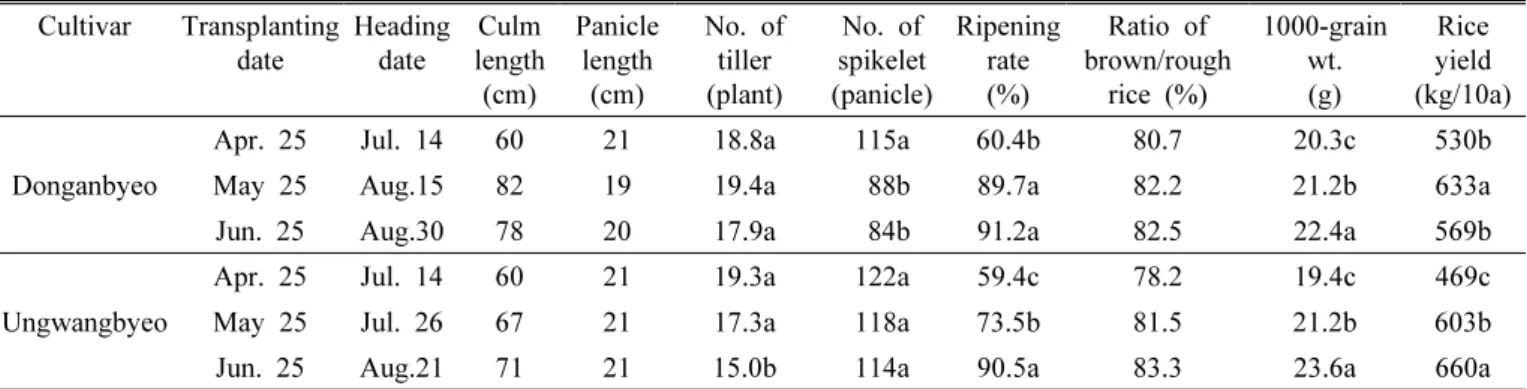
Table 2. Growth characteristics, yield component, and rice yield as affected by different transplanting dates in two rice cultivars.

Cultivar Transplanting date

Heading date

Culm length (cm)

Panicle length

(cm)

No. of tiller (plant)

No. of spikelet (panicle)

Ripening rate (%)

Ratio of brown/rough

rice (%)

1000-grain wt.

(g)

Rice yield (kg/10a)

Donganbyeo

Apr. 25 Jul. 14 60 21 18.8a 115a 60.4b 80.7 20.3c 530b

May 25 Aug.15 82 19 19.4a 88b 89.7a 82.2 21.2b 633a

Jun. 25 Aug.30 78 20 17.9a 84b 91.2a 82.5 22.4a 569b

Ungwangbyeo

Apr. 25 Jul. 14 60 21 19.3a 122a 59.4c 78.2 19.4c 469c

May 25 Jul. 26 67 21 17.3a 118a 73.5b 81.5 21.2b 603b

Jun. 25 Aug.21 71 21 15.0b 114a 90.5a 83.3 23.6a 660a

Different letters within each column indicate significant differences (P < 0.05).

only increased in Donganbyeo when transplanted on April 25th. Similarly, it was noted that the number of grains and grain weight per panicle were positively correlated with grain yield (Singh, 1994). Data on 25th of June gave commonly the highest ripening rate in the two rice cultivars, Donganbyeo and Ungwangbyeo.

Thousand-grain weight, an important yield-determining component, is a genetic character least influenced by environ- ment (Ashraf, 1999). 1000-grain weight in the two rice cultivars was only increased in late transplanting time, June 25th. Among yield component parameters, ratio of brown by rough rice did not show a regular tendency in two rice cultivars. Milled rice yield is a function of interplay of various yield components such as number of productive tillers, spikelets per panicle and 1000-grain weight (Hassan, 2003). Among transplanting dates, maximum paddy yield (633 kg/10a) was produced on 25th May, while the rest of two transplanting dates (on 25th of April and 25th of June) produced comparati- vely lower paddy yield by 530 and 569 kg per 10a in Donganbyeo. In Ungwangbyeo, highest rice grain yield

(660kg/10a) was produced on 25th June, otherwise the rest of two transplanting dates (on 25th of April and 25th of May) produced comparatively lower paddy yield by 469 and 603kg per 10a, respectively.

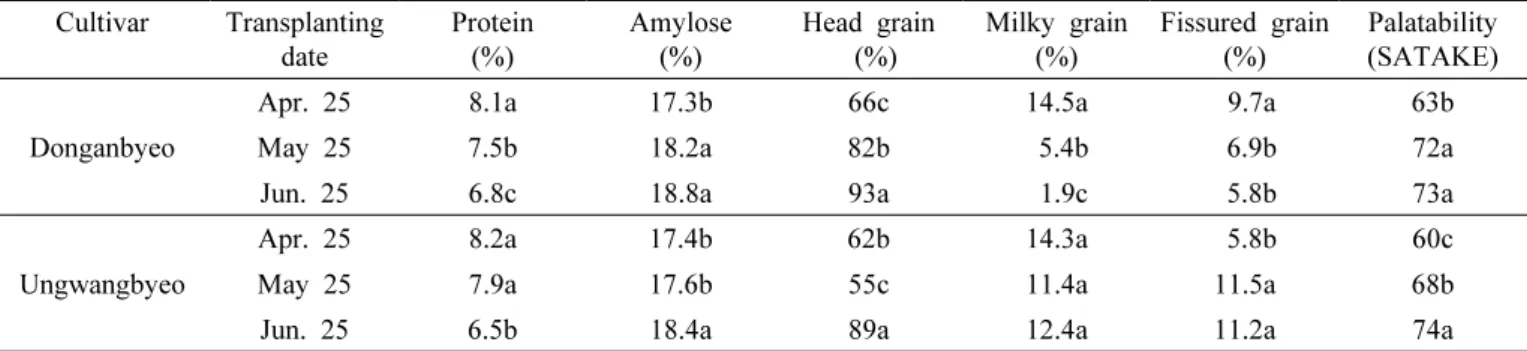
Table 3 represents the change of grain qualities and

palatability as affected by different transplanting date in two

rice cultivars. Amylose content is well known to be influenced

by ripening temperature. Determined by an iodine colorimetric

method, amylose content in the Donganbyeo rice grains

transplanted on April 25th was 17.3%, which was lower than

the rice grains transplanted on May 25th and June 25th

(18.2%, 18.8%). In the Ungwangbyeo rice grains, amylose

content was gradually increased by delayed transplanting

date. Protein content in Donganbyeo rice endosperms

significantly decreased by delayed transplanting date, protein

content in Ungwangbyeo showed similar results like a

Donganbyeo. The rate of head rice grain as one of the

commercial indices was significantly increased at late trans-

planting date resulting from lower air temperature during

grain ripening.

(4)

Table 3. Changes in grain qualities and palatability as affected by different transplanting dates in two rice cultivars.

Cultivar Transplanting date

Protein (%)

Amylose (%)

Head grain (%)

Milky grain (%)

Fissured grain (%)

Palatability (SATAKE)

Donganbyeo

Apr. 25 8.1a 17.3b 66c 14.5a 9.7a 63b

May 25 7.5b 18.2a 82b 5.4b 6.9b 72a

Jun. 25 6.8c 18.8a 93a 1.9c 5.8b 73a

Ungwangbyeo

Apr. 25 8.2a 17.4b 62b 14.3a 5.8b 60c

May 25 7.9a 17.6b 55c 11.4a 11.5a 68b

Jun. 25 6.5b 18.4a 89a 12.4a 11.2a 74a

Different letters within each column indicate significant differences (P < 0.05).

Table 4. Pasting properties of two rice flours obtained from rice transplanted on different dates, determined by a Rapid Visco Analyzer.

Cultivar Transplanting date

Pasting time (min.)

Pasting temp.

(°C)

Viscosity (cP)

PVa HPV CPV BD SB

Donganbyeo

Apr. 25 May 25 Jun. 25

4.07 3.93 4.14

86.2a 84.6b 87.0a

1,679 2,046 2,047

915 1,223 1,460

1,802 2,384 2,833

764 823 587

123 338 786

Ungwangbyeo

Apr. 25 May 25 Jun. 25

4.04 3.90 4.07

85.7a 84.0b 86.1a

2,369 2,388 2,583

1,528 1,482 1,747

2,509 2,518 3,058

841 907 837

140 130 475 Different letters within each column indicate significant differences ( P < 0.05).

a

PV: Peak viscosity, HPV: Hot peak viscosity, CPV: Cooling peak viscosity, BD: breakdown, SB: setback.

It is important to clarify the effects of high temperature on grain filling in rice and on the physiological processes affecting grain filling. High summer conditions have damaged both rice quality and production (Terashima et al., 2001). Several cultural practices are used to produce high-quality rice grains in southern area of Korea. Most farmers try to transplant the early matured rice cultivars or shorten transplanting time avoiding high temperature during grain ripening. Replacement of the sensitive cultivars by tolerant cultivars in the fields increases the rice production. It has been reported that high temperature at the milky stage of grain filling has the greatest influence on grain chalkiness (Tashiro and Wardlaw, 1989), and the panicle is the most sensitive organ to high temperature (Sato and Inaba, 1973; Morita et al., 2004).

High temperatures during ripening period lead to smaller grain size and deterioration of grain appearance quality such as chalky and fissured grains. Under high temperatures, increasing grain weight is accelerated in the early ripening period while duration of ripening period becomes shorter,

which results in smaller final grain size (Sato, K. Inaba, 1976).

It was reported that high temperatures above 26 ~ 27 during early ripening stages increase the occurrence of chalky and fissured grain in rice (Kondo et al., 2006; Nagata et al., 2004;

Terashima et al., 2001). Chalky grains are composed of various types such as white-backed, milky white, white-belly, and white-based grain having different opaque endosperm portion. Milky white grain seriously degrades the commercial value. Not only high temperature, but also other climatic conditions such as low radiation, typhoon and plant factors such as high spikelet number are important factors to cause milky-white grain. Grain chalkiness is suggested to be caused by disorder of starch accumulation processes based on the fact that opaque portions of chalky grain and amyloplast develo- pment is abnormal (Zakaria et al., 2002). Palatability value in two rice grains was similarly promoted by delayed trans- planting times.

Table 4 shows the pasting properties of two rice flours

obtained from different transplanting dates. Two transplanting

(5)

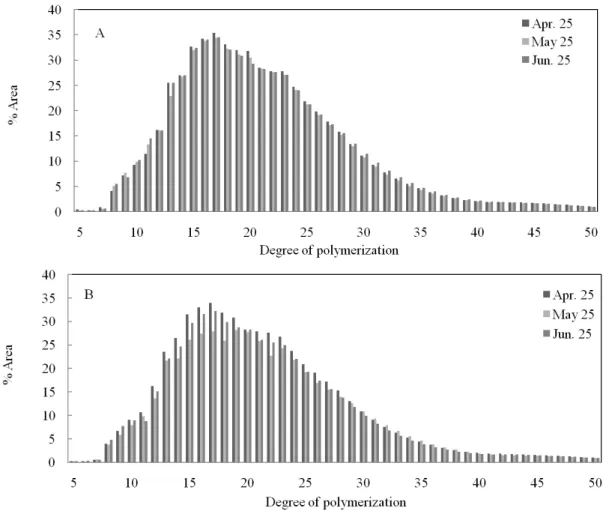
Fig. 1. Amylopectin branch-chain length distributions in rice starch as affected by different transplanting dates in translucent rice grains (A) and chalky rice grains (B) of Donganbyeo.

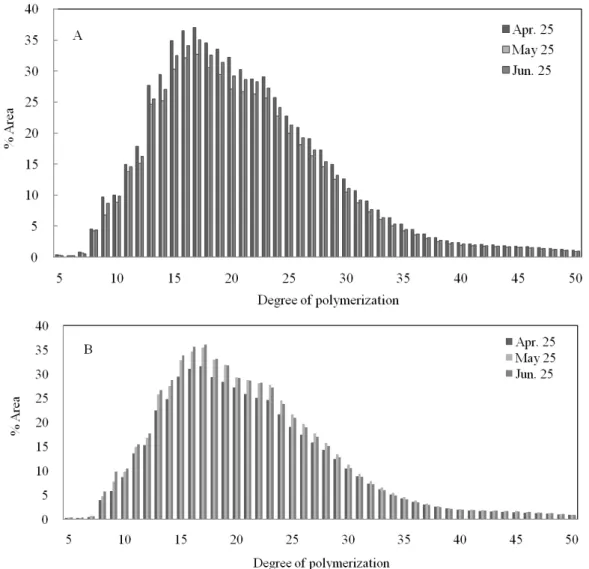
dates, April 25th and June 25th, showed commonly higher pasting temperature compared to that of May 25th in two rice cultivars. Peak viscosity (PV) was gradually increased with delayed transplanting dates. Above results, an elevated peak viscosity is seemed to be related to the relatively lower air mean temperature. Considering the grain yield together with quality, we suggest that, for the coordination of high yielding and quality, rice transplanting date should be least delayed in the Gyeongsangbuk-do area. Data from Fig. 1 and Fig. 2 show amylopectin branch chain-length distributions of rice starch and its difference as affected by different transplanting dates in translucent and chalky rice grains in two rice cultivars. In changes of amylopectin branch chain-length distribution, the amylopectin structure of translucent Dongan rice cultivar transplanted on April 25th was characterized by the significant decreased in A chains with DP >12 and decrease in long chains DP >= 37 compared to that of June 25th. Otherwise,

the amylopectin structure of chalky Dongan rice cultivars transplanted on April 25th showed more decreased in 13<DP<19 than that of June 25th. In Ungwang rice cultivar, the amylopectin structure of translucent Ungwang rice cultivars transplanted in April 25th and June 25th was characterized by the significant decreased in total amylopectin chain lengths. Meanwhile, the amylopectin structure of chalky Ungwang rice cultivars transplanted on April 25th was characterized by the significant increase in 7<DP<30, and significant decrease in that of June 25th. Finally, it showed that the high temperature seemed to increase the amount of long B chains and decrease that of short chains of amylopectin.

It suggested that amylopectin structure is altered by different transplanting times depending on character of rice cultivars.

There are known to be varietal differences in grain chalkiness among rice cultivars when ripened under a given temperature.

To elucidate the causative biochemical factors for the chalky

(6)

Fig. 2. Amylopectin branch-chain length distributions in rice starch as affected by different transplanting dates in translucent rice grains (A) and chalky rice grains (B) of Ungwangbyeo.

appearance of high temperature-ripened grains with regard to starch components, severely chalky grains and almost translucent grains, both of which were harvested from three different transplanted rice cultivars were compared for amylose content and amylopectin chain-length distribution. The chalky grains were shown to have amylopectin consisting of more elongated side chains than the translucent grains. Furthermore, the reduction of amylose content and amylopectin side chain elongation by high temperature was not correlated to the grain chalkiness, but rather correlated to grain weight reduction, suggesting that the difference in the extent of rice grain chalkiness between high temperature-tolerant and -sensitive rice cultivars might be attributed to neither the reduction of amylose content nor the change in amylopectin structure.

REFERENCES

Ashraf, A., A. Khalid, and K. Ali. 1999. Effect of seedling age and density on growth and yield of rice in saline soil, Pak. J.

Biol . Sci. 2, 860-862.

Fujita, N., A. Kubo, D.S. Suh, K.S. Wong, J.L. Jane, and K.

Ozawa. 2003. Antisense inhibition of isoamylase alters the structure of amylopectin and the physicochemical properties of starch in rice endosperm. Plant Cell Physiol. 44, 607-618.

Hassan, G., K.U. Khan, and Q.N. Khan. 2003. Effect of trans- planting date on the yield and yield components of different rice cultivars under high temperature of D.I. Khan. Sci. Khy.

16, 129-137.

Ito, S., W.F. Peterson, and W.R. Grant. 1989. Rice in Asia: is it

becoming an inferior good?. American J. Agric. Econo .71,

32-42.

(7)

Kasemsuwan, T., J. Jane, P. Schnable, P. Stinard, and D.

Robertson. 1995. Characterization of the dominant mutant amylose-extender(Ae1-5180) maize starch. Cereal Chem. 72, 457-464.

Kondo, M., S. Morita, K. Nagata, Y. Koyama, N. Ueno, J. Hosoi, Y. Ishida, T. Yamakawa, Y. Nakayama, Y. Yoshioka, Y.

Ohashi, M. Iwai, Y. Odaira, S. Nakatsu, Z. Katsuba, M.

Hajima, Y. Mori, H. Kimura, and M. Sakata. 2006. Effects of air temperature during ripening and grain protein contents on grain chalkiness in rice. Jpn. J. Crop Sci. 75, 14-15.

Morita, S., H. Shiratsuchi, J. Takanashi, and K. Fujita. 2004.

Effect of high temperature on grain ripening in rice plants:

analysis of the effects of high night and high day temperatures applied to the panicle and other parts of the plant. Jpn J Crop Sci. 73, 77-83

Nakamura, Y. 2002. Toward a better understanding of the metabolic system for amylopectin biosynthesis in plants: rice endosperm as a model tissue. Plant Cell Physiol. 43, 718-725.

Nagata, K., T. Takita, S. Yoshinaga, K. Terashima, and A.

Fukuda. 2004. Effect of air temperature during the early grain- filling stage on grain fissuring in rice. Jpn. J. Crop Sci. 73, 336-342.

Peng, S., J. Huang, J.E. Sheehy, R.C. Laza, R.M. Visperas, X.

Zhong, G.S. Centeno, G.S. Khush, and K.G. Cassman. 2004.

Rice yields decline with higher night temperature from global warming. Proc. Natl. Acad. Sci. 101, 9971-9975.

Safdar, B.M., A.I. Ullah, and H. Gul. 2006. Growth and yield of rice as affected by transplanting dates and seedlings per hill under high temperature of Dera Ismail Khan Pakistan, J.

Zhejiang Univ. Science B. 7, 572-579.

Sato, K. and K. Inaba. 1973. High temperature injury of ripening in rice plant. II. Ripening of rice grains when the panicle and straw were separately treated under different temperature.

Proc. Crop Sci. Soc. Japan 42 , 214-219.

Sato, K. and K. Inaba. 1976. High temperature injury of ripening in rice plant: V. On the early decline of assimilates storing ability of grains at high temperature. Proc. Crop Sci. Soc. Jpn.

45, 156-161.

Singh, V.P. 1994. Correlation studies in rice. Agric. Sci. Digest.

14, 185-188.

Tashiro, I.F. and A. Wardlaw. 1989, Comparison of the effect of high temperature on grain development in wheat and rice.

Annals of Botany 64, 59-65.

Terashima, K., Y. Sato, N. Sakai, T. Watanabe, T. Ogata, and S.

Akita. 2001. Effect of high air temperature in summer of 1999 on ripening and grain quality of rice. Jpn. J. Crop Sci. 70, 449-458.

Tetlow, I.J., M.K., Morell, and M.J. Emes. 2004. Recent developments in understanding the regulation of starch metabolism in higher plants, J. Expt. Bot. 55, 2131-2145.

Wang, Y.J. and L. Wang. 2000. Effects of modification sequence on structures and properties of hydroxyproylated and crosslinked waxy maize starch. Starch 52, 406-412.

Zakaria, S., T. Matsuda, S. Tajima, and Y. Nitta. 2002. Effect of high temperature at ripening stage on the reserve accumulation in seed in some rice cultivars. Plant Prod. Sci. 5, 160-168.

Zhang, G., Z. Cheng, X. Zhang, X. Guo, N. Su, and L. Jiang.

2011. Double repression of soluble starch synthase genes

SSIIa and SSIIIa in rice ( O. sativa L.) uncovers interactive

effects on physic-chemical properties of starch. Genome 54,

448-459.

수치

Table 2. Growth characteristics, yield component, and rice yield as affected by different transplanting dates in two rice cultivars.
Table 3. Changes in grain qualities and palatability as affected by different transplanting dates in two rice cultivars
Fig. 1. Amylopectin branch-chain length distributions in rice starch as affected by different transplanting dates in translucent  rice grains (A) and chalky rice grains (B) of Donganbyeo.
Fig. 2. Amylopectin branch-chain length distributions in rice starch as affected by different transplanting dates in translucent  rice grains (A) and chalky rice grains (B) of Ungwangbyeo.

참조

관련 문서

In this study, effects of the ultra-fine pulverization technique on the physicochemical properties of rice starch (RS) with broken particle structure were investigated using a

Changes in Paddy Soil Properties and Rice Yield as Affected by Application Time of Granular Livestock Manure Compost.. Do-Young Ko 1 , Byung-Koo Ahn 2 *, Hyung-Cheol Moon 1 ,

Regression analysis showed that maximum head rice yield was attained from the transplanting on May 18, for which the flowering date was July 21, and daily mean temperature for

Changes of pasting properties of two types of rice flour during different storage temperature.. SK: Samkwang, HG: Hangaru, RT: Room Temperature, LT:

Study of Molecular and Crystalline Structure and Physicochemical Properties of Rice Starch with Varying Amylose Content.. Su-Yeon You, Eun-Jung Lee, and