Changes in Physicochemical Properties of Rice Starch Processed by Ultra-Fine Pulverization
Myung-Ryun Han
1, Moon-Jeong Chang
2and Myung-Hwan Kim
1,*
1Department of Food Engineering, Dankook University, Cheonan 330-714, Korea
2Department of Food & Nutrition, Kookmin University, Seoul 136-702, Korea Received July 9, 2007; Accepted November 20, 2007
The effects of ultra-fine pulverization on the physicochemical properties of rice starch (RS) were investigated using a high impact planetary mill. After pulverization, RVA characteristics, peak viscosity, break down, and set back values of RS decreased from 274.75 to 9.42 RVU, 214.46 to 6.17 RVU, and 87.80 to 17.00 RVU, respectively. The pasting properties also changed significantly. X- Ray diffractogram revealed RS had four A-type peaks, which disappeared after pulverization. The peak temperature and gelatinization enthalpy of RS using differential scanning calorimetry (DSC) were 13.99 J/g at 75.14oC, whereas the pulverized RS (PRS) had two peaks, 0.13 J/g at 63.88oC and 1.23 J/g at 101.24oC. DSC measurement showed the retrogradation degree of PRS was lower than that of RS after storage at 4 and 25oC. The enzymatic (α-amylase) digestibilities of RS and PRS were 72.7 and 77.3%, respectively.
Key words: high impact planetary mill, physicochemical property, rice starch, ultra fine pulverization
Starches exhibit different properties in accordance with the sources and the genotypes. Starch properties mainly depend on the physical and the chemical characteristics, such as mean granular size, granule size distribution, amylose/amylopectin ratio, and mineral content [Madsen et al., 1996].The shapes and the sizes of the starch granules are characteristics of their botanical origins. Granules vary from perfectly spherical to polyhedral, round or oval [Buleon et al., 1998; Jane et al., 1994]. The relatively high molecular weight and the extensive network formed by the hydrogen bonds lead to high gelatinization temperature, and lower fluidity and chemical reactivity of the starch [Zu et al., 2007]. Preference of the market is leaning towards starches with less extensive crystalline regions, thereby improving the physicochemical properties and the reactivity of the starches for commercial applications. Therefore, there is a great interest in the development of methods to modify the structures of the crystalline regions [Fiedorowicz et al., 2001; Liang et al., 2004; Yang et al., 1999].
Several chemical methods are available for decreasing
the starch crystalline regularity such as acidolysis [Nakazawa et al., 2003], oxidation [Wang et al., 2003], and enzymatic degradation process [Zhang et al., 1999].
In the physical processes, heat-moisture treatment [Gunaratne et al., 2002], radio-active degradation [Bertolini et al., 2001], microwave degradation [Mewandowicz et al., 2000], ultrasonic degradation [Renata et al., 2005], and extrusive degradation processes [Cai et al., 1995]
were performed.
The ultra-fine pulverization techniques can be used to modify the crystalline structure and the physicochemical properties of the starch granules by friction, collision, impingement, shear or other mechanical actions. Mechanical damages to the starch granules caused by ball milling induce a progressive loss of crystalline order and the conversion of the large-ordered regions into essentially disordered amorphous materials that are freely accessible to the external agents including such solvent as water and amylolytic enzymes [Morrison and Tester, 1994]. One of the ultra-fine pulverization techniques is the high impact planetary mill, in which the rotating grinding bowls are mounted eccentrically on a rotating support disc. The balls strike the inner wall of the bowl vertically (impact energy), approach each other tangentially (friction) or just roll down the inner wall of the bowl (centrifugal mills).
The properties of the grinding can be influenced by the initial amount of materials, the initial particle size
*Corresponding author
Phone: 82-41-550-3563; Fax: 82-41-550-3566 E-mail: [email protected]
Abbreviations: PRS, pulverized rice starch; RS, rice starch;
RVA, rapid visco analyzer; RVU, rapid visco unit
distribution, the milling time, and the milling parameters such as rpm [Martinez et al., 2007].
In this study, effects of the ultra-fine pulverization technique on the physicochemical properties of rice starch (RS) with broken particle structure were investigated using a high impact planetary mill.
Materials and Methods
Sample preparation. Rice (Oryza sativa L. Seohaejinmi), the first crop of 2005 from Dangjin, was purchased at a local market in Cheonan, Korea. For RS isolation, the rice was soaked in the deionized water for 8 h and ground for 3 min in two volumes of 0.2% (w/v) NaOH solution using a blender. The rice suspension was passed through a 100-mesh sieve and allowed to stand at 4oC for 24 h, and the supernatant was removed. This process was repeated until the proteins were completely removed. The resulting sediment was washed with the deionized water until neutral pH was achieved. The isolated starch was dried to a 5% moisture content (wet basis) using a vacuum-freeze drier (Alpha 1-4, Christ, Germany). High impact planetary mill (Pulverisette 6, Fritsch Co., Germany) was used for pulverization of the isolated rice starch. Ten grams each of the isolated rice starch were put into the jars containing 250 g each of 11- and 5-mm zirconium oxide beads. The operation conditions were 300 rpm for 30 min. The mean diameter, specific surface area, and damaged starch content decreased from 15.35 to 11.88µm, increased from 19,471 to 24,233 cm2/g, and increased from 16.4 to 99.2%, respectively, after the pulverization of rice starch using a high-impact planetary mill.
X-ray diffractometry. The samples were analyzed using an X-ray diffractometer under the following conditions: voltage, 30 kV; current, 30 mA; θ-2θ method using Cu tube; rate, 4.0 deg/min.
Gelatinization and retrogradation. Thermal analysis of the sample was performed using a differential scanning calorimeter (DSC 2010, TA instrument, Twin Lakes, WI).
The sample (3 mg, dry weight basis) was weighed and put into a 40µL aluminum hermetic pan. Subsequently, 8µL deionized water was directly added into the pan.
The pan was sealed and left standing for 24 h to allow the sample to mix and equilibrate. The sample was then heated from 30 to 120oC at a heating rate of 10oC/min. An empty pan was used as a reference. Onset temperature (Ti), peak temperature (Tp) and endothermic enthalpy of gelatinization (∆E) were recorded. The first heated sample in the sealed pan was stored 4~8 days at 4 and 25oC, and the second heating was performed after storage for the measurement of the relative retrogradation degree.
Pasting property. A rapid visco analyzer (RVA-3D,
Newport Scientific Ltd., Warriewood, Australia) was employed to determine the pasting properties of the samples. The sample (3.0 g, dry weight basis) and 25 mL distilled water were combined and stirred in the aluminum RVA sample canister. A programmed heating and cooling cycle was used, where the sample was held at 50oC for 1 min, heated to 95oC in 3 min 30 s, held at 95oC for 2 min 30 s, and cooled to 50oC in 3 min 50 s. The parameters such as peak, hold, and final viscosities, peak time, and pasting temperature were determined.
Digestibility with α-amylase. Enzymatic digestibility with α-amylase was performed using the method described by Liu et al. [1999]. Approximately 1 g of the sample was added to 30 mL phosphate buffer (0.2 M, pH 6.9) in the test tube and allowed to stand for 30 min in a 95oC water bath. After cooling to 25oC, α-amylase (320 units, Sigma, MO) was added and incubated with shaking at 30oC for up to 14 h. After digestion, the digested sample was removed by centrifugation, and the undigested sample was analyzed using the gravimetric method.
Results and Discussion
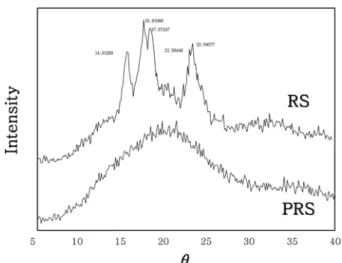
X-Ray diffractograms. The spectrum of rice starch shows definite diffraction peaks that presumably reflect the crystalline region in the starch (Fig. 1). The characteristic diffraction peaks at 14.0, 16.9, 17.6 and 22.9o revealed that the structure of RS is A type pattern. This type of crystallinity is most susceptible to the enzymatic hydrolysis [Martinez et al., 2007]. The peak diffraction of the pulverized rice starch (PRS) disappeared completely, implying that it has been converted largely into the non- crystalline state, and the diffraction spectrum showed a broad featureless peak that is a typical spectrum of the amorphism.
Fig. 1. X-Ray diffractograms of rice starch (RS) and pulverized rice starch (PRS).
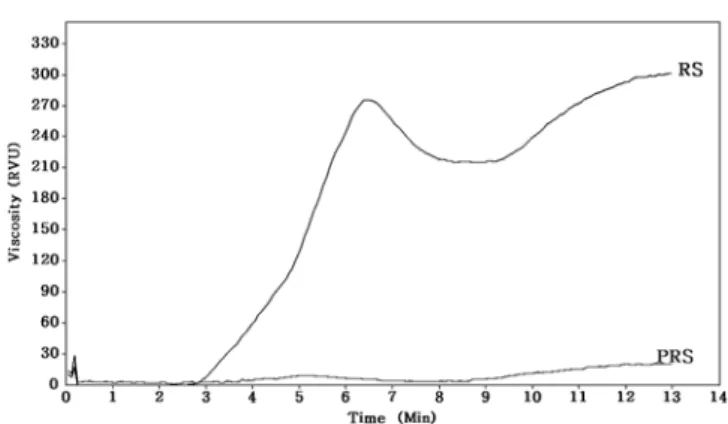
Pasting property. RVA characteristics of RS and PRS are given in Fig. 2 and Table 1. The peak viscosity value of RS decreased from 274.75 to 9.42 RVU after pulverization. The peak viscosity is a measure of the water-holding capacity of the starch in terms of the resistance of the swollen granules to shear and the swelling performance of the granules [Dengate, 1984].
The higher peak viscosity of RS than that of PRS may be due to the presence of granules with a broad size distribution range, leading to the different swelling patterns in RS [Lovedeep et al., 2007]. Break down value of RS, the difference in the peak and final viscosities, decreased from 214.46 to 6.17 RVU after pulverization.
During the break down, the swollen granules are disrupted, and the amylose molecules generally leach out into the solution [Whistler and BeMiller, 1997]. The set back value of RS also decreased from 87.80 to 17.00 RVU after pulverization. The set back is the viscosity increase resulting from the rearrangement of the amylose molecules that leached from the swollen starch during cooling, and is generally used as a measure of the gelling ability or retrogradation tendency of the starch [Karim et
al., 2000]. The other pasting properties also significantly changed (Table 1), showing a linear pattern (Fig. 2), an indication that the granule structure of RS was changed by pulverization. RS can be used by the food processing industry as a functional material for the preparation of foods for infants, pregnant women, patients, and elderly people.
Gelatinization and retrogradation. The DSC curves of RS and PRS are shown in Fig. 3. The peak temperature (Tp) and gelatinization enthalpy (∆E) of RS was 75.14 and 13.99 J/g, respectively (Table 2), whereas PRS had two endothermic peaks around 63.88 and 101.24oC with 0.13 and 1.23 J/g, respectively. The endotherm peak 1 appeared to reflect the transformation from granule into the gelatinized state upon heating of PRS. Peak 2 reflected the rearrangement of amylose molecules in the PRS and destruction of the crystalline structure between water and starch [Zhang et al., 2001]. The onset temperature (Ti), peak temperature (Tp), and gelatinization enthalpy Fig. 2. RVA profile changes of rice starch (RS) and pul-
verized rice starch (PRS).
Fig. 3. Differential scanning calorimetry thermograms of rice starch (RS) and pulverized rice starch (PRS) at differ- ent storage temperatures and storage days. Upper left, rice starch at 4oC storage; upper right, rice starch at 25oC stor- age; bottom left, pulverized rice starch at 4oC storage; bottom right, pulverized rice starch at 25oC storage.
(∆E) of PRS decreased as compared to those of RS, indicating that the RS crystalline structure was damaged by pulverization (Table 2) [Zu et al., 2007; Martinez et
al., 2007].
The first heated sample in the sealed pan was stored for 4~8 days at 4oC and 25oC, and the second heating was performed for the relative retrogradation analysis during storage. The results showed that the retrogradation degree value of PRS was lower than that of RS during storage.
The appearances of 10% (v/w) rice starch solutions stored for 6 days at 4oC, before and after pulverization, are shown in Fig. 4. RS showed sticky paste gel status, whereas PRS had non-sticky sol status, which indicates that the rheology of RS changed completely after pulverization.
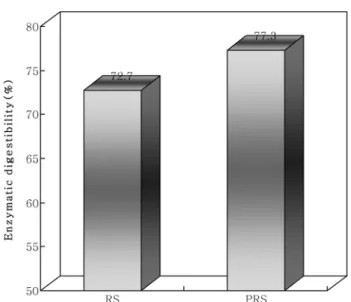
Digestibility with α-amylase. The in vitro starch digestibilities of RS and PRS by α-amylase are shown in Fig. 5. The starch digestibility differences could be attributed to the interplay of such factors as the starch source, granule size, amylose/amylopectin ratio, extent of molecular association among the starch components, degree of crystallinity and amylose chain length [Tester et
al., 2004]. RS (72.7%) had lower digestibility value than PRS (77.3%). After pulverization of rice starch, most of Table 1. Pasting characteristics of rice starch and pulverized rice starch
Peak Visc.
(RVUa) Hold Visc.
(RVU) Break downb
(RVU) Final Visc.
(RVU) Set Backc
(RVU) Peak time
(min) Pasting temp. (oC)
RS 274.75 214.46 60.30 302.25 87.80 6.50 78.15
PRS 9.42 3.25 6.17 20.25 17.00 5.20 Err
aRVU = Rapid Viscosity Unit
bBreak down = Peak viscosity − Hold viscosity
cSetback = Final viscosity − Hold viscosity RS: rice starch
PRS: ultra fine pulverized rice starch
Fig. 4. Appearances of 10% (v/w) gels of rice starch (RS) and pulverized rice starch (PRS) stored at 4oC for 6 days. Left, PRS; Right, RS.
Table 2. Differential scanning calorimetry of rice starch and pulverized rice starch Storage time
(days) Peak Peak
Ti (oC)a Tp (oC)b ∆E (J/g)c Ti (oC) Tp (oC) ∆E (J/g) RS
0 68.95 75.14 13.99 - - -
4oC 4 - - - 88.40 96.86 2.46
8 - - - 90.55 96.83 1.83
25oC 4 58.20 61.24 0.19 90.27 97.76 1.50
8 57.61 60.79 0.22 88.31 97.09 3.55
PRS
0 59.00 63.88 0.13 92.85 101.24 1.23
4oC 4 - - - 85.73 92.02 0.37
8 - - - 83.55 98.06 2.08
25oC 4 56.83 61.93 0.63 88.03 96.21 1.10
8 56.72 62.58 1.57 94.74 101.79 0.82
aTi = onset temperature
bTp = peak temperature
c∆E = endothermic enthalpy of gelatinization RS: rice starch
PRS: pulverized rice starch
the crystalline state is changed into the non-crystalline state, reduced mean granule particle size, and increased granule specific surface area, which makes RS susceptible to the enzymatic hydrolysis [Lovedeep et al., 2007].
Acknowledgments. This work was supported by the Korea Research Foundation Grant funded by the Korean Government (R05-2004-000-10390-0).
References
Bertolini AC, Mestres C, Colonna P and Raffi J (2001) Free radical formation in UV- and gamma-irradiated cassava starch. Carbohyd Polym 44, 269-271.
Buleon A, Colonna P, Planchot V and Ball S (1998) Starch granules: Structure and biosynthesis. Int J Bio Macro- mol23, 85-112.
Cai W, Diosady LL and Rubin LJ (1995) Degradation of wheat starch in a twin-screw extruder. J Food Eng 26, 289-300.
Dengate HN (1984) Swelling, pasting and gelling of wheat starch. In Y. Pomeranz (ed.), Advances in cereal science and technology (pp. 49-82) USA: American Association of Cereal Chemists.
Fiedorowicz M, Tomasik P and Lii CY (2001) Degradation of starch by polarised light. Carbohyd Polym 45, 79-87.
Gunaratne A and Hoover R (2002) Effect of heat-moisture treatment on the structure and physicochemical proper- ties of tuber and root starches. Carbohyd Polym49, 425- Jane JL, Kasemsuwan T, Leas S, Ia A, Zobel H, and Il D437.
(1994) Anthology of starch granule morphology by scan- ning electron microscopy. Starch 46, 121-129.
Karim AA, Norziah MH and Seow CC (2000) Methods for
the study of starch retrogradation. Food Chem71, 9-36.
Lewandowicz G, Jankowski T and Fornal J (2000) Effect of microwave radiation on physico-chemical properties and structure of cereal starches. Carbohyd Polym 42, 193- Liang Y, Zhang BS, Yang LS and Gao DW (2004) Chemi-199.
cal reaction activity of tapioca starch with non-crystal- lized granule state. J Zhengzhou Inst Technol 25, 9-13.
Liu H, Ramsden L and Corke H (1999) Physical properties and enzymatic digestibility of hydroxypropylated ae, wx, and normal maize starch. Carbohyd Polym40, 175-182.
Lovedeep K, Jaspreet S, Owen JM and Harmit S (2007) Physico-chemical, rheological and structural properties of fractionated potato starches. J Food Eng 82, 383-394.
Madsen MH and Christensen DH (1996) Changes in viscos- ity properties of potato starch during growth. Starch 48, 245-249.
Martinez BF, Lopez SM, San MME, Zazueta MJJ and Velez MJJ (2007) Effects of high energy milling on some functional properties of jicama starch (Pachyrrhizus ero- sus L. Urban) and cassava starch (Manihot esculenta Crantz). J Food Eng78, 1212-1220.
Morrison WR and Tester RF (1994) Properties of damage starch granules. IV. Composition of ball-milled wheat starches and of fractions obtained on hydration. J Cereal Sci20, 69-77.
Nakazawa Y and Wang YJ (2003) Acid hydrolysis of native and annealed starches and branch-structure of their Nae- geli dextrins. Carbohyd Res 338, 2871-2882.
Renata CB, Bozena R, Salah L, Piotr U and Janusz MR (2005) Degradation of chitosan and starch by 360-kHz ultrasound. Carbohyd Polym 60, 175-184.
Tester RF, Karkalas J and Qi K (2004) Starch structure and digestibility enzyme-substrate relationship. World Poul- try Sci J60, 186-195.
Wang YJ and Wang LF (2003) Physicochemical properties of common and waxy corn starches oxidized by differ- ent levels of sodium hypochlorite. Carbohyd Polym 52, 207-217.
Whistler RL and BeMiller JN (1997) Carbohydrate chemis- try for food scientists. St. Paul, MN: American Associa- tion of Cereal Chemists.
Yang HG, Zhang H, Gu HC and Fang TN (1999) Study on the thixotropy simulation of shear-thinning suspensions.
J Chem Eng Chinese Univ 13, 506-510.
Zhang BS, Xu LH, Yang LS and Gao DW (2001) Study on the melting characters of starch crystal. J Zhengzhou Inst Technol 22, 15-18.
Zhang T and Oates CG (1999) Relationship between α- amylase degradation and physico-chemical properties of sweet potato starches. Food Chem 65, 157-163.
Zu QH, Jian PL, Xuan HL and Zhang FT (2007) Effect of mechanical activation on physico-chemical properties and structure of cassava starch. Carbohyd Polym 68, 128-135.
Fig. 5. Enzyme digestibility of rice starch (RS) and pul- verized rice starch (PRS).