Original article http://dx.doi.org/10.14478/ace.2014.1100
1. 서 론
1)
금-이산화지르코늄 복합물질은 수소생산, 촉매제조, 그리고 태양광 전지 등의 여러 가지 분야들에 응용될 수 있는 가능성을 가지고 있다 [1-6]. 이 물질은 빛에 의하여 태양에너지 전환에 중요한 전자전송과 정을 유도하는 여기상태로 전환되는데, 이 과정에서 물질의 활성도와 선택도는 구성물들의 분포에 따라 달라진다[7,8]. 금-금속산화 복합물 질의 제조를 위하여, 증착 및 석출 그리고 금속이온 주입 및 소성의
† Corresponding Author: Department of Chemical and Biomolecular Engineering, College of Energy and Biotechnology Seoul National University of Science and Technology, 232 Gongreung-ro, Nowon-gu, Seoul 139-743, Korea
Tel: +82-2-970-6605 e-mail: [email protected]
pISSN: 1225-0112 eISSN: 2288-4505 @ 2014 The Korean Society of Industrial and Engineering Chemistry. All rights reserved.
방법들이 이용되었다[9-11]. 이 방법들에 의해 이산화지르코늄표면에 금 입자의 직접 증착이 가능하나, 몇 가지 문제점들을 야기한다. 그 문제점들은 전구체의 불균일성에 기인한 생성물의 다분산성, 열처리 로 발생되는 불균일한 뭉침, 그리고 이온성 확산으로 나타나는 화학 적 변화이다[8]. 이에 따라, 금-이산화지르코늄 복합물질의 제조를 위 한 대안이 모색되었고, 그 결과로 제시된 대안은 용액에서 용액상에 서 균일한 크기의 금 나노입자들을 제조하고 이 나노입자들을 이산화 지르코늄 표면에 증착하는 것이다[12-14]. 이 방법은 포스핀과 싸이올 과 같은 피복리간드의 활용을 전제로 한 것이며, 피복리간드들은 나 노입자들이 표면에 응집없이 흡착된 후에 하소로 제거된다[15-17].
AFM의 등장은 표면의 물리적 특성 규명에 새로운 전환점이 되었 다. 그중에 하나로서 AFM을 이용하여 콜로이드 입자와 평평한 표면 사이에 작용하는 힘을 거리에 따라 직접적으로 측정하는 것이 가능하 게 되었다[18]. 이 측정된 힘을 Derjaguin-Landau-Verwey-Overbeek
금 표면 위의 메르캡토언데카노익산층 표면과 이산화지르코늄 표면 사이의 정전기적 상호작용
박진원
서울과학기술대학교 에너지바이오대학 화공생명공학과 (2014년 9월 3일 접수, 2014년 9월 25일 심사, 2014년 9월 30일 채택)
Electrostatic Interaction between Mercaptoundecanoic-acid Layers on Gold and ZrO
2Surfaces
Jin-Won Park
Department of Chemical and Biomolecular Engineering, College of Energy and Biotechnology Seoul National University of Science and Technology, 232 Gongreung-ro, Nowon-gu, Seoul 139-743, Korea
(Received September 3, 2014; Revised September 25, 2014; Accepted September 30, 2014)
이산화지르코늄 표면에 흡착되는 금 입자의 분포 또는 그 반대 경우의 분포에 영향을 끼칠 수도 있는 정전기적 상호 작용과 금 입자를 코팅한 mercaptoundecanoic acid층의 표면물성을 규명하였다. 이를 위하여, 원자힘현미경(AFM)으로 mercaptoundecanoic acid층 표면과 이산화지르코늄표면 사이의 표면힘을 염 농도와 pH 값에 따라 측정하였다. 측정된 힘은 Derjaguin-Landau-Verwey-overbeek (DLVO) 이론에 의해 표면의 정량적인 전하밀도와 포텐셜 값들로 전환되었다.
이 값들이 염 농도와 pH에 따라 달라지는 특성을 질량보존의 법칙으로 기술하였으며, 산출된 표면 특성의 염 농도 의존성은 이론적으로 예측했던 결과와 일치하는 것으로 확인되었다. Mercaptoundecanoic acid층의 표면이 이산화지르 코늄 표면보다 높은 전하밀도와 포텐셜을 갖는 것이 발견되었는데, 이는 mercaptoundecanoic acid층의 이온화 기능기에 기인한 것으로 생각된다.
Abstract
The physical properties of mercaptoundecanoic-acid layer formed on gold surfaces, which may affect the distribution of either gold particles adsorbed to the zirconium dioxide surface or vice versa, were investigated. To conduct this investigation, the surface forces were measured between the surfaces with respect to the salt concentration and pH value using atomic force microscope (AFM). The forces were quantitatively converted by the Derjaguin-Landau-Verwey-Overbeek (DLVO) theory to the surface potential and charge density of surfaces. The converted-value dependence on the salt concentration and pH was described with the law of mass action, and the dependence was consistent with the theoretical prediction. It was found that the mercaptoundecanoic-acid layer had higher values for the surface charge densities and potentials than the ZrO2 surfaces, which may be attributed to the ionized-functional-groups of the mercaptoundecanoic-acid layer.
Keywords: Mercaptoundecanoic-acid, Gold surface, Zirconium dioxide surface, AFM, DLVO theory
(DLVO) 이론으로 정전기적 표면특성치들로 변환할 수 있다[19]. 이 특성치들은 입자들 사이에 존재하는 정전기적 작용의 지표이며, 금-이 산화지르코늄 복합물질의 활성도와 선택도를 좌우하는 입자분포에 영 향을 끼칠 수 있다. 본 연구에서는 Mercaptoundecanoic-acid층을 입자 의 균일한 분포를 위한 피복리간드로 고려하고자 한다. 즉, 이산화지르 코늄과 상호작용하는 금의 표면에 형성된 Mercaptoundecanoic-acid층 의 전하밀도와 포텐셜을 정량적으로 규명하고자 한다.
2. 실 험
금 표면은 고진공 전자 빔 증발기를 이용하여 실리콘 기판에 5 nm 크롬 층과 100 nm 금 층을 순차적으로 증착하여 제조되었다. 금 표면은 사용하기 바로 전에 96% 황산과 30% 과산화수소의 4 : 1용액으로 5 min 동안 대략 70 ℃에서 세척되었다. 금 표면에 Mercaptoundecanoic-acid층 은 금 표면을 상온에서 10 mM Mercaptoundecanoic-acid 용액(100 mM 질산칼륨, pH 4) 속에 3∼4 h 동안 넣어두는 것으로 형성된다. 용액 속 에서 꺼낸 후에, 충분한 양의 버퍼용액으로 금 표면을 씻는다.
Mercaptoundecanoic-acid층 형성은 pH 8의 100 mM 질산칼륨 용액 조 건에서 정성적인 표면힘 측정으로 확인되었다. 정량적인 표면힘의 측 정을 위하여, 용액은 목적 버퍼 용액으로 대체되었다(본 실험에서는 6개의 목적 버퍼 용액들이 있다. -pH 4와 8에서 각각 100, 10, 그리고 1 mM 질산칼륨 용액). 이산화지르코늄 표면은 실리콘기판 위에 RF전 자관 스퍼터링을 2 kW에서 41 min간 아르곤-산소 환경에서 지르코늄 을 증착하여 제조되었으며, 스퍼터링 바로 전에 불산을 이용하여 실 리콘기판의 산화층을 제거하였다. 증착조건은 압력이 5 × 10⁻⁶ bar이 고, 아르곤과 산소의 유속은 각각 6 및 1.2 dm3/min이었다. 기판과 지 르코늄소스의 거리는 7 cm이며 지르코늄소스의 직경은 20 cm이다.
이산화지르코늄 표면의 형상은 금 표면과 동일했다.
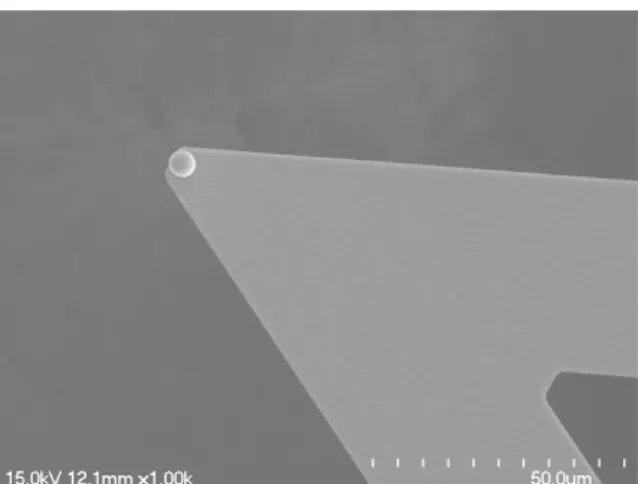
형상의 시각화와 표면힘의 측정은 되먹임으로 제어되는 압전소자 의 3-D Molecular Force Probe AFM (Asylum Research, Santa Barbara, CA)으로 수행되었다. 곡률반경이 20 nm인 미세제조된 질화실리콘 외 팔보(Olympus, Shinjuku-ku, Tokyo, Japan)가 시각화와 정성적인 표면 힘 측정에 이용되었으며, 정량적인 표면힘 측정은 3 µm 직경의 이산 화지르코늄 구(Microspheres-Nanospheres, Cold Spring, NY)가 부착된 외팔보로 수행되었다(Figure 1). 이산화지르코늄 구는 UV-경화 접착 제(Norland Products, New Brunswick, NJ)를 이용하여 외팔보 끝의 중 앙에 부착되었다. UV 오존세척기(Jelight, Irvine, CA) 안에서 1 min간
자외선에 노출됨으로써 접착제가 경화되었다. UV 노출은 외팔보의 움직임에 변화를 일으키지 않는 것으로 관찰되었다. 외팔보의 탄성계 수는 외팔보의 열진동수 스펙트럼으로부터 0.02 N/m인 것으로 확인 되었다[20].
3. 이 론
정전기적 이중층의 상호작용을 기술한 DLVO 이론에 의해, 표면힘 들이 이론적으로 해석된 여러 사례들이 있다[21]. 두 개의 편평한 판 들 사이의 상호작용은 van der Waals 에너지(VA), 정전기 에너지(VE), 그리고 지근 거리에 존재하는 척력 에너지(VS)에 의한 것이라고 이론 적으로 설명된다[22-25]. Derjaguin 근사를 통해 반지름이 RT인 구와 편평한 표면 사이의 힘(F)은 두 편평한 표면들 사이의 단위 면적당 에 너지로 변환된다[26].
(1)
Van der Waals 에너지(VA)는 방해되지 않는 조건에서 두 편평한 판 사이의 거리(d)와 아래의 관계를 갖는다[27].
(2)
AH는 Hamaker상수이며, 구성물의 대부분이 탄화수소인 Mercaptoundecanoic-acid층은 7.0 × 10⁻²⁰ J로 계산되었고, 이산화지르 코늄은 5.0 × 10⁻²⁰ J이다[28,29]. VE는 표면에 형성되는 전하이중충의 자유에너지를 바탕으로 전개될 수 있다[30-32]. 1 : 1 전해질에 대하여 정전기 에너지는
d
E ds
ds d kT
kT ze n V
2 0
1 2 cosh
2
(3)
여기에서 ψ는 정전기적 포텐셜, n0는 염 농도, k는 볼츠만상수, z는 이온가, e는 전자의 전하량, T는 온도, ε은 유전상수, 그리고 s는 거리 에 대한 적분변수이다. 위의 (3)식을 이용하여 VE를 계산하려면, 거리 에 따른 ψ을 필요로 한다. 이는 아래의 Poisson-Boltzmann식의 해로 부터 구할 수 있다.
i
i i
i
r kT
e e z
z dz n
d
1 0 exp
0 2 2
(4)
ε0은 진공의 유전상수이고 εr은 상대적인 유전율이다.
식(4)와 같은 비선형식의 해는 수치해석기법으로 구하며, 식(3)의 적분은 심슨의 3/8법칙으로 수행된다[33]. 식(1)에서의 VS는 정렬된 용 매 분자들의 존재에 기인하는 것으로서, 표면의 지근거리에서 멀어질 수록 급격하게 진동적으로 감소한다고 알려져 있다[34]. 그러나, 본 연구에서 산출하려는 입자분포제어 지표의 산출은 2∼3 nm 이상의 영역이 고려되므로, VS는 계산에 포함되지 않았다.
Figure 1. Cantilever to which a zirconium dioxide sphere is attached.
4. 결과 및 고찰
금 표면 위에 형성된 Mercaptoundecanoic-acid층의 표면구조가 AFM을 이용하여 파악되었다. 되먹임 작용으로 외팔보에 가해지는 힘 이 일정하도록 유지된 조건에서 금표면, Mercaptoundecanoic-acid층의 표면, 그리고 이산화지르코늄 표면이 시각화되었다. 이 세 표면들의 형상은 다결정구조이며, 거친 정도는 1.5 nm로 동일하게 나타났다.
즉, 이 세 가지 표면들의 형상은 본질적으로 구분이 되지 않았다 (Figure 2). 표면의 형상에서 특정 영역이 존재하면, 인지질층의 표면 에서와 같이 AFM에 의해 초미세크기의 범위에서 그 영역이 관찰된 다[35]. 금표면 위에 형성된 Mercaptoundecanoic-acid층의 표면에서 특정 영역이 관찰되지 않았으므로, 이 층이 균일함을 알 수 있다.
Mercaptoundecanoic-acid층의 형성은 20 nm 곡률반경의 외팔보로 금 표면과 금표면 위에 형성된 Mercaptoundecanoic-acid층 표면에서 측정된 표면힘의 차이를 비교하여 확인할 수 있다(Figure 3). Mercaptoundecanoic- acid층에서 측정된 표면힘은 표면과 2.0 nm 떨어진 지점으로부터 대 략 0.2 nN의 척력이 특징적으로 존재하고 있다. 그와 반면에, 금표면 에서 측정된 힘은 순수하게 인력인 것으로 확인되었다. 금표면에서 관찰되지 않았던 짧은 거리의 척력은 이온화 그룹이 더 많은 Mercaptoundecanoic-acid층 표면에서 더 많은 수화의 존재가 원인인 것으로 판단된다[28]. 표면힘의 명확한 차이는 Mercaptoundecanoic- acid층의 형성을 나타내고 있다.
Mercaptoundecanoic-acid층 표면의 전하밀도와 포텐셜에 대한 정량
적인 해석은 이산화지르코늄 표면과 함께 존재하는 비대칭적인 두 표 면의 경계조건이 Poisson-Boltzmann식에 적용되므로, 이산화지르코늄 표면에 대한 정보를 구하는 것이 선행되어야 한다. 따라서, 3 µm 직경 의 이산화지르코늄 구와 편평한 이산화지르코늄 사이에 표면힘을 측 정하고 해석하여 이산화지르코늄 표면에 대한 전하밀도와 포텐셜을 먼저 산출한다. Figure 4에 pH 8에서의 표면힘 측정결과가 제시된 바 와 같이, 원거리 영역 표면힘은 용액의 이온농도 의존성의 척력이다.
척력의 거리에 대한 지수함수 의존성은 수용액에서 전하성 표면들 사 이에 존재하는 이중층 힘의 경향과 일치하며, 2 nm보다 작은 거리에 서 명확하게 관찰되는 근거리 척력은 표면의 입체척력과 표면 고유의 거친 형상에 의해 나타나는 것으로 판단된다[36,37].
그러나, pH 4에서 원거리 척력은 pH 8와는 대폭 감소한 것으로 나 타나고 있다. Figure 5에서 보이는 것처럼, 1 mM 질산칼륨 pH 4 용액 에서 존재하는 원거리 척력이 pH 8에서보다 매우 작았으며 질산칼륨 농도의 증가와 함께 원거리 척력은 관찰되지 않았다. pH 4의 10과 100 mM의 질산칼륨 용액에서는, 원거리 영역의 정전기적 힘은 열적 유동에 의해 나타나는 외팔보의 거동에서 구별될 만큼 나타나지 않았 다. 이러한 결과들은 아마도 이산화지르코늄의 등전점에 기인한 것으 로 판단된다. pH 4의 10과 100 mM 질산칼륨 용액에서는 원거리 영역 의 힘이 미미하였으므로, 표면힘에 대한 DLVO이론의 적용이 수행되 지 않았다.
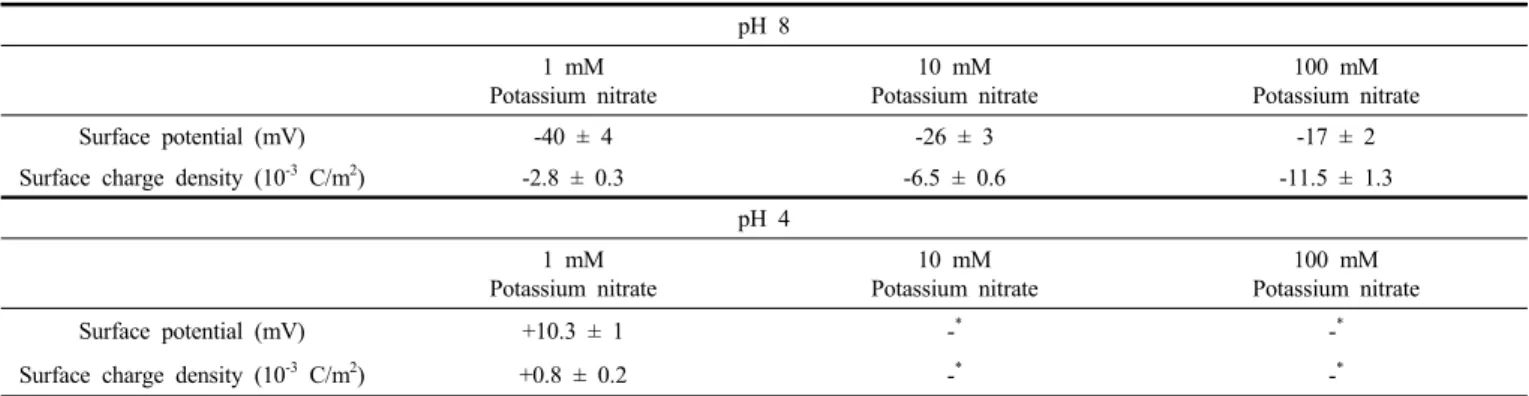
DLVO이론의 적용에 따른 결과는 Table 1에 요약되어 있다. pH 8
(A) (B) (C) (B)
Figure 2. Morphology of surfaces, (A) gold, (B) Mercaptoundecanoic-acid-coated gold, and (C) zirconium dioxide.
Figure 3. Force-distance curve between a Si3N4 cantilever and the mercaptoundecanoic-acid layer formed on the gold surface in 100 mM potassium nitride at pH 8.
Figure 4. Approaching force curve as a function of the separation between the sphere and the surface of the zirconium dioxide in 1, 10, 100 mM potassium nitride at pH 8; , , for surface potential, and , , for surface charge density.
에서 산출된 이산화지르코늄 표면포텐셜은 -10∼100 mV로서 예전에 발표되었던 연구결과와 일치하며, pH 4에서 표기된 양의 값은 pH 5.5 의 등전점에서 기인한다[38,39]. pH 8에서 확인된 이온농도와 표면특 성치의 관계는 Pashley가 질량보존의 법칙을 바탕으로 제안한 모형으 로 설명될 수 있다[40]. 이온농도의 감소에 따라, 포텐셜은 단조롭게 증가하고 표면전하밀도는 단조롭게 감소한다 [38]. 이 관계의 식은 아 래와 같이 제시된다.
kT
K e kT K
H e
Ka o K o
o
exp exp
1
1
(5)
K H
kT kT e o
o r
8 sinh
(6) pH 8
1 mM Potassium nitrate
10 mM Potassium nitrate
100 mM Potassium nitrate
Surface potential (mV) -40 ± 4 -26 ± 3 -17 ± 2
Surface charge density (10-3 C/m2) -2.8 ± 0.3 -6.5 ± 0.6 -11.5 ± 1.3
pH 4 1 mM
Potassium nitrate
10 mM Potassium nitrate
100 mM Potassium nitrate
Surface potential (mV) +10.3 ± 1 -* -*
Surface charge density (10-3 C/m2) +0.8 ± 0.2 -* -*
* Electrostatic property was not acquired.
Table 1. Electrostatic Properties of the Zirconium Dioxide Surfaces
pH 8 1 mM
Potassium nitrate
10 mM Potassium nitrate
100 mM Potassium nitrate
Surface potential (mV) -85 ± 5 -52 ± 5 -33 ± 3
Surface charge density (10-3 C/m2) -14 ± 2 -24 ± 3 -47 ± 5
pH 4 1 mM
Potassium nitrate
10 mM Potassium nitrate
100 mM Potassium nitrate
Surface potential (mV) -20 ± 2 -** -**
Surface charge density (10-3 C/m2) -1.7 ± 0.2 -** -**
** Electrostatic property was not acquired.
Table 2. Electrostatic Properties of the Mercaptoundecanoic-acid Layer
Figure 5. Approaching force curve as a function of the separation between the sphere and the surface of the zirconium dioxide in 1, 10, 100 mM potassium nitride at pH 4; for surface potential, and
for surface charge density.
Figure 6. Approaching force curve as a function of the separation between the zirconium dioxide sphere and the mercaptoundecanoic-acid layer in 1, 10, 100 mM potassium nitride at pH 8; , , for surface potential, and , , for surface charge density.
여기에서 σo은 최대 표면 전하밀도이며, εr은 물에 해당되는 유전 율이 대입된다.
형성된 Mercaptoundecanoic-acid층에 대해서도 이산화지르코늄 표 면에서의 실험과정이 동일하게 수행되었다. 측정된 표면힘들은 기 파 악된 이산화지르코늄의 표면포텐셜과 표면전하밀도와 함께 DLVO이 론으로 해석되었다. pH 8에서 측정된 표면힘의 결과가 Figure 6에 제 시되어 있다. 척력으로 나타난 원거리 영역의 표면힘은 이온농도에 따른 이중층 힘의 경향을 보이고 있다. pH 값에 따른 척력 크기의 변 화는 Mercaptoundecanoic-acid의 이온화 그룹에 기인한다. pH 8에서 카르복시그룹은 음이온성이나, pH 값이 감소할수록 이 특성이 감소된 다. Table 2는 pH 값과 이온농도에 따른 Mercaptoundecanoic-acid층의 표면포텐셜과 표면전하밀도를 제시하고 있다. 이 특성들도 Pashley가 제시한 모형에 일치하는 경향을 보이고 있으며, Mercaptoundecanoic- acid의 pKa 값과 이산화지르코늄의 등전점을 고려하여 예측되었다.
그리고, Mercaptoundecanoic-acid층 표면에서도 pH 4의 10과 100 mM 질산칼륨 용액에서 원거리 영역의 힘이 보이지 않았다.
위에 제시된 결과들은 금표면 위에 형성된 Mercaptoundecanoic-acid층 과 이산화지르코늄 표면 사이에 정전기적인 힘을 이온농도와 pH 값을 통하여 제어할 수 있음을 시사하고 있다. 그러므로, Mercaptoundecanoic- acid의 금표면 코팅을 이용하여 금과 이산화지르코늄의 흡착속도와 복합체의 분포를 조절할 수도 있다. 따라서, 이온농도와 pH 값에 따른 표면힘은 표면에 존재하는 입자들의 분포를 설계함에 있어서 유용할 것으로 여겨진다. 그리고, 이 분포는 이산화지르코늄-금 복합물질의 활성에 영향을 끼치므로, 두 물질 표면 각각의 특성과 복합물질의 활 성 사이에 밀접한 관련성이 있음을 유추할 수 있다.
5. 결 론
금 표면 위에 형성된 Mercaptoundecanoic-acid층과 이산화지르코늄 표면 사이의 표면힘들이 이온농도와 pH 값에 따라서 측정되었고, DLVO이론으로 해석하여 표면포텐셜과 표면전하밀도들을 정량적으 로 산출하였다. 그리고, 각 조건에 따른 이 특성들이 질량보존의 법칙 을 토대로 유도된 모형과 경향이 일치하는지 확인하였다. 본 연구에 서 파악된 정량적인 표면포텐셜과 표면전하밀도들은 이산화지르코늄 입자들과 금 표면 위에 형성된 Mercaptoundecanoic-acid층 사이의 상 호작용에 대한 지표로서 입자들이 층 위에 균등한 배열에 영향을 끼 치게 된다. 입자들의 배열 후에 하소를 통해 이산화지르코늄-금 복합 체가 제조될 수 있으므로, 본 연구의 결과는 이산화지르코늄-금 복합 체 형성을 제어하는 지표로 활용될 수 있다.
감 사
이 연구는 서울과학기술대학교 교내연구비의 지원으로 수행되었습 니다.
References
1. D. M. Soolaman and H.-Z. Yu, Monolayer-directed electro- deposition of oxide thin films: surface morphology versus chem- ical modification, J. Phys. Chem. C, 111, 14157-14164 (2007).
2. A. Hugon, L. Delannoy, and C. Louis, Supported gold catalysts for selective hydrogenation of 1,3-butadiene in the presence of an ex- cess of alkenes, Gold Bull., 41, 127-138 (2008).
3. X. Zhang, H. Shi, and B.-Q. Xu, Vital roles of hydroxyl groups and gold oxidation states in Au/ZrO2 catalysts for 1,3-butadiene hydrogenation, J. Catal., 279, 75-87 (2011).
4. C.-M. Wang, K.-N. Fan, and Z.-P. Liu, Origin of Oxide Sensitivity in Gold-Based Catalysts: A First Principle Study of CO Oxidation over Au Supported on Monoclinic and Tetragonal ZrO2, J. Am.
Chem. Soc., 129, 2642-2647 (2007).
5. H. H. Kwak, G. Y. Han, J. W. Bae, and K. J. Yoon, Tungsten ox- ides supported on nano-size zirconia for cyclic production of syn- gas and hydrogen by redox operations, Korean J. Chem. Eng., 1000, 1-11 (2014).
6. M.-Y. Kim, G. Seo, J.-H. Park, C.-H. Shin, and E. S. Kim, Dispersion and Stability of Platinum Catalysts Supported on Titania-, Vanadia-, Zirconia- and Ceria-Incorporated Silicas, Korean Chem. Eng. Res., 49, 1-9 (2011).
7. S. Arrii, F. Morfin, A. J. Renouprez, and J. L. Rousset, Oxidation of CO on gold supported catalysts prepared by laser vaporization:
direct evidence of support contribution, J. Am. Chem. Soc., 126, 1199-1205 (2004).
8. X. Zhang, H. Wang, and B. Q. Xu, Remarkable nanosize effect of zirconia in Au/ZrO2 catalyst for CO oxidation, J. Phys. Chem. B, 109, 9678-9683 (2005).
9. P. V. Kamat, Meeting the Clean Energy Demand: Nanostructure Architectures for Solar Energy Conversion, J. Phys. Chem. C, 111, 2834-2860 (2007).
10. M. Valden, X. Lai, and D. W. Goodman, Onset of Catalytic Activity of Gold Clusters on Titania with the Appearance of Nonmetallic Properties, Science, 281, 1647-1650 (1998).
11. H. Sakurai, S. Tsubota, and M. Haruta, Hydrogenation of CO2
over gold supported on metal oxides, Appl. Catal. A-General, 102, 125-136 (1993).
12. X. Li, J. Fu, M. Steinhart, D. H. Kim, and W. Knoll, Au/titania composite nanoparticle arrays with controlled size and spacing by organic-inorganic nanohybridization in thin film block copolymer templates”, Bull. Korean Chem. Soc., 28, 1015-1020 (2007).
13. G. Schmid, Large clusters and colloids. Metals in the embryonic state, Chem. Rev., 92, 1709-1727 (1992).
14. J. Noh, H. Park, Y. Jeong, and S. Kwon, Structure and Electrochemical Behavior of Aromatic Thiol Self-Assembled Monolayers on Au(111), Bull. Korean Chem. Soc., 27, 403-406 (2006).
15. M. Dasog and R. W. J. Scott, Understanding the Oxidative stabil- ity of Au MPCs in the presence of halide ions under ambient con- ditions, Langmuir, 12, 3381-3387 (2007).
16. N. Sandhyarani and T. Pradeep, Oxidation of alkanethiol mono- layers on gold cluster surface, Chem. Phys. Lett., 338, 33-36 (2001).
17. N. J. Brewer, R. E. Rawsterne, S. Kothari, and G. J. Leggett, Oxidation of Self-assembled Monolayers by UV Light with a Wavelength 254 nm, J. Am. Chem. Soc., 123, 4089-4090 (2001).
18. G. Binnig, C. Quate, and G. Gerber, Atomic Force Microscope, Phys. Rev. Lett., 56, 930-933 (1986).
19. B. V. Derjaguin and L. Landau, The Theory of Stability of Highly Charged Lyophobic Sols and Coalescence of Highly Charged Particles in Electrolyte Solutions, Acta Physiochem. URSS, 14(11), 633-652 (1941).
20. J. P. Cleveland, S. Manne, D. Bocek, and P. K. Hansma, A Nondestructive Method for Determining the Spring Constant of
Cantilevers for Scanning Force Microscopy, Rev. Sci. Instrum., 64(2), 403-405 (1993).
21. B. Derjaguin, On the Repulsive Forces Between Charged Colloid Particles and on the Theory of Slow Coagulation and Stability of Lyophobe Sols, Trans. Faraday Soc., 35(3), 203-214 (1940).
22. J. N. Israelachvili and G. E. Adams, Measurement of Forces Between 2 Mica Surfaces in Aqueous-electrolyte Solutions in Range 0-100 nm, J. Chem. Soc. Faraday Trans., 74, 975-1001 (1978).
23. V. E. Shubin and P. Kekicheff, Electrical Double-layer Structure Revisited Via a Surface Force Apparatus-Mica Interfaces In Lithium-nitrate Solutions, J. Colloid Interface Sci., 155(1), 108-123 (1993).
24. J. L. Parker and H. K. Christenson, Measurements of the Forces Between a Metal-surface and Mica Across Liquids, J. Chem.
Phys., 88(12), 8013-8014 (1988).
25. S. J. O’Shea, M. E. Welland, and J. B. Pethica, Atomic-force mi- croscopy of local compliance at solid-liquid interfaces, Chem.
Phys. Lett., 223(4), 336-340 (1994).
26. B. V. Derjaguin, Analysis of friction and adhesion IV. The theory of the adhesion of small particles, Kolloid Z., 69(2), 155-164 (1934).
27. U. Hartmann, Van der Waals interactions between sharp probes and flat sample surfaces, Phys. Rev. B, 43(3), 2404-2407 (1991).
28. J. N. Israelachivili, Intermolecular & Surface Forces, 183-192, Academic Press, New York, USA (1991).
29. H. Shin, M. Agarwal, M. R. de Guire, and A. H. Heuer, Deposition mechanism of oxide thin films on self-assembled or- ganic monolayers, Acta Mater., 46, 801-815 (1998).
30. E. J. W. Verwey and J. T. G. Overbeek, Theory of the Stability of Lyophobic Colloids, 51-63, Elsevier, New York, USA (1948).
31. R. Hogg, T. W. Healy, and D. W. Fuersten, Mutual coagulation of colloidal dispersions, Trans. Faraday Soc., 62(522P), 1638-1651 (1966).
32. R. J. Hunter, Foundations of Colloid Science, 396-417, Oxford University Press, Oxford, U.K. (1987).
33. D. Y. C. Chan, R. M. Pashley, and L. R. White, A simple algo- rithm for the calculation of the electrostatic repulsion between identical charged surfaces in electrolyte, J. Colloid Interface Sci., 77(1), 283-285 (1980).
34. J. L. Parker, Surface force measurements in surfactant systems, Prog. Surf. Sci., 47(3), 205-271 (1994).
35. J.-W. Park and D. J. Ahn, Temperature effect on nanometer-scale physical properties of mixed phospholipid monolayers, Colloids &
Surf. B: Biointerfaces, 62(1), 157-161 (2008).
36. W. A. Ducker, T. J. Senden, and R. M. Pashley, Direct measure- ment of colloidal forces using an atomic-force microscope, Nature, 353(6341), 239-241 (1991).
37. R. G. Horn, D. T. Smith, and W. Haller, Surface forces and vis- cosity of water measured between silica sheets, Chem. Phys. Lett., 162(4-5), 404-408 (1989).
38. J. Y. Choi and D. K. Kim, Preparation of Monodisperse and Spherical Powders by Heating of Alcohol-Aqueous Salt Solution, J. Sol-Gel Sci. and Tech., 15, 231-241 (1999).
39. M. Schultz, St. Grimm, and W. Burckhardt, The isoelectric point of pure and doped zirconia in relation to the preparation route, Solid States Ionics, 63-65, 18-24 (1993).
40. R. M. Pashley, DLVO and hydration forces between mica surfaces in Li+, Na+, K+, and Cs+ electrolyte solution: A correlation of dou- ble-layer and hydration forces with surface cation-exchange prop- erties, J. Colloid Interface Sci., 83(2), 531-546 (1981).