© Copyright
Keimyung University School of Medicine 2016
To analyze the infectious causes and clinical symptoms of febrile infants aged less than 3 months presenting to a Pediatric Emergency Medical Center (PEMC) and to propose more efficient, evidence-based management and treatment. We conducted a retrospective study of 462 febrile infants aged less than 3 months who visited PEMC at Keimyung University Dongsan Medical Center from January 2015 to June 2016. Infants’ sex, age, fever duration, and laboratory findings, including bacterial or viral pathogens, were recorded. To evaluate clinical signs, one point per sign was given for grunting, decreased activity, and the presence of cyanosis; total scores were compared between the bacterial infection (BI) and non-bacterial infection (NBI) groups. BI was diagnosed in 118 (25.5%) infants, and no BI was diagnosed in 344 (74.5%) infants. Escherichia coli was the most frequently isolated pathogen, accounting for 80.5% (n = 95) of all infections (n = 118). Statistically significant differences in sex, the duration of fever, sign scores, white blood cell count, neutrophil count, lymphocyte count, and C-reactive protein (CRP) level were found between the BI and NBI groups. The cut-off value for CRP was 1.445 mg/dL, with sensitivity and specificity values of 76.3% and 75.9%, respectively, in BI patients, as determined by the receiver operating characteristic curve. As more PEMCs are being built in Korea, hospital accessibility is better; thus, it may be possible to perform outpatient management of young, febrile infants aged younger than 3 months without antibiotics and lumbar puncture using individual sign scores and laboratory findings.
Keywords: Bacterial infections, C-reactive protein, Fever, Infants
Received: October 21, 2016 Revised: November 14, 2016 Accepted: November 21, 2016
Corresponding Author: Ye Jee Shim, M.D., Department of Pediatrics,
Keimyung University School of Medicine, 56 Dalseong-ro, Jung-gu, Daegu 41931, Korea Tel: +82-53-250-7024
E-mail: [email protected]
• The authors report no conflict of interest in this work.
Department of Pediatrics, Emergency Medicine
1, Keimyung University School of Medicine, Daegu, Korea
Ji Hyun Park, M.D., Ye Jee Shim, M.D., Dong Seok Kim
1, M.D., Jin Hyeok Choi, M.D., Kwang Jin Kwak, M.D., Heung Sik Kim M.D.
Pathogenic Etiology and Clinical Indictors of Bacterial Infection in
Febrile Infants Aged Less than 3 Months: A Single Institute Study
Introduction
A Pediatric Emergency Medical Center (PEMC) opened at the Keimyung University School of Medicine and Dongsan Medical Center in 2013. After opening the PEMC, an increasing number of patients visited it, and the admission rate increased. In our experience, fever was the main reason for visiting the PEMC, especially in infants younger than 3 months. The current protocol at our institution is to hospitalize febrile infants younger than 3 months old and to perform a sepsis evaluation, including lumbar puncture. However, after experiencing many febrile young infants’ clinical course, we doubted the necessity of admission and a complete sepsis evaluation for these patients. Therefore, the necessity of admission and a complete sepsis evaluation for febrile infants is now questionable. As the etiology of bacterial infections is changing [1-5], newer, more advanced diagnostic tools are making it easier to detect viral pathogens, and clinicians are able to diagnose viral infections in infants more effectively [1]. Many institutions that select young febrile infants and do not perform a complete sepsis workup have been studied, but they do not yet fully suit the various needs of this patient population [6-8]. A clearer understanding of the etiology and presentation of fever in young Korean infants, and an understanding of how febrile infants are managed in other regions is needed so that a comprehensive treatment protocol can be developed and implemented in Korean PEMCs. This retrospective, single center study analyzed the etiology and presentation of febrile infants who presented to the PEMC at Keimyung University School of Medicine and Dongsan Medical Center.
Materials and Methods
Study participants
Participants were febrile infants aged less than 3 months who visited the PEMC at Keimyung University Dongsan Medical Center from January 2015 to June 2016. The infants were previously healthy (e.g., they were born at term and had not been previously hospitalized at an institution, including a neonatal intensive care unit) and had no congenital disorders (e.g., a congenital immunodeficiency or congenital anomaly). Febrile infants who had a co-morbid condition (e.g., omphalitis, bronchiolitis, pneumonia, or gastroenteritis) were excluded from the study.
Febrile infants with mild upper respiratory infection (URI) symptoms such as a cough and runny nose, and infants with mild gastrointestinal symptoms such as a small amount of loose stool or regurgitation that did not result in a dehydration state were included in the study.
Methods
This study was a retrospective review of an
electronic medical database. Patients were chosen for
the study based on age, the duration of fever,
symptoms (e.g., grunting, decreased activity, and
cyanosis), and laboratory findings. Initially, patients
underwent a complete sepsis evaluation, including a
complete blood cell count, C-reactive protein (CRP)
level, urine analysis, blood and urine cultures, and
lumbar puncture. We obtained one blood culture
specimen initially. In 2016, routine lumbar puncture
was no longer performed, and cerebral spinal fluid
(CSF) analysis was only performed when a patient’s
condition indicated it. We did not perform a CSF
study at first in patients who had no ill appearance
and only had fever for 1 day with a low CRP level
(<0.5 mg/dL). However, if the fever persisted for 24
hours after admission or the patient became ill, we
did not hesitate to perform a CSF study. We
administered antibiotics to those who had undergone
a complete sepsis workup, including a CSF study.
Urine specimens were collected through pediatric urine collection bags, and CSF samples were obtained through a lumbar puncture. Specimens were analyzed for cell counts, chemistries, and bacterial and fungal cultures. Respiratory virus real-time polymerase chain reaction (PCR) tests were performed on any patient who had URI symptoms, and specimens were obtained through a nasal swab. The PCR tested for the adenovirus, rhinovirus, influenza A/B, parainfluenza virus, respiratory syncytial virus A/B, bocavirus, coronavirus, and metapneumovirus.
Rotavirus PCR was performed on patient who had mild gastrointestinal symptoms.
Definitions
Fever was defined as a tympanic temperature reading greater than 38℃. A febrile illness without a documented cause (FISDC), defined as fever that subsided spontaneously within 5 days of admission with no identifiable cause in a patient discharged without any complication or sequelae, was used in accordance with previous published studies [1,9].
Bacteremia was defined as a positive blood culture with a clinically septic presentation. Positive culture results from infants without septic symptoms who had negative laboratory findings were considered contaminated. Aseptic meningitis was defined as CSF pleocytosis with a negative CSF culture, and bacterial meningitis was defined as CSF pleocytosis with a positive CSF culture. A urinary tract infection was defined as culture-positive urine (greater than 100,000 colonies of a single organism per mL) with marked pyuria (white blood cell [WBC] count greater than 10-19 cells/HPF). A viral infection was only defined by positive PCR results, without any other diagnoses.
FISDC, aseptic meningitis, and viral infections were categorized as non-bacterial infections (NBI) whereas bacteremia, UTI, and bacterial meningitis were categorized as bacterial infections (BI). In the
bacterial infections group, we categorized patients as having a UTI and bacteremia if they had positive blood and urine cultures. One point per symptom was given for grunting, decreased activity, and cyanosis, and total scores were compared between the two groups. Since these symptoms were easy to access in the emergency department, we chose used them in the scoring system of our study.
Statistical analysis
Statistical analyses were performed using SPSS software, version 22 (SPSS, Inc., Chicago, IL, USA).
Data are presented as means ± standard deviations.
The independent t-test was used to compare parametric variables between the two groups, and the Mann-Whitney U test was used to compare non- parametric variables between the two groups. The chi-square test was used to compare ratios between the two groups. Receiver operating characteristic (ROC) curves were used to calculate the area under curve and define cutoff values. P -values less than 0.05 were considered significant.
Ethics statement
This study was approved by the institutional review board of Keimyung University Dongsan Medical Center (approval no.: 2016-06-020), which waived the requirement for informed consent.
Results
Infant demographic characteristics and diagnoses
There were 462 infants in this study (male:female
= 321:141), and all were febrile and less than 3
months old. Infants’ demographic characteristics and
specimens tested are shown in Table 1. Overall, 344 patients (74.5%) had no BI, whereas 118 patients (25.5%) had a BI. There were 25 (5.4%) positive blood cultures, and 105 (22.7%) positive urine cultures. There were 3 (0.6%) positive CSF cultures.
Twelve patients had both positive blood and urine cultures; 1 patient had positive blood and CSF cultures, and 1 patient had positive blood, urine, and CSF cultures. Sixteen patients (3.5%) had aseptic meningitis based on the CSF analysis results and clinical symptoms.
BI group
Of 462 blood culture samples obtained, 25 (5.4%) were positive for bacterial infections, whereas 2 samples were contaminated with Staphylococcus epidermidis and Streptococcus parasanguinis . With the exception of these cases of contamination, the
true bacteremia rate was 5.0%. E. coli was found in 8 (36.4%) cultures, and it was the most frequently isolated pathogen that caused bacteremia; however, all these cultures had bacteremia concurrent with Table 1. Demographic characteristics of the 462
febrile infants aged less than 3 months
Patient characteristic Descriptive statistics Sex
Male Female
321 (69.5%) 141 (30.5%) Age (month)
≤1
≤2
≤3
194 (42.0%) 181 (39.2%) 87 (18.8%) Duration of fever (day) 1.3 ± 0.63 Tested specimen for laboratory test
Blood Urine
Cerebrospinal fluid Nasal secretion
462 (100%) 462 (100%) 374 (80.9%) 348 (75.3%)
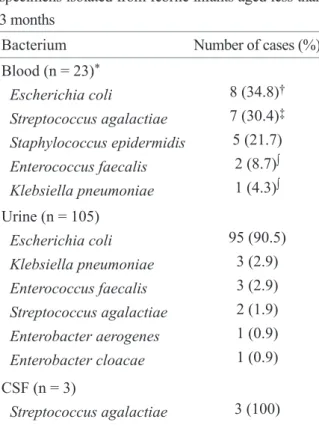
Table 2. Bacterial pathogens among positive specimens isolated from febrile infants aged less than 3 months
Bacterium Number of cases (%)
Blood (n = 23)
*Escherichia coli
Streptococcus agalactiae Staphylococcus epidermidis Enterococcus faecalis Klebsiella pneumoniae
8 (34.8)
†7 (30.4)
‡5 (21.7)
2 (8.7)
∫1 (4.3)
∫Urine (n = 105)
Escherichia coli Klebsiella pneumoniae Enterococcus faecalis Streptococcus agalactiae Enterobacter aerogenes Enterobacter cloacae
95 (90.5) 3 (2.9) 3 (2.9) 2 (1.9) 1 (0.9) 1 (0.9) CSF (n = 3)
Streptococcus agalactiae 3 (100)
*
We excluded three contaminated specimens.
†Eight
patients had blood and urine cultures positive for
Escherichia coli, and we counted them twice in each
group.
‡One patient had positive blood and urine
cultures for Streptococcus agalactiae, one patient had
positive blood and cerebrospinal fluid (CSF) cultures
for Streptococcus agalactiae, and one patient had
positive blood, urine, and CSF cultures for Streptococcus
agalactiae.
∫One patient had positive blood and urine
cultures for Enterococcus faecalis. One patient had
positive blood and urine cultures for Klebsiella
pneumoniae. One patient had a positive blood culture
for Enterococcus faecalis and a positive urine culture
for Escherichia coli.
bacteruria. Urine samples were collected from all febrile infants; 105 (22.7%) were culture positive for bacteria. Among infants with UTIs, E. coli was found in 95 (90.5%), and this was the most frequently isolated pathogen. CSF samples were obtained from 374 (80.8%) of 462 infants, and 3 (0.8%) were positive for Streptococcus agalactiae ; thus, these patients were diagnosed as having bacterial meningitis. Other bacterial pathogens are listed in Table 2. The mean
age of infants in the BI group was 0.18 months. Fifty infants (42.4%) were aged less than 1 month. A UTI was the most common infection (89%) in the BI group. Of infants in the BI group (118, 25.5%), 25 (21%) had a concurrent viral infection.
NBI group
FISDC was the most common final diagnosis for febrile infants without a BI (212, 45.8%). Viral infections accounted for 113 (24.4%) diagnoses.
Sixteen infants (3.5%) were diagnosed as having aseptic meningitis. Of viral infections, 9 had two viral co-infections. Forty-one (36.3%) infants were diagnosed as having rhinovirus infections, 22 (19.5%) as having the parainfluenza virus, 17 (15%) as having the respiratory syncytial virus, 13 (11.5%) as having the bocavirus, 12 (10.6%) as having the influenza A virus and 7 (6.2%) as having the rotavirus. One other cause of fever was Kawasaki disease (n = 3). All diagnoses are shown in Table 3.
Comparison between BI and NBI groups
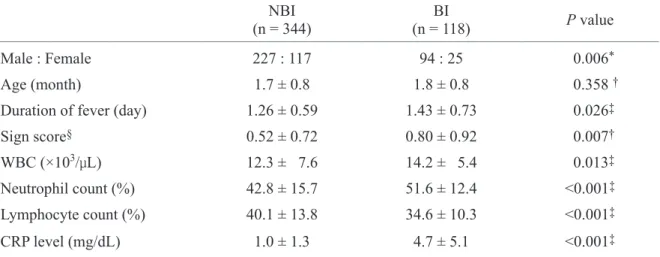
Male infants were twice as likely to develop bacterial infections compared to female infants ( P = 0.006, odds ratio 1.99, 95% confidence interval 1.13- 2.4), and they were more likely to present with bacteriuria. Age was not a risk factor for BI ( P = 0.358). The duration of fever was significantly longer in the BI group ( P = 0.026). The total symptom score was significantly higher in infants with a BI than in those without a BI ( P = 0.007) (Table 4).
Laboratory analyses showed that the WBC counts were higher in infants with a BI than in those with a BI ( P = 0.013). The percentage of neutrophils was significantly different between the BI and NBI groups ( P < 0.001), as was the percentage of lymphocytes ( P
< 0.001). The mean CRP level was significantly higher in infants with a BI than in those without a BI Table 3. Final diagnoses of 462 febrile infants aged
less than 3 months
Diagnostic category No. of cases (%) Non-bacterial infection
FISDC Viral infection Aseptic meningitis Kawasaki disease
344 (74.5) 212 (45.8) 113 (24.4) 16 (3.5) 3 (0.6) Bacterial infection
*UTI Bacteremia
Bacterial meningitis Contamination
118 (25.5) 105 (22.7) 23 (5.0)
†3 (0.6)
‡2 (0.4)
*
In the bacterial infections group, we categorized
patients as having a UTI and bacteremia if they had
positive blood and urine cultures.
†Eleven patients
had blood and urine cultures positive for same
bacterial pathogens and one patient had a positive
blood culture for Enterococcus faecalis and a positive
urine culture for Escherichia coli.
‡One patient had
positive blood and cerebrospinal fluid (CSF) cultures
for Streptococcus agalactiae, and one patient had
positive blood, urine, and CSF cultures for Streptococcus
agalactiae. FISDC: febrile illness without a
documented cause, UTI: urinary tract infection.
( P < 0.001) (Table 4). The area under the curve on the ROC for the CRP level was 0.817, indicating that it was the largest contributing factor to infection. Our cut-off value was 1.445 mg/dL (reference range, <0.5
mg/dL), with sensitivity of 76.3% and specificity of 75.9% according to the ROC curve (Fig. 1).
Discussion
Fever is the most common reason for infants visit emergency departments or outpatient clinics [6,9-12].
Causes of fever are usually self-limiting viral infection, but bacterial infections such as urinary tract infections, bacteremia, and bacterial meningitis are also common in older children [6-8,12-14]. Many studies have tried to establish guidelines to distinguish BIs from self-limiting viral infections, and Shin et al . reported risk factors for serious BIs in febrile young infants at a community referral hospital since 1992 [6,8-10,15,16]. In Shin et al . [15] study independent risk factors for BI were 1) CRP level ≥1.87 mg/dL, 2) lack of mild URI symptoms in the patient, and 3) no URI symptoms in the patient’s siblings. Managing selected young, febrile infants as outpatients has been attempted at several institutions, and this has been reported elsewhere [6,15,17]. The present study Table 4. Comparison of variables between the non-bacterial (NBI) and bacterial infection (BI) groups
(n = 344) NBI BI
(n = 118) P value
Male : Female 227 : 117 94 : 25 0.006
*Age (month) 1.7 ± 0.8 1.8 ± 0.8 0.358
†Duration of fever (day) 1.26 ± 0.59 1.43 ± 0.73 0.026
‡Sign score
§0.52 ± 0.72 0.80 ± 0.92 0.007
†WBC (×10
3/μL) 12.3 ± 7.6 14.2 ± 5.4 0.013
‡Neutrophil count (%) 42.8 ± 15.7 51.6 ± 12.4 <0.001
‡Lymphocyte count (%) 40.1 ± 13.8 34.6 ± 10.3 <0.001
‡CRP level (mg/dL) 1.0 ± 1.3 4.7 ± 5.1 <0.001
‡*