Trend analysis of diabetic prevalence and
incidence in a rural area of South Korea between 2003–2008
Ji Yun Jeong 1 , Jung-Guk Kim 1 , Bo-Wan Kim 1 , Seong Su Moon 1 , Hye-Soon Kim 2 , Keun-Gyu Park 2 , Kyu Chang Won 3 , Hyoung Woo Lee 3 , Ji Sung Yoon 3 , Ho-Sang Shon 4 , Ji Hyun Lee 4 , Eui-Dal Jung 4 , Mi Young Park 5 , Byung-Yeol Chun 6 , Keon-Yeop Kim 6 , Tae-Yoon Hwang 7 , Mi-Young Lee 8 , In-Kyu Lee 1,9,10 *
ABSTRACT
Aims/Introduction: This study determined the change in prevalence of diabetes and prediabetes over a period of 5 years in South Korea. The incidence of diabetes and prediabetes and risk factors associated with the development of diabetes were also investigated.
Materials and Methods: The Dalseong population-based cohort survey recruited 1806 subjects who were over 20-years-old in 2003. Five years later, 1287 of the original subjects were re-evaluated and 187 new subjects were added to the study. All participants completed a questionnaire, were given a physical examination, and provided blood samples for analysis including 2 h oral glucose tolerances.
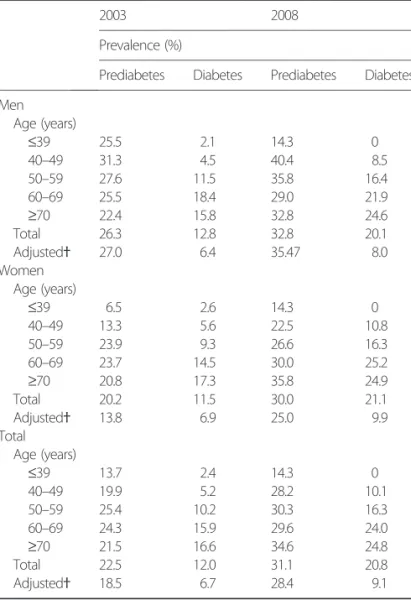
Results: Age-adjusted prevalence of diabetes rose from 6.7% in 2003 to 9.1% in 2008. The prevalence of prediabetes also increased from 18.5% in 2003 to 28.4% in 2008. The incidence rates of diabetes and prediabetes were 18.3 per 1000 person-years and 55.4 per 1000 person-years, respectively. The development of diabetes was associated with impaired fasting glucose (IFG) (odds ratio [OR]
5.661), impaired glucose tolerance (IGT) (OR: 6.013), age (OR 1.013), and waist-to-hip ratio (OR 1.513). After excluding the IFG and IGT, systolic blood pressure (OR 1.023), high-sensitivity C-reactive protein (hsCRP; OR 1.097), triglyceride (OR 1.002) and waist-to-hip ratio (OR 1.696) were statistically significant risk factors in a multivariate logistic regression analysis.
Conclusions: A significant rise in the prevalence of diabetes and prediabetes was observed between 2003 and 2008. In addition, this study newly demonstrated that waist-to-hip ratio and hsCRP were associated with the development of diabetes after adjusting for several confounding factors. (J Diabetes Invest, doi: 10.1111/j.2040-1124.2010.00045.x, 2010)
KEY WORDS: Diabetes mellitus, Prevalence, South Korea
INTRODUCTION
Diabetes mellitus is increasing rapidly worldwide, especially in Asia
1. In 2007, more than 100 million people in Asia suffered from diabetes and 60% of the world’s individuals with diabetes came from Asia
2. Rapid socioeconomic changes, such as dietary patterns, technology transfer and economic growth, have led to a diabetes epidemic in Asia. According to previous reports, the prevalence of diabetes varies throughout Asia, according to race,
lifestyle, and urbanization
3–7. South Korea is one of several countries in which a rapid change in lifestyle of individuals is occurring with a rapid progression to an aging society. However, reports on the trends in the prevalence of diabetes in South Korea are not consistent. According to one study, a significant trend toward increased prevalence of diabetes from 6.9% in 1997 to 11.7% in 2003 was observed in one population-based cohort study carried out in a rural area of South Korea
8. In con- trast, the Korea National Health and Nutrition Examination Survey (KNHANES) carried out in 1998, 2001 and 2005 reported that the prevalence of diabetes decreased from 11.1%
in 1998 to 8.9% in 2001, followed by a slight increase to 9.1% in 2005
9,10. However, in these previous surveys, a 75 g oral glucose tolerance test (OGTT) could not be completely carried out for diagnosis of diabetes and prediabetes.
Based on these considerations, we felt it was important to reinvestigate the recent change in the prevalence of diabetes and prediabetes in South Korean adults using the 75 g OGTT. At the same time, we investigated the incidence of diabetes and
1
Department of Internal Medicine, Kyungpook National University School of Medicine,
2
Department of Internal Medicine, School of Medicine, Keimyung University,
3
Department of Internal Medicine, College of Medicine, Yeungnam University,
4
Department of Internal Medicine, School of Medicine, Catholic University of Daegu,
5