• 검색 결과가 없습니다.

The Effect of Sharia Destination Image on Developing Post-Visit Behavior: A Case Study in Indonesia

N/A
N/A
Protected

Academic year: 2021

Share "The Effect of Sharia Destination Image on Developing Post-Visit Behavior: A Case Study in Indonesia"

Copied!
11
0
0

로드 중.... (전체 텍스트 보기)

전체 글

(1)

Print ISSN: 2288-4637 / Online ISSN 2288-4645 doi:10.13106/jafeb.2021.vol8.no4.0959

The Effect of Sharia Destination Image on Developing Post-Visit Behavior: A Case Study in Indonesia*

Marlizar MARLIZAR

1

, Abdul Rahman LUBIS

2

, Sorayanti UTAMI

3

, Syafruddin CHAN

4

Received: December 20, 2020 Revised: March 07, 2021 Accepted: March 15, 2021

Abstract

This study aims to develop new constructs and indicators for sharia destination image, and then examine its effects on perceived value, tourist satisfaction, and post-visit behaviour. Furthermore, it analyses the mediating role of perceived value and tourist satisfaction on relationship between sharia destination image and post-visit behaviour. The population were domestic and Malaysian Muslim tourists who visited Aceh during the study period. The sampling was carried out in two stages. The first stage involved selecting most visited districts. The second stage involved randomly selecting tourists who visit during the study period in the districts. Data was collected using a structured questionnaire with a Likert scale. Also, a total of 270 questionnaires were distributed to domestic and Malaysian tourists in Aceh. Cluster sampling was used to determine the sample area, and purposive sampling technique was used to determine the study sample. Furthermore, the data analysis technique is Structural Equation Modelling. The results showed that the sharia destination image has a significant effect on perceived value.

Meanwhile, the perceived value significantly influenced tourist satisfaction and post-visit behaviour. In addition, the perceived value and tourist satisfaction can mediate the effects of sharia destination image, which has no direct effect on post-visit behaviour.

Keywords: Sharia Destination Image, Perceived Value, Tourist Satisfaction, Post-Visit Behaviour JEL Clasification Code: C83, M16, M31, L83, Z32

economy. This is because the growth of the sector is always above the economic growth (Soebagyo, 2012). The development of tourism is directed at increasing its role in economic activities that facilitates investment in the sector which can increase state and public income. Furthermore, it can expand employment opportunities, and encourage activities of supporting industries and other side industries.

Tourism development efforts are carried out through the development and utilization of various national potentials which are expected to increase the number of visits, length of stay, and expenditure of foreign tourists during their trip to Indonesia (Basiya & Rozak, 2012). Aceh, which is one of the four special autonomous provinces in Indonesia, has a lot of tourism potential which can be developed in order to increase economic growth. In fact, Aceh has a fairly long coastline, delicious culinary delights, interesting cultural activities, and the central region has beautiful nature. There are about 803 tourist spots in this Province, however, not all of them are centre of tourist atraciton. Before the earthquake and tsunami, Aceh was a province which was hit by conflict between the Free Aceh Movement and the Indonesian Government which made the region unsafe and was avoided by the tourists. Nevertheless, the earthquake and tsunami disaster at the end of 2004 and the end of the conflict in 2005

*Acknowledgments:

This research was made possible because of the full support of the University Muhammadiyah Aceh.

1

First Author and Corresponding Author. Ph.D. Student, Department of Management, Faculty of Economics and Business, Universitas Syiah Kuala, Banda Aceh, Indonesia [Postal Address: Jl. Teuku Nyak Arief No.441, Kopelma Darussalam, Kec. Syiah Kuala, Kota Banda Aceh, Aceh 23111, Indonesia]

Email: [email protected]

2

Professor, Departement of Management, Faculty of Economics and Business, Universitas Syiah Kuala, Banda Aceh, Indonesia.

Email: [email protected]

3

Lecturer, Departement of Management, Faculty of Economics and Business, Universitas Syiah Kuala, Banda Aceh, Indonesia.

Email: [email protected]

4

Lecturer, Departement of Management, Faculty of Economics and Business, Universitas Syiah Kuala, Banda Aceh, Indonesia.

Email: [email protected]

© Copyright: The Author(s)

This is an Open Access article distributed under the terms of the Creative Commons Attribution Non-Commercial License (https://creativecommons.org/licenses/by-nc/4.0/) which permits unrestricted non-commercial use, distribution, and reproduction in any medium, provided the original work is properly cited.
1. Introduction

As the largest maritime country in the world, Indonesia

has realized the importance of the tourism sector to its

(2)

made Aceh known to the outside world both domestically and abroad.

From the perspective of tourist consumption process, tourist behavior can be divided into three stages, namely pre- visit, during the visit, and post-visit (Ryan, 2002; Williams

& Buswell, 2003). From a theoretical perspective, there are contradictions of some research regarding behavioral theories for revisit, which are most likely caused by the diversity of methods, models, and predictive variables used in forming tourist behavior (Chen & Chen, 2010; Chen & Tsai, 2007;

De Rojas & Camarero, 2008). Specifically, the behavior is an agreed term that includes pre-visit, during visits, behavioral evaluation, and post-visit behavior. The tourist behavior includes a choice of destinations to visit and evaluation of future behavior. Meanwhile, subsequent evaluations include the travel experience or perceived quality of travel, the perceived value and total satisfaction, the future behavior including revisit, and the willingness to recommend.

Satisfaction is an important factor that contributes to the behavior of visiting destinations and recommending to others (Cronin et al., 2011). One of the important elements of successful destination marketing is tourist satisfaction, which affects the choice and decision to revisit (Le & Le, 2020;

Yoon & Uysal, 2005). Meanwhile, satisfaction is related to perceived quality, perceived value, and destination image, and is believed to be an antecedent of tourist satisfaction (Alamgir, 2005; Aliman et al., 2014). The relationship between the concepts of perceived value, satisfaction, and future behavior has also been investigated by some studies which stated that perceived value often stands out as a major antecedent and determinant of customer satisfaction, as well as tourists’ future behavior (Cronin et al., 2000; McDougall

& Levesque, 2000; Parasuraman & Grewal, 2000). In fact, precious research has shown that perceptions of service quality, perceived value, and satisfaction are good predictors of revisit behavior (Baker & Crompton, 2000).

In addition to satisfaction, the destination image is a variable that is considered in this study and it has been recognized in some literature because it has an influence on tourist behavior (Bigne et al., 2001; Fakeye & Crompton, 1991; Lee et al., 2005). Also, destination image plays an important role in evaluation or travel behavior regarding revisit, and behavior to share by word of mouth (Giao et al., 2020; Kozak et al., 2007). Furthermore, several studies have shown that the attractiveness of a destination image varies for each person, depending more on emotions and perceptions, and not facts (Abodeeb et al., 2015; Kim &

Richardson, 2003). Abodeeb et al. (2015) studied how to determine destinations that were formed for international and domestic tourists. Destination image also has an impact on new perceptions, hedonic promotions, and perceived value, as well as it encourages the behavior to revisit (Cheng

& Lu, 2013).

Although there are many studies on the impact of destination image, research on this factor and its effect on tourist satisfaction and visiting behavior is not yet available or is still very limited. Only studies on Islamic attribute destination were conducted by Battour et al. (2013). Unlike Battour et al. (2013) who wrote about the Islamic attributes of destinations, the focus of this study is to develop a construct and indicator for sharia destination image, and also examine its impact on perceived value, tourist satisfaction, and post- visit behavior. Therefore, based on the research gap, the variable of sharia destination image was synthesized, which is a development of tourism theory (Ali, 2015; Lohmann &

Netto, 2016), Islamic tourism (Henderson, 2009; Jaelani, 2017; Organisation of Islamic Cooperation, 2017) with marketing theory (Cravens & Piercy, 2013; Kotler & Keller, 2016), destination marketing (Pike, 2008; Youcheng Wang, 2011) and destination image (Chen & Tsai, 2007; Chi &

Qu, 2008; Coban, 2012; Sonnleitner, 2011). Furthermore, consideration is the relevance of the conditions in Aceh which apply Islamic law, in order for the concept of sharia destination image to be applied as a construct to measure satisfaction through the perceived value and its effect on tourist behavior in Aceh.

2. Literature Review 2.1. Sharia Destination Image

Destination image is always shaped by experiences or facts, but it can also be shaped to become a motivating factor or driving force for tourists’ trips. Meanwhile, destination images calculated by tourists can vary between individuals.

Coban (2012) reported that destination image is the result of the consumers’ forecast. This image has a big influence on satisfaction, and can influence selection factors related to visit, such as accommodation and travel itinerary (Chen & Tsai, 2007; Chi & Qu, 2008). Also, destination image consists of cognitive, affective, and systemic dimensions (Hartman, 1967).

The cognitive dimension of service experience, the affective dimension of mental reactions to customers towards service delivery, and the systemic dimension is the distance between the expected service and the experience (Yu & Goulden, 2006).

Image is the belief that tourists purchase products or services according to halal standards (Pitana & Diarta, 2009). Therefore, research defines sharia destination image as beliefs, perceptions, and thoughts of tourists on destinations that include various products and attributes according to halal standards.

Destination image can directly or indirectly influence satisfaction through expectations, perceived quality and value. The positive relationship between destination image and satisfaction has strong ratings in the tourism literature for destination types, including islands (Chen & Tsai, 2007;

Chi & Qu, 2008; Lee et al., 2005; Prayag & Ryan, 2012;

(3)

Xia, et al., 2009). Similarly, Hutchinson et al. (2009) found that there is a positive relationship between image and tourist satisfaction with perceived value. Meanwhile, several studies have examined the destination image as an independent variable that affects consumer behavior variables that not only occur before, but also during and after visiting (Chen &

Hsu, 2000). Tourists can form a positive or negative image towards a destination. Therefore, it was hypothesized that the sharia destinations has an effect on the perceived value, satisfaction and post-visit behavior.

H1: sharia destination image has a positive effect on perceived value.

H2: sharia destination image has a positive effect on tourist satisfaction.

H3: sharia destination image has a positive effect on post-visit behavior through the perceived value.

H4: sharia destination image has a positive effect on post-visit behavior through tourist satisfaction.

Religion and religiosity are the factors that influence behavior in social settings (Battour et al., 2011). Therefore, there have been recommendations to determine the effect of catering to the religious needs in obtaining high satisfaction levels, which can affect future behavior or product preferences and revisits (Fleischer, 2000; Weidenfeld & Ron, 2008). Therefore it is hypothesized that sharia destination image has an effect on post-visit behavior.

H5: sharia destination image has a positive effect on post-visit behavior.

2.2. Perceived Value

Perceived value is defined as the overall consumer assessment of a product or service usefulness based on perceptions of what is received and given (Zeithaml, 1988). Likewise, Lovelock (2000) defined perceived value as the ratio between the benefits felt and the costs incurred. Furthermore, perceived value is described as the overall assessment made by the tourists based on their comparison between perceived utility or benefits and the costs or tradeoffs associated with the destination. From a benefit perspective, the value scale includes monetary costs (Petrick, 2002), and non-monetary costs such as effort or time (Boksberger & Melsen, 2011). Duman and Mattila, (2005) found that perceived monetary quality and values are the two main antecedents of perceived value. Chen & Tsai (2007) measured the perceived value using three scale items, namely money, time, and effort. Meanwhile, Clemes et al.

(2011) used one item for perceived value, while Sun and Chi proposed two item scales for perceived value, including functional and overall value (Sun et al., 2013).

Perceived value is the key to relational marketing and to gain a competitive advantage (McDougall & Levesque, 2000). Previous research recognized that perceived value is considered to be antecedent of behavior (Chen & Tsai, 2007;

McDougall & Levesque, 2000; Petrick, 2004). Also, research showed that perceived value can be a better predictor of repurchase behavior (Chen & Chen, 2010; Cronin et al., 2000; Oh, 1999). Lee et al. (2007) found that perceived value is the best predictor of behavior. Furthermore, Bajs (2015) showed that the pereceived value directly affected satisfaction, which has a direct impact on future behavior regarding destination. Therefore it is hypothesized that the perceived value affects tourist satisfaction and post-visit behavior.

H6: perceived value has a positive effect on tourist satisfaction.

H7: perceived value has a positive effect on post-visit behavior.

H8: perceived value has a positive effect on post-visit behavior through tourist satisfaction.

2.3. Tourist Satisfaction

Satisfaction is defined as the total response of consumers or their affective behaviour in product consumption (Oliver, 1997), and assessment of satisfying the level of pleasure from using a product and service (Chen et al., 2016). Tourist satisfaction is a person’s feeling of pleasure or disappointment resulting from the product perceived performance (results) with expectations (Kotler, 2000).

The underlying dimensions and psychological processes of satisfaction may differ as a result of complexity level of the consumption experience (Oliver, 1997). A trip to a tourist destination, especially international, is a complex experience, in which the tourists may be satisfied with some aspects and dissatisfied with others. Therefore tourist satisfaction at the destination level is different from visitors at the transactional level because the overall visitors’ experience is the sum of the many individual experiences that occur during stay. This experience may include interactions with various attributes of natural and cultural destinations, and by the viewpoints of the destination, as well as the tourists perception about service quality and price (Ying et al., 2010; Yu & Goulden, 2006).

Also, destination satisfaction is described as cumulative satisfaction and as an abstract concept which describes the total customer experience of a product or service (Fornell et al., 1996; Foster, 1999).

Campo-Martinez et al. (2010) found that the biggest factor affecting destination visits is the tourists’ perception.

Brida et al. (2013) stated that total satisfaction affects the

behavior to return to their destination and recommend

to others. Meanwhile, Lee et al. (2011) studied Chinese

(4)

tourists in South Korea to analyze the cause and effect of the relationship between tourist motivation, expectations, quality, satisfaction, complaints on tourist loyalty. They found that satisfaction affects tourists’ loyalty. Accordingly, loyalty can be divided into two intentions to revisit. Positive experiences will make tourists revisit, and positive word of mouth will influence friends and relatives (Chi & Qu, 2008).

Therefore, it is hypothesized that satisfaction has an effect on post-visit behavior.

H9: tourist satisfaction affect positively post-visit behavior.

2.4. Post-Visit Behaviour

The concept of repurchase comes from behavior. Baker &

Crompton (2000) described that the intention to revisit is the possibility of tourists for activities or revisits to a destination.

Tourist behavior includes choice of destination to visit, subsequent evaluations, and future behavior (Chen & Tsai, 2007). The next evaluation is about the value and satisfaction felt, while future behavior refers to the willingness to revisit the same destination in the future and recommend it to others (Hume et al., 2007; Ryu et al., 2010; Som et al., 2012). An important element of success in the tourism sector is the intensity of tourists revisiting destinations (Lin et al., 2007).

Shoemaker & Lewis (1999) stated that loyal consumers are more likely to provide free advertising in a network of friends, relatives and other potential consumers. In fact, several research have investigated revisit from tourists because they produce more long-term economic benefits and positive impressions (Baker & Crompton, 2000). Meanwhile, loyalty indicators in many studies are revisit and recommendation behavior (Chen & Gursoy, 2001; Niininen et al., 2004).

3. Research Methods and Materials 3.1. Research Instruments

Data was collected using a questionnaire with a 7-point Likert scale. Also, this study used in-depth interviews with several sources (informants) representing elements of tourism actors, souvenir and clothing traders, managers of tourist objects, managers of Islamic boarding schools and worship houses. This was done to obtain in-depth information related to the study variables and to support the results of quantitative analysis.

3.2. Sample Design and Data Collection

The population were domestic and Malaysian Muslim tourists who visited Aceh during the study period. Non- probability sampling was used with the type of two stage cluster, which is the development of the cluster sampling

method. The sampling was carried out in two stages, namely first and stage. In the first stage, several clusters in the population were randomly selected as samples, while in the second stage, elements from each cluster was randomly selected (Schafer, 1997). The first stage involved selecting most visited districts, namely districts of Aceh Besar, Kota Banda Aceh and Kota Sabang. The second stage involved randomly selecting tourists who visit during the study period in the district of Aceh Besar, Kota Banda Aceh and Kota Sabang. Furthermore, the chosen location of each chosen district/city was busy attraction sites and tourist favorite.

Determination of the samples number in the opinion of Hair et al. (2014) which stated that the sample size in the study needs to have a minimum number of five times the number of analyzed questions. The sample size for the SEM model was between 100–200, or by multiplying the number of indicators 5 to 10 (Ferdinand, 2014). In addition, the minimum sample size taken was 270 tourists (27 indicators

× 10) in order to provide better calculation results.

3.3. Data Analysis

The data analysis technique in this study was descriptive and verification. Descriptive analysis was conducted to assess the demographic profile of respondents and the internal consistency of the constructs. Meanwhile, the verification analysis used SEM (Structural Equation Modeling) to verify the relationship path of the sharia destination image, perceived values, tourist satisfaction and post-visit behavior. In addition, the SEM analysis software was IBM SPSS-AMOS version 22.

4. Results and Discussion

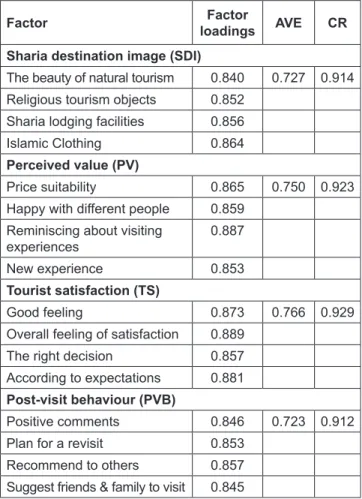
4.1. Sharia Destination Image and Indicators The result discussion begins with development of sharia destination image and indicators, which is the first aim of this study. Based on previously discussed literature, this study defines sharia destination image as beliefs, perceptions, and thoughts of tourists on destinations that include various products and attributes according to halal standards. This study developed 8 indicators for sharia destination image namely: (1) the beauty of natural attractions; (2) tsunami tourism object; (3) religious tourism objects; (4) halal food; (5) sharia lodging facilities; (6) the availability of worship facilities; (7) Islamic entertainment; and (8) Islamic clothing. All these indicators are developed from the previous literature which is integrated with the fatwas of the Indonesian council of Ulama (Battour et al., 2013; Cheng

& Lu, 2013; Chi & Qu, 2008; & The Indonesian council

of Ulama, 2016). Unfortunately, only 4 indicators met the

requirements of the confirmatory factor analysis that goes

into the empirical testing phase.

(5)

Table 1: Validity and Reliability for Construct

Factor Factor

loadings AVE CR Sharia destination image (SDI)

The beauty of natural tourism 0.840 0.727 0.914 Religious tourism objects 0.852

Sharia lodging facilities 0.856

Islamic Clothing 0.864

Perceived value (PV)

Price suitability 0.865 0.750 0.923

Happy with different people 0.859 Reminiscing about visiting

experiences 0.887

New experience 0.853

Tourist satisfaction (TS)

Good feeling 0.873 0.766 0.929

Overall feeling of satisfaction 0.889

The right decision 0.857

According to expectations 0.881 Post-visit behaviour (PVB)

Positive comments 0.846 0.723 0.912

Plan for a revisit 0.853

Recommend to others 0.857

Suggest friends & family to visit 0.845

Notes: χ

2

= 399.493, GFI = 0.878, AGFI = 0.846, TLI = 0,957, C

FI

= 0.962, RMSEA = 0,066, Normedchisq/C

MIN

= 2.183, p = 0.012.

4.2. Demographic Profile of Respondents

The number of respondents was 270 tourists which consisted of 162 domestic and 108 Malaysian respondents.

However, the analyzed data were only of 263 respondents because there were 7 outlier data. The respondents were male 145 (55.1%) and female 118 (44.9%). Furthermore, those aged under 21 years were 54 (20.5%), 21–30 years were 146 (55.5%), 31–40 years were 33 (12.5%), 41–

50 years were 22 (8.4%), and over 50 years were 8 (3%).

Those who graduated from SD were 2 (0.8%), junior high schools were 41 (15.6%) senior high school were 61 (23.2%), diplomas were 87 (33.1%), bachelors were 61 (23.2%), and postgraduates were 11 (4.2%). Respondents’ occupations consisted of 29 government employees (11.0%), 20 private (7.6%), 13 lecturers/teachers (4.9%), 2 police (0.8%), 4 army (1.5%), 38 self-employed (14.4 %), 133 students (50.6%), and 24 others (9.1%).

4.3. Measurement Model

Based on the results of confirmatory factor analysis (CFA) examiner, it is known that the construct model measurement has met the Goodness of Fit Test criteria even though there are three criteria that are below standard. The measurement model of this study construct has the following values:

Therefore, based on Table 2, it was shown that the measurement of this study item has good validity and reliability.

4.4. Structural Model

The structural model is estimated to test H1 to H6.

The model obtained the value of Goodness of Fit Test, namely: the value of Chi Square/χ

2

= 132.049, GFI = 0.944, AGFI = 0.922, TLI = 0.993, CFI = 0.994, RMSEA = 0.036, Normedchisq/C

MIN

= 1.347. This showed that the model met the requirements for suitability and data adequacy. Therefore, it can be used for further analysis.

4.5. Hypothesis Testing Model

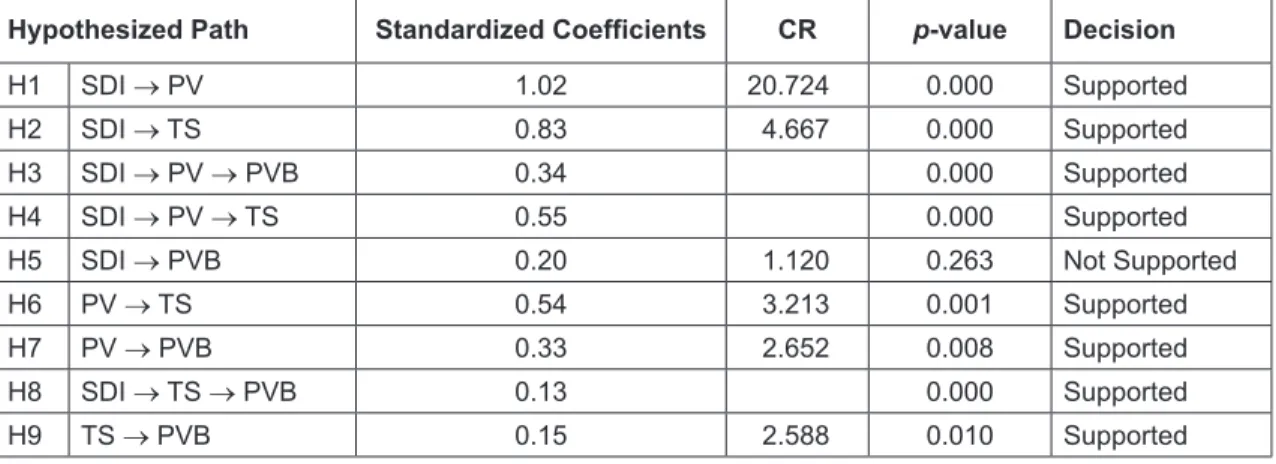
Based on the test results, the proposed model showed that 5 structural paths have significant coefficient values (p < 0.05; p < 0.01). However, there is one structural path that is not significant. The following table showed the standard path coefficients generated from the structural test model.

The hypothesized relationship between sharia destination image and perceived value has a p-value of 0.000 (p <

0.01). These results showed that sharia destination image has an influence on tourists’ perceived value, hence H1 is accepted. Also, the hypothesized relationship between sharia destination image and tourist satisfaction has a p-value

of 0.000 (p < 0.01), which showed that sharia destination

image has an influence on tourist satisfaction, therefore H2

is accepted. Furthermore, the path coefficient between the

sharia destination image and post-visit behavior is 0.263

(p > 0.01), which showed that sharia destination image

has no direct effect on post-visit behavior, therefore H3 is

rejected. The hypothesized relationship between perceived

value and tourist satisfaction has a p-value of 0.001

(p < 0.01). These results showed that higher value will

increase tourist satisfaction, hence H4 is accepted. The

hypothesized relationship between perceived value and

post-visit behavior has a p-value of 0.008 (p < 0.01),

which showed that perceived value has an influence on

post-visit behavior of tourists, thus H5 is accepted. The

hypothesized relationship between tourist satisfaction and

post-visit behavior has a p-value of 0.010 (p < 0.05). These

results showed that tourist satisfaction has an effect on visit

behavior, thus H6 is accepted. The total results support

(6)

Table 2: Results of the Structural Model

Hypothesized Path Standardized Coefficients CR p-value Decision

H1 SDI → PV 1.02 20.724 0.000 Supported

H2 SDI → TS 0.83 4.667 0.000 Supported

H3 SDI → PV → PVB 0.34 0.000 Supported

H4 SDI → PV → TS 0.55 0.000 Supported

H5 SDI → PVB 0.20 1.120 0.263 Not Supported

H6 PV → TS 0.54 3.213 0.001 Supported

H7 PV → PVB 0.33 2.652 0.008 Supported

H8 SDI → TS → PVB 0.13 0.000 Supported

H9 TS → PVB 0.15 2.588 0.010 Supported

*p < 0.05; **p < 0.01.

Figure 1: Structural Results of the Proposed Model previous studies which verified that sharia destination image,

perceived value, and satisfaction have an effect on post- tourist behavior. The figure below shows the final estimation results of the structural model.

From the test results, it can be seen that each variable have a significant and positive effect. Sharia destination image has a significant effect on tourists’ perceived value in Aceh. This finding is in accordance with previous studies that identified image role on post-visit behavior (Aliman et al., 2014; Chen & Chen, 2010; Cheng & Lu, 2013). Also, sharia destination image has a significant effect on tourist satisfaction in Aceh, which is in accordance with previous studies (Mohamad et al., 2011; Tavitiyaman & Qu, 2013;

Wang & Hsu, 2010). However, sharia destination image has no direct effect on post-tourism behavior, which is in accordance with the previous studies (Bosque & Martín, 2008; Chen & Tsai, 2007). Furthermore, perceived value has an effect on tourist satisfaction, and satisfaction has an effect on the post-visit behavior which is in accordance

with previous studies (Rohman, 2020; Waheed & Hassan, 2016). In addition, the perceived value has an effect on post- visit behavior, which is in accordance with previous studies (Munhurrun et al., 2015; Waheed & Hassan, 2016).

4.6. Mediation Analysis

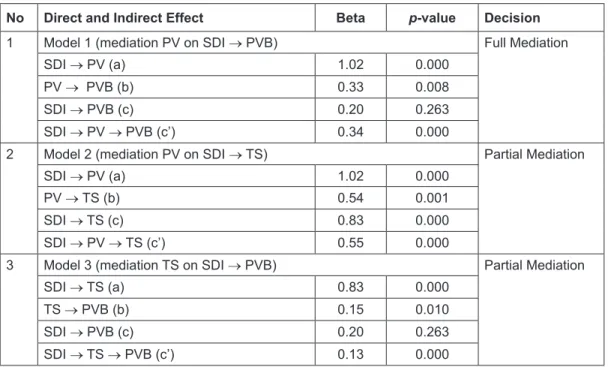
Testing the effect of mediation used the Baron &

Kenny (1986) approach. Meanwhile, mediation analysis was used to examine the mediation role of perceived value by tourists (H3, H4, and H8). The following table presents the results of 3 mediation models, namely:

(1) The mediation effect of perceived value in the

relationship between sharia destination image and post-

visit behavior. (2) The mediation effect of perceived value

in the relationship between sharia destination image and

tourist satisfaction. (3) The mediating effect of tourist

satisfaction in the relationship between sharia destination

image and post-visit behavior.

(7)

Table 3: Mediation Test

No Direct and Indirect Effect Beta p-value Decision

1 Model 1 (mediation PV on SDI → PVB) Full Mediation

SDI → PV (a) 1.02 0.000

PV → PVB (b) 0.33 0.008

SDI → PVB (c) 0.20 0.263

SDI → PV → PVB (c’) 0.34 0.000

2 Model 2 (mediation PV on SDI → TS) Partial Mediation

SDI → PV (a) 1.02 0.000

PV → TS (b) 0.54 0.001

SDI → TS (c) 0.83 0.000

SDI → PV → TS (c’) 0.55 0.000

3 Model 3 (mediation TS on SDI → PVB) Partial Mediation

SDI → TS (a) 0.83 0.000

TS → PVB (b) 0.15 0.010

SDI → PVB (c) 0.20 0.263

SDI → TS → PVB (c’) 0.13 0.000

Based on the above table, it is known that H3, H4, and H8 are acceptable, which means that the perceived value can fully mediate the relationship between sharia destination image and post-visit behavior. Furthermore, it can partially mediate the relationship between sharia destination image and tourist satisfaction.

5. Conclusion

The sharia destination image is defined as beliefs, perceptions, and thoughts of tourists on destinations, which include various products and attributes according to halal standards. This study developed 8 indicators for sharia destination image, but only 4 indicators met the CFA analysis requirements, namely the beauty of natural tourism, religious tourism objects, Islamic lodging facilities, and Islamic clothing.

The results showed that sharia destination image has a significant effect on perceived value. Furthermore, the perceived value has a significant effect on satisfaction and post-visit behaviour. In addition, the perceived value and tourist satisfaction can mediate the influence of sharia destination on post-visit behaviour. However, sharia destination has no direct effect on the post-visit behaviour.

This showed that image will affect post-visit behaviour as long as the tourists are satisfied. Tourist satisfaction will also be created through the perceived and good quality of tourism products. Therefore, Aceh as an area that applies Islamic law needs to create a sharia destination image because it is

the main driver of visits through the perceived value and satisfaction to improve post-visit behaviour.

Although these results have provided empirical evidence on developing post-visit behavior through sharia destination image, perceived value, and satisfaction, several limitations need to be addressed in further research, namely: a more representative sampling approach. Hence, it is important to carefully generalize the results. For example, the findings should be carefully interpreted when applied to tourists of different religions and countries. This study used a unidimensional construct from the sharia destination image.

Therefore, it may be necessary to use multi-dimensional image construction of sharia destinations in future studies.

References

Abodeeb, J., Wilson, E., & Moyle, B. (2015). Shaping destination image and identity: Insights for Arab tourism at the Gold Coast, Australia. International Journal of Culture, Tourism, and Hospitality Research, 9(1), 6–21. https://doi.org/10.1108/

IJCTHR-06-2014-0051

Adinegara, G. J., Suprapti, N. W. S., Yasa, N. N. K., & Sukaatmadja, I. P. G. (2017). Antecedents And Consequences Of Tourist Satisfaction : A Literature Review. Asean Marketing Journal, 9(1), 40–53.

Alamgir, M. (2005). Antecendents of Perceived Value and its

Impact on Tourist Satisfaction: A Bangladesh Persepective

Study. Journal of Tourism, (22), 19–25.

(8)

Ali, M. A. B. (2015). Travel and tourism management (1

st

ed.). PHI Learning.

Aliman, N. K., Hashim, S. M., Wahid, S. D. M., & Haridun, S.

(2014). Tourist Expectations , Perceived Quality and Destination Image : Effects on Perceived Value and Satisfaction of Tourists Visiting Langkawi Island , Malaysia. Asian Journal of Business and Management, 02(03), 212–222.

Bajs, I. P. (2015). Tourist Perceived Value, Relationship to Satisfaction, and Behavioral Intentions: The Example of the Croatian Tourist Destination Dubrovnik. Journal of Travel Research, 54(1), 122–134. https://doi.org/10.1177/0047287513513158

Baker, D. A., & Crompton, J. L. (2000). Quality satisfaction and behavioral intentions. Annals of Tourism-Research, 27(3), 785–804.

Baron, R. M., & Kenny, D. A. (1986). The Moderator-Mediator Variable Distinction in Social Psychological Research:

Conceptual , Strategic , and Statistical Considerations. Journal of Personality and Social Psychology, 51(6), 1173–1182.

Battour, M., Battor, M., & Bhatti, M. A. (2013). Islamic Attribute of Destination: Construct Development and Measurement Validation, and Their Impact on Tourist Satisfaction.

International Journal of Tourism Research, 16(6), 556–564.

https://doi.org/10.1002/jtr

Battour, M., Ismail, M. N., & Battor, M. (2011). The impact of destination attributes on Muslim tourist’s choice. International Journal of Tourism Research, 13(6), 527–540. https://doi.

org/10.1002/jtr.824

Bigne, J. E., Sanchez, M. I., & Sanchez, J. (2001). Tourism image, evaluation variables and after purchase behaviour: Tourism Management, 22(6), 607–616. https://doi.org/10.1016/s0261- 5177(01)00035-8

Boksberger, P. E., & Melsen, L. (2011). Perceived value: a critical examination of definitions, concepts and measures for the service industry. Journal of Services Marketing, 25(3), 229–240. https://doi.org/10.1108/08876041111129209 Bosque, I. R. del, & Martín, H. S. (2008). Tourist satisfaction a

cognitive-affective model. Annals of Tourism Research, 35(2), 551–573. https://doi.org/10.1016/j.annals.2008.02.006 Brida, J. G., Pulina, M., Riaño, E., & Aguirre, S. Z. (2013). Cruise

Passengers in a Homeport: A Market Analysis. Tourism Geographies, 15(1), 1–20. https://doi.org/10.1080/14616688.

2012.675510

Campo-Martinez, S., Garau-Vadell, J. B., & Martinez-Ruiz, M. P.

(2010). Factors influencing repeat visits to a destination: The influence of group composition. Tourism Management, 31(6), 862–870. https://doi.org/10.1016/j.tourman.2009.08.013 Chen, C.-C., Huang, W.-J., & Petrick, J. F. (2016). Holiday recovery

experiences, tourism satisfaction and life satisfaction - Is there a relationship? Tourism Management, 53, 140–147. https://doi.

org/10.1016/j.tourman.2015.09.016

Chen, C., & Chen, F. (2010). Experience quality , perceived value, satisfaction and behavioral intentions for heritage tourists.

Tourism Management, 31(1), 29–35. https://doi.org/10.1016/j.

tourman.2009.02.008

Chen, C. F. (2008). Investigating structural relationships between service quality , perceived value, satisfaction, and behavioral intentions for air passengers : Evidence from Taiwan.

Transportation Research Part A, 42, 709–717. https://doi.

org/10.1016/j.tra.2008.01.007

Chen, C. F., & Tsai, D. (2007). How destination image and evaluative factors affect behavioral intentions? Tourism Management, 28(4), 1115–1122. https://doi.org/10.1016/j.

tourman.2006.07.007

Chen, J. S., & Gursoy, D. (2001). An investigation of tourists’

destination loyalty and preferences. International Journal of Contemporary Hospitality Management, 13(2), 79–85. https://

doi.org/10.1108/09596110110381870

Chen, J. S., & Hsu, C. H. C. (2000). Measurement of Korean tourists’ perceived images of overseas destinations.

Journal of Travel Research, 38(4), 411–416. https://doi.

org/10.1177/004728750003800410

Cheng, T.-M., & Lu, C.-C. (2013). Destination Image, Novelty, Hedonics, Perceived Value, and Revisiting Behavioral Intention for Island Tourism. Asia Pacific Journal of Tourism ResearchOnline) Journal Asia Pacific Journal of Tourism Research, 18(10), 1094–1665. https://doi.org/10.1080/109416 65.2012.697906

Chi, C. G. Q., & Qu, H. (2008). Examining the structural relationships of destination image, tourist satisfaction and destination loyalty: An integrated approach. Tourism Management, 29(4), 624–636. https://doi.org/10.1016/j.tourman.2007.06.007 Clemes, M. D., Brush, G. J., & Collins, M. J. (2011). Analysing

the professional sport experience: A hierarchical approach.

Sport Management Review, 14(4), 370–388. https://doi.

org/10.1016/j.smr.2010.12.004

Coban, S. (2012). The Effects of the Image of Destination on Tourist Satisfaction and Loyalty : The Case of Cappadocia The Effects of the Image of Destination on Tourist Satisfaction and Loyalty : The Case of Cappadocia. European Journal of Social Sciences, 20(2), 222–232.

Cravens, D. W., & Piercy, N. . (2013). Strategic Marketing (10th ed.). New York: McGraw-Hill.

Cronin, J. J., Brady, M., & Hult, G. T. (2000). Assessing the effects of quality, value, and customer satisfaction on consumer behavioral intentions in service environments. Journal of Retailing, 76(2), 193–218. https://doi.org/10.1016/S0022- 4359(00)00028-2

De Rojas, C., & Camarero, C. (2008). Visitors’ experience, mood and satisfaction in a heritage context: Evidence from an interpretation center. Tourism Management, 29, 525–537.

https://doi.org/10.1016/j.tourman.2007.06.004

Duman, T., & Mattila, A. S. (2005). The role of affective factors on

perceived cruise vacation value. Tourism Management, 26(3),

311–323. https://doi.org/10.1016/j.tourman.2003.11.014

(9)

Fakeye, P. C., & Crompton, J. L. (1991). Image Differences between Prospective, First-Time, and Repeat Visitors to the Lower Rio Grande Valley. Journal of Travel Research, 30(2), 10–16. https://doi.org/10.1177/004728759103000202

Ferdinand, A. (2014). Structural Equation Modeling in Management Research; Application of Complex Models in Research for Thesis and Doctoral Dissertation. Semarang: BP Undip - Undip Press. https://opac.perpusnas.go.id/DetailOpac.

aspx?id=357589

Fleischer, A. (2000). The tourist behind the pilgrim in the Holy Land. International Journal of Hospitality Management, 19(3), 311–326. https://doi.org/10.1016/S0278-4319(00)00026-8 Fornell, C., Johnson, M. D., Anderson, E. W., & Bryant, B. E.

(1996). The American Customer Satisfaction Index : Nature , Purpose , and Findings. Journal of Marketing, 60(4), 7–18.

Foster, D. (1999). Measuring customer satisfaction in the tourism industry. The Third International and Sixth National Research Conference on Quality Management. Melbourne: The Centre for Management Quality Research at RMIT University.

Giao, H. N. K., Ngan, N. T. K., Phuc, N. P. H., Tuan, H. Q., Hong, H. K., Anh, H. D. T., … Lan, N. T. (2020). How destination image factors affect domestic tourists revisit intention to Ba Ria-Vung Tau province, Vietnam. Journal of Asian Finance, Economics and Business, 7(6), 209–220. https://doi.

org/10.13106/JAFEB.2020.VOL7.NO6.209

Hair, J. F., Black, W. C., Babin, B. J., & Anderson, R. E. (2014).

Multivariate data analysis. Pearson custom library. https://doi.

org/10.1038/259433b0

Hartman, R. S. (1967). The structure of value: Foundations of scientific axiology. WIPF & Stock. https://doi.org/10.1016/

S0924-977X(99)80362-9

Henderson, J. C. (2009). Islamic Tourism Reviewed. Tourism Recreation Research, 34(2), 207–211. https://doi.org/10.1080 /02508281.2009.11081594

Hume, M., Mort, G. S., & Winzar, H. (2007). Exploring repurchase intention in a performing arts context: who comes? and why do they come back? International Journal of Nonprofit &

Voluntary Sector Marketing, 12(2), 216–230. https://doi.

org/10.1002/nvsm

Hutchinson, J., Lai, F., & Wang, Y. (2009). Understanding the relationships of quality, value, equity, satisfaction, and behavioral intentions among golf travelers. Tourism Management, 30(2), 298–308. https://doi.org/10.1016/j.tourman.2008.07.010 Jaelani, A. (2017). Halal tourism industry in Indonesia: Potential

and prospects. International Review of Management and Marketing, 7(3), 1–20.

Kim, H., & Richardson, S. L. (2003). Motion picture impacts on destination images. Annals of Tourism Research, 30(1), 216–237.

https://doi.org/10.1016/S0160-7383(02)00062-2

Kotler, P. (2000). Marketing Management. Upper Saddle River, NJ:

Prentice-Hall. https://doi.org/10.1016/0024-6301(90)90145-T Kotler, P., & Keller, K. L. (2016). Marketing Management (15

th

ed.). Upper Saddle River, NJ: Pearson Education Inc.

Kozak, M., Crotts, J., & Law, R. (2007). The impact of perception of risk on inter- national travellers. International Journal of Tourism Research, 9(4), 233–242. https://doi.org/10.1002/

jtr.607

Kozak, M., & Rimmington, M. (2000). Tourist Satisfaction with Mallorca, Spain, as an Off-Season Holiday Destination.

Journal of Travel Research, 38(3), 260–269. https://doi.

org/10.1177/004728750003800308

Le, H. B. H., & Le, T. B. (2020). Impact of destination image and satisfaction on tourist loyalty: Mountain destinations in Thanh Hoa province, Vietnam. Journal of Asian Finance, Economics and Business, 7(4), 185–195. https://doi.org/10.13106/

JAFEB.2020.VOL7.NO4.185

Lee, C.-K., Lee, Y.-K., & Lee, B. (2005). Korea’s destination image formed by the 2002 World Cup. Annals of Tourism Research, 32(4), 839–858. https://doi.org/10.1016/j.annals.2004.11.006 Lee, S., Jeon, S., & Kim, D. (2011). The impact of tour quality

and tourist satisfaction on tourist loyalty: The case of Chinese tourists in Korea. Tourism Management, 32(5), 1115–1124.

https://doi.org/10.1016/j.tourman.2010.09.016

Lee, S. Y., Petrick, J. F., & John, C. (2007). The roles of quality and intermediary constructs in determining festival attendees’

behavioral intention. Journal of Travel Research, 45(4), 402–412. https://doi.org/10.1177/0047287507299566

Lin, C. H., Morais, D. B., Kerstetter, D. L., & Hou, J. S. (2007).

Examining the role of cognitive and affective image in predicting choice across natural, developed, and theme-park destinations. Journal of Travel Research, 46(2), 183–194.

https://doi.org/10.1177/0047287506304049

Lohmann, G., & Netto, A. P. (2016). Tourism Theory: Concepts, Models and Systems. CABI Pub.

Lovelock, C. (2000). Service Marketing (4

th

ed.). Upper Saddle River, NJ: Prentice Hall International.

The Indonesian council of Ulama. Fatwa of the National Sharia Council-MUI No. 108/DSN-MUI/X/2016 regarding the guideline for tourism management based on sharia principles (2016). https://dsnmui.or.id/?s=Pedoman+Penyelenggaraan +Pariwisata+Berdasarkan+Prinsip+Syariah

McDougall, G. H. G., & Levesque, T. (2000). Customer Satisfaction With Services: Putting Perceived Value Into The Equation.

Journal of Services Marketing, 14(5), 392–410. https://doi.org/

http://dx.doi.org/10.1108/08876040010340937

Mohamad, M., Ali, A. M., & Ghani, N. I. A. (2011). A Structural Model of Destination Image, Tourists’ Satisfaction and Destination Loyalty. International Journal of Business and Management Studies, 3(2), 2860–2869.

Munhurrun, P. R., Seebaluck, V. N., & Naidoo, P. (2015). Examining the Structural Relationships of Destination Image, Perceived Value, Tourist Satisfaction and Loyalty: Case of Mauritius.

Procedia - Social and Behavioral Sciences, 175(230), 252–259.

https://doi.org/10.1016/j.sbspro.2015.01.1198

Niininen, O., Szivas, E., & Riley, M. (2004). Destination loyalty

and repeat behaviour: an application of optimum stimulation

(10)

measurement. International Journal of Tourism Research, 6(6), 439–447. https://doi.org/10.1002/jtr.511

Oh, H. (1999). Service quality, customer satisfaction, and customer value: A holistic perspective. International Journal of Hospitality Management, 18(1), 67–82. https://doi.org/10.1016/

S0278-4319(98)00047-4

Oh, H. (2000). Diners ’ Perceptions of Quality, Value, and Satisfaction. The Cornell Hotel and Restaurant Administration Quarterly, 41(3), 58–66.

Oliver, R. L. (1997). Satisfaction: A Behavioral Perspective on the Consumer. Journal of Consumer Marketing (Vol. 14). McGraw Hill. https://doi.org/10.1139/h11-134

Organisation of Islamic Cooperation. (2017). Strategic Roadmap for Development of Islamic Tourism in OIC Member Countries.

Ankara, Turkey.

Parasuraman, A., & Grewal, D. (2000). The impact of technology on the quality-value-loyalty chain: A research agenda. Journal of the Academy of Marketing Science, 28(1), 168–174. https://

doi.org/10.1177/0092070300281015

Petrick, J. F. (2002). Development of a multi-dimensional scale for measuring the perceived value of a service. Journal of Leisure Research, 34(2), 119–134. https://doi.org/http://

js.sagamorepub.com/jlr/article/view/625

Petrick, J. F. (2004). Are loyal visitors desired visitors? Tourism Management, 25(4), 463–470. https://doi.org/10.1016/S0261- 5177(03)00116-X

Pike, S. (2008). Destination Marketing: An Integrated Marketing Communication Approach. Oxford, UK: Elsevier/Butterworth- Heinemann.

Pitana, I. G., & Diarta, I. K. S. (2009). Introduction to Science Tourism. Yogyakarta: Penerbit Andi.

Prayag, G., & Ryan, C. (2012). Antecedents of Tourists’ Loyalty to Mauritius: The Role and Influence of Destination Image, Place Attachment, Personal Involvement, and Satisfaction.

Journal of Travel Research, 51(3), 342–356. https://doi.

org/10.1177/0047287511410321

Qu, H., Kim, L. H., & Im, H. H. (2011). A model of destination branding: Integrating the concepts of the branding and destination image. Tourism Management, 32(3), 465–476.

https://doi.org/10.1016/j.tourman.2010.03.014

R, B., & Rozak, H. A. (2012). The Quality of Tourist Attraction, Satisfaction and Revisit Intention of Foreign Tourists in Central Java. Tourism Dynamics, 11(2), 1–12. Retrieved from http://

www.unisbank.ac.id/ojs/index.php/pdk1/article/view/1715 Rohman, F. (2020). Determining Adventure Tourist Loyalty:

Mediating Role of Tourist Satisfaction and Quality of Life.

The Journal of Asian Finance, Economics and Business, 7(10), 255–265. https://doi.org/10.13106/jafeb.2020.vol7.n10.255 Ross, G. F. (1993). Destination evaluation and vacation preferences.

Annals of Tourism Research, 20(3), 477–489. https://doi.

org/10.1016/0160-7383(93)90004-M

Ryan, C. (2002). The tourist experience. Continuum. https://doi.

org/10.1016/S0261-5177(03)00053-0

Ryu, K., Han, H., & Jang, S. (Shawn). (2010). Relationships among hedonic and utilitarian values, satisfaction and behavioral intentions in the fast‐casual restaurant industry. International Journal of Contemporary Hospitality Management, 22(3), 416–432. https://doi.org/10.1108/09596111011035981 Schafer, J. (1997). Analysis of Incomplete Multivariate Data

(Vol. 72). New York, NY: Chapman & Hall. https://doi.

org/10.1201/9781439821862

Schroeder, T. (1996). The relationship of residents’ image of their state as a tourist destination and their support for tourism.

Journal of Travel Research, 34(4), 71–73. https://doi.

org/10.1177/004728759603400411

Shoemaker, S., & Lewis, R. C. (1999). Customer loyalty: the future of hospitality marketing. International Journal of Hospitality Management, 18(4), 345–370. https://doi.org/10.1016/S0278- 4319(99)00042-0

Soebagyo. (2012). Tourism Development Strategy in Indonesia.

Journal Liquidity, 1(2), 153–158. http://ojs.itb-ad.ac.id/index.

php/LQ/article/view/145

Som, A. P. M., Marzuki, A., Yousefi, M., & Abukhalifeh, A.

N. (2012). Factors Influencing Visitors’ Revisit Behavioral Intentions: A Case Study of Sabah , Malaysia. International Journal of Marketing Studies, 4(4), 39–50. https://doi.

org/10.5539/ijms.v4n4p39

Sonnleitner, K. (2011). Destination Image and Its Effects on Tourism Marketing and Branding: A Case Study about the Austrian National Tourist Office - with a Special Focus on the Market Sweden. LAP Lambert Acad. Publ.

Sun, X., Geng-Qing Chi, C., & Xu, H. (2013). Developing destination loyalty: The case of hainan island. Annals of Tourism Research, 43, 547–577. https://doi.org/10.1016/j.

annals.2013.04.006

Tasci, A. D. A., Gartner, W. C., & Cavusgil, T. S. (2007).

Conceptualization and Operationalization of Destination Image. Journal of Hospitality and Tourism Research, 31(2), 194–223. https://doi.org/10.1177/1096348006297290

Tavitiyaman, P., & Qu, H. (2013). Destination Image and Behavior Intention of Travelers to Thailand: the Moderating Effect of Perceived Risk. Journal of Travel & Tourism Marketing, 30(August 2014), 169–185. https://doi.org/10.1080/10548408 .2013.774911

Waheed, N., & Hassan, Z. (2016). Influence of Customer Perceived Value on Tourist Satisfaction and Revisit Intention : A study on Guesthouses in Maldives. International Journal of Accounting

& Business Management, 4(1), 1–23. https://doi.org/10.24924/

ijabm/2016.04/v4.iss1/98.119

Wang, C., & Hsu, M. K. (2010). The Relationships of Destination Image, Satisfaction, and Behavioral Intentions: An Integrated Model. Journal of Travel &amp; Tourism Marketing, 27(8), 829–843. https://doi.org/10.1080/10548408.2010.527249 Wang, Y., & Davidson, M. C. G. (2010). Chinese holiday makers’

expenditure: Implications for marketing and management.

Journal of Hospitality Marketing and Management, 19(4),

373–396. https://doi.org/10.1080/19368621003667101

(11)

Wang, Y. (2011). Destination marketing and management: scope, definition and structures. Wallingford, Oxfordshire, UK:

CABI. https://doi.org/10.1079/9781845937621.0001

Weidenfeld, A., & Ron, A. S. (2008). Religious Needs in the Tourism Industry. Tourism and Hospitality Research, 6(2), 143–159. https://doi.org/10.1080/13032917.2008.9687080 Williams, C., & Buswell, J. (2003). Service quality in leisure and

tourism/Christine Williams, John Buswell. Wallingford, Oxfordshire, UK: CABI Pub. Retrieved from https://encore.uib.

es/iii/encore/record/C__Rb1701483;jsessionid=29FA9BDD0175 076402DA2944417C5F7D?lang=cat

Xia, W., Jie, Z., Chaolin, G., & Feng, Z. (2009). Examining Antecedents and Consequences of Tourist Satisfaction:

A Structural Modeling Approach. Tsinghua Science and Technology, 14(3), 397–406. https://doi.org/10.1016/S1007- 0214(09)70057-4

Yoon, Y., & Uysal, M. (2005). An examination of the effects of motivation and satisfaction on destination loyalty: A structural model. Tourism Management, 26(1), 45–56. https://doi.

org/10.1016/j.tourman.2003.08.016

Yu, L., & Goulden, M. (2006). A comparative analysis of international tourists’ satisfaction in Mongolia. Tourism Management, 27(6), 1331–1342. https://doi.org/10.1016/j.tourman.2005.06.003 Zeithaml, V. A. (1988). Consumer Perceptions of Price Quality,

and Model Synthesis of Evidence. Journal of Marketing,

52(3), 2–22.

수치

Table 1: Validity and Reliability for Construct
Figure 1: Structural Results of the Proposed Model previous studies which verified that sharia destination image,
Table 3: Mediation Test

참조

관련 문서

In this regard, this study analyzes the effect of the job characteristics and work environment of workers with physical disabilities on job satisfaction

In addition, we more checked the direct effect of job calling and perceived organizational politics moderate between job calling and work engagement.. Also

The purpose of this study is to clarify the effect of identification affirmation according to K-Pop star image on the desire of middle school students to participate

The purpose of this study is to examine the effects of flow experience through the dance sports media, a dance sports image, and identification on

This study examined the achievement, satisfaction and interest of an English grammar class based on flipped learning in order to find out the effect of

Within the limitation of this study, it can be concluded that pretreatment with EDTA or phosphoric acid have negative effect in apical part on push out bond strength of fiber

Minwer Al-Rimawi, “Relevance of Shari'a in Arab Securities Regulation with Particular Emphasis on Jordan as an Arab Regulatory Model”, 27(8) Comp.. Doi, Sharia: The Islamic

Based on the above results, participation in judo sports clubs has a positive effect on the body composition of elementary school students, which