Print ISSN: 2288-4637 / Online ISSN 2288-4645 doi:10.13106/jafeb.2021.vol8.no7.0647
How Social Capital Mediates the Impact of Job Crafting on Job Performance: Evidence from Vietnamese Industrial Enterprises
Toan Khanh Pham TRAN
1Received: March 30, 2021 Revised: June 07, 2021 Accepted: June 17, 2021
Abstract
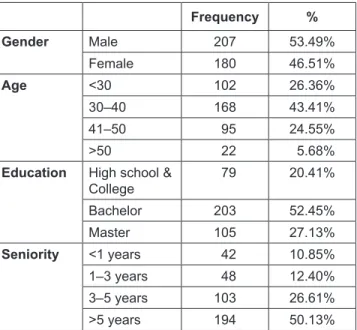
Job crafting refers to changes that individuals make in their work to achieve their preferences and needs. Contingent on the social exchange theory, the aim of this study is to explore the relationship between job crafting and job performance. In addition, the study examines the mediating effect of social capital in the relationship between job crafting and job performance. The data was collected from 387 employees in Vietnamese industrial enterprises through a questionnaire survey using both qualitative and quantitative methods.
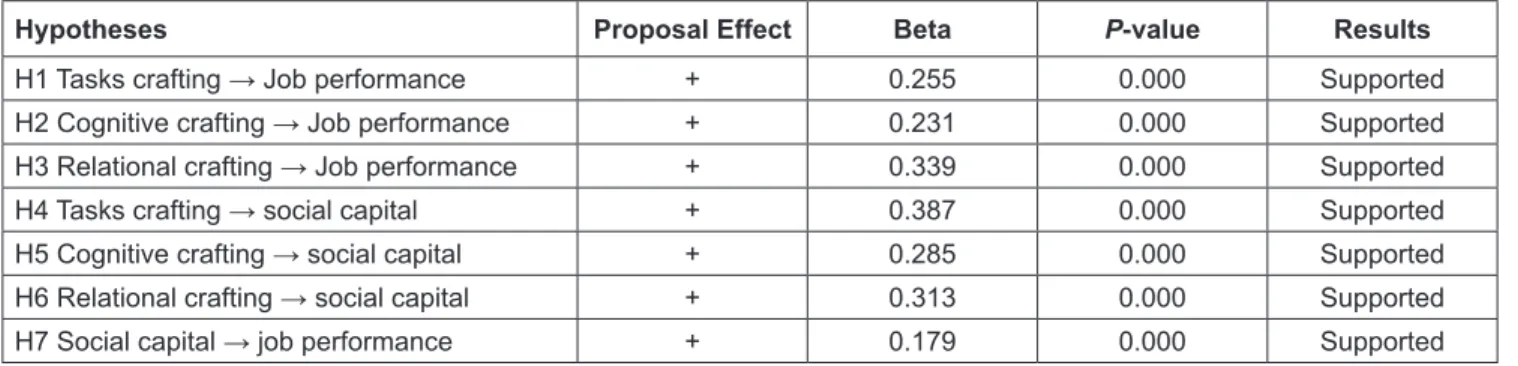
The information was then analyzed by explanatory factor analysis (EFA) confirmatory factor analysis (CFA) as well as structural equation modeling (SEM). The results show that all three dimensions of job crating positively affect job performance and that social capital plays a mediating role in that relationship. This study contributes to the field of human resources management, particularly job crafting, by examining different dimensions of job crafting that impacts job performance. Moreover, this is the first study to test the mediating role of social capital on the relationship between job crafting and job performance. These insights may help the organizational managers to encourage beneficial job crafting.
Keywords: Job Crafting, Social Capital, Job Performance, Industrial Sector, Vietnam JEL Classification Code: M1, M10, M12, M5, M54
Job crafting is one of the specific forms of proactive behavior. Job crafting is defined as the changes in work made by employees to meet their preferences and needs (Tims et al., 2013), and can lead to the accumulation of social capital (Bolino et al., 2002). The notion of a social network is taken from job design, and the link between job crafting and social capital is worth exploring (Muhammad et al., 2016; Qi et al., 2014). Applying social exchange theory (Blau, 1960), this means that by job crafting, employees have the advantages of exchanging resources with their colleagues and they are good at building and maintaining a network of relationships with others. Job crafters actively help their colleagues, and as such they get these benefits from their colleagues, resulting in increased social capital.
To our knowledge no study has been found, that engages social exchange theory, which is the most often used theory in behavior literature, to explain the impact of job crafting on job performance from the data collected from Vietnamese industrial company employees. There are two main contributions of this study to the literature of human resource management. First, this study examines the relationship of all three dimensions of job crafting and social capital. Second, most of the previous studies were explored
1
First Author and Corresponding Author. Ph.D. Student, Graduate School, Ho Chi Minh City Open University, Vietnam [Postal Address:
97 Vo Van Tan Street, District 3, Ho Chi Minh City, 700000, Vietnam]
Email: [email protected]; [email protected]
© Copyright: The Author(s)
This is an Open Access article distributed under the terms of the Creative Commons Attribution Non-Commercial License (https://creativecommons.org/licenses/by-nc/4.0/) which permits unrestricted non-commercial use, distribution, and reproduction in any medium, provided the original work is properly cited.