서 론
Idso1,2)는 대기 중 이산화탄소 농도가 현재의 두 배로 증 가할 경우 대기온도는0.26℃ 감소할 것으로 예측한 바 있으 나, IPCC3)에 따르면20세기 동안 지구의 평균 온도는 이미 상승했고 세기 말까지 대기 중 이산화탄소 농도는 0.6℃ , 21
현재의 두 배 수준 그리고 대기 온도는 1.4 5.8~ ℃ 상승할 것으로 예측하고 있다 연구자들 간 온난화에 대한 많은 논란. 에도 불구하고 이러한 온난화 현상은 지구생태 환경 중 특히 농업생태계에 큰 영향을 미칠 것으로 판단된다 온난화의 두. 가지 주요 인자로 거론되는 온도와 이산화탄소 상승이 작물
생장과 밀접한 관계가 있기 때문이다.
일반적으로 대기 중 이산화탄소 농도 증가는 작물의 광합 성 속도를 촉진시킴으로써 작물 생육과 수량을 증가시킨다. Kimball4)에 따르면37종의 작물을 대상으로 대기 중 CO2
증가 효과를 분석한 결과 대기 중 이산화탄소 농도가 현재의, 두 배로 상승할 경우 작물 수량은24 43%~ 증가할 것으로 예측하였다 그러나 작물 수량에 미치는 이산화탄소 효과는. 작물에 따라 다소 다른 양상을 보이는 것으로 생각된다 증가. 된 이산화탄소 환경 하에 장기간 노출시 엽육조직 내 축적된 전분입자가 엽록체의 그라나 구조를 압박하여 구조적 변형을 일으킴으로서 광합성작용에 대한 feedback 억제의 원인이 될 수 있기 때문이다5-10). 유사한 보고로서Lee와Lee5)는 대 기중 이산화탄소 농도를800 mol molμ -1로 상승시 정상(350
mol mol
μ -1)에 비해 토마토 엽 내 전분입자가 현저하게증가
이산화탄소 및 온도 상승이 토마토 수량 및 과실특성에 미치는 영향
이인복
*․ 강석범 ․ 박진면
농촌진흥청 국립원예특작과학원 원예특작환경과
년 월 일 접수 년 월 일 수리
(2008 11 21 , 2008 12 22 )
Effect of Elevated Carbon Dioxide Concentration and Temperature on Yield and Fruit Characteristics of Tomato ( Lycopersicon esculentum Mill.)
In-Bog Lee*, Seok-Beom Kang, and Jin-Myeon Park (National Institute of Horticultural and Herbal Science, RDA, Suwon, 440-706, Korea)
ABSTRACT: The objective of this study is to investigate the effect of the level of CO2 (370 and 650 molμ mol-1) and temperature (ambient and ambient+5 ) on tomato growth and fruit characteristics as affected by℃ the application rate of N-fertilizer (68 and 204 N kg ha-1), for the purpose of evaluating the influence of elevated CO2 and temperature on tomato crop. The elevated atmospheric CO2and temperature increased the plant height and stem diameter for tomato crop, while the differences among the nitrogen(N) application rates were not significantly different. Under the elevated CO2, temperature, and a higher N application rate, the biomass of aerial part increased. The fruit yield showed the same result as the biomass except for the elevated temperature. The elevated temperature made the size of fruit move toward the small, but the elevated CO2 and the application of N-fertilizer were vice versa. The sugar content and pH of fruit juice were affected by nitrogen application rate, but not by the elevated CO2 and temperature. These results showed that both the elevated CO2 and temperature stimulated the vegetative growth of aerial parts for tomato, but each effects on the yield of fruit showed an opposite result between the elevated temperature and CO2. In conclusion, the elevated CO2increased tomato yield and the ratio of large size of fruit, but the elevated temperature did not. Therefore, to secure the productivity of tomato as nowadays in future environment, it will need to develop new breeder as high temperature-tolerable tomato species or new type of cropping systems.
Key Words: Tomato yield, Fruit size, Leaf starch, Photosynthesis
428
*
연락저자:
Tel: +82-31-290-6223 Fax: +82-31-290-6259
E-mail: [email protected]
함을 관찰하였다 그 결과 이산화탄소를 상승시킨. 800 mol molμ -1처 리구에서 정식 후30일 이후에 광합성능이 서서히 감소하기 시작하여50일째에는 대조구(350 mol molμ -1)보다 낮은 광 합성능을 보였다11).그에 반하여Ho12)는 대기 중 이산화탄소 농도의 증가에도 불구하고 광합성능은 큰 차이 없으나 동화 산물의 전류속도는 증가한다고 하였다 이러한 작물 반응의. 차이는 작물의 종류에 따라서 또는 같은 작물이라 할지라도, 품종 간 다른 양상을 보일 수 있음을 의미한다 한편 많은 연. 구들이 제한된 짧은 시간동안 이산화탄소를 작물에게 노출시 키거나 일정기간 동안 재배한 결과를 토대로 작물 생산성에, 미치는 온난화 영향을 해석하는 경우가 많다 따라서 본 연구. 는 토마토 전 생육기간 동안 상승 이산화탄소 및 상승 온도 에 장기간 노출 시 생육 수량 및 과실특성에 미치는 영향을, 평가하고자 실시하였으며 그 결과를 보고하고자 한다, .
재료 및 방법
실험재료 및 재배방법
실험을 위하여 육묘 상에서45일간 생장한 모모타로 토‘ ’ 마토(Lycopersicon esculentumMill.) 유묘는 사양토와 피트 모스를 2:1 부피비율(Table 1)로 충전한 1/2000a Wagner 포트에 2006년 월4 15일 정식한 다음 착근 일후 대기 중, 7 이산화탄소 농도와 온도 조절이 가능한 폐쇄된 유리온실 안 에 완전임의배치법에 따라 반복으로 배치하였다 온실 내5 . 대기 중CO2농도(±20 mol molμ -1) Infrared는 가스 분석기 (ZRH model, Fuji Electric Co., Japan)를 이용하여 그리고, 온도(±1 )℃는 실시간으로 수집된 기상정보를 바탕으로POREX 중앙분산식 제어시스템을 이 6800(POSCON Co., Korea)
용하여 조절하였다 온도 및 이산화탄소 농도에 따라. 정상기후 (대기CO2및 대기온도 를 대조로 하여 상승) CO2(650 mol molμ -1 CO2및 대기온도 상승온도 대기), ( CO2및 대기온도+5 ),℃ 상 승기후(650 mol molμ -1 CO2및 대기온도+5 )℃ 등4시험구 로 처리하였다 시험기간 동안. RDA13)의 방법에 준하여 질소 는 요소를 이용하여 저 농도 질소(68 kg N ha-1)와 표준 질소 (204 kg N ha-1)로 구분하여처리하였으며 인산과 칼리는 용, 성인비와 염화칼리를 사용하여 각각 103 kg ha-1과122 kg ha-1의 비율을 시비하였다.
분석 및 조사방법
RDA14)의 분석방법에 따라 토양 pH는 토양과 증류수의 비를 1:5로 혼합하여 진탕 후 pH meter(ORION Model 로 측정하였고 토양 는 법으로 침출한 다 720A, USA) , EC 1:5
음 전기전도계(YSI model 35, USA)로 측정하였다 토양 유. 기물은Tyurin , KCl-법 추출성 질산태 질소는 Kjeldahl법으 로 측정하였고 유효인산은, Lancaster ,법 그리고 치환성 K, Ca, Mg NH은 4OAc(pH 7.0)추출 후Inductively coupled plasma atomic emission spectroscopy(GBC Integra
로 측정하였다 XM2 model, Australia) .
토마토의 초장 경경 및 부위별 건물중은 수확기인 정식, 후120일째 그리고 엽록소 엽육조직 중의 전분함량 비엽건, , , 물중(specific leaf dry matter, SLDM) 및 광합성은 정식 후 90일째 조사하였다 토마토 엽의 엽록소 함량은. SPAD
엽록소측정기 를 이용하여 측정하였고
502 (Minolta, Japan) ,
은 엽의 건조중량을 엽면적으로 나누어
SLDM mg cm-2로
표기하였다 엽 내 유리당 분석을 위하여. Wang등15)의 방법 에 따라 엽 시료0.5 g에20 mL 80% 에탄올을 가한 후 하 룻밤 침지 시킨 다음 호모지나이저로 분쇄하면서 회 침출하3 여 토마토 엽 중saccharose (sucrose, glucose, galactose, 을 분석하였고 전분 함량 분석을 위하여 침출 잔류 fructose) ,
물에 1mL 0.1% amylogucosidase(EC 3.2.1.3) (Sigma 를 가하여 전분입자로부터 가수분해 된
Chemical Co.) glucose
를 전분함량으로 환산하였다 당 분석을 위하여. CARBOSep 컬럼이 부착된
CHO-820 CA HPLC (Youngin Instrument
에 용액 을 분당
Co., Korea) EDTA (50 mg EDTA/1L) 0.5 속도로 용리하였으며 이 때의 오븐온도는 사용된
mL , 80 ,℃
검출기는Refractory index detector 이었다 엽육조직 내. 전분입자에 대한 광학현미경 검경을 위하여Luft16)의 방법에 따라 엽육조직 절편을2.5% glutaraldehyde와1% osmium
를 이용하여 고정한 다음
tetroxide , 0.1M phosphate buffer
로 세척한 후 을 이용하여 탈수하였다
(pH 7.2) ethanol .
블록을 만들기 위하여 을 시료 절편과
Epon epon+D.M.P 30
함께silicon mold에 넣어서 열중합 시켰다. Epon블록은초 미세 절편기(Ultracut R, Leica Co)를 이용하여1,500nm의 두께로 절단 후, 0.5% periodic acid(H5IO6) 용액, Schiff's
그리고 용액 순서로 침지하
reagent, 1% sodium bisulfite
여 염색한 다음 광학현미경, (Axioskop 2, Carl Zeiss Co., 을 이용하여 배로 검경하였다 광합성은 토마
Germany) 100 .
토 성엽을 대상으로 휴대용 광합성측정기(LI-6400, LI-COR 를 이용하여 측정하였다 측정 당시의 Inc., Lincoln, USA) .
챔버 내 이산화탄소 농도는 각 처리구의 이산화탄소 농도와 동일한 조건에서 측정하였으며 광량은, 0 2000 mol m~ μ ・ -2・ s-1 범위 엽면적은, 6 cm2, IRGA 챔버 내 온도는25℃로 유 지하며 30초 간격으로 회씩 반복으로 측정하여 평균값을5 3 이용하였다.
Table 1. Soil chemical properties before this experiment
(1:5) pH EC
(dS m
-1) Av.P
2O
5(mg kg
-1) OM (g kg
-1)
Exch. cation (cmol kg
-1) NO
3-N (mg kg
-1)
K Ca Mg
7.0 1.4 660 33 1.0 6.0 2.4 42
과실크기 분포는Locascio등17)의 기준에 따라 완숙 토마 토를 대상으로 조사하였으며 과실 당도는 과실즙액을 착즙, 하여 굴절당도계(Atago, PR-101 model, Japan)로 측정하 고 산도는pH meter로 결정하였다.
결과 및 고찰
생육 및 엽 특성
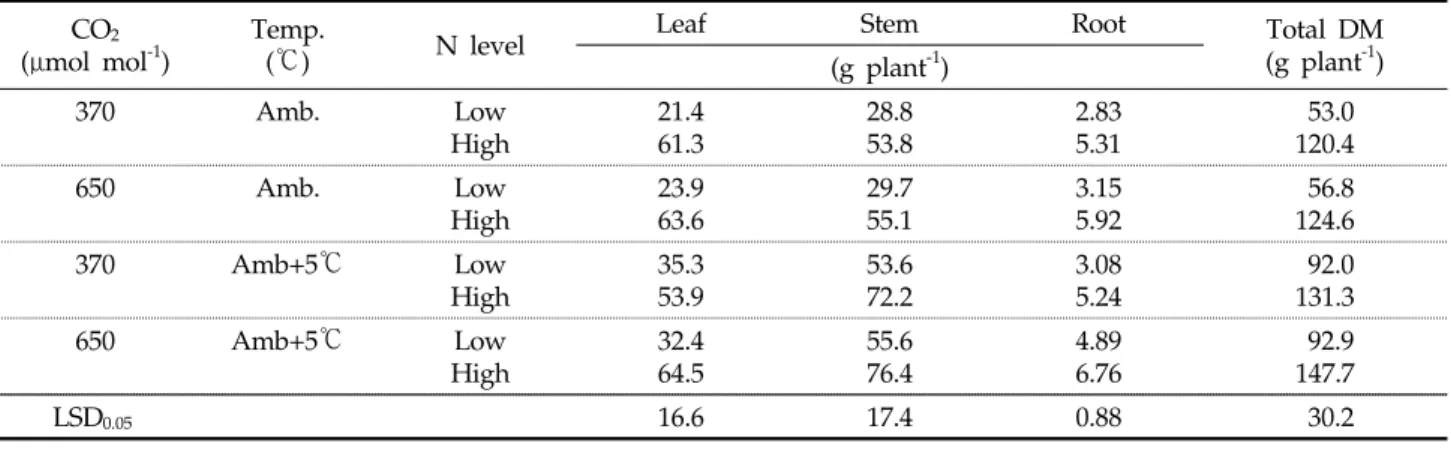
대기 중 이산화탄소 농도가 550 mol molμ -1로 상승 시 C3두과작물의 평균 생장량은24%, 영년생 목본류인 포도와 목화의 생장량은32% 가량 증가하여18) 대기 중 이산화탄소 농도 상승은 작물의 생장을 조장하는 것으로 판단된다 또한. 일반적으로 토마토는 온도 증가에 따라25 30~ ℃ 범위까지 동화산물 전류가 활발하여19), 대기 중 이산화탄소 및 온도의 증가는 토마토 생육을 촉진 시킬 것으로 예측된다 유사한 결. 과로서 질소처리와 무관하게 대기 중CO2및 온도처리 증가 로 대조구인 정상기후 대기온도 대기( , CO2)와 비교할 때 전반 적으로 토마토의 초장 경경, (Table 2) 및 총건물중(Table 3) 은 증가하였다 대기 중 이산화탄소 농도와 온도 증가에 따른. 토마토 부위별 건물중 변화 양상을 살펴보면 상승온도 대기, (
온도+5 ,℃ 대기CO2) 처리로 줄기의 건물중은 증가하였으나 잎과 뿌리는 뚜렷한 경향이 없었던 반면 상승 이산화탄소 농, 도 처리는 잎 줄기 뿌리 모두 증가시켰다, , (Table 3).대기 중 이산화탄소 농도 증가에 따른 잎의 건물중 증가(Table 3)는 비엽건물중(specific leaf dry matter, SLDM) 증가(Table 와 밀접한 관련이 있어 보인다 즉 이산화탄소 농도 증가
2) . ,
로 토마토의 엽 두께(SLDM)는 저 질소 및 고 질소 처리 시 대조구에 비해 각각33%와23.5% 증가를 보였는데 이러한, 증가는 상승 온도 처리구의13.9% 2.9%와 증가와 비교할 때 현저한 수준의 증가이다. Kimball 등18)은SLDM에 대한 연 구결과들의 경우 심한 변이로 인해 명확한 단정이 어렵다 하 였음에도 불구하고, Wand 등20)은190 mol molμ -1의 이산 화탄소 상승으로C3와C4초지작물의SLDM은 각각13%와
의 증가를 보였고 등
3% , Daepp 21)은 호밀을 대상으로 한 6 년간의 연구결과로부터SLDM은0 14%~ 증가하였으며 토, 양 내 질소가 충분한 경우보다 낮은 질소농도 환경 하에서 의 증가 정도는 더욱 크다고 보고하였다 뿌리 건물중
SLDM .
또한 잎과 유사하게 이산화탄소 농도 처리시 질소처리와 무 관하게 약11%증가했다(Table 3). 유사한 결과들로서 이산 화탄소 증가로 클로버 뿌리는 25%22), 그리고 C3 초지류의
Table 2. Growth and leaf characteristics of tomato at the different conditions of atmospheric CO2 and temperatures, and soil N levels
CO
2( mol mol μ
-1) Temp.
( ) ℃ N level Plant height
(cm)
diameter Stem (mm)
Chlorophyll (SPAD)
Specific leaf DM (mg cm
-2)
Saccharose of leaf (mg g
-1)
Starch of leaf (mg g
-1)
370 Amb. Low
High 173
187 8.9
10.0 31.0
39.1 7.2
6.8 20.7
19.6 17.0
13.5
650 Amb. Low
High 204
203 9.0
10.2 33.6
37.0 9.6
8.4 40.3
29.4 33.9
25.3
370 Amb+5℃ Low
High 225
241 10.7
10.1 39.3
41.9 8.2
7.0 40.0
22.8 14.3
10.5
650 Amb+5℃ Low
High 254
236 10.8
10.3 38.6
36.1 10.2
9.5 28.3
25.3 30.7
19.3
LSD
0.0524 2.1 6.7 1.1 6.2 4.2
Table 3. Dry matter of tomato plant parts at the different conditions of atmospheric CO2 and temperatures, and soil N levels
CO
2( mol mol μ
-1) Temp.
( ) ℃ N level Leaf Stem Root Total DM
(g plant
-1) (g plant
-1)
370 Amb. Low
High 21.4
61.3 28.8
53.8 2.83
5.31 53.0
120.4
650 Amb. Low
High 23.9
63.6 29.7
55.1 3.15
5.92 56.8
124.6
370 Amb+5℃ Low
High 35.3
53.9 53.6
72.2 3.08
5.24 92.0
131.3
650 Amb+5℃ Low
High 32.4
64.5 55.6
76.4 4.89
6.76 92.9
147.7
LSD
0.0516.6 17.4 0.88 30.2
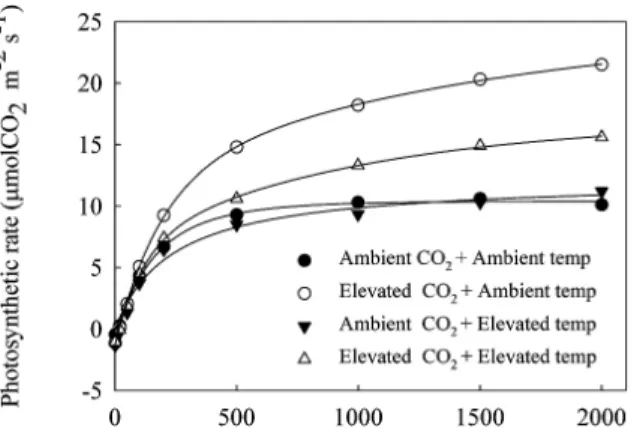
뿌리는 평균 47% 가량 증가23)한다고 보고된 바 있다 한편. 대기 중 이산화탄소 증가에 따른 엽과 뿌리의 발달은 광합성능 증가와 밀접한 관련이 있어 보인다. 380 mol molμ -1의 이산 화탄소 농도 증가로 토마토 엽의 광합성 속도는 약 두 배가량 증가하였으며(Fig. 1),그 결과 동화산물인 유리당(saccharose) 과 전분 함량은 잎에서 현저히 증가하였다(Table 2 Fig. 2).와 이러한 식물체내 탄수화물 축적현상에 대해 Lee와 Lee5)는 와 의 관점에서 해석하였다 즉 광합성의 기질이
source sink . ,
되는 이산화탄소 농도 증가로 광합성속도가 증가하여 탄수화 물 합성량은 많아지고 합성된 탄수화물을 수용할 충분한, sink 가 있을 경우 탄수화물 축적은 없으나sink가 부족할 경우 과잉 의 동화산물은 잎 내 전분의 형태로 집적되어 광합성feedback 저해의 원인이 된다는 것이다 그러나. Lee Lee와 5)의 지적과는 달리 잎 내 전분 축적에 따른 광합성feedback저해현상은 관 찰되지 않았다. 그림 와 같이 광합성과 무관한 엽육조직 내에2 전분입자를 분산시킴으로써 전분입자 축적에 따른 광합성 억 제현상을 최소화 시킨 때문으로 판단된다 그에 반하여 온도. 증가는 이산화탄소 증가만큼 잎과 뿌리 발달에 효과적이지 못하였다(Table 3). 일반적으로 토마토의 적정 재배온도는 범위인데 반하여 온도상승처리구의 경우 재배기
25 30~ ℃ ,
간이 고온인 하계로 접어들면서 상승 이산화탄소 처리구에 비해 광합성 속도가 감소하고(Fig. 1), 고온기 동안 동화산물 의 전이가 제한된 때문19)으로 판단된다.
과실 특성 및 수량
대기 중 이산화탄소 농도 증가는 순 광합성 량을 증가시 킴으로서 많은 작물들에서 수량 증가 효과가 인정되고24-27), 온도 증가는 과실의 성숙기간을 단축시킬 뿐 아니라 과실의 비대속도를 증가시키는 것28)으로 알려져 있다 비록 낮은 질. 소 처리농도에서 이산화탄소 상승처리구의 토마토 상품수량 은 정상 이산화탄소 처리구에 비해 낮았으나 충분한 질소가, 공급된 처리구의 토마토의 수량은 대기 중 이산화탄소 증가 로49%의 수량이 증가하였으며(Table 4), 이러한 수량 증가 Fig. 1. Light-response curves for photosynthesis of leaves
measured at the conditions of CO2 and temperature.
Photosynthesis was measured in the leaves of tomato applied with standard N.
Fig. 2. Electron photomicrographs of mesophyll tissues showing starch grains. Ambient(A) or elevated(B) CO2
concentration with ambient temperature pattern, and ambient(C) or elevated(D) CO2 concentrations with a temperature pattern 5
℃
above ambient. In the figures starch granules are a black spots. Investigation was achieved in the leaves of tomato applied with standard N.는Knecht O'Leary와 29)의 결과와 유사하다 반면에 대기 온. 도5℃상승 처리구의 토마토 상품 수량은 저질소 및 고질소 처리 모두에서 각각18%와33%의 토마토 수량을 감소시켰 으며 이산화탄소와 온도를 복합적으로 상승시킨 처리구에서, 도 질소처리와 무관하게 토마토 수량은 약 16% 감소하여 대기 중 온도상승은 토마토의 수량을 감소시키는 (Table 4)
인자로 작용하였다 한편 이산화탄소와 온도 상승에 따른 과. 실크기 분포를 살펴보면 정상기후에 비해 이산화탄소 증가, 시 질소처리와 무관하게 소형과는 감소하고 대형과는 증가하 였던 반면 온도 상승은 역으로 소형과는 증가시키고 대형과, 는 감소하는 경향을 보였다(Table 4).이와 같은 현상은 이산 화탄소 증가에 따른 광합성 특성 변화보다 온도 증가에 따른 고온장해가 미래의 토마토 생산성에 보다 큰 영향을 줄 수 있음을 의미한다 온도와 이산화탄소가 복합적으로 처리된. 상승기후 상승( CO2, 대기온도+5 )℃의 경우 광합성 속도는, 정상기후 대기( CO2, 대기온도 에 비해 약) 30%증가하였으나, 과실 수량이 낮고 소형 과실의 비율이 높았기 때문이다 실제. 로 지나친 고온은 토마토의 결실과 과실발달을 억제한다는 많은 증거가 있다 토마토의 적정 재배온도는. 25 30~ ℃ 범 위이나 주간과 야간의 온도가 각각26℃와20℃ 이상일 때 토마토 결실이 저해되고30), 지나친 고온은 난세포에 피해를 줌으로써 생식생장을 방해하며31-32)불임의 원인33)이 되는 것 으로 알려져 있다 더욱이 고온은 광합성 계의 활성을 저해. Ⅱ 함으로써 광합성 능력을 감소시키는 것으로 알려져 있는데34), 온도 증가에 따른 토마토 잎의 광합성 감소 현상(Fig. 1)도 그와 밀접한 관련이 있어 보인다 그 때문에. Aung35)은 특히 고온인 여름 시설환경 하에서는 초세 위축 및 고온장해에 따 른 피해가 빈번하다고 보고한 바 있어 온난화에 따른 온도 상승은 토마토 생산성에 심각한 영향을 줄 것으로 예측된다. 한편 토마토 과실의 당도와 산도는 온도 및 이산화탄소 처리로 현저한 변화가 없었던 반면 질소 처리량 증가로 당도,
는 증가하고 과실즙액의 pH는 다소 감소하는 경향이었다 이산화탄소 상승에 따른 광합성 증가로 동화산물 (Table 4).
의 생산량이 증가하였으나 과실의 당도와 산도에는 별 다른 영향이 주지 못하였다.
결론적으로 이산화탄소 증가에 따른 광합성 속도 증가로 지상부 및 지하부 발달이 촉진되어 과실 수량이 증가하고 대 형 과실의 분포비율이 높아졌으나, Lee와Lee5)가 보고한 바 와 같은 잎 중 전분축적에 따른 광합성의feedback 저해 현 상은 관찰되지 않았다 반면에 대기 온도 증가는 과실의 수량. 을 감소시키고 과실의 발달을 저해함으로써 소형과의 비율을 높이는 결과를 초래 하였다 이러한 결과들을 고려할 때 미래. 기후 환경하에서 안정적인 토마토 생산을 위해서는 고온 적 응성 품종을 육성하거나 고온피해를 최소할 수 있는 재배기 술이 개발되어야 할 것으로 판단된다.
적 요
이산화탄소 상승에 따른 지구온난화 환경이 토마토의 생 육반응에 미치는 효과를 검토하기 위하여 대기 중 이산화탄 소농도(370과650 mol molμ -1)와 온도수준 대기온도와 대기( 온도+5 )℃을 달리하면서 질소 처리수준(68 204 kg N ha과 -1) 별 토마토의 생육 수량 및 과실크기 분포 등을 조사하였다, . 대기 중 이산화탄소 농도와 온도 증가는 토마토의 초장과 경 경을 증가시켰으나 질소처리에 따른 초장과 경경 변화는 뚜, 렷한 경향이 없었다 토마토의 지상부 중량은 상승 이산화탄. 소와 상승 온도 조건하에서 그리고 높은 농도의 질소처리로, 증가하였다 토마토의 과실 수량은 높은 질소농도 조건하에. 서 그리고 상승 이산화탄소 환경 하에서 증가하였으나 상승, 온도 환경 하에서는 감소하였다 토마토 과실의 크기분포는. 대기온도 증가로 인해 소형과의 비율이 증가하고 대형과는 감소하였으며 이산화탄소 증가로 인해 소형과는 감소하고, Table 4. Fruit characteristics and size distribution of tomato at the different conditions of atmospheric CO2 and temperatures, and soil N levels
CO
2( mol mol μ
-1) Temp.
( ) ℃ N level Soluble solid (Bx%)
of fruit pH juice
Size distribution (g plant
-1) Marketable fruit yield Small Medium Large Extra
large (g plant
-1)
370 Amb. Low
High 5.7
6.7 4.4
4.3 327
252 371
334 160
287 72
522 930
1395
650 Amb. Low
High 5.6
5.8 4.5
4.4 98
85 269
345 231
250 277
1405 875
2085
370 Amb+5℃ Low
High 5.7
6.1 4.5
4.4 296
413 296
187 175
338 0
0 767
938
650 Amb+5℃ Low
High 5.5
6.6 4.5
4.3 327
181 336
431 116
330 0
225 779
1167
LSD
0.050.3 0.2 344
* Small, 85 114g; Medium, 115 149g; Large, 150 204g; Extra large, >204g ~ ~ ~
초대형과는 증가한 반면 질소처리는 대형과와 초대형과의, 비율을 크게 하였다 과실의 당도와 산도는 상승 이산화탄소. 와 상승 온도 처리로 현저한 차이가 없었으나 질소처리 농도, 증가로 인해 당도는 증가하고 과실즙액의pH는 감소하였다. 결과적으로 온도 상승은 과실 수량과 과실 크기를 감소시키 나 상승 이산화탄소는 과실 수량과 과실의 크기를 증대시키, 므로 온난화 환경 하에서 안정적인 토마토 생산을 위해서는 고온 적응성 품종을 육성하거나 새로운 재배기술 개발이 필 요함을 의미한다.
인용문헌
1. Idso, S. B. (1980) The climatological significance of a doubling of Earth's atmospheric carbon dioxide concentration, Science. 207, 1462-1463.
2. Idso, S. B. (1982) A surface air temperature response function for Earth's atmospheric, Boundary-Layer Meteorol. 22, 227-232.
3. IPCC(Intergovernmental Panel on Climate Change).
(2001) Special Report on Emissions Scenarios (SRES) - Climate Change 2001: Impacts, Adaptation and Vulnerability, IPCC.
4. Kimball, B. A. (1983) Carbon dioxide and agricultural yield: an assemblage and analysis of 430 prior observations, Agron. J. 75, 779-788.
5. Lee, Y. B. and Lee, B. Y. (1994) Effect of long term CO2enrichment on chlorophyll, starch, soluble protein content, and RUBPCase activity in tomato plants, J. Kor. Soc. Hort. Sci. 35, 309-317.
6. Ewart, A. J. (1986) On assimilatory inhibition, J. of the Linnean Soc. 31, 364-461.
7. Warren-Wilson, J. (1966) An analysis of plant growth and its control in arctic environments, Annals of Bot. 30, 383-402.
8. Wildman, S. G. (1967) The organization of grana- containing chloroplasts in relation to location of some enzymatic systems concerned with photosynthesis, protein synthesis and ribonucleic acid synthesis, pp. 295-319. In: Goodwin, T. W.(ed.). Biochemistry of chloroplasts, Vol. 2. Proceedings NATO Advanced Study Institute (Aberystwyth), New York Academic Press.
9. Neales, T. F. and Incoll, L. D. (1968) The control of leaf photosynthesis rate by the level of assimilate concentration in the leaf: a review of the hypothesis, Bot. Rev. 34, 107-125.
10. Paul, M. J. and Foyer, C. H. (2001) Sink regulation
of photosynthesis, J. of Exp. Bot. 360, 1383-1400.
11. Lee, Y. B. and Lee, B. Y. (1994) Effect of long term CO2enrichment on leaf temperature, diffusion resistance, and photosynthetic rate in tomato plants, J. Kor. Soc. Hort. Sci. 35, 421-428.
12. Ho, L. C. (1977) Effect of CO2enrichment on the rates of photosynthesis and translocation of tomato leaves. Ann. Applied Biol. 87, 191-200.
13. RDA(Rural Development Administration) (1999) Recommended standard fertilization for crops, RDA, Korea.
14. RDA(Rural Development Administration) (1988) Method of Soil Chemical Analysis, RDA, Korea.
15. Wang, Z., Yuan, Z. and Quebedeuax, B. (1997) Photoperiod alters diurnal carbon partitioning into sorbitol and other carbohydrates in apple, Aust. J.
Plant Physiol. 24, 587-597.
16. Luft, J. H. (1973) Compounding of Luft's epon embedding medium for use in electron microscopy with reference to anhydride: epoxide ratio adjust- ment, Mikroskopie. 29, 337-342.
17. Locascio, S. J., Olson, S. M. and Rhoads, F. M.
(1989) Water quantity and time of N and K application for trickle-irrigated tomatoes, J. Am.
Soc. Hort. Sci. 114, 265-268.
18. Kimball, B. A., Kobayashi, K. and Bindi, M. (2002) Responses of agricultural crops to free-air CO2
enrichment, Adv. in Agron. 77, 293-367.
19. Hull, H. M. (1952) Carbohydrate translocation in tomato and sugar beet with particular reference to temperature effect, Am. J. of Botany. 39, 661-669.
20. Wand, S. J. E., Midgley, G. F., Jones, M. H. and Curtis, P. S. (1999) Responses of wild C4 and C3
grasses (Poaceae) species to elevated atmospheric CO2 concentration: a meta-analytic test of current theories and perceptions, Global Change Biol. 5, 723-741.
21. Daepp, M., Suter, D., Almedia, J. P. F., Isopp, H., Hartwig, U., Frehner, M., Blum, H., Nösberger, J.
and Lüscher, A. (2000) Yield responses of Lolium perenne swards to free-air CO2enrichment increased over six years in a high N input system on fertile soil, Global Change Biol. 6, 805-816.
22. Hebeisen, T., Lüscher, A., Zanetti, S., Fisher, B.
U., Hartwig, U., Frehner, M., Hendry, G. R., Blum, H. and Nösberger, J. (1997) Growth responses of Trifolium repens L. and Lolium perenne L. as
monocultures and bi-species mixture to free-air CO2 enrichment and management, Global Change Biol. 3, 149-160.
23. Jongen, M., Jones, M. B., Hebeisen, T., Blum, H.
and Hendrey, G. (1995) The effect of elevated CO2 concentrations on the root growth of Lolium perenne and Trifolium repens grown in a FACE system, Global Change Biol. 1, 361-371.
24. Fock, H., Canvin, D. T. and Grant, B. R. (1971) Effects of oxygen and carbon dioxide on photosynthetic O2
evolution and CO2uptake in sunflower and Chlorella, Photosythetica. 5, 389-394.
25. Hellmuth, E. O. (1971) The effect of varying air-CO2
level, leaf temperature, and illuminance on the CO2 exchange of the dwarf pea, Pisium sativa L.
var. Meteor, Photosythetica. 5, 190-194.
26. Holly, W. D. (1970) CO2 enrichment for flower production, Trans. Am. Soc. Agr. Eng. 13, 257-258.
27. Kretchman, D. W. and Howlett, F. S. (1970) CO2
enrichment for vegetable production, Trans. Am.
Soc. Agr. Eng. 13, 252-256.
28. Adams, S. R., Cokshull, K. E. and Cave, C. R. J.
(2001) Effect of temperature on the growth and development of tomato fruits, Annals of Bot. 88, 869-877.
29. Knecht, G. N. and O'Leary, J. W. (1974) Increased tomato fruit development by CO2 enrichment, J.
Am. Soc. Hort. Sci. 99, 214-216.
30. Lohar, D. P. and Peat, W. E. (1998) Floral characteristics of heat-tolerance and heat-sensitive tomato cultivars at high temperature, Scientia Horticulturae. 73, 53-60.
31. Iwahori, S. (1966) High temperature injuries in tomato V. Fertilization and development of embryo with special reference to the abnormalities caused by high temperature, J. Jpn. Soc. Hort. Sci. 33, 379-388.
32. Stevens, M. A. and Rudich, J. (1978) Genetic potential for overcoming physiological limitations on adaptability, yield, and quality in the tomato, HortSci. 673-678.
33. Kinet, J. M. and Peet, M. M. (1997) Tomato, pp.
207-258. In: Wien, H. C. (Ed.), The Physiology of Vegetable Crops. Commonwealth Agricultural Breau (CAB) International, Wallinford, UK.
34. Havaux, M., Greppin, H. and Strasser, R. (1991) Functioning of photosystem Ⅰ and Ⅱ in pea leaves exposed heat stress in the presence or absence of light, Analysis using in vivo fluorescence, absorbance, oxygen and photoacoustic measure- ments, Planta. 186, 88-98
35. Aung, L. H. (1976) Effects of photoperiod and temperature on vegetative and reproductive responses of Lycoperisicon esculentum Mill., J. Am. Soc. Hort.
Sci. 101, 358-360