Screening of Rice Germplasm for the Distribution of Rice Blast Resistance Genes and Identification of Resistant Sources
Asjad Ali, Do-Yoon Hyun, Yu-Mi Choi, Sukyeung Lee, Sejong Oh, Hong-Jae Park and Myung-Chul Lee*
National Agrobiodiversity Center, National Institute of agricultural Sciences, RDA, Jeonju-si 54874, Korea
Abstract - Rice blast, caused by a fungus Magnaporthe oryzae, is one of the most devastating diseases of rice worldwide.
Analyzing the valuable genetic resources is important in making progress towards blast resistance. Molecular screening of major rice blast resistance (R) genes was determined in 2,509 accessions of rice germplasm from different geographic regions of Asia and Europe using PCR based markers which showed linkage to twelve major blast R genes, Pik-p, Pi39, Pit, Pik-m, Pi-d(t)2, Pii, Pib, Pik, Pita, Pita/Pita-2, Pi5, and Piz-t. Out of 2,509 accessions, only two accessions had maximum nine blast resistance genes followed by eighteen accessions each with eight R genes. The polygenic combination of three genes was possessed by maximum number of accessions (824), while among others 48 accessions possessed seven genes, 119 accessions had six genes, 267 accessions had five genes, 487 accessions had four genes, 646 accessions had two genes, and 98 accessions had single R gene. The Pik-p gene appeared to be omnipresent and was detected in all germplasm.
Furthermore, principal component analysis (PCA) indicated that Pita, Pita/Pita-2, Pi-d(t)2, Pib and Pit were the major genes responsible for resistance in the germplasm. The present investigation revealed that a set of 68 elite germplasm accessions would have a competitive edge over the current resistance donors being utilized in the breeding programs.
Overall, these results might be useful to identify and incorporate the resistance genes from germplasm into elite cultivars through marker assisted selection in rice breeding.
Key words - Rice blast, Disease resistance, Rice germplasm, Resistance gene
*Corresponding author. E-mail : [email protected] Tel. +82-63-238-4900
ⓒ 2016 by The Plant Resources Society of Korea
Introduction
Rice (Oryza sativa L.) is one of the most important cereal crops that feed half of the global population (Khush, 2004).
Due to different types of biotic and abiotic stresses, rice production is less (5 tons/ha) than its average yield potential (10 tons/ha) (Khush and Jena, 2009). Among the biotic stresses, blast caused by Magnaporthe oryzae has been reported as a major contributor to the yield gap (Sharma et al., 2012) in the rice growing ecosystems. Manipulation of disease resistance in rice has been a key objective in all rice breeding programs to maintain the production because many plant pathogens evolve quickly and may breakdown the resistance developed by resistance (R) genes (Pink, 2002) that will result in the form of disease spread. In this respect,
different factors such as growth stage of the plant at the time of infection, its resistance level and prevailing environmental conditions contribute towards the crop losses. Previously, different yield losses have been reported ranging from 5 to 10%, 8%, 14%, and 50 to 85% in India, Korea, China, and the Philippines, respectively (Padmanabhan, 1965). Therefore, the most effective way to control blast is to use resistant cultivars.
In the past two decades, many advances have been attained by exploring the genetics of resistance to the blast disease.
Both conventional and molecular genetic techniques have played their role to identify more than 100 genes for resistance to blast from japonica (45%), indica (51%), and other (4%) genotypes (Sharma et al., 2012). Generally, differential physiological races of M. oryzae are being used to identify R genes in landraces, cultivars, and wild rice collections (Tanksley et al., 1997). Resistance to blast is considered as a monogenic trait as some varieties are resistant
Original Research Article
to one race and susceptible to another. For example, Piricularia (pi) genes confer complete resistance to those strains which bear related avirulence (Avr) genes. This strategy of using single genes is successful with known and targeted strains but variable nature of M. oryzae pathogen breaks this resistance (Han et al., 2001). Such resistance is controlled by gene-for-gene hypothesis that leads towards incompatibility due to interaction between R:Avr genes.
Thus, in the development of durable resistant varieties, both major and minor genes can contribute collectively towards persistent resistance (Wang et al., 1994).
The R genes are being widely used in crop breeding for protection against various diseases. According to a previous report, these R genes, except chromosome 3 showed presence on all 12 chromosomes (Yang et al., 2008) and most of them clustered on regions of chromosome 6, 11, and 12 (Ballini et al., 2008). Twenty-two R genes have been cloned and many have been mapped in different rice varieties of japonica, indica, and wild species. Some of the R genes such as Pi39(t), Pi5, Pik, Pik-p, Pita, Pita-2, and Piz-t have been reported for broad-spectrum resistance (BSR) (Liu et al., 2007; Yang et al., 2008; Cho et al., 2007) and other genes such as Pib, Pii, Pik-m, Pit, and Pi-d(t)2 confer race specific resistance (RSR) (Chen et al., 2006; Ashikawa et al., 2008; Hayashi et al., 2009; Yang et al., 2008). Molecular markers linked to these genes are used in marker assisted selection (MAS) to provide broad resistance in the field. Many R linked markers such as RM3, RM247, T311, JJ113-T3, and YL155/87 have been discovered in previous reports (Jia et al., 2002; Liu et al., 2007; Chen et al., 2004; Hayashi et al. 2006) that could be used in MAS programs. MAS has the advantage for the blast control, functioning in accordance with the gene-for-gene hypothesis, it contributes in selecting the traits of interest along with linked molecular markers. With the progress in knowledge about blast resistance, different strategies have been used for breeding blast resistance that includes multilines, mixtures, and pyramiding (Abe, 2004; Zhu et al., 2000).
MAS has been used in pyramiding to confirm the presence of multiple genes and screening of populations to track the introgression of genes (Kelly, 1995). However, the changing nature of pathogen demands positive screening and identification for more blast R genes in germplasm.
Crop germplasm collections including landraces and wild relatives have been maintained in gene banks in different countries. These collections provide a favorable gene pool for specific traits such as resistance to blast. Previously, Pi9 from Oryza minuta and Pup1 locus from traditional cultivar Kasalath have been reported for their contribution towards resistance breeding (Qu et al., 2006; Gamuyao et al., 2012).
Thus, it is vital to explore the germplasm for its function and potential use in future breeding and food security. Therefore, the present study was carried out to assess the distribution of blast R genes in recent collections of rice germplasm and selection of resistant sources to develop high yielding rice varieties.
Materials and Methods
Plant materials and DNA extraction
The experimental material was comprised of 2,509 accessions of rice (Oryza sativa L.) collected from seven geographical regions of the world (24 countries) (Table 1). All the germplasm accessions used in this study were acquired from National Agrobiodiversity Center (NAS, RDA, Republic of Korea). The seeds were germinated and grown in the green house. Young leaves from two week old plantlets were used for DNA extraction. Genomic DNA was extracted according to the Qiagen DNeasy Plant Mini Kit protocol (QIAGEN, Germany). The concentrations of DNA were estimated using Take3 TM Micro-Volume Plate (BioTek Instruments, Inc., USA) and final adjustment was made at 100 ng/µℓ.
Gene specific markers
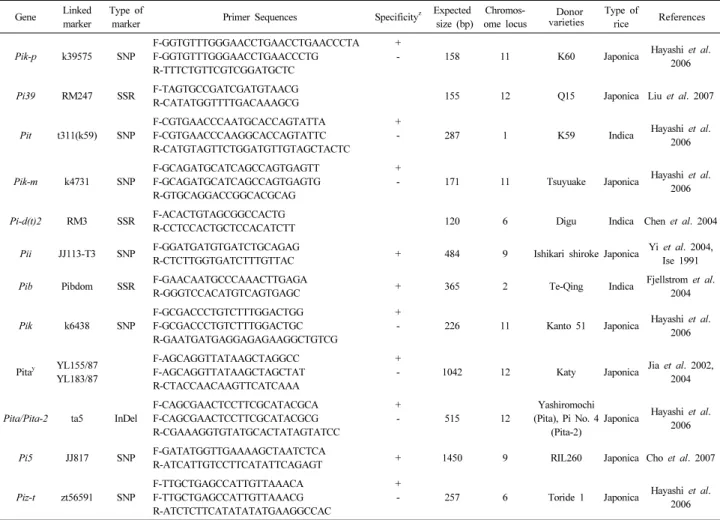
The whole germplasm collection of rice accessions was screened for the presence of twelve major blast resistance genes such as Pik-p, Pi39, Pit, pik-m, Pi-d(t)2, Pii, Pib, Pik, Pita, Pita/Pita-2, Pi5, and Piz-t using a set of SNP, SSR, and InDel markers (Table 2). All the markers were selected to identify the blast resistance genes in the germplasm used in this study.
Marker analysis
Gene specific markers were employed for genotyping by
examining the presence or absence of an amplified product.
Table 1. Details of 2,509 accessions of rice ( Oryza sativa L.) acquired from National Agrobiodiversity Center (NAS, RDA, Republic of Korea)
Region Country Abbreviation Number of
accessions Region Country Abbreviation Number of accessions
Eastern Asia Japan JPN 756 Central Asia Uzbekistan UZB 12
South Korea KOR 748 Azerbaijan AZE 05
China CHN 401 Kazakhstan KAZ 02
Taiwan TWN 100 Kyrgyzstan KGZ 02
Hong Kong HKG 01 Northern Asia Russia RUS 12
Southeastern Asia Philippines PHL 323 Western Asia Turkey TUR 04
Viet Nam VNM 17 Iran IRN 03
Myanmar MMR 02 Europe Italy ITA 20
Cambodia KHM 06 Hungary HUN 05
Southern Asia Afghanistan AFG 02 Spain ESP 04
Bangladesh BGD 09
India IND 35
Pakistan PAK 29
Nepal NPL 11
Table 2. List of blast resistance genes and specific primers used for the amplification of genes in 2509 accessions of rice
Gene Linked marker
Type of
marker Primer Sequences Specificity
zExpected size (bp)
Chromos- ome locus
Donor varieties
Type of
rice References Pik-p k39575 SNP
F-GGTGTTTGGGAACCTGAACCTGAACCCTA F-GGTGTTTGGGAACCTGAACCCTG R-TTTCTGTTCGTCGGATGCTC
+
- 158 11 K60 Japonica Hayashi et al.
2006
Pi39 RM247 SSR F-TAGTGCCGATCGATGTAACG
R-CATATGGTTTTGACAAAGCG 155 12 Q15 Japonica Liu et al. 2007
Pit t311(k59) SNP
F-CGTGAACCCAATGCACCAGTATTA F-CGTGAACCCAAGGCACCAGTATTC R-CATGTAGTTCTGGATGTTGTAGCTACTC
+
- 287 1 K59 Indica Hayashi et al.
2006
Pik-m k4731 SNP
F-GCAGATGCATCAGCCAGTGAGTT F-GCAGATGCATCAGCCAGTGAGTG R-GTGCAGGACCGGCACGCAG
+
- 171 11 Tsuyuake Japonica Hayashi et al.
2006
Pi-d(t)2 RM3 SSR F-ACACTGTAGCGGCCACTG
R-CCTCCACTGCTCCACATCTT 120 6 Digu Indica Chen et al. 2004
Pii JJ113-T3 SNP F-GGATGATGTGATCTGCAGAG
R-CTCTTGGTGATCTTTGTTAC + 484 9 Ishikari shiroke Japonica Yi et al. 2004, Ise 1991 Pib Pibdom SSR F-GAACAATGCCCAAACTTGAGA
R-GGGTCCACATGTCAGTGAGC + 365 2 Te-Qing Indica Fjellstrom et al.
2004
Pik k6438 SNP
F-GCGACCCTGTCTTTGGACTGG F-GCGACCCTGTCTTTGGACTGC R-GAATGATGAGGAGAGAAGGCTGTCG
+
- 226 11 Kanto 51 Japonica Hayashi et al.
2006
Pita
yYL155/87 YL183/87
F-AGCAGGTTATAAGCTAGGCC F-AGCAGGTTATAAGCTAGCTAT R-CTACCAACAAGTTCATCAAA
+
- 1042 12 Katy Japonica Jia et al. 2002, 2004
Pita/Pita-2 ta5 InDel
F-CAGCGAACTCCTTCGCATACGCA F-CAGCGAACTCCTTCGCATACGCG R-CGAAAGGTGTATGCACTATAGTATCC
+
- 515 12
Yashiromochi (Pita), Pi No. 4
(Pita-2)
Japonica Hayashi et al.
2006
Pi5 JJ817 SNP F-GATATGGTTGAAAAGCTAATCTCA
R-ATCATTGTCCTTCATATTCAGAGT + 1450 9 RIL260 Japonica Cho et al. 2007
Piz-t zt56591 SNP
F-TTGCTGAGCCATTGTTAAACA F-TTGCTGAGCCATTGTTAAACG R-ATCTCTTCATATATATGAAGGCCAC
+
- 257 6 Toride 1 Japonica Hayashi et al.
2006
z+: Resistant specific and -: susceptible specific primers,
ydominant marker.
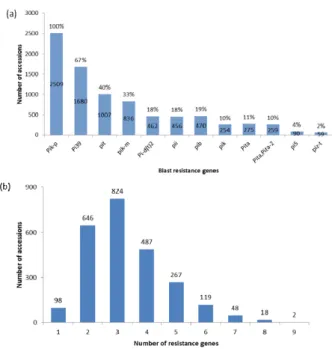
Fig. 1. Frequency distribution of blast resistance genes. (a) Frequency of 12 R genes among 2,509 accessions of rice ( Oryza sativa L.), (b) frequency of rice accessions bearing variable number of blast resistance genes.
The amplifications were carried out in 20 µℓ of reaction mixture containing 40 ng of genomic DNA, 0.5 µℓ of each primer (10 picomoles), 10x buffer 2 µ ℓ, 1 U of Taq DNA polymerase (Promega Co, USA), 1 µℓ of dNTP (2.5 mM), and 14.85 µℓ nuclease-free water. DNA amplifications were performed in PTC-100 thermal controller (MJ Research Watertown, MA, USA). Thermal cycling program involved an initial denaturation at 94 o C for 5 min, followed by 35 cycles of denaturation at 94 o C for 40 sec, annealing at 50-55 o C for 30 sec, primer extension at 72 o C for 30 Sec, followed by a final extension at 72 o C for 10 min. The amplifications from SSR markers were sized using high-resolution capillary electrophoresis on a QIAxcel system (Qiagen, Germany), while all other amplifications were performed using 2% agarose gel to visualize the banding pattern at >20 bp product size between the alleles.
The amplified fragments using markers were scored as presence (1) or absence (0) of amplicon linked to each gene DNA fragment.
Data analysis
The data was analyzed by principal component analysis (PCA) in Microsoft excel by add-in “Multibase” package (http://www.numericaldynamics.com). Rice blast resistance genes and rice accessions were examined for identifying the presence of principal components that may segregate germplasm into different regional classes. There were 12 variables (values of rice blast genes) in our data.
Results
Screening of rice blast resistance genes
The whole collection of rice germplasm was subjected to PCR-based markers to get data for the amplification patterns of resistance genes against rice blast using BSR (Pik-p, Pi39, Pik, Pita, Pita/Pita-2, Pi5, Piz-t) and RSR (Pit,Pik-m, Pi-d(t)2, Pii, Pib) genes. All the 2,509 accessions of different geographic origins possessed one or more blast resistance genes on the basis of positive bands for different markers (Fig. 1a). Among these R genes, Pik-p was widely distributed in 2,509 (100 %) accessions. The second most disseminated R gene was Pi39 in 1,680 accessions followed by Pit in 1,007, Pik-m in 836,
Pib in 470, Pi-d(t)2 in 462, Pii in 456, Pita in 275, Pik in 254, and Pita/Pita-2 in 259 accessions, whereas Pi5 and Piz-t were comparatively less amplified in 90 and 59 accessions, respecti- vely.
Most of the accessions in the entire collection contained
one to nine different R genes. Only two accessions had maximum
nine blast resistance genes, while 18 accessions possessed
eight blast resistance genes (Fig. 1b). Among other R genes,
forty-eight accessions had seven genes, 119 accessions had
six genes, 267 accessions had five genes, 487 accessions had
four genes, 824 accessions had three genes, 646 accessions
had two genes, and 98 accessions had only one gene. There
was not a single accession found without any R gene in the
present study. All the 98 monogenic accessions held Pik-p
gene to resist the rice blast. Two accessions which possessed
the highest number of R genes belong to Chinese germplasm,
while eighteen accessions, each of them with eight R genes
belong to different countries including the Philippines, South
Korea, China, Cambodia, and Viet Nam bearing six, five,
three (both for CHN and KHM) and one accession, respectively
(Fig. 2).
Fig. 2. Twenty rice accessions with highest number of resistance genes along with country of origin. Blue, and brown bars show 8, and 9 genes per accession, respectively.
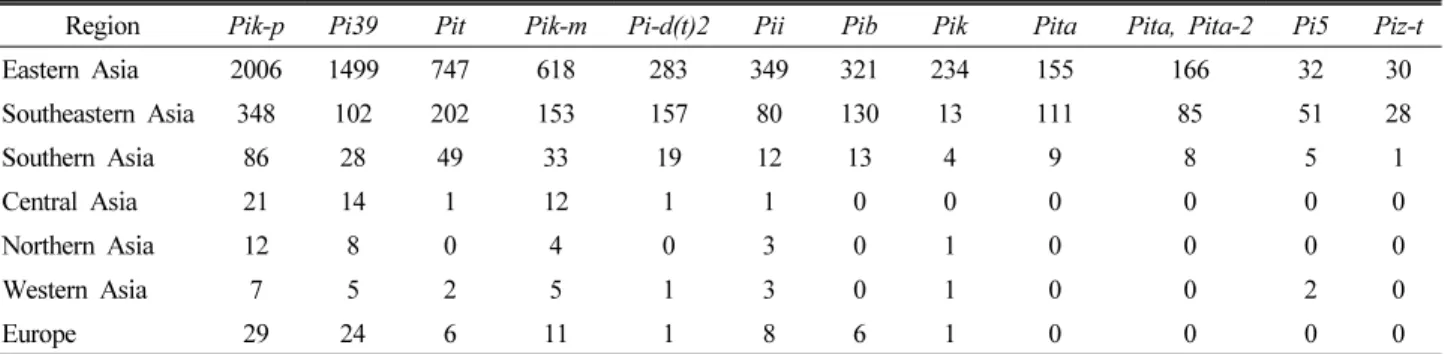
Table 3. Region-wise distribution of resistance genes in present collection of rice germplasm
Region Pik-p Pi39 Pit Pik-m Pi-d(t)2 Pii Pib Pik Pita Pita, Pita-2 Pi5 Piz-t
Eastern Asia 2006 1499 747 618 283 349 321 234 155 166 32 30
Southeastern Asia 348 102 202 153 157 80 130 13 111 85 51 28
Southern Asia 86 28 49 33 19 12 13 4 9 8 5 1
Central Asia 21 14 1 12 1 1 0 0 0 0 0 0
Northern Asia 12 8 0 4 0 3 0 1 0 0 0 0
Western Asia 7 5 2 5 1 3 0 1 0 0 2 0
Europe 29 24 6 11 1 8 6 1 0 0 0 0
Genetic diversity of BSR genes
The Pik multi-gene family comprised of three genes including Pik-p, Pik-m, and Pik and located on chromosome 11. Among them Pik-P was the most dominant gene, having been detected in all germplasm accessions from Asia and Europe (Table 3). Similarly, Pik gene was detected in 234, 13, and 4 accessions from Eastern, Southeastern, and Southern Asia, respectively, whereas a single accession from each of the Northern, and Western Asia and Europe expressed Pik gene.
As a whole, 836 (33.3%) accessions had a combination of Pik-p, and Pik-m (RSR) genes. Furthermore, seventy-nine accessions showed positive results for all the three Pik multi genes. The Pi39 was the second most dominant gene with its presence from minimum 5 accessions in Western Asia to maximum 1,499 accessions in Eastern Asia. The Pita gene was expressed in 155, 111, and 9 accessions, while Pita/Pita-2 was detected in 166, 85, and 8 accessions in Eastern, Southeastern, and Southern Asian germplasm, respectively.
Moreover, a combination of Pita and Pita/Pita-2 genes was
observed in 199 accessions (7.9%). However, both Pita and Pita/Pita-2 genes did not amplify in the rest of the germplasm studied here (Table 3). The Pi5 gene was present in 51, 32, and 5 accessions from Southeastern, Eastern, and Southern Asia, respectively, including two accessions from Western Asia. Similarly, Piz-t was detected in 30, and 28 accessions from Eastern and Southeastern Asian germplasm, respectively.
There was also a single accession from Bangladesh in the Southern Asia, which held Piz-t gene.
Genetic diversity of RSR genes
The Pit gene showed its presence in the whole set of germplasm in various frequencies except Northern Asia.
Eastern Asia had highest number of accessions (747) with Pit gene followed by Southeastern, and Southern Asia, and Europe with 202, 49, and 6 accessions, respectively. Whereas, two accessions from Western Asia and a single accession from Central Asia expressed Pit gene. The Pik-m gene was also expressed in the germplasm collected from all seven regions showing lowest presence (4 accessions) in Northern Asia and highest (618 accessions) in eastern Asia. The Pi-d(t)2 gene was possessed in 283, 157, and 19 accessions from Eastern, Southeastern, and Southern Asia, respectively.
Among other regions, each of the Central, and Western Asia,
and Europe demonstrated a single accession with Pi-d(t)2
gene. Similarly, the Pii gene was observed in Eastern,
Southeastern, and Southern Asian and European germplasm
with 349, 80, 12, and 8 accessions, respectively. Central
Asian germplasm depicted only one accession, while Northern
and Western Asia each possessed three accessions bearing
the Pii gene. The RSR genes Pit and Pi-d(t)2 were present in
the same single accession from Uzbekistan in Central Asia,
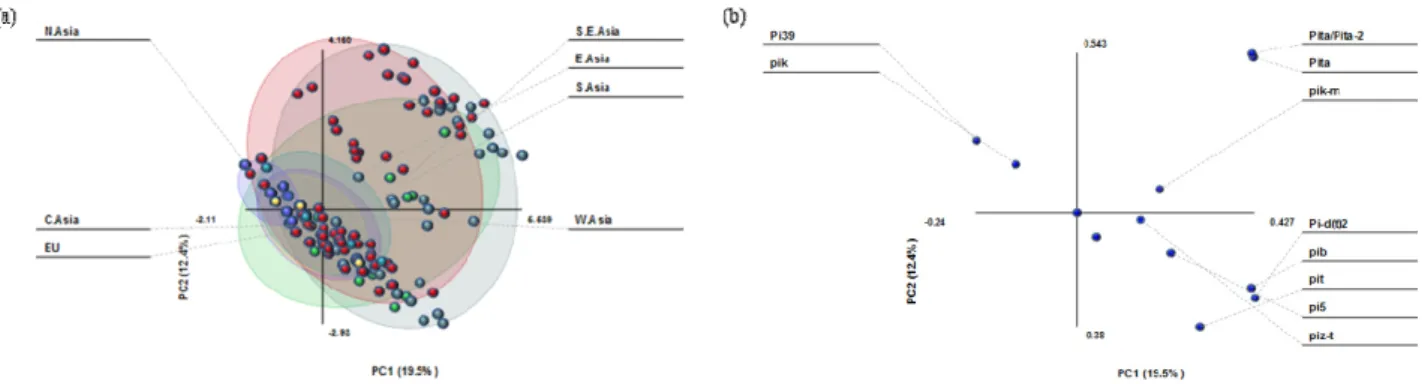
Fig. 3. Principal component analysis of randomly selected rice germplasm (653 accessions) based on twelve resistance genes. PC1 and PC2 are the first and second principal components, respectively. (a) PCA was done among germplasm collected from seven different geographical regions of Asia and Europe. The colors were coded according to regions: Eastern Asia, red; Southern Asia, green; Southeastern Asia, light blue; Europe, purple; Central Asia, yellow; Western Asia, blue-green; Northern Asia, slate-blue. (b) The overall variance and 12 mostly contributing resistance genes in these two components.
while the Pii gene was detected in an another accession from the same country. The Pib gene was amplified in 321, 130, and 13 accessions from Eastern, Southeastern, and Southern Asia, respectively, while it did not amplify in germplasm from Central, Northern, and Western Asia. There were also six accessions from Europe, which expressed Pib gene (Table 3).
Principal component analysis (PCA)
The PCA has been reported useful to determine the important variables and genetic variation among plant accessions (Shankar et al., 2009). Therefore, the general pattern of variation of rice blast resistance genes and rice germplasm was observed by PCA, which revealed the contribution and relation among 12 R genes (Fig. 3). The first two principal components (PCs) accounted for 19.5 and 12.4% of total variability, respectively. The PC1 was correlated with all R genes except Pi39 and Pik, however these R genes showed correlation in PC2. Among R genes Pi-d(t)2, Pib, Pita, and Pita/Pita-2 were more important than other variables in constructing PC1 (Fig. 3b). The overall analysis indicated that North Asian germplasm clustered on the left part of the PCA graph with a higher proportion of accessions holding Pi39, Pik-p, Pik-m, and Pii genes, while Central and West Asian, and European germplasm was located on the lower right part with more accessions showing Pi39, Pik-m, Pii, and Pit genes, including Pi-d(t)2 which was present in one accession from each region (Fig. 3, Table 3). The majority of accessions from Southern, Southeastern, and Eastern Asia
were located on the upper right side of the graph. These three regions were influenced by Pi-d(t)2, Pita, Pita/Pita-2, Pib, and Pit genes in wider extent and Pi5, Pik-m, piz-t, Pii, Pi39, and Pik genes from moderate to lesser extent. The Pik-p gene remained with no influence on resistance holding its position at zero scale in PCA analysis (Fig. 3).
Selection of elite sources for resistance breeding
Based on the findings from this study a set of 68 accessions of elite germplasm expressing higher number of R genes was identified from Eastern, Southeastern, and Southern Asia.
Among fourteen selected accessions from Chinese germplasm, two accessions (K115566, IT114581) held highest number (9) of R genes followed by three and nine accessions each with eight and seven genes, respectively. The Piz-t gene was absent in Chinese germplasm, whereas Pik gene was present in a single accession (Table 4). Korean germplasm also contributed with five and eleven accessions bearing eight and seven genes (Pik-p, Pi39, Pii, Pik-m, Pi-d(t)2, Pib, Pita, and Pita/Pita-2), respectively, whereas only single accession (IT17707) from Japanese collection exhibited seven genes.
Among the selected germplasm, 23% are the landraces
collected from various parts of South Korea. The germplasm
from Southeastern Asia contributed 32 accessions that
include twenty-five from Philippines, five from Cambodia,
and two from Viet Nam bearing seven to eight genes. All the
germplasm from Philippines were obtained from International
Rice Research Institute (IRRI). Southern Asia was represented
Table 4. Details of sixty-eight elite germplasm accessions bearing seven to nine rice blast resistance genes Accession
number Country Pik-p Pi39 Pit Pik-m Pi-d(t)2 Pii Pib Pik Pita Pita/
Pita-2 Pi5 Piz-t Total
K115566 CHN + - + + + + + - + + + - 9
IT114581 CHN + + + + + + - - + + + - 9
K115565 CHN + + - + - + + - + + + - 8
IT110068 CHN + - + + + + - - + + + - 8
IT219967 CHN + - + - + + + - + + + - 8
K174878 CHN + + + + - - + - + + - - 7
IT275266 CHN + + - + - + + - + + - - 7
IT275268 CHN + + - + - + + - + + - - 7
IT275307 CHN + + - + - + + - + + - - 7
K179078 CHN + + + + + - + + - - - - 7
K115661 CHN + - + + + - + - + + - - 7
IT219970 CHN + - + - + + - - + + + - 7
IT251604 CHN + + + - + - + - + + - - 7
IT264912 CHN + + + - + + - - + + - - 7
IT212003 KOR + + - + + - + - + + - + 8
IT259452 KOR + + + + - - + - + + - + 8
K115016 KOR + - + + + - + - + + + - 8
IT283524 KOR + + + + + - + - + + - - 8
K115407 KOR + + + + + - + - + + - - 8
IT192004 KOR + + - + + - + - + + - - 7
IT212028 KOR + + + - + - + - + + - - 7
K023073 KOR + + + + + - - - + + - - 7
IT251452 KOR + - + + + - + - + + - - 7
IT268126 KOR + + + + + + - - + - - - 7
K179257 KOR + + - + - - + + + + - - 7
K115021 KOR + - + + + - + - + + - - 7
K115413 KOR + - + + + - + - + + - - 7
K115417 KOR + - + + + - + - + + - - 7
K115418 KOR + - + + + - + - + + - - 7
K115419 KOR + + + + + - + - + - - - 7
IT17707 JPN + + + + - + + + - - - - 7
IT102255 PHL + + + + - - + - + + - + 8
IT122817 PHL + + + + - - + - + + - + 8
IT122884 PHL + + + + - + + - - - + + 8
IT265437 PHL + + + + - - + - + + - + 8
IT284228 PHL + + + - - + - - + + + + 8
IT102017 PHL + - - + + + + - + + + - 8
IT9592 PHL + - + + + + + - - - + - 7
IT122675 PHL + - + + + - + - + + - - 7
IT122759 PHL + - + + + - + - + + - - 7
IT122772 PHL + + + + - - + - + + - - 7
IT122848 PHL + + + + + + + - - - - - 7
IT228658 PHL + + + + + - + - + - - - 7
IT268017 PHL + - - + + + + - - + + - 7
K115081 PHL + + + + + - - - + + - - 7
IT267996 PHL + + + + + - + - + - - - 7
IT267999 PHL + + + + - - + - - - + + 7
K115166 PHL + - + + - - + - + - + + 7
Table 4. Details of sixty-eight elite germplasm accessions bearing seven to nine rice blast resistance genes (Continued) Accession
number Country Pik-p Pi39 Pit Pik-m Pi-d(t)2 Pii Pib Pik Pita Pita/
Pita-2 Pi5 Piz-t Total
IT265427 PHL +
y-
x- - + + + - + + - + 7
IT101911 PHL + - - - + + + + + + - - 7
IT101970 PHL + - - + + + + - + + - - 7
IT102078 PHL + - + + + - - - - + + + 7
IT102183 PHL + - - - + + + - + + + - 7
IT102193 PHL + - - - + + + - + + + - 7
IT102256 PHL + - - + + + + - - + + - 7
IT102265 PHL + + - + + - - - + + + - 7
IT265931 VNM + - - + + + + - + + + - 8
IT265530 VNM + - + + + - + - + + - - 7
IT268279 KHM + - - + + + + - + + + - 8
IT268280 KHM + + + + + + + - + - - - 8
IT268278 KHM + + + + + + + - + - - - 8
IT227062 KHM + + + - + - + - + + - - 7
IT268289 KHM + - - + + + - - + + + - 7
IT219152 IND + + + + + - - - + + - - 7
IT219153 IND + + + + + - - - + + - - 7
K177612 IND + - + + + - + - + + - - 7
IT275312 IND + - + + + - + - + + - - 7
IT265398 IND + + + + + - + + - - - - 7
z