• 검색 결과가 없습니다.

Immune Cells Activity, Nitrite Scanvenging and ABTS Radical Scavenging Activities of Codonopsis lanceolata Ethanol Extracts from Districts in Korea

N/A
N/A
Protected

Academic year: 2021

Share "Immune Cells Activity, Nitrite Scanvenging and ABTS Radical Scavenging Activities of Codonopsis lanceolata Ethanol Extracts from Districts in Korea"

Copied!
8
0
0

로드 중.... (전체 텍스트 보기)

전체 글

(1)

Immune Cells Activity, Nitrite Scanvenging and ABTS Radical Scavenging Activities of Codonopsis lanceolata Ethanol Extracts from

Districts in Korea

Hee-Ock Boo 1 *, Jeong-Hun Park 1 , Hong-Gi Kim 2 , Hag-Hyun Kim 3 , Soo-Jeong Kwon 3 , Dong-Yeon Seo 4 and Moon-Soon Lee 5

1 WELLPHYTO Co. Ltd., BI Center, GIST, Gwangju 61005, Korea

2 Biological Control Center, Jeonnam Provincial College, Gokseong 57510, Korea

3 Faculty of Food Nutrition and Cookery, Woosong Information College, Daejeon 34606, Korea

4 Department of Hotel and Restaurant Culinary Art, Kunjang University, Gunsan 54045, Korea

5 Department of Industrial Plant Science & Technology, Chungbuk National University, Cheongju 28644, Korea

Abstract - This study was executed to evaluate the immune activity, nitrite scavenging activity and ABTS radical scavenging activity against extracts of various concentration of ethanol solvent from Codonopsis lanceolata cultured at 6 local regions. The immune responses from both human T and B cell line was significantly enhanced in the cell growth compared to control while the cell growth was influenced at a certain period of culture. The results revealed that the cell growth of both human T and B cell was altered in a time dependent manner. The nitrite scavenging activity of ethanol extracts from various solvent concentration of C. lanceolata were affected by pH. At a pH of 1.2, the nitrite scavenging effect of all of the extracts tested observed higher than that of the other two pH ranges. There was no distinct detection of nitrite scavenging effects of the pH range 6.0. The ABTS radical scavenging activity was progressively increased in a dose-dependent manner, and the activity was the highest in 100% ethanol extract. The result from this investigation suggests that the extract of Codonopsis lanceolata could be an addition to basic medicine for immune modulation and natural food additives.

Key words - Immune activity, Nitrite Scavenging Activity, ABTS radical scavenging activity, Codonopsis lanceolata

*Corresponding author. E-mail : [email protected] Tel. +82-62- 224-8972

Introduction

Codonopsis lanceolata is a perennial flowering plant belonging to the family Campanulaceae and is grown commercially in East Asia. The roots of C. lanceolata have been used as a tonic crude drug and an edible plant in Korea, and mainly contain triterpenoid saponins including codonolaside, codonolaside

Ⅰ-Ⅴ, lancemaside A-G. Their saponins have shown anti- inflammatory effects such as bronchitis and cough, insomnia, and hypomnesia. Lancemaside A, which is a main constituent of C. lanceolata was reported to potently inhibit LPS-stimulated, TLR-4-linked NF-jB activation of 293-hTLR4-hemagglutinin (HA) cells (Joh et al., 2010). C. lanceolata is well known to affect various pharmacological effects for human health and

its consumption is increasing. Recently, plant and plant-derived products are treated a part of the healthcare system by applying the bioactive phytochemicals. Various chemical agents with strong apoptosis-inducing activity, but minimal toxicity have potential as anticancer drugs. As an herb, C.

lanceolata is widely used in food preparation, but its medicinal application has not been explored yet in South Korea (Wang et al., 2011). Due to the adverse ecological conditions and stress factors, immune dysfunction occurs in humans. However, synthetic, biotechnological and natural and natural medicinal preparations are used in order to mitigate the immunological disorders (Isaykina et al., 2008). Furthermore, medicinal plant may aslo reduce the risk of oxidative stress and cell damage (Guizani et al., 2013). It has been revealed that the increasing immune response will improve the defense against various diseases such as microbial infections and leukemia (Paul et

Original Research Article

(2)

al., 2014). In the immune system, cell and molecules play an important role. In addition, the cellular dichotomy in adaptive immune responses is also reflected in functional division whereas T cells serve as effectors of cell. Mediated immune responses such as delayed type hypersensitivity and B cells serve as the helpers for the production of highly specific proteins (Janeway et al., 1999). Medicinal plants are belived to be a potential source for the research of new biologically active compounds. A part from the medicinal effects of traditional herbs, exploratoty researches have been executed and a vast variety of new biological activities from traditional medicinal plants have recently been reported, including anticancer activity (Pittella et al., 2009). Nitric oxide (NO) is free radicals originated from the interaction between NO with O 2 or reactive O 2 species. That is classified as free radical because of its unpaired electron and shows crucial reactivity with certain types of proteins and other free radicals such as superoxide (Boora et al., 2014; Kang et al., 2015; Park et al., 2016). However, NO plays many important roles as an effector molecules in diverse biological systems.

NO is associated with various carcinomas and inflammatory conditions when it is exposed to chronic condition. Furthermore, the toxicity of NO aslo increases amazingly when it reacts with superoxide radical (Noh et al., 2014). Antioxidant compounds in food play an important role as a health protecting factor.

Scientific evidence suggests that antioxidants reduce the risk for chronic diseases, including cancer and heart disease.

Most of the antioxidant compounds in a typical diet are derived from plant sources and belong to various classes of compounds with a wide variety of physical and chemical properties. The main characteristic of an antioxidant is its ability to trap free radicals. Highly reactive free radicals and oxygen species are present in biological systems from a wide variety of sources. In response to the increased production of oxygen radicals the capacity of the antioxidant defense system is increased, but in most situations the response is moderate (Foyer et al., 1994). Consequently, we have focused on establishing a relationship between immune activity against T cell, B cell lines and nitrite scavenging activity with ABTS radical scavenging activity using root organ of C.

lanceolata.

Materials and Methods

Plant material and extract preparation

C. lanceolata plant was grown in 6 regions (Hwasun, Uljin, Hoengseong, Jeju, Jecheon and Muju areas), and purchased from the cultivation farms of each region. The root samples were freeze dried and then ground into a fine powder. The powder was stored at -20℃ for further experiments. The freeze dried powder was immersed in 30%, 50%, 70% and 100% ethanol concentrations, and the filtrate was collected for three times with constant stirring of the mixture at every 24 hrs interval of a 72 hrs total collection period. The crude extracts were filtered through a Whatman filter paper No. 3.

The collected filtrate was evaporated to dryness under vacuum at -45℃ using a rotary evaporator (IKA RV 10, Germany). The concentrated extract was stored at -20℃ until required.

Assay of immune activity

Immune enhancement effect was assayed in a similar method to the procedure described earlier (Lee et al., 2004) using T cell and B cell (RPMI 8226, KCLB No.10155). The cells were incubated for 24 hrs in RPMI-1640 medium containing 10% fetal bovine serum (FBS) at 37 ℃ under 5%

CO 2 in a humidified incubator. After the incubation for 24 hrs, purified cells were cultured for durations of 1~10 days at densities ranging from 2.5 × 10 4 cells/well in 24 well microtiter plates with adding the extract of 0.5 ㎍ ㎖ -1 to each of the wells. After the incubation for 10 days, the immune enhancement effect of the treatment was determined as counting of the number of cells using hemacytometer, and then compared to untreated cell.

Assay of ABTS radical scavenging rate

The spectrophotomeric analysis of ABTS (2,2'-azinbis-(3-

ethyl-benzothiazoline-6-sulfonic acid) radical cation (ABTS •+ )

scavenging activity of C. lanceolata was determined according

to the method described previously (Re et al., 1999) Re et al.,

1999). 7 mM ABTS solution with 2.45 mM potassium persulfate

was mixed, and the mixture was incubated in the dark at

room temperature for 15 hours, and then was diluted to the

absorbance 0.7 at 734 ㎚. Fifty ㎕ of each sample prepared in

(3)

RAEAC = Caa

× ΔAs

ΔAaa Cs

different concentrations with 950 ㎕ diluted solution was added, and was shaken for 10 seconds by vortex mixer, and then was reacted for 5 min at room temperature, and the absorbance was read at 734 ㎚ using a spectrophotometer (Biochrom Co., England). The ABTS •+ scavenging activity showed as RAEAC (relative ascorbic acid equivalent antioxidant capacity), was calculated by the following equation:

ΔAaa: change of the absorbance after addition of ascorbic acid

Caa: concentration of ascorbic acid

ΔAs: change of the absorbance after addition of sample solution Cs: concentration of sample

Assay of Nitrite scavenging rate

The nitrite scavenging activity (NSA) was determined according to a method using Griess reagent (Kato et al., 1987).

First, 40 ㎕ of each sample was mixed with 20 ㎕ of 1 mM nitrite sodium. Then the mixture was added to 140 ㎕ of 0.2 M citrate buffer (pH 1.2, 4.2, or 6.0). The final volume of each sample wad adjusted to 200 ㎕. After, the mixtures had been incubated for 1 h at 37 ℃, and added to 1000 ㎕ of 2%

acetic acid and 80 ㎕ of Griess reagent (1% sulfanilic acid and 1% naphthylamine in a methanol solution containing 30% acetic acid). After vigorous mixing with a vortex, the mixture was placed at room temperature for 15 min, and absorbance was measured at 520 ㎚. The nitrite scavenging activity was determined based on the following formula:

NSA (%) = ((1-A-C)/B)×100

Where A is the absorbance of the mixture sample during a reation with 1 mM NaNO 2 after a 1 h reaction, B is the absorbance of a mixture of distilled water and 1 mM NaNO 2 after a 1 h reaction and C is the absorbance of the sample.

Data analysis

All experiments were conducted for three to five independent replicates. The data are expressed in terms of mean and standard error. The statistical analysis was performed using the procedures

of the Statistical Analysis System (SAS version 9.1). The ANOVA procedure followed by LSD (least significant difference) test was used to determine the significant difference at the P

< 0.05 level.

Results and Discussion

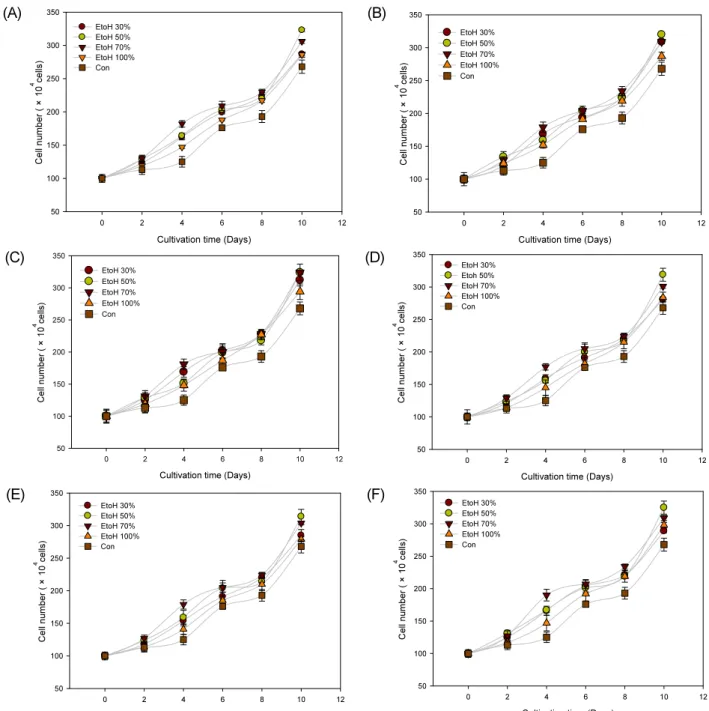
Responses of immune activity towards T cell and B cell line The immune response using medicinal plant products as a possible therapeutic measure has become a subject of active scientific investigations. The immune enhancement effect was assayed by hemacytometer using T cell and B cell. The cell growth of human T cell line of each extract from 6 regions cultured C. lanceolata is shown in Fig. 1. The cell growth of human T cell line enhanced gradually when the cell cultivation period increased. The extracts of all studied plants showed a pronounced cell growth till the 10 th day of cell culture while all extracts from C. lanceolata decreased its cell growth after the 10 th day of cell culture. However, 50% ethanol extract from C. lanceolata exhibited a promising immune activity, whereas 100% ethanol extract from C.

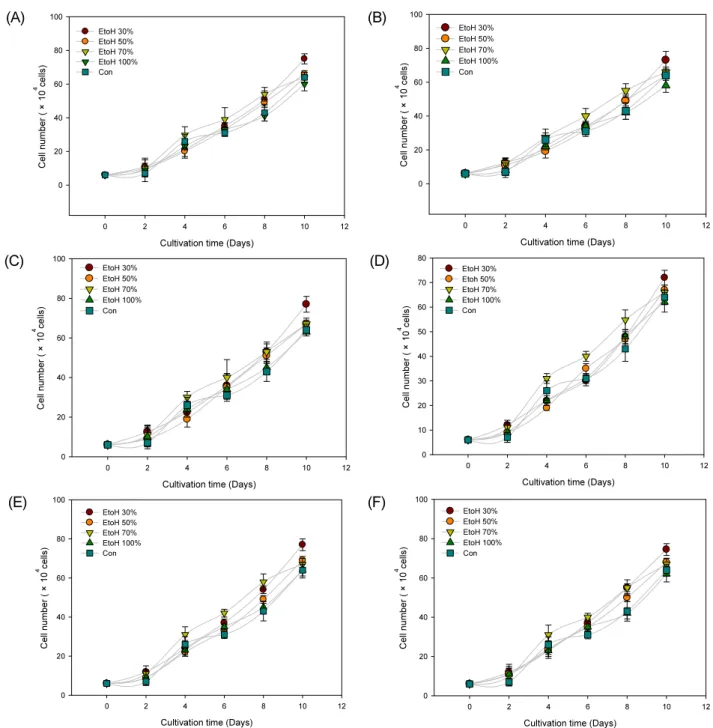
lanceolata demonstrated the lowest immune activity. Compared to untreated cell (Control), the all extracts from C. lanceolata showed higher immune enhancement effect. The immune enhancement effect of human B cell line from 6 regions cultured C. lanceolata is shown in Fig. 2. The 30% ethanol extract from C. coreana exhibited the highest immune activity on the 10 th day of cell culture. On the cell culture day 10, the all extracts of the studied samples showed pronounced immune activity effects. The most of ethanol extracts from C. lanceolata demonstrated a promising cell growth compared to untreated cell line (Control). However, There was no significant difference between extracts cultured in 6 regions.

This results in the present study is somewhat similar to the

results obtained that reported earlier (Lee et al., 2004). However,

the results indicate that the cell growth of human T and B cell

is dependent to culture period and after a certain period, the

cell number decreases when it increases the duration of cell

culture. Between the two cell lines, the cell growth of T cell

and B cell increased significantly till the 10 th day of cell

culture and then it decreased gradually. So, the result revealed

that both T and B cell responses were triggered by the period

(4)

Cultivation time (Days)

0 2 4 6 8 10 12

Ce ll nu m be r ( × 10 4 cells )

50 100 150 200 250 300 350

EtoH 30%

EtoH 50%

EtoH 70%

EtoH 100%

Con

(A)

Cultivation time (Days)

0 2 4 6 8 10 12

C ell n umbe r ( × 10 4 ce lls)

50 100 150 200 250 300 350

EtoH 30%

EtoH 50%

EtoH 70%

EtoH 100%

Con

(B)

Cultivation time (Days)

0 2 4 6 8 10 12

Cel l numbe r ( × 10 4 cel ls)

50 100 150 200 250 300 350

EtoH 30%

EtoH 50%

EtoH 70%

EtoH 100%

Con

(C)

Cultivation time (Days)

0 2 4 6 8 10 12

Cell number ( × 10 4 cell s)

50 100 150 200 250 300 350

EtoH 30%

Etoh 50%

EtoH 70%

EtoH 100%

Con

(D)

Cultivation time (Days)

0 2 4 6 8 10 12

Cell number ( × 10 4 ce lls)

50 100 150 200 250 300 350

EtoH 30%

EtoH 50%

EtoH 70%

EtoH 100%

Con

(E)

Cultivation time (Days)

0 2 4 6 8 10 12

Ce ll nu mber ( × 10 4 ce lls)

50 100 150 200 250 300 350

EtoH 30%

EtoH 50%

EtoH 70%

EtoH 100%

Con

(F)

Fig. 1. The cell growth of human T cell line according to the concentration of ethanol solvent from 6 region cultured Codonopsis lanceolata. The bars represent the standard error. (A: Hwasun, B: Uljin, C: Hoengseong, D: Jeju, E: Jecheon, F: Muju).

of cell culture. Previous result revealed that severe combined immunodeficiency is the result of defects in more than 15 known genes that cause severe abnormal T cell and B cell immune function (Buckley et al., 1999).

Nitrite scavenging activity

Nitrite reacts with second and third grade amines to form

nitrosamine in protein-rich foods, medicines, and residual

pesticides. It is also present in large quantities in meat and

both leafy and root vegetables. Nitrosamine is converted to

diazoalkane (alkane nucleic acid), proteins, and intracellular

components, which can increase the risk for cancer (Choi et

al., 2008). Nitric oxide (NO) is basically generated from

amino acid larginine by vascular endothelial cells, phagocytes

(5)

Cultivation time (Days)

0 2 4 6 8 10 12

Cell number ( × 10 4 cells ) 0 20 40 60 80 100

EtoH 30%

EtoH 50%

EtoH 70%

EtoH 100%

Con

(A)

Cultivation time (Days)

0 2 4 6 8 10 12

C ell n umb er ( × 10 4 ce lls) 0 20 40 60 80 100

EtoH 30%

EtoH 50%

EtoH 70%

EtoH 100%

Con

(B)

Cultivation time (Days)

0 2 4 6 8 10 12

C el l nu m ber ( × 10 4 cells)

0 20 40 60 80

100 EtoH 30%

EtoH 50%

EtoH 70%

EtoH 100%

Con

(C)

Cultivation time (Days)

0 2 4 6 8 10 12

Ce ll nu m be r ( × 10 4 cells )

0 10 20 30 40 50 60 70 80

EtoH 30%

Etoh 50%

EtoH 70%

EtoH 100%

Con

(D)

Cultivation time (Days)

0 2 4 6 8 10 12

Cell number ( × 10 4 ce lls)

0 20 40 60 80 100

EtoH 30%

EtoH 50%

EtoH 70%

EtoH 100%

Con

(E)

Cultivation time (Days)

0 2 4 6 8 10 12

C ell nu m ber ( × 10 4 cells )

0 20 40 60 80 100

EtoH 30%

EtoH 50%

EtoH 70%

EtoH 100%

Con

(F)

Fig. 2. The cell growth of human B cell line according to the concentration of ethanol solvent from 6 regions cultured Codonopsis lanceolata. The bars represent the standard error. (A: Hwasun, B: Uljin, C: Hoengseong, D: Jeju, E: Jecheon, F: Muju).

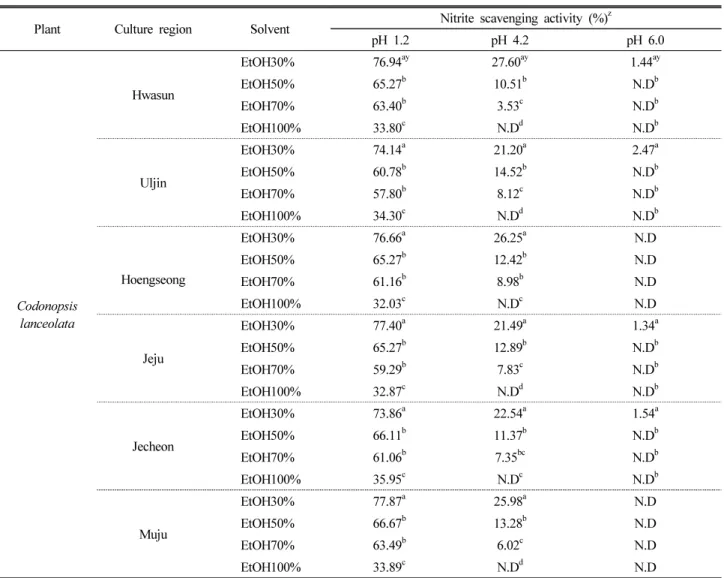
and certain cells of the brain. The toxicity of nitric oxide becomes adverse when it reacts with superoxide radical, forming a highly reactive peroxyritrite amino (ONOO - ) (Boora et al., 2014). The results of the determination of nitrite scavenging activity of C. lanceolata are summarized in the Table 1. As can be seen, the ethanol extracts from various solvent concentration of the studied plant were affected

by pH. Three pH ranges (pH 1.2, pH 4.2 and pH 6.0) were

considered in the present study. At a pH of 1.2, the

scavenging effect of all of the extracts tested observed higher

than that of the other two pH ranges. In addition, there was

no distinct detection of nitrite scavenging effects of the pH

range 6.0. The highest scavenging ability was observed from

30% ethanol solvent extract of C. lanceolata at a pH of 1.2

(6)

Table 1. Nitrite scavenging activities according to the concentration of ethanol solvent from 6 regions cultured Codonopsis lanceolata Plant Culture region Solvent Nitrite scavenging activity (%) z

pH 1.2 pH 4.2 pH 6.0

Codonopsis lanceolata

Hwasun

EtOH30% 76.94 ay 27.60 ay 1.44 ay

EtOH50% 65.27 b 10.51 b N.D b

EtOH70% 63.40 b 3.53 c N.D b

EtOH100% 33.80 c N.D d N.D b

Uljin

EtOH30% 74.14 a 21.20 a 2.47 a

EtOH50% 60.78 b 14.52 b N.D b

EtOH70% 57.80 b 8.12 c N.D b

EtOH100% 34.30 c N.D d N.D b

Hoengseong

EtOH30% 76.66 a 26.25 a N.D

EtOH50% 65.27 b 12.42 b N.D

EtOH70% 61.16 b 8.98 b N.D

EtOH100% 32.03 c N.D c N.D

Jeju

EtOH30% 77.40 a 21.49 a 1.34 a

EtOH50% 65.27 b 12.89 b N.D b

EtOH70% 59.29 b 7.83 c N.D b

EtOH100% 32.87 c N.D d N.D b

Jecheon

EtOH30% 73.86 a 22.54 a 1.54 a

EtOH50% 66.11 b 11.37 b N.D b

EtOH70% 61.06 b 7.35 bc N.D b

EtOH100% 35.95 c N.D c N.D b

Muju

EtOH30% 77.87 a 25.98 a N.D

EtOH50% 66.67 b 13.28 b N.D

EtOH70% 63.49 b 6.02 c N.D

EtOH100% 33.89 c N.D d N.D

z Data represent the mean values±SE of three independent experiments. y Means with the same letter in column are not significantly different at p<0.05 level by Duncan’s multiple range test.

while the lowest scavenging activity was observed from 100% ethanol solvent extract of C. lanceolata. The results prevailed that the nitrite scavenging activity was influenced by the ethanol concentration and was recognized the significance between ethanol solvent extracts. However, The nitrite scavenging activity was no significant difference between extracts cultured in 6 regions. The fact that the nitrite scavenging activity was high at pH 1.2 suggests that nitrosamine production can be inhibited in vivo (Choi et al., 2008). These results were consistent with other findings that had the highest the nitrite scavenging at pH of 1.2 in fermented pine extract (Hong et al., 2004) and extracts from different parts of citron (Shin et al., 2005).

ABTS radical scavenging activity

In order to evaluate the radical scavenging activities of

extracts according to the concentration of ethanol solvent

from C. lanceolata, ABTS assays were performed. The

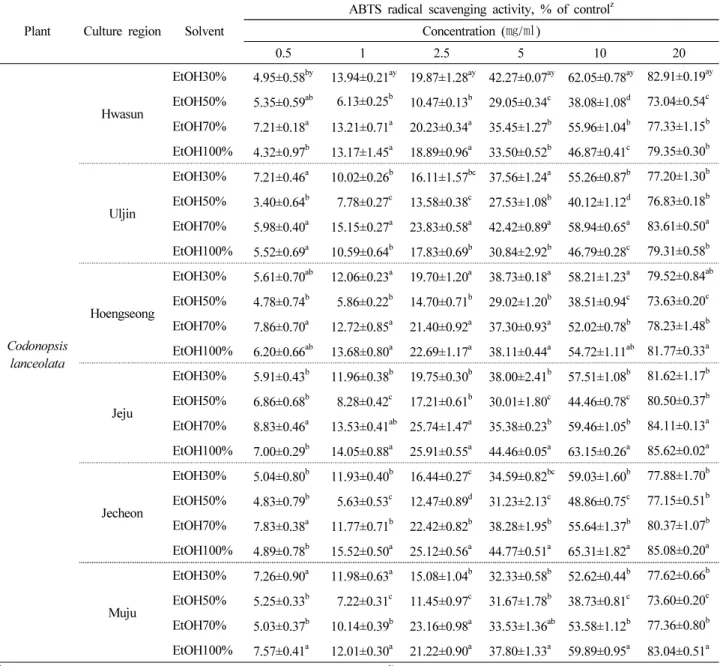
results of the ABTS radical scavenging activity were shown

in Table 2. When the experimental samples from C. lanceolata

were treated with various concentrations (500, 1000, 2500,

5000, 10000 and 20000 ㎎ L -1 ) of extracts, the ABTS radical

scavenging activity was progressively increased in a dose-

dependent manner. The ABTS radical scavenging activity

was the highest in 100% ethanol extract. Particularly, the

ABTS radical scavenging activity showed that the increase

was proportional to the ethanol concentration except 30%

(7)

Table 2. ABTS radical scavenging activities according to the concentration of ethanol solvent from 6 regions cultured Codonopsis lanceolata

Plant Culture region Solvent

ABTS radical scavenging activity, % of control z Concentration ( ㎎/㎖)

0.5 1 2.5 5 10 20

Codonopsis lanceolata

Hwasun

EtOH30% 4.95±0.58 by 13.94±0.21 ay 19.87±1.28 ay 42.27±0.07 ay 62.05±0.78 ay 82.91±0.19 ay EtOH50% 5.35±0.59 ab 6.13±0.25 b 10.47±0.13 b 29.05±0.34 c 38.08±1.08 d 73.04±0.54 c EtOH70% 7.21±0.18 a 13.21±0.71 a 20.23±0.34 a 35.45±1.27 b 55.96±1.04 b 77.33±1.15 b EtOH100% 4.32±0.97 b 13.17±1.45 a 18.89±0.96 a 33.50±0.52 b 46.87±0.41 c 79.35±0.30 b

Uljin

EtOH30% 7.21±0.46 a 10.02±0.26 b 16.11±1.57 bc 37.56±1.24 a 55.26±0.87 b 77.20±1.30 b EtOH50% 3.40±0.64 b 7.78±0.27 c 13.58±0.38 c 27.53±1.08 b 40.12±1.12 d 76.83±0.18 b EtOH70% 5.98±0.40 a 15.15±0.27 a 23.83±0.58 a 42.42±0.89 a 58.94±0.65 a 83.61±0.50 a EtOH100% 5.52±0.69 a 10.59±0.64 b 17.83±0.69 b 30.84±2.92 b 46.79±0.28 c 79.31±0.58 b

Hoengseong

EtOH30% 5.61±0.70 ab 12.06±0.23 a 19.70±1.20 a 38.73±0.18 a 58.21±1.23 a 79.52±0.84 ab EtOH50% 4.78±0.74 b 5.86±0.22 b 14.70±0.71 b 29.02±1.20 b 38.51±0.94 c 73.63±0.20 c EtOH70% 7.86±0.70 a 12.72±0.85 a 21.40±0.92 a 37.30±0.93 a 52.02±0.78 b 78.23±1.48 b EtOH100% 6.20±0.66 ab 13.68±0.80 a 22.69±1.17 a 38.11±0.44 a 54.72±1.11 ab 81.77±0.33 a

Jeju

EtOH30% 5.91±0.43 b 11.96±0.38 b 19.75±0.30 b 38.00±2.41 b 57.51±1.08 b 81.62±1.17 b EtOH50% 6.86±0.68 b 8.28±0.42 c 17.21±0.61 b 30.01±1.80 c 44.46±0.78 c 80.50±0.37 b EtOH70% 8.83±0.46 a 13.53±0.41 ab 25.74±1.47 a 35.38±0.23 b 59.46±1.05 b 84.11±0.13 a EtOH100% 7.00±0.29 b 14.05±0.88 a 25.91±0.55 a 44.46±0.05 a 63.15±0.26 a 85.62±0.02 a

Jecheon

EtOH30% 5.04±0.80 b 11.93±0.40 b 16.44±0.27 c 34.59±0.82 bc 59.03±1.60 b 77.88±1.70 b EtOH50% 4.83±0.79 b 5.63±0.53 c 12.47±0.89 d 31.23±2.13 c 48.86±0.75 c 77.15±0.51 b EtOH70% 7.83±0.38 a 11.77±0.71 b 22.42±0.82 b 38.28±1.95 b 55.64±1.37 b 80.37±1.07 b EtOH100% 4.89±0.78 b 15.52±0.50 a 25.12±0.56 a 44.77±0.51 a 65.31±1.82 a 85.08±0.20 a

Muju

EtOH30% 7.26±0.90 a 11.98±0.63 a 15.08±1.04 b 32.33±0.58 b 52.62±0.44 b 77.62±0.66 b EtOH50% 5.25±0.33 b 7.22±0.31 c 11.45±0.97 c 31.67±1.78 b 38.73±0.81 c 73.60±0.20 c EtOH70% 5.03±0.37 b 10.14±0.39 b 23.16±0.98 a 33.53±1.36 ab 53.58±1.12 b 77.36±0.80 b EtOH100% 7.57±0.41 a 12.01±0.30 a 21.22±0.90 a 37.80±1.33 a 59.89±0.95 a 83.04±0.51 a

z Data represent the mean values±SE of three independent experiments. y Means with the same letter in column are not significantly different at p<0.05 level by Duncan’s multiple range test.

ethanol extract. There was little difference in the ABTS activity between extracts cultured in 6 regions. However, the extracts cultured in Jeju and Jecheon region showed slightly high the ABTS activity. Overall, ABTS activity of C. lanceolata exhibited slightly lower at 50% ethanol solvent extract than any other concentration of ethanol. In the present evaluation, The results of the nitrite scavenging activity and ABTS radical scavenging activity of C. lanceolata was not consistent

with each other. These results were supposed that there is a difference in the nitrite scavenging activity and ABTS radical scavenging activity according to plant species.

Acknowledgement

This research was supported by High Value-added Food

Technology Development Program of IPET, Ministry of

(8)

Agriculture, Food and Rural Affairs, Republic of Korea.

References

Boora, F., E. Chirisa and S. Mukanganyama. 2014. Evaluation of Nitrite Radical Scavenging Properties of Selected Zimbabwean Plant Extracts and Their Phytoconstituents. J.

Food Process.

Buckley, R.H., S.E. Schiff, R.I. Schiff, M.L. Markert, L.W.

Williams, J.L. Roberts, L.A. Myers and F.E. Ward. 1999.

Hematopoietic stem-cell transplantation for the treatment of severe combined immunodeficiency. New Engl. J. Med.

340:508-516.

Choi, D.B., K.A. Cho, M.S. Na, H.S. Choi, Y.O. Kim, D.H.

Lim, S.J. Cho and H. Cho. 2008. Effect of bamboo oil on antioxidative activity and nitrite scavenging activity. J. Ind.

Eng. Chem. 14:765-770.

Foyer, C.H., P. Descourvières and K.J. Kunert. 1994.

Protection against oxygen radicals: an important defence mechanism studied in transgenic plants. Plant Cell Env.

17:507-523.

Guizani, N., M.I. Waly, V. Singh and M.S. Rahman. 2013.

Nabag (Zizyphus spina-christi) extract prevents aberrant crypt foci development in colons of azoxymethane-treated rats by abrogating oxidative stress and inducing apoptosis.

Asian Pac J Cancer Prev. 14:5031-5035.

Hong, T.G., Y.R. Lee, M.H. Yim and C.N. Hyun. 2004.

Physiological functionality and nitrite scavenging ability of fermentation extracts from pine needles. Korean J Food Preserv. 11:94-99.

Isaykina, N., T. Perevozchicova and G. Kalinkina. 2008.

Immunotropic activity of plant extract echinosol. B. Exp.

Biol. Med. 146:223-225.

Janeway, C.A., P. Travers, M. Walport and J.D. Capra. 1999.

Immunobiology: the immune system in health and disease.

Current Biology Publications New York, NY (USA).

Joh, E.H., I.A. Lee, S.J. Han, S.J. Chae and D.H. Kim. 2010.

Lancemaside A ameliorates colitis by inhibiting NF-jB

activation in TNBS-induced colitis mice. Int. J. Colorectal Dis. 25:545-551.

Kang, M.Y., S.H. Lee, S.W. Cha, J.L. Song and S.C. Lee. 2015.

Effect of Achyranthis radix and Drynariae rhizome extracts on antioxidant activity and antioxidant enzymes. Korean J.

Plant Res. 28(5):600-607.

Kato, H., I.E. Lee, N. Van Chuyen, S.B. Kim and F. Hayase.

1987. Inhibition of nitrosamine formation by nondialyzable melanoidins. Agr. Biol. Chem. 51:1333-1338.

Lee, J.Y., W.I. Hwang and S.T. Lim. 2004. Antioxidant and anticancer activities of organic extracts from Platycodon grandiflorum De candolle roots. J. Ethnopharmacol. 93:409-415.

Noh, B.Y., H.J. Lee, J.R. Do and H.K. Kim. 2014. Antioxidant and ACE inhibitory activity of cultivated and wild Angelica gigas Nakai extracts prepared using different extraction conditions. Prev. Nutr. Food Sci. 19:274.

Park, Y.J., G.Y. Cheon, H.W. Song, C.S. Shin, Y.G. Ku, N.R.

Kang and B.G. Heo. 2016. Mineral composition and physiological activities of methanol extract from the seeds of Persicaria tinctoria. Korean J. Plant Res. 29(1):032-038.

Paul, D.J., N.B. Laure, S.K. Guru, I.A. Khan, S.K. Ajit, R.A.

Vishwakarma and T. Pierre. 2014. Antiproliferative and antimicrobial activities of alkylbenzoquinone derivatives from Ardisia kivuensis. Pharm. Biol. 52.

Pittella, F., R.C. Dutra, D.D. Junior, M.T. Lopes and N.R.

Barbosa. 2009. Antioxidant and cytotoxic activities of Centella asiatica (L) Urb. Int. J. Mol. Sci. 10:3713-3721.

Re, R., N. Pellegrini, A. Proteggente, A. Pannala, M. Yang and C.R. Evans. 1999. Antioxidant activity applying an improved ABTS radical cation decolorization assay. Free Radical Bio.

Med. 26(9-10):1231-1237.

Shin, J.H., J.Y. Lee, J.C. Ju, S.J. Lee, H.S. Cho and N.J. Sung.

2005. Chemical properties and nitrite scavenging ability of citron (Citrus junos). J. Korean Soc. Food Sci. Nutr. 34:496-502.

Wang, L., M.L. Xu, J.H.u, S.K. Rasmussen and M.H. Wang.

2011. Codonopsis lanceolata extract induces G0/G1 arrest and apoptosis in human colon tumor HT-29 cells - Involve- ment of ROS generation and polyamine depletion. Food Chem. toxicol. 49:149-154.

(Received 12 May 2016 ; Revised 15 June 2016 ; Accepted 20 June 2016)

수치

Fig. 1. The cell growth of human T cell line according to the concentration of ethanol solvent from 6 region cultured Codonopsis  lanceolata
Fig. 2. The cell growth of human B cell line according to the concentration of ethanol solvent from 6 regions cultured Codonopsis  lanceolata
Table 1. Nitrite scavenging activities according to the concentration of ethanol solvent from 6 regions cultured Codonopsis lanceolata Plant Culture region Solvent Nitrite scavenging activity (%) z
Table 2. ABTS radical scavenging activities according to the concentration of ethanol solvent from 6 regions cultured Codonopsis  lanceolata

참조

관련 문서

ABSTRACT In the present study, the levels of phenolic compounds and flavonoids, as well as activities of radical scavenging (DPPH and ABTS radical scavenging activity) and

Changes in DPPH radical scavenging activity of Doraji ethanol extracts with different aging temperatures and periods.. Changes in ABTS radical scavenging activity

The DPPH free radical scavenging activity of extracts from Chionanthus retusus was above 70% at phenolic concentration 100 μg/mL.. The ABTS radical decolorization activities of

This study was to conducted to investigate the antioxidative activity of 70% ethanol extracts of kiwi of three different colors (gold, green and red) by measuring DPPH, ABTS

DPPH and ABTS radical scavenging activities of barley sprout leaf, root, and stem ethanol extracts.. Results were expressed the radical scavenging activities as

palmatopinnatifidus were determined. Although the DPPH radical scavenging activities of the extracts were propor- tional to total polyphenol contents, there are no

Results : The highest the contents of chlorogenic acid was from 10% ethanol extracts showed. Scavenging activities of DPPH, ABTS, and hydroxyl radical significantly increased

DPPH and ABTS radical scavenging activities were 70% EtOH extract showed a little higher activity than the hot water extract, and at a concentration of 500 ㎍/㎎, the