Evaluation of Antioxidant and Nitrite Scavenging Activity of Seaweed Extracts
Seon-Mi Ahn, Yong-Ki Hong
1, Gi-Seok Kwon
2and Ho-Yong Sohn*
1
Department of Food and Nutrition, Andong National University, Andong 760-749, Korea
2
Department of Biotechnology, Pukyong National University, Busan 608-737, Korea
3
The School of Bioresource Science, Andong National University, Andong 760-749, Korea Received January 25, 2011 /Accepted April 1, 2011
In the course of study for the development of functional food ingredients from seaweeds having use- ful biological activities, the in-vitro antioxidant and nitrite scavenging activities of the methanol ex- tracts prepared from 35 different seaweeds (17 phaeophyta, 11 rhodophyta and 7 chlorophyta) were determined. At 500 μg/ml concentration of the methanol extracts, Ecklonia cava, Ecklonia stolonifera, Eisenia bicyclis (Kjellman) Setchell, Ishige foliacea, I. okamurai, Sargassum confusum, S. fulvellum, S. yamade and Zostera marina showed 60% more DPPH and ABTS scavenging activity. The exceptions were found in I. okamurai and Z. marina, which showed 45% and 53% ABTS scavenging activity, respectively. The correlation coefficient between DPPH and ABTS scavenging activities was 0.855, sug- gesting that the 9 different seaweeds extracts could scavenge anion and cation radicals concurrently.
In reducing power, only E.cava, E.stolonifera and E.bicyclis showed above 0.88 (Abs
700). In a while, in nitrite scavenging activity at 100 μg/ml concentration of the methanol extracts, 19 different seaweeds extracts including I. foliacea, I. okamurai, S. confusum, S. fulvellum, and S. yamade showed 60% more activity. Calculation of IC
50s of DPPH, ABTS and nitrite scavenging activities of 9 different seaweeds extracts further showed that I. foliacea and S. yamade, besides E.cava, E.stolonifera and E.bicyclis, have strong antioxidant and nitrite scavenging activity. These results suggest that the selected 9 different seaweeds could be developed as functional food ingredients and I. foliacea and S. yamade have poten- tial as novel natural sources of antioxidant and nitrite scavenger.
Key words : Edible seaweeds, DPPH scavenging activity, ABTS scavenging activity, reducing power, nitrite scavenging activity, Sargassum yamade
*Corresponding author
*Tel:+82-54-820-5491, Fax:+82-54-820-7804
*E-mail : [email protected]
서 론
생명체는 생명을 영위하기 위해 에너지 생산이 필수적이며, 에너지 생산과정 중 산소를 최종전자 수용체로 사용하는 경우 활성산소(reactive oxygen species)의 생성은 불가피하다. 이 러한 반응성이 강한 산화성 물질들은 생체 내 비특이적 항산 화 물질들과 특이적 항산화 효소 시스템에 의해 제거되어야 하며, 그렇지 못한 경우 세포막 지질 및 DNA 손상, 세포사멸, 노화 및 암 등을 유발하게 된다[2].
인류는 오래 전부터 육상 천연물로부터 다양한 항산화 물질 을 선별, 이용하여 왔으며[28], 최근에는 신규의 경제성 있는 항산화 물질을 개발하고자 해양자원을 적극 활용하고 있다 [12]. 삼면이 바다로 둘러싸여 있는 한국은 다양한 해양생물을 식용, 약용 및 화장품 등으로 이용하여 왔으며, 해조류 생산이 전 세계 4위에 달할 만큼 해조류 이용 및 양식산업이 매우 발달해 있다[13]. 특히 김, 미역, 다시마, 청각, 파래, 톳 등의 해조류는 국내 주요 식품재료이며, 이들을 이용한 다양한 건
제품, 염장품, 조미품 및 식품 첨가물을 가공, 판매하고 있다.
해조류의 경우 주로 재배, 수확 및 저장에 관한 연구[13]에서 벗어나, 다양한 생리활성에 대한 연구가 진행되면서 식품, 의 약품 및 화장품 분야의 이용이 빠르게 증가되고 있다. 실제 해조류의 고지혈증 및 고혈압 예방[8,21], 항당뇨[20], 항돌연 변이[16], 항암[17], 멜라린 생성억제[9], 항염증[9] 및 항응고 [1,24,29] 등의 기능들이 보고되면서 해조류를 건강기능성 식 품원료로 인식하고 있으며[3], 최근에는 해조류의 fucoidans 과 같은 다당류의 항혈전[18], 항암[26] 및 중금속 제거 활성[6]
이 각광받고 있다. 또한 해조류는 항미생물 활성이 우수하여 항충치[15] 및 항적조제[7]로의 개발도 가능하다고 알려져 있 다[10,22-24]. 본 연구팀에서도 해조류를 이용한 건강기능성 식품소재 개발연구의 일환으로, 35종 해조류의 인간 트롬빈 저해활성을 포함하는 항혈전 활성을 검토하여 곰피, 대황, 넓 패 등의 갈조류가 매우 우수한 항혈전 활성을 가짐을 보고[1]
한 바 있다.
본 연구에서는 35종의 해조류 추출물을 대상으로 in-vitro
항산화 및 nitrite 소거활성을 평가하였다. 기존 해조류의 항산
화 활성 관련연구는 개별 해조류에 대한 다양한 활성 연구
중의 일부로 보고되어 있으며, 주로 감태[5,14] 곰피[11], 톳
[12], 서실[2] 및 파래[19] 등에 집중되어 있다. 또한 일부 연구
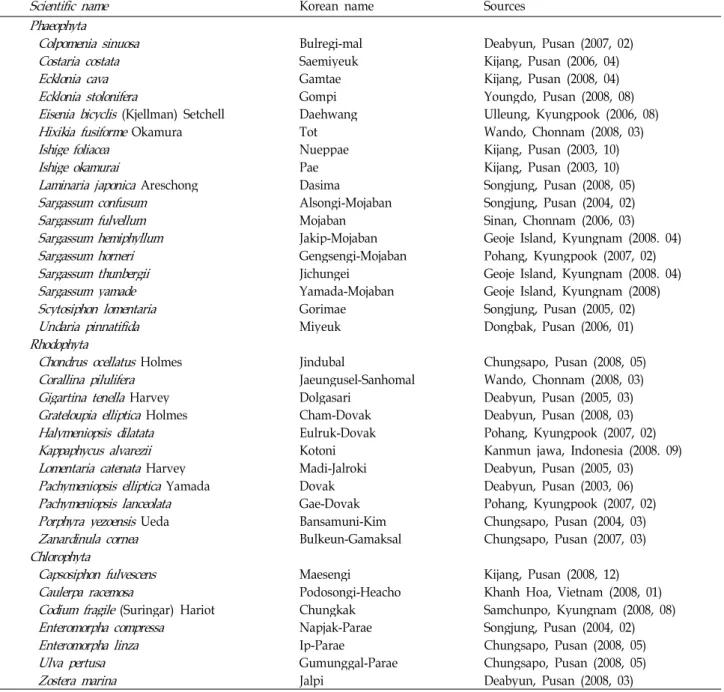
Table 1. The list of seaweeds used in this study
Scientific name Korean name Sources
Phaeophyta
Colpomenia sinuosa Bulregi-mal Deabyun, Pusan (2007, 02) Costaria costata Saemiyeuk Kijang, Pusan (2006, 04)
Ecklonia cava Gamtae Kijang, Pusan (2008, 04)
Ecklonia stolonifera Gompi Youngdo, Pusan (2008, 08) Eisenia bicyclis (Kjellman) Setchell Daehwang Ulleung, Kyungpook (2006, 08) Hixikia fusiforme Okamura Tot Wando, Chonnam (2008, 03) Ishige foliacea Nueppae Kijang, Pusan (2003, 10)
Ishige okamurai Pae Kijang, Pusan (2003, 10)
Laminaria japonica Areschong Dasima Songjung, Pusan (2008, 05) Sargassum confusum Alsongi-Mojaban Songjung, Pusan (2004, 02) Sargassum fulvellum Mojaban Sinan, Chonnam (2006, 03) Sargassum hemiphyllum Jakip-Mojaban Geoje Island, Kyungnam (2008. 04) Sargassum horneri Gengsengi-Mojaban Pohang, Kyungpook (2007, 02) Sargassum thunbergii Jichungei Geoje Island, Kyungnam (2008. 04) Sargassum yamade Yamada-Mojaban Geoje Island, Kyungnam (2008) Scytosiphon lomentaria Gorimae Songjung, Pusan (2005, 02) Undaria pinnatifida Miyeuk Dongbak, Pusan (2006, 01) Rhodophyta
Chondrus ocellatus Holmes Jindubal Chungsapo, Pusan (2008, 05) Corallina pilulifera Jaeungusel-Sanhomal Wando, Chonnam (2008, 03) Gigartina tenella Harvey Dolgasari Deabyun, Pusan (2005, 03) Grateloupia elliptica Holmes Cham-Dovak Deabyun, Pusan (2008, 03) Halymeniopsis dilatata Eulruk-Dovak Pohang, Kyungpook (2007, 02) Kappaphycus alvarezii Kotoni Kanmun jawa, Indonesia (2008. 09) Lomentaria catenata Harvey Madi-Jalroki Deabyun, Pusan (2005, 03) Pachymeniopsis elliptica Yamada Dovak Deabyun, Pusan (2003, 06) Pachymeniopsis lanceolata Gae-Dovak Pohang, Kyungpook (2007, 02) Porphyra yezoensis Ueda Bansamuni-Kim Chungsapo, Pusan (2004, 03) Zanardinula cornea Bulkeun-Gamaksal Chungsapo, Pusan (2007, 03) Chlorophyta
Capsosiphon fulvescens Maesengi Kijang, Pusan (2008, 12) Caulerpa racemosa Podosongi-Heacho Khanh Hoa, Vietnam (2008, 01) Codium fragile (Suringar) Hariot Chungkak Samchunpo, Kyungnam (2008, 08) Enteromorpha compressa Napjak-Parae Songjung, Pusan (2004, 02) Enteromorpha linza Ip-Parae Chungsapo, Pusan (2008, 05) Ulva pertusa Gumunggal-Parae Chungsapo, Pusan (2008, 05)
Zostera marina Jalpi Deabyun, Pusan (2008, 03)
가 다수의 해조류를 대상으로 항산화 활성을 상호 비교 검토 한 바 있으나, 강원 지역의 7종 해조류(다시마, 괭생이모자반, 곰피, 구멍쇠미역, 고리매, 김, 지누아리)[11], 국민 다소비 해조 류 5종(다시마, 톳, 미역, 파래, 김)[19] 등의 제한된 시료를 대 상으로 이루어져 왔다. 따라서 본 연구에서는 해조류를 이용 한 기능성 식품소재 개발의 기본자료로 이용하고자 국내 연안 에서 수확된 33종의 해조류와 전 세계적으로 식용으로 널리 사용되는 포도송이해초(베트남산) 및 코토니(인도네시아산) 를 대상으로 항산화능을 광범위하게 비교하였다. 그 결과 곰 피, 대황, 감태, 야마다모자반 및 넓패에서 강력한 항산화 활성 과 nitrite 소거활성을 확인하였기에 이에 보고하는 바이다.
재료 및 방법
실험재료 및 시료의 조제
본 실험에 사용된 해조류들은 갈조류 17종, 홍조류 11종 및
녹조류 7종의 35종으로, 최근 보고[1]와 동일한 시료를 사용하
였다(Table 1). 메탄올 추출물 조제를 위해서는 해조류들의 이
물질을 제거하고 수돗물로 세척한 후 실온에서 음건하고, 건
조 해조류들을 믹서기로 분쇄한 후 건조분말 해조류에 10배
부피의 메탄올을 가한 후 상온에서 2일 추출하였으며, 이를4
회 반복한 후 추출액을 모아 50℃에서 감압 농축하여 추출물
을 제조하였다[1].
항산화 활성
조제된 추출물은 dimethylsulfoxide (DMSO)에 녹인 후 적 당한 농도로 희석하여 항산화 활성을 평가하였으며, 항산화 활성은 1,1-diphenyl-2-picryl hydrazyl (DPPH) anion 소거능 [28], 2,2-azobis(3-ethylbenzothiazoline-6-sulfonate) (ABTS) cation 소거능[20] 및 환원력[11]을 측정하여 평가하였다. 대조 구로는 vitamin C (Sigma Co., USA)를 사용하였으며, 용매 대조구로는 DMSO를 사용하였다. 각각의 활성 평가는 각각 3회 이상 반복한 실험의 mean±SD로 표시하였으며, 소거능 평가에서 50%의 소거능이 나타나는 시료 농도를 IC
50로 나타 내었다.
DPPH scavenging activity (DSA)
DSA평가는 기존의 보고한 방법[28]과 동일한 방법을 사용 하였다. 다양한 농도로 희석한 시료 20 μl에 99.5% 에탄올에 용해시킨 2×10
-4M DPPH용액 380 μl를 넣고 혼합하여 37℃에 서 30분 동안 반응시킨 후, 516 nm에서 microplate reader (Asys Hitech, Expert96, Asys Co., Austria)를 사용하여 흡광 도를 측정하고 다음의 식에 의해 DSA를 결정하였다[28]. DSA (%) =[1-(S/C)]×100, C: 용매 대조구 DMSO 첨가 시의 흡광도, S, 시료 첨가시의 흡광도.
ABTS scavenging activity (ASA)
ASA평가를 위해 7 mM ABTS (Sigma Co., USA) 5 ml와 140 mM potassium persulfate 88 μl를 섞은 후 상온에서 16 시간 빛을 차단하여 ABTS 양이온을 형성시켰으며, 이후 이 용액을 414 nm에서 흡광도 값이 1.5가 되도록 에탄올로 희 석하였다. 조제된 희석용액 190 μl와 해조류 시료 10 μl를 혼합한 후 상온에서 6분간 반응시킨 후 734 nm에서 흡광도 를 측정하고 다음의 식에 의해 ASA를 결정하였다[19]. ASA (%)=(C-S)/C×100, C: 용매 대조구 DMSO 첨가시의 흡광도, S, 시료 첨가시의 흡광도.
환원력 측정(reducing power: RP)
에탄올에 용해시킨 해조류 시료 2.5 ml에 0.2 M sodium phosphate buffer (pH 6.6) 2.5 ml와 10% potassium ferricya- nide 2.5 ml를 첨가하고 50℃에서 20분 동안 반응시킨 후, 10%
trichloroacetic acid 2.5 ml를 넣어 반응을 종료하고 4,000 rpm 에서 10분간 원심분리하여 상등액을 회수하였다. 회수한 상등 액을 0.1% ferric chloride 용액과 5:1 (v/v) 비율로 혼합하고 700 nm에서 흡광도를 측정하여 환원력을 평가하였다[11,20].
Nitrite 소거활성(Nitrite scavenging activity: NSA)
해조류 추출물의 NSA평가를 위해, 아질산염 용액(1 mM) 에 시료용액을 가하고, 여기에 0.1 N HCl을 가해 pH 1.2로 조정한 후, 37℃에서 1시간 반응시킨 후 Griess reagent (Sigma
Co., USA)를 가하고 혼합하였다. 이후 15분간 실온에서 방치 후 520 nm에서 흡광도를 측정하여 잔존 nitrite 양을 측정하였 다. NSA (%)는 다음의 식에 의해 계산하였다[5].
NSA (%)=[1-(A-C)/B]×100, A: 1 mM nitrite 용액에 시료를 첨가하여 1시간 반응시킨 후의 흡광도, B: 1 mM nitrite 용액의 흡광도, C: 해조류 시료의 흡광도.
대조구로는 vitamin C (Sigma Co., USA)를 사용하였으며, 용매 대조구로는 DMSO를 사용하였다. 각각의 활성 평가는 각각 3회 이상 반복한 실험의 mean±SD로 표시하였으며, 소거 능 평가에서 50%의 소거능이 나타나는 시료 농도를 IC
50로 나타내었다.
통계 분석
실험 결과는 SPSS 18.0 버전을 사용하여 mean±SD로 나타 내었으며, 각 군간의 차이는 ANOVA Tukey LSD 통계처리방 법으로 통계적 유의성 검정을 조사하였다. 유의수준은 p<0.05 로 하였다. 항산화 활성 평가 결과들의 상관관계 검토는 SigmaPlot 2001 (Ver 7.0)의 linear regression을 이용하였다.
결과 및 고찰
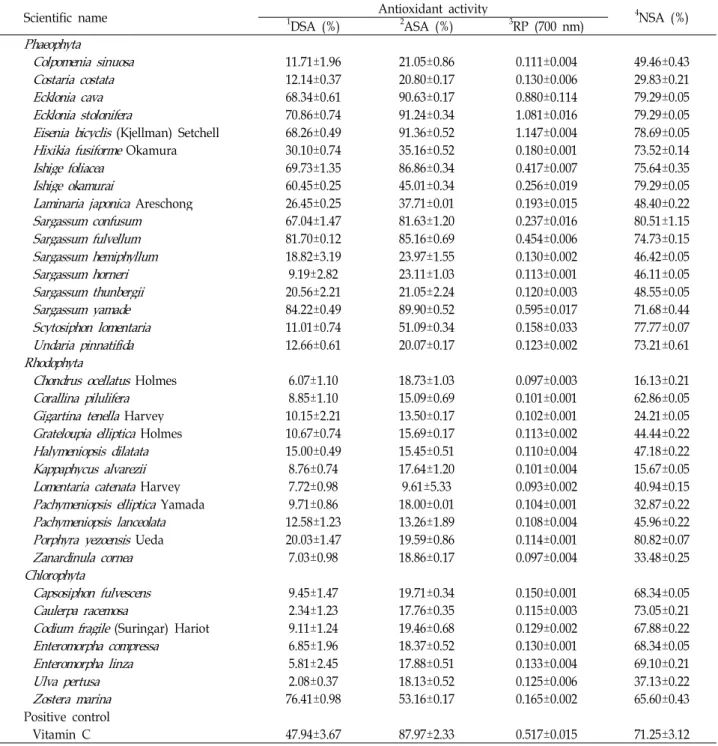
국내 연안에서 수확된 33종의 해조류와 2종의 베트남 및 인도네시아의 해조류의 항산화능을 광범위하게 비교하였다 (Table 1). 먼저 해조류 추출물 농도 500 μg/ml 농도에서 DSA 를 평가한 결과, 17종의 갈조류에서는 감태, 곰피, 대황, 넓패, 패, 모자반, 알송이모자반 및 야마자모자반의 8종에서 60% 이 상의 활성을 나타내었으며, 홍조류의 경우 11종 모두에서 6~20%의 매우 낮은 DSA를 보였다. 녹조류의 경우 잘피에서 만 76.4%의 활성을 보인 반면 나머지 시료들은 2.3~9.5%의 매우 약한 활성을 보였다(Table 2). 이러한 결과는 해조류들의 DSA가 각각의 polyphenol 함량과 비례한다는 기존에 보고 [18]를 고려할 때, 일반적으로 갈조류들이 녹조류 및 홍조류보 다 polyphenol함량이 높음을 의미하며, 실제 기존의 본 연구 팀에서 보고[1]한 35종 해조류의 total polyphenol 함량 분석결 과와도 일치하는 결과이다.
ASA 분석의 경우, 패와 고리메를 제외한 모든 시료에서 DSA분석결과와 유사한 패턴을 나타내었다. 패 추출물의 경우 500 μg/ml 농도에서 DSA는 60.45%로 우수한 반면 ASA는 45.01%로 나타나 상대적으로 음이온 소거능이 우수함을 알 수 있었으며, 고리메 추출물의 경우 DSA는 11.01%로 미미하 였으나 ASA는 51.09%로 양이온 소거능이 매우 강력하였다.
RP 측정의 경우, DSA 및 ASA 분석결과와 다른 양상을 나타낸
바, 감태, 곰피 및 대황의 3종만이 0.88 이상의 강력한 활성을
나타내었다. 활성대조구로 사용된 vitamin C의 경우, 12.5 μ
g/ml 농도에서 DSA, ASA 및 RP는 각각 47.94%, 87.97% 및
0.517을 나타내어 우수한 활성이온 소거능 및 환원력을 가짐
Table 2. In-vitro antioxidation activity of 35 different seaweeds
Scientific name
1DSA (%) Antioxidant activity
2ASA (%)
3RP (700 nm)
4NSA (%) Phaeophyta
Colpomenia sinuosa 11.71±1.96 21.05±0.86 0.111±0.004 49.46±0.43 Costaria costata 12.14±0.37 20.80±0.17 0.130±0.006 29.83±0.21 Ecklonia cava 68.34±0.61 90.63±0.17 0.880±0.114 79.29±0.05 Ecklonia stolonifera 70.86±0.74 91.24±0.34 1.081±0.016 79.29±0.05 Eisenia bicyclis (Kjellman) Setchell 68.26±0.49 91.36±0.52 1.147±0.004 78.69±0.05 Hixikia fusiforme Okamura 30.10±0.74 35.16±0.52 0.180±0.001 73.52±0.14 Ishige foliacea 69.73±1.35 86.86±0.34 0.417±0.007 75.64±0.35 Ishige okamurai 60.45±0.25 45.01±0.34 0.256±0.019 79.29±0.05 Laminaria japonica Areschong 26.45±0.25 37.71±0.01 0.193±0.015 48.40±0.22 Sargassum confusum 67.04±1.47 81.63±1.20 0.237±0.016 80.51±1.15 Sargassum fulvellum 81.70±0.12 85.16±0.69 0.454±0.006 74.73±0.15 Sargassum hemiphyllum 18.82±3.19 23.97±1.55 0.130±0.002 46.42±0.05 Sargassum horneri 9.19±2.82 23.11±1.03 0.113±0.001 46.11±0.05 Sargassum thunbergii 20.56±2.21 21.05±2.24 0.120±0.003 48.55±0.05 Sargassum yamade 84.22±0.49 89.90±0.52 0.595±0.017 71.68±0.44 Scytosiphon lomentaria 11.01±0.74 51.09±0.34 0.158±0.033 77.77±0.07 Undaria pinnatifida 12.66±0.61 20.07±0.17 0.123±0.002 73.21±0.61 Rhodophyta
Chondrus ocellatus Holmes 6.07±1.10 18.73±1.03 0.097±0.003 16.13±0.21 Corallina pilulifera 8.85±1.10 15.09±0.69 0.101±0.001 62.86±0.05 Gigartina tenella Harvey 10.15±2.21 13.50±0.17 0.102±0.001 24.21±0.05 Grateloupia elliptica Holmes 10.67±0.74 15.69±0.17 0.113±0.002 44.44±0.22 Halymeniopsis dilatata 15.00±0.49 15.45±0.51 0.110±0.004 47.18±0.22 Kappaphycus alvarezii 8.76±0.74 17.64±1.20 0.101±0.004 15.67±0.05 Lomentaria catenata Harvey 7.72±0.98 9.61±5.33 0.093±0.002 40.94±0.15 Pachymeniopsis elliptica Yamada 9.71±0.86 18.00±0.01 0.104±0.001 32.87±0.22 Pachymeniopsis lanceolata 12.58±1.23 13.26±1.89 0.108±0.004 45.96±0.22 Porphyra yezoensis Ueda 20.03±1.47 19.59±0.86 0.114±0.001 80.82±0.07 Zanardinula cornea 7.03±0.98 18.86±0.17 0.097±0.004 33.48±0.25 Chlorophyta
Capsosiphon fulvescens 9.45±1.47 19.71±0.34 0.150±0.001 68.34±0.05 Caulerpa racemosa 2.34±1.23 17.76±0.35 0.115±0.003 73.05±0.21 Codium fragile (Suringar) Hariot 9.11±1.24 19.46±0.68 0.129±0.002 67.88±0.22 Enteromorpha compressa 6.85±1.96 18.37±0.52 0.130±0.001 68.34±0.05 Enteromorpha linza 5.81±2.45 17.88±0.51 0.133±0.004 69.10±0.21 Ulva pertusa 2.08±0.37 18.13±0.52 0.125±0.006 37.13±0.22 Zostera marina 76.41±0.98 53.16±0.17 0.165±0.002 65.60±0.43 Positive control
Vitamin C 47.94±3.67 87.97±2.33 0.517±0.015 71.25±3.12
The concentrations of seaweed extracts in antioxidant activity assay (DSA, ASA and RP) and NSA were 500, 100, and 100 μg/ml respectively. The concentrations of vitamin C as positive control used in antioxidant activity assay (DSA, ASA and RP) were 12.5 μ g/ml, respectively.
1
DSA: DPPH anion scavenging activity,
2ASA: ABTS cation scavenging activity,
3RP: reducing power, and
4NSA: nitrite scavenging activity.
을 확인하였다.
35종 해조류 추출물(100 μg/ml)을 대상으로, 식품에서의 발 암인자인 nitrosoamine생성억제와 관련된 NSA평가의 경우 17종의 갈조류 중 11종에서 70% 이상의 활성을 나타내었으나,
홍조류의 경우 방사무늬김 1종에서만 80.82%의 소거능을 나
타내었다(Table 2). 녹조류의 경우에는 구멍갈파래를 제외한
모든 시료에서 65% 이상의 소거능을 보여 갈조류와 녹조류가
홍조류보다 일반적으로 NSA가 높음을 알 수 있었다. 이러한
DPPH scavenging activity
0 20 40 60 80 100
A B T S c a ti o n s c a v e n g in g a c ti v it y
0 20 40 60 80 100
y=0.9516 x + 9.996 r2 =0.855
DPPH scavenging activity
0 20 40 60 80 100
R e d u c in g p o w e r
0.0 0.2 0.4 0.6 0.8 1.0 1.2 1.4
y=7.29 x + 0.04 r2 =0.536
DPPH scavenging activity
0 20 40 60 80 100
N it ri te s c a v e n g in g a c ti v it y
0 20 40 60 80 100
y=0.413 x + 46.09 r 2=0.323
ABTS cation scavenging activity
0 20 40 60 80 100
R e d u c in g p o w e r
0.0 0.2 0.4 0.6 0.8 1.0 1.2 1.4
y=8.10 x - 0.053 r2=0.70
ABTS cation scavenging activity
0 20 40 60 80 100
N it ri te s c a v e n g in g a c ti v it y
10 20 30 40 50 60 70 80 90
y=0.414x + 42.46 r2=0.345
Reducing power
0.0 0.2 0.4 0.6 0.8 1.0 1.2 1.4
N it ri te s c a v e n g in g a c ti v it y
0 20 40 60 80 100
y=34.65 x + 49.09 r2=0.23
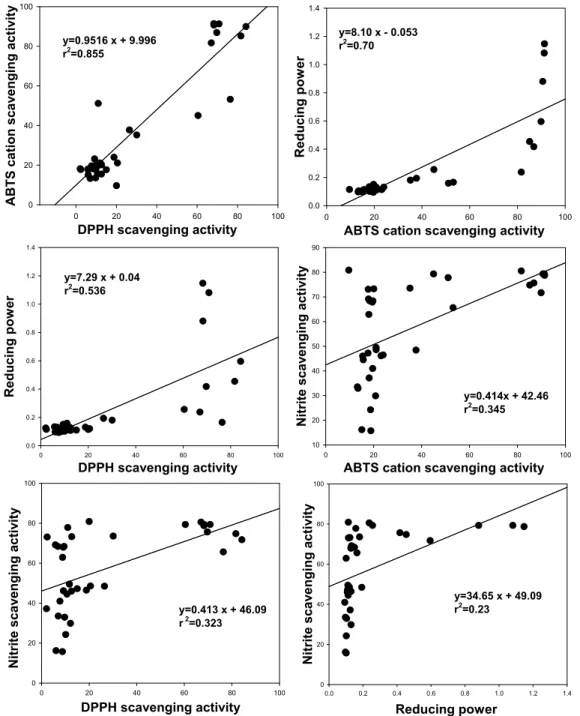
Fig. 1. The relationship among the DPPH anion scavenging activity, ABTS cation scavenging activity, reducing power and nitrite scavenging activity of the different seaweed extracts.
결과는 vitamin C (12.5 μg/ml)의 NSA가 71.25%임을 고려하 면 해조류의 NSA활성이 강력함을 의미하며, 감태, 곰피, 구멍 쇠미역의 NSA가 100 μg/ml 농도에서 79% 이상이라는 기존 의 연구결과[27]와도 일치한다.
한편 해조류의 다양한 항산화능 및 NSA 분석 결과의 상관 관계는 Fig. 1에 나타내었다. 해조류의 경우 DSA와 ASA분석 결과는 약 0.855의 상관계수를 나타내어, 대부분의 항산화 활 성을 나타내는 해조류 시료는 음이온 및 양이온 소거능을 동 시에 가짐을 추측할 수 있었다. 그러나, DSA와 RP (상관계수
0.536), ASA와 RP (상관계수 0.70), ASA와 NSA (상관계수 0.345), DSA와 NSA (상관계수 0.323) 및 RP와 NSA (상관계수 0.23)는 상관 관계가 높지 않았다. 이러한 결과는 해조류에서 는 polyphenol 물질 이외의 다양한 물질들이 항산화 및 nitrite 소거에 관여함을 추측하게 한다. 따라서 35종의 해조류 중 항 산화능 및 NSA 활성을 동시에 나타내는 감태, 곰피, 대황, 패, 넓패, 모자반, 알송이모자반, 야마다모자반 및 잘피의 9종을 1차 선별하였다.
선별된 9종 해조류 추출물을 대상으로 다양한 농도에서의
0 100 200 300 400 500
DPPH scavenging activity (%)
0 20 40 60 80 100
0 100 200 300 400 500
ABTS scavenging activity (%)
0 20 40 60 80 100
Concentration (mg/ml)
0 100 200 300 400 500
Reducing Power (700 nm)
0.0 0.2 0.4 0.6 0.8 1.0 1.2 1.4
Concentration (mg/ml)
0 20 40 60 80 100
Nitrite scavenging activity (%)
0 20 40 60 80 100
(a)
(c) (d)
(b)
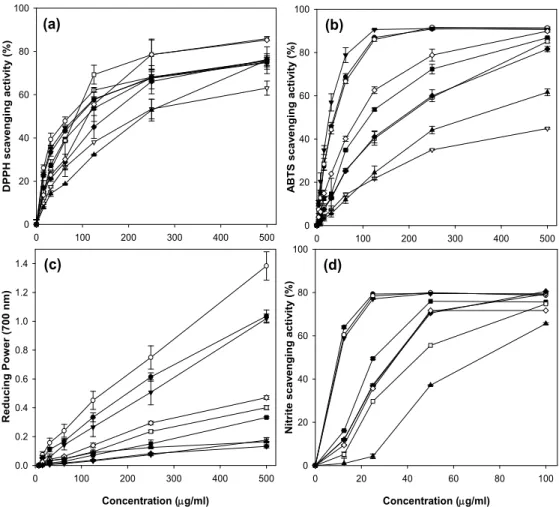
Fig. 2. Comparison of antioxidation and nitrite scavenging activity of the selected seaweeds (a) DPPH anion scavenging activity, (b) ABTS cation scavenging activity (c) reducing power, and (d) nitrite scavenging activity of 9 different seaweeds. Symbols:
▼: Ecklonia cava , ●: E. stolonifera , ○: Eisenia bicyclis Setchell, ▽: Ishige okamurai , ■: Ishige foliacea , □: Sargassum fulvellum,
◆: S. confusum , ◇: S. yamade and ▲: Zostera marina.
항산화 및 NSA를 평가한 결과는 Fig. 2에 나타내었다. 전체적 으로 해조류 추출물 농도 증가에 따라 평가 활성의 증가가 나타났다. DSA의 경우 62.5 μg/ml 이하의 저농도에서는 대황 과 감태가 가장 우수하였으나, 250 μg/ml 이상의 고농도에서 는 모자반과 야마다모자반에서 우수한 소거능을 나타내었다.
ASA의 경우 모든 시험농도에서 감태, 곰피 및 대황 추출물이, 환원력 평가의 경우 대황 추출물이 다른 해조류 추출물과 비 교할 때 우월한 활성을 나타내었다. NSA의 경우에는 곰피, 대황, 감태 추출물이 모든 시험농도에서 가장 강력한 활성을 나타내었다. 이러한 결과는 기존의 감태[5,14] 곰피[11], 톳[12], 서실[2], 및 파래[19]에 집중된 항산화 관련 연구를 다양한 해 조류에 확대할 필요가 있음을 제시하고 있다.
1차 선별된 9종 해조류의 항산화능 및 NSA의 IC
50를 Fig.
2의 결과에 기초하여 계산하였다. Table 3에 나타낸 바와 같이 vitamin C의 DSA, ASA 및 NSA의 IC
50는 각각 13.7, 5.7, 및 9.5 μg/ml으로 계산되었다. 해조류의 경우 DSA 평가에서 대 황, 감태, 모자반, 곰피 추출물은 72.1~91.9 μg/ml의 IC
50를,
Table 3. The IC
50s of the selected seaweed extracts in anti- oxidation and nitrite scavenging activity assay Scientific name IC
50(μg/ml)
DSA
1ASA
2NSA
3Phaeophyta
Ecklonia cava 88.0 26.3 10.6 Ecklonia stolonifera 91.9 37.1 9.8 Eisenia bicyclis Setchell 72.1 39.3 10.4 Ishige foliacea 108.8 112.8 31.6 Ishige okamurai 222.7 505.5 35.5 Sargassum confusum 154.3 184.3 35.8 Sargassum fulvellum 85.6 189.1 46.9 Sargassum yamade 111.5 90.0 36.1 Chlorophyta
Zostera marina 232.7 331.9 77.6 Positive control
Vitamin C 13.7 5.7 9.5
1
DSA: DPPH anion scavenging activity,
2ASA: ABTS cation
scavenging activity, and
3NSA: nitrite scavenging activity.
패, 넓패, 알송이모자반, 야마다모자반 및 잘피 추출물은 108.8~232.7 μg/ml의 IC
50를 나타내었다. ASA 평가에는 대황, 감태, 곰피에서 26.3~39.3 μg/ml의 IC
50를, 야마바모자반 및 넓패에서 90~112.8 μg/ml의 IC
50를 나타내었다. 또한 NSA평 가의 경우 대황, 감태, 곰피에서 9.8~10.6 μg/ml의 IC
50를, 그 외의 7종에서는 31.6~77.7 μg/ml의 IC
50를 나타내었다. 이러한 결과로서 기존에 알려진 대황, 감태, 곰피의 우수한 항산화능 및 NSA를 재확인할 수 있었으며, 추가적으로 야마다모자반 및 넓패 등의 유용 활성을 확인하였다. 본 연구에서 우수한 항산화능으로 최종선별된 넓패의 경우, 항고혈압 활성[4] 및 항균활성[24]이 확인되어 있으며, 최근 항산화능을 가지는 phlorotannins 화합물이 학술대회에서 보고된 바 있다[30]. 따 라서 본 연구에서의 넓패의 항산화 활성과 phlorotannins 물 질이 관련이 있을 것으로 판단된다. 한편 강력한 항산화능을 나타낸 야마다모자반은, 모자반속으로 한국은 물론 중국, 타 이완 일본 등지에 광범위하게 분포하고 있으며, 한국에서는 모자반, 괭생이모자반, 야마다모자반 등의 20여 종이 주로 보 고되어 있다. 그러나 현재까지 야마다모자반에 대한 생활사 및 생리활성 연구가 진행된 바는 없다. 따라서 야마다모자반 에 대해서는 추가적인 연구가 필요하며, 특히 야마다모자반의 우수한 항혈전 활성이 최근 확인되었으므로[1], 항산화, NSA 및 항혈전능을 동시에 가지는 유용 해양생물소재로 개발할 필요가 있다고 판단된다. 현재 최종선정 해조류들을 대상으로 활성물질의 정제 및 기작 연구가 진행 중에 있다.
감사의 글
본 연구는 중소기업청에서 지원하는 2010년도 산학연공동 기술개발사업(No. 00041080)의 연구수행으로 인한 결과물임 을 밝힙니다.
References