Ⅰ. 서 론
작업치료는 클라이언트가 지역사회, 가정, 학교를 비 롯한 환경에서 활동으로 구성된 작업 패턴에 참여할 수 있도록 일상 활동, 즉 작업을 사용한 치료로 정의된다
(AOTA, 2014). 작업적 중재가 필요한 클라이언트는 질 병 및 장애 등으로 인하여 활동 수행이 어려운 사람들뿐 만 아니라 의학적 진단을 받지 않더라도 활동 제한과 참 여 제약이 있는 사람들 역시 포함한다. 장애인과 비장애 인이 함께 살아가는 지역사회에서 구성원의 건강과 안녕
대한지역사회작업치료학회지 제8권 제3호
The Journal of Korean Society of Community Based Occupational Therapy Vol. 8 No. 3 (December 2018), 59-67
ISSN 2234-0866 https://doi.org/10.18598/kcbot.2018.8.3.06
집단 요리활동 프로그램이 지역아동센터 비장애 아동의 실행기능에 미치는 영향
이초희*, 권선정**, 이승민**, 제영현**, 조예나**, 김은영**
*순천향대학교 대학원 작업치료학과
**순청향대학교 작업치료학과
― 국문초록 ―
목적 : 본 연구는 작업에 기반을 둔 집단 요리활동 프로그램이 지역아동센터 비장애 아동의 실행기능에 미치는 효과를 알아보고자 하였다.
연구방법 : 지역아동센터를 이용하는 만 6~9세 아동 6명이 2017년 7월부터 2017년 8월까지 본 연구에 참여하였다. 본 연구는 단일 집단 사전-사후 설계로, 지역아동센터 아동들을 대상으로 집단 요리활동 프로그램을 진행하였다. 중재 전・후에 스트룹 아동 색상-단어 검사(STROOP Color and Word Test), 아동 색 선로 검사(Children’s Color Trails Test), 운동처리기술평가(Assessment of Motor and Process Skills)를 사용하여 아동들의 실행기능을 평가하여 프 로그램의 효과를 측정하였다.
결과 : 중재 전과 비교하여 중재 후 스트룹 아동 색상-단어 검사와 운동처리기술평가의 처리기술 점수가 통계적으로 유의하게 향상되었다(p<.05). 아동 색 선로 검사에 있어 중재 전 점수와 중재 후 점수 간에 통계적으로 유의한 차이 가 나타나지 않았다(p>.05).
결론 : 본 연구는 지역아동센터 비장애 아동을 대상으로 한 집단 요리활동 프로그램 중재가 인지적 억제 실행기능과 수행 실행기능에 효과가 있음을 제시하였다. 본 연구는 작업에 기반을 둔 중재 접근이 지역사회의 다양한 대상들에 게 적용될 수 있음을 시사한다.
주제어 : 실행기능, 작업 기반 중재, 지역아동센터, 집단 요리활동 프로그램
교신저자: 김은영([email protected])
접수일: 2018. 11. 23. 심사일: 2018. 11. 24. 게재승인일: 2018. 12. 24.
을 도모하는 작업적 중재의 필요성은 강조되어 왔다 (Doll, 2010).
최근에는 지역사회에서 비장애 아동들을 대상으로 작 업 수행을 촉진하는 작업치료 서비스의 효과성을 보고하 는 연구들이 작업치료의 범위를 확장하고 있다(Bellows, Davies, Anderson, & Kennedy, 2013; Case-Smith, 2013).
이는 지역사회에서 발달과정에 있는 클라이언트를 대상 으로 한 작업치료 역시 장애 여부를 넘어서서 작업에 어 려움을 경험하는 영유아 및 아동들을 포함하고 있음을 의미한다(Bundy et al, 2008; Law et al, 2005; Vasak, Williamson, Garden, & Zwicker, 2015).
미국의 경우 지역사회에서 저소득층 아동들을 대상으 로 발달을 촉진하는 해드스타트 프로그램에서 작업치료가 적용되고 있다(Bowyer, Moore, & Thom. 2016; Donica, Goins, & Wagner, 2013; Lust & Donica, 2011). 우리나라 에는 저소득층 아동들을 대상으로 방과 후 돌봄을 제공하 는 지역아동센터(Cho, 2017; Lee, 2007)에 작업 중재 프로 그램이 최근 도입되기 시작했다(Kim & Kim, 2016). 저소 득층 비장애 아동 대상 서비스에서 작업치료가 필요한 이 유는 낮은 사회경제적 지위가 아동의 사회정서발달, 학습 성취 등에 부정적으로 영향을 미치는 요인이기 때문이다 (Lee, Bae, Lee, Choi, & Lee, 2004; Werner, 1989).
아동의 정서 및 인지 발달에 기여하는 중요한 요소로 실행기능이 있다(Garon, Bryson, & Smith, 2008). 실행 기능은 목적 달성을 위해서 적절한 문제해결을 가능하게 하는 고차원 인지기능(Welsh & Pennington, 1988)으 로 일상생활과 학업 수행의 적응적 발달에 필수적이다 (Jurado & Rosselli, 2007). 실행기능은 행동 수준에서의 기 초 실행기능, 과제 수행 시 관찰 가능한 수행 실행기능으로 분류될 수 있다. 기초 실행기능은 작업기억, 인지적 억제, 인지적 융통성을 포함하고(Lehto, Juujärvi, Kooistra, &
Pulkkinen, 2003), 수행 실행기능은 시작, 조직화, 순서화, 판단/결정, 완료 등을 포함한다(Baum, Connor, Morrison, Hahn, Dromerick, & Edwards, 2008).
실행기능 저하가 핵심적 손상으로 나타나는 소아정신 과 장애로는 주의력결핍 과잉행동장애와 자폐스펙트럼 장애가 있지만(Craig, Margari, Letrottaglier, Palumbi, Giambattista, & Margari, 2016), 실행기능 문제는 비장애 아동들에게서도 나타날 수 있다(Lawson & Farah, 2017) 실행기능 저하는 낮은 사회경제적 지위와 관련될 수 있 고, 이는 사회정서 발달 및 학업 성취에 영향을 미친다
(Madhushanthi, Wimalasekera, Goonewardena, Amarasekara,
& Lenora, 2018).
아동의 다양한 발달 영역에서 실행기능의 중요성은 강 조되기 때문에, 실행기능 향상을 위한 중재프로그램들이 개발되었다(Diamond & Ling, 2016). 실행기능 향상 프로 그램은 직접적으로 실행기능 하위 요소를 증진시키는 인 지 훈련(Melby-Lervag & Hulme, 2012)에서 신체적 활 동 프로그램(Fedewa & Ahn, 2012)에 이르기까지 그 범 위가 넓다. 다양한 활동이 실행기능을 증진시킬 수 있다 고 제안되는데, 새로운 공작품 만들기, 팀 스포츠(예, 야 구), 동물 돌보기 등과 같이 실행기능이 요구되는 활동이 여기에 포함된다(Diamond & Ling, 2016). 이러한 제안과 일관되게 최근 연구에서 실행기능을 포함한 활동이 뇌성 마비 아동의 실행기능 증진에 효과가 있음을 검증하였다 (Moon & Kim, 2018).
요리는 실행기능을 포함하는 대표적인 활동으로, 실 행기능을 측정하는 과제로 활용되어 왔다(Baum &
Edwards, 1993; Rocke, Hays, Edwards, & Berg, 2008).
요리를 활용하여 성인의 실행기능을 측정하는 도구로 는 부엌 과제 평가(Kitchen Task Assessment; KTA;
Baum & Edwards, 1993)가 있고, 아동의 실행기능을 측정하는 도구로는 아동 부엌 과제 평가(Children's Kitchen Task Assessment; CKTA; Rocke et al., 2008) 가 있다. 요리가 실행기능을 포함하고 있음은 부엌 과제 평가 점수와 실행기능 측정치 간의 관련성으로 나타났 다(Rocke et al., 2008). 부엌 과제 평가에서 요리는 시작, 조직화, 계획/순서화, 판단/안전, 완료의 수행 실행기능 을 포함한다. 이는 실행기능이 요구되는 요리활동이 실 행기능을 향상시키는 작업 기반 중재가 될 수 있음을 가 리킨다.
본 연구는 요리를 실행기능을 포함하는 활동으로 선정하 여 치료적 중재로 적용하였다. 본 연구의 목적은 지역사회 세팅에서 작업 기반 요리활동 프로그램이 저소득층 비장애 아동들의 실행기능에 미치는 영향을 알아보는 것이다.
Ⅱ. 연구 방법 1. 연구 대상자
본 연구에는 A시 지역아동센터를 이용하는 아동 6명
이 참가하였다(Table 1). 본 연구의 목적과 프로그램에 대해서 보호자에게 충분히 설명한 후에 서면으로 연구 참여 동의를 얻었고, 참여에 동의한 아동들을 대상으로 프로그램을 진행하였다. 총 9명의 아동들을 대상으로 프 로그램을 진행하였으나, 프로그램 전·후 평가 결과가 수 집되지 않은 3명은 본 연구에서 제외하였다.
Participant Gender Age
A Male 6years 11months
B Female 9years 5months
C Female 7years 8months
D Male 6years 9months
E Female 8years
F Male 7years 1months
Table 1. General characteristics of participants
2. 연구 과정
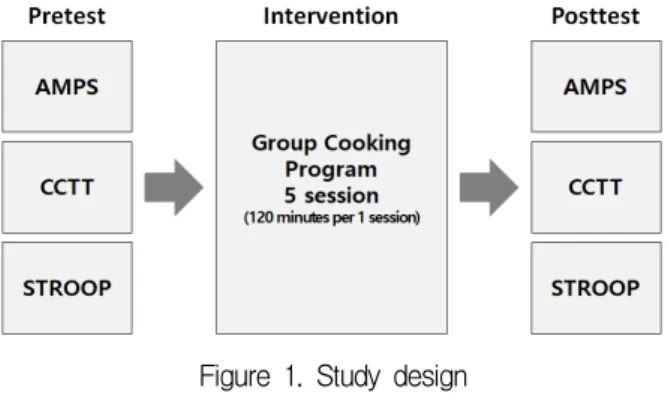
본 연구는 단일집단 사전-사후 설계(one group pretest- posttest design)를 적용하였다. 중재 프로그램은 요리활 동 집단 중재로 구성 되었고 2017년 7월부터 2017년 8월 까지 총 5회기(1회기당 120분)로 진행되었다. 프로그램 전과 후에 실행기능 변화를 측정하였다.
3. 연구 도구
1) 운동처리기술평가(Assessment of Motor and Process Skills; AMPS)
AMPS는 일상생활 과제를 수행하는 동안 관찰되는 수행 기술의 신체적 노력, 효율성, 안정성, 독립성을 평가한다 (Fisher & Jones, 2010). 평가는 만 3세에서 90세를 대상으로 하고, 110개의 일상생활활동 과제 중에 2-3개 과제를 관찰하 여 평가한다. 운동기술과 처리기술 각각의 로짓 점수로 결과 가 산출된다. 운동 기술 영역의 검사-재검사 신뢰도는 두 가지 과제를 실시하였을 때 r=.91이고, 처리 기술 영역의 검사-재검사 신뢰도는 두 가지 과제를 실시하였을 때 .87~.90이다. SIB(Scales of Independent Behavior)와의 동 시타당도는 .50~.85이다. 본 연구에서 사용한 평가 과제는 차가운 우유와 시리얼 먹기(C-1), 젓가락으로 동양음식 먹 기(P-9)였다. 아동에 걸쳐 수행 기술 측정의 일관성을 위해 서 동일한 과제를 시행하였고 AMPS 평가 자격이 있는
동일한 평가자가 사전-사후 평가를 진행하였다. 본 연구에 서는 프로그램 전과 후 아동의 수행 실행기능 측정을 위해 AMPS-P 로짓 점수를 사용하였다.
2) 아동 색 선로 검사(Children’s Color Trails Test;
CCTT)
CCTT는 정신운동속도, 순차적 처리속도, 인지적 유 연성 및 지속적 분할 주의력을 측정하는 비언어적인 평 가도구이다(Shin & Koo, 2007). CCTT-1는 숫자를 순차 적으로 이어나가는 과제이고, CCTT-2는 두 가지 색으 로 된 숫자들을 색을 번갈아 가며 순차적으로 연결하는 과제이다. 검사는 5세에서 15세를 대상으로 한다. 검사- 재검사 신뢰도는 .50~.75이고. 스트룹 아동 색상-단어 검 사와의 동시타당도는 -.48~-.51이다. 본 연구에서는 프 로그램 전과 후 아동의 실행기능 중 인지적 유연성을 측 정하기 위해 CCTT-2 검사를 사용하였다. CCTT-2의 총 완성 시간은 아동이 첫 번째 원을 향해 움직일 때부터 마지막 원에 연필이 닿을 때까지 소요된 시간이다. 총 완 성 시간은 평균 50, 표준편차 10인 T점수로 변환된다. 본 연구에서는 T점수를 사용하였다.
3) 스트룹 아동 색상-단어 검사(STROOP Color And Word Test; STROOP)
STROOP은 글자 색상에 주의를 기울여 반응하기 위 해 글자를 읽으려는 자동화된 반응을 억제하는 능력을 알아보는 검사로 실행기능 중 주의통제영역의 인지적 억제를 측정하는 도구이다(Shin & Park, 2007). 검사는 5세에서 14세를 대상으로 하고, 단어, 색상, 색상-단어 하위 검사로 구성되어 있다. 검사-재검사 신뢰도는 .66~.76이고, CCTT-2와의 동시타당도는 -.48~-.51이
Figure 1. Study design
다. 본 연구에서는 프로그램 전과 후 아동의 실행기능 중 인지적 억제를 측정하기 위해 색상-단어 검사를 사 용하였다. STROOP 색상-단어의 원점수는 아동이 45 초 동안 읽은 색상 개수이다. 원점수는 평균이 50, 표준 편차 10인 T점수로 변환된다. 본 연구에서는 T점수를 사용하였다.
4. 집단 요리활동 중재 프로그램
본 연구에서는 아동 부엌 과제 평가(Rocke et al., 2008) 의 실행기능 요소-시작, 조직화, 계획/순서화, 판단/안전, 완료-를 적용하여 요리활동 프로그램을 고안하였다. 또 한, 본 프로그램은 기존 연구에서 검증된 실행기능 증진 미술활동 프로그램에 기반을 둔다(Moon & Kim, 2018).
집단 요리활동 프로그램의 각 회기는 준비활동 및 활 동에 대한 소개(20분), 장보기(30분), 요리활동(40분), 쉬 는 시간(10분), 활동 마무리 및 정리(20분)로 구성되었다.
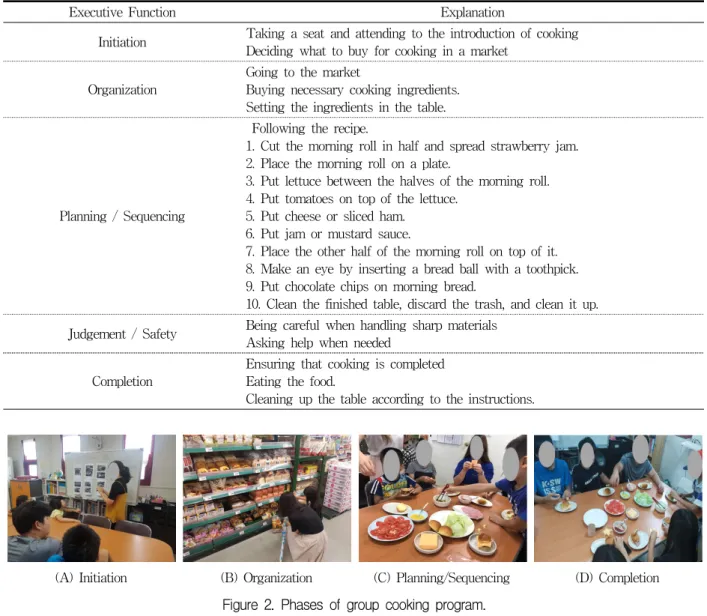
프로그램은 총 5회기로 시행되었고, 각 회기별 요리는 샌 드위치(1회기), 개구리 햄버거(2회기), 팥빙수(3회기), 소 세지 김밥(4회기), 화분 컵케이크(5회기)이었다. Table 2 는 개구리 햄버거 만들기 활동의 실행기능을 나타낸다.
시작 단계에서 아동들은 요리 순서에 대한 설명을 듣고, 필요한 재료에 대해서 파악하였다. 조직화 단계에서 아 동들은 마트에 가서 재료들을 구입하였고 센터로 돌아와 요리가 이루어지는 테이블에 재료들을 배치하였다. 계획 /순서화 단계에서 아동은 요리 순서에 따라서 음식을 만 들었고, 활동 진행자들이 아동을 보조하였다. 판단/안전 은 요리를 만드는 과정에 걸쳐 적용이 되는 단계로 날카
Table 2. A Representative group cooking program session (Making a frog-shaped hamburge)
Executive Function Explanation
Initiation Taking a seat and attending to the introduction of cooking Deciding what to buy for cooking in a market
Organization
Going to the market
Buying necessary cooking ingredients.
Setting the ingredients in the table.
Planning / Sequencing
Following the recipe.
1. Cut the morning roll in half and spread strawberry jam.
2. Place the morning roll on a plate.
3. Put lettuce between the halves of the morning roll.
4. Put tomatoes on top of the lettuce.
5. Put cheese or sliced ham.
6. Put jam or mustard sauce.
7. Place the other half of the morning roll on top of it.
8. Make an eye by inserting a bread ball with a toothpick.
9. Put chocolate chips on morning bread.
10. Clean the finished table, discard the trash, and clean it up.
Judgement / Safety Being careful when handling sharp materials Asking help when needed
Completion
Ensuring that cooking is completed Eating the food.
Cleaning up the table according to the instructions.
(A) Initiation (B) Organization (C) Planning/Sequencing (D) Completion
Figure 2. Phases of group cooking program.
로운 도구나 액체를 다룰 때 주의를 필요로 한다. 완료 단계에서 아동은 완성된 음식을 먹었고, 프로그램 진행 자들의 안내에 따라 정리와 청소를 하였다. 실행기능 요 소는 모든 활동에 동일하게 포함되었다.
5. 분석 방법
집단 요리활동 프로그램의 효과성을 알아보기 위해 사 전·사후 AMPS-P, CCTT-2, STROOP 점수를 윌콕슨 순위 검정(Wilcoxon matched-pairs signed-ranks test) 으로 분석하였다. SPSS 22.0 프로그램을 이용하여 통계 분석을 하였고, 통계적 검증을 위한 유의수준은 α=.05로 설정하였다.
Ⅲ. 연구 결과
1. 수행 실행기능에 대한 프로그램 전·후 비교
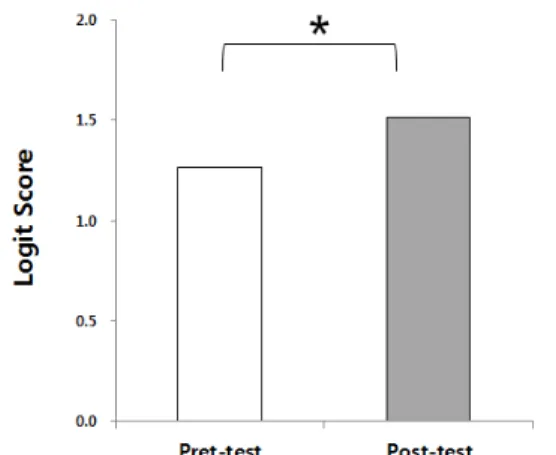
AMPS-P의 로짓 평균에 있어 사전 검사 1.26(0.45)점 에서 사후 검사 1.51(0.33)점으로 0.25(0.28)점이 증가하였 고, 증가폭은 통계적으로 유의하였다(Z=-2.06, p<.05, Figure 3).
Figure 3. Comparison between pre-test and post-test scores on AMPS
2. 인지적 유연성 실행기능에 대한 프로그램 전·후 비교
CCTT-2 T점수 평균에 있어 사전 검사 50.83(9.94)점
과 사후 검사 50.67(0.16)점 간 유의미한 차이는 없었다 (Z=-.213, p=.832, Figure 4).
3. 인지적 억제 실행기능에 대한 프로그램 전·후 비교
STROOP 아동 색상-단어 검사의 T점수 평균은 사전 검사 43.16(10.23)점에서 사후 검사 49.83(10.82)점으로 6.67(4.5)점 증가하였고, 증가폭은 통계적으로 유의하였 다(Z=-2.207, p<.05, Figure 4).
Figure 4. Comparison between pre-test and post-test scores on CCTT-2 and STROOP
Ⅳ. 고 찰
본 연구는 지역아동센터 아동을 대상으로 한 집단 요 리활동 프로그램이 실행기능 향상에 효과가 있음을 보여 주었다. 집단 요리활동 프로그램은 수행 실행기능 요소 를 고려하여 시작, 조직화, 계획/순서화, 판단/안전, 완료 요소를 포함하였다. 프로그램 전과 후에 수행 실행기능 은 AMPS-P, 인지적 유연성은 CCTT-2, 인지적 억제는 STROOP으로 측정하였고 수행 실행기능과 인지적 억제 실행기능에서 프로그램의 유의미한 효과를 검증하였다.
본 연구는 지역사회 세팅에서 작업에 기반한 활동 프로 그램이 저소득층 아동의 실행기능 향상을 촉진할 수 있 음을 제안한다.
본 연구에서는 중재 전·후 점수 비교에 있어 AMPS-P 점수의 유의미한 향상이 나타났다. AMPS-P는 수행 실 행기능을 측정하는 평가로(Baum et al., 2008; Poulin, Korner-Bitensky, & Dawson, 2013), 실행기능을 포함한
인지기능과 관련되고(Kizony & Katz, 2002) 실행기능 수 행 검사(Executive Function Performance Test) 점수와 정적 상관을 나타내는 것으로 보고되었다(Kim, Lee, Jo,
& Lee, 2017). AMPS-P와 실행기능 간의 관련성에 기초 하여 본 연구에서는 AMPS-P를 활용하여 프로그램 효 과를 측정하였다. 요리활동에서 향상된 수행 실행기능이 AMPS-P 점수 향상에서 반영이 된 것으로 생각된다.
본 연구에서는 중재 전·후 기초 실행기능 비교에 있어 STROOP에서는 프로그램 전·후 변화가 유의미하였지만, CCTT-2에서는 프로그램 전·후 변화가 유의미하지 않았 다. STROOP 검사는 기초 실행기능의 요소 중 인지적 억제를 평가하는 검사이며(Shin & Park, 2007) CCTT-2 는 인지적 유연성을 평가하는 검사이다(Shin & Koo, 2007). 인지적 유연성은 인지적 억제와 작업 기억이 복합 되어 나타나는 기능으로 인지적 억제보다 발달된 실행기 능 수준을 요구하기 때문에(Diamond, 2013), 인지적 억 제와 달리 인지적 유연성에서는 프로그램 효과를 관찰하 지 못한 것으로 추정된다.
본 연구의 결과는 작업 기반 활동 프로그램이 실행기 능을 향상시킨다는 선행 연구(Moon & Kim, 2018)에 추 가적인 증거를 제공하였다. 나아가 본 연구는 수행 실행 기능을 포함한 활동의 고유한 효과를 보여주었다. 뇌성 마비 아동을 대상으로 실행기능 프로그램 효과성을 보고 한 Moon과 Kim(2018) 연구에서는 수행 실행기능을 포 함한 미술활동과 기초 실행기능을 포함한 게임 활동을 함께 진행하였다. 이 선행 연구에서 두 수준의 실행기능 프로그램이 복합적으로 진행되었기 때문에 수행 실행기 능에 중점을 둔 미술활동 프로그램의 고유한 효과성을 분리하기는 어려웠다. 이와 다르게, 본 연구는 수행 실행 기능에 초점을 맞춘 요리활동만 진행하였기 때문에 본 연구는 수행 실행기능 프로그램의 효과성을 제시할 수 있었다.
본 연구는 비장애 아동을 대상으로 한 실행기능 증진 요리활동 프로그램을 제시한다. 최근 10년 동안 국내에 서 실행기능 중재 프로그램을 조사한 연구에 의하면 주 의력결핍 과잉행동장애 또는 학습부진 아동들을 대상으 로 프로그램이 진행되었지만, 비장애 아동을 대상으로 한 실행기능 프로그램에 대한 연구는 많지 않은 실정이 다(Lee, 2017). 본 연구가 비장애 아동을 대상으로 한 실 행기능 프로그램의 기초자료가 될 수 있을 것이다.
본 연구의 제한점은 다음과 같다. 첫째, 본 연구는 단
일 집단 사전-사후 설계로 대조군 없이 진행되었다. 향 후 연구에서는 통제 집단 사전-사후 설계와 같이 근거 수준이 높은 연구 설계로 프로그램의 효과성을 검증할 필요가 있다. 둘째, 본 연구의 프로그램 회기가 인지적 유연성을 향상시키기에는 충분하지 않은 것으로 추정된 다. 향후 연구에서 확장된 회기의 프로그램을 진행한다 면 인지적 유연성 향상을 관찰할 가능성이 있을 것이다.
셋째, 본 연구에서는 실행기능에 초점을 맞추어서 프로 그램의 효과성을 측정하였지만, 측정하지 않은 다른 기 능도 함께 증진되었을 거라 생각된다. 향후 연구에서는 요리활동의 긍정적 영향을 다각적으로 측정한다면 작업 기반 활동의 의미를 추가적으로 제안할 수 있을 것이다.
Ⅴ. 결 론
본 연구는 요리활동 프로그램이 지역아동센터 비장애 아동의 실행기능에 미치는 효과를 알아보았다. 본 연구 결과는 작업에 기반을 둔 활동 프로그램이 기능 수준의 기초 실행기능을 비롯하여 작업 수행 시 발현되는 수행 실행기능을 향상시킴을 보여주었다. 나아가, 본 연구는 작업 중재가 지역사회의 비장애 아동에게 적용될 수 있 음을 제시한다. 작업치료가 지역사회 환경에서 다양한 대상들의 참여를 증진하는 서비스로 확장되는데 있어 본 연구가 초석이 되기를 기대해 본다.
ACKNOWLEDGMENTS
This work was supported by the Soonchunhyang University Research Fund and by the National Research Foundation of Korea(NRF) grant funded by the Korea government(MSIT) (No. 2017R1C1B5018118).
REFERENCES
American Occupational Therapy Association (2014).
Occupational therapy practice framework: Domain and process (3rd Edition). American Journal of Occupational Therapy, 68, S1-S48.
Baum, C. M., Connor, L. T., Morrison, T., Hahn, M., Dromerick, A. W., & Edwards, D. F. (2008).
Reliability, validity, and clinical utility of the Executive Function Performance Test: A measure of executive function in a sample of people with stroke. American Journal of Occupational Therapy, 62(4), 446-455.
Baum, C., & Edwards, D. F. (1993). Cognitive performance in senile dementia of the Alzheimer’s type: The Kitchen Task Assessment. American Journal of Occupational Therapy, 47, 431-436.
Bellows, L. L., Davies, P. L., Anderson, J., & Kennedy, C. (2013). Effectiveness of a physical activity intervention for Head Start preschoolers: A randomized intervention study. American Journal of Occupational Therapy, 67, 28-36.
Bowyer, P., Moore, C. C., & Thom, C. (2016).
Occupational therapy in the context of Head Start:
A preliminary survey study. Journal of Occupational Therapy, Schools, & Early Intervention, 9(4), 332-339.
Bundy, A. C., Luckett, T., Naughton, G. A., Tranter, P.
J., Wyver, S. R., Ragen, J., et al. (2008). Playful interaction: Occupational therapy for all children on the school playground. American Journal of Occupational Therapy, 62(5), 522-527.
Case-Smith, J. (2013). Systematic review of interventions to promote social–emotional development in young children with or at risk for disability. American Journal of Occupational Therapy, 67, 395–404.
Cho, Y. H. (2017). The effect of group art therapy on the happiness of children in the regional children’s center. Unpublished master’s thesis, University of Chosun, Gwangju.
Craig, F., Margari, F., Letrottaglier, A. R., Palumbi, R., Giambattista, C., & Margari, L. (2016). A review of executive function deficits in autism spectrum disorder and attention-deficit/hyperactivity disorder.
Neuropsychiatric Disease and Treatment, 12, 1191-1202.
Diamond, A. (2013). Executive functions. Annual Review
of Psychology, 64, 135-168.
Diamond, A., & Ling, D. S. (2016). Conclusions about interventions, programs, and approaches for improving executive functions that appear justified and those that, despite much hype, do not.
Developmental Cognitive Neuroscience, 18, 34-48.
Doll, J. D. (2010). Program development and grant writing in occupational therapy: Making the connection Sudbury. Mass.: Jones & Bartlett Publishers.
Donica, D. K., Goins, A., & Wagner, L. (2013).
Effectiveness of handwriting readiness programs on postural control, hand control, and letter and number formation in Head Start classrooms.
Journal of Occupational Therapy, Schools, and Early Intervention, 6(2), 81-93.
Fedewa, A., & Ahn, S. (2012). The effects of physical activity and physical fitness on children's achievement and cognitive outcomes: A meta- analysis. Research Quarterly for Exercise and Sport, 82(3), 521–535.
Fisher, A. G., & Jones, K. G. (2010). Assessment of motor and process skills. Vol.1, Development, Standardization, and Administration Manual (7th ed.). Fort Collins, Three Star Press.
Garon, N., Bryson, S. E., & Smith, I. M. (2008).
Executive function in preschoolers: A review using an integrative framework. Psychological Bulletin, 134(1), 31.
Jurado, M. B., & Rosselli, M. (2007). The elusive nature of executive functions: A review of our current understanding. Neuropsychology Review, 17(3), 213-233.
Kim, H., Lee, Y. N., Jo, E. M., & Lee, E. Y. (2017).
Reliability and validity of culturally adapted Executive Function Performance Test for Koreans with stroke. Journal of Stroke and Cerebrovascular Diseases, 26(5), 1033-1040.
Kim. H. J., & Kim. E. Y. (2016). The effect of group occupational activity program on visual perception and motor function of children in community
children center. The Journal Korean Academy of Sensory Integration, 14(1), 9-18.
Kizony, R., & Katz, N. (2002). Relationships between cognitive abilities and the process scale and skills of the assessment of motor and process skills (AMPS) inpatients with stroke. Occupational Therapy Journal of Research, 22(2), 82-92.
Law, M., Majnemer, A., McColl, M. A., Bosch, J., Hanna, S., Wilkins, S., et al. (2005). Home and community occupational therapy for children and youth: A before and after study. Canadian Journal of Occupational Therapy, 72(5), 289-297.
Lawson, G. M., & Farah, M. J. (2017). Executive function as a mediator between SES and academic achievement throughout childhood. International Journal International Journal of Behavioral Development, 41, 94-104.
Lee, H. J. (2007). A study of children's status and their satisfaction of educational environment at community child care centers. Unpublished masters’s thesis, Women’s University of Sook-Myung, Seoul.
Lee, J. M. (2017). Current research trends on executive function in children. Korean Journal of Child Studies, 38(2), 17-35.
Lee, M. H., Bae, N. Y., Lee, G. S., Choi, K. C., & Lee.
M. L. (2004). Problem in emotion and behavior presented by poverty children in their school activities. Journal of Emotional & Behavioral Disorders, 20(4), 311-334.
Lehto, J. E., Juujärvi, P., Kooistra, L., & Pulkkinen, L.
(2003). Dimensions of executive functioning: Evidence from children. British Journal of Developmental Psychology, 21(1), 59-80.
Lust, C. A., & Donica, D. K. (2011). Effectiveness of a handwriting readiness program in Head Start: A two-group controlled trial. American Journal of Occupational Therapy, 65(5), 560-568.
Madhushanthi, H. J., Wimalasekera, S. W., Goonewardena, C. S. E., Amarasekara, A. T. D., & Lenora, J. (2018).
Socioeconomic status is a predictor of neurocognitive
performance of early female adolescents. International Journal of Adolescent Medicine and Health, 47, 777-780.
Melby-Lervag, M., & Hulme, C. (2012). Is working memory training effective a meta-analytic review.
Developmental Psychology, 49, 270-291.
Moon, Y. S., & Kim, E. Y. (2018). Effectiveness of performance-basic executive function group program for preschool children with cerebral palsy. The Journal of Korean Society of Occupational Therapy, 26(2), 17-31.
Poulin, V., Korner-Bitensky, N., & Dawson, D. R. (2013).
Stroke-specific executive function assessment: A literature review of performance-based tools.
Australian Journal of Occupational Therapy, 60, 3-19.
Rocke, K., Hays, P., Edwards, D., & Berg, C. (2008).
Development of a performance assessment of executive function: The Children’s Kitchen Task Assessment. American Journal of Occupational Therapy, 62(5), 528-537.
Shin, M. S., & Koo, H. J. (2007). A standardization Study of Children’s Color Trails Test (CCTT).
Seoul: Hakjisa Publisher.
Shin, M. S., & Park, M. J. (2007). STROOP Color And Word Test. Seoul: Hakjisa Publisher.
Vasak, M., Williamson, J., Garden, J., & Zwicker, J. G.
(2015). Sensory processing and sleep in typically developing infants and toddlers. American Journal of Occupational Therapy, 69(4), 6904220040p1- 6904220040p8.
Welsh, M. C., & Pennington, B. F. (1988). Assessing frontal lobe functioning in children: Views from developmental psychology. Developmental Neuropsychology, 4(3), 199-230.
Werner, E. E. (1989). High‐risk children in young adulthood: A longitudinal study from birth to 32 years. American Journal of Orthopsychiatry, 59(1), 72-81.
Abstract
The Effects of Group Cooking Program on Executive Function of the Non-disabled Children in Community Children’s Center
Lee, Cho-Hee*, Gwon, Sun-Jeong**, Lee, Seung-Min**, Je, Young-Hyeon**, Jo, Ye-Na**, Kim, Eun-Young**
*Dept. of Occupational Therapy, Graduate School, Soonchunhyang University
**Dept. of Occupational Therapy, Soonchunhyang University
Objective : This study was conducted to investigate the effects of occupation-based group cooking program on executive function for children in community children’s center.
Methods : The children who participated in the study were 7 to 9 years old. This study was based on a one-group pre-posttest design, which the group cooking program included making of sandwiches, frog-shaped hamburgers, patbingsu, sausage gimbap, and flowerpot cupcake. This study consisted of five activity sessions, which each session lasted for 120 minutes. Effectiveness of the program was measured by using the STROOP Color and Word Test, Children’s Color Trails Test and Assessment of Motor and Process Skills.
Results : The differences between pre and posttest scores on STROOP Color and Word Test and the process skill score of Assessment of Motor and Process Skills were statistically significant. There was no difference significantly between pre and posttest scores in Children’s Color Trails Test-2.
Conclusion : This study demonstrated that the group cooking program intervention has effects on cognitive inhibition executive function and performance executive function of children in the community children’s center. This study suggests that occupation-based intervention can be applied to various clients in the community setting.
Key words : Community Child Center, Executive Function, Group Cooking Program, Occupation-Based Intervention