Ⅰ. 서 론
하고 싶고, 해야 하고, 할 거라 기대되어지는 작업들 에 참여하면서 사람들은 작업 정체성을 형성해 나가고 삶에 참여한다. 생애 초반 발달 시기에 지지적인 환경에 서 양육되는 아동들은 작업적 정당성을 보장 받으며 다 양한 활동에 참여하고 이를 통해 신체적, 인지적 기술들 을 발전시켜 나간다. 반면, 충분한 자원을 가용할 수 없 는 환경에서 양육되는 아동들은 적은 레퍼토리의 활동을 경험하는 것으로 인해 기술을 충분히 발달시키지 못할 가능성이 크며, 기술의 미성숙은 다시 제한된 작업 기회
로 이어질 수 있다.
아동의 발달에 영향을 줄 수 있는 대표적 환경 요인은 가족의 사회경제적 지위(socioeconomic status: SES) 인데, 낮은 SES는 다양한 영역의 발달과 부정적으로 관 련된다고 알려져 있다(Bradley & Corwyn, 2002). 낮은 SES 환경의 아동들은 높은 SES 환경의 아동들에 비하여 낮은 수준의 장악력, 시운동 통합, 실행을 나타낸다 (Bowman & Wallace, 1990). 또한, 낮은 SES 환경의 아 동들은 운동 수행의 어려움을 나타낼 가능성이 큰데, 이 는 적은 신체 활동의 참여와 관련된다(Hardy, Reinten- Reynolds, Espinel, Zask, & Okely, 2012; Lingam, 대한감각통합치료학회지 제14권 제1호
The Journal Korean Academy of Sensory Integration 2016 Vol. 14, No. 1
http://dx.doi.org/10.18064/JKASI.2016.14.1.009
집단 작업 활동 프로그램이 지역아동센터 아동의 시지각 및 운동기능에 미치는 효과
김혜진, 김은영 순천향대학교 작업치료학과
국문초록
목적 : 본 연구는 집단 작업 활동 프로그램이 지역아동센터 아동들의 시지각 및 운동기능을 향상시킬 수 있는지 알아보았다.
연구방법 : 지역아동센터를 이용하는 만 6∼9세 학령기 아동 5명을 대상으로 집단 작업 활동 프로그램을 실시하였 다. 프로그램은 놀이를 기반으로 시지각 및 운동기능을 촉진할 수 있는 요소를 포함하였고, 주 1회(90분) 총 9회기 로 진행되었다. 아동의 시지각 및 운동기능에 대한 프로그램 효과를 알아보기 위하여 프로그램 전과 후에 Motor Free Visual Perception Test-Third Edition(MVPT-3)와 Bruiniks-Oseretsky Test of Motor Proficiency 2nd Edition(BOT-2) 평가를 실시하여 두 시점의 평가 결과를 비교하였다.
결과 : 집단 작업 활동 프로그램은 지역아동센터 아동의 시지각 및 운동기능을 향상시키는 효과가 있었다.
결론 : 본 연구는 지역아동센터 아동들의 시지각 및 운동기능의 발달 촉진에 있어서 집단 작업 활동 프로그램의 효과를 보여주었다. 이러한 경험적 증거는 발달을 촉진하는 작업 활동이 지역사회에 적용되고 확대될 수 있는 근거를 제시한다.
주제어 : 시지각, 운동기능, 지역아동센터, 집단 작업 활동 프로그램
교신저자: 김은영([email protected])
Hunt, Golding, Jongmans, & Emond, 2009). 이렇게 충분히 발달하지 못한 시지각 및 운동 기술은 아동기 주 요한 작업 수행(예, 학습)의 부진으로 이어질 수 있다 (Pienaar, Barhorst, & Twisk, 2014).
지지가 부족한 환경에서 양육되는 아동들에게 발달에 적합한 작업을 제공하고 작업 수행에 필요한 기술들을 촉진하는 중재프로그램이 제안되어 왔다. 경제적으로 불 리한 아동을 대상으로 감각통합, 운동학습, 인지적 전략 등을 포함한 쓰기 기술 작업치료 프로그램의 효과성 (Peterson & Nelson, 2003)과 글쓰기 운동기술 (graphomotor skill)을 촉진하기 위한 작업 중재의 시지 각 및 운동능력 향상 효과(Ratzon, Efraim, & Bart, 2007)가 보고되었다. 이 선행 연구들은 낮은 SES 혹은 저소득층 아동을 대상으로 한 작업치료 활동 프로그램들 이 아동들의 기술 발달 및 작업 수행에 긍정적으로 영향 을 미친다는 증거를 제공한다.
국내에서는 저소득층 아동들을 대상으로 한 미술치 료, 심리치료 프로그램 효과에 대해서 보고되었지만 (Jang, 2011; Yeom, 2011) 작업 활동 프로그램의 효과 를 알아보는 연구는 미비하다. 본 연구는 저소득층 학령 기 아동들을 대상으로 시지각과 운동기술을 촉진하기 위 한 작업 활동 프로그램의 효과에 대해서 알아보고자 한 다. 활동 프로그램은 저소득층 아동청소년들이 주 이용 대상인 지역아동센터(Kim & Choi, 2014)에서 실시되었 고 프로그램 효과를 검증하기 위해서 프로그램 사전 사 후 시지각 및 운동기술을 측정하였다.
Ⅱ. 연구 방법
1. 연구대상
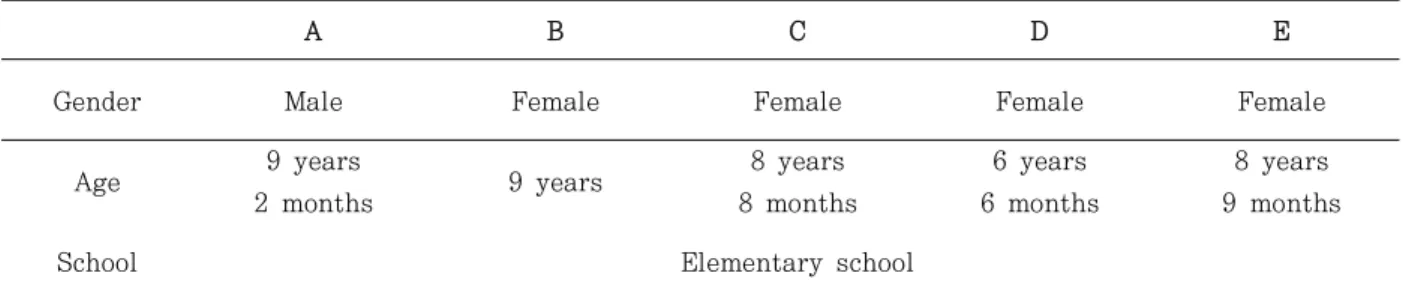
본 연구는 2016년 3월부터 6월까지 C지역의 시소재 지역아동센터에 다니고 있는, 집단 작업 활동 프로그램 에 참여하고 있는 평균 9세의 아동 5명(남 1명, 여 4명)을 대상으로 실시하였다(Table 1). 지역 아동센터 내 사회 복지사로부터 놀이 작업 활동을 의뢰 받았다. 대상 아동 들은 진단명을 가지고 있지 않으며, 작업 활동 프로그램 당시 요일마다 센터 내에서 진행하는 다양한 프로그램 (과학교실, 수학교실, 난타교실 등)에 참여하였다. 집단 프로그램은 한 회기에 약 10명의 아동을 대상으로 진행 되었다. 본 연구에서는 연구 실시 전 프로그램 진행 목적 에 관련해 설명했다. 보호자가 연구 참여에 동의하고 전 후 평가 결과가 수집된 아동 5명의 자료만을 보고하였 다. 프로그램 시작 전 시행했던 초기평가 결과 Motor Free Visual Perception Test-Third Edition(MVPT-3) 에서 1명의 아동이 Very low, 2명의 아동이 Low, 2명의 아동이 Average이고, Bruiniks-Oseretsky Test of Motor Proficiency 2nd Edition(BOT-2)에서 1명의 아 동이 Well-below average, 2명의 아동이 Below average, 2명의 아동이 Average였다. 대상 아동들의 과반수가 평 균 이하의 수행을 나타냈다.
2. 평가도구
아동의 시지각과 운동 능력을 평가하기 위해 MVPT-3 와 BOT-2를 실시하였다.
1) Motor Free Visual Perception Test- Third Edition (MVPT-3)
A B C D E
Gender Male Female Female Female Female
Age 9 years
2 months 9 years 8 years 8 months
6 years 6 months
8 years 9 months
School Elementary school
Table 1. General characteristics of subjects
MVPT-3은 운동기능을 사용하지 않고 시지각 능력을 평가하는 도구로서, 스크리닝, 진단, 연구를 목적으로 고안된 평가도구이다. 대상 연령은 4세부터 95세까지로, 그 범위가 넓다. MVPT-3의 영역은 공간 관계성(spatial relationships), 시각 구별(visual discrimination), 전 경-배경(figure-ground), 시각폐쇄(visual closure), 시각 기억(visual memory)과 같이 크게 5가지 영역으로 나뉜다. 총 65개의 항목으로 만 4∼10세는 1∼40문항, 11세 이상부터는 14∼65문항까지 실시한다. 본 연구는 만 6세∼9세의 아동을 대상으로 하였으므로 모든 문항을 맞출 경우 원점수의 만점은 40점이다. 만 4∼10세를 대 상으로 한 검사-재검사 간 신뢰도는 .87이다(McCane, 2006). MVPT-3는 DTVP-2와 비교한 결과 .65∼.78의 준거타당도를 보인다(Colarusso & Hammill, 2003).
2) Bruiniks-Oseretsky Test of Motor Proficiency 2nd Edition (BOT-2)
BOT-2는 종합적인 운동 기술에 대한 평가를 제공한 다. 대상 연령은 4세부터 21세 11개월이며 하위검사로는 미세운동조절(fine manual control), 손 협응(manual coordination), 신체 협응(body coordination), 근력과 민첩성(strength and agility)으로 나뉘어져 있다.
BOT-2는 완전형(complete form)과 단축형(short form)
검사가 있는데, 본 연구에서는 단축형 검사를 사용하였 다. 단축형 검사는 원점수 88점이 만점이다. 검사자 간 신뢰도는 .92∼.99, 검사-재검사 신뢰도는 .65∼.90이 고 구성타당도는 정상적인 발달을 보이는 아동들의 점수 보다 운동 기능의 손상과 관련된 진단을 가진(발달성협 응장애, 지적 장애, 고기능의 자폐 또는 아스퍼거) 아동 들의 유의미하게 낮은 점수로 검증된다(Bruininks &
Bruininks, 2005).
3. 연구과정
1) 사전·사후 검사
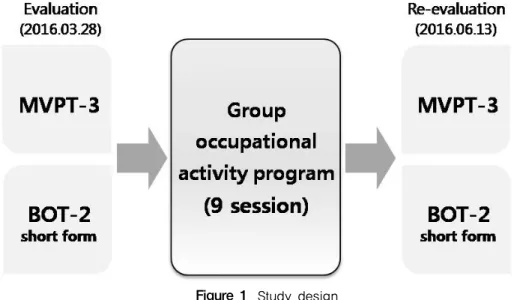
본 연구는 단일집단 사전-사후 설계(one group pretest- posttest design)를 사용하여 프로그램 전과 후 아동의 시지각 기술과 운동 기술의 변화를 측정하였다. 아동 평 가와 중재는 작업치료사 1명과 작업치료사로부터 훈련받 은 학부생 4명의 보조로 진행되었다(Figure 1).
2) 집단 작업 활동 프로그램
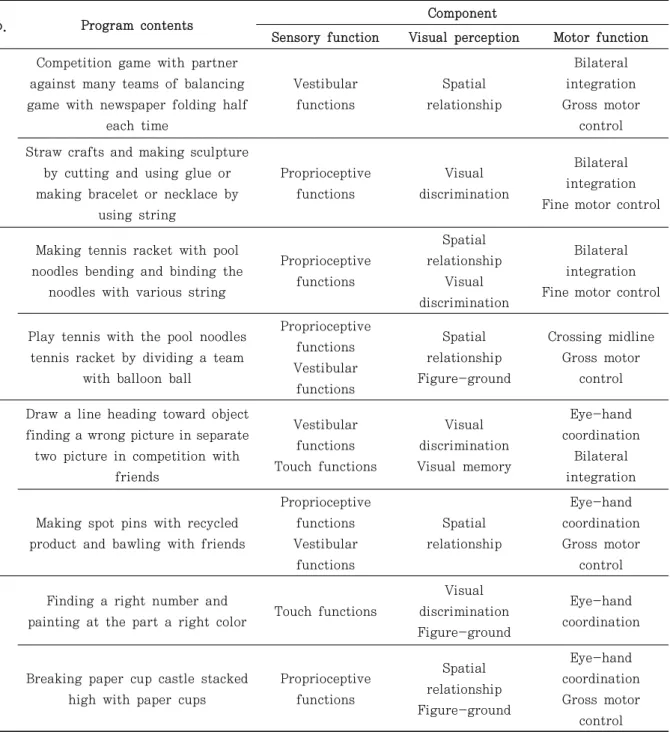
프로그램은 주 1회 총 9회로 진행되었으며, 회기마다 총 90분 중 준비활동(인사 및 소개 5분), 활동1(30분), 활동2(40분), 그리고 활동 마무리 및 정리(15분)로 구성 되었다(Table 2).
Figure 1. Study design
MVPT-3: Motor Free Visual Perception Test-Third Edition
BOT-2: Bruiniks-Oseretsky Test of Motor Proficiency 2nd Edition
No. Program contents Component
Sensory function Visual perception Motor function
1
Drawing and painting friend or teacher's face on canvas for
rapport building
Touch functions Proprioceptive
functions
Visual discrimination Visual memory
Eye–hand coordination Fine motor control
Making a animal shape doll with paper cup and color paper
Touch functions Proprioceptive
functions
Visual discrimination Visual memory
Bilateral integration
Eye–hand coordination
2
Turn color panel upside down with friends in competition at the quadrupedal position as fast as
possible
Proprioceptive functions Vestibularfunctio
ns
Spatial relationship Figure-ground
Eye–hand coordination Gross motor
control
Making a certificate with
decoration for oneself or friends Touch functions Visual memory
Eye–hand coordination
Bilateral integration
3
Using sharp variable tools after drawing overlapping design on
metal embossing craft
Touch functions Proprioceptive
functions
Spatial relationship Visual closure
Eye–hand coordination Fine motor control Game of how many tear the
newspaper, gather and shatter newspaper in competition with
friends
Touch functions Proprioceptive
functions
Figure-ground
Muscle power Eye–hand coordination
4
Building on paper cups as high and large as possible during a three-legged race and making
paper cup castle
Proprioceptive functions Vestibular
functions
Spatial relationship
Eye–hand coordination Gross motor
control Paper mosaic by tearing and cut
freely and then paste with glue with paper design you picked
Proprioceptive functions
Visual closure Visual memory
Eye–hand coordination
Bilateral integration
5
Making a ball made by newspaper folden many times and the compressed and winding around the ball with an adhesive tape and then
throwing play with the ball
Proprioceptive functions Vestibular
functions
Spatial relationship
Gross motor control Eye–hand coordination
Making necklace or bracelet by binding candies edge each other
Proprioceptive functions
Visual discrimination
Bilateral integration Fine motor control Table 2. Group occupational activity program
집단 작업 활동 프로그램은 이러한 학령기 발달에 적 합한 신체, 구성, 사회적 놀이들로, 활동 내에서 시지각 기술 및 운동 능력 발달 기회를 제공하도록 고안되었다 (Parham & Mailloux, 2015). 각 활동은 촉각, 고유수용 성 감각, 전정 감각 요소를 포함하였고 적응적 놀이 반응 을 격려하였다.
프로그램 초반에는 치료사 및 프로그램 보조요원이 아 동들과 라포를 형성 할 수 있는 활동(예, 얼굴 그리기)으 로 계획하였고, 회기가 진행됨에 따라 아동들의 공통적 인 선호들(예, 경쟁, 부수기, 찢기)을 반영하여 집단 활 동을 기획하고 진행하였다.
No. Program contents Component
Sensory function Visual perception Motor function
6
Competition game with partner against many teams of balancing game with newspaper folding half
each time
Vestibular functions
Spatial relationship
Bilateral integration Gross motor
control Straw crafts and making sculpture
by cutting and using glue or making bracelet or necklace by
using string
Proprioceptive functions
Visual discrimination
Bilateral integration Fine motor control
7
Making tennis racket with pool noodles bending and binding the
noodles with various string
Proprioceptive functions
Spatial relationship
Visual discrimination
Bilateral integration Fine motor control
Play tennis with the pool noodles tennis racket by dividing a team
with balloon ball
Proprioceptive functions Vestibular
functions
Spatial relationship Figure-ground
Crossing midline Gross motor
control
8
Draw a line heading toward object finding a wrong picture in separate two picture in competition with
friends
Vestibular functions Touch functions
Visual discrimination Visual memory
Eye-hand coordination
Bilateral integration
Making spot pins with recycled product and bawling with friends
Proprioceptive functions Vestibular
functions
Spatial relationship
Eye-hand coordination Gross motor
control
9
Finding a right number and
painting at the part a right color Touch functions
Visual discrimination Figure-ground
Eye-hand coordination
Breaking paper cup castle stacked high with paper cups
Proprioceptive functions
Spatial relationship Figure-ground
Eye-hand coordination Gross motor
control
Table 2. Group occupational activity program (Continues)
4. 분석방법
본 연구는 SPSS 22.0 프로그램을 이용하여 통계분석 을 하였다. 집단 작업 활동 프로그램의 효과성을 알아보 기 위해 사전/사후의 MVPT-3, BOT-short form 결과 를 윌콕슨 순위 검정(Wilcoxon matched–pairs signed- ranks test)을 이용하여 분석하였다. 통계적 검증을 위 한 유의수준은 α=.05로 하였다.
Ⅲ. 연구 결과
1. 집단 작업 활동 프로그램 적용 전·후 시지각 기능 비교
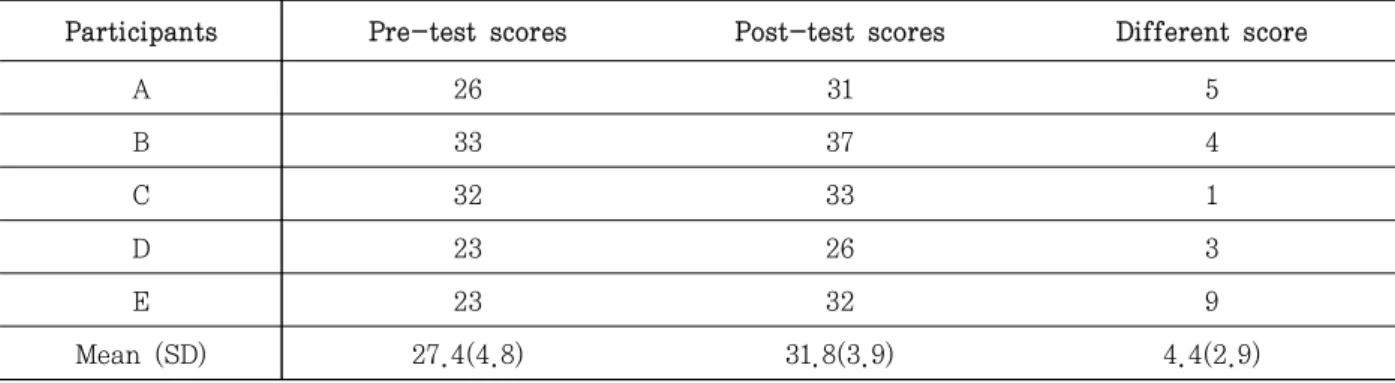
집단 작업 활동 프로그램 전 MVPT-3의 원점수 평균 은 27.4(4.8), 프로그램 후 원점수 평균은 31.8(3.9)로 4.4(2.9)점이 증가하였고(Table 3), 증가폭은 통계적으 로 유의하였다(Z = -2.023, p < .05). 하위영역에 대한 프로그램 전후 평균점수를 비교한 결과 시각폐쇄(Z = -2.041, p =.041)에서 통계적으로 유의한 차이가 있었 다. 그 외 나머지 하위영역의 평균점수는 향상되었으나 통계적으로 유의하지 않았다(ps > .059).
2. 집단 작업 활동 프로그램 적용 전·후 운동 기능 비교
집단 작업 활동 프로그램 전 BOT-2의 원점수 평균은
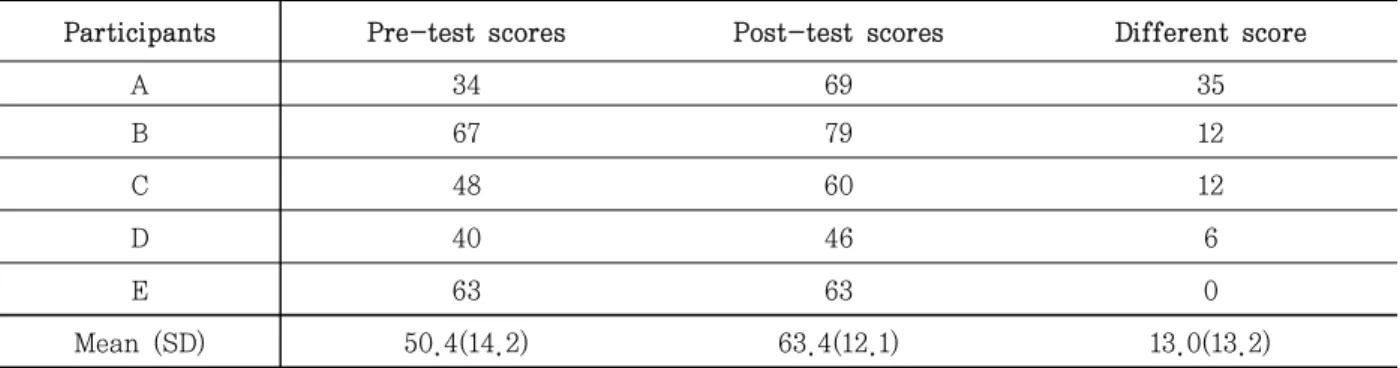
50.4(14.2), 프로그램 후 원점수 평균은 63.4(14.2)로 13.0(13.2)점이 증가하였으나(Table 4), 증가폭은 통계 적으로 유의미하지 않았다(Z = -1.841, p = .066). 하위 영역의 프로그램 전후 점수를 비교해보면 근력과 민첩성 영역에서 유의한 향상이 나타났다(Z = -2.023, p = .045). 그 외 나머지 하위영역 평균점수는 향상되었으나 통계적으로 유의하지 않았다(ps > .063).
Ⅳ. 고 찰
본 연구는 지역아동센터 아동들을 대상으로 한 집단 작업 활동 프로그램이 아동들의 신체 기능을 증진시키는 효과가 있음을 보여준다. 집단 작업 활동 프로그램을 통 해서 아동들이 기본적 감각 요소(촉각, 고유수용성, 전 정감각)와 시지각 처리를 통합하여 조절된 움직임을 산 출하고 놀이 동안 적응적인 반응을 할 수 있도록 격려하 였고, 그 결과로 프로그램이 시지각 능력의 유의한 향상 을 이끌고, 운동능력 중 근력과 민첩성에 긍정적인 영향 을 미쳤다는 것을 관찰하였다. 본 연구는 환경적 제약을 경험할 가능성이 높은 저소득층 아동들에게 시지각과 운 동 능력을 증진시킬 수 있도록 고안된 놀이 작업 활동을 제공함으로써 아동의 기술적 발달을 촉진할 수 있음을 보여주었다.
프로그램 적용 전 시지각과 운동 능력에서 규준 집단 의 평균보다 낮은 수행을 나타낸 아동은 각각 60%, 60%
이었다. 이는 제한된 환경이 아동의 기술적 발달을 저해 함을 나타낸다. 프로그램 적용 후, 시지각과 운동 능력에
Participants Pre-test scores Post-test scores Different score
A 26 31 5
B 33 37 4
C 32 33 1
D 23 26 3
E 23 32 9
Mean (SD) 27.4(4.8) 31.8(3.9) 4.4(2.9)
SD : Standard Deviation
Table 3. Motor Free Visual Perception Test-Third Edition (MVPT-3) raw scores of groups before and after program
서 평균보다 낮은 수행을 나타낸 아동은 각각 20%, 20%
로 감소하였는데, 이는 집단 작업 활동이 시지각 및 운동 기능에서 어려움을 경험하는 아동들의 수행을 또래와 유 사한 수준으로 촉진할 수 있음을 보여준다.
작업 활동을 통해서 저소득층 아동의 시지각 및 근력/
민첩성 향상을 관찰한 본 연구 결과는 시운동 통합 수행 이 좋지 않은 저소득층 아동에게 미세 운동 놀이 및 종이 -연필 과제를 포함한 작업치료가 시지각 및 운동능력 향 상에 효과가 있다는 Ratzon 등(2003)의 선행연구와 일 관된다. 또한, 저소득층 아동들에게 구조화된 놀이와 사 회적 상호작용을 촉진하기 위한 집단 작업치료 프로그램 - HOPE(healthy occupations for positive emotions)- 의 작업참여 증진 및 정서 조절 기술 향상 효과를 보고한 Bazyk과 Bazyk(2009)의 연구와 더불어 본 연구는 집단 상황에서 구조화된 놀이의 긍정적 효과를 검증한다. 종 합해 보면, 집단 작업 활동 프로그램은 사회 참여의 맥락 을 제공하고 놀이 작업 기회를 제공함으로써 다양한 기 술 발달을 촉진할 수 있다.
본 연구의 놀이 활동들은 감각적 요소 역시 포함하고 있다. 감각통합 견지에서 본 연구는 그룹 감각통합치료 가 아동들의 감각처리 및 운동 능력에 긍정적인 효과가 있다는 기존의 Hong과 Kim(2009a)의 연구 결과에 추가 적 증거를 제공한다. 반면, 기존의 Hong과 Kim(2009b) 의 연구에서 그룹감각통합치료가 시지각 및 운동기술 향 상에 미치는 영향이 유의미하지 않은 것과 다르게 본 연 구에서는 집단 작업 활동 프로그램으로 인한 아동의 시 지각에서 의미 있는 증가를 관찰할 수 있었다. 이와 같은 연구 간의 차이는 대상의 연령 및 특성을 비롯하여 프로
그램의 차이에 기인할 수 있다. 예를 들어, 본 연구에서 는 학령기 아동을 대상으로 한 반면, Hong과 Kim (2009b)의 연구에서는 학령 전후기 아동을 대상으로 프 로그램을 진행하였다.
본 연구에서는 아동 개개인에게 의미 있는 작업에 대 한 요구를 구조적으로 평가하지는 못하였지만, 치료 활 동 회기가 진행되는 동안 프로그램을 진행하는 작업치료 사가 아동과의 비구조화된 의사소통과 활동 몰입도를 통 해서 아동들의 활동 흥미를 파악해 나갔고 이를 프로그 램에 적극적으로 반영함으로써 프로그램이 작업 기반이 되도록 노력하였다. 예를 들어, 아동들이 판을 뒤집는 경 쟁놀이에 부수는 행동을 하면서 높은 참여율을 보이는 회기 이후에 종이컵 성 쌓아 부수기와 같은 활동을 포함 하여 아동들이 흥미 있어 하는 놀이 레퍼토리를 확장하 였다. 향후 연구에서는 아동의 작업 요구를 체계적으로 조사하여 이에 기반을 둔 프로그램 개발이 필요하리라고 본다. 또한, 본 연구에서는 놀이 작업에 초점을 맞추어서 활동을 제공하였지만 향후 연구에서는 다양한 작업에서 의 활동 프로그램 효과를 검증하는 것이 요구된다.
Ⅳ. 결 론
본 연구에서는 지역아동센터 아동들을 대상으로 한 집 단 작업 활동 프로그램이 시지각 및 운동기능 발달에 미 치는 영향을 알아보았다. 본 연구의 결과는 다음과 같다.
첫째, 집단 작업 활동 프로그램은 지역아동센터 아동 Participants Pre-test scores Post-test scores Different score
A 34 69 35
B 67 79 12
C 48 60 12
D 40 46 6
E 63 63 0
Mean (SD) 50.4(14.2) 63.4(12.1) 13.0(13.2)
SD : Standard Deviation
Table 4. Bruiniks-Oseretsky Test of Motor Proficiency 2nd Edition (BOT-2) raw scores of groups before and after program
의 시지각 능력을 향상시켰다.
둘째, 집단 작업 활동 프로그램은 지역아동센터 아동 의 운동 능력 향상에 긍정적인 영향을 미쳤다.
본 연구는 한 지역아동센터에서 소수 아동들을 대상으 로 진행하였기 때문에 일반화하기에는 어려움이 있다.
하지만, 지역아동센터 아동들을 대상으로 작업 활동 프 로그램을 시도한 국내 초창기 연구로 향후 프로그램 개 발에 초석을 제공할 것으로 기대된다.
감사의 글 : 지역아동센터 프로그램 진행에 도움을 준 김예은, 김진원, 박기배, 박정은, 이윤아, 이주경, 조 성훈에게 진심으로 감사의 뜻을 전합니다.
참 고 문 헌
Bazyk, S., & Bazyk, J. (2009). Meaning of occupation- based groups for low-income urban youths attending after-school care.
American Journal of Occupational Therapy
,63
(1), 69-80. http://dx.doi.org/10.5014/ajot.63.1.69
Bowman, O. J., & Wallace, B. A. (1990). The effects of socioeconomic status on hand size and strength, vestibular function, visuomotor integration, and praxis in preschool children.
American Journal of Occupational Therapy
,44
(7), 610-621. http://dx.doi.org/10.5014/ajot.44.7.610
Bradley, R. H., & Corwyn, R. F. (2002). Socioeconomic status and child development.
Annual Review of Psychology, 53
(1), 371–399. http://dx.doi.org/10.1146/annurev.psych.53.100901.135233
Bruininks, R. H., & Bruininks, D. B. (2005).
Brunininks- oseretsky test of motor proficiency (2nd ed.).
MN. USA: Pearson Education.
Colarusso, R. P., & Hammill, D. D. (2003).
Motor- Free Visual Perception Test-3 manual.
Novato, CA: Academic Therapy Publications.Hardy, L. L., Reinten-Reynolds, T., Espinel, P., Zask, A., & Okely, A. D. (2012). Prevalence and correlates of low fundamental movement skill
competency in children.
Pediatrics, 130
(2), e390-398. http://dx.doi.org/10.1542/peds.2012- 0345dHong, E. K., & Kim, K. M. (2009a). The effect of group sensory integrative intervention for play skill and social interaction.
The Journal Korean Academy of Sensory Integration, 7
(1), 13-25.Hong, E. K., & Kim, H. G. (2009b). The effects of group sensory integration intervention for sensory processing, fine motor skill, and social skill.
The Journal Korean Academy of Sensory Integration, 7
(2), 1-12.Jang, H. J. (2011).
Effects of ceramic work-centered group art therapy on the self-resilience of adolescents from low income families,
Master's thesis, Yeungnam University, Gyeongsan.Kim, H. J., & Choi, E. Y. (2014). Community child center users' parents-child relationship, social capital, and self-esteem: Application of mixed research methods.
Health and social welfare review, 34
(1), 239-267.Lingam, R., Hunt, L., Golding, J., Jongmans, M., &
Emond, A. (2009). Prevalence of developmental coordination disorder using the DSM-IV at 7 years of age: A UK population-based study.
Pediatrics, 123
(4), e693-700. http://dx.doi.org/10.1542/peds.2008-1770
McCane, S. J. (2006). Test review: Motor-free visual perception test.
Journal of Psychoeducational Assessment
,24
(3), 265-272. http://dx.doi.org/10.1177/0734282906286339
Parham, L. D., & Mailloux, Z. (2015). Sensory integration. In J. Case-Smith & J. C. O’Brien (Eds.),
Occupational therapy for children and adolescents
(7th ed., pp. 258–303). St. Louis:Mosby.
Peterson, C. Q., & Nelson, D. L. (2003). Effect of an occupational intervention on printing in children with economic disadvantages.
American
Journal of Occupational Therapy
,57
(2),152-60. http://dx.doi.org/10.5014/ajot.57.2.152 Pienaar, A. E., Barhorst, R., & Twisk., J. W.
(2014). Relationships between academic performance, SES school type and perceptual- motor skills in first grade South African learners: NW-CHILD study.
Child: Care, Health and Development, 40
(3), 370–378.http://dx.doi.org/10.1111/cch.12059
Ratzon, N. Z., Efraim, D., & Bart, O. (2007). A short-
term graphomotor program for improving writing readiness skills of first-grade students.
American Journal of Occupational Therapy
,61
(4), 399-405. http://dx.doi.org/10.5014/ajot.61.4.399
Yeom, J. S. (2011).
The effects dramatherapy on
emotional stability, self-esteem, and interpersonal
relationship of children in low-income families
, Masters' thesis, Wonkwang University, Iksan.Abstract
The Effect of Group Occupational Activity Program on Visual Perception and Motor Function of Children in Community Children Center
Kim, Hye-Jin, B.S., O.T., Kim, Eun-Young, Ph.D., O.T.* Dept. of Occupational Therapy, Soon Chun Hyang University
Objective : The current study investigated the effectiveness of group occupational activity program in increasing visual-perception and motor function of children in Community Children Center.
Methods : Five children aged between 6-9 years in a community children center participated in the group occupational activity program. The program was designed to facilitate children's visual-perception and motor function based on play occupations. We examined performances of MVPT-3 and BOT-2 before and after the program.
Results : Children who participated in the group program showed significant increases in visual perception and motor function.
Conclusion : The study revealed the effectiveness of group occupational activity program in promoting visual perception and motor function of children in a community children center, which suggests the possibility of application of occupational activity toward low-income children in the community.
Key words : community children center, group occupational activity program, motor-function, visual-perception