Korean J ournal of S oil S cience and F ertilizer
Short communication https://doi.org/10.7745/KJSSF.2019.52.3.173
pISSN : 0367-6315 eISSN : 2288-2162
Four-year Field Study on the Effect of Nutrient Management Practices on Soil Chemical Properties and Leaf Mineral Content in Newly Established Apple Orchard
Seong Eun Lee*, In Bog Lee, Pyoung Ho Yi, and Gopal Selvakumar
Horticultural & Herbal Crop Environment Division, National Institute of Horticultural & Herbal Science, Wanju 55365, Korea
*Corresponding author: [email protected]
A B S T R A C T
Received: May 13, 2019 Revised: August 29, 2019 Accepted: August 29, 2019
This four-year field study aimed to demonstrate the effect of nutrient sources and recommended fertilizer application (RFA) based on soil testing result on leaf mineral content and soil chemical properties in newly established ‘Hongro’/M.9 apple orchard. Chemical fertilizer (NPK), castor oil meal, hairy vetch + PK, and no fertilizer treatments were included. The results showed that there were no significant differences between nutrient sources on soil chemical properties, but leaf nitrogen and potassium content tended to be higher in oil meal and hairy vetch treatments. Meanwhile, RFA was revealed to have no effect on increasing soil chemical properties. Therefore, additional application of organic material should be needed in RFA system for appropriate soil nutrient management in newly established apple orchards under low fertility condition.
Keywords: Malus pumila, Natural resource, Optimum range, Recommended fertilizer application, Soil fertility
Effect of nutrient sources and recommended fertilizer application on soil chemical properties in ‘Hongro’/M.9 apple orchard.
Ⓒ The Korean Society of Soil Science and Fertilizer. This is an Open Access article distributed under the terms of the Creative Commons Attribution Non- Commercial License (http://creativecommons.org/licenses/by-nc/4.0) which permits unrestricted non-commercial use, distribution, and reproduction in any medium, provided the original work is properly cited.
Introduction
Soil nutrient management determines fruit quality and productivity, by affecting soil fertility and sustainability.
The problem is that over-application does not always result in corresponding increases in nutrient supply (Hammermeister et al., 2006). Also, excessive nitrogen (N) applications can increase leaching losses and water contamination (Atucha et al., 2011). Moreover, excessive N application increases growth and leaf N content, but negatively affects both fruit coloring and quality (Komamura et al., 2000). Therefore, agricultural management practices focused on a reduced impact on the agroecosystem, mainly with regard to biological processes, are promising techniques for sustainable agriculture (Homma et al., 2012). Still, however, it is unclear what is the best management of soil nutrient in newly established apple orchard. The aim of this study was to assess the influence of recommended fertilizer application (RFA) and nutrient management practices on soil chemical properties and leaf mineral content in low fertility clayey apple orchard.
Materials and Methods
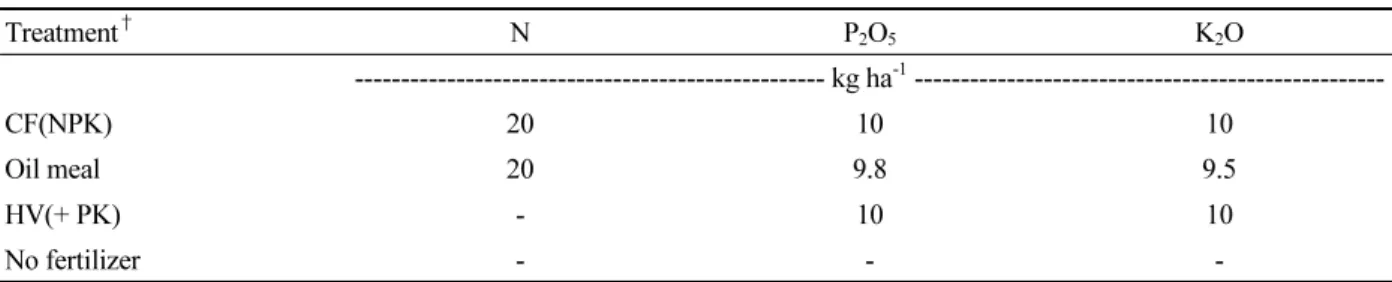
Experimental site and treatment details This study was carried out at experimental plots for long-term application (4 × 4 m) in National Institute of Horticultural and Herbal Science (NIHHS) research field, located in Wanju, Korea. The plots were separated by a concrete wall about 1.5 meter deep to avoid mobilization of mineral nutrients between the plots. Initial soil chemical properties and fertilizer treatments to assess the effect of nutrient management practices in ‘Hongro’/M.9 apple orchard are described in Table 1 and 2, respectively. Four treatments were applied in the experimental plots in a randomized complete block design with three replications per treatment.
The treatments were as follows: chemical fertilizer (NPK), castor oil meal, hairy vetch (Vicia villosa L.) + PK, and no fertilizer treatment. Fertilizer application for comparing the effects followed 『Guideline for recommendation of fertilizer application in crops』 (NAAS, 2017). At the end of the second year, all experimental plots received excess livestock manure compost at the rate of 120 ton ha-1 to improve soil fertility of apple orchard and to imitate the condition of farmland soil. ‘Hongro’/M.9 apple tree seedling was planted in each plot with 2 × 1.5 m distance in 2017. For chemical analysis, rhizosphere soil samples were collected in the depth of 5 - 20 cm by soil auger in late July. Healthy and fully expanded leaves were taken from the middle of the shoot at the beginning of August. Then, the leaf samples were dried at 70℃ in a drying oven for two weeks after rinsing with distilled water. Finally, the samples were finely ground by using a blender.
Table 1. Initial soil chemical properties used in this study.
pH OM Av.P2O5 Exch. cation
K Ca Mg
1:5 g kg-1 mg kg-1 --- cmolc kg-1 ---
5.8 4.0 3.67 0.22 3.73 3.48
Soil analysis Chemical analysis of each soil sample was conducted according to Methods of soil chemical analysis (NIAST, 2000). For determination of soil pH, air-dried soil samples were mixed with deionized water in 1:5 ratio (soil:water), and the pH of the clear supernatant was measured using pH meter (Orion VERSA STAR, Thermo fisher scientific, USA). Soil organic matter content was measured by Walkley-Black method, and soil available phosphate content was determined according to the method of Lancaster. For determination of soil exchangeable cations (K, Ca, and Mg), air-dried soil samples were extracted with 1 N ammonium acetate solution (soil and solution ratio was 1:10) for 30 minutes, and the concentration of the extract was determined by inductively coupled plasma optical emission spectrometry (ICP-OES).
Results and Discussion
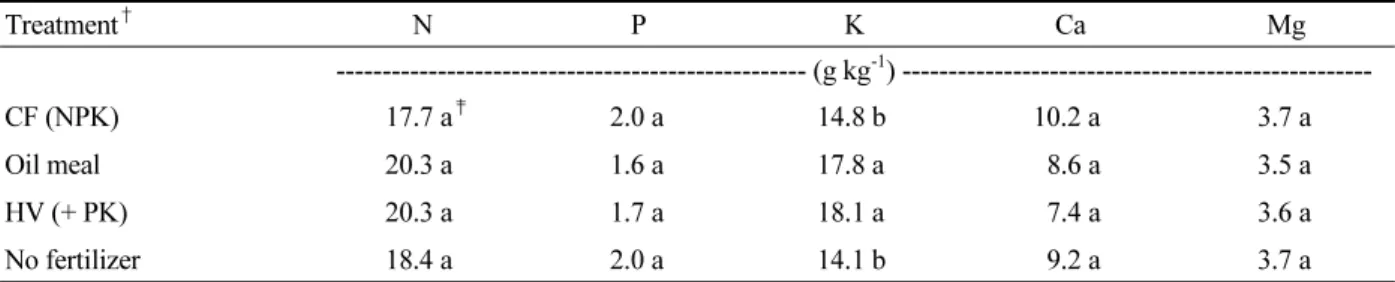
There were no significant differences between nutrient sources on soil chemical properties (Fig. 1), indicating that oil meal and leguminous cover crops could be effectively used instead of chemical fertilizer to meet nutrient requirement of apple tree for sustainable fruit production. previous studies have emphasized the importance of leguminous plants as N sources in organic crop production (Drinkwater et al., 1998; Muchanga et al., 2017) because legumes form root nodules and symbiotic N-fixation occurred inside. Also, the application of organic fertilizers is an environment-friendly approach to reduce the use of chemical fertilizers, improving soil quality and crop yield (Selvakumar et al., 2018). Soil organic matter and nutrient availability were sharply increased after excess application of livestock manure compost (Fig. 1.). Edmeades (2003) also pointed out that excessive accumulation of some nutrients, particularly P and N, can arise from the long-term use of manures, because the ratio of nutrients in manures is different from the ratio of nutrients removed by common crops, relative to the use of fertilizers. RFA was effective in reducing excessive soil mineral nutrients, while it was not sufficient to increase essential soil nutrients into optimum range under low fertility condition. Soil available phosphate and exchangeable cations effectively decreased over the time, except soil pH and organic matter content for 0 to 15 cm depth (Fig. 1.). The results also provided evidence that nutrient management using organic resources is more effective on potassium (K) uptake of apple tree from the soil (Table 3). Castor oil meal and hairy vetch treatments showed higher K content in the leaves. High K returns from sod clippings have previously been reported (Neilsen and Hogue, 1985).
Table 2. Fertilizer treatments to assess the effect of nutrient management practices in ‘Hongro’/M.9 apple orchard.
Treatment† N P2O5 K2O
--- kg ha-1 ---
CF(NPK) 20 10 10
Oil meal 20 9.8 9.5
HV(+ PK) - 10 10
No fertilizer - - -
†CF: chemical fertilizer, Oil meal: N requirement based castor oil meal application, HV: hairy vetch
Fig. 1. Effect of nutrient sources and recommended fertilizer application on soil chemical properties in ‘Hongro’/M.9 apple orchard.
Table 3. Effect of nutrient sources on leaf mineral content of ‘Hongro’/M.9 apple tree in early August.
Treatment† N P K Ca Mg
--- (g kg-1) ---
CF (NPK) 17.7 a‡ 2.0 a 14.8 b 10.2 a 3.7 a
Oil meal 20.3 a 1.6 a 17.8 a 8.6 a 3.5 a
HV (+ PK) 20.3 a 1.7 a 18.1 a 7.4 a 3.6 a
No fertilizer 18.4 a 2.0 a 14.1 b 9.2 a 3.7 a
†CF: chemical fertilizer, Oil meal: N requirement based castor oil meal application, HV: hairy vetch.
‡Mean separation within columns by Fisher's LSD test at P ≤ 0.05.
Conclusions
In this study, we confirmed that oil meal and hairy vetch treatments can be effective nutrient sources to replace the use of chemical fertilizer. RFA without additional organic material showed gradual decrease in soil nutrient content. Therefore, sufficient supply of organic resources is recommended to increase soil chemical properties into optimum range in newly established apple orchard under low fertility condition.
Acknowledgement
This work was funded and supported by RDA, Project PJ01138103.
References
Atucha, A., K. Purohit, and G. Brown. 2011. Nitrogen dynamics and nutrient budgets in four orchard groundcover management systems. Hortscience. 46:1184-1193.
Drinkwater, L.E., P. Wagoner, and M. Sarrantonio. 1998. Legume-based cropping systems have reduced carbon and nitrogen losses. Nature. 396:262-265.
Edmeades, D.C. 2003. The long-term effects of manures and fertilizers on soil productivity and quality: a review.
Nutr. Cycl. Agroecosys. 66:165-180.
Hammermeister, A.M., T. Astatkie, E.A. Jeliazkova, P.R. Warman, and R.C. Martin. 2006. Nutrient supply from organic amendments applied to unvegetated soil, lettuce and orchard grass. Can. J. Soil Sci. 86:21-33.
Homma, S.K., H. Tokeshi, Mendes, W. Lucas, and S.M. Tsai. 2012. Long-term application of biomass and reduced use of chemicals alleviate soil compaction and improve soil quality. Soil Till. Res. 120:147-153.
Komamura, K., A. Suzuki, M. Fukumoto, K. Kato, and Y. Sato. 2000. Effects of long-term nitrogen application on tree growth, yield, and fruit qualities in a ‘Jonathan’ apple orchard. J. Jpn. Soc. Hortic. Sci. 69:617-623.
Muchanga, R.A., T. Hirata, and H. Araki. 2017. Hairy vetch becomes an alternative basal N fertilizer in low-input fresh-market production in a plastic high tunnel. Horticult. J. 86:493-500.
NAAS. 2017. Guideline for recommendation of fertilizer application in crops. National Academy of Agricultural Science, RDA, Suwon, Korea.
Neilsen, G.H. and E.J. Hogue. 1985. Effect of orchard soil management on growth and leaf nutrient concentration of young dwarf ‘Red Delicious’ apple trees. Can. J. Soil Sci. 65:309-315.
NIAST. 2000. Methods of soil chemical analysis. National Institute of Agricultural Science and Technology, RDA, Suwon, Korea.
Selvakumar, G. P.H. Yi, S.E. Lee, and S.K. Han. 2018. Influence of organic and inorganic fertilizer application on red pepper yield, soil chemical properties, and soil enzyme activities. Korean J. Hortic. Sci. 36:789-798.